Considered as a group, [experimental composers] appear to have something of the pioneer spirit preserved in them. Always a part of their time (though seldom in fashion), they simultaneously transcend it, inventing new philosophies, new scales, new instruments, and new ways of doing, uniquely their own. They never fit easily into categories. To truly understand them, they must be approached as individuals, each with his or her own distinct claim on the musical landscape.Footnote 1
Most definitions of the term ‘experimentalism’, like the one quoted above, emphasize innovation and a pioneering approach to musical composition. According to such definitions, Conlon Nancarrow was a quintessentially ‘experimental’ composer. His use of the player piano, itself an experiment, was directly inspired by a suggestion in New Musical Resources, whose author, Henry Cowell, is perceived by many as the father of American experimentalism.Footnote 2 In a 1995 study of Nancarrow's music, composer and critic Kyle Gann fills two entire pages with examples of ideas that Nancarrow attempted only once, detailing unprecedented explorations of musical time, rhythm, and metre, as well as the organization of pitch, register, and texture with respect to these parameters.Footnote 3 This quantity and variety of approaches leads Gann to refer to an ‘unremitting experimentalism’ in Nancarrow's music, and to the composer himself as ‘the eternal revolutionary’.Footnote 4
Yet other, stricter, definitions of experimental music seem far less applicable to Nancarrow. These include some of those espoused by John Cage: ‘What is the nature of an experimental action? It is simply an action the outcome of which is not foreseen’;Footnote 5 ‘Those involved with the composition of experimental music find ways and means to remove themselves from the activities of the sounds they make’.Footnote 6 Nancarrow's player piano studies are rich with experimental ‘actions’ that could easily be left to generate whatever unforeseen outcomes they may. However, Nancarrow does not simply abnegate responsibility for the process of composition and its consequences. Rather, he uses his experimental designs as mere starting points and composes into and beyond these initial ideas with exquisite attention to detail at all levels of musical organization.
In this article I shall analyse two of Nancarrow's player piano studies, Study no. 21 and Study no. 36.Footnote 7 In each of these studies, the generating principle of the piece would be considered experimental by any definition of the term. Study no. 21 (Canon X) is a two-voice canon in which one voice accelerates and one decelerates, with tempos crossing at the mid-point of the piece, and Study no. 36 is a four-voice tempo canon based on a tempo ratio of 17:18:19:20 between the voices, with a central convergence point.Footnote 8 Although many of Nancarrow's studies are free (i.e., with no predetermined canonic relationship between voices), Studies 21 and 36 employ canonic structures that might be expected to impose profound constraints on their musical organization. However, as these analyses will show, in spite of these self-imposed pre-compositional strictures, Nancarrow carefully tailors individual moments, and the relationships between them, by means of the more conventional realms of pitch and register choice, motivic development, and counterpoint. The resulting forms often eschew the structural articulations implied by their initial frameworks in favour of more traditional dramatic shapes. Throughout these analyses, I shall argue that Nancarrow draws on these more traditional compositional strategies to make what is truly experimental – the tempo relationships – clearly perceptible. The analyses will be followed by a discussion of Nancarrow's music in the broader context of definitions of experimentalism and trends in twentieth-century art music.
Study no. 21 (Canon X)
Structure and form
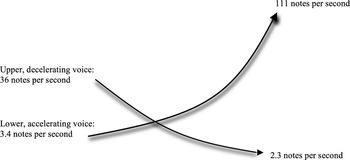
Study no. 21, also known as Canon X, consists of two voices. Gann's analysis of the piano roll demonstrates that the lower voice begins at 3.4 notes per second and accelerates to 111, while the higher voice begins at 36 notes per second and gradually decelerates to 2.3.Footnote 9 The ‘X’ refers to the crossing of the tempos as the slower voice accelerates and the faster voice decelerates. But Nancarrow does not settle merely for a literal experiment in progressive tempo modification. Rather, he begins with the ‘X’ structure as a template and composes a piece that goes far beyond the simple experiment. This is particularly evident in the details of the acceleration and deceleration of the voices, the form of the piece, and the organization of the pitch material, all of which help to enhance the perceptibility of the underlying tempo relationships.
Tempo and form: more than just a simple ‘X’
Although Eric Drott writes that ‘the crossover of tempo (as well as register) that takes place roughly halfway through the study gives the work both its title and its transparent formal contour’,Footnote 10 the ‘X’ is not a literal ‘X’ for two reasons: the tempos themselves and the way they are manipulated. When the piece begins, one voice is roughly ten times faster than the other; by the conclusion, the tempo relationship is not only inverted, but magnified, with one voice nearly fifty times faster than the other (see Example 1). The lower voice ends nearly three times faster than the initial tempo of the higher voice, while the upper voice ends about thirty per cent slower than the initial tempo of the lower voice. The resultant juxtaposition, with tempos more extreme at the end of the piece than at the beginning, places the faster voice into relief as its concluding accelerations spiral beyond previously imagined tempo frontiers. The dramatic shape of the work thus transcends the simple ‘X’ implied by its title and the conceptual relationship between its two voices.
Tempo relationships in Study no. 21.
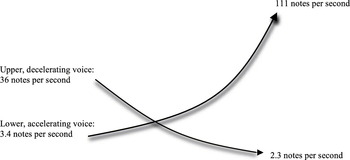
James Tenney's analysis of the piano roll has identified the second reason why the ‘X’ is not quite as simple as it first appears: the tempos in this piece accelerate and decelerate not simply arithmetically, but geometrically.Footnote 11 That is, the rate of tempo change is a percentage of the tempo itself at any given moment. Thus, the faster the tempo, the faster the rate of acceleration, and the slower the tempo, the slower the rate of deceleration (as indicated by the curves of the arrows in Example 1).Footnote 12 The slowing in the upper voice's rate of deceleration prevents this voice from quickly becoming static, while the lower voice's acceleration takes place increasingly by leaps and bounds, rather than by way of a smooth progression. Tenney's analysis demonstrates that, near the end of the piece, this faster voice jumps from 55 notes per second to 74 and, finally, 111.Footnote 13 One of these sudden changes in tempo occurs roughly nine-tenths of the way through the piece (2′46″; p. 14, system 1),Footnote 14 bringing the music to its frenetic close. When Nancarrow listened to the original version of the piece, he noticed that as the accelerating voice began to reach a certain tempo, its barrage of notes eclipsed the decelerating voice, rendering it inaudible.Footnote 15 To rectify this situation, he progressively added octave doublings to this voice. The onset of the maximal, five-octave reinforcement corresponds precisely with the final sudden increase in tempo of the accelerating voice at 2′46″. This is also an important moment in the progression of the pitch material, which is discussed below.
Pitch organization I: the macro level
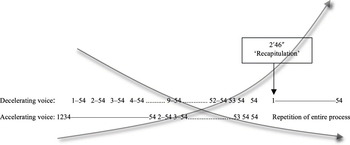
Both canonic voices of Study no. 21 utilize the same fifty-four-note pitch succession, which is presented in progressive subtractions. First the entire fifty-four-note melody is heard, then the last fifty-three notes (notes 2–54), then the last fifty-two (notes 3–54), etc., until finally notes 53 and 54 are followed by note 54 alone.Footnote 16 Once this point is reached in the top voice, the tempo has slowed to the extent that the original fifty-four-note melody will be heard only once more before the end of the piece. After completing this same subtractive process, the lower voice has accelerated to the point where it still has time to go through the entire subtractive process again before the study's conclusion (see Example 2). The point at which the upper (decelerating) voice begins its final fifty-four-note statement therefore coincides with the start of the lower (accelerating) voice's second run through the same melody and its subsequent subtractive process. This happens at the beginning of system 1 on page 14 (2′46″), the point of maximal octave doubling, corresponding with the sudden increase in the accelerating voice's tempo, mentioned above. It is thus a major structural articulation in terms of the tempos, the pitches, and, as a result, the form. Subverting the simple ‘X’ idea, this key moment in the music occurs approximately nine-tenths of the way through the piece. The climax occurs at an aesthetically logical place, rather than at the structurally significant mid-point where the tempos of the two voices momentarily coincide (a point that passes essentially unnoticed). Nancarrow's sense of dramatic form trumps the pre-compositionally established structural articulation dictated by the tempo canon's shape. X does not mark the spot.
The progression and alignment of the subtractive iterations in the two voices of Study no. 21.
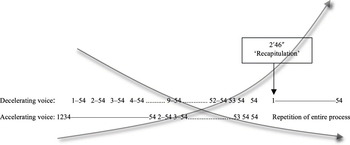
Tenney refers to this moment at 2′46″ as the beginning of a ‘recapitulation’, since the subsequent music repeats the processes of the entire piece (albeit at different tempos).Footnote 17 Tenney's allusion to sonata form can be extended: in Study no. 21 material is first presented, then developed (or better, distorted) by the processes of acceleration, deceleration, and transposition, and finally recapitulated near the end. This recapitulation combines repetition of what came before with the novelty of new tempos and an inverted voice–tempo relationship. The music beginning at 2′46″ can be clearly heard as a recapitulation, because it begins with the top voice stating the fifty-four-note melody that began the piece, reinforced by five octaves of doubling. This strengthening of the upper voice demonstrates the importance to Nancarrow of placing the recapitulation in relief. Moreover, the repetition of the original material over five octaves highlights the new relationship between the voices in terms of register and tempo, allowing the listener to hear just how much the tempos have changed over the course of the piece. Merging his experimental design with aspects of sonata form, Nancarrow enables his initial conception to assume a shape that enhances the perceptibility of its underlying processes.
Pitch organization II: the micro level
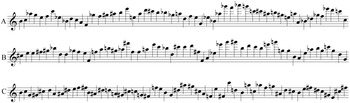
Examining the pitch material of the fifty-four-note succession and its subsequent subtractive iterations in greater detail reveals numerous relationships. Nancarrow devotes more careful attention to the pitch structures than is suggested by Kyle Gann's assertion that ‘a melody so complex and run through such strict arithmetical procedures is little more than a prop for the illustration of the tempo effect’, or that ‘pitch becomes secondary’.Footnote 18 Each time the contracting pitch succession is presented, it is also transposed, providing a continual replenishment of pitch material (and thus avoiding harmonic stasis), while also preserving contour and intervallic content. If one compares the sequence of pitches derived from the initial notes of all contracted iterationsFootnote 19 (Example 3, line B) with the original fifty-four-note succession (Example 3, line A), one notes a striking similarity in the overall contours of the two sets of pitches. Both consist of four waves, with the third wave of each reaching the highest register. Thus the contour of the original succession and that of the starting pitches of its transposed repetitions are similar, creating a sort of fractal. It is unclear whether Nancarrow did this intentionally. If he did, it points to extremely rigorous pre-compositional planning. If he did not, it represents a remarkable intuitive correspondence between microstructure and macrostructure. In either case, this finding indicates that Nancarrow has prioritized musical architecture at multiple levels in this composition.
Pitch material in Study no. 21. Line A: fifty-four-note succession. Line B: first notes of all of the successive transposed subtractive iterations. Line C: first note of original succession and extrapolated first notes of all successive subtractive iterations. For explanation, see ‘Pitch organization II: the micro level’ in text.
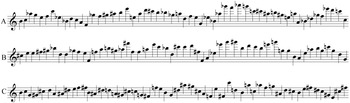
If one goes further, inferring from each repetition what the initial note would have been had it not been subtracted, one obtains a further fifty-four-note sequence that represents the transposition levels of the progressively contracted statements.Footnote 20 Numerous pitch relationships become apparent when one analyses this sequence of extrapolated first notes (Example 3, line C). The first thirty-six notes form three complete twelve-note statements, each beginning on the note B (which is the first pitch of the original fifty-four-note succession). The first two ‘rows’ are inversions of each other. The last eighteen pitches are two nine-note successions, again without pitch-class duplication, each beginning on the note B. There appears to be no relationship between the third twelve-note statement and the two nine-note successions.Footnote 21
Nancarrow's use of at least one twelve-note row and its inversion to determine the transpositions of the progressively contracted pitch succession demonstrates that he did indeed seek highly organized pitch relationships in the piece. Moreover, when comparing the original fifty-four-note succession and the fifty-four-note sequence derived from the extrapolated initial pitches of the transposed statements, one notes a consistency in the relative prevalence of intervals (see Table 1). Additionally, the intervals between the first twenty-four pitches of this extrapolated sequence (those that form the twelve-note ‘row’ and its inversion) consist exclusively of the ascending or descending intervals of the minor second and the perfect fourth, two of the intervals most prevalent in the original fifty-four-note-succession. Intervallic content is therefore consistent across many levels of structural organization.

In summary with respect to the pitch material of Study no. 21, the fifty-four-note- succession not only shares a nearly identical contour with the succession of starting pitches of all the transposed subtractive iterations, but also manifests an intervallic prevalence similar to the sequence of extrapolated first notes. Nancarrow did not simply settle for the original experiment of having two voices changing tempos in opposite directions, removing himself from the act of composition to let this set-up achieve whatever unforeseen outcome it may. Rather, he carefully composed the pitch material, texture, and form in order to highlight the process of acceleration and deceleration. Eric Drott has noted similarly of Study no. 33 that, while the irrational tempo relationships produce of themselves little potential for convergence, ‘Nancarrow intervenes in the unfolding of the canons, by providing occasions for convergence points. In so doing, he gives the work a clear formal design and thereby makes it easier for the listener to track the music's unfolding’.Footnote 22 Nancarrow goes beyond the implications of his pre-conceived tempo experiments, intervening to create forms that make the underlying processes perceptible and formally satisfying. Fusing the experimental and the traditional, he creates compositions that transcend the initial blueprints provided by their canonic structures. An analogous amalgam of experiment and tradition is at play in Study no. 36.
Study no. 36
Structure and form
Study no. 36 is another of Nancarrow's tempo canons, this time with four voices in a tempo ratio of 17:18:19:20. The convergence point of the four voices lies at the centre of the piece (see Example 4a). The slowest and lowest voice begins alone, and the next three voices enter in order of increasing speed, each successive entry higher in register than the previous one. Because of their relative speeds, the voices exit in reverse order, the fastest/highest ending first and the slowest/lowest ending last. The voices' entries and exits create an arch-like shape, which is further reflected in their registral relationships throughout the piece: before the convergence point, the canonic imitation from voice to voice proceeds from the lowest/slowest voice to the highest/fastest; after the convergence point, imitation proceeds from the highest/fastest voice to the lowest/slowest. As a result of the tempo canon framework, as voices approach the convergence point, their echo distanceFootnote 23 decreases; after the convergence point, the echo distance gradually increases, such that the imitation between voices becomes progressively further apart. Thus the density of musical events follows the same arch-like shape as the registral entries and exits of the voices, progressively increasing as the central convergence point approaches, and gradually decreasing after this point.
Formal design and materials in Study no. 36. Example 4a demonstrates the canonic arrangement of the voices. Example 4b displays the arrangement of material: T = theme; ∼T = material based on theme; t = theme in diminution; x ♪ = number of ♪ articulated per bar; G = glissando (with arrow indicating direction); CP = convergence point. (This example conveys the same information, albeit in a slightly different presentation, as Gann's Fig 8.18 in The Music of Conlon Nancarrow, p. 193).


Although the tempo canon framework sets up these general trends in register, density, and relationships between voices, it is Nancarrow's musical material and what he does with it that allow for the audibility of these processes and the creation of form within this predetermined structure. As Example 4b shows, after presenting the theme and material based upon it (see below), Nancarrow leads from passages containing only one quaver per 2/4 bar in each voice, to two, to three, to all four, and finally to the culminating glissandos surrounding the convergence point. Thus as the tempo canon leads to a progressive piling-up of the four voices, Nancarrow's successive saturation of the material in each voice further contributes to the momentum of the music. As Gann writes of the later studies, ‘the canonic structure has a determining effect on canonic materials: what kind of figure Nancarrow uses at a given point depends on where it occurs in the canon. Process and materials interrelate: figures within a structure are derived from it, and their relationship to it is audible.’Footnote 24 The interactions that Nancarrow creates between structure, materials, and their audibility will be revealed further throughout the course of this analysis.
A general outline of Nancarrow's presentation of musical materials in this study shows additional arch-like characteristics. The main theme is introduced in the opening bars and is then later stated in 2:1 diminution; the end of the piece recapitulates these versions of the theme in reverse order. Glissandos that ascend before the convergence point are symmetrically mirrored by descending glissandos after the convergence point. Thus the arch form dictated by the alignment of the four voices is also reflected in the overall shape of the piece with respect to the exposition and recapitulation of material, as well as the symmetrical reversal of processes with respect to the convergence point (registrally, gesturally, and contrapuntally). Further analysis will reveal the presence of this arch-like shape at various levels of the composition.
Theme and motive
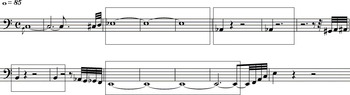
Serving as a seed for the material of the rest of the piece, the opening theme of Study no. 36 consists of three motivic elements: sustained notes, staccato notes with rests between them, and glissando-like figures of varying sizes that introduce each sustained note, enlarging from one grace note on the first note to a five-note descending glissando leading into the last long note (see Example 5). As any student of counterpoint learns, a good subject must generate material of sufficient interest for the piece, but it must also be amenable to having counterpoint written against it. Nancarrow's opening theme clearly fulfils both these functions: it comprises materials that provide fertile ground for development and also includes space in the form of sustained notes and staccato notes separated by rests. In addition, its strong profile allows it to be easily identified when imitated in new tempos in the immediately subsequent entries. The subtle tempo relationships between voices can therefore be heard quite clearly from the first moments of the piece.
Opening theme of Study no. 36.

This opening material is developed throughout the study. Sustained notes reappear alone and as chords. Staccato notes gradually accumulate and coalesce to form progressively denser figures as the convergence point approaches. The short grace-note figures that ornament the theme's longer notes progressively expand to encompass the entire piano, as ascending glissandos approaching the convergence point, as descending glissandos following it, and, finally, as both ascending and descending glissandos towards the end of the piece.
The opening theme is ideally suited for contrapuntal treatment because each of its three types of material interacts well with the others. Semibreves can accompany glissandos or staccato notes, placing them into relief. Staccato notes alternating with glissandos (e.g., in the moments before the convergence point) allow for a rich, contrasting set of materials that can create increasing density while maintaining textural variety.
As CarlsenFootnote 25 and GannFootnote 26 have both noted, the boxed notes in Example 5 – E, A♭ (G♯), B, E♭ (D♯) – outline a major seventh chord. This is also the intervallic relationship between the four voices of the canon and is thus the chord momentarily sounded at the convergence point, the only moment in the piece where the voices play exactly together (1′54″; system 3, p. 23). The opening theme thus generates the harmonic material for the piece. As if to highlight the importance of the major seventh chord sonority, Nancarrow ends the opening theme with a quick major seventh chord arpeggio. While Boulez has criticized Nancarrow's music for what he perceives as its lack of harmonic interest, Nancarrow seems to choose relatively simple harmonic structures precisely so as to place the temporal innovations and processes in relief.Footnote 27 By using a major seventh chord sonority both within the opening theme and to define the intervallic relationship between voices, he provides the piece with a degree of harmonic unity. In so doing, he prevents the complexities and subtleties of the rhythmic and tempo relationships from being obscured by an equally complex harmonic design.
The opening theme not only provides a template for the work's harmonic and motivic structure and development, but can also be seen as a microcosm of the entire piece. Not only is the beginning of the theme self-evidently the beginning of the piece, but the lead-in to the closing gesture of the theme, a downward glissando to a sustained note, reappears at the very end of the study. The glissandos that occur within the theme – three ascending and one descending – are reflected in the study's larger structure: much of the material of the first half of the piece consists of an increasing enlargement of the ascending glissando figure until it spans the entire piano, while the second half of the piece develops the descending glissando. The progression of density in the opening material is also mirrored at the global level. Two sustained notes – of, respectively, seven and three-quarter crotchets and twelve crotchets in length – are followed by crotchets only four beats apart, and then by a longer sustained note, fifteen and a half crotchets long. Similarly, in the overarching form of the piece, the textural density gradually increases, only to unravel into slower, sustained notes at the end of the piece. Thus harmonically, rhythmically, and gesturally (in its arch-like shape with respect to density, duration, and size and direction of glissandos), the opening theme foreshadows the arch-shaped macrostructure of the entire piece. This relationship between microstructure and macrostructure creates coherence across multiple musical levels. The distinctive opening theme and its development throughout the piece are clearly audible, thus allowing the listener to perceive the microstructure, the macrostructure, and all the processes at work in the piece. Scholars have noted this in other Nancarrow works as well. For example, Margaret Thomas has observed of Study no. 24 that ‘when the material has a clear identity – usually a line of single pitches with a distinct character – it is easier to identify as a single voice, and thus the individual canonic voices are easier to perceive’.Footnote 28
Nancarrow's description of his working method partly explains the close relationship of materials within his overall design: ‘The marked out roll has no rhythms […]. When I start to write the piece, the melody and rhythm – the harmonic connotation – are all done together.’Footnote 29 The initial experimental design thus served merely as a blueprint, allowing Nancarrow to focus his attention on more traditional musical elements and their interaction.
Contrapuntal planning
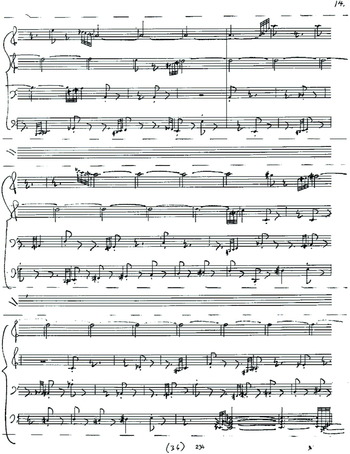
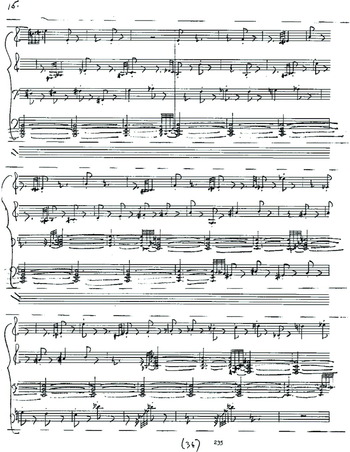
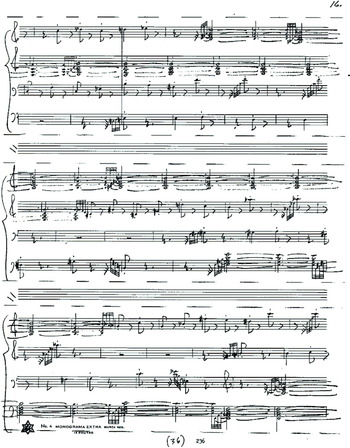
An examination of the relationships between voices in Study no. 36 further reveals how Nancarrow anticipates and crafts each moment of the four-voice texture. He places the opening statement of the theme in the lowest voice in such a way that its imitation in the next voice/tempo will follow closely on its heels. Throughout the piece, the structural implications of the 17:18:19:20 canonic framework (whose alignment is shown in Example 4a) are such that extremely close imitation moves up through the voices in progressively faster tempos, up to the convergence point at the piece's centre. After the convergence point, imitation trickles down through the voices, progressively slowing down. The form and processes that arise from the tempo canon and its configuration of voices would undoubtedly have yielded an interesting result if Nancarrow had merely written material for a single voice, ‘transposed’ it into the three other tempos, lined them up, and removed himself to allow the musical experiment to play itself out. But this was not Nancarrow's approach. As he himself stated, ‘I don't write out a long melody and say, “Well now I am going to make a canon out of it”’.Footnote 30 He is constantly thinking a few moves ahead and exercising his compositional craft within the self-imposed constraints of his initial experiment. One particular example of such contrapuntal planning can be seen in Example 6 (approximately 1′10″–1′25″; pp. 14–16 of the score).
Pages 14–16 of Study no. 36. © 1987 Schott Music
GmbH & Co. KG, Mainz, Germany. All Rights Reserved. Used by permission.

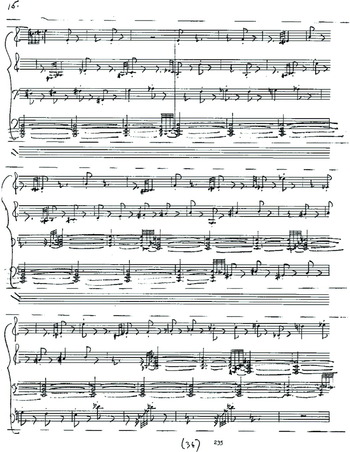
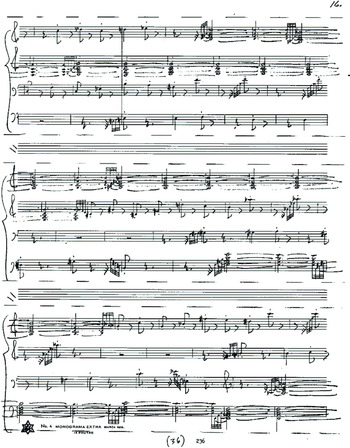
Example 6 occurs just after the opening theme, stated in diminution, has passed through all four canonic voices. Beginning in the first system, one observes fast, energetic material consisting of staccato notes and rapid-fire grace notes in the lowest voice, which subsequently passes through the three upper voices (thus accelerating), ending in the uppermost voice only at the top of the third page. In the final bars of the first page of Example 6 Nancarrow writes chordal accompaniment in the lowest voice, which passes through the upper lines over the next two pages to accompany the denser material as it accelerates through the upper voices. After the lowest voice has ended its chordal passage towards the end of the middle system of the second page, Nancarrow returns to high-activity material once again. This material interacts with continued imitation in the upper voices of material that the lowest voice had provided before turning to the chordal passage. By the time the uppermost line has received and completed its iteration of this chordal passage (at the beginning of the final system of the third page), the lowest voice has begun a new set of chords, starting the process once again. Through a sort of pre-imitation, Nancarrow thus links the resultant contrapuntal responses in the highest line to the subsequent material beginning in the lowest line, creating a sense of continuity between adjacent sections.
At any given moment in this example, a variety of interacting components contributes to the texture. Setting energetic staccato material against a more static accompaniment of sustained chords allows the tempo relationships between voices to be more clearly audible. As described above, owing to the arrangement of canonic voices, echo distance decreases over the course of the first half of the piece, leading to a progressive piling-up of the voices as they approach the convergence point. The juxtaposition of highly active material and chordal accompaniment combines forward motion and restraint, allowing for overall increasing density, albeit in a carefully controlled manner. Nancarrow thus simultaneously highlights the underlying processes at work and keeps them in check as he builds towards the climax. The passage in Example 6 demonstrates a moment-to-moment awareness of the implications of everything written in the lowest voice, as well as the subsequent planning of counterpoint, motivic development, and form. This contrapuntal planning makes the relationships created in the approach to the tempo canon's convergence point more clearly perceptible, and creates timbral variety and fluidity of motion en route to the climax of the piece.
Form revisited
As in Study no. 21, the major structural event of Study no. 36 occurs at its centre, at the convergence point of voices. Also as in Study no. 21, this convergence point, which is the primary structural articulation, is not marked musically in any particular way. In fact, it passes completely unnoticed, embedded within a process of systematic focusing of the material, in which the large upward glissandos are progressively eliminated until only single rapid-fire grace notes remain. The true registral and textural climax occurs a few moments later (at the beginning of the third system on page 24 of the score), where the tension of the ever-rising, ever-quickening glissando figures finally explodes into dense counterpoint that cascades down from the highest/fastest voice to the lowest/slowest. Although at the convergence point itself the contrapuntal relationship between voices has shifted (i.e., from bottom-up to top-down), Nancarrow does not highlight this change for his listeners until this true climax. This is further evidence of the relative insignificance of the initial structural markers for his construction of the final dramatic shape of the piece.
Although the climax is displaced to occur slightly after the convergence point, nearly half the piece still remains. Had it been executed literally, the perfectly symmetrical arch implied by Nancarrow's initial structural design would have led to a disappointing dissipation of energy, a point also noted by Gann.Footnote 31 Given these circumstances, how is that, as Gann states, ‘Nancarrow's keen sense of form prevents disappointment’?Footnote 32 Nancarrow does not proceed methodically in reverse, decreasing musical density at the rate at which he had gradually increased it over the first half of the piece. Instead, he maintains the density of the texture following the convergence point for much longer after the climax than it had taken to build up before, employing a series of overlapping falling glissandos, observable from system 2, page 25, to system 3, page 26 (2′09″–2′15″) (see Example 7).
Density curve of Study no. 36 superimposed upon the tempo canon structure, with layout of materials below. See Example 4b for explanation of symbols for materials.

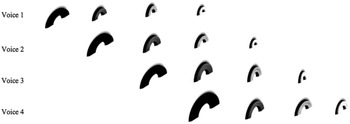
Beyond this point of climax, Nancarrow retains the listener's interest by introducing new material: he forges the earlier ascending glissandos and descending glissandos into single upward and downward glissando figures (pp. 31–42 of the score, 2′30″–2′50″). These passages serve as a sort of summary of the entire piece, alluding to events both before and after the convergence point, as well as reflecting the piece's arch-like shape. After this new ascending–descending glissando figure has made its way once through the four voices with sparse accompaniment, Nancarrow deftly deploys the gesture in another feat of contrapuntal construction (Example 8). On the first system of page 33 of the score (2′35″), an ascending–descending glissando appears in the top voice (voice 1) and, as the canonic structure requires, is then imitated in each of the lower voices. When the figure passes to voice 2, Nancarrow embeds a slightly more compressed ascending–descending glissando in voice 1. When the original glissando arrives in voice 3, voice 2's imitation of voice 1's embedded glissando becomes embedded in it, and in voice 1 a further glissando is superimposed upon these two. When the original ascending–descending glissando finally arrives in the fourth voice, the embedded and canonically imitated glissandos have made their way to Voices 2 and 3, and yet another glissando is added in Voice 1 to generate one ascending–descending mega-glissando that ingeniously incorporates all four voices. For this to work as it does, Nancarrow must have taken into account when composing each figure not only the echo distances that dictate when imitations will occur in subsequent voices, but also the progressive temporal dilation of each figure as it descends through the progressively slower voices.Footnote 33
A diagram of the embedded glissandos from pp. 33–42 of Study no. 36. The arches represent glissandos, and their shades are maintained to show the progression of material through the four voices. This figure depicts the same passage as Gann's figure 8.18 (The Music of Conlon Nancarrow, 193). Here I seek to highlight the identity of the material as it passes from voice to voice.
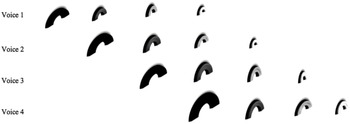
After the glissando that incorporates all four voices, the top voice moves on to other material, leaving the other voices to finish their imitations. This yields a retracing of the steps that preceded it: a three-voice ascending–descending glissando in the bottom three voices followed by a two-voice ascending–descending glissando in the bottom two voices and, finally, a solo ascending–descending glissando in the lowest voice. Again microstructure and macrostructure are analogous in this arch-shaped progression of glissandos from one voice through four and back, as well as in the shape of the glissando figures themselves.
The material sounded by the top voice after its final arch-shaped glissando is based on the opening motive of the piece, serving as a sort of retransition to the recapitulation of the theme's presentation in diminution, which is followed shortly thereafter by the return of the opening theme. The theme in diminution sneaks into the top voice amidst a flurry of activity in the lower ones, making its reappearance inconspicuous until it begins to manifest itself in the other voices. Similar coy manipulations of the listener and other elisions associated with the return of the opening material are prominent in the works of Haydn, Mozart, and Beethoven. Nancarrow's recapitulation is also similar to those of the Classical composers in that it combines repetition (i.e., returning to previously heard material) with the novelty of continued development (here, the ascending–descending glissandos).
The structure of the piece could be described as a sort of sonata form, as was Study no. 21 above. It begins with a theme that leads, through a transition, to a presentation of the same theme in diminution (analogous to a second thematic group, which in numerous Classical sonata-form movements can consist of a modified first theme, e.g., the first movement of Haydn's, Sonata in C, Hob. XVI:50, to name one of many possible examples). This exposition leads to a development section, which is then followed by a recapitulation, first of the theme in diminution and then of the opening theme itself. The structure of Study no. 36 can also be mapped onto a fugue form, as Stephen Taylor proposes for György Ligeti's Sixth Piano Etude (‘Automne à Varsovie’).Footnote 34 The four voices of Study no. 36 enter in the manner of an exposition, followed by an episode based on the material of the subject, which then leads into a first re-exposition of the theme in diminution. After a number of episodes, a counter-exposition of the theme in diminution occurs (with the order of voice entries reversed vis-à-vis the opening). This is followed by a concluding episode, and finally the statement of the subject in its original note values in counter-exposition. (Of course, to have this number of ‘episodes’ preceding the restatement of the subject in counterpoint would be unlikely in any traditional fugue.)
Study no. 36 is not a sonata or a fugue, but its proportioning and placement of repetitive and novel elements is consistent with that in more traditional Western musical forms. Nancarrow is in constant dialogue with his initial experimental layout, continually striving for musical and dramatic results through the use of more traditional formal shapes. Nothing is left to chance, no action's outcome is unforeseen.
Conclusion
In the same ‘Credo’ of 1937 in which he advocated the incorporation of noise, electronic instruments, and percussion in contemporary composition, John Cage stated that:
The principle of form will be our only constant connection with the past. Although the great form of the future will not be as it was in the past, at one time the fugue and at another the sonata, it will be related to these as they are to each other: through the principle of organization or man's common ability to think.Footnote 35
Indeed many of Cage's sonatas in Sonatas and Interludes resemble Baroque dance movements in their binary or ternary forms.Footnote 36 As in Nancarrow's works, this appears to be an attempt to place the experimental aspect of each piece (timbre/rhythm for Cage, rhythm/tempo for Nancarrow) into relief through relative clarity of the larger-scale musical architecture.
Of course, the use of canon itself also links Nancarrow's music with that of the past. In a 1977 radio interview, Charles Amirkhanian asked Nancarrow how he became interested in working with canons. Nancarrow replied:
Very simple. […] I'm interested in this temporal thing […]. Let's say you have two times going, two tempi going at the same time. […] If you have them both at the same melodic proportions, it's easier to follow the temporal changes, so in other words […] if it's the same melody, you don't have to follow the melody, you're just hearing the temporal relationship.Footnote 37
For Nancarrow, the use of canon as an organizing device appears to have had the express purpose of enhancing the audibility of his complex tempo experiments. Given his statement, it is not unreasonable to presume that many of the more traditional aspects of his composing (e.g., motivic development, contrapuntal planning, formal schemes) may have been similarly motivated. Nancarrow himself described his compositional process in ways that corroborate the above analyses. For example, in interviews, Roger Reynolds and Nancarrow had the following exchanges:
RR: What effect does your sense of canon – or imitative structure – have on your feelings about form? […] What about its [the canon's] relationship to overall form?
CN: You know, it's funny, I never really think of form as such. I work in a certain way, but I don't think of any specific form. It comes out for me more or less as a result of other things.Footnote 38
RR: What do you think of the notion attributed to Stravinsky in The Poetics of Music that the more constrained he was, the more free he was?
CN: I agree with that. Also, you remember the famous statement of Stravinsky's when he started on a piece of music: ‘I just sit down and I'm overwhelmed at the infinite possibilities’.Footnote 39
These two quotations exemplify the relationships between Nancarrow's tempo experiments, which serve as initial starting points, and his final compositions, which entail musical decision-making at every structural level with regard to each musical parameter.
Although this article began by noting that Nancarrow's music does not fit some of John Cage's definitions of experimentalism, my goal has not been to strip Nancarrow of his experimentalist achievements, nor to draw a particular contrast between his music and Cage's music or ideas (beyond Cage's definition of experimentalism itself).Footnote 40 A wide range of specificity exists in definitions of experimentalism, from Cage's strict inclusion of only compositions involving acts ‘the outcome of which [are] not foreseen’Footnote 41 to more general definitions that require only innovation broadly defined.Footnote 42 Furthermore, several authors have sought to distinguish the music and ideology of (American) experimentalism from that of the (European) avant garde.Footnote 43 While such categories can provide useful frameworks for examining broader trends in twentieth-century composition, they necessarily obscure shared pursuits between seemingly distinct musical idioms, and can neglect profound differences in compositional priorities within broader stylistic categories. Most composers who have expressed a desire to break with the past to create a new music have nonetheless maintained aspects of past musical practices to varying degrees. An analysis of how new and old musical elements are combined can therefore provide further insights into connections and disparities between such composers and groups of composers.
Examining Nancarrow and his music in terms of this framework yields a variety of insights. Nancarrow's pioneer-like spirit, exemplified by his desire to experiment with new compositional techniques in each new composition and near-exclusive composition for a mechanical instrument, places him in good company with experimentalists such as John Cage, Henry Cowell, and Harry Partch. However, his use of traditional compositional techniques and his interest in the perceptibility of his experiments connect him to composers with whom he might not immediately be associated. For instance, Schoenberg's turn to the twelve-note technique is associated with the adoption of a highly simplified gestural language, as well as Classical and Baroque forms. In this way Schoenberg and Nancarrow appear to have shared a desire to fuse radical musical innovation in one domain – pitch for Schoenberg, time for Nancarrow – with compensatory and complementary clarity in other musical parameters: gesture and form for Schoenberg, pitch and form for Nancarrow.
In Nancarrow's desire to make his experiments perceptible, he sets himself apart from certain composers of both ‘American experimental’ and ‘European avant-garde’ music. Composers using indeterminacy or chance operations often create unpredictable (and at times indiscernible) relationships between compositional procedures and the ultimate sonic result. Analogously, multiple serialism can make the relationship between compositional process and musical product almost completely imperceptible to the ear and, in some cases, even to the eye when examining a score. When Roger Reynolds asked Nancarrow if he had heard other music that he thought was too complex, he responded ‘Oh yes. I think that a lot of Boulez is too complex in the sense that one can't hear all the things he does […] I'm talking about the “total serialism” period. You just don't hear those things. They're not for the ear. It's paper music I think.’Footnote 44
Nancarrow shares his prioritization of perceptibility with some minimalist composers, an observation also made by Gann.Footnote 45 To make the subtle process-driven manipulations of their musical materials perceptible, minimalist composers often employ short, harmonically simple, and easily identifiable musical motives, which are subjected to various processes (such as the additive rhythmic processes of early Philip Glass or the phase techniques of Steve Reich). Of course, as Margaret Thomas notes, ‘the perceptible prominence of the canonic process is one of the areas in which Nancarrow's studies vary most dramatically’.Footnote 46 Even within a given piece, perceptibility of process is a parameter that Nancarrow varies. However, by prioritizing this perceptibility as often as he does, Nancarrow sets himself apart from many other composers classified as either experimental or avant-garde.
Nancarrow's use of canon also connects him to minimalism, since the minimalist phasing technique can be seen as a sort of canon. Steve Reich himself has acknowledged
When I composed my phase pieces […] I thought to myself: Is this Day One, am I on another planet, or is there some relationship between these […] pieces and anything that's happened before in the history of music? And at that point I realized that my phase pieces were basically an unusual type of canon or round. And that thought made me feel very good; because it made me aware that I was varying something that's been around a long time. To someone interested, as I was, in the history of music, it was very encouraging.Footnote 47
Thus Nancarrow and some minimalist composers share a link with earlier traditions through their use of canon, despite their radical departures from other past musical practices.
Nancarrow once remarked, ‘my essential concern, whether you can analyze it or not, is emotional; there's an impact that I try to achieve by these means’.Footnote 48 In exploring the dialectics of the experimental and the traditional, the complex and the visceral, the abstract and the tangible, the mathematical and the musical, Nancarrow found unique and personal solutions to some of the most pervasive issues facing composers of the twentieth century, staking his ‘own distinct claim on the musical landscape’.