INTRODUCTION
The incantations of the Yucatec Maya manuscript known as the Ritual of the Bacabs are our earliest surviving source for how Maya cosmology provided a framework for Maya healing practices. Although the extant text-artifact dates to the late eighteenth century, it is the culmination of centuries of cultural, linguistic, and intellectual interaction with other Mesoamerican peoples and, ultimately, Spanish and African colonists. The incantations make frequent use of archaic terminology and metaphors, some of which are found almost exclusively in Classic period hieroglyphic texts (Knowlton Reference Knowlton, Hull and Carrasco2012). At the same time, the Ritual of the Bacabs contains material without parallel in other Maya sources, including what appear to be innovations in the healing cosmology that emerged as a result of the interethnic intellectual exchange that characterized Mesoamerica during the Late Postclassic period (ca. A.D. 1200–1500). This paper analyzes the role and attributes of the Maya goddess Ix Hun Ahau. This feminine manifestation of the better-known Maya deity Hun Ahau is at present only known from references in the Ritual of the Bacabs. Although it is common in the Postclassic Maya codices to render female counterparts to male deities (as their “wives,” y atan), the accoutrements and roles ascribed to Ix Hun Ahau in the incantations identifies her as a Maya parallel to Tlazolteotl-Ixcuina, the Nahua goddess of weaving, sexuality, pollution, and its purification. Pollution concepts and purification practices that are otherwise peripheral in the Ritual of the Bacabs are specifically related to Ix Hun Ahau in that text, suggesting that intellectual exchange between Mesoamerican peoples in the pre-Columbian period extended to medical cosmologies as well.
RITUAL OF THE BACABS AS SOURCE
Although recent decades have witnessed major advances in scholarly knowledge of many domains of ancient Maya civilization, we have very little direct evidence of pre-Columbian Maya medical concepts and practices. Despite early claims to the contrary (Thompson Reference Thompson1958), no extant Maya hieroglyphic texts are known that explicitly address the topic of medicine, and so much of what we think we know is reconstructed from colonial sources.Footnote 1 Indigenous pharmacopeia is well represented in the instructions for remedies (u ɔacal) contained in the corpus of Yucatec Maya documents from the northern Maya lowlands during the Colonial period (Roys Reference Roys1931), especially in the Book of Chilam Balam of Kaua (Bricker and Miram Reference Bricker and Miram2002), Book of Chan Kan (Hires Reference Hires1981), Book of Nah (Gubler and Bolles Reference Gubler and Bolles2000), and Book of Ixil (Caso Barrera Reference Caso Barrera2011). Although remedies such as these are also contained in the colonial Maya manuscript called the Ritual of the Bacabs (Arzápalo Marín Reference Arzápalo Marín1987; Roys Reference Roys1965), this work is best known as a repository of incantations (u tħanil) and invocations (u payil) against sickness. In practice such verbal cures often are paired with the herbal remedies, as I have had the opportunity to observe ethnographically in my work with contemporary Yucatec Maya healers. In contrast to the wealth of information on indigenous pharmacopeia, with the exception of one partial incantation in the Book of Chilam Balam of Chumayel (Roys Reference Roys1967 [1933]:131), the Ritual of the Bacabs is our only direct colonial source of this communicative aspect of Maya healing.
The Ritual of the Bacabs is a notoriously difficult manuscript to interpret. As Thompson (Reference Thompson1970:160) noted, decades ago:
Ritual of the Bacabs, another colonial document, contains a number of cures with invocations of deities. Unfortunately the material is wrapped in symbolism, much of which is beyond the comprehension of present-day Maya and modern scholars alike … Even in translation the incantations are very hard to comprehend.
Part of this difficulty resides in the fact that the manuscript is meant to serve as a script for performance (Knowlton Reference Knowlton2015). Nonetheless, scholars have made progress in recent years by way of comparison with Classic Maya sources. The colonial incantations are grounded in a cosmology populated by indigenous gods and their sickness-causing daemons, called tancas. Because of their animal and chimeric attributes, epigraphers have speculated for some time about a relationship between these personified sicknesses and the way creatures depicted on Classic Maya ceramics (Grube and Nahm Reference Grube, Nahm and Kerr1994; Houston and Stuart Reference Houston and Stuart1989; Stuart Reference Stuart2005), with Helmke and Nielsen (Reference Helmke and Nielsen2009) recently publishing a systematic inquiry into this hypothesis. In addition to this apparent historical link between personified sicknesses and Classic Maya spiritual co-essences, the Ritual of the Bacabs is exceptional in its use of archaic vocabulary. The extant copy of the manuscript dates to the late eighteenth century, as its final two pages are written on the paper of a plenary indulgence printed with the date February 1779. Yet several of the terms employed throughout the manuscript were already explicitly referred to as vocablo antiguo in the earliest extant Yucatec Maya dictionary, the Motul, dating to the late sixteenth or early seventeenth century (Ciudad Real Reference Ciudad Real and Acuña2001). The Ritual of the Bacabs is also almost unique among colonial Maya documents in its use of the couplet metaphor (difrasismo) “genesis and darkness” cħab akab, employed in Classic Maya texts in reference to the mythological birth of gods and the conjuring of divine powers by humans through sacrificial gifts (Knowlton Reference Knowlton2010, Reference Knowlton, Hull and Carrasco2012). The cħab akab couplet appears frequently in the Ritual of the Bacabs in the course of the healer inquiring about the origins of the sicknesses-causing daemons. Together this makes a compelling case for the antiquity of the Maya illness etiology operating in the incantations.
Despite its archaic features, it is important to remember that the manuscript itself was composed and performed by Maya healers in a colonial Mesoamerican society characterized by several centuries of intensive interethnic exchange. The institutions and practices of Spanish Catholicism had a substantial impact on virtually all areas of Yucatec Maya life, including language (Hanks Reference Hanks2010). This is reflected in the Ritual of the Bacabs in the fact that most incantations conclude with “amen” and several incorporate the interjection “Jesús Maria” in framing the incantation, facts that have been remarked on for some time (Arzápalo Marín Reference Arzápalo Marín1987; Roys Reference Roys1965). However, evidence in the Ritual of the Bacabs of other instances of interethnic interaction has been less often remarked on. Specifically, I wish to address how (memory of) earlier interactions with other Mesoamerican peoples may have shaped the incantation texts that were ultimately put to paper.
For example, intellectual interchange between the Maya lowlands and central Mexico has a very long history going back to at least the Classic period (Carrasco et al. Reference Carrasco2002). Nahua loan words first appear in Maya monumental inscriptions during the Classic period, likely arriving via the Eastern Nahua dialect of the Gulf Region (Macri and Looper Reference Macri and Looper2003). Furthemore, the interaction between the Terminal Classic centers of Tula and Chichen Itza has loomed large in both the modern scholarly imagination (Kowalski and Kristen-Graham Reference Kowalski and Kristen-Graham2007) as well as in the historical memory of Maya peoples during early Colonial times (Landa Reference Landa and Gates1978 [ca.1566]). The Postclassic period in Mesoamerica was characterized by an international milieu of stylistic interaction and information exchange (Boone Reference Boone, Smith and Berdan2003; Boone and Smith Reference Boone, Smith, Smith and Berdan2003), and there are numerous lines of evidence for substantial intellectual interchange between the northern Maya lowlands and central Mexico during the Late Postclassic period (Vail and Hernández Reference Vail and Hernández2010). Central Mexican Nahua deities were integrated by name into the Venus Table of the northern lowland Maya Dresden Codex (Taube and Bade Reference Taube and Bade1991; Whittaker Reference Whittaker1986). Direct intellectual interchange is also reflected in the Late Postclassic Maya Madrid Codex (Vail and Aveni Reference Vail and Aveni2004), including specific evidence of interaction with scribes responsible for the Borgia Group of codices from central Mexico (Bricker and Milbrath Reference Bricker and Milbrath2011; Hernández and Vail Reference Hernández, Vail, Vail and Hernández2010; Just Reference Just, Vail and Aveni2004). The Colonial period witnessed the emergence of new, though certainly not benign, possibilities for interaction between the Maya of the northern lowlands and other Mesoamerican peoples. The invasion of Yucatan by Francisco Montejo and sons in the late 1530s through early 1540s was conducted with indigenous Mesoamerican allies and auxiliaries. These included Nahua archers from central Mexico who went on to settle and serve as alcaldes in the new province's colonial government (Chuchiak Reference Chuchiak, Matthew and Oudijk2007).
The incantations of the Ritual of the Bacabs make use of both Spanish Catholic terms and demonstrably very archaic Maya metaphors deriving from the Classic period (Knowlton Reference Knowlton, Hull and Carrasco2012), but they incorporate features of the international milieu of Postclassic Mesoamerica as well. Of course, the incantations make frequent reference to the skybearers, colors, directional trees, and birds long recognized as essential to the cosmologies of both Maya and central Mexican peoples of the Postclassic (Thompson Reference Thompson1934). However, since some of these elements make up the repertoire of Maya symbolism going back as far as the Preclassic period (Taube et al. Reference Taube, Saturno, Stuart and Hurst2010) they cannot be considered indicative of Postclassic interethnic exchange. More direct evidence comes from Nahuatl loan words that occur in the incantations that are not known from Classic period Maya sources. These include: maxcal (from temascalli, “sweatbath”); two instances of the honorific suffix –tzin on proper names; and the bird name coco, which may be derived from cocotzin, the name of the third volatile of the Aztec trecena (Kendall Reference Kendall1992:107–108). Xuchit, from Nahuatl (xochitl, “flower”), appears twice, including once in parallel with Maya nicte (“flowering tree”) or Plumeria. Another loan word that is very significant for the present study is the Colonial Yucatec name for the underworld itself, alternately spelled Mitnal or Metnal, which derives from the Nahua name for the underworld, Mictlan (Justeson et al. Reference Justeson, Norman, Campbell and Kaufman1985:25).
Perhaps more telling than individual loan words, there is explicit reference in the Ritual of the Bacabs to international Postclassic symbolism and lore as it circulated among the Maya during the Colonial period. In an incantation, the healer enquires into the origin of the sickness-causing wind in the form of a monstrous animal (bob och, “daemon opossum”) plaguing the patient (Arzápalo Marín Reference Arzápalo Marín1987:M. 194–206; compare Redfield and Redfield Reference Redfield and Park Redfield1940:61 with Redfield and Villa Rojas Reference Redfield and Rojas1964:122). “Where are you from?” (tux a tal) the healer intones three times, followed each time by the response that the wind had come from the ceiba tree (yaxche) towards the east, then from the ceiba tree towards the north, and then from the ceiba tree towards the south (Arzápalo Marín Reference Arzápalo Marín1987:M. 201–203). Having determined the source of the wind as deriving from abodes in three out four of the cardinal directions (with the notable exception of west), the healer announces:

Suyua, better known as Tollan Suyua, is the common Postclassic Mesoamerican trope for a legendary center and ancestral place of origin, whose inhabitants were the source of civilization, arts and sciences (e.g., López Austin and López Luján Reference López Austin, López Lújan and Carrasco2002). In Colonial Yucatec Maya sources like the Book of Chilam Balam of Chumayel, Suyua is said to be “in the west” (ti chikin; Roys Reference Roys1967:M. 77), the location implied from its place in the directional sequence in the incantation. In the legendary historiography recorded by Landa (Reference Landa and Gates1978 [ca.1566]:10–12), the colonial Maya the friar spoke with believed Kukulcan to be the same personage as the central Mexican god Quetzalcoatl, who is said to have come from the west, lived at Chichen Itza, and to have founded the city of Mayapan. Taube (Reference Taube1992:60–61, 136–140) has discussed Postclassic iconographic representations of Quetzalcoatl in Yucatan, including his appearance at Chichen Itza and as an aspect of Schellhas’ (Reference Schellhas1904) God H in the Dresden Codex. Milbrath and Peraza Lope (Reference Milbrath, Peraza Lope, Cecil and Pugh2009) link changes in the material culture of Mayapan over the course of the Late Postclassic to the rivalry between the Xiu and Cocom families, the latter with significant economic and military ties to central Mexico and its widespread cult of the feathered serpent (Ringle et al. Reference Ringle, Negrón and III1998). All this is to say that the conservatism of the Ritual of the Bacabs does not preclude analyzing the incantations as a bricolage that includes the (memory of) concepts and practices of Nahua speakers with whom Maya had been engaged in intellectual exchange with for several centuries. Having established that the colonial manuscript of the Ritual of the Bacabs inherited memory of features from both Classic and Postclassic Maya worldviews, let us move on to examine a particular incantation.
INTRODUCING IX HUN AHAU
The extant manuscript of the Ritual of the Bacabs was not the work of only one scribe. The bulk of the manuscript, including most of the incantations translated by Roys (Reference Roys1965), was written by someone whom I will call Bacabs Scribe A. Most of the pages by Bacabs Scribe A up until the page numbered 109 are written on only one side, leaving the reverse side blank. However, at a few points in the manuscript prior to page 109 there is writing in different hands on the reverse of the folios. One example is an incantation titled u noh uinicil can lae, which appears on the back of the page in a different hand (Arzápalo Marín Reference Arzápalo Marín1987:M. 19, 22). I attribute this incantation to another writer I am calling Bacabs Scribe B. Whereas most of the incantations by Bacabs Scribe A address numerous deities in the course of the incantation, this one is unusual in its exclusive focus on a single one, (I)x Hun Ahau (“Lady One King”):

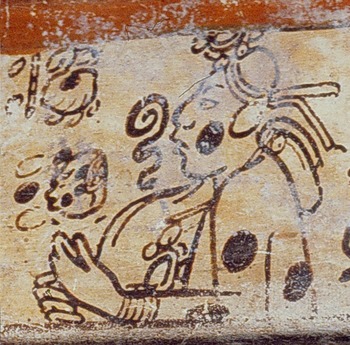
Scripts for incantations such as these are expressions of the semiotic ideologies underlying Maya healing during the Colonial period (Knowlton Reference Knowlton2015); in other words, they enable us to learn about Maya healers’ “ideas about what signs are and how they function in the world” (Keene Reference Keane2003). In this case, the verbal act of performing the oration (can) is directed at relieving an elderly person suffering from abdominal swelling (sot; Ciudad Real Reference Ciudad Real and Acuña2001:151). Since sot is a descriptive term for an observable symptom, we can suspect but not confirm that the sickness it addresses is ascites (abdominal dropsy) characterized by the accumulation of fluid in the abdomen resulting from underlying pathologies such as liver failure, heart failure or cancer that often occur in the elderly. Interestingly, ascites can cause the umbilical hernias that scholars have recognized as a common feature of Classic Maya depictions of elderly men (Figure 1; Houston et al. Reference Houston, Stuart and Taube2006:31–32) and of the Classic Maya way spirit named Sitz’ Chamiiy (“Glutton Death”) (Grube and Nahm Reference Grube, Nahm and Kerr1994:709; Stuart Reference Stuart2005:163).
Classic Maya depiction of an elderly man with herniated abdomen, perhaps indicative of ascites. Detail of photography by Justin Kerr, Kerr Archives K2794.

As in other colonial Maya incantations, healing is accomplished through a communicative process by which the healer reveals associations between the patient's experience (microcosm) and elements of the larger cosmology (macrocosm). Having established these microcosmic-macrocosmic links, it becomes possible for the healer's actions in the here and now to affect the sickness, which is itself symptomatic of cosmological disorder. In the course of the incantation, the healer relays that individual elements of the patient's suffering body are themselves the “icons” (uayasba) of, or are otherwise penetrated (oc) by, the golden accoutrements and body parts of the goddess Ix Hun Ahau:
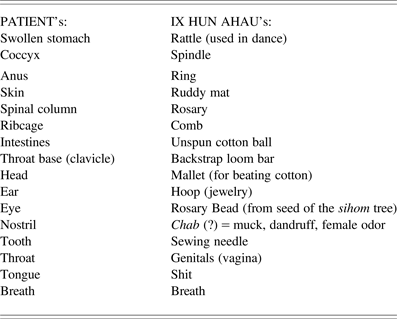
Starting with the patient's distended stomach and working through the body, the healer makes a series of iconic and indexical associations between the patient's body parts and elements of the goddess. By “iconic” and “indexical” I am using terminology from the semiotics of Pierce (Reference Pierce, Hartshorne and Weiss1974), in which an icon is a sign involving a connection based on a quality of likeness, whereas an index is a sign involving a connection based on causal or spatiotemporal contiguity (Mertz Reference Mertz2007; Stasch Reference Stasch2011). Most of the instances involve associations based on iconicity in shape (the distended stomach is round like the rattles used in dances; the ribs of the ribcage like the teeth of a comb), although other connections are occasionally made (the “ruddy mat” being like the patient's skin in color and texture). Like the “body scan” mindfulness techniques employed in contemporary clinical psychology, the Maya healer directs the patient's attention from point to point throughout the body. The trajectory of the incantation moves roughly from the patient's lower body to upper body, while the iconic associations move from Ix Hun Ahau’s accoutrements to the goddess herself, and, finally, completes the association by identifying the patient's vital breath (yk) with the vital breath of the goddess herself.
Although the structure of this incantation is apparent, some of the associations made are less obvious. Why are intestines likened to unspun cotton, or the patient's tongue likened to excrement? Understanding the relevance of these associations for Maya healing's “rhetoric of transformation” (Csordas Reference Csordas2002) requires understanding the goddess at work in the incantation. Who is Ix Hun Ahau that identifying the component parts of an elderly patient's body with her body and accoutrements is crucial to the curative process? At present, Ix Hun Ahau is only known from references in the Ritual of the Bacabs, where she appears to serve as a female counterpart or manifestation of the god Hun Ahau. Most of the named deities first identified in the Postclassic Maya codices from the northern lowlands by Schellhas (Reference Schellhas1904) are males. Yet beyond the multiple manifestations of the distinctively named goddesses also present in the codices (Tremain Reference Tremain2013), the masculine deities can and do take on female counterparts as well. Rather than taking on distinctive names in the sources, however, many of these female manifestations are introduced in the hieroglyphic texts as y atan (“his wife”) of a typically male deity, as in Dresden Codex page 2b, which depicts the wife (y atan) of the death god Cimil (Vail and Stone Reference Vail, Stone and Ardren2002). Rather than entirely distinct personalities, these female and male manifestations in the Late Postclassic codices comprise not so much discrete entities as members of overlapping complexes of deities with multiple manifestations (Vail Reference Vail2000). Therefore, we have two lines of inquiry for interpreting Ix Hun Ahau. First, we can evaluate the multiple references to the better-known deity Hun Ahau, especially as the deity was understood by Maya in Late Postclassic and Colonial Yucatan. Second, we can consider what we can know more specifically about Ix Hun Ahau’s roles and attributes based on additional, albeit fragmentary, references to her in the Ritual of the Bacabs.
LORD AND LADY HUN AHAU IN LATE POSTCLASSIC AND COLONIAL YUCATAN
In Yucatec Maya, the name Hun Ahau literally means “One King.” Although Hun Ahau appears in Maya iconography at least as early as the Preclassic in the southern lowlands (Taube et al. Reference Taube, Saturno, Stuart and Hurst2010), he is perhaps best known as a protagonist of the Popol Vuh, a Colonial period compilation of K'ichee’ Maya mythology and history from highland Guatemala (Christenson Reference Christenson2007, Reference Colop2008; Colop Reference Colop1999, Reference Colop2008; Tedlock Reference Tedlock1985, Reference Tedlock, Simon and Schuster1996). In the Popol Vuh he is called Hunahpu, which is actually the name of two protagonists in the mythology. The first Hunahpu is one of two sons of Xmucane, a creator goddess. These sons offend the disease-causing lords of the underworld (Xibalba in K'ichee’) with their noisy ball playing on the world's surface, and so are deceived and killed by them. This first Hunahpu miraculously impregnates Xqiq (Lady Blood), the daughter of an underworld lord, who then gives birth to another set of twins, one of whom is named Hunahpu and the other named Xbalanque. These Hero Twins are also sacrificed in the underworld, but upon returning from death they trick and defeat the lords of disease and death. Having avenged their father and uncle, they speak with them at their burial place before the twins’ apotheosis as the sun and the moon, respectively.
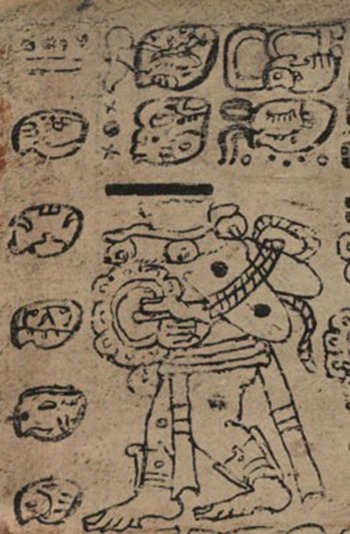
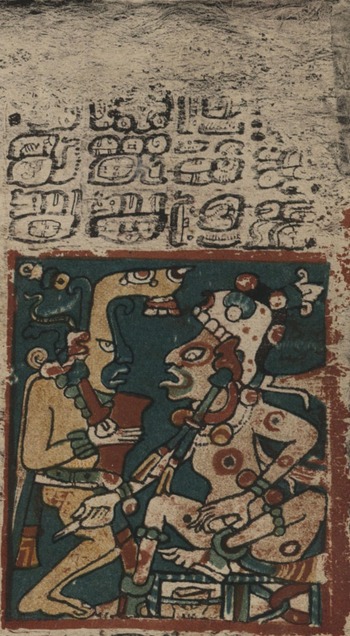
Ceramics painted with annotated scenes of Hun Ahau evidence that earlier versions of the Popol Vuh mythology circulated in the Maya mythology of the southern lowlands during the Classic period (Chinchilla Mazariegos Reference Chinchilla Mazariegos2003; Coe Reference Coe1978). In Classic and Postclassic iconography, Hun Ahau’s body is marked with “death spots” like those of the skeletal death deity, Schellhas’ (Reference Schellhas1904) God A (Taube Reference Taube1992:116). He also appears with the Caban sign for (“earth”) or “excrement” along his mouth and nose (Figure 2; Taube Reference Taube1992:112; Houston et al. Reference Houston, Stuart and Taube2006:143; see also Houston Reference Houston2014:20), cab (“earth”) being a euphemism for excrement that also appears in the Ritual of the Bacabs (Roys Reference Roys1965:M. 189, 194). Later in the Postclassic Dresden Codex from the northern lowlands, Hun Ahau appears in contexts highlighting his role in sacrifice, death, and the underworld (Taube Reference Taube1992:116). He appears as a beheaded sacrificial victim labeled in the text as a “dead person” on page 2a of the Dresden Codex (Figure 3). On page 50 in the Dresden Codex, he appears enthroned on a skyband, wearing a skull headdress, the accompanying caption describing Hun Ahau as a “sun lord” or kin ahau (Figure 4; Vail Reference Vail2013).
Classic period Hun Ahau with “death spots” and Caban “earth” or “excrement” sign in front of nose and mouth. Detail of photograph by Justin Kerr, Kerr Archives K1202.

Postclassic Hun Ahau as beheaded sacrificial victim described in text as ah cimil, “dead person” (Dresden Codex:M. 2a; Vail Reference Vail2013).

Postclassic Hun Ahau with skeletal cap, enthroned on a sky band, described in hieroglyphic text as an ahau kin, “sun lord” (Dresden Codex:M. 50; Vail Reference Vail2013).

In Colonial Yucatec Maya sources, Hun Ahau is the deity presiding over the Maya underworld, alternately called in these sources Mitnal or Metnal. This name is derived through metathesis from the Nahua name of the underworld Mictlan (Justeson et al. Reference Justeson, Norman, Campbell and Kaufman1985:25), suggesting some significant intellectual interchange occurred regarding ideas about the underworld. Xibalba, the name for the underworld found in the K'ichee’ Popol Vuh, is translated as “el Diablo” in the earliest extant Yucatec Maya dictionary (Ciudad Real Reference Ciudad Real and Acuña2001:587). Both Spanish and Maya language sources penned by missionaries and their associates in Yucatan during the Colonial period recast Hun Ahau in terms of their Christian views of indigenous gods. All indigenous deities, and non-Christian beings with underworld associations in particular, were understood as being demoniacal. The pre-Columbian codices from Yucatan depict various death gods and the punishing god cisin, “the flatulent one” (Taube Reference Taube1992; Vail Reference Vail1998). But colonial texts make it clear that missionaries in Yucatan actively sought to transform indigenous understandings of their underworld. Early in these missionaries’ transformation of the Maya language (Hanks Reference Hanks2010), cisin becomes a generic term for a demon or an idol of any god whatsoever (Ciudad Real Reference Ciudad Real and Acuña2001:109). However it is Hun Ahau, presiding over the closest indigenous equivalent to the Christian Hell, who was singled out as the Prince of Devils. Landa (Reference Landa and Gates1978 [ca.1566]:58) writes:
The torments of the evil life which they said awaited the wicked, lay in going to an evil place below the other, and which they called Mitnal, meaning hell, where they were tormented by demons, by great pains of cold and hunger and weariness and sadness. They said there was in this place a chief demon whom all the rest obeyed and whom in their language they called Hunahau.
The Motul dictionary lists Cumhau as “Lucifer, prince of the demons” (Ciudad Real Reference Ciudad Real and Acuña2001:127). And the Morley Manuscript, a Maya compilation likely dating to the late sixteenth century, makes repeated references to “Hun Ahau Lucifer” as a compound name used in these Yucatec language Christian texts (Morley Manuscript ca. 1576:130; Whalen Reference Whalen2003). By at least the seventeenth century, those Maya specialists performing incantations (healing and otherwise) were invoking Hun Ahau in their performances. As the extirpator of idolatry Sánchez de Aguilar (Reference Sánchez de Aguilar and Benítez1987 [1639]:82) reports:
And I took notice of a native of the town of Teɔoc, a great idolatrous enchanter, that bewitched and took in his hand a viper, or rattlesnake, with certain words of their heathenry, that I wrote down out of curiosity. As these are not worthy of paper and ink, it is sufficient to say that in these one invokes the demon, Prince of darkness and of caves (translation mine).
Although he doesn't provide us with the actual palabras de su gentilidad (“words of their heathenry”) he recorded, his reference recalls the numerous incantation texts in the eighteenth century Ritual of the Bacabs that begin by invoking Hun Ahau as both a day name and as the patron god of the day on which the sickness-causing daemons were spawned.
Besides the incantation already discussed, additional references to Ix Hun Ahau in the Ritual of the Bacabs identify her as a denizen of the underworld. One of her appellatives is Ix Can U Hol Cab, “She-of-the-Four-Entrances-to-the-Earth” (Arzápalo Marín Reference Arzápalo Marín1987:M. 25). Sicknesses removed from the body of a patient are cast into her presence, as in the incantation against Macaw Tancas (mo tancas): U pichintabal bin ycnal yx hun ahau (“Reportedly it is thrown violently in the presence of Lady One Ahau”) (Arzápalo Marín Reference Arzápalo Marín1987:M. 30, translation mine). Elsewhere, the incantations mention explicitly where sicknesses are being banished to: talebal ulenebal u kakil u llumbil t uy oxlahun tas cab t metnal y icnal Ix Hun Ahau Sisil Ahau (“The ulcer of the [patient's] spleen may come to, may arrive at the thirteenth layer of the world, at the underworld in the presence of Lady One Ahau, the Cold Ahau”) (Arzápalo Marín Reference Arzápalo Marín1987:M. 108, translation mine).
Here Ix Hun Ahau is explicitly stated as being within Metnal, in the deepest layers of the world. Her epithet as the (ix) sisil ahau (“Cold Queen”) echoes Landa's specific statement mentioned earlier of the Yucatec underworld as being a place where the deceased were tormented with cold, as well as the House of Cold encountered by the Hero Twins in the underworld of the Popol Vuh (Christenson Reference Christenson2007:169). Having established that Ix Hun Ahau is a denizen of the underworld to which agents of sickness are cast by the healer, it certainly makes sense why Ix Hun Ahau would be invoked in a healing text. Whether related in Colonial period documents like the Book of Chilam Balam of Kaua (Bricker and Miram Reference Bricker and Miram2002:94–99, 292) or in interviews with contemporary Maya healers (h menob) I have conducted, sickness causing tancas winds may descend from clouds in the sky or alternately creep up out of caves and similar portals to the underworld to plague people.
But stopping here in our analytical task leaves unexplained some of the most striking features of Ix Hun Ahau in the incantation discussed previously. Why the repeated references to her accoutrements of cotton, precious metal (takin), and various weaving implements? Why the apparently “profane” conclusion to the incantation, in which the patient's throat becomes Ix Hun Ahau’s vagina, and the patient's tongue is the goddess's “pure shit” (suhuy ta)? It is useful to consider at this point one final context in which Ix Hun Ahau is invoked in the Ritual of the Bacabs.
Also written on the back of a folio, we find the incantation against the ykal nicte tancas (“wind of the flowering tree tancas”) (Arzápalo Marín Reference Arzápalo Marín1987:M. 63). The incantations often refer to the sickness by the term co which more generally refers to “mischief” (Bricker et al. Reference Bricker, Po'ot Yah and de Po'ot1998:130) or to “madness” (Ciudad Real Reference Ciudad Real and Acuña2001:113). When combined with references to nicte (Plumeria; flowering tree), however, co in the incantations refers to a chaotic or mad lust, an association between flowering trees and sexual desireFootnote 2 found in the colonial Maya Songs of Dzitbalché as well (Barrera Vásquez Reference Barrera Vásquez1965; Sigal Reference Sigal2000:111–119):
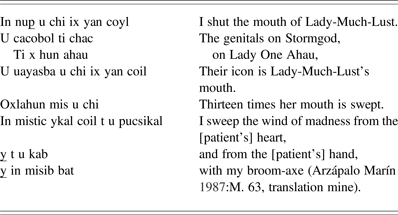
There are several interesting features of this example, both internal to the text and in light of the rest of the incantations in the manuscript. First of all, we have the statement that the mouth of the personified lust spirit is represented iconically (u uayasba) by genitals (u cacobol) on Ix Hun Ahau and on the storm god Chac. The reversal of orifices from low to high parallels the previous incantation, in which Ix Hun Ahau’s genitals are likened to the patient's throat.
Also intriguing is the reference to sweeping (mis) as the mechanism of cleansing the patient. The Ritual of the Bacabs has an enormously rich vocabulary of the ways in which the healer abuses the spirits of illness, but with the exception of this example, the healer never sweeps them away. In terms of pre-Columbian Maya sources, sweeping rituals are directed toward beehives on pages 111–112 of the Late Postclassic Madrid Codex (Vail Reference Vail2013). In the colonial K'ichee’ Popol Vuh, Ajal Mes (“Demon Sweepings”) is listed in the census of the sickness-causing lords of Xibalba, but is curiously missing from the narrative of their confrontation with Hunahpu and Xbalanque later in the manuscript (Christenson Reference Christenson2008:67, 120–121). Although relatively common in contemporary Yucatec Maya healing ritual I have documented, sweeping is virtually absent from healing in the Ritual of the Bacabs apart from this incantation. But sweeping as a means of cleansing sickness is a far more common feature of descriptions of Nahua notions of purity, pollution, and healing (Burkhart Reference Burkhart1989).
Beyond the general concept of a mistress of the underworld, the particular cluster of associations we have encountered in Ix Hun Ahau have no obvious parallel in Maya deities encountered in the textual record of Yucatan from the Postclassic through the Colonial period: a healer of the elderly; associated with lust; with pollution and its purification metaphorically located in the patient's mouth; and characterized by cotton and weaving accoutrements. In Late Postclassic and Colonial central Mexico, however, there was such a deity: Tlazolteotl-Ixcuina. Let us now consider the Nahua sources on concepts of pollution sickness, purification, and the roles and attributes of Tlazolteotl.
TLAZOLLI AND TLAZOLTEOTL
Nahua ideas of sickness and healing were informed by the concept of pollution, or tlazolli. In Molina's (Reference Molina1944 [1571]:118v) Nahuatl dictionary, tlazolli is defined as vasura que echan en el muladar (“trash they throw out onto the dungheap”). The term derives from the Nahuatl izolihui, the verb for things getting old and worn out (Molina Reference Molina1944 [1571]:33v). As Burkhart (Reference Burkhart1989:88) explains: “[tlazolli] is used broadly to denote any sort of dirt or ‘matter out of place’: chaff, straw, twigs, bits of hair or fiber, excrement, muck. What one sweeps up with a broom is tlazolli.” Body waste and the excretions of sexual activity were both considered tlazolli, and contact with tlazolli or immoderate sexual activity could bring on sickness (Burkhart Reference Burkhart1989:ch. 6; see also Sigal Reference Sigal2011). Tlazolli is, in short, filth that could pollute and sicken a person. Baths and sweeping could cleanse tlazolli from people and places. Crucial to purity and health, sweeping was an essential domestic activity in Aztec homes, schools, and temples, as well as a crucial element of the New Fire Ceremony celebrated to inaugurate the next fifty-two year period (Burkhart Reference Burkhart1989:117–120).
Tlazolteotl, the “Goddess of Filth” or “Divine Filth” (Klein Reference Klein1993), was a Nahua goddess with multiple appellatives and manifestations. Sahagún (Reference Sahagún, Anderson and Dibble1950:23) writes of her:
It was said: evil and perverseness, debauched living – these Tlaçolteotl offered one, cast upon one, inspired in one. And likewise she forgave, set aside, removed [corruption]. She cleansed one; she washed one. In her hand lay the blue and yellow waters.
In the Aztec calendar, Tlazolteotl is patroness of the fourteenth day-sign ocelotl (“jaguar”) (Durand-Forest Reference Durand-Forest and Carrasco2001) and as such is a nighttime counterpart to the sun. Consisting of four manifestations, Tlazolteotl was patroness of excessive sexuality and at the same time the goddess who cleanses people from polluting tlazolli, especially the elderly who purified themselves through an indigenous rite of confession (Sahagún Reference Sahagún, Anderson and Dibble1950:1:23–27, 71). Interestingly, confession in response to sickness is a practice Nahua speakers also shared with the Late Postclassic Maya of the northern lowlands (Landa Reference Landa and Gates1978 [ca.1556]:45). Tlazolteotl is also known in the colonial sources by the title Tlaelcuani, which Sullivan (Reference Sullivan and Boone1982:15) translates as “Eater of Ordure.” Tlazolteotl is often depicted with her mouth, nose, and chin painted black to index this role of filth eater who purifies penitents through the indigenous confession rite (Quiñones Keber Reference Quiñones Keber1995:34). Her role of cleansing people of filth is further developed in her depiction in the Florentine Codex, which portrays her with a broom to sweep away the filth clinging to those who call upon her (Burkhart Reference Burkhart1989:93–94).
Tlazolteotl was herself the result of intercultural exchange. She is very commonly referred to by the appellative Ixcuina, a Huastec name meaning “Lady Cotton.” The Huasteca region of the northern Gulf Coast of Mexico has been a multiethnic crossroads since pre-Columbian times, populated by both Teenek (Huastec-Maya) and Nahua peoples (Faust and Richter Reference Faust and Richter2015). Previous research on the Postclassic sculptures of seminude women from the Huasteca often identify these as Tlazolteotl, and include a monument of “a woman with a circular headdress emitting rays identical to Aztec and Mixteca Puebla solar rays” (Taube Reference Taube, Faust and Richter2015:99). True to her Huastec appellative, in central Mexican iconography Tlazolteotl-Ixcuina’s headdress contains bands of unspun cotton and spindles with cotton strands dangling from them, which serve as diagnostic aspects of her costume. Sullivan (Reference Sullivan and Boone1982) argues these tools of spinning and weaving identify her both as “the model noblewoman” and symbol of generation and regeneration, as the process of spinning is metaphorically likened to reproduction in Aztec riddles. As Burkhart (Reference Burkhart1989) and Klein (Reference Klein1993) discuss, filth and excrement have not only polluting but generative associations as decayed components of the fertile humus of the earth. In the Codex Borbonicus, Tlazolteotl is depicted giving birth, and Boone (Reference Boone2007:43) notes her domains in the Mexican divinatory codices is as the goddess of childbirth and the patron of weavers. Also in keeping with the association with regeneration, in the Codex Borbonicus and elsewhere the goddess is depicted dressed in a flayed skin like Xipe Totec, the god of spring and of goldsmiths (Durand-Forest Reference Durand-Forest and Carrasco2001).
Very relevant for our discussion are references to Tlazolteotl in the early seventeenth century Nahuatl incantations recorded by Ruiz de Alarcón. He presents an incantation meant to cure sicknesses caused by tlazolmiquiztli (“filth-death”) resulting from excessive sexuality or from coming in close contact with persons characterized by excessive sexuality (Ruiz de Alarcón Reference Ruiz de Alarcón, Andrews and Hassig1984 [1629]:134–139). The Nahuatl incantation against this sickness begins by invoking four manifestations of Tlazolteotl-Ixcuina (Ruiz de Alarcón Reference Ruiz de Alarcón, Andrews and Hassig1984 [1629]:136, 353, n15) prior to administering a medicinal bath of water and copal. Afterwards the polluting tlazolli itself is invoked as the source behind the sickness, alongside two manifestations of Tlaloc (the central Mexican storm god), who are warned against resisting the healer's efforts (Ruiz de Alarcón Reference Ruiz de Alarcón, Andrews and Hassig1984 [1629]:137). Although as scathing in his denunciation of this practice as he is of the other indigenous rites he reports, Ruiz de Alarcón (Reference Ruiz de Alarcón, Andrews and Hassig1984 [1629]:138–139) remarks on the superficial similarity between Nahuatl medicinal baths and Christian baptism, noting however that the former are aimed at alleviated physical sicknesses.
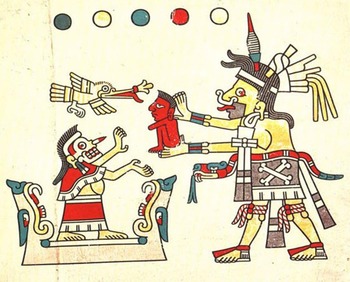
Contemporary Nahua peoples of the Huasteca continue to link tlazolli with sickness, in particular, with the sickness-causing winds from the underworld. For example, Sandstrom (Reference Sandstrom1978:13, 35–36) has documented paper cut images of mictlan tlazolli ehecatl (“Underworld filth-wind”) that Nahua healers of the region use in their curing rituals. These ritual cleansings are called ochpantli or “sweeping” and involve incantations and accoutrements serving as symbolic brooms (Sandstrom Reference Sandstrom1991:311). Although more often associated with childbirth, the earth and weaving, the underworld does factor occasionally into the pre-Columbian and Colonial sources on Tlazolteotl. In the Codex Laud she is depicted dressed in a crossbones skirt delivering a child over to a female death figure standing in the gapping maw of the earth (Figure 5). Moreover, one of the sixteenth century annotators of the Codex Telleriano-Remensis, commenting on her image on folio 17v, states that Tlazolteotl was the “wife of Mictlantecuhtli” (Quiñones Keber Reference Quiñones Keber1995:264), the Nahua lord of the underworld. Although Mictlancihuatl, not Tlazolteotl, is the “canonical” wife of the Nahua death god, this early reference provides us with the range of possible interpretations of Tlazolteotl circulating in the early Colonial period, especially as missionaries sought to recast indigenous deities as Christian-style demons. Regarding the colonial historical processes that ultimately resulted in the contemporary Nahua curing rituals he documented, Sandstrom (Reference Sandstrom and Michelet1989:362) argues that “while Tlazolteotl herself was lost, her function of consuming and destroying polluting sin, now linked to the Devil with its many faces, became the task of the shaman in cleansing rituals.”
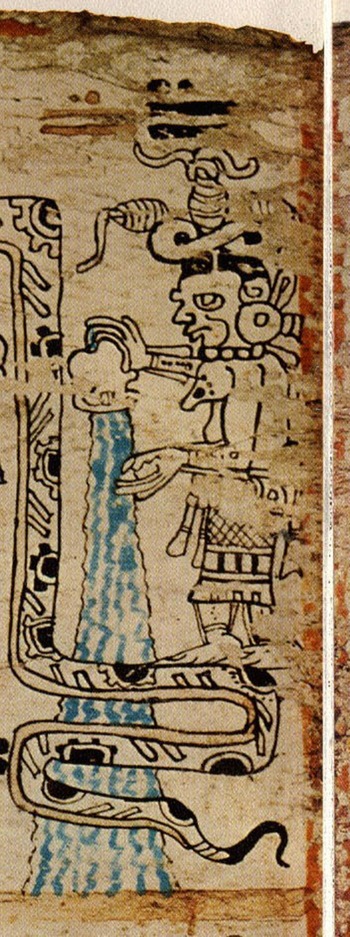
Tlazolteotl (with weaving accoutrements, painted mouth, and cross-bone skirt) delivering child to female death being in the earth in Codex Laud (Anders Reference Anders1994:42).

To summarize, Nahua illness etiologies have long held that tlazolli (“filth”) is a cause of illness. Tlazolli included all manner of dirt and “matter out of place” (Douglas Reference Douglas1966), including excessive lust and sexual activity. Tlazolteotl-Ixcuina was a Huastec goddess whom Nahua peoples of the Late Postclassic and Colonial periods invoked to cleanse them of tlazolli and the sicknesses associated with it. This was done through confession or incantations accompanying medicinal baths, the latter in association with the storm god Tlaloc. She is very often depicted with spindles, unspun cotton, and cotton threads among her accoutrements, symbols of generation and regeneration according to Sullivan (Reference Sullivan and Boone1982), and she is also dressed in the flayed skin of Xipe Totec, patron of spring and of goldsmiths. Furthermore, Tlazolteotl is depicted at times carrying a broom and with her mouth painted black in her role as the “Eater of Ordure” in the indigenous confession rite. Some sources associate her with the underworld, an association that apparently grew during the Colonial period and after, resulting in the curing concepts and practices linking filth, death and the underworld documented ethnographically among contemporary Nahua peoples of the Huasteca.
IX HUN AHAU AS THE MAYA GODDESS OF FILTH AND HEALING
Now having surveyed the basic features of the Nahua goddess Tlazolteotl-Ixcuina, we can now reconsider what we know about the roles and accoutrements of Ix Hun Ahau in relation to her. Although several Nahua deities are known from the texts and iconography of Yucatan, evidence of Tlazolteotl among the pre-Columbian Maya outside of the Huasteca is very scant. One piece of evidence is an effigy censer fragment recovered from Mayapan with black face paint and other elements that often make up images of Tlazolteotl (Taube Reference Taube1992:122–124). Evidence for the Maya goddess Ix Hun Ahau is likewise rare, but a systematic evaluation of the evidence available from the incantations of the Ritual of the Bacabs indicates that she is the Maya counterpart to Tlazolteotl, documenting one way in which interethnic exchange affected Mesoamerican groups’ medical concepts and practices.
First, there is Ix Hun Ahau’s weaving equipment. The incantation lists numerous items manifested in the patient's body, most of these accoutrements being used in weaving (Arzápalo Marín Reference Arzápalo Marín1987:M. 20–21). These include a mallet and mat for beating cotton fiber in preparation for spinning, the bar of a backstrap loom, and a threading needle for brocading. Perhaps most notable are the spindle, unspun cotton, and cotton threads which together also make up diagnostic elements of Tlazolteotl-Ixcuina’s costume in central Mexican iconography. The patient's body is the site of so many of Ix Hun Ahau’s weaving materials and implements in the healing incantation that these appear to index the generative and regenerative notions linked to weaving that Sullivan (Reference Sullivan and Boone1982) discusses for Tlazolteotl-Ixcuina also. The suhuy (“virgin”) cotton that appears among Ix Hun Ahau’s equipment (as opposed to lesser fibers) in the Mesoamerican context marks Ix Hun Ahau’s high status as a noblewoman, which is reinforced in the incantation though reference to her gold (or silver) jewelry as well. Archaeological correlates of the metallic items and weaving implements described for Ix Hun Ahau can be found elsewhere in Mesoamerica, at as distant locales as the Late Postclassic interments in Monte Albán Tomb 7, the material culture of which McCafferty and McCafferty (Reference McCafferty and McCafferty1994) associate with both Mesoamerican notions of regeneration as well as their related ideologies of warfare and sacrifice.
As basic as weaving implements are to depictions of Tlazolteotl-Ixcuina as patron of weavers (Sullivan Reference Sullivan and Boone1982), their occurrence with Ix Hun Ahau does not by itself establish an identification between the two. As in many societies around the world, weaving was considered women's work, so the association is not surprising, even if the degree of emphasis on weaving is. Almanacs in the Postclassic Maya codices from Yucatan depict numerous goddesses engaged in weaving activities (Ciaramella Reference Ciaramella1999; Vail and Stone Reference Vail, Stone and Ardren2002), including the “wife” (y atan) of the death god A. The Postclassic goddess Chac Chel, in particular, appears in the Madrid Codex with unspun cotton and spindle in her hair, all accoutrements of Tlazolteotl (Figure 6; Vail and Hernández Reference Vail, Hernández and Braswell2012:296) and of Ix Hun Ahau as described above. Even more common than weaving alone is the description of Ix Hun Ahau’s implements as being made of either gold or silver (takin can refer to either; Ciudad Real Reference Ciudad Real and Acuña2001:528), materials which also indexes her high status as well as pan-Amerindian concepts of spiritual brilliance (Saunders Reference Saunders, Quilter and Hoopes2003).
Postclassic goddess Chac Chel with weaving accoutrements in her hair, from the Madrid Codex (M. 32a; Anders Reference Anders1967).

There is a rich folklore surrounding excrement in both ancient and contemporary Mesoamerican societies (López Austin Reference López Austin1988), and gold is described as holy excrement in both Nahua and Yucatec Maya languages. Gold in Nahuatl is teocuitlatl, literally “divine shit” (Klein Reference Klein1993). Sahagún (Reference Sahagún, Anderson and Dibble1963:11:233–234) noted that gold is the excrement of the sun god and that gold was consumed as medicine for skin diseases. The Maya term for gold or silver, takin (“sun shit”), is probably a calque from Nahua. Takin is otherwise unattested to in known Classic Maya hieroglyphic texts except for an example from the Terminal Classic site of Chichen Itza (Helmke Reference Helmke2013:3), well-known for its gold and gold alloy artifacts and its shared iconography with central Mexico. Interestingly, there is a process of interpretation evident in the calque, as a literal translation of Nahuatl teocuitlatl would be tak'uh (“divine shit”) rather than the actual term used, takin. To arrive at takin involves knowing that the deity being referenced is the sun, and so may suggest some familiarity with the Nahua lore surrounding gold.
Yucatan's reliance on interregional trade for precious metals has been remarked up since Landa (Reference Landa and Gates1978 [ca.1566]:94). Gold alloy jewelry and tools (such as needles and bell-rattles) were among the metal items arriving or refashioned in Postclassic Yucatan from elsewhere in Mesoamerica (Paris Reference Paris2008), and similar metal items continued to be fashioned in the Colonial period using a combination of indigenous and European techniques (Cockrell et al. Reference Cockrell, Martinón-Torres and Graham2013). Elsewhere, archaeological and ethnohistoric evidence substantiates that, by the Late Postclassic, the multiethnic gold-working community in central Mexican urban centers were producing and exporting significant amounts of gold ornaments (King Reference King2015; López Luján and Ruvalcaba Reference López Lújan and Ruvalcaba Sil2015). Furthermore, Tlazolteotl is depicted at times in the central Mexican sources wearing the flayed skin of Xipe Totec, who as patron of spring and of goldsmiths align gold with the generative and regenerative associations already discussed for weaving.
Among Ix Hun Ahau’s golden items, we have the obviously colonial rosario (“rosary”) making up the spine of the patient, and the rosary bead (sihom) that enters his eye. We might initially dismiss this as simply an import from Spanish Catholicism, but it seems more productive to ask what significance in this context did rosaries have for Maya peoples? Maya rosaries in Colonial times were made from the seeds of the sihom tree, which Roys (Reference Roys1931:309) identifies as the soapberry tree (Sapindus saponaria L.). These black seeds are contained in the soapberry's golden colored fruit, which the Motul dictionary notes was used by Mayas as soap (Ciudad Real Reference Ciudad Real and Acuña2001:145), a use also recognized in both the Latin and common names of the tree. According to Landa (Reference Landa and Gates1978 [ca.1566]:44) the ca put sihil (“rebirth”) or coming-of-age ceremony of Late Postclassic Yucatan involved first scattering and then sweeping up the leaves of the sihom tree. This ceremony involved the impersonators of the Maya storm god Chac and was likened by Landa to baptism. In the Colonial period, the cleansing association between the soapberry tree and the use of its seeds in making rosaries would have been palpable given the use of rosaries in Catholic rites of penance following confession. Rosaries therefore would make perfect sense as an addition to the accoutrements of a Colonial manifestation of the goddess of filth, cleansing, and confession.
As Tlaelcuani, the “Eater of Ordure,” Tlazolteotl was the subject of the indigenous Nahua confession rites, which parallels the Late Postclassic Maya confession rites reported by Landa (Reference Landa and Gates1978 [ca.1566]:44–45), including in their emphasis on sexuality and goal of physical healing. The association of Ix Hun Ahau with cleansing confession is most striking when we consider the icons that the incantation places within the mouth of the patient towards its conclusion (Arzápalo Marín Reference Arzápalo Marín1987:M. 20–21). The sort of pairing of sex and excrement that pervades Nahua sources on tlazolli is evident in the Maya healer's incantation, which identifies the patient's throat as Ix Hun Ahau’s genitals and the patient's tongue as her suhuy ta (“pure shit”). Locating excrement in the patient's mouth simultaneously indexes the function of confession and a role for Ix Hun Ahau as being, like Tlazolteotl, the eater of filth. This is accomplished as the incantation moves towards an increased identification between the patient and the goddess, culminating in the one-to-one correspondence of the vital breath (ik) of one being the vital breath of the other. The use of suhuy (“pure, virgin”) here and elsewhere in describing Ix Hun Ahau’s accoutrements in the patient's body points again to her role as purifier and healer. Recall also that the elderly in particular confessed to Tlazolteotl (Sahagún Reference Sahagún, Anderson and Dibble1950:27) and that the Maya incantation is explicitly u noh uinicil can (“the oration for an old man”) (Arzápalo Marín Reference Arzápalo Marín1987:M. 20–21).
Finally, the argument that Ix Hun Ahau is a Maya counterpart to Tlazolteotl is furthered by considering her role in the Maya incantation against sicknesses caused by excessive sexuality, the ykal nicte tancas (“wind of the flowering tree tancas”) introduced earlier. In that incantation, it is the mouth of Lady-Much-Lust (Ix Yan Coyl) that is swept thirteen times, referring there to the actions of the healer as he touches the patient's body with his purifying paraphernalia (the “broom-axe” or misib bat). Recall what the patient's mouth represents (u uayasba) in the healing context: “The genitals on Stormgod, on Lady One Ahau, their icon is Lady-Much-Lust's mouth” (Arzápalo Marín Reference Arzápalo Marín1987:M. 63).Footnote 3 The pairing of Chac, the Maya storm god, and Ix Hun Ahau here is very important. Whereas the elderly Postclassic goddess Chac Chel is paired with Chac in rainy season rituals in the Madrid Codex (Vail and Hernández Reference Vail, Hernández and Braswell2012:291), a more direct correspondence to the context under discussion here is actually found in Nahua sources. We have already discussed the parallel seventeenth century Nahua incantation against sicknesses caused by excessive sexuality reported by Ruiz de Alarcón (Reference Ruiz de Alarcón, Andrews and Hassig1984 [1629]). In that incantation, the deities invoked are Tlazolteotl and Tlaloc, the latter being the Nahua storm god who was the counterpart of the Maya storm god Chac. Tlaloc was well known to the Maya, being common in the Terminal Classic and Postclassic iconography of Chichen Itza (Taube Reference Taube1992:133). Contemporaneous Chac and Tlaloc effigy censers were prominent offerings at Balankanche cave near Chichen Itza, alongside images of Xipe Totec (Andrews Reference Andrews1970). Moreover, Late Postclassic Maya scribes reworked almanacs with Tlaloc iconography from the Borgia group of codices into similar almanacs featuring Chac in the Madrid Codex (Hernández and Bricker Reference Hernández, Bricker, Vail and Aveni2004). In this particular case we are fortunate enough to have colonial incantations from both Maya and Nahua sources for sicknesses with the same etiology (excessive sexuality), which likewise employ similar deity pairs. As Tlaloc is to Chac in these parallel incantations, then so Tlazolteotl is to Ix Hun Ahau.
CONCLUDING REMARKS
While this paper focuses on a single goddess, it has broader implications for our knowledge of Maya healing concepts and practices. This is because understanding the roles and attributes of the deities invoked in indigenous curing rituals provides us with insight into the comparative diversity of the “rhetorics of transformation” employed in Mesoamerican ritual healing practices over time (Csordas Reference Csordas2002). In the Ritual of the Bacabs, Ix Hun Ahau’s role as mistress of the underworld is emphasized in those incantations involving exorcism, as agents of sickness were violently thrown (pichin) or cast away (pul) from the patient that they might arrive in the goddess's presence (icnal) below the earth (Arzápalo Marín Reference Arzápalo Marín1987:M. 25, 30, 108).
Although superficially similar, the rhetoric of the incantation against sexually-derived sickness exhibits significant differences (see Arzápalo Marín Reference Arzápalo Marín1987:M. 63). Its rhetoric of transformation foregrounds the identification of the sickness-causing agent's upper orifice (mouth) as the icon of the lower orifices (genitals) of Ix Hun Ahau and the storm god Chac. Rather than locating the deities in a place apart, they are identified with the patient's polluted body. The patient's vulnerability is reflected in the body's permeability, so the first action of the healer is to close (nup ) the mouth. In keeping with concepts of tlazolli, sickness is swept (mistic) from the body of the patient, first from the mouth, then moving to the core (pucsikal), and then outward through the extremities (kab).
In Nahua cosmology, Tlazolteotl is both goddess of pollution and of purification. Ix Hun Ahau, too, is invoked not only as a polluting presence but as a cleansing one as well. So in the role of patron of weavers she is invoked to revitalize the worn body of an elderly man. In his widely influential analysis of a Kuna healing song, Lévi-Strauss (Reference Lévi-Strauss, Jacobson and Schoepf1950) asserts that the locations in the itinerary of the shaman's mythical journey are literally parts of the patient's body. He argues that the effectiveness of the shamanic cure is to be found in the symbolic process by which “a transition will be made from the most prosaic reality to myth, from the physical universe to the physiological universe, from the external world to the internal body” (Lévi-Strauss Reference Lévi-Strauss, Jacobson and Schoepf1950:193). In the rhetoric of transformation at work in the Maya incantation, however, the physiological universe is not in this case a mythical landscape traversed by the healer (Arzápalo Marín Reference Arzápalo Marín1987:M. 20–21). Rather, the very permeability of the body that makes it susceptible to pollution is addressed through identification of the diseased parts with the deity herself. Moving roughly from lower body to upper body, ultimately the corporeal polarity between goddess and patient is reversed, as the lower orifices of the underworld goddess become the upper orifices of the patient (Galinier Reference Galinier, Aronoff and Scott2004:221–226). Bit by bit it is revealed what golden accoutrements of Ix Hun Ahau entered (oc) the patient's body, until the now purified excrement of the one exits the mouth of the other, and the vital breath of the goddess becomes the patient's vital breath as well.
The presence of multiple rhetorics of transformation in ritual healing are not due to the absence of a coherent system to indigenous medicine, but rather from the historical exchange, accumulation and accommodation of multiple systems over the centuries. The case of the parallel between the Nahua goddess Tlazolteotl-Ixcuina and the Maya goddess Ix Hun Ahau exemplifies this more general process in the transition from pre-Columbian to Colonial Mesoamerica.
RESUMEN
Los conjuros del manuscrito maya yucateco conocido como El Ritual de los Bacabes constituyen la fuente lo más antiguo conocido por la forma en que la cosmología maya relacionó a las prácticas curativas. Aunque el texto proviene de los finales del siglo XVIII, lo es la culminación de siglos de interacción cultural, lingüística e intelectual con otros pueblos mesoamericanos y, en última instancia, los españoles. Los encantamientos hacen uso frecuente de la terminología arcaica y metáforas, algunas de las cuales se encuentran casi exclusivamente en los textos jeroglíficos de la época Clásico (Knowlton Reference Knowlton, Hull and Carrasco2012). Al mismo tiempo, El Ritual de los Bacabes contiene material sin paralelo en otras fuentes mayas, incluyendo lo que parecen ser innovaciones en la cosmología de curación que surgió como resultado del intercambio intelectual interétnica que caracterizó Mesoamérica durante la época Posclásico Tardío (ca. d.C. 1200–1500). Este trabajo analiza el papel y los atributos de la diosa maya Ix Hun Ahau. Esta manifestación femenina del dios maya bien conocido Hun Ahau es en la actualidad sólo se conoce a partir de las referencias en El Ritual de los Bacabes. Aunque es común en los códices Maya Posclásico para hacer contrapartes femeninas a las deidades masculinas (como sus “esposas” y atan), el equipo y los papeles atribuidos a Ix Hun Ahau en los encantamientos identifica la diosa Maya como semejante a Tlazolteotl-Ixcuina, la diosa Nahua del tejido, la sexualidad, la contaminación, y su purificación. Conceptos de contaminación y prácticas de purificación que son periféricas en El Ritual de los Bacabes están específicamente relacionadas con Ix Hun Ahau en ese texto, lo que sugiere que el intercambio intelectual entre los pueblos mesoamericanos precolombinos extendió a cosmologías médicos también.
ACKNOWLEDGMENTS
I would like to thank the staff and fellows of Dumbarton Oaks Research Library and Collection, where I wrote the initial draft of this article while in residence as a Fellow in Pre-Columbian Studies during the 2014–2015 academic year. I would like to address special thanks to Pre-Columbian Studies Director Colin McEwan, as well as Bryan Cockrell, Billie Folensbee, Cara Tremain and Gary Urton for their suggestions and, in some cases, comments on previous drafts while at Dumbarton Oaks. I am extremely grateful for the research assistance Edber Dzidz Yam provided during my fieldwork among contemporary Maya healers in Yucatan. Additionally, my gratitude extends to Gabrielle Vail, Oswaldo Chinchilla Mazariegos, and an anonymous reviewer for Ancient Mesoamerica for their helpful comments on earlier versions of this manuscript. Any errors of fact or interpretation after such stellar commentary are of course my own.