A substantial body of research, spanning experimental investigations with animals and correlational studies with humans, points to the important role played by the hypothalamus–pituitary–adrenocortical (HPA) axis in mediating both the adaptive and maladaptive changes that occur as a result of acute and chronic stress (see Frodl & O'Keane, Reference Frodl and O'Keane2013; Gunnar, Reference Gunnar1998; Loman & Gunnar, Reference Loman and Gunnar2010; Lupien, McEwen, Gunnar, & Heim, Reference Lupien, McEwen, Gunnar and Heim2009). The HPA axis forms part of an orchestrated network of peripheral and central neurobiological processes that are responsible for regulating the bioenergetic, respiratory, cardiac, muscular, and cognitive/affective responses to stressors (Blair, Granger, & Peters Razza, Reference Blair, Granger and Peters Razza2005; Shields, Bonner, & Moons, Reference Shields, Bonner and Moons2015), and these changes are adaptive in optimizing a rapid fight–flight response. However, there is compelling evidence that chronic activation of these stress systems can lead to long-term maladaptive changes both within the stress systems themselves and across wider biological systems involved in a range of homeostatic and cognitive functions (Lupien et al., Reference Lupien, McEwen, Gunnar and Heim2009).
Developmental studies indicate that sustained stress may lead to hyperactivation of the HPA axis in the short term, which gives way, over time, to a gradually emerging hypoactivation, as the maturing system recalibrates (Gunnar & Quevedo, Reference Gunnar and Quevedo2007). Further, some evidence suggests that early life may represent a key period in which the HPA axis is particularly sensitive to being recalibrated in this way. On the basis of a wide range of data, primarily from animal studies, Loman and Gunnar (Reference Loman and Gunnar2010) have suggested that, under normal circumstances, the HPA axis demonstrates a special period of low responsivity in early life, which is thought to protect the maturing stress system from the harmful effects of glucocorticoids. The parent–child relationship appears to play a critical role in this buffering process (Hostinar, Sullivan, & Gunnar, Reference Hostinar, Sullivan and Gunnar2014), as evidence shows that the supportive presence of an adult strongly regulates the HPA response to stressors in young children (Gunnar & Donzella, Reference Gunnar and Donzella2002). When this buffering process fails, exposure to chronic stress may lead to long-term alterations in HPA function, which for reasons not fully understood, may include heightened or blunted stress reactivity (Del Giudice, Ellis, & Shirtcliff, Reference Del Giudice, Ellis and Shirtcliff2011). Striking evidence of this in humans comes from a recent treatment trial at the Centre of Excellence in Human Development, University of the Witwatersrand, South Africa, in which Romanian orphans raised in highly deprived circumstances (i.e., institutional care) were randomly allocated to receive high-quality foster care versus institutional care as usual. McLaughlin et al. (Reference McLaughlin, Sheridan, Tibu, Fox, Zeanah and Nelson III2015) found that usual institutional care was associated with blunted cortisol reactivity to a social stressor at age 12 years, while the provision of high-quality foster care normalized physiological responding. It is critical to note that the authors found that the positive effects of treatment were restricted to children placed before 24 months of age, suggesting the possibility of a sensitive period. Lasting changes in the functioning of the HPA axis have wide-ranging clinical significance because they are associated with impairments in executive function, working memory function, depression, externalizing problems and risk for cardiovascular disease, obesity, and Type 2 diabetes (Gotlib, Joormann, Minor, & Hallmayer, Reference Gotlib, Joormann, Minor and Hallmayer2008; McEwen, Reference McEwen1998; Rosmond, Reference Rosmond2003; Rosmond, Dallman, & Bjorntorp, Reference Rosmond, Dallman and Bjorntorp1998; Schoofs, Wolf, & Smeets, Reference Schoofs, Wolf and Smeets2009; Wolf, Reference Wolf2003).
Given the potential importance of early-life exposure to stressors in the development of the HPA axis, and the significance ascribed to parental behavior in providing protection from such effects, a number of cross-sectional and longitudinal studies have examined HPA axis reactivity in young children or infants and related this to measurements of the quality of the parent–child relationship. Several studies have, for example, shown that secure parent–child attachment may reduce stress responses in infants and young children as measured by salivary cortisol (e.g., Spangler & Grossmann, Reference Spangler and Grossmann1993). Similarly, several studies have found that sensitive and responsive parenting, itself related to security of attachment, also shows evidence of being linked to reduced cortisol responses in young children (e.g., Blair, Granger, Willoughby, & Kivlighan, Reference Blair, Granger, Willoughby and Kivlighan2006).
However, these studies are limited in two critical respects. First, almost all are cross-sectional in nature, and few have investigated the effects of early insecurity or low parental responsiveness on long-term HPA axis function (though see McLaughlin et al., Reference McLaughlin, Sheridan, Tibu, Fox, Zeanah and Nelson III2015; Roisman et al., Reference Roisman, Susman, Barnett-Walker, Booth-LaForce, Owen and Belsky2009). Second, virtually all studies thus far have been conducted in high-income countries, which limits our understanding in several ways. In particular, the rate of significant stress exposure in high-income countries is generally much lower than in low- and middle-income countries (LMIC), which means that we have little understanding of the extent to which current findings generalize to contexts where chronic exposure to stress is more prevalent. Furthermore, a focus on high-income countries has tended to mean that where high-risk groups have been investigated, they have often been defined by parental psychiatric status (particularly depression; see, e.g., Barry et al., Reference Barry, Murray, Fearon, Moutsiana, Cooper, Goodyer and Halligan2015; Halligan, Herbert, Goodyer, & Murray, Reference Halligan, Herbert, Goodyer and Murray2007), which although important in its own right, limits the generalizability of the findings. In the current report, we present the first study to investigate the association between two indicators of early care measured in infancy (parental sensitive responsiveness and security of attachment) and long-term HPA axis reactivity in a sample of adolescents raised in the context of extreme poverty in a LMIC. In the sections that follow, we review the background literature informing this study and then outline the study's goals and hypotheses.
Stress and HPA Axis Function
The body's stress response system, though multifaceted, is organized into three levels (see Gunnar & Fisher, Reference Gunnar and Fisher2006). At the highest level, a corticolimbic network involving the anterior cingulate cortex and orbitofrontal cortex serves as a cognitive–affective appraisal system that passes on signals to subcortical (hypothalamus–brainstem) regions responsible for initiating a biological response. At the subcortical level, the hypothalamus and locus coeruleus regulate cortical/attentional arousal, while the paraventricular nucleus of the hypothalamus is involved in the release of corticotropin-releasing hormone (CRH) to the pituitary, which in turn triggers the release of adrenocorticotropin hormone (ACTH) into circulation. The hypothalamus is also closely connected to other brainstem structures responsible for the control of the sympathetic and parasympathetic nervous systems that regulate, among other things, vasoconstriction and digestion. The third level within the stress system involves the peripheral organs, most notably the adrenal glands. When ACTH reaches its target receptors within the adrenal cortex, this triggers the release of the stress hormone cortisol into circulation, which has a wide range of biological effects that serve to optimize the body's response to an acute stressor, such as the increased release of glucose into the bloodstream and suppression of the immune system. Cortisol-sensitive receptors in the pituitary, hypothalamus, and hippocampus act as part of a negative feedback control loop to inhibit CRH and ACTH and dampen the cortisol response; the HPA axis is therefore intrinsically self-limiting. Basal levels of cortisol, which vary in a diurnal pattern, are regulated by partially distinct mechanisms from those regulating phasic responses to acute stressors; however, basal cortisol levels act synergistically in relation to acute HPA responses by enhancing the biological effects of stress agents on their target tissues (Gunnar & Quevedo, Reference Gunnar and Quevedo2007). Short term, these mechanisms are vital for regulating the broad range of metabolic demands of the flight–fight response. However, chronic exposure to stress appears to have a range of negative effects on cognitive, emotional, and physical development (Lupien et al., Reference Lupien, McEwen, Gunnar and Heim2009). Glucocorticoid and CRH receptors are highly prevalent throughout the brain, and the hippocampus, amygdala, anterior cingulate cortex, and prefrontal cortex have all been found to be prone to (albeit sometimes reversible) dendritic hypertrophy as a result of glucocorticoid exposure. These neurobiological changes provide at least one set of pathways via which altered HPA axis activity affects emotion, cognition, and behavior (Lupien et al., Reference Lupien, McEwen, Gunnar and Heim2009).
The HPA axis is the most well-studied “arm of the stress” system in the field of developmental psychopathology, and there has been considerable interest in the potential role of the HPA axis in understanding variations in children's cognitive and emotional functioning, and in mediating the effects of adversity on these outcomes. Alterations in HPA function have been implicated in the development of depression, aggression, and problems with executive function in children (Alink et al., Reference Alink, van IJzendoorn, Bakermans-Kranenburg, Mesman, Juffer and Koot2008; Berry, Blair, Willoughby, Granger, & Family Life Project Key Investigators, Reference Berry, Blair, Willoughby and Granger2012; Guerry & Hastings, Reference Guerry and Hastings2011; Lopez-Duran, Kovacs, & George, Reference Lopez-Duran, Kovacs and George2009). A number of investigations have also sought to delineate the role played by the HPA axis in mediating the effects of exposure to specific stressors on later developmental outcomes. A good example comes from the work of Blair et al. (Reference Blair, Granger, Willoughby, Mills-Koonce, Cox, Greenberg and Fortunato2011) and Blair, Berry, Mills-Koonce, Granger, and Famly Life Project Key Investigators (Reference Blair, Berry, Mills-Koonce and Granger2013), which has shown that cumulative poverty during infancy and preschool predicts heightened basal cortisol at ages 3 and 4 years, and this in turn partially mediates the effect of poverty on executive functioning at preschool age. Cicchetti, Rogosch, Gunnar, and Toth (Reference Cicchetti, Rogosch, Gunnar and Toth2010) have also explored the connection between maltreatment, daily cortisol levels, and symptoms of anxiety and depression. They found that children who had experienced such maltreatment and also showed high levels of internalizing symptomatology had heightened afternoon cortisol levels and flatter diurnal cortisol slopes. These findings underline the potential importance of understanding the causal determinants of HPA function for developing prevention strategies (Gunnar & Fisher, Reference Gunnar and Fisher2006).
Early Care and HPA Axis Function
Attachment
Contact and comfort from a primary caregiver is widely recognized to be a key mechanism by which children regulate stress. It is thus expectable that variations in security of attachment would be linked to differences in stress regulation and in cortisol responsiveness to stressors in young children. A number of studies have tested this hypothesis. Spangler and Grossmann (Reference Spangler and Grossmann1993), for example, found that relative to secure infants, insecure infants showed greater increases in cortisol during the Strange Situation Procedure (compared to baseline), particularly those with disorganized attachments. Nachmias, Gunnar, Mangelsdorf, Parritz, and Buss (Reference Nachmias, Gunnar, Mangelsdorf, Parritz and Buss1996) also found elevated cortisol responses to the Strange Situation in insecure infants, although in this case only among those who were temperamentally inhibited, a finding replicated by Spangler (Reference Spangler1998). In the largest study to date, Luijk et al. (Reference Luijk, Saridjan, Tharner, van IJzendoorn, Bakermans-Kranenburg, Jaddoe and Tiemeier2010) found that resistant, but not disorganized, infants showed larger increases in cortisol during the Strange Situation relative to secure infants, an effect that was strongest for infants whose mothers also reported high levels of depression. Broadly speaking, then, there is evidence that insecure attachment is linked to greater physiological arousal and/or poorer downregulation of stress during separation–reunion procedures. A number of these studies have indicated that such effects are moderated by other factors, particularly temperament and stress-relevant genes (see Fearon & Belsky, Reference Fearon, Belsky, Cassidy and Shaver2016).
It is notable that all the studies reviewed above examined the association between attachment and stress reactivity during the Strange Situation itself, which, in addition to possible concerns regarding their common contexts of measurement, also highlights the cross-sectional nature of the majority of extant studies. As regards the generality of findings beyond the Strange Situation, work by Nachmias et al. (Reference Nachmias, Gunnar, Mangelsdorf, Parritz and Buss1996) is informative. These authors found that insecure infants, particularly those who were also temperamentally inhibited, showed greater cortisol responses to a separate challenging/fear-provoking task. Furthermore, in the same sample, Gunnar, Brodersen, Nachmias, Buss, and Rigatuso (Reference Gunnar, Brodersen, Nachmias, Buss and Rigatuso1996) found that, compared to inhibited secure infants, infants who were both insecure (as assessed at 18 months) and temperamentally inhibited showed greater cortisol responses to an inoculation at 15 months, a finding broadly replicated by Schieche and Spangler (Reference Schieche and Spangler2005). Longitudinal data on attachment and stress function are limited. One exception, though not focusing on the HPA axis, is work by Burgess, Marshall, Rubin, and Fox (Reference Burgess, Marshall, Rubin and Fox2003), who found that avoidant attachment predicted lower resting heart rate and respiratory arrhythmia at age 4 years. This longer term hypoarousal is consistent with the notion referred to earlier, that early stress exposure may result in a subsequent dampening of the stress system (Gunnar & Quevedo, Reference Gunnar and Quevedo2007). Another example is work by Spangler and Zimmerman (Reference Spangler and Zimmermann2014), who found that 12-year-olds who were classified as disorganized in infancy showed heightened cortisol responses to a social stress task, particularly if they rated themselves as having felt fearful during the task. Despite these suggestive findings, it is striking how few studies have investigated the longitudinal association between attachment and later stress responsivity.
Sensitive responsiveness
A number of studies have shown associations between early maternal insensitivity and later heightened cortisol response to stress. In a large cross-sectional study, Blair et al. (Reference Blair, Granger, Willoughby and Kivlighan2006) found that lower maternal sensitivity, when infants were 6 months of age, was associated with heightened cortisol responses to emotion-eliciting tasks. Similarly, Albers, Riksen-Walraven, Sweep, and Weerth (Reference Albers, Riksen-Walraven, Sweep and Weerth2008) found that cortisol responses to a mild stressor were higher among 3-month-old infants whose mothers were less sensitive and responsive during the stressor. Doan et al. (Reference Doan, Tardif, Miller, Olson, Kessler, Felt and Wang2016) found that maternal psychological control was associated with 4-year-old children's heightened cortisol responses during a challenge task in both a Chinese and an American sample. Nevertheless, it is important to note though that not all studies find that insensitivity is related to heightened cortisol reactivity. For example, in a recent study of preschoolers from low-income families, Sturge-Apple, Davies, Cicchetti, and Manning (Reference Sturge-Apple, Davies, Cicchetti and Manning2012) found that maternal insensitivity was associated with reduced cortisol response to separation, and measures of interparental conflict were associated with reduced cortisol responses to a simulated parental conflict task, suggesting that these risk factors led to hypoactivation in the HPA axis and that some specificity exists in the kinds of influences that trigger stress responses in varying contexts. Other studies have found associations to vary according to moderating factors. Kertes et al. (Reference Kertes, Donzella, Talge, Garvin, Van Ryzin and Gunnar2009), for example, found that maternal insensitivity predicted heightened cortisol responses but only among preschoolers who were also socially inhibited. Conradt et al. (Reference Conradt, Hawes, Guerin, Armstrong, Marsit, Tronick and Lester2016) found that maternal insensitivity was associated with reduced cortisol response during the still-face procedure, but only in the context of high levels of maternal depressive symptomatology. It is also the case that a number of studies have not detected associations between sensitivity and cortisol reactivity at all (e.g., Haley & Stansbury, Reference Haley and Stansbury2003; Thompson & Trevathan, Reference Thompson and Trevathan2008).
In addition to the evidence regarding cortisol reactivity, research has also investigated the relationship between parenting sensitivity and basal cortisol level. For example, Blair et al. (Reference Blair, Granger, Willoughby, Mills-Koonce, Cox, Greenberg and Fortunato2011) studied basal cortisol in a large low-income sample of preschoolers for whom data on observed maternal positive parenting (which included sensitivity and other positive parenting indicators) had been collected repeatedly across infancy. These authors found that less positive parenting in infancy was associated with heightened basal cortisol levels at age 3. In contrast, using data from the large NICHD Study of Early Childcare and Youth Development, Roisman et al. (Reference Roisman, Susman, Barnett-Walker, Booth-LaForce, Owen and Belsky2009) found that maternal insensitivity in infancy was associated with lower basal (morning) cortisol levels at age 15 years. The differing ages at the time of the cortisol measurements may explain the apparently discrepant results between these two studies, although sampling and other methodological factors may also be responsible. Recently, evidence has emerged that randomized interventions aimed at increasing maternal sensitivity may reduce children's basal cortisol levels (Bakermans-Kranenburg, van IJzendoorn, Mesman, Alink, & Juffer, Reference Bakermans-Kranenburg, van IJzendoorn, Mesman, Alink and Juffer2008; Bernard, Dozier, Bick, & Gordon, Reference Bernard, Dozier, Bick and Gordon2015), which suggests that associations between sensitivity and child stress may be causal and not just correlational in nature. Thus, there is some positive evidence that maternal sensitivity in early development is associated cross-sectionally, longitudinally, and in treatment studies with cortisol levels, particularly in response to stressors, but also in relation to basal cortisol levels, although the direction of effects is not always consistent, and the effects are sometimes conditional on other factors. As noted earlier, we are not aware of any studies that have examined the association between maternal sensitivity, or attachment, and cortisol reactivity in a LMIC context, and few studies have explored longitudinal associations of more than 2–3 years.
Stress Exposure and HPA Function in LMICs
It is particularly striking how few studies have investigated the impact of parental care on HPA function in LMICs, when it might be expected to be particularly critical given the substantially higher prevalence of social–contextual stressors. Nevertheless, a small number of pioneering studies have looked more generally at adversity and HPA function in LMICs. For example, Panter-Brick, Worthman, Lunn, Baker, and Todd (Reference Panter-Brick, Worthman, Lunn, Baker and Todd1996) studied chronic physiological stress among Nepalese boys (ages 10–14 years) and found that urban environments were associated with higher cortisol levels and lower daily variation in cortisol levels than rural environments. Flinn and England (Reference Flinn and England1997) conducted a large survey of family composition and child cortisol levels in a rural village in Dominica and found that children living with a lone parent, a stepfamily, or nonrelatives showed elevated cortisol levels. Paralleling the small number of intervention studies referred to above, Fernald and Gunnar (Reference Fernald and Gunnar2009) found evidence that a poverty alleviation program (cash-transfer scheme) in Mexico reduced child basal cortisol levels, particularly for those whose mothers were depressed. These important studies establish the value of biomarkers of stress in understanding the impact of adversity in LMICs on child health and development.
Aims and Hypotheses
Evidence reviewed above indicates that the quality of early care, as indicated by observed parental responsiveness during interactions and secure parent–infant attachment, may buffer a child's HPA system. However, as noted, existing studies have tended to be cross-sectional or employ short-term follow-ups and have not studied populations in LMICs, where contextual stressors are more likely to be extreme and chronic. In this study, we therefore investigated whether early care in infancy was associated with long-term differences in HPA reactivity in adolescence (age 13 years) in a population of children born in the township of Khayelitsha, an impoverished periurban settlement on the outskirts of Cape Town, South Africa. We tested the hypothesis that greater sensitivity of care and secure attachment in infancy would be associated with alterations in cortisol response using a controlled social stressor, the well-validated Trier Social Stress Test (TSST), at age 13 years. In light of the established inverted U-shaped function relating HPA response to adaptation, and the variable findings arising from existing studies (hypo- and hyperactivation both being potentially maladaptive), we did not assert directional hypotheses concerning HPA hyper- or hypoactivation associated with these early care variables. Given that a number of studies have suggested that males may be more stress responsive than females (Bouma, Riese, Ormel, Verhulst, & Oldehinkel, Reference Bouma, Riese, Ormel, Verhulst and Oldehinkel2009; Takai et al., Reference Takai, Yamaguchi, Aragaki, Eto, Uchihashi and Nishikawa2007) and that sex may moderate predictor or outcome associations with cortisol (Tout, de Haan, Campbell, & Gunnar, Reference Tout, de Haan, Campbell and Gunnar1998), we also examined whether the associations between early care and cortisol reactivity were moderated by sex. Finally, we explored the role of cumulative contextual adversity on the stress response, testing whether this might account for any observed effects of attachment security or sensitivity, and whether higher quality of early care might moderate the impact of cumulative contextual adversity on HPA reactivity.
Methods
Participants
Over the period 1999 to 2003 we conducted a randomized controlled trial in a socioeconomically disadvantaged South African periurban settlement near Cape Town (Khayelitsha) to assess the efficacy of an intervention that aimed to enhance maternal sensitivity and responsiveness. We found the intervention to be associated with significant benefit to the mother–infant relationship, including infant attachment (see Cooper et al., Reference Cooper, Tomlinson, Swartz, Landman, Molteno, Stein and Murray2009). The last outcome point in the original trial took place at 18 months (infant age). Over the period 2012–2014 we reenrolled 333 (74.1%) of the children from the original sample of 449 mother–child pairs. Only limited and out-of-date address information was available from the original study, and many of the names of areas and roads in the informal parts of Khayelitsha had changed in the period between the original study and the reenrollment period. In addition to going door to door to find participants at their old addresses, reenrollment strategies also included engaging local community structures. While several participants were still resident in the area, a high proportion had migrated to other parts of the country since the age 18 month assessment, with participants located in five different provinces of the country. Wherever possible, the team arranged for these child and mother participants to travel to Cape Town for their study assessments so that they could complete all of the assessments using the equipment and infrastructure on site. However, there was a small subgroup of participants who were not able to travel across the country to Cape Town. In these cases, a data collection team traveled to their homes to conduct the assessments, but measures of cortisol reactivity could not be obtained in these circumstances. At 13 years of age, 24 children had died since the original randomization process. In total, 316 adolescents provided cortisol samples, 15 of whom were excluded due to asthma steroid pump use, which can interfere with cortisol measurements. A further 14 cases were lost due to problems with the labeling and storage of the samples. Of these, 232 had been observed in the Strange Situation at 12 months, 217 had completed assessments of general sensitivity, and 212 completed the assessment of sensitivity during feeding.
Comparisons of those we were able to follow up and collect cortisol data with those we could not revealed no significant differences in the proportions of secure and insecure attachments, χ2 (2) = 0.05, p = .82, intervention versus control group members, χ2 (2) = 0.34, p = .56, or mean sensitivity (for the two indices described below), general sensitivity, t (316) = 1.18, p = .24; sensitivity during feeding, t (307) = 1.67, p = .10. Further, the cases with cortisol data were not different from those without in terms of mothers’ employment status at the start of the original trial, χ2 (2) = 0.25, p = .62, or level of education (Grade 8 or above or not), χ2 (2) = 0.30, p = .58. However, mothers of children included in the analyses reported here tended to be somewhat older at the time the original study started than those not included (M = 26.3, SD = 5.8 vs. M = 24.7, SD = 4.8), t (442) = 2.72, p = .007, and were more likely to be married (43% vs. 30%), χ2 (2) = 6.03, p = .014.
The focus of this report is not on treatment effects, and although there were benefits of the treatment at 18 months (Cooper et al., Reference Cooper, Tomlinson, Swartz, Landman, Molteno, Stein and Murray2009) we found no treatment effect on cortisol response at age 13 years. We therefore do not report further analysis in terms of treatment group. Inclusion of a dummy variable representing treatment group did not substantively affect any of the results reported in this paper.
Procedures
All cortisol (TSST) research assessments at 13-year follow-up were conducted at the Prevention Research for Community, Family and Child Health Research Center (part of Stellenbosch University) in Khayelitsha. Participants were provided with transport to and from the research center, a voucher for participation, and a meal before starting assessment procedures.
Measures
Ainsworth Strange Situation Procedure
At 18 months, we used the well-known Strange Situation Procedure developed by Ainsworth, Blehar, Waters, and Wall (Reference Ainsworth, Blehar, Waters and Wall1978) to assess infant attachment. This is a structured, standardized procedure, which has been used extensively in research in both high-income countries and LMIC (e.g., see Fearon & Belsky, Reference Fearon, Belsky, Cassidy and Shaver2016; Mesman, van IJzendoorn, & Sagi-Schwartz, Reference Mesman, van IJzendoorn, Sagi-Schwartz, Cassidy and Shaver2016). The infant was filmed through a one-way mirror in an unfamiliar playroom over a 21-min period, during seven 3-min episodes involving two episodes of separation and reunion with the mother. Author Mark Tomlinson, who had been trained for reliability and was blind to all other information about the infants and their mothers, rated the videotapes. He used the ABCD system; that is, infants were rated as securely attached or insecurely attached, the second of these being specified as avoidant, anxious–resistant, or disorganized. We confirmed reliability by assessing agreement between Mark Tomlinson and a second trained rater on 16 tapes (four-way κ = 0.96). In the original trial, a total of 263 infants were successfully assessed in the Strange Situation, of whom 180 were classified as secure, 40 as avoidant, 21 as resistant, and 22 as disorganized. In keeping with the literature and in order to maximize cell sizes in the analysis, we restricted our analyses to the binary distinction between secure versus nonsecure (A/C/D) classifications.
6-Month sensitivity
At 6 months, the mothers and infants were filmed in a 10-min free play interaction in which we asked mothers to interact with their infants as they would if they were at home. After this, a further feeding interaction lasting approximately 5–10 min was recorded. Sensitivity was rated in both episodes using the Global Rating Scales (Murray, Fiori-Cowley, Hooper, & Cooper, Reference Murray, Fiori-Cowley, Hooper and Cooper1996), which captured the mother's capacity to respond to the infant's cues and included the mother's warmth and acceptance during interactions. We assessed interrater reliability on 20 tapes and found intraclass correlation (ICC) to be uniformly good (ICCs > 0.80, ps < .001). The two sensitivity indices were not strongly intercorrelated (r = .27), and so were treated separately in the analyses.
Cumulative contextual adversity
To develop an overall summary measure of the degree of current exposure to adversity, we adopted a cumulative risk perspective. Using data completed by the child's carer and the child at the age 13 assessment, we dichotomized the following indices, scored as present versus absent (zero versus one): overcrowding (number of people dwelling in the household reported by carer, above or below highest quintile), community violence exposure (reported by the child, above or below highest quintile), house has no running water (present/absent), house has no toilet (present/absent), house has no electricity (present/absent), the parent endorsed that members of the family had gone for whole day without eating because of a lack of food (present/absent), primary caregiver is unemployed (present/absent), caregiver has only primary-level education (present/absent), relationship breakup with partner or husband (present/absent), and partner has been violent toward mother/caregiver (present/absent). As there was some missing data across these indicators (see Table 1), we took the average of all available indicators for each child, which formed our measure of cumulative risk. The overall mean was 0.32 (SD = 0.18) for the sample as a whole (from 0 to 1, 1 representing the presence of risk status on all measures).
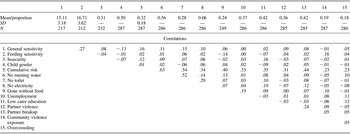
Descriptive statistics and correlations for main independent variables

Note: Child gender, 0 = male, 1 = female; insecurity, 0 = secure, 1 = insecure. Variables 3–14 are binary, and proportions are reported.
Cortisol reactivity: TSST
For the TSST procedure, participants (who had not eaten or drunk anything in the last hour) were first asked to provide a saliva sample by directly filling a 2-ml plastic sampling device (SaliCap) or using a short plastic straw to do so. They were told that they would be given 3 min to prepare a 5-min speech on anything about themselves. Then they would be led to a room in an adjacent building where they would deliver their speech to an audience. In the second room, two white-coated adult examiners sat behind a table. A video camera was positioned on the side wall focused at head height above the spot in front of the desk where the participant was told to stand. A 24-in. monitor screen displaying the image of the participant being captured by the camera was positioned about a meter away and slightly ahead in the participant's upper left visual field. Participants were instructed to begin speaking immediately and that they would be told when to stop after 5 min had elapsed. After the speech, one of the examiners administered a serial sevens subtraction task. This was maintained for 4 min without any intervention or responses from the examiners, regardless of how well the participant was performing. After 4 min the research assistant entered the room and led the participant to the next room, where a second saliva sample was collected. Participants were then told that the task was over, and they returned to the first room to commence a structured interview unrelated to the TSST. For the next 50 min the interview was interrupted every 10 min to collect a saliva sample. The seven prelabeled salicaps were bagged and stored in a conventional deep-freeze (–4 °C) until they were batched and shipped on dry ice to the lab in Germany for cortisol assay.
Cortisol assays
Salivary cortisol samples were prepared for biochemical analysis by centrifuging at 2000 × g for 5 min, which resulted in a clear supernatant of low viscosity. Cortisol concentrations were determined by a commercially available chemiluminescence immunoassay (IBL Hamburg, Germany) at the Technical University of Dresden. Inter- and intraassay coefficients of variation were both under 8%. Five individual observations (not whole cases) were excluded as biologically implausible due to extremely high readings.
Analysis
Multilevel/linear mixed models were used to test the trajectory of cortisol concentration over time. Multilevel modeling provides a flexible set of methods for estimating clustered and longitudinal data, which captures fixed effects and intraindividual (Level 1) variability in baseline levels and slopes over time (Boyle & Willms, Reference Boyle and Willms2001). We modeled the cortisol response profile using polynomial functions to describe the change in cortisol over time, including terms for the intercept (the baseline level), linear, quadratic, and cubic trends. The effects were then modeled as a function of Level 2 variables (across individuals), such as attachment and parental sensitivity. These cross-level interactions allowed us to test whether, for example, the linear increase in cortisol over time varied as a function of attachment security, gender, adversity, or their interaction. The patterning of cross-level interactions, where significant, was explored using plots of estimated marginal means (i.e., model-based predictions) and tests of simple slopes. The order of analyses proceeded as follows. We began by testing effects of security and sensitivity on the intercept and slopes (in separate analyses), including Predictor × Gender interactions. We then tested the role of cumulative adversity on cortisol reactivity, and tested whether including such effects reduced or eliminated effects of security and sensitivity. Finally, we tested the hypothesis that attachment and sensitivity might moderate the effects of cumulative adversity on cortisol reactivity by testing Attachment/Sensitivity × Cumulative Adversity interactions, as well as the three-way interaction involving gender. In all cases, we conducted sensitivity analyses to check that the results were robust. All analyses were conducted using the XTMIXED procedure in STATA Version 14.
Results
Descriptive statistics
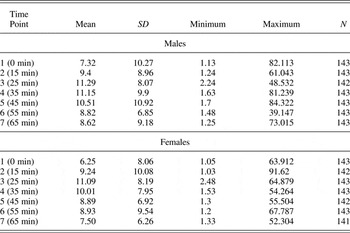
The summary statistics for the main independent variables in this report, including the overall cumulative risk measure and the individual indicators comprising it, are presented in Table 1. Before conducting the main analyses, we also examined the distribution of the cortisol data for the whole sample and conducted initial hierarchical linear modeling analyses to establish the base model for later hypothesis testing. The relevant summary statistics are shown below in Table 2.
Summary statistics for salivary cortisol concentration by gender
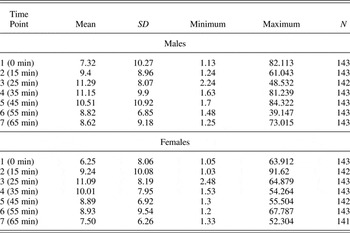
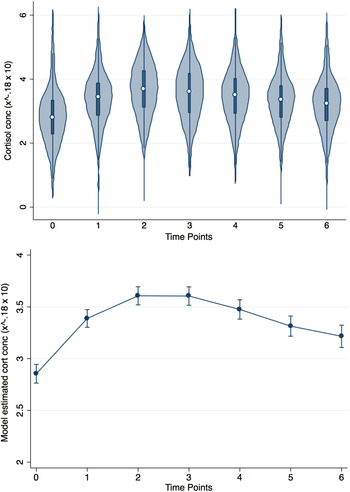
The data were negatively skewed, as is typical of cortisol measurements. Maximum likelihood Box–Cox estimates indicated an optimal normalizing transformation of x –0.18. For ease of interpretation, the resulting transformed data were multiplied by a factor of 10, so that the data fell in the range of –0.006 to 6.70 (mean = 3.35, SD = 0.90). The distribution of the transformed cortisol measurements over time, and their estimated kernel density at each time point, are shown in Figure 1 as violin plots.
(Color online) Violin plots and hierarchical linear modeling growth curve estimates for transformed cortisol data.

The upper panel of Figure 1 clearly indicates curvilinear change with time, with a peak occurring around time points 3 and 4 (~10 and 20 min after the end of the TSST) and a gradual recovery thereafter. Hierarchical linear modeling of the transformed cortisol data confirmed the existence of linear, quadratic, and cubic trends: linear B = 0.72, p < .001, 95% confidence interval (CI) [0.66, 0.79]; quadratic B = –0.20, p < .001, 95% CI [–0.23, –0.18]; cubic B = 0.016, p < .001, 95% CI [0.013, 0.019]. Tests of random effects variance components indicated significant random variation in the linear, SD = 0.091, 95% CI [0.077, 0.101], but not quadratic or cubic slopes. Variance in the intercept was significantly negatively correlated with variance in the linear slope, r = –.30, 95% CI [–0.43, –0.16].
Effects of the caregiving environment: Maternal sensitivity and attachment security
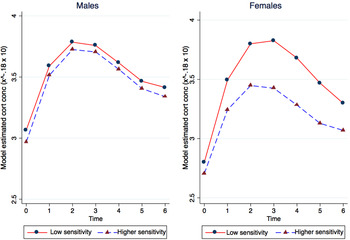
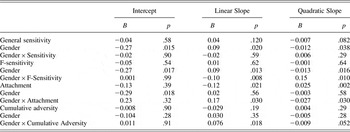
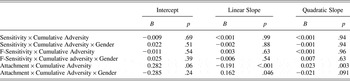
To test for the main effects of the early care indicators on stress response, we ran separate HLM models for maternal sensitivity and attachment respectively, in each case including gender main effects and Gender × Early Care interactions in relation to the cortisol intercept and linear and quadratic slopes. Because of the complexity of interpreting interactions involving cubic slopes, interactions involving the cubic slope were omitted from the model. The results are provided in Table 3. General maternal sensitivity showed little evidence of association with cortisol response (linear and quadratic slope), alone or interaction with gender. However, there was some evidence that sensitivity during feeding interactions was associated with cortisol response. Significant effects of feeding sensitivity were found on the linear and quadratic slopes of the cortisol curves, which were moderated by Gender × Sensitivity interactions. To explore the interaction, we plotted the model-based predicted cortisol concentration at ±1 SD on the feeding sensitivity scale for males and females separately. The results are shown in Figure 2. As the plot indicates, for females, but not for males, low maternal sensitivity during early feeding interactions was associated with sharper cortisol peak responses. Consistent with this, the effect of sensitivity on the linear and quadratic slopes were both significant for females, linear B = –0.09, p = .001, 95% CI [–0.15, –0.04]; quadratic B = 0.013, p = .002, 95% CI [0.005, 0.022], but not for males, linear B = –0.013, p = .62, 95% CI [–0.03, 0.07]; quadratic B = –0.002, p = .64, 95% CI [–0.009, 0.006].
(Color online) Cortisol response as a function of gender and maternal sensitivity during feeding at 6 months.

Hierarchical linear modeling growth curve analyses of cortisol response in relation to sensitivity, attachment, and cumulative adversity, by gender

Note: Male gender is the reference category. General sensitivity, sensitivity during free play observation; F-sensitivity, sensitivity observed during feeding interaction.
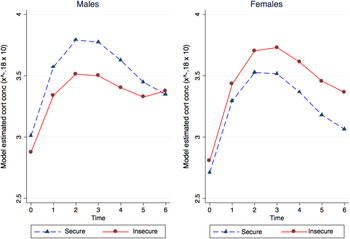
The analyses also revealed significant effects of attachment security, with significant effects on both the intercept and slope. Again there was evidence of moderation by gender. Predicted cortisol concentrations for teenagers with histories of secure and insecure infant attachment are provided in Figure 3 separately by gender. Inspection of Figure 3 suggests that for males, secure attachment was associated with a larger cortisol response compared to the insecure males, whose response was relatively flat. Some differences were also apparent for females, with a stronger cortisol response for insecure females than secure ones. However, although the effect of security was significant for males, linear B = –0.12, p = .021, 95% CI [–0.22, –0.18]; quadratic B = 0.024, p = .002, 95% CI [0.009, 0.040], it was not for females, linear B = 0.045, p = .41, 95% CI [–0.06, 0.16]; quadratic B = –0.001, p = .83, 95% CI [–0.018, 0.014].
(Color online) Cortisol response as a function attachment security and gender.

We conducted an additional analysis to test whether the finding regarding sensitivity during feeding was independent of the effects of attachment security. Entering these variables simultaneously, alongside their respective gender interactions, left the effects reported previously essentially intact. One exception to this was the Attachment × Gender interactions on the cortisol slopes, which were no longer significant, although the main effect of attachment on both linear and quadratic slopes remained, linear B = –0.18, 95% CI [–0.30, –0.060], p = .005; quadratic B = 0.034, 95% CI [0.015, 0.052], p < .001.
Cumulative contextual adversity
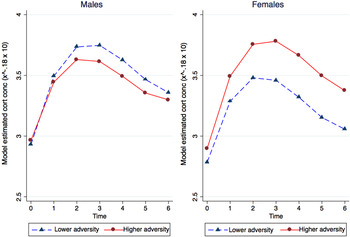
The cortisol data were then subjected to additional hierarchical linear modeling with cumulative adversity as a predictor of the intercept and slope, as well as Gender × Cumulative Adversity interactions (see Table 3). These analyses revealed no effects of adversity (as main effect or in interaction with gender) on the intercept. However, there was evidence of an effect of adversity on the linear, B = –0.048, 95% CI [–0.090, –0.005], p = .029, and quadratic, B = 0.007, 95% CI [0.0001, 0.013], p = .044, slopes, as well as Gender × Cumulative Adversity interactions for the linear, B = 0.100, 95% CI [0.036, 0.164], p = .002, and quadratic, B = –0.013, 95% CI [–0.022, –0.003], p = .052, slopes. As Figure 4 shows, for females there was a stronger (linear) increase in cortisol response for those with high levels of adversity compared to those with lower adversity, linear B = 0.053, 95% CI [0.005, 0.100], p = .030; quadratic B = –0.006, 95% CI [–0.013, 0.001], p = .106. In contrast, for males, the effects of adversity on the linear, B = –0.048, 95% CI [–0.090, –0.005], p = .029, and quadratic, B = 0.007, 95% CI [0.0002, 0.013], p = .044, slopes were in the opposite direction. When the terms from this model were included in the earlier model testing effects of attachment and gender, the results reported previously for attachment were not substantively changed (statistics not shown). The same was true for the analysis of maternal sensitivity during feeding and gender. Cumulative adversity was not significantly correlated with attachment security (r = .12, p = .06) or feeding sensitivity (r = –.015, p = .81).
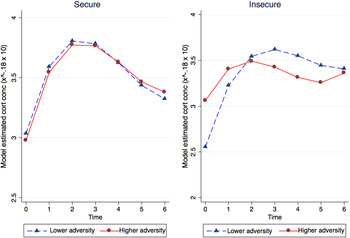
Next, we tested whether attachment security might moderate the relationship between adversity and cortisol reactivity, also including potential gender-specific effects (i.e., gender interactions). Significant interactions were found between attachment and cumulative adversity for both the linear and quadratic slopes (Table 4). Although the three-way interactions with gender were only marginally significant, it was notable that the Attachment × Adversity interactions were only significant for boys, linear B = –0.19, 95% CI [–0.29, –0.09], p < .001; quadratic B = 0.023, 95% CI [0.007, 0.038], p = .003, and not girls, linear B = –0.028, 95% CI [–0.15, 0.100], p = .58; quadratic B = –0.002, 95% CI [–0.017, 0.020], p = .86. The estimated cortisol concentrations by attachment security and cumulative adversity are shown in Figure 5, estimated for the males. The chart suggests that, under conditions of high adversity, insecure (but not secure) boys showed a relatively high baseline and flattened cortisol curve. There were no significant effects of maternal sensitivity.
(Color online) Estimated cortisol concentrations as a function of cumulative adversity and gender.

(Color online) Estimated cortisol concentrations as a function of cumulative adversity and attachment security, estimated for males.

Sensitivity analyses: Testing the robustness of results
We ran a series of checks to explore the extent to which the results we observed might be robust, by examining the possible impact of influential cases. We focused on the analyses from the earlier sections where significant effects had been found: namely, the feeding sensitivity main effect and gender interaction, the attachment main effect and gender interaction, and the two- and three-way interactions between attachment, cumulative adversity, and gender.
First, rerunning the models after observations with standardized residuals >±2 had been excluded led to comparable results to those reported in Tables 3 and 4, and none of the results was changed substantively, although the trend-level gender interactions involving attachment and cumulative adversity in Table 4 became clearly significant, linear B = 0.22, 95% CI [0.084, ~0.35], p = .001; quadratic B = –0.032, 95% CI [–0.051, ~ –0.013], p = .001. Second, rerunning the models removing cases with high leverage (>3 SD on DFBeta) on any model parameter also did not substantively change the results (in most cases the pertinent parameters increased in magnitude and p values reduced). Third, we also reran the models using ordinal mixed models, with the cortisol measurements collapsed into both eight and five equally sized bins. In both cases (i.e., using the eight- or five-level ordinal variables), the substantive effects reported previously remained the same.
Hierarchical linear modeling growth curve analyses of cortisol response in relation to Early Care × Cumulative Adversity interactions, by gender

Note: F-sensitivity, sensitivity observed during feeding interaction.
Discussion
This paper presents data from a longitudinal study on early caregiving and biological stress responsivity in adolescence, undertaken in the context of urban poverty in South Africa. Remarkably little research has been conducted on the effects of stress in LMIC, where the great majority of the global burden of chronic childhood adversity is experienced. The current study is the first to investigate the connections between the quality of parental caregiving and attachment security in infancy and long-term physiological reactivity in a LMIC. On the basis of a sizable body of animal research and predominantly correlational studies with humans (although see McLaughlin et al., Reference McLaughlin, Sheridan, Tibu, Fox, Zeanah and Nelson III2015), we hypothesized that security of attachment and sensitive and responsive maternal care in early development would be associated with long-term changes in cortisol reactivity in early adolescence. In addition to this “main effect” hypothesis, we also examined the extent to which early care effects on cortisol reactivity operated differentially as a function of gender, and whether early care moderated the impact of contextual adversity on stress function.
The results of the study provided some support for these hypotheses. Thus, while we found no evidence that maternal sensitivity as assessed at 6 months of age during a free play interaction was associated with cortisol reactivity, sensitivity observed during feeding was. Specifically, for girls, though not for boys, insensitive interactions were linked to heightened cortisol response during the TSST in adolescence. Security of attachment in infancy was also associated with HPA reactivity at age 13 years. In this case, however, the picture was rather different: insecure attachment was linked to a smaller increase in cortisol during stress relative to secure attachment. In addition, in contrast to the sensitivity findings, in the case of attachment, it was boys, not girls, who seemed most affected: insecure males in particular seemed to show a reduced cortisol response to the TSST.
These distinctive findings for sensitivity and security of attachment were not anticipated and should therefore be treated with caution. Nevertheless, the findings are notable, and may suggest that these two indicators of early care are tapping into distinctive mechanisms in the development of the HPA axis. Certainly, there is consistent evidence that sensitivity and security of attachment share only modest variance (De Wolff & van IJzendoorn, Reference De Wolff and van IJzendoorn1997). Furthermore, the well-known and repeatedly replicated observation that sensitivity does not account for a large proportion of the intergenerational transmission of attachment (van IJzendoorn, Reference van IJzendoorn1995; Verhage et al., Reference Verhage, Schuengel, Madigan, Fearon, Oosterman, Cassibba and van IJzendoorn2016) underlines the fact that attachment security involves mechanisms that are not reducible to sensitivity. Not only did we find no correlation between sensitivity and attachment in this sample, but also their opposing direction of effects in relation to HPA activity suggests that they may be linked to quite dissociable mechanisms.
The community that took part in this study were living in highly challenging circumstances, characterized by poverty, poor housing, high levels of community violence, and poor standards of education and employment. Nevertheless, even within this highly impoverished settlement, there was a considerable range of adversity. When we analyzed the cortisol data in relation to a measure of cumulative adversity, derived from 10 different indicators, we found that a high level of adversity was associated with heightened cortisol reactivity, an effect that was restricted to girls. Furthermore, when we tested the hypothesis that positive indicators of early care might buffer the effects of cumulative adversity on cortisol reactivity, we found evidence of this in the case of attachment, but not for either measure of sensitivity. For adolescents who had been classified as secure in infancy, cumulative adversity had no association with cortisol reactivity. In contrast, among adolescents who had been insecure as infants there was a marked association, with high levels of adversity being linked to a particularly flat cortisol response to the TSST. This pattern tended to be most marked for males, although the gender interaction was only marginally significant.
Our findings are thus broadly consistent with the overall hypothesis that stress reactivity in the HPA axis is influenced by early caregiving, and that a secure relationship may buffer the developing stress system from the impact of contextual stressors. The findings regarding attachment in particular are remarkably consistent with the results of the foster care intervention study by McLaughlin et al. (Reference McLaughlin, Sheridan, Tibu, Fox, Zeanah and Nelson III2015). The specific findings were also in line with some nonintervention studies on attachment (e.g., Burgess et al., Reference Burgess, Marshall, Rubin and Fox2003), and sensitivity (e.g., Sturge-Apple et al., Reference Sturge-Apple, Davies, Cicchetti and Manning2012), although variability in the results and designs of past studies makes such direct comparisons difficult. Several factors could contribute to the mixed results of these previous studies. One potentially influential factor is methodological: the majority of existing studies have used stressors that only weakly or inconsistently produce a measurable cortisol response, which may explain why some studies failed to identify associations, or found them to be dependent on third factors such as temperament. In contrast, the current study employed a well-validated stressor, the TSST, which presents participants with one of the two robust conditions for activating the HPA system: social-evaluative stress (the other being uncontrollability; see Dickerson & Kemeny, Reference Dickerson and Kemeny2004). Another possibility concerns the age group we studied. There is considerable evidence that cortisol responses are more difficult to activate in children under ages 4–5 years. In our study, substantial changes in cortisol response were observed, mirroring many other studies using the same procedure with older groups of children and adults.
Our findings provide some support for Del Guidice et al.’s (2011) adaptive calibration model of individual differences in stress responsivity. These authors argue that variation across individuals in the responsiveness of the stress system reflects conditional adaptations designed to maximize survival and reproductive fitness. Based on life-history theory, Del Guidice et al. contend that during early development, the stress system is sensitive to variables in the environment indicative of high mortality, low resource availability and unpredictability, and that the system undergoes a process of calibration to prepare the organism for these likely long-run conditions. At high levels of adversity/unpredictability, they argue, the stress system is optimized to be highly responsive, so that rapid flight–fight responses can be mobilized efficiently. At the same time, resource-rich or supportive contexts may also lead to a relative lowering of the threshold for activation in the stress system because this enhances learning and maximizes capacity to extract benefits from the environment. Intermediate levels of stress lead to a lowering of the responsiveness of the stress system because the energetic costs of a strongly responsive, readily activated biological state start to outweigh the benefits that can be extracted from the environment. Finally, these authors also argue that in extremely adverse contexts, the stress system is downregulated again, becoming very insensitive, because survival in this context depends on very low sensitivity to cues of threat or risk. The authors suggest that this downregulation of the stress system in conditions of extreme adversity may be particularly characteristic of strategies adopted by males, who are more likely to engage in risk-taking, competitive, or aggressive behavior in these circumstances. Females, by comparison, are expected to show increasing cortisol reactivity in such circumstances. Our observation that early attachment insecurity was associated with blunted cortisol responses in males, which may even be accentuated in conditions of more extreme social adversity, seems to fit well with this model. Furthermore, the heightened cortisol responses we observed in females living in conditions of high adversity and who had experienced insensitive early care also seems consistent with the gender-differentiated pathways suggested by Del Guidice et al.
Limitations
There are several limitations to this study that are important to keep in mind. The findings, though longitudinal in nature, are intrinsically correlational, and we therefore have no strong basis for inferring causation. Cross-lagged longitudinal studies and experimental trials would be extremely valuable in addressing those issues more robustly in future research. In addition, a significant period of time had elapsed between the early care assessments undertaken at 18 months and the 13-year follow-up, and we have limited information about stability and change in family circumstances during the intervening period, particularly the quality of care. This means that we cannot establish whether the findings we have reported are due to effects operating specifically in infancy or whether they reflect continuities in the caregiving environment beyond infancy. In addition, although the analyses we presented accounted for some relevant ancillary factors, we did not undertake exhaustive tests for potential confounders, and we cannot rule out the possibility that these could have contributed to the findings we have presented. The results reported herein should be free from bias caused by shared method variance, in the sense that all measures were obtained objectively and independently, as they were based on video records of maternal and child behavior in infancy, and biological assays of the stress response in adolescence. Nevertheless, we cannot exclude the possibility that other forms of bias (such as nonignorable missing data) could have influenced the results. A further limitation is that we cannot determine the extent to which the cortisol reactivity we observed in the TSST is generalizable to other kinds of stressors or to situations outside of the laboratory.
Conclusion
The first 2 years of life are thought to be a key phase, and possibly a sensitive period, in the development of stress response systems, and converging evidence suggests that during this time the quality of care may play an important role in shaping the long-term responsivity of the HPA axis. Only a handful of studies (Roisman et al., Reference Roisman, Susman, Barnett-Walker, Booth-LaForce, Owen and Belsky2009; Spangler & Zimmermann, Reference Spangler and Zimmermann2014) have examined these hypotheses using long-term prospective follow-up studies, and fewer still in the context of extreme adversity in LMIC settings. The results of our study, though in need of replication, provide further evidence that early caregiving may be implicated in HPA axis development into adolescence and in buffering the HPA axis from the effects of chronic and extreme adversity.