Introduction
Nowadays, more than half of cancer patients can be treated successfully and become long-term survivors (Miller et al. Reference Miller, Siegel, Lin, Mariotto, Kramer, Rowland, Stein, Alteri and Jemal2016). Cancer survivors are at increased risk for psychological distress (Hoffman et al. Reference Hoffman, McCarthy, Recklitis and Ng2009) and of the struggle with unmet psychological needs (Thewes et al. Reference Thewes, Butow, Girgis and Pendlebury2004; Santin et al. Reference Santin, Murray, Prue, Gavin, Gormley and Donnelly2015).There is growing attention on the important role of sense of meaning in improving psychological well-being, and preventing or reducing psychological distress among cancer patients (LeMay & Wilson, Reference LeMay and Wilson2008). Up until now, research on meaning in cancer patients focused mostly on patients with advanced cancer, who might face death and meaning-related existential issues like demoralization and the desire for hastened death (McClain et al. Reference McClain, Rosenfeld and Breitbart2003; Lethborg et al. Reference Lethborg, Aranda, Cox and Kissane2007). However, sense of meaning is also an important issue in cancer survivors (Tomich & Helgeson, Reference Tomich and Helgeson2002; van der Spek et al. Reference van der Spek, Vos, van Uden-Kraan, Breitbart, Tollenaar, Cuijpers and Verdonck-de Leeuw2013). The cancer diagnosis and the treatment with curative intent often imply fundamental uncertainties that patients have to deal with. These include the possible recurrence of the cancer, or negative (long-term) side-effects of the treatment, and are often accompanied by losses in different domains of life (i.e. physical, social, personal), which can challenge the experience of meaning in life (Lee, Reference Lee2008; van der Spek et al. Reference van der Spek, Vos, van Uden-Kraan, Breitbart, Tollenaar, Cuijpers and Verdonck-de Leeuw2013). According to Frankl (1955, 1959), suffering can trigger a need for meaning, and also an opportunity for growth and meaning. Breitbart & Poppito (Reference Breitbart and Poppito2014) describe that after the diagnosis of a potentially deadly illness like cancer ‘either one has a loss of sense of meaning and purpose in life, or one has sustained or even heightened sense of meaning, purpose, and peace, which allows one to value more profoundly the time remaining and positively appraise events’. Patients who experience more meaning have higher psychological well-being, a more successful adjustment, better quality of life, and less psychological distress after the cancer diagnosis, than patients who experience little meaning in life (Zika & Chamberlain, Reference Zika and Chamberlain1992; Jaarsma et al. Reference Jaarsma, Pool, Ranchor and Sanderman2007; Park et al. Reference Park, Edomondson, Fenster and Blank2008).
Breitbart et al. (Reference Breitbart, Rosenfeld, Pessin, Applebaum, Kulikowski and Lichtenthal2015) developed and evaluated meaning-centered group psychotherapy (MCGP), in order to meet the needs of patients with advanced cancer to help with meaning-making, improving spiritual well-being and reducing psychological distress. In a randomized controlled trial (RCT) among 273 patients with advanced cancer, MCGP was compared with supportive group psychotherapy (SGP) (Breitbart et al. Reference Breitbart, Rosenfeld, Pessin, Applebaum, Kulikowski and Lichtenthal2015). After controlling for gender, social support, religiosity and cognitive functioning, intention-to-treat analyses showed significant positive effects of MCGP on spiritual well-being, quality of life, hopelessness, depression, and desire for hastened death immediately after the intervention and at 2 months follow-up (FU), with small to moderate effect sizes (−0.27 to −0.67).
Besides MCGP there are several other interventions that focus, at least partly, on sense of meaning in advanced cancer patients and that show varying degrees of positive effects (Yalom & Greaves, Reference Yalom and Greaves1977; Spiegel & Spira, Reference Spiegel and Spira1991; Kissane et al. Reference Kissane, Bloch, Smith, Miach, Clarke, Ikin, Love, Ranieri and McKenzie2003; Lee et al. Reference Lee, Cohen, Edgar, Laizner and Gagnon2006; LeMay & Wilson, Reference LeMay and Wilson2008; Chochinov et al. Reference Chochinov, Kristjanson, Breitbart, McClement, Hack, Hassard and Harlos2011). To our knowledge there are no evidence-based meaning-focused interventions specifically targeting cancer survivors treated with curative intent.
We adjusted the MCGP manual for cancer survivors (MCGP-CS) and subsequently conducted a feasibility study, which showed good acceptability, compliance and satisfaction of MCGP among cancer survivors (van der Spek et al. Reference van der Spek, Vos, van Uden-Kraan, Breitbart, Cuijpers, Knipscheer-Kuipers, Willemsen, Tollenaar, van Asperen and Verdonck-de Leeuw2014a ).
The aim of the present study was to assess the efficacy of MCGP-CS among cancer survivors to improve personal meaning. Based on earlier studies (Zika & Chamberlain, Reference Zika and Chamberlain1992; Lee et al. Reference Lee, Cohen, Edgar, Laizner and Gagnon2006; Jaarsma et al. Reference Jaarsma, Pool, Ranchor and Sanderman2007; LeMay & Wilson, Reference LeMay and Wilson2008; Breitbart et al. Reference Breitbart, Rosenfeld, Pessin, Applebaum, Kulikowski and Lichtenthal2015) we also expected a positive effect of MCGP-CS on psychological well-being, post-traumatic growth (PTG), adjustment to cancer, optimism and quality of life. Moreover, we expected MCGP-CS to reduce hopelessness and psychological distress. In this RCT, MCGP-CS was compared with SGP and with care as usual (CAU) to investigate the value of group psychotherapy, specifically focusing on personal meaning compared with regular SGP and with standard care. We specifically expected that MCGP-CS would at least perform better than SGP on personal meaning. Efficacy was evaluated post-intervention and at 3 and 6 months FU, to obtain insight into a possible decay of the effect.
Method
Study design and population
This study was a multi-center RCT with three study arms. The methods of this study have been described in a previously published study protocol (van der Spek, et al. Reference van der Spek, Vos, van Uden-Kraan, Breitbart, Cuijpers, Knipscheer-Kuipers, Willemsen, Tollenaar, van Asperen and Verdonck-de Leeuw2014b ). The study protocol was approved by the Medical Ethics Committee of the Leiden University Medical Center and the trial was registered in the Netherlands Trial Register (NTR3571).
Eligible participants were adult cancer survivors who were diagnosed in the last 5 years, who were treated with curative intent, and who had completed their main treatment (i.e. surgery, radiotherapy, chemotherapy). Participants had to have an expressed need for psychological care and at least one psychosocial complaint (e.g. depressed mood, anxiety, coping issues, life questions, meaning-making problems, relationship problems).
Participants were excluded if they suffered from severe cognitive impairment, had current psychological treatment, or insufficient mastery of the Dutch language. The criteria were ascertained during a telephone interview by a trained psychologist (K.H.).
Cancer survivors were recruited between August 2012 and September 2014 via four hospitals and via public media (i.e. advertisements on websites of patient societies, and in magazines and local newspapers). Cancer survivors were informed about the study, and asked to respond if they were interested in participating. The cancer survivors who signed the informed consent were randomized into one of the three study arms: MCGP-CS, SGP and CAU. All participants provided written informed consent.
Interventions
MCGP-CS
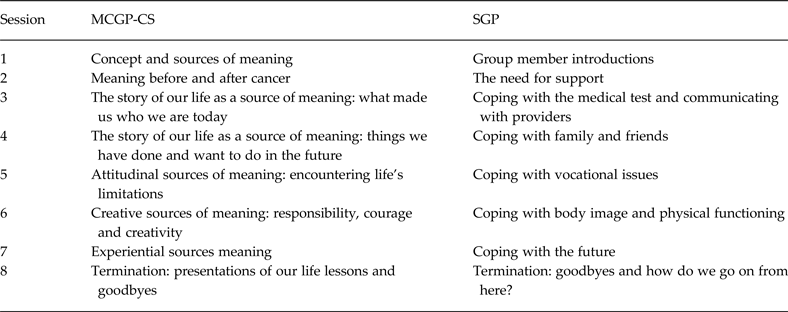
The main purpose of MCGP-CS is to sustain or enhance a sense of meaning or purpose in a patient's life, in order to cope better with the consequences of cancer. Theoretically, enhanced meaning is considered to be the catalyst of positive psychological outcomes. MCGP-CS is an adaptation of MCGP for advanced cancer patients. MCGP was developed based on the work on meaning-making of Viktor Frankl (Frankl, Reference Frankl1986, Reference Frankl1998), and influenced by the existential work of Yalom (Reference Yalom1980); Chochinov et al. (Reference Chochinov, Kristjanson, Breitbart, McClement, Hack, Hassard and Harlos2011) and Kissane et al. (Reference Kissane, Bloch, Smith, Miach, Clarke, Ikin, Love, Ranieri and McKenzie2003). Important existential concepts are incorporated in the theoretical framework of MCGP, such as identity, freedom, existential guilt and existential isolation. A more comprehensive description of MCGP has been published elsewhere (Breitbart, Reference Breitbart2002; Breitbart & Poppito, Reference Breitbart and Poppito2014; Breitbart et al. Reference Breitbart, Rosenfeld, Pessin, Applebaum, Kulikowski and Lichtenthal2015). The adaptations concerned the use of different terminologies and topics more relevant for survivors. For instance, the topic ‘a good and meaningful death’ was replaced by the topic ‘carrying on in life despite limitations’. Also, brief mindfulness exercises were added, to help participants with introspection before each group exercise. MCGP-CS is a manualized 8-week intervention that makes use of didactics, group discussions and experimental exercises that focus around themes related to meaning and cancer survivorship. The sessions lasted 2 h each and were held weekly. The participants used a workbook (called Life lessons portfolio) and completed homework assignments every week. MCGP-CS was led by a psychotherapist with considerable experience in treating patients with cancer. The psychotherapists partaking in this study were trained in MCGP-CS during a pilot study (van der Spek et al. Reference van der Spek, van Uden-Kraan, Vos, Breitbart, Tollenaar, van Asperen, Cuijpers and Verdonck-de Leeuw2014a ). Each session addressed a theme related to the concepts and sources of meaning (Table 1).
Session topics covered in MCGP-CS and SGP

MCGP-CS, Meaning-centered group psychotherapy for cancer survivors; SGP, supportive group psychotherapy.
SGP
SGP is an 8-week social supportive group therapy following Payne et al. (Reference Payne, Vroom and Phil2009). The sessions lasted 2 h and were held weekly. Each group was supervised by a psychotherapist with considerable experience in treating patients with cancer. In SGP no specific attention is paid to meaning. The psychotherapists were trained to avoid group discussions on meaning-related topics. The psychotherapist has an unconditionally positive regard and empathetic understanding, stimulates patients to actively share their experiences, and focuses on positive emotions and expression of feelings. Each of the eight sessions had a different theme (Table 1).
CAU
Cancer survivors assigned to the CAU study arm did not participate in one of the group interventions. If a patient in the CAU study arm asked the researcher for psychological care, he or she was referred to their general practitioner. Health care uptake was monitored, to enable detailed post-hoc description of what CAU entailed.
There were two psychotherapists involved in this study, who facilitated MCGP-CS as well as SGP. In both treatment arms, the psychotherapist wrote a short summary of each session and noted whether the protocol was followed. All sessions were audiotaped, and randomly selected audio fragments were analysed by a researcher (N.v.d.S.) to establish whether the therapy protocol was followed correctly. During the trial, three evaluation sessions with the therapists were held in which they obtained feedback from each other and from the researchers (N.v.d.S. and I.M.V.-d.L.) on conducting the therapies according to the manuals, based on the summaries of the sessions and the analysis of the audio fragments. The therapy protocols of both MCGP-CS and SGP were followed accurately and meaning was barely discussed in SGP. Based on these analyses and evaluation, we concluded that treatment integrity was good.
Outcome measurement
The primary outcome was personal meaning; secondary outcomes were psychological well-being, PTG, adjustment to cancer, optimism, hopelessness, psychological distress (anxiety and depression) and global quality of life. Outcome measures were collected at baseline before the intervention was scheduled and before randomization (T0), with FU assessments 1 week post-intervention (T1) and after 3 (T2) and 6 (T3) months FU.
The primary outcome measure was Personal Meaning Profile-Dutch Version (PMP-DV) (total score) (Jaarsma et al. Reference Jaarsma, Pool, Ranchor and Sanderman2007).
Secondary outcome measures were: subscales of PMP (relation to God/higher order, dedication to life, fairness of life, goal-orientedness, and relations with others), Ryff's Scales of Psychological Well-being (SPWB) (no total score available; eight subscales of positive relations, autonomy, environmental mastery, personal growth, purpose in life, self-acceptance, inner strength, and higher power) (van Dierendonck, Reference van Dierendonck2004); Posttraumatic Growth Inventory (PTGI) (total score) (Jaarsma & Pool, Reference Jaarsma and Pool2003); Mental Adjustment to Cancer (MAC) (no total score available; five subscales of fighting spirit, helpless/hopeless, anxious preoccupation, fatalism, and avoidance) (Watson et al. Reference Watson, Greer, Young, Inayat, Burgess and Robertson1988); Life Orientation Test-Revised (LOT-R) (total score) (ten Klooster et al. Reference ten Klooster, Weekers, Eggelmeijers, Van Woerkom, Drossaert, Taal, Baneke and Rasker2010); Beck's Hopelessness Scale (BHS) (total score) (Young et al. Reference Young, Halper, Clark, Scheftner and Fawcett1992), Hospital Anxiety and Depression Scale (HADS) (total score, and subscales of anxiety and depression) (Spinhoven, Reference Spinhoven1997); and the European Organization for Research and Treatment of Cancer Quality of Life Questionnaire (EORTC QLQ-C30) version 3.0 (global quality of life subscale) (Fayers & Bottomley, Reference Fayers and Bottomley2002).
A study-specific questionnaire at baseline comprised questions about sociodemographic factors (i.e. age, gender, religious background, marital status, household composition, education level, history of psychological treatment, other important negative life events in the past 2 years). Clinical characteristics (i.e. type of cancer, cancer treatment, time since diagnosis) of the patients recruited in hospitals were retrieved from the hospital information system; the clinical characteristics of patients recruited via public media were obtained from self-reports.
Sample size
Based on a priori power analyses for hierarchical multiple regression, assuming a power of 0.80, Cohen's d of 0.80 and α of 0.05, each study condition needed at least 43 cancer survivors. We anticipated a 30% loss for the FU, and therefore included 56 cancer survivors per condition at baseline.
Randomization and blinding
This was a three-arm RCT study with block randomization. A computer-generated randomization table with random block sizes was prepared by an independent researcher not involved in the study. Participants were allocated to a group. When the group counted between seven and 10 survivors, the group was randomly assigned by the independent researcher, using a list of sequentially numbered allocations, to one of the three study arms. Participants and psychotherapists were aware of the allocated arm, whereas data managers were blinded to the allocation.
Statistical analyses
Descriptive statistics, analyses of variance, independent-samples t tests, Kruskal–Wallis tests and χ2 tests were used to determine whether patient characteristics (sociodemographic and clinical) were similar across experimental conditions. Missing values were excluded analysis by analysis. Results were reported on an intention-to-treat basis. Linear mixed models (LMM), with fixed effects for group, assessment and their two-way interaction, as well as a random intercept for randomization group and subjects (nested within the randomization group), were used to investigate differences in the course of the outcome measures between the three groups. Potential confounders were checked for all outcome measures and were added as fixed effects as well, in case they differed between experimental conditions. Post-hoc analyses were performed to assess which two groups differed significantly (via LMM) and at which points in time (via independent-samples t tests). Post-hoc analyses were corrected for multiple testing by Bonferroni's correction, and for the potential confounders that differed significantly between conditions. Effect sizes (Cohen's d) were calculated by dividing the difference in change since the baseline between groups by the pooled standard deviation, at the separate points in time (post-intervention, 3 months FU and 6 months FU). Effect sizes of 0.2 were categorized as small, 0.5 as medium and 0.8 as large (Cohen, Reference Cohen1977). For all analyses SPSS 20 was used; a p value < 0.05 was considered to indicate statistical significance.
Results
Study population
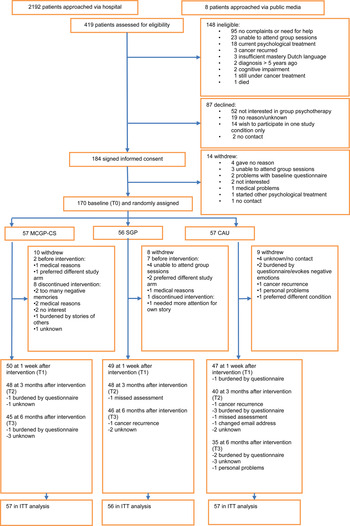
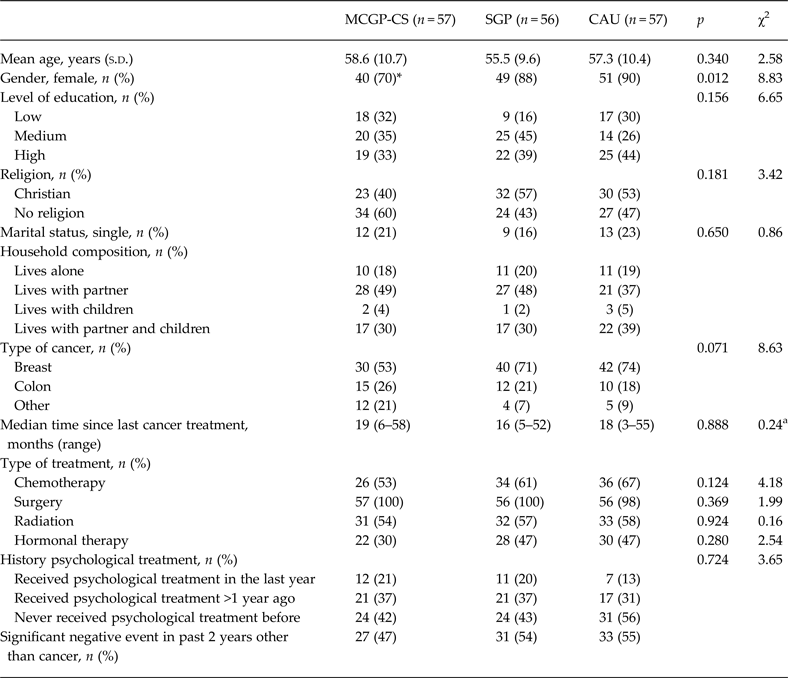
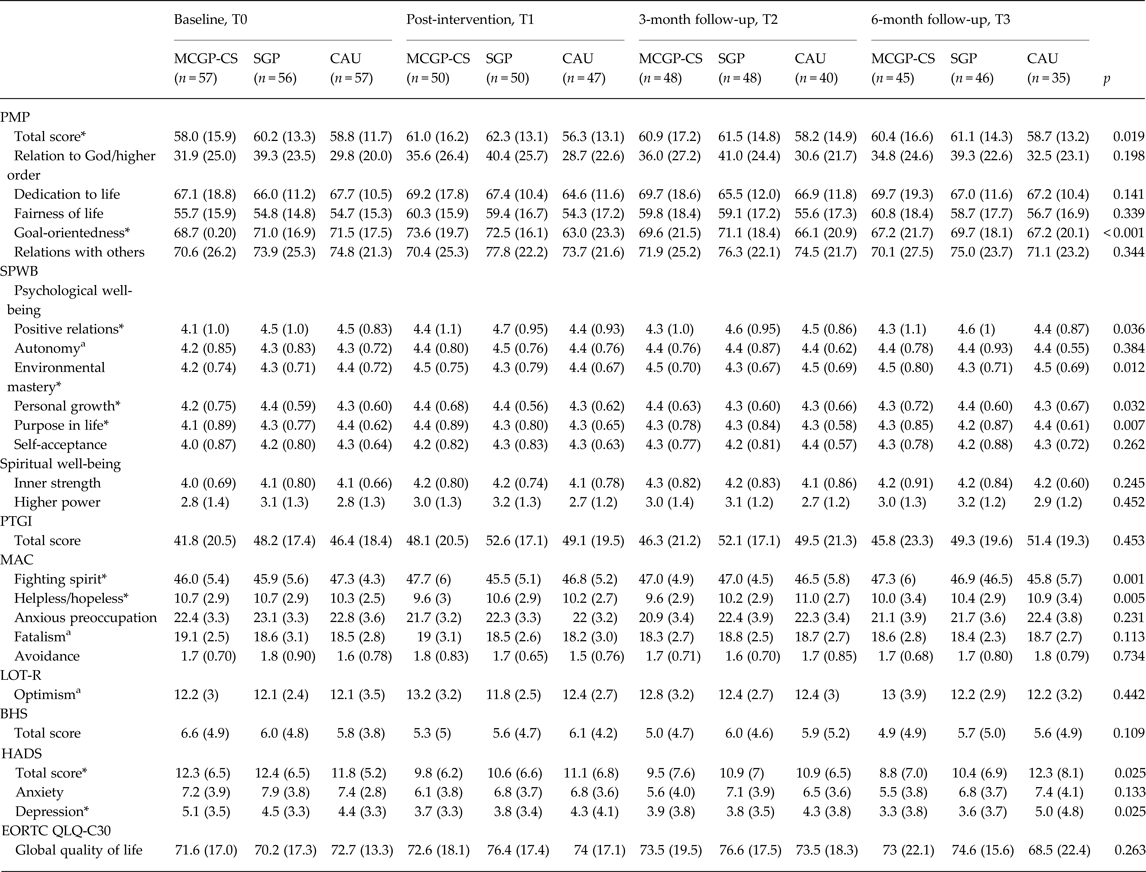
A total of 2192 cancer survivors were approached via their hospital to participate in this study. Of these patients, 411 (19%) applied for participation in response to this mailing (Fig. 1). Eight participants applied in response to the advertisement in public media. Of the 419 cancer survivors who were screened for eligibility, 148 were ineligible and 87 declined to participate. A total of 184 consented to participate. Of those, 170 participants (40 male, 130 female) completed the baseline questionnaire and were randomly assigned to MCGP-CS (n = 57), SGP (n = 56) or CAU (n = 57). Table 2 displays the sociodemographic and clinical characteristics of the study population. There was a significant difference with respect to gender between the three groups, with more males in the MCGP-CS condition. When comparing the outcome measures at baseline (see Table 3), there was a significant difference between the study arms on positive relations (MCGP-CS = 4.1, SGP = 4.5, CAU = 4.5, χ2 = 6.685, degrees of freedom = 2, p = 0.035).
Consolidated Standards of Reporting Trials (CONSORT) diagram. Meaning-centered group psychotherapy for cancer survivors (MCGP-CS), supportive group psychotherapy (SGP) and care as usual (CAU). ITT, Intention to treat. For a color figure, see the online version of the paper.

Participant characteristics

MCGP-CS, Meaning-centered group psychotherapy for cancer survivors; SGP, supportive group psychotherapy; CAU, care as usual; s.d., standard deviation.
a Kruskall–Wallis test.
* Significant difference between MCGP-CS and CAU.
Linear mixed models analysing treatment outcome

Data are given as mean (standard deviation).
MCGP-CS, Meaning-centered group psychotherapy for cancer survivors; SGP, supportive group psychotherapy; CAU, care as usual; PMP, Personal Meaning Profile; SPWB, Ryff's Scale of Psychological Well-being; PTGI, Posttraumatic Growth Inventory; MAC, Mental Adjustment to Cancer Scale; LOT-R, Life Orientation Test-Revised; BHS, Beck's Hopelessness Scale; HADS, Hospital Anxiety and Depression Scale; EORTC QLQ-30, European Organization for Research and Treatment of Cancer Quality of Life Questionnaire.
a Corrected for gender.
* p < 0.05.
In MCGP-CS, two participants (4%) never attended any group sessions, and in SGP seven participants (13%) never attended. In MCGP-CS, eight participants (14%) did not complete the intervention, mostly because the intervention differed from their expectations or because of medical reasons. In SGP, one participant discontinued (2%) due to lack of interest in the intervention. A total of 147 participants (86%) completed the assessment post-intervention, 136 (80%) the 3-month FU, and 126 (74%) the 6-month FU. In CAU, most participants received no additional psychosocial care during the study (93%), 7% received additional care (i.e. psychotherapy, self-help group, social work or spiritual counseling).
Efficacy of MCGP-CS
Table 3 shows the results of the LMM analysing outcome measures per time assessment. In these models, the random slope for randomization group was removed as the estimated variance of randomization group was zero. Significant differences (corrected for gender) between MCGP-CS, SGP and CAU were found on the course of personal meaning (total score PMP), and on secondary outcomes: subscale PMP (i.e. goal-orientedness), psychological well-being (SPWB) (i.e. positive relations, purpose in life, environmental mastery, personal growth), adjustment to cancer (MAC) (i.e. fighting spirit, helpless/hopeless) and psychological distress (HADS) (i.e. total score and depression). There were no significant differences between the three groups on the course of PTG (PTGI), optimism (LOT-R), hopelessness (BHS) or global quality of life (EORTC QLQ-C30) (Table 3).
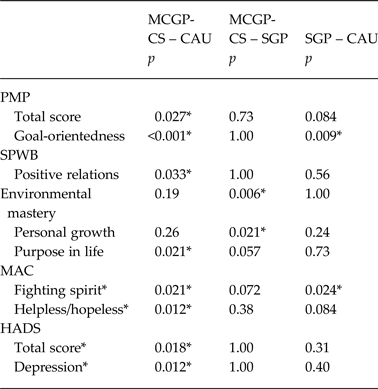
Post-hoc analyses showed significantly stronger treatment effects of MCGP-CS compared with CAU with respect to the course of personal meaning, goal-orientedness, positive relations, purpose in life, fighting spirit, helpless/hopeless, distress, depression, and significantly stronger effects of MCGP-CS compared with SGP for personal growth and environmental mastery (Table 4). Significantly stronger treatment effects of SGP compared with CAU were observed for goal-orientedness and fighting spirit.
Linear mixed model analyses: differences between two study arms

MCGP-CS, Meaning-centered group psychotherapy for cancer survivors; CAU, care as usual; SGP, supportive group psychotherapy; PMP, Personal Meaning Profile; SPWB, Ryff's Scale of Psychological Well-being; MAC, Mental Adjustment to Cancer Scale; HADS, Hospital Anxiety and Depression Scale.
* p < 0.05.
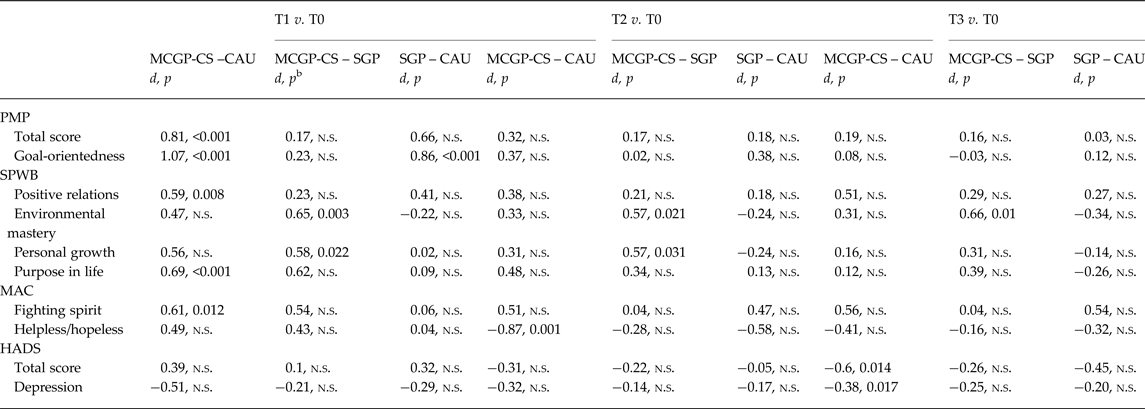
Table 5 shows treatment effects post-intervention, and at the FU after 3 and 6 months. When comparing MGCP-CS with CAU post-intervention, large effect sizes were found on the primary outcome measure personal meaning and secondary outcome goal-orientedness, and medium effect sizes on positive relations, purpose in life and fighting spirit. At the FU after 3 months, a large effect size was found on helpless/hopeless. At the FU after 6 months, a medium effect size was found on distress, and a small effect on depression (6 months FU). When comparing MCGP-CS with SGP, a medium effect size was found for personal growth (3 months FU) and environmental mastery (6 months FU). When comparing SGP with CAU, a large effect was observed for goal-orientedness (post-intervention).
Treatment effects post-intervention (T1), at 3-month (T2) and 6-month (T3) follow-up compared with baseline (T0) a

MCGP-CS, Meaning-centered group psychotherapy for cancer survivors; CAU, care as usual; SGP, supportive group psychotherapy; PMP, Personal Meaning Profile; n.s., non-significant; SPWB, Ryff's Scale of Psychological Well-being; MAC, Mental Adjustment to Cancer Scale; HADS, Hospital Anxiety and Depression Scale.
a Only those scales are shown with significant differences after linear mixed model analysis.
b d Corresponds to the between-group difference score of Cohen's d.
Discussion
This RCT provides evidence for the efficacy of MCGP-CS to improve personal meaning among cancer survivors. With respect to the secondary outcomes, support was found that MCGP-CS also improves goal-orientedness, psychological well-being and ad justment to cancer, and, furthermore, that it reduces psychological distress and depressive symptoms in cancer survivors in the long run, at 6 months after intervention.
The results of this study are in line with the results of a previous study on MCGP for cancer patients in the palliative phase (Breitbart et al. Reference Breitbart, Rosenfeld, Pessin, Applebaum, Kulikowski and Lichtenthal2015), showing that MCGP is not only beneficial for patients with advanced cancer, but also for survivors. Another new finding of the present study is that positive effects of MCGP-CS occurred not only shortly after the intervention but also in the longer term. Although the effect with respect to personal meaning, psychological well-being, and adjustment to cancer decayed, longer-term effects were found on environmental mastery, distress and depressive symptoms. Interestingly, the effect of MCGP-CS on distress and depressive symptoms did only occur at the long-term FU. An explanation may be that experiencing personal meaning or purpose after a search for meaning precedes a decrease in psychological distress, in accordance with Park's Meaning Making Model (Park, Reference Park2010). However, further research is needed to explore this finding.
MCGP-CS had no significant effect on PTG. Growth is considered a part of psychological well-being (Wong, Reference Wong2010); therefore it was hypothesized that MCGP-CS could improve PTG as well. However, recent empirical findings suggest that PTG is not related to psychological well-being (Zoellner et al. Reference Zoellner, Rabe, Karl and Maercker2011). This might explain why we did not find any effect on PTG. Interestingly, MCGP-CS did have an effect on personal growth. Whereas PTG entails growth that is specifically attributed to cancer as a traumatic event, narrowly focusing on the cancer experience, personal growth involves seeing oneself as developing through time and thereby realizing personal potential (van Dierendonck, Reference van Dierendonck2004), unrelated to cancer. It may be that MCGP-CS focuses on sense of meaning placed in a broader context of one's personal narrative, and thus addressed personal growth rather than PTG. Further (qualitative) research is needed to examine this effect of MCGP-CS on personal growth.
When compared with CAU, it is clear that MCGP-CS is efficacious in improving the primary outcome measure of personal meaning post-intervention. No differences were found on personal meaning when MCGP-CS and SGP were compared with each other directly; however, the analyses showed that on the primary outcome measure, only MCGP-CS was effective (as compared with CAU). With respect to secondary outcomes, several improvements were measured until the 6-month FU. MCGP-CS was equally effective compared with SGP on personal meaning, but more effective on personal growth and environmental mastery, also in the longer term. When compared with CAU, SGP only had a positive effect on goal-orientedness, and only post-intervention. These findings indicate that in comparison with CAU, MCGP-CS is more efficacious than SGP, which implicates that a meaning-focused approach is more successful than traditional SGP. Meaning-focused coping might be more effective than other coping strategies, in improving positive psychological outcomes, as well as symptom-related outcomes, possibly because it affects the identity of the patients, placing the disease in a broader context of their life's narrative and their personal meaning. Future research should look into the working mechanisms of meaning-focused coping and MCGP(-CS).
Important strengths of this study were the specific focus on cancer survivors, a large sample size with various types of cancer diagnoses, and high treatment adherence. Furthermore, a strength of MCGP-CS is that it was developed based on both theoretical and empirical knowledge, as well as on input from cancer survivors and clinical experts (van der Spek et al. Reference van der Spek, Vos, van Uden-Kraan, Breitbart, Cuijpers, Knipscheer-Kuipers, Willemsen, Tollenaar, van Asperen and Verdonck-de Leeuw2014b ). A limitation of this study was that no clear cut-off scores or minimal important difference (MID) criteria are available regarding the primary outcome measure of personal meaning, and the secondary outcome measures of psychological well-being and mental adjustment to cancer. Future research is needed to define cut-off scores and MIDs that may help to identify cancer survivors who might benefit most from MCGP-CS. Also, when interpreting the results of the LMM analyses of the secondary outcome measures, it should be borne in mind that the use of multiple comparisons might only have led to significant results by chance. There is no clear consensus on whether this should be corrected, and a correction might have led to less efficient estimates. Therefore we did not perform a correction, and for every 20 true null hypotheses we expect one to be falsely rejected (Gelman et al. Reference Gelman, Hill and Yajima2012). However, with respect to the post-hoc analyses, Bonferroni corrections were applied. Another limitation is that patients and therapists in the study could not be blinded which may have caused bias. Also, MCGP-CS and SGP were supervised by the same therapists; this incorporates a risk of bleed across conditions; however, no indication for this was found in the evaluation of treatment integrity. Finally, it is important to note that allegiance bias is a risk in this type of research (e.g. Leykin & DeRubeis, Reference Leykin and DeRubeis2009). However, several measures were taken to minimize this risk. For instance, the randomization was carried out by an independent researcher, using a random number table, and an independent researcher (B.I.W.) performed the first statistical analyses.
Despite the study limitations, this study provides evidence on the efficacy of MCGP-CS to improve personal meaning, psychological well-being and mental adjustment to cancer, and to reduce psychological distress and depressive symptoms in the long run. Given that dealing with the aftermath of cancer is both a psychological and an existential challenge for many survivors, an evidence-based intervention such as MCGP-CS, that addresses and successfully affects both these aspects, is an important addition to psycho-oncological health care.
Acknowledgements
This study was funded by the Dutch Cancer Society.
Declaration of Interest
None.