During the coronavirus disease 2019 (COVID-19) pandemic, several countries imposed social distancing and protective measures to break the infection chain. However, this would not work without the individuals’ changing their lifestyle practices. Reference Bacon and Corr1 This includes voluntary behaviors of reducing time in public or crowded places, a preference to stay at home, maintaining an adequate personal distance, and adopting personal hygiene practices.
In March 2020, the first case of COVID-19 was registered in Jordan. At that time, the Jordanian government has declared a state of emergency and obligated home confinement, quarantine periods, and movement restrictions. Reference Alqutob, Al Nsour and Tarawneh2 The Jordanian government used television broadcasting and social media posts to enhance awareness about behaviors that protect them from infection. However, Jordanians adoption of these behaviors during the pandemic may vary.
Currently, while Jordan is fighting against the third wave of COVID-19, people’s behavioral change remains the most effective strategy for disease prevention, even with vaccine availability and use. A recent study found that Jordanians had satisfactory practices to prevent contracting COVID-19 infection, including avoiding shaking hands, hugging, kissing, and crowded areas. Reference Elayeh, Aleidi and Ya’acoub3
Understanding protective behaviors within the Jordanian context would help us understand their concerns, provide appropriate advice, shape the health promotion campaigns, and guide decision-makers to facilitate the required resources and support to the citizens. The current study answered the following research questions:
-
1. What are the personal preventive measures and infection avoidance behaviors among Jordanians during the COVID-19 pandemic?
-
2. What are the differences in personal preventive measures and infection avoidance behaviors among Jordanians during the COVID-19 pandemic based on their demographic variables?
-
3. What are the predictors of adopting infection avoidance behaviors among Jordanians during the COVID-19 pandemic?
Methods
A cross-sectional descriptive design was used to collect data using an electronic questionnaire on Microsoft Forms. The sample was recruited conveniently according to the following criteria were: (1) Jordanian, (2) age more than 18 y, (3) comprehending written Arabic, and (4) willing to participate in the study.
This study was approved by the Scientific Research Committee at the School of Nursing, The University of Jordan. The participants were assured that they should freely participate without coercion and were reminded of their right to withdraw from the study at any time.
Instruments
Data were collected using a self-reported questionnaire that comprised 3 sections. The first one inquired about participants’ characteristics. The second section is the Protection from Infection Scale (PIS), which comprises 9 items divided into 2 subscales (self-care and protective behaviors). The PIS measures the strategies used by a person to protect oneself from the infection. The third section is the Infection Avoidance Scale (IAS), which comprises 10 items that measure the infection avoidance behaviors. Both scales are measured on a 5-point Likert scale, from 1 (Not at all) to 5 (Always). Reference Moore, Bouchoucha and Buchwald4 The instruments were translated, both forward and backward, into Arabic using the World Health Organization (WHO) translation guidelines and validated by 3 expert health-care providers. The primary authors reported reliability for both scales; Cronbach alpha was .79-.84 for the PIS and .88 for the IAS. For the Arabic version, the Cronbach alpha is .71-.74 (PIS) and .83 (IAS).
Data Analysis Plan
Statistical analysis was performed using IBM SPSS version 26. Descriptive statistics were used to describe the sample and main variables. The scales were reported using the sum scores and scores of each item. A series of Pearson correlation, independent samples t-test, and analysis of variance (ANOVA) were used to find differences in scores based on the participants demographics. Finally, the predictors of adopting infection avoidance behaviors were identified using a multiple linear regression test. The results were considered statistically significant at a level of significance less than 0.05.
RESULTS
Sample Description
The total sample was 1053 participants. Participants’ mean age was 26.7 y (SD = 10.1) with a mean family size of 5.9 members (SD = 2.2). Mainly, they were females (80%; n = 842) and living in cities (85.1%; n = 896). A detailed description of the sample is presented in Table 1.
Participants’ characteristics (N = 1053)

Note: Some variables do not total 100% due to missing values.
Description of Study Variables
The participants had a moderate level of self-care behaviors (M = 9.16/15; 61.1%; SD = 2.9). The most reported item was “Make sure I get enough sleep” (M = 3.41/5; SD = 1.3), and the least reported item was “Exercise regularly” (M = 2.6/5; SD = 1.3). However, they reported more protective behaviors with a percentage of 75.6% (M = 22.69/30; SD = 4.1), the most reported items were “Wear a mask when outside my house” and “Wash my hands” (M = 4.71/5; SD = 0.7) and the least reported item was “Wear gloves when outside my house” (M = 2.14/5; SD = 1.2). Similarly, participants reported relatively high infection avoidance behaviors (M = 37.3/50; 74.6%, SD = 8.1), where the most avoided item was “Travel to infected areas” (M = 4.53/5; SD = 1.1) and the least avoided item was “Going to work or school” (M = 2.88/5; SD = 1.7).
Differences in Study Variables Based on Participants’ Demographics
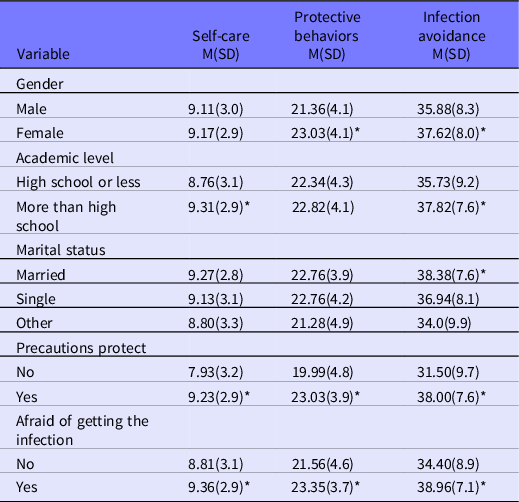
Participants’ age was found to have a low but significant positive correlation with their self-care (r = .103; P = 0.04) and infection avoidance behaviors (r = .142; P = 0.001). Similarly, participants’ family size had low but significant negative correlation with protective (r = - .099; P = 0.001) and infection avoidance behaviors (r = - .112; P = 0.004). Categorical variables had many significant differences displayed in Table 2.
Comparison of the study variables based on participants’ demographics

* Significant at P < 0.01. Note: The category with * was used as a reference for comparison.
Note: Only demographics that have at least one significant differences
Predictors of Infection Avoidance Behaviors
To identify predictors of participants’ infection avoidance behaviors (Question 3), a multiple linear regression test was used, including the demographics that had significant correlation or differences with infection avoidance behaviors (gender, age, family size, being married, having higher than high school certificate, believing precautions protect, and being afraid of getting the infection) as potential predictors. Analysis revealed a 5-predictor model (gender, age, having higher than high school certificate, believing precautions protect, and being afraid of getting the infection) that explained approximately 15.2% of the variance in participants’ infection avoidance behaviors (R 2 = .152; F(1052) = 26.17; P = 0.000). The comparison between predictors revealed that the strongest predictor was being afraid of getting the infection (β = 0.226; t = 7.674; P = 0.000), and the weakest was having higher than high school certificate (β = 0.068; t = 2.276; P = 0.023).
Discussion
This study evaluated Jordanians’ protective measures during the COVID-19 pandemic to protect themselves from infection. We found that the most used self-care behavior was getting enough sleep. Several studies reported that insufficient or irregular sleep could impair the immune system and increase a person’s vulnerability to viral infections, such as COVID-19. Reference Souza5 Hence, adequate sleep is essential to enhance immunity and fight COVID-19 infection.
Conversely, the least adopted behavior among Jordanians was regular exercise, which is congruent with a previous study that reported a predominantly sedentary lifestyle during the pandemic. Reference Moore, Bouchoucha and Buchwald4 The lack of physical activity is a serious concern, especially during times of sickness, as it has been reported that regular exercise enhances immunity and decreases the severity of infectious attacks. Reference Wackerhage, Everett and Krüger6 Several reasons could explain this behavior. First, most Jordanians are not adopting healthy lifestyle behaviors, including regular physical activity. Second, it could be due to the confinement measures imposed by the government during the pandemic combined with the limited resources at Jordanian homes, such as sport and fitness equipment. Furthermore, it seems that physical inactivity during COVID-19 is a world-wide issue that is postulated to negatively impact the general population’s health conditions, which inspired recommendations for indoor activity and simple home exercises. Reference Fauzi, Suherman and Safari7
Wearing masks and performing hand hygiene were predominant behaviors among Jordanians, which was an expected finding considering the proactive measures initiated by the WHO and the Jordanian government. The WHO initiated public awareness and released several recommendations of protective measures during the pandemic, including the importance of personal protective equipment such as face masks and hand hygiene. 8 On the national level, the Jordanian government released several Defense Laws that governed the country during the pandemic, particularly Defense Law No. 11, which mandated citizens to wear masks in public to minimize the spread of the virus and the mortality rates during the COVID-19 pandemic and penalized those who did not.
With regard to wearing gloves in public during the COVID-19, public health officials stated that it is not a proven prevention measure. For instance, the Centers for Disease Control and Prevention (CDC) stated that wearing gloves is unnecessary in most situations, except during cleaning or caring for someone infected with COVID-19. 9 Likewise, the WHO stated that wearing gloves in public does not offer any additional protection or replace the need for hand hygiene. Despite these declarations, there is a variation in public practice world-wide. In the current study, most did not perceive wearing the gloves as a protective strategy, and few were compliant with it. This behavior might be encouraged by the awareness messages on social media concluding that wearing gloves might give a false sense of safety and increase the risk of contracting the infection if the person touched his/her face after touching dirty surfaces.
Regarding avoidance behaviors, Jordanians avoided traveling to infected areas, but they did not stop going to work or school. This should be interpreted carefully considering 2 main issues. The first 1 is the travel restrictions imposed by the government during the pandemic. The second issue is the economic status among Jordanians, which affects their baseline traveling behaviors and mandates them to attend work to grant getting a payment. According to the latest report from the Department of Statistics, the per share of total household income per capita is 2500 JOD/Year, which equals 290 Dollars/month. Furthermore, Jordanians’ average expenditure on recreation activities, including traveling, is only 0.025% of the average annual expenditure.
We found that older people have better self-care and infection avoidance behaviors, which contradicts previously published studies where younger people had better compliance with the protective behaviors against respiratory-transmitted diseases. Reference Shook, Sevi and Lee10 It should be noted that older people are considered vulnerable to developing severe complications if they contract the infection, making them more willing to adapt the avoidance and preventive behaviors.
Furthermore, women, married, and educated people were found to follow protective behaviors more frequently than others. Female’s compliance can be related to their perceived susceptibility and having higher risk judgment than men. In terms of education level, more-educated people are more likely to update their knowledge, have higher perceived efficacy of the preventive and avoidant behaviors, and have higher compliance. Last, greater concern about COVID-19 was associated with more frequent engagement in protective behaviors, supporting results from a previous study. Reference Shook, Sevi and Lee10 It can be postulated that those people perceive the COVID-19 as a threat to themselves and their loved ones; therefore, they act proactively to protect them.
Our findings provide several practical implications. First, this study presented baseline data about the public’s adoption of protective behaviors; these behaviors may vary throughout the pandemic wave and could be traced to our findings. Second, our results may inform policy-makers to foster the identified protective behaviors and encourage them to overcome negative perceptions and adopt the deserted behaviors. Third, we identified various demographic characteristics that affect the individual’s infection avoidance behaviors during pandemics; targeted advice and education to these individuals through health promotion campaigns may enhance healthy behaviors necessary to combat the spread of COVID-19 and other infectious diseases.
Study Limitations
Online sampling may limit the accessibility to eligible participants who do not have Internet access. Additionally, the study used self-report questionnaires for data collection, which may introduce response biases, such as social desirability bias. Another issue is that the study could not verify the participants’ responses of covid-19 vaccine status (ie, positive test or vaccination status). These biases may limit the sample representativeness, though a large number of participants may minimize the selection bias.
Conclusions
In conclusion, Jordanians had a moderate level of self-care behaviors and high levels of protective and infection avoidance behaviors. Jordanians’ most common protective behaviors reported were getting enough sleep, wearing masks, washing hands, and avoiding travel to infected areas. Contrariwise, the least adopted behaviors were exercising, wearing gloves, and leaving their jobs or schools. Overall, better protective behaviors were exhibited by women, married, holders of higher than high school certificates, participants who believed that precautions protect them, and those who were afraid of getting the infection.
Author Contributions
All authors made substantial contributions to the conception and design, acquisition of data, analysis, and interpretation of data, took part in revising the article, gave final approval of the version to be published, and agreed to be accountable for all parts of the work.