Introduction
The Food and Agriculture Organisation of the United Nations has identified red palm weevil Rhynchophorus ferrugineus (Olivier) (Coleoptera: Curculionidae/Rhynchophoridae/Dryophthoridae) as a category-1 pest of date palm in the Middle East (Anonymous, 2004a). Ever since it was reported from the United Arab Emirates in 1985, it has spread rapidly to all the countries of the Gulf region in the Middle East, including Saudi Arabia, which produces nearly 1 million tonnes of dates annually, accounting for 15% of global production.
Rhynchophorus ferrugineus has been managed in Saudi Arabia since 1994 using the male-produced aggregation pheromone 4-methyl-5-nonanol through an area-wide integrated pest management (IPM) strategy, which relies mainly on mass trapping of adult weevils and the use of preventive and curative insecticidal treatments (Abraham et al., Reference Abraham, Faleiro, Al-Shuaibim and Prem Kumar2000). Unlike pheromone traps for other insect species, R. ferrugineus pheromone traps have to be serviced (replace food bait and insecticide solution so as to sustain trapping efficiency and kill the captured weevils) at periodic intervals of 10–15 days (Faleiro et al., Reference Faleiro, Abraham and Al Shuaibi1998). Hence, in area-wide R. ferrugineus IPM programmes, the number of traps deployed per ha of plantation would influence not only weevil captures but also the expenditure incurred on men and material. Oehlschlager (Reference Oehlschlager1994) recommended a trap density of 1 trap/ha for R. ferrugineus mass trapping and since then the pest has been mass trapped at different pheromone trap densities in several countries. Mass trapping R. ferrugineus using pheromone trap densities that are not optimum would either compromise the efficiency of the IPM programme or result in wasteful expenditures. We, therefore, carried out field trials in date plantations of Al-Hassa, Saudi Arabia, to ascertain the optimum density of pheromone traps to mass trap adult R. ferrugineus.
Materials and methods
We carried out two trials between February and May 2009 where different trap densities to mass trap R. ferrugineus were evaluated. Rhynchophorus ferrugineus trap densities ranging from 1 to 10 traps/ha have previously been recommended (Oehlschlager, Reference Oehlschlager1994; Soroker et al., Reference Soroker, Blumberg, Haberman, Hamburger-Rishad, Reneh, Talebaev, Anshelevich and Harari2005). The present study aims to test the trapping efficiency of these trap densities and those in between at varying levels of weevil activity.
Five R. ferrugineus pheromone trap densities namely 10, 7, 4, 2 and 1 traps/ha were tested in two date plantations having low (plantation-1) and high (plantation-2) weevil activity as gauged from infestation reports during 2008. Although in plantation-1 (consisting of about 1000 palms) only two infestations were reported during 2008, in plantation-2 (consisting of about 2000 palms) a total of 53 infestations were detected during 2008. Although the plantation sizes for the study were different, we adopted the same experimental protocols in both the plantations.
In the study, the standard 5-litre capacity four-window bucket trap as recommended by Faleiro et al. (Reference Faleiro, Abraham and Al Shuaibi1998) was used. Each trap contained a new pheromone lure (Ferrolure™ manufactured by ChemTica Internacional S.A., Costa Rica), 200 g dates (food bait) along with 1 l of water and 1 g of non-repellent insecticide (acetamiprid 20% soluble powder, manufactured by MEDMAC Company, Kingdom of Jordan as Cezar®) to kill and retain trapped weevils.
In both plantation-1 and -2, five blocks (1 ha each) were marked 50 m apart. Traps were set at ground level 10 m apart in each 1 ha block. To overcome the effect of ‘spot bias’ due to the aggregated nature of the pest (Faleiro et al., Reference Faleiro, Ashok Kumar and Rangnekar2002), the treatments (traps) were moved from one block to another within each plantation at an interval of 7 days so that each treatment remained in every block for a week. Prior to rotating the traps to the assigned block, observation of the number of weevils trapped in each trap (block wise) was recorded. All traps were serviced at an interval of 7 days before setting the treatments in the new block. Thus observations on weevil captures in the five R. ferrugineus trap densities were recorded for 5 weeks with each week serving as one replication. At the end of the first 5-week trial and after an interval of 7 days, the second 5-week trial was repeated in the same plantations. Data on weevil captures were subjected to ANOVA using the two-factor factorial randomized block design, where the plantation type (factor A) was the main treatment and the trap density (factor B) was the subtreatment. The data were analysed through the Web-based Agricultural Statistics Software Package (WASP 1.0 – http://www.icargoa.res.in) for two-factor factorial experiments.
Results
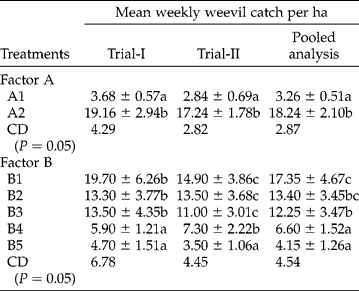
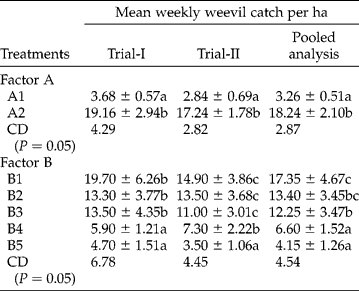
Results presented in Table 1 reveal that weevil activity was significantly different in the two plantations (3.26 and 18.24 weevils/ha/week in plantation-1 and plantation-2, respectively). Table 1 also indicates that the highest weevil catches were recorded in plantation-2 at a trapping density of 10 traps/ha (17.3 weevils/ha/week), which was not significantly different compared with a trapping density of 7 traps/ha (13.4 weevils/ha/week), which in turn was not significantly different compared with a trap density of 4 traps/ha (12.2 weevils/ha/week). At the lower trapping densities of 1 and 2 traps/ha, weevil captures were at par and varied from 4.1 to 6.6 weevils/ha/week, respectively, which was significantly lower compared with the weevil densities in 4–10 traps/ha treatments.
Weevil captures in date plantations with varying weevil activity/infestation levels and different pheromone trap densities (Al-Hassa, Saudi Arabia, 2009)
The data were computed through the Web-Based Agricultural Statistics Software Package (WASP 1.0) for two-factor factorial experiments; available at: http://www.icargoa.res.in
Values followed by ± denote standard errors (SE). Means ± SE followed by different letters within the same column are significantly different at the 5% significance level.
Factor A: plantation type (A1: < 1% infested palms; A2: >1% infested palms).
Factor B: trap density (B1: 10 traps/ha, B2: 7 traps/ha, B3: 4 traps/ha, B4: 2 traps/ha, B5: 1 trap/ha).
Discussion
Initially, Oehlschlager (Reference Oehlschlager1994) recommended a trapping density of 1 trap/ha to mass trap R. ferrugineus. However, mass trapping of this pest in pheromone-based area-wide IPM programmes has been implemented at different densities ranging from high-density trapping of 10 traps/ha in date plantations to 1 trap/1.5 ha in the date plantations of the Al-Hassa region in Saudi Arabia (Abraham et al., Reference Abraham, Faleiro, Al-Shuaibim and Prem Kumar2000; Soroker et al., Reference Soroker, Blumberg, Haberman, Hamburger-Rishad, Reneh, Talebaev, Anshelevich and Harari2005). In Egypt, R. ferrugineus was efficiently mass trapped at 0.5 traps/ha (Anonymous, 2004b). Although R. ferrugineus was initially mass trapped at 10 traps/ha in Israel between 1999 and 2001 on 450 ha of date plantations, the trapping density was subsequently reduced to 1 trap/ha because of considerably decreased number of weevil captures. Since 2002, no new infestations have been detected (Soroker et al., Reference Soroker, Blumberg, Haberman, Hamburger-Rishad, Reneh, Talebaev, Anshelevich and Harari2005). This illustrates that trap density in area-wide mass trapping of R. ferrugineus can be lowered after the initial high level of infestation is reduced.
The Al-Hassa mass trapping programme was initially implemented in 1994 uniformly at 1 trap/1.5 ha, which successfully curtailed the population (Abraham et al., Reference Abraham, Faleiro, Al-Shuaibim and Prem Kumar2000). However, increasing infestation reports after 1998 indicate that this uniform trapping density grid may be currently inadequate to mass trap the pest in all the operational areas. Our study reveals that in plantations with low weevil activity and < 1% infested palms, a trap density of 1 trap/ha is sufficient. In plantations where infestation levels are >1%, 10 traps/ha resulted in the best weevil captures. However, depending on the resources available to service the traps in area-wide mass trapping programmes, weevils could be effectively mass trapped at 4–7 pheromone traps/ha.
The study revealed that the pheromone trap density for mass trapping R. ferrugineus in date palm plantations depends on the intensity of the pest population in the field. Plantations with high weevil activity need to be mass trapped at a higher pheromone trap density compared with date plantations with lower weevil activity.
Acknowledgements
We wish to thank Dr Salah Al Eid, Director of the Date Palm Research Centre (Centre of Excellence), King Faisal University, Al-Hassa, Saudi Arabia, and Mr Salah Nasser Al Homaidi, Director of the Directorate of Agriculture, Ministry of Agriculture, Al-Hassa, Saudi Arabia, for providing the necessary institutional support to take up this study. We also thank Mr J. Ashok Kumar, Senior Scientist, Computer Applications, Central Institute of Brackish Water Aquaculture, Chennai, India for support provided with regard to data treatment. Technical assistance given by Mr Ibrahim A. Bukuoah and Mr Mohamad Al Ammar in carrying out the trials is also acknowledged with thanks.