Introduction
In the past few years, analyses of narrative and story have been increasing across disciplinary boundaries. The 2008 Georgetown University Round Table on narrative, for example, included scholars whose academic affiliations included anthropology, communication, education, English, history, law, linguistics, media studies, medicine, psychology, and sociology. Not surprisingly, a wide range of texts and practices were analyzed as narratives, some quite far from the canonical Labovian narrative that had been pivotal to the development not only of Narrative Analysis, but also of Linguistic Discourse Analysis. For example, we now hear, analyze, and read about narratives compressed into small stories that consist of no more than a clause or two deeply embedded in the turn-taking of everyday conversation (Ochs & Capps Reference Ochs and Capps2001, Georgakopoulou Reference Georgakopoulou2007) as well as narratives stretched out to long, complex, and discontinuous life stories that reframe the course of our lives even as we continue to create them day by day (Linde Reference Linde1993, Mishler Reference Mishler1999).
Even more fundamental than differences in size and scope are questions of ontology: Must a narrative be verbalized, entextualized, or realized through a semiotic process, either language or other media? Or is narrative even more abstract, serving as a template for organizing experience through abstract schemas and frames (Tannen Reference Tannen and Chafe1980). And equally abstract, but at a collective level, can narrative be construed at the level of discourse in the Foucauldian sense, or Master Narrative (Lyotard Reference Lyotard1979, Tannen Reference Tannen2008), such that it is a social and/or cultural resource for organizing communal ideologies and socializing members of a community, even if no one ever turns these underlying meanings into a single coherent discourse?
The widening scope of narrative analysis, with its attention to varied forms, meanings, and functions, suggests the value of examining the canonical Labovian narrative. In Labov’s (Reference Labov1972) model, temporally ordered clauses (i.e., events with temporal juncture) are more central to the text than are other sequences of clauses. Descriptions of spaces, characters, or thoughts are either part of the orientation in which who, why, and when join where to preface what happened, or they are inserted within a sequence of temporal clauses to create suspense before the denouement of the story. Along with external evaluation (e.g., information exterior to the story world), what conveys the point of a story are syntactic, prosodic, and textual modifications of temporally ordered event clauses themselves.
In this article, I use two analytical tools stemming from the Labovian approach to analyze two narratives that together contribute to an intertextual narrative (Schiffrin Reference Schiffrin2002; to be defined below) from an oral history. The stories are told by a White middle-class suburban woman (Mrs. Siegel), and they contain two descriptions of Scotland, a small African American enclave in Maryland near Mrs. Siegel’s home whose residents were descendants of former slaves. The narratives and descriptions to be analyzed were recorded in 1972; the events themselves occurred in the summer of 1964 and the winter of 1965. My analysis depends upon the Labovian view of narrative in two ways: I identify the parts of narrative and base evaluation on contrastive syntactic and textual patterns. However, I also query four interrelated assumptions of his approach.
The first assumption is that text types are mutually exclusive: Narrative is formally and functionally different from other text types such as description and argumentation. Whereas narratives are based largely on time and events, descriptions are basically additive and arguments are based largely on logical inferences. However, each of these texts can intersect or blend. Descriptions that appear within narrative can simultaneously delimit the scope of possible actions (De Fina Reference De Fina2003; see also Georgakopoulou & Goutsos Reference Georgakopoulou and Goutsos1997, Virtanen Reference Virtanen1992). Argumentation can also intersect with narrative, as when the complicating action and evaluation of a narrative support or challenge a contestable position. And although typological comparisons of texts, based on grammatical form, focus, information structure, and point of view, differentiate modes of texts, they also find partial mergers (Smith Reference Smith2003).
The second assumption is the privileged view of time as opposed to space. If noted at all, spatial information provides background information within the orientation of the narrative, or adds details that help create the point of the story – that is, through evaluation (Johnstone Reference Johnstone1990, Tannen Reference Tannen1989). Following Bakhtin’s (Reference Bakhtin, Emerson and Holquist1981) construct of “chronotopes” (time/space coordinates), however, linguistic anthropologists have shown that the balance between time and space may vary among cultures: See Basso Reference Basso and Bruner1984 and Becker (Reference Becker1995:41) who notes that although “a Wayang plot [in Javanese shadow theater] has no temporal beginning, middle, or end .... [it] must begin and end in certain places.” Likewise, literary theorists (e.g., Herman Reference Herman2007) have argued the importance of time/space coordinates for cognitive models of narrative. And in keeping with the three points of deixis – time, space, and person – still other scholars (Agha Reference Agha2007, Silverstein Reference Silverstein2005) have pursued Bakhtin’s incorporation of “person” (and voicing) into chronotopes, such that personal identity sits at the crux of time and space not just in narrative, but in all discourse at both denotational (text) and interactional (context) levels.
Third, it is well known that narrative provides opportunities to display, perform, and construct self/other identity on two planes: one projected through storytelling performance, and the other through the storyworld. However, analyses of the politics and cultural meanings of the places that we inhabit (Modan Reference Modan2007) have highlighted not only who we are, but also the semiotic resources that help to identify places themselves (Scollon & Scollon Reference Scollon and Scollon2003) and the texts that represent them (Benwall & Stokoe Reference Benwell and Stokoe2006). Likewise, when space itself is personified as a protagonist (Johnstone Reference Johnstone1990) and/or crucial to plot (Finegan Reference Finegan1998), narrative may be more about place itself than about the people who populate it.
So far, I have been suggesting an ecumenical approach to narrative in which time/space coordinates and descriptions within the storyworld create a blend of textual features by which a speaker can construct both personal and place identity. The fourth non-Labovian feature queries another aspect of time: When is a narrative actually told? Although many stories are told without interruption, within one turn at talk, within a relatively continuous text during one speech event, others are co-constructed through audience participation that extends and changes the structure and meaning of a story, as well as actual authorship. Even more extended time gaps appear in life stories that comprise non-adjacent swatches of information connected cumulatively over long periods of time or across texts that are non-contiguous (as in oral history).
Before concluding and moving toward the analysis, I suggest that chronotopes are useful not only for analyzing narrative, but also for theorizing both the (denotational) storyworld and the interactional world. Although I mentioned chronotopes as time/space coordinates embodied by person, we can apply them to the actual production of texts that reproduce themselves over time and space (intertextuality) and recurrent semiotic practices (interdiscursivity), as suggested by Silverstein Reference Silverstein2005 and Agha Reference Agha2007. Thus the two different versions of Scotland to be examined, and the intertextual narrative to which they both contribute, are at the nexus of time/space/person coordinates within both the denotational storyworld and the interactional world in which they emerge.
After describing the background of the narratives and their embedded descriptions, as well as specific methods of analysis, I analyze the first description of Scotland, which provides a resolution for the complicating action of a narrative about Mrs. Siegel’s search for a place to do volunteer work. The second description appears after a series of narratives that contribute to an ongoing chronicle (Linde Reference Linde1993) in which Mrs. Siegel is challenged to take a more active role in community change. Because that description is quite long, I provide only samples of changes. Space also prohibits a third description of Scotland in an oral history 29 years later in 2003. The final section summarizes and brings together place and person identities.
Background
We begin with some local and national historical background to situate Scotland and African Americans in Maryland. During the Civil War (1881–1885), Maryland was a state in which owning slaves was legal. But unlike other slave states, Maryland did not secede from the Union; even before the Civil War began, Maryland slave owners had freed nearly half their slaves, and within the next year, ex-slaves had bought 17,000 acres in Montgomery County. It was not until the 1880s, however, that ex-slaves purchased land in Scotland: Some of their descendants still live on their ancestors’ land.Footnote 1
One hundred years later, however, opportunities were far from equal in the Scotland discussed in Mrs. Siegel’s 1972 oral history. Racial segregation and discrimination limited educational opportunities (Montgomery County’s schools were not fully integrated until 1961) and basic amenities (e.g., plumbing, heat, trash collection) were not provided by the county. To aggravate circumstances further, Scotland was threatened by the suburbanization of Rockville (the seat of Montgomery County in suburban Maryland adjacent to Washington, D.C., and the area in which Scotland was located). Private developers were targeting new upscale housing, and the county itself was planning to put aside acreage for a nature preserve.
Although the local initiatives threatening Scotland coincided with the civil rights movement, it appears only once in Mrs. Siegel’s oral history. Her only direct comment refers to the 1965 march to Selma, Alabama (aimed at ending disenfranchisement of African Americans) led by Martin Luther King. Mrs. Siegel relates that a lot of the ministers in the area who were coming to the meeting to address conditions in Scotland had just come back from Selma, Alabama, and they didn’t know what to do. They wanted to do something meaningful in the field of civil rights. And in 1972, the year of Mrs. Siegel’s oral history, again no overt comments about larger social and political contexts appear.
The oral history itself was part of an initiative sponsored by the League of Women Voters (a nonpartisan political organization dedicated to using grassroots efforts to improve government and public policy). The oral history project itself had two goals: A local goal was to record significant aspects of county history; a national goal was to mark the upcoming United States bicentennial. Mrs. Siegel’s 1972 oral history is one of about 100 oral histories that cover different topics (e.g., education, religion) and communities within the county. Although some are from county officials, most were provided by ordinary county residents. Initially donated to the public library in Rockville, they are now stored in a small library in a building that itself has a rich history: It was previously the home of an upper class family and their slaves.
Despite limited attention to oral histories from linguists, scholars in other fields have noticed that oral history as a genre “depends to a large extent on the shifting balance between the personal and the social, between biography and history” (Portelli Reference Portelli1997:6). Oral histories produce lengthy documents (Mrs. Siegel’s is a 75-page transcription) in which various types of texts are combined. My prior work on oral histories found that within a general question/answer format, respondents often expand their answers through descriptions, examples, reflections, and explanations. Despite the general fluidity of topics that such opportunities provide on a local sequential level, both interviewers and respondents also maintain a global structure by adhering to two overarching, but interlocking, frameworks: the linear passage of time, and the non-linear distribution and recurrence of themes that facilitate connections among non-adjacent parts of discourse (Schiffrin Reference Schiffrin2002).
Like other oral histories, Mrs. Siegel’s 1972 oral history sits at a three-way nexus of time. The first two relationships are straightforward: the real time between telling and retelling the Scotland description (only several minutes), and the actual interval between the events (about six months apart). Third is the span between the reported events (1964–1965) and the reporting event (1972). The seven years between Mrs. Siegel’s reported event (the experience) and the reporting event (the telling) in the oral history creates a disjunction that Mishler Reference Mishler, De Fina, Schiffrin and Bamberg2006 describes as a double arrow of time through which the reporting event affects evaluation and possibly content (see also Schiffrin Reference Schiffrin2006, chaps. 6, 7). Also appearing in Mrs. Siegel’s narratives are explanatory narratives that connect events explaining a transition, and illustrative narratives that describe a particular instance of a more general experience. Also constructed are intertextual narratives that emerge across a set of non-adjacent segments that are linked in some way – for example, by topic (housing problems), type of interaction (a meeting), or goal (efforts to provide plumbing in a church). Although the first description to be analyzed is part of an explanatory narrative and the second description is more illustrative, both contribute to an intertextual story about how Scotland was reconstructed.
We turn now to my analytical tools. Along with identifying sections of the narrative, I examine syntactic and textual patterns (and their exceptions) for clues about what happened, what it meant to Mrs. Siegel (evaluation), and the overall function of her narratives and their embedded descriptions. Of particular interest is how different types of clauses structure information and how they combine to create textual structures (hierarchical, linear, or both). Clauses to be examined are dependent clauses (Ford Reference Ford1993; Schiffrin Reference Schiffrin1985, Reference Schiffrin1991), relative clauses, coordinate clauses linked by and or other connectives (Schiffrin Reference Schiffrin1987, chap. 5) and existential there sentences (Schiffrin Reference Schiffrin2006, chap. 4). Along with finding textual patterns is their flip side: Departure from a pattern provides resources for highlighting evaluation and particular information (e.g., Schiffrin Reference Schiffrin1987, chap. 5). Also noted are contextualization cues (constructed dialogue, verb chains, and conditional sentences) that add cohesion and coherence to Mrs. Siegel’s intertextual story of working for Scotland. Finally, since the narratives and their descriptions recount walking through a community, we pay close attention to time and space, including references to people, places, and things, spatial deixis and the use of there in its adverbial and presentational uses (existential there).
The next sections turn to the two descriptions of Scotland. Both are locally situated in ongoing topics and a prior narrative. But they are also linked together as a thematically coherent intertextual narrative that creates a higher arc: the first description provides an orientation, the second description acts as an illustrative narrative recounting community problems (comparable to a complicating action), and a third description from a 2003 oral history (analysis not included here) provides a coda.
“Looking for Some Volunteer Work, to Do in the Community”
In this section, I examine Mrs. Siegel’s narrative about her efforts in the summer of 1964 to find volunteer work in a neighborhood close to her home. I highlight particular features of the data as follows: Complicating Action (CA) verbs are in bold italics; conjunctions appear in upper case (AND); dependent clauses (including relative clauses) and modifiers are in italics; the word there as both presentational in existential sentences and as adverbial is bold and underlined (there).
Opening the interview
In keeping with the official status of Mrs. Siegel’s oral history, the oral history interview is prefaced by identifying information: who, when, where, agenda, and topic.
(1) MC: a. Today is March 24, 1972 and I am Margaret Cutler visiting Mrs. Joyce Siegel at her home, address [excluded]
b. and, today we’re going to talk about the community of Scotland, and Mrs. Siegel’s (no need to add lines or underline, just showing where text should begin part in its rehabilitation.
c. Mrs. Siegel, tell me how you first became aware of the community of Scotland, in the county.
JS: d. Well:, I became aware of it… not knowing I was looking for it actually.
MC’s opening of the oral history is consistent with a text that will have its place in an archive in which it is important to know who, when, and where, as well as agenda and topic (b). As indicated by the use of Mrs. Siegel as a referring term (a, b) rather than a term of address, MC first directs her announcement to a general public. Included in the announcement is why Mrs. Siegel is being interviewed: to talk about her part in the rehabilitation of Scotland. After announcing the interview, MC speaks directly to Mrs. Siegel, addressing her by name and requesting that she tell how she became aware of Scotland, presupposing (correctly) that Mrs. Siegel did not always know about Scotland. The starting point itself, then, is a change of state: MC’s request is for information about how the change came about. We see that Mrs. Siegel’s overall goal is to find some volunteer work to do in the community that must be both plausible and necessary.
Places to work
In this section, Mrs. Siegel looks for places to volunteer, finds a place, goes there until the opportunity ends, and then goes elsewhere. Sections of the narrative are indicated on the right.
(2) e. I was looking for some volunteer work, to do in the community. Abstract
f. My children were still very young. Orientation/eval
g. I had one… under two (continued)
h. AND I needed something where I could get out during the day, (continued) and possibly take them with me.
i. So…through the League of Women Voters I found out about this CA-1 …um play school that was being started in Lincoln Park out in Rockville.
j. AND I went out there and worked with them. CA-2
k. I brought my children with me orientation/eval
l. AND after awhile it was obvious they had so many volunteers they CA-3 didn’t need me.
m. AND sent me to Cabin John, where the home study group was having CA-4 some kind of a play school there.
n. I brought my children there.orientation/eval
o. AND that- that was a much more convenient spot for me (continued) because it was not too far from my home which is near Seven Locks Road
The text above includes the standard parts of a narrative. I was looking for some volunteer work, to do in the community (e) provides an abstract, followed by an orientation in which the assertion of need (h) also has an evaluative function because it indicates a possible challenge (young children) to Mrs. Siegel’s goal. The actions are presented in temporal order in four CA clauses that cluster together (i–n) in a sequence, broken by embedded orientation that is evaluative by showing the fulfillment of family needs.
The abstract identifies the scope of Mrs. Siegel’s search for work to be the community (e), which can have both a broad and a narrow extension. For example, MC’s introductory use of community is narrow and specified as the community of Scotland (b). Mrs. Siegel’s use of community (e), however, is broader and is the domain in which she is searching for a place to work. Narrow and wide extensions of community are indicated through deixis. Out indexes distance: this play school that was being started in Lincoln Park out in Rockville (i), which is about 8 miles from Mrs. Siegel’s home, and I went out there and worked with them (j). Also providing a deictic distinction are verbs of motion that create a contrast not of distance, but of hypothetical vs. actual actions. Thus, before the description of finding a place to volunteer, the distal verbs take and get out focus on motion away from a place: I needed something where I could get out during the day and possibly take them [her children] with me (h). But once finding a place to volunteer is established, movement is directed toward a proximal location to which she has arrived through the proximal verb bring: I brought my children with me (k) to Lincoln Park; I brought my children there to Cabin John (o).
Sentence structure, more specifically the contrast between main and subordinate clauses, differentiates CA events from other types of information in the narrative. In Labov’s framework, independent clauses (depending on verb type, tense, and aspect) may be CA clauses. Dependent clauses (regardless of verb type) provide orientation and/or evaluation. Consistent with these form/function relationships is Mann & Thompson’s (Reference Mann and Thompson1988) rhetorical structure theory, in which major information appears in independent clauses and minor information that supports and/or adds information appears in subordinate clauses or phrases. Both perspectives also mesh with Chafe’s (Reference Chafe1994) cognitive approach to discourse, in which an independent clause (often coterminous with an intonation unit) activates and verbalizes new information on which the speaker is focusing. These perspectives help to account for Linde and Labov’s (Reference Linde and Labov1975) analysis of apartment descriptions, in which clause types reflect the space being mentioned. Whereas major parts of apartments appeared in independent clauses, minor spaces (e.g., a closet or bathroom) appeared more often in dependent clauses or phrases.
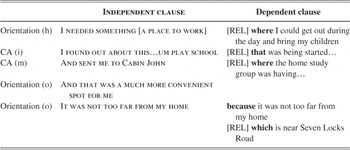
Mrs. Siegel’s narrative follows a textual pattern of “main clause + relative clause” starting with an orientation clause right before the CA (h), continuing with each CA clause (i–n), and ending with an embedded orientation (q). In each of the parallel forms an independent clause has a relative clause adding spatial information about a place, as shown in Table 1.
Clause structure in the search for a place to work.

Recurrent use of this structure adds cohesion to the search by connecting the orientation to the CA, comprised of motion from one place to another, and then to embedded orientation with an evaluative function. Thus key information is specified as an appropriate place to fulfill her needs.
When a textual pattern ends, the switch highlights new and potentially important information to another subpart of a text (e.g., Schiffrin Reference Schiffrin1987, chap. 5). In Mrs. Siegel’s narrative, details about Cabin John appear not in a relative clause, but in an and-prefaced independent clause that provides evidence of its suitability as a place to work that was convenient and not too far from home (o). Continuing the textual shift is a postposed because clause that details the value (convenience) of the spatial information. Note, also, the density of the Cabin John description. It is redundantly located by proximal place and person deixis as an especially convenient spot for me and not too far from my home (not just home or my house), thus highlighting the importance of proximity to home. Cabin John is also evaluated through comparison (more) and a scalar intensifier (most). Finally, the focus on Cabin John is highlighted by repeated references: it and that (o), and there, appearing at the end of (m) as a physical link to activity at Cabin John and in (n) as a place for her own children.
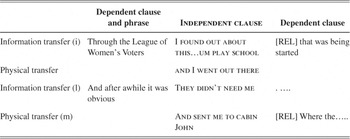
We turn now to the time/space coordinates of the narrative in which gaining information leads to going to a new place: Both underlie the movement of time. The first transition is a metaphorical movement of information from one person (a source) to another (a destination), common in the conduit metaphor of communication. Next is the physical move to a new place of work, as summarized in Table 2. Although both information and physical transfers are CA clauses, two features show that learning about a place to work is less important than the physical transition itself.
Clause structure in information and physical transfer.

The first feature resembles the contrast between main and subordinate clauses discussed earlier. Information transfers begin with preposed prepositional phrases that are both shorter and even less dominant than dependent clauses. They serve as background material, leaving an independent clause for the more important information of transition to a new place.
The second feature is the paucity of information in the information transfers: They are brief, impersonal, and void of detail. Instead of details about who said what, when, where, and how, they focus almost entirely on the outcome of the transfer. When Mrs. Siegel was first being assigned to Lincoln Park (i), and then (when they had enough volunteers) transitioning to Cabin John (m), the physical transfers had to be communicated by people providing information through speech or writing. But the identities of the senders and the messages are minimally specified. Mrs. Siegel learned about her first place of volunteer work through the League of Women Voters (i), never differentiated as one specific person. The group appears only as a conduit for information to Mrs. Siegel, who found out … about Lincoln Park (i). Agency of a potential messenger is truncated even further in the next transfer to a new place. Mrs. Siegel had worked at Lincoln Park until it was obvious they (an institutional metonymy) had so many volunteers that they no longer needed her (l) and sent her to another location (m). The lack of detail in transfers to both places thus contrastively highlights the physical transitions themselves.
So far, the physical transitions that we have been discussing have been linear, but also within the narrative is cyclical motion. Once at work at Cabin John, Mrs. Siegel undertakes a daily round that is part of her routine as a volunteer.
(3) p. There had always been a lot of children who didn’t show up
q. and we would GO around to- uh through the area and try to collect the children.
r. We would GO by car, AND SEE if some of the youngsters were going to show up_if we’d drive them over to the playschool
Mrs. Siegel’s daily round creates physical motion based on making efforts to achieve an overall goal. Indicative of this motion are verb chains: temporally ordered verbs with no repeated subjects, verbs linked together by and or to, and the last verb enabled by prior verb(s) to convey concrete processes whose steps lead to a specific outcome. Verb chains are in upper case italic above (GO). Note, also, that conditional clauses (with if in bold) provide contingencies that create options that may fulfill a desired (or undesired) outcome. Narrowing down what may happen next will have a role later in Mrs. Siegel’s plans for upcoming projects associated with Scotland.
The recurrent cycles created by verb chains not only have aspectual functions that create a process, but also add a goal-oriented inception to the process. Detailing the separate but related steps toward a goal draws attention more to the process than to the person putting forward the goal. The verb chains first appearing here recur in Mrs. Siegel’s talk about her work throughout her oral histories. And at the level of agency as part of personal identity, the verb chains also act as contextualization cues that index Mrs. Siegel’s own description of how she acted in many cases as a catalyst to get things happening, as we see in the second description of Scotland.
In sum, Mrs. Siegel’s narrative depends on physical transitions that require domestic adjustments (being with her children) and show her constantly in motion either sequentially from one place to another or cyclically through a daily round at work. We see next how the continuation of her narrative provides a temporally and spatially ordered orientation to the next spatial transition.
Finding Scotland
In this section, we see two formal changes from Mrs. Siegel’s narrative thus far. First is the information transfer to Lincoln Park and Cabin John that pales compared to the upcoming communication about Scotland. Second is the sequential distribution of information: Although CA clauses continue, details of Scotland are provided not in recurring relative clauses but in an overall linear structure, as indicated primarily by conjunctions – and (t), (u), (w), (x), (y), but (v), because (z) – all prefacing important information about Scotland in full clauses. Note that I use the same conventions to highlight particular features of the text.
(4) s. On one occasion I mentioned to one of the young ladies with me that the homes were in pretty bad condition, that it looked pretty bad. CA-5
t. AND she said to me that if I thought that was bad, CA- 6 why didn’t I go look in my own back yard.
u. AND uh I didn’t really know what she was talking about. Orientation/eval
v. But she told me about a little community off Seven Locks Road CA-7 and Bells Mill Road, which was even closer to my home . Orientation/eval
w. AND that it was called Scotland.
x. AND if I was interested in helping, they had plenty of volunteers over at Cabin John.
y. AND they NEEDED TO GET a play school group STARTED over at Scotland
z. because there was nothing going on there.
In contrast to the paucity of details in earlier information transfers, three temporally ordered verbs convey communication: mention (s), say (t), tell (v); also present is a cognitive verb, know (u). Although Mrs. Siegel doesn’t specify the occasion or the name of the woman, both are singled out as one member of a larger set of occasions and young women. Thus, rather than convey general routine activities during an unspecified duration with institutions and their representatives, Mrs. Siegel focuses on a specific period of time and person.
Also different is Mrs. Siegel’s role in the communicative event. Instead of occupying a silent role as a recipient, Mrs. Siegel initiates an interaction with an assertion, a speech act that makes a claim to truth. The claim – a potentially subjective assessment about a community – is presented through the quotative verb mention, which has connotations of brevity and casualness. Yet Mrs. Siegel’s assessment that the homes were in pretty bad condition that it looked pretty bad (v) evokes a challenging directive from the young woman to go (an inceptive) and look (rather than the less agentive and less focused see) at a place, her own back yard.Footnote 2 Following up on the directive, Mrs. Siegel learns that Scotland is near Seven Locks Road, an already familiar pathway from line (o).
To augment the logic of the directive still further, Mrs. Siegel is provided with reasons for following the directive that echo the requirements (plausibility and necessity) underlying her earlier decisions: Scotland was even closer to my home (v); Scotland needed to get a play school group started over there (y) where therewas nothing going on there (z). If Mrs. Siegel uses the clues to get to Scotland and follows the directive, she will be led exactly to what she has been looking for from the onset of her search for volunteer work.
The introduction of Scotland itself is partially similar to mentions of other workplaces, but with extra details. Scotland is immediately described and evaluated as a little community. It is located not only on a pathway, but at a more informative intersection. Proximity is indicated by deictic information to my home (note, again, not just home or my house). Notice, however, an inversion of prior information structure: Comparative proximity to my home appears in a relative clause (v) before mentioning Scotland by name (w). Another contrast appears with the name Scotland. Whereas Lincoln Park and Cabin John were presented as proper nouns, with information (in relative clauses) describing them, Scotland is introduced metalinguistically (it was called) in its own independent clause, conjoined to the other details with and. The introduction by name begins a list of properties: it was called Scotland, and there was no need to remain at Cabin John (x) and good reason to go to Scotland (y), (z)).
“I drove up to Scotland”
Going to Scotland is the last part of Mrs. Siegel’s narrative about her search for volunteer work. It provides a description that serves as a resolution for the story in which earlier syntactic and textual patterns of the narrative continue. Another link with the prior section of the narrative is the because clause in (z): because there was nothing going on there. Notice that (y) is seamlessly connected to (aa) as if they were in adjacent position in a narrative. This is because preposed because clauses can be interpreted as a cause for an event that either precedes or follows the because clause (Schiffrin Reference Schiffrin1985).This two-way causal connection reinforces the sequential connection from the constructed dialogue about Scotland to the immediate action to be taken at Scotland.Footnote 3
We turn now to the continuation of the narrative in which Mrs. Siegel describes Scotland. Although it provides a resolution to the problem underlying the story, the description also has its own internal structure, cohesion, and coherence. Typography indicates textual features as before.
(5) y. AND they NEEDED TO GET a play school group STARTED over at Scotland
z. because there was nothing going on there.
aa. I didn’t want to go to Scotland empty handed orientation/eval
bb. I just had no idea what to expect. (Continued)
cc. So I asked around my neighborhood if anyone had toy:s, or books, CA-8that we could USE TO GET a play school program started.
dd. AND with my children and a carload of toys, which was pretty nervy I guess, I drove up to Scotland. CA-9
Mrs. Siegel prepares to go to Scotland by enlisting help from her neighbors, using again a preposed if clause to background a request that requires a verb chain. Further background for the request is provided by negation. Along with providing a reason for both prior and upcoming events, because there was nothing going on there (z) also provides the first part of a three-part negation that combines to indicate an underlying frame whose expectations are not met – that is, Scotland is out of one’s ordinary expectations. Thus after I didn’t want to go to Scotland empty handed (aa) is I just had no idea what to expect (bb), which prefaces a speech act (cc) whose uptake will fill the void of going empty-handed. And since negatives typically indicate background expectations, I had no idea what to expect (bb) also conveys the lack of a frame or schema.
Mrs. Siegel’s request for donations of toys or books from neighbors is consistent with a play school program, combining components of play (toys) and school (books). And like the communication with the young woman who had directed her to Scotland, Mrs. Siegel uses a conditional (if anyone had toys or books) in indirect reported speech (I asked around my neighborhood (cc)) to make a request. Also familiar are verb chains: use to get started (cc). Having acquired toys and books, Mrs. Siegel then goes to Scotland, and it is here that she first sees and describes it. To preview, major features of Scotland are introduced in existential there sentences with clause final adverbial there, with relative clauses and other dependent modifiers (in italics). AND (in uppercase below) links clauses that presents further qualities, items, or features of a site. Note that I identify only CA clauses. Other parts of this phase of narrative are discussed, rather than labeled, thus highlighting two non-Labovian features of narrative that we are querying: the blending of description and narration, and the space/time/person coordinates.
(6) dd. I drove up to Scotland.
ee. AND hh the first sight of it, I-I just couldn’t believe what I saw.
ff. There was a one room school house, that had a Maryland- National Capital Park and Planning sign there.
gg. AND it was just run down with a pot-bellied stove and one electric light hanging by a wire.
hh. AND, an outhouse that was for the school
ii. but smelled so badly I knew it hadn’t been cleaned for a long time.
jj. There was a well there, a hand pump, which I had never seen in my life.
kk. AND there were houses there,
ll. the ones that I could see from the beginning of the road, that were teeming with people.
mm. They had no regular heat.[the letters crossed out were correct (kk) etc.nnThey had no water, no toilets. ooSome of the walls were caving in.
pp. AND the road was so bad I was afraid to take my car up even half way.
qq. It was deeply rutted and strewn with broken bottles.
rr. I just had never seen, first of all, so many Black children in my life,
ss. AND uh such awful housing conditions.
tt. So, when I got up the road,
uu. I saw that there was a recreation director theresupplied by the county, for a summer program. CA-10
ww. AND I spoke to him and asked if they would like some additional CA-11 volunteer workers, or if they needed anything.
The Scotland description appears through Mrs. Siegel’s reported perceptions of physical space, including a contrast between front and back region. I adapt this contrast from Goffman’s (Reference Goffman1959) analysis of how physical separations provide opportunities for the relatively private management of potentially discreditable self-presentations (back region) for an audience who may then participate in more socially acceptable actions (front region). Of course, Scotland residents did not create the two regions willfully: The de facto contrast emerged over years of county neglect and lack of crucial resources.
The front region of Scotland appears when Mrs. Siegel drove up to Scotland (dd) on Seven Locks Road, the familiar pathway and an area of Scotland visible and accessible to outsiders. The back region begins with a road not visible from Seven Locks Road and it provides little access to outsiders: it is deeply rutted and strewn with broken bottles (qq). It evokes fear (I was afraid (pp)) that threatens Mrs. Siegel’s ability to take her car up even halfway (pp). In addition to being a stumbling block to further access to Scotland, these conditions convey trouble through both natural and human causes: roads are rutted from cars driving in mud resulting from a lack of paving. Another lack of responsibility is inferable from broken bottles that were strewn in the road, a place “where suppressed facts make an appearance” (Goffman Reference Goffman1959:112).
Also central to the structure is there-NP-there, the use of both existential and locative there within one sentence. Existential there is a common strategy for introducing new referents into discourse (Schiffrin Reference Schiffrin2006, chap. 4). Although they frequently include references to prior spatial conditions, adverbial there does not commonly occur with existential there. It is there-NP-there sentences – and the material they present – that creates a hierarchical topic structure in the description of the front region, while also creating cohesion throughout the descriptive resolution of the narrative.
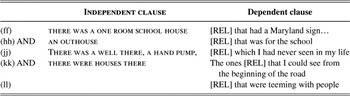
As shown in Table 3, the features textually marked by there-NP-there replicate the use of relative clauses from the narrative search for Scotland, while also conjoining features.
There sentences in the first description of Scotland.

In the front region, three buildings are connected by and, end with there, and are evaluated by modifiers. The sign on the schoolhouse from the Maryland-National Capital Park and Planning Commission indexes danger for Scotland by evoking the authority that has created a large part of the threat to Scotland.
The schoolhouse also provides an anchor for other features: a pot-bellied stove and one electric light. The lack of basic services provides overall evidence of the just rundown condition of the schoolhouse. Electric problems are evaluated through metonymy: a single light hanging by a wire conveys the precariousness of light gg. The outhouse hh shows evidence of neglect through scent (ii) and also evokes the larger issue of plumbing: a well and a hand pump (jj). The final reference point in the front region is houses (kk). The information attached to the houses contains a three-member list of gaps in basic services: heat, running water, toilets. In addition to the stanza-like structure – repeated negation concerning a lack of heat, water, and toilets – note the ambiguity of they in they had (nn); see Schiffrin (Reference Schiffrin2006, chap. 4), which notes that they need not be anaphoric to references to people per se, but rather evokes a general presence of people in the location.
Notice, also, that virtually every feature in the description is evaluated at least once, including descriptive verbs such as reeked and rutted with teeming. Also evaluative is the use of so as an intensifier in which bad becomes scalar: The high degree of being “bad” has visceral consequences – for instance, smell is due to a lack of sanitation (ii); the bad condition of the road evokes fear (pp). Other extremes appear: never seen, first of all, such awful.
We turn now to time and space coordinates within the description. Although only two clauses are CA clauses, we assume a temporal sequence through Mrs. Siegel’s apprehension of what is contained in Scotland. Numerous sources of sensory-based observations pervade the description – sight ee, ll, rr, scent ii, inference (ii, and fear pp – but it is mostly her presumed vision of different properties of Scotland that evokes temporal motion. Thus each there-NP-there sentence (with its stative predicate) indexes what she perceives within the physical environment surrounding her. Put another way, this three-way nexus is the same interdependence among the person, time, and place triangulation of the linguistic anthropological notion of chronotopes. Because the chronology of Mrs. Siegel’s visit can be inferred not through verbs with temporal juncture but through her perception of space, the precedence of time in the resolution of the narrative is thus completely inverted
The description closes with another triangulation of semiotic resources that evoke place. The last CA clauses are completive actions (note the use of up in (dd) and (tt) that continue the CA timeline from the earlier parts of the narrative: I drove up to Scotland (dd): So when I got up the road, I saw that therewas a recreation director there ((tt), (uu). Thus details about Otho Jones depend upon three types of sign-vehicles (Scollon & Scollon Reference Scollon and Scollon2003) that close Mrs. Siegel’s drive through Scotland: spatial organization, visual semiotics, and social interaction. The detailed encounter with Otho Jones also echoes the density of verbs of speaking, details of constructed dialogue that earlier led Mrs. Siegel to the explicit presentation of Scotland: it was called Scotland (w). The information transfer at the end of the Scotland description is similar. After explicitly presenting him (his name was Otho Jones (uu) and his role (recreation director), she combines two quotative verbs speak and ask to offer help, a passage in which the if clauses create an irrealis mood consistent with offers and a lead into further actions.
In conclusion, the overlapping sign-vehicles, the reappearance of there-NP-there, and the presentation of the recreation director by name, highlight Otho Jones as someone supplied by the county who might provide something, rather than the nothing initially noted in because there was nothing going on there. And what he will provide for Mrs. Siegel is another connection, framed as a suggestion that she speak to a gentleman named Dr. Lurie who was the head of a Baha’i religious group there and Dr. Lurie had been trying to organize something for the community.
In sum, the first description of Scotland is embedded within a narrative in which Mrs. Siegel is looking for a place to do volunteer work. The description continues seamlessly from earlier parts of the narrative in terms of temporal juncture,) embedded orientations that provide evaluation, and structural continuity through the recurrent use of independent clauses (with either action verbs or stative verbs), or through dependent clauses including relative clauses. Although switching syntactic and textual patterns also continues to provide evaluation, specific features are also internally evaluated with adjectives and adverbs. The most striking difference, however, is the calculation and appearance of time. Whereas plot-based actions in the earlier parts of the narrative provided a timeline, it is observations of space and what was found there that provide the timeline within Scotland.
The Second Description: “the First Time I Really Saw That Community”
In this section, we see the results of meeting Otho Jones and how it leads to the second Scotland description, glossed by Mrs. Siegel as a walking tour of the community with people who had also become involved in Scotland’s rehabilitation. The length of the description prohibits its full presentation and its comprehensive analysis. Although I examine the same features as in earlier texts, I thus analyze details in only one part of the description. Also provided, however, is a summary of the overall changes from the first description. Whereas the first description, serving as a resolution of a narrative, continued both the syntactic and textual patterns used in the earlier sections of the narrative, we will see how the second description makes a structural break from both the narrative in which it is embedded and the first description.
Background
Oral histories often include stories that combine into longer chronicles, such that a single story about one set of actions with one group of people may continue without explicit transition to another story. This is what happens after Mrs. Siegel meets Otho Jones in Scotland. Briefly, Mrs. Siegel went to a meeting with someone who was the head of a Baha’i religious group… and had been trying to organize something for the community. She goes to one of their meetings, but finds it non-directed…nothing seemed really specific. While the group decides on a Christmas party, Mrs. Siegel continues volunteer work by getting one of the Scotland children a scholarship for a co-op nursery school that her son attended. Driving the children to the nursery school became an opportunity to learn about Scotland: I drove up and picked her up to get her to the co-op nursery and that was how I got to know more families in Scotland and talked to them about their problems (note the verb chains).
The Christmas party for Scotland people turns out to be lousy, as Mrs. Siegel realizes that a party would do nothing to solve Scotland’s problems. Her frustration grows when she describes the party to a fellow member of the League of Women Voters. Like the young woman who had challenged her to go to Scotland, the League member poses a challenge: “What are we going to do when the people’s houses fall down, have another Christmas party?” After feeling mad for a moment, Mrs. Siegel decides to take more action: she writes a very passionate letter complaining about the lack of housing in the county to the editor of a local newspaper, speaks with local ministers, and goes to Scotland to ask residents to come to a meeting. Mrs. Siegel’s role intensifies during the meeting attended by more than 100 people who talked about the community. Toward the end of the meeting, she is elected chair of a fact-finding committee about Scotland. It is while she is chronicling and describing ways of learning about, and furthering projects for, Scotland that the second description is presented. We can thus characterize the narrative of the walking tour as an illustrative narrative about early efforts to rehabilitate Scotland.
The second description
Whereas the goal of the first visit to Scotland was to find a place for volunteer work, Mrs. Siegel’s goal here is to learn more about Scotland’s problems so that they can be resolved. Hence the walking tour continues the intertextual narrative about how to rehabilitate Scotland. Armed with a set of preliminary facts about the community, Mrs. Siegel reports interactions with county officials, and outlines the process whereby one of the major problems in Scotland (the lack of plumbing and hence consistent water supply) can be resolved.
Before going to details of the second description, note that one major difference from the first description is that the back region of Scotland becomes visible. Prior to the walking tour, Mrs. Siegel observes that at that time, neither I nor any of the white people there had really seen the community. Thus the back region of Scotland had been completely outside the range of White neighbors: we had only seen a few houses that bordered on Seven Locks Road (the front region). Entry into the back region of Scotland for the first time is conveyed in several ways. Along with identifying a watershed moment (And for the first time, I really saw that community) is disbelief (It was just unbelievable), comparable to I just couldn’t believe what I saw from the first description. And as bad as the situation seemed in the front region (recall its scalar intensification), it escalates in the back region: I didn’t know how bad it was until I walked up there. I couldn’t bring my car up there. There was garbage all over the place. Not even people who might be expected to be aware of the depth of problems in Scotland really knew how many people lived there or what the real situation was. And even those who served Scotland – teachers in the one-room schoolhouse – had never driven into that community.
Below I give an overview of how the second description differs from the first description, and then focus on one topic – water – that illustrates several of the changes.
Overview of changes in the second description. With the prior background in mind, we turn now to the changes in the second description. First, time and space are not as tightly coordinated as in the first description. This is partly because Mrs. Siegel’s description is no longer based on her immediate observations. Instead, facts are culled from various sources, including prior conversations with Scotland residents. Also responsible for the separation of time and space is the temporal range (from past to present to future), along with irrealis mood. As example of the latter, Scotland in the 1960s of the storyworld is compared to places existent in the storytelling time of 1972. Thus, temporality is manipulated for evaluation.
On a structural level, existential there continues to introduce major features of Scotland. However, the final adverbial there is gone and often replaced by concrete locations and the nouns identifying them. Adding this more specific information to location is consistent with the loss of on-the-moment observations of Scotland. Another difference is that, along with introducing features, existential there interlocks with strings of and-prefaced features, such that relative and other dependent clauses are less frequent. In the next section, we see how these structural changes join others in a backstory that highlights changes in Mrs. Siegel’s persona.
“The water, to me, was the main thing”. Mrs. Siegel’s relationship with Scotland and her new role as community organizer pervades her second description of Scotland. Armed with a set of facts about the community, she reports interactions with county officials, evokes a we of co-workers, and outlines in a backstory how a major problem in Scotland (the lack of plumbing) can be resolved. The backstory is also instructive for our purposes because it shows not just Mrs. Siegel’s new role, but also the following: the input of information from multiple sources; incorporation of other voices; problem solving that involves cause and consequence relationships; a non-linear time frame; and some familiar contextualization cues.
In the first description, the topic of water had appeared metonymically through the outhouse and the pump that were close to the first building (the schoolhouse). Later descriptions of houses also noted gaps: no regular heat, no water, no toilets. In the second description, it is a different building – a house in which there were about 28 people living in it, five families – that evoked the outhouse that just reeked and was falling down and only one water pump for 280 people...[that] was broken. All of the features are listed in a sequence of and-prefaced problems.
Mrs. Siegel then reports that the people had no water except a stream that was across the street. A detailed and vivid recounting of the environment prefaces a list of the habitual acts needed to bring water into Scotland (each feature connected by and along with alliteration and parallelism). Included is walking in the winter snow across Seven Locks Road (the familiar pathway) down the hill, and then boiling the water. These habitual acts have an evaluative function not only conveying hardship, but also demonstrating Mrs. Siegel’s renewed efforts to bring water to Scotland: Everybody knew it because I had spent the summer screaming (note the evaluation of intent here, different from her other communicative verbs) about the water. I didn’t know how bad it was until I walked up there. The water, to me, was the main thing. In fact, to go back a little bit, the water was what really got me involved.
It is then that Mrs. Siegel enacts a role as organizer. As we see below, describing the challenge of bringing water to Scotland combines bureaucratic terms (in small caps) and reported interactions with county officials (also in small caps), with an incipient prioritizing of goals (noted in brackets below) in which accomplishment of one goal depends upon prior accomplishment of others. Repeated forms concerning different needs and obligations (underlined below) suggest the interdependence and underlying unity of the different goals. Yet interwoven with goals and bureaucratic register is a doubtful stance toward success and inferences about underlying similarities of community needs (both shown in italics). Verb chains are underlined.
(7) a. And the Park Commission said that in order to get a spigot, [Goal 3]
b. they would have to bring a pipe all through the community to carry the water [Goal 2],
c. and in order to get a pipe, they would have to have a dedicated road and dedicated pieces of property [Goal 1a].
d. I mean, it just seemed so impossible to get that spigot. [Goal 3]
e. And what we needed to get the spigot was the same as what we needed [no underlining] to get housing. [Goal 3 of spigot = Goal 4 of housing]
f. We needed clear title. [Goal 1b]
g. We needed a dedicated road [Goal 1a], some of the exact same things [Goal 1].
Observe the contextualization cues that convey Mrs. Siegel’s development as a manager of change. Like other pivotal information transfers (with the young woman, Otho Jones), interaction with the Park Commissioner is dense with verbs of speaking. When contacting him for information about getting a spigot, Mrs. Siegel called him, then asked a question and finally talked. How the goals are linked and nested together in (a) to (c) through the repetition of we needed also includes contextualization cues. Goals are presented through parallelism (we needed) in the text, and the relationship between actual actions replicates the verb chains that described the daily round in the search narrative, but as textual rather than verb-based interdependency. Thus, just as getting clear title to a house establishes ownership and responsibility, so too does a dedicated road: a public pathway accepted for service by a municipality that also must manage its maintenance (exactly what the back region has been lacking).
In sum, the second description of Scotland continues the goals of working in Scotland. In keeping with its complex role in the intertextual narrative, we found a greater range of textual structures, multiple voices, and a mixture of internal and external evaluation, as well as a separation of time and space, based on an expanded range of time itself along with increased modes of description and evaluation. Genres are also more complex. Along with providing information from prior interactions, and cause/consequence reasoning, we found a backstory that prioritized water as the main problem, as indicated by an embedded plan of action.
Conclusion
We began with a reassessment of the canonical Labovian narrative prompted by the ever-widening scope of narrative research. Analysis of narratives with two extensive descriptions within them also motivated queries about the following: the integrity of typologies of text types; the dominance of temporal order over physical space; the privileged site of identity work of narrator-as-story character rather than identity of place; and the presentation of an entire narrative from beginning to end in one telling. Analyses of the two descriptions have shown the malleability of textual typologies, the non-contiguous appearance of narrative sections, and the different ways that time and space can be coordinated, such that time can take precedence or may be too fused with space to be wrested apart. We have also incorporated the Bakhtinian construct of chronotope as time/space coordinates embodied by person that apply to both the storyworld and the interactional world.
We have briefly examined the narrator as a character (in Goffman’s [Reference Goffman1981] sense of participant in a storyworld) whose stance toward the Scotland community changes from the first to second description. However, missing are identities of other people/characters and their place: Who else appears in Mrs. Siegel’s narrative, and how? And how is Scotland itself discursively constructed? Like codas and other forms of conclusions, answers to these questions bridge past, present, and future.
In the first description and its embedding narrative, Mrs. Siegel evokes a range of people. Within her narrative search for a place for volunteer work were her own children: they delimit her choice of work and they remain with her, but have no active role. Adults (the people who provided information about volunteer work) in the narrative also had an impact but were invisible and inaudible. In sharp contrast, two people who had concrete impacts on Mrs. Siegel’s next course of action – the young woman and Otho Jones – were given voice. Once within Scotland, Mrs. Siegel evokes undifferentiated collectivities: children, youngsters, adults crowding the area. All are viewed impersonally and with astonishment: Adults’ houses were teeming with people and Mrs. Siegel just had never seen, first of all, so many black children in [her] life.
Like the mixture of genres within the second description, we also find people displaying various roles through their actions. Two people – Tom Allen and Percy – who are also on the walking tour are named. Others are indicated by their roles and alliances, to be described briefly below. Note, first, however, that when detailing housing problems, undifferentiated groups again appear as evidence of Scotland’s problems. But unlike the vague teeming from the first description, numbers of people are carefully provided: 28 people, 5 families, 38 people living in another house near one water pump for 280 people corrected to 265 people. Other problems in Scotland are shared by the people (note use of the definite article the specifying a subset of Scotland residents). Scotland residents also appear as they when they share problems and possible resolutions: they had no water except a stream that was across the street; chopping wood in the back of their homes, which was how a lot of people heated their houses. Other ongoing and repetitive activities are also taken by people despite their negative consequences (running their cars and spending more in heating).
A broader collectivity appears as community, specified as either that or the community.Footnote 4 Distance from the front region is deictically marked by that for the back region and its abundance of trash. When acting as a negotiating partner with the county and the Park Commission, however, Scotland is the community. Also appearing in those negotiations is a distinction between us/we (Mrs. Siegel and others committed to Scotland) and them/they (the county and Park Commission) over the issue of water. Finally, a general you appears in a post hoc general maxim about Scotland’s interrelated goals of bringing in water and a dedicated road: If doing all that, you may as well build houses.
We have seen briefly how Scotland and its people appear within Mrs. Siegel’s narratives and their embedded descriptions. In general, people move from being general undifferentiated parts of the terrain to subgroups of people who take action and form groups. Community appears as a social construct based on back/front regions, and then juxtaposed against the county and its officials who must agree to provide resources to rehabilitate Scotland.
Distinctions such as these are critical to the discursive construction of Scotland and the people involved with its rehabilitation. Thus we can move to a still higher level of discursive construction of identity that would position texts about Scotland in radically different chronotopes and their time/place/person coordinates. Consider, for example, the title of an article about Scotland in the 1960s: Neighbors aid Negro town. Every facet of the title separates Scotland residents from others. The verb aid suggests a need for help and a lack of agency, a sharp contrast with more current African American empowerment practice and ideology. Equally important are the referring terms Negro and neighbors. Although Negro has been replaced over time by Black and then African American, what endures is the implicature that the neighbors (not identified by race) and the Negroes (not individuated, but used to characterize the town) were not one and the same.
In recent conversations with other people about Scotland in the 1960s, I learned that some familiar with the 1960s rehabilitation are interpreting what happened then in relation to their own identities now. This should not be surprising. Just as the terms Negroes and aid can now be viewed as discriminatory and passive, so too, perhaps, the discourse analyzed here and the broader oral history will become part of a different Discourse. Although past “facts” on the ground do not change, their interpretation can change in relation to social, cultural, economic, political, and ideological circumstances, along with personal factors that matter more to some people than to others.
In an interview with Esther Mason Young, a daughter of Geneva Mason (a Scotland resident known as the community leader, who had worked closely with Mrs. Siegel), for example, I learned that she felt that her mother’s years of efforts and success – and the view of Scotland in general – had been overlooked or misrepresented in public Discourse. From Mrs. Young, I heard happy stories of Scotland and saw pastoral photographs of the family home. To take another example, Reverend Jim Mcdonnell, who had also worked closely with Mrs. Siegel during the 1960s, viewed his Scotland work as a pinnacle of his many other local, national and international humanitarian efforts, in part because it represented a harmonious blending of diverse people working together to achieve a goal that materially and otherwise was so clearly needed.
That different people view the “same” actions and the “same” area differently should not be surprising. By broadening our view of narrative as illustrated here, perhaps we will be better equipped to understand why and how different renditions of life experiences emerge, why they matter, and whether we might want to aim for conformity, welcome diversity, or reach a middle ground that allows some areas of similarity and others of difference. And perhaps these efforts can reach beyond academic analyses of narratives to more consequential views of “what happened” not only in storyworlds, but also in the actual world in which we live and coexist.