Introduction
There is a high interest in developing new sustainable, energy-efficient technologies using novel materials. Magnetic cooling is an emerging thermal management technology that is environment-friendly and has higher energy efficiency than conventional gas compressor-based cooling technology.[Reference Gschneidner and Pecharsky1] Various industrial giants like GE, BASF, Haier, Cooltech, Astronautics corporation, etc., have participated in the development of magnetic cooling systems; a wine cooler and a supermarket chilling cabinet have been showcased.[Reference Holzhäuser2] The magnetocaloric effect (MCE) is a thermodynamic phenomenon that is being exploited extensively to develop such cooling systems.
MCE refers to the thermal response of a magnetic material under the application or removal of a magnetic field. The magnetic entropy change (ΔS m) and the relative cooling power (RCP) are some of the performance metrics that are used to quantify the MCE.[Reference Tishin and Spichkin3] The magnetic materials that undergo first-order phase transitions, e.g., Mn–Ni–Fe–Ge[Reference Ma, Ge, Han, Liu, Chen, Yu, Yang, Song, Zhang and Zhong4] exhibit high values of ΔS m due to the sharp change in magnetization in the vicinity of the ferromagnetic↔paramagnetic transitions and/or the coupled magneto-structural transitions. However, these materials suffer from issues such as high magnetic hysteresis, low mechanical integrity, and narrow operating temperature range. On the other hand, second-order phase transition (SOPT) magnetic materials exhibit moderate values of ΔS m with a broad magnetic transition, resulting in a large operating temperature range and higher RCP values.[Reference Law, Ramanujan and Franco5] The thermal and magnetic hysteresis values are negligible for SOPT materials. Although rare-earth-based SOPT materials offer several advantages, they suffer from geographical and political limitations resulting in high and unstable prices; hence, there is a considerable interest in rare-earth-free magnetocaloric materials (MCMs). Interest in transition metal-based, rare-earth-free MCM has raised due to their low cost, ready availability, high RCP values, and superior mechanical properties. For example, Fe–Cu,[Reference Repaka, Sharma and Ramanujan6] Fe–Ni–Mn,[Reference Chaudhary and Ramanujan7] and Fe–Cr–Al[Reference Sharma, Repaka, Chaudhary and Ramanujan8] alloys are made from readily available materials, possess high RCP values, and excellent mechanical and thermomagnetic (TM) properties. Iron aluminides are a class of well-established intermetallics, which also possess attractive mechanical and thermo-physical properties including relatively low density, high tensile strength, high thermal conductivity, superior oxidation, and corrosion resistance, etc.[Reference Kim, Kim and Kim9] Addition of Cr in Fe3Al composition lowers the transition temperature, from ~700 K to the desired near room temperature values, owing to the antiferromagnetic nature of Cr.[Reference Sharma, Repaka, Chaudhary and Ramanujan8]
Magnetic fluids (MFs) employing such MCM find applications in various thermal management devices, e.g., TM pumps, where a MF is used as the heat transfer medium. MF-based cooling devices are a passive method of cooling that can operate with low or no external energy input. It does not suffer from limitations like mechanical vibrations, noise, and high maintenance cost.[Reference Love, Jansen, McKnight, Roh and Phelps10] MFs, also known as ferrofluids, are colloidal suspensions of subdomain magnetic nanoparticles in a suitable carrier fluid.[Reference Joseph and Mathew11] MFs have the exceptional feature of being magnetic besides possessing the desired fluidic properties; hence, flow behavior can be controlled by tuning the strength and orientation of the external magnetic field. Due to these features, MFs find applications in diverse areas, such as thermal engineering, biomedical engineering, energy harvesting, etc.[Reference Scherer and Figueiredo Neto12] One such area is the use of ferrofluidic pumps for cooling. Such heat pumps operate on the principle of TM convection, the MF experiences a magnetic driving force, induced by the non-uniform magnetization state of the MF. The non-uniform field is a result of the combined effect of temperature gradient and external magnetic field.[Reference Bahiraei and Hangi13] Most studies on ferrofluids focus on ferrite-based materials prepared by chemical methods.[Reference Gomes, Azevedo, Depeyrot, Mestnik-Filho, Da Silva, Tourinho and Perzynski14] However, in spite of their higher thermal conductivities, only a few studies are available on metallic alloy-based ferrofluid synthesis due to limited synthesis strategies, which result in broad size distribution, particle agglomeration, and unstable suspensions.[Reference Wang, Bian, Yang, Zhao and Yu15]
Here, we report the structural, magnetic, and magnetocaloric properties of Fe75−xCrxAl25 (19≤x≤25) bulk alloys prepared by arc melting. Subsequently, based on the good magnetic properties obtained in bulk samples, Fe75−xCrxAl25 (x = 19, 23, and 25) nanoparticles were synthesized by surfactant-assisted high-energy ball milling.[Reference Chakka, Altuncevahir, Jin, Li and Liu16] This technique avoids agglomeration by minimizing magnetic dipole–dipole and van der Waals interactions. MFs employing these nanoparticles were prepared at various magnetic nanoparticle volume concentrations and subsequently tested for cooling performance in a TM cooling device (TMCD) under varying heat load conditions.
Experimental
Sample synthesis (bulk and MF)
Buttons with the nominal composition of Fe75−xCrxAl25 (19≤x≤25) were prepared from elemental iron pieces (3.2–6.4 mm, Aldrich, Singapore, 99.99%), chromium chips (~1 mm thick, Aldrich, Singapore, 99.995%) and aluminum (Al) sheet (99.88%, 0.3 mm thick, 30 mm wide, Fisher-Scientific, Singapore, Emsure) in an arc melter (Edmund Bühler GmbH, Bodelshausen, Germany, MAM-1) under argon gas atmosphere; melting was repeated several times. To homogenize the buttons, heat treatment of 1000°C for 24 h was performed in a vacuum furnace.
For MF synthesis, surfactant-assisted ball milling was performed on the Fe75−xCrxAl25 (x = 19, 23, and 25) buttons. The buttons were crushed to powder in a mortar and pestle and loaded in a 125 mL zirconia bowl along with 15 mm diameter zirconia balls. The ball-to-powder ratio was maintained at 10:1. High-energy ball milling was performed in a planetary ball mill (FRITSCH), at a speed of 600 rpm/min, under Ar gas atmosphere. After every 1 h, a drop of oleic acid (OA) was added to the bowl; the powder was mixed well and sealed. To prevent oxidation, the bowls were only opened inside the glove box. The surfactant-coated powder samples were then ball milled at 600 rpm for 12 h to prepare the MFs using OA as the carrier fluid. A simplified schematic representation of the synthesis procedure is shown in Supplementary Fig. S1.
The crystal structure and phases were determined by an x-ray diffractometer (Bruker D8 Advance) operating at 40 kV, 40 mA with Cu Kα radiation (1.5418 Å) in the scan range of 20–100°. Phase analysis of the milled samples was performed using MATCH and TOPAS software. To determine the particle size distribution of the milled powders, transmission electron microscopy (TEM) was carried out using a TEM JEOL 2010 HR at an operating voltage of 200 kV. The temperature- and field-dependent magnetic properties were investigated by a Physical Property Measurement System (PPMS) unit, (EverCool-II, Quantum Design, USA) with a VSM attachment. The bulk samples of Fe75−xCrxAl25 (x = 19, 21, 23, and 25) with a range of Cr content were named as Cr-19, Cr-21, Cr-23, and Cr-25, respectively. The fluid samples were named as Cr-19 MF, Cr-23 MF, and Cr-25 MF. Cr-21 MF was unstable even after repeating the synthesis process; hence, this sample is not included for detailed study.
TMCD design
A 15 cm × 15 cm borosilicate glass tube with 1 mm wall thickness was used for fluid flow and for the magnetic cooling experiments. The cross-section of the flow region was circular with an internal diameter (ID) of 5 mm. The heat load (50 mm length) was prepared by wrapping kanthal wire (ρ = 15 Ω/m) around an Al foil. This Al foil was wrapped around the glass tube for uniform heat distribution. The heat load region was thermally insulated using ceramic wool to minimize heat loss by air convection. The heat sink (water at ~18°C) was located opposite to the heat load. An Nd–Fe–B permanent magnet (10 cm × 5 cm × 2 cm) (B = 0.3 T) was kept 5 mm near the heat load. This magnet provided a non-uniform magnetic field across the flow channel. A K-type thermocouple, placed at the glass tube to measure heat load temperature, was connected to a data logger to record temperature as a function of time.
Numerical modeling
A TMCD works due to a non-uniform Kelvin body force in the MF due to a thermal gradient and external magnetic field. A force imbalance exists, which induces movement of the ferrofluid from the colder to the warmer region. This phenomenon is called TM convection.[Reference Pal, Datta, Sen, Mukhopdhyay, Bandopadhyay and Ganguly17] To investigate this effect, a two-dimensional model was developed for the flow. COMSOL Multiphysics simulation software based on the finite element method was used to solve the coupled partial differential equations.[18] In this model, coupling between the magnetic, thermal, and fluid dynamics effects was included. The MF was considered as a single-phase, electrically non-conductive and incompressible Newtonian fluid and its properties are listed below (Table I). Experimental temperature-dependent magnetization behavior was used as input. No-slip boundary conditions were applied at the tube walls. As a boundary condition, a constant temperature of 18°C was assumed at the heat sink region. The direction of gravity was assumed to be horizontal; hence, its effect was neglected for force calculations.
Properties of the Fe–Cr–Al MF.

The governing equations to simulate MF motion in tube have been stated by Chaudhary et al.[Reference Chaudhary, Wang, Ray, Sridhar and Ramanujan19]
Results and discussion
Structural and magnetic properties
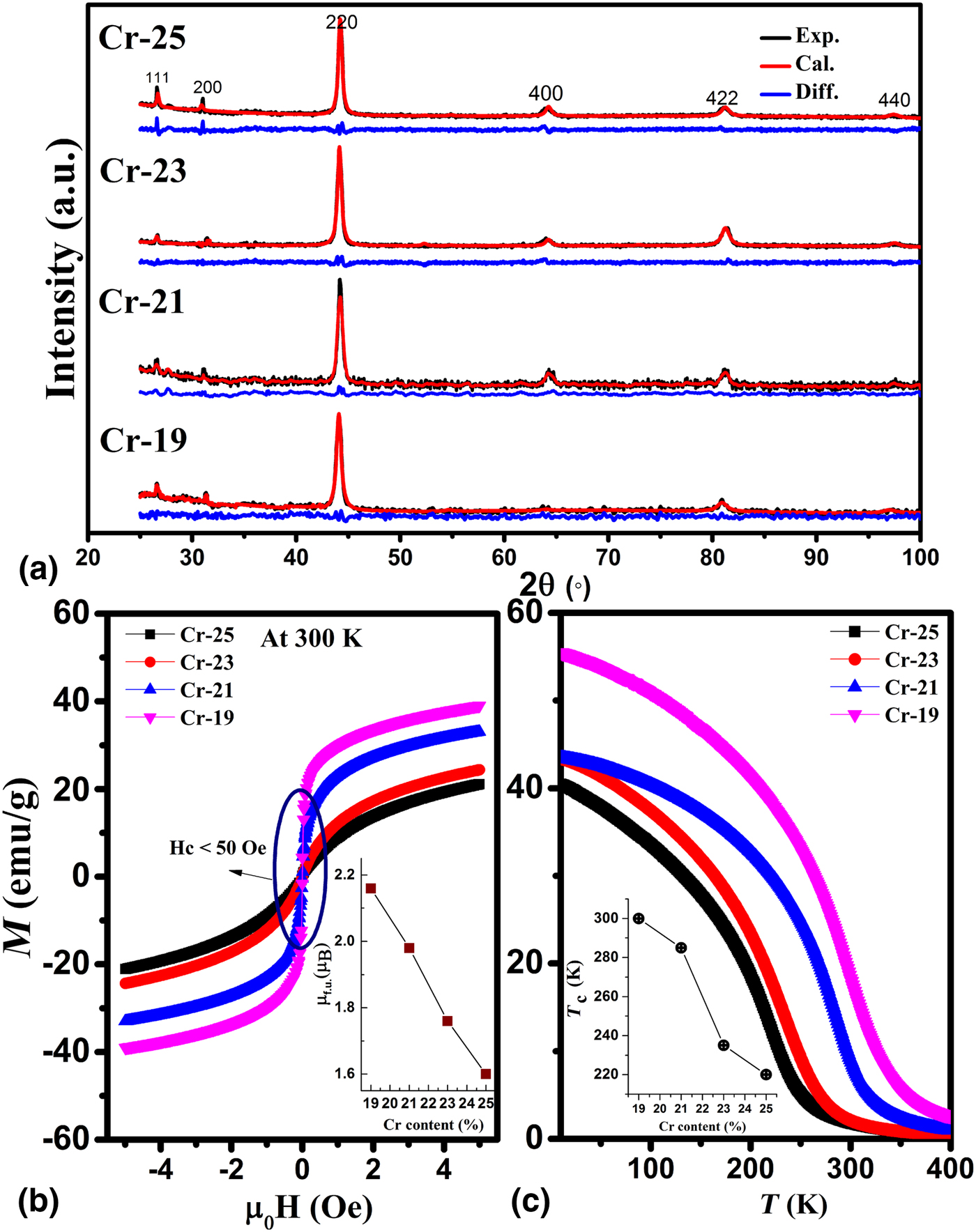
Figure 1(a) shows the Rietveld refined x-ray diffraction patterns of Fe75−xCrxAl25 (19≤x≤25) bulk samples. All the samples crystallized in an L21 structure with the Fm3m space group. An L21 structure is confirmed by the presence of (111) and (200) superlattice reflections, which signify ordering in the Cr–Al and Fe–Cr sublattices, respectively.[Reference Sebastian, Lakshmi and Venugopalan20] All the samples were single phase. The lattice parameters obtained from Rietveld refinement showed a decrease, from 5.83 Å for Cr-19 to 5.79 Å for Cr-25. With an increase in Cr content, the lattice parameter as well as cell volume decreased due to lattice compression in the x–y plane.[Reference Paduani, Pöttker, Ardisson, Schaf, Takeuchi, Yoshida, Soriano and Kalisz21] The field-dependent magnetic properties, i.e., M versus H, were recorded at 300 K and field sweeps from –5 to +5 T [Fig. 1(b)]. All the samples exhibited soft ferromagnetic behavior with low coercivity values (<50 Oe), which is desirable for magnetic cooling. The increase in saturation magnetization (M s) with decreasing Cr content could be explained by mean field theory and the Bethe–Slater curve.[Reference McHenry, Willard and Laughlin22] With decreasing Cr content, the lattice parameter increased; hence, effective exchange interactions also increased, resulting in higher M s. The temperature-dependent magnetic properties are shown in Fig. 1(c). The M–T curves were recorded at an applied field of 0.1 T, temperature sweeps from 400 K down to 10 K, followed by an increase in temperature back to 400 K. The cooling and warming curves overlapped, signifying the absence of thermal hysteresis. The T c was derived from the minima of the dM/dT versus T curve. For Cr content, i.e., x = 25, 23, 21, and 19, the T c values were 220, 235, 282, and 300 K, respectively [inset Fig. 1(c)]. Chromium, being antiferromagnetic in nature, contributes negative exchange interactions in the ferromagnetic Fe–Al system, resulting in lower T c.[Reference Chaudhary and Ramanujan23] Specifically, the T c values of 282 and 300 K obtained in this work are attractive for near room temperature cooling. All the samples exhibited a broad transition from the FM to PM phase.
(a) Rietveld refined x-ray diffraction pattern for Fe75−xCrxAl25 bulk samples with different Cr content. Black line represents experimental values, red line represents calculated values, and blue line represents the difference in these values. (b) Field-dependent magnetization (M versus μ 0H) for Fe75−xCrxAl25 (19≤x≤25) bulk samples from −5 to +5 T applied field at 300 K. Inset shows the plot of Bohr magnetron per formula unit (μ f.u.) versus % Cr content. (c) Temperature-dependent magnetization (M versus T) curves for Fe75−xCrxAl25 (19≤x≤25) bulk samples. Inset shows the plot of T c with % Cr content.

MCE properties
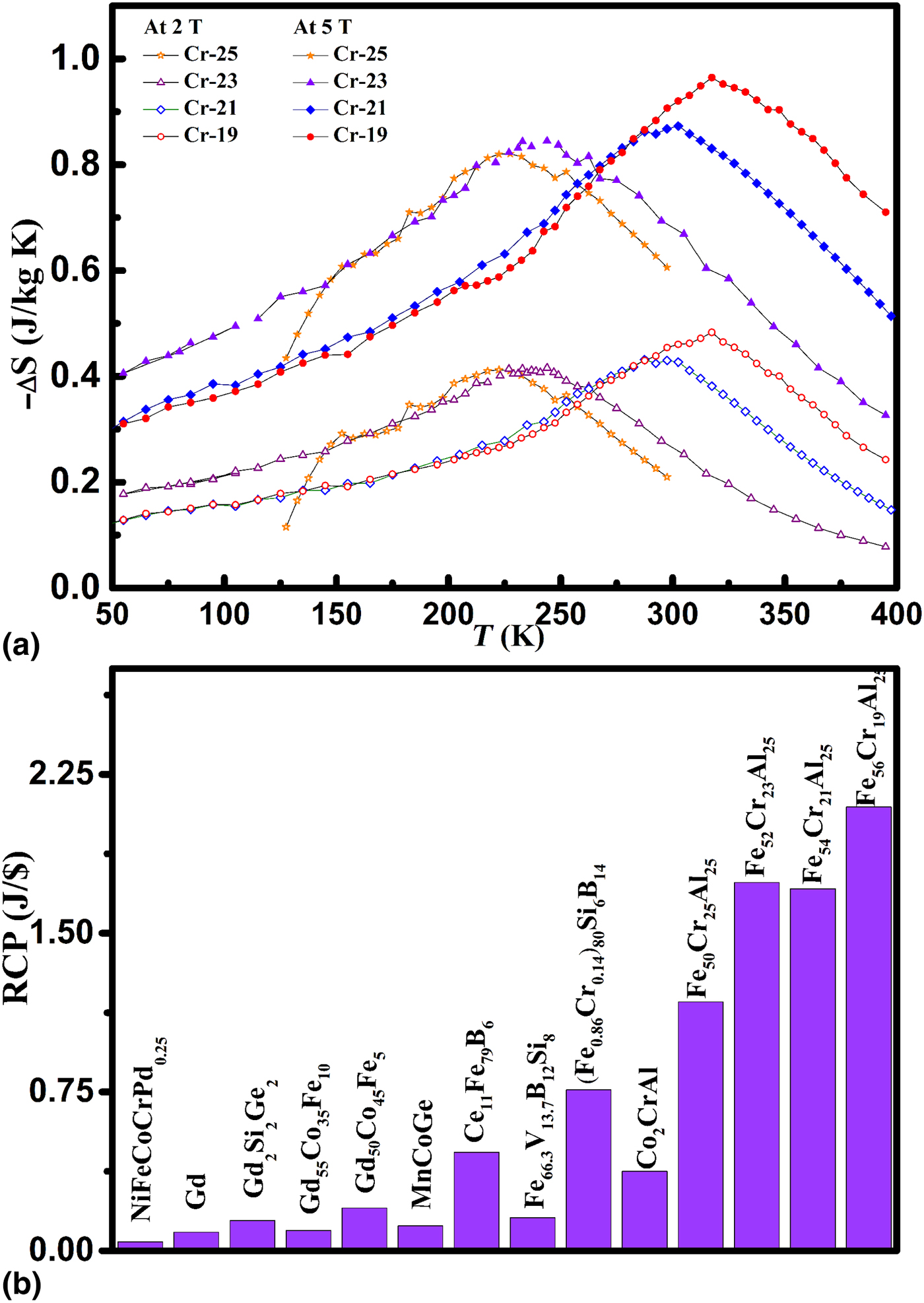
To evaluate the magnetocaloric properties of Fe75−xCrxAl25 (x = 19, 21, 23, and 25) bulk samples, isothermal magnetization curves around the Curie temperature were recorded with ΔT = 5 K. Using the Maxwell relationship, $\Delta S_{\rm M} = \int_0^{H_{\rm m}} {} \left( {\partial M/\partial T} \right)_{\rm H}\; dH$, the magnetic entropy change w.r.t. temperature was determined for field strengths ranging from 0 to 5 T, [Fig. 2(a)]. Since ΔS M is proportional to the derivative of magnetization w.r.t. temperature, its magnitude should be largest near the transition temperature. As expected, upon increasing the magnetic field, the magnitude of ΔS M increases due to enhanced ferromagnetic interactions. With a decrease in Cr content, from 25 to 19 wt.%, the peak of the magnetic entropy change curve shifted toward higher temperatures, consistent with the trend in T c. This shift in T c is accompanied by ~18% increment in the ΔS M value of Cr-19 compared with the corresponding value of Cr-25.
(a) ΔSM versus T curves for Fe75−xCrxAl25 (x = 19, 21, 23, and 25) bulk samples at 2 T (open symbols) and 5 T (closed symbols). (b) RCP/US$ for some of the popular magnetocaloric materials (cost of elements in US$/100 g from https://www.chemicool.com/).

Another figure of merit used to quantify the MCM is the RCP. It is defined as the amount of heat that can be transferred between the hot and cold ends in a typical refrigeration cycle. Mathematically, it can be expressed as the product of the magnitude of maximum magnetic entropy change and the temperature difference at full width of half maximum (FWHM), i.e., RCP = − ΔS M| × δT FWHM.[Reference Law, Franco and Ramanujan24] The RCP of a MCM should be high for practical applications. This implies that δT FWHM, i.e., the width of the ΔS Mcurve is also an important metric to compare different MCM. The effect of Cr content on δT FWHM and RCP at ΔH = 5 T is shown in Supplementary Fig. S2. Both δT FWHM and RCP are highest for Cr-19. These values decrease with Cr addition.
The RCP values of our alloys are comparable to recently reported NiFeCoCrPdx high entropy alloys,[Reference Belyea, Lucas, Michel, Horwath and Miller25] (Fe1−xMnx)2Y[Reference Wang, Ma, Guo and Zhou26] and Pr0.4Re0.1Sr0.5−yBayMnO3.[Reference Bourouina, Krichene, Boudjada and Boujelben27] The cost of an MCM is an important and critical factor to consider for developing industrial applications.[Reference Russek and Zimm28] An analysis of RCPFWHM in terms of the cost of the material was performed [Fig. 2(b)]. Materials that show promising RCP values, e.g., Gd, Fe-based alloys, and high entropy alloys, were considered. Gd shows good RCP values but considering its high cost, RCP/US$ of Gd is quite low compared with Fe75−xCrxAl25 alloys. Ce11Fe79B6 exhibits RCP of 420/Jkg at 5 T,[Reference Li, Zhang, Li, Zhao, Zhao and Shen29] which is higher than the RCP (300/Jkg) of Fe56Cr19Al25; however, the RCP/US$ of Fe56Cr19Al25 is 400% more than that of Ce11Fe79B6. The RCP/$ performance for our alloys was found to be ~24 times higher than the RCP/$ of “benchmark” Gd and ~15 times higher than that of Gd2Si2Ge2.
Characterization of nanoparticles
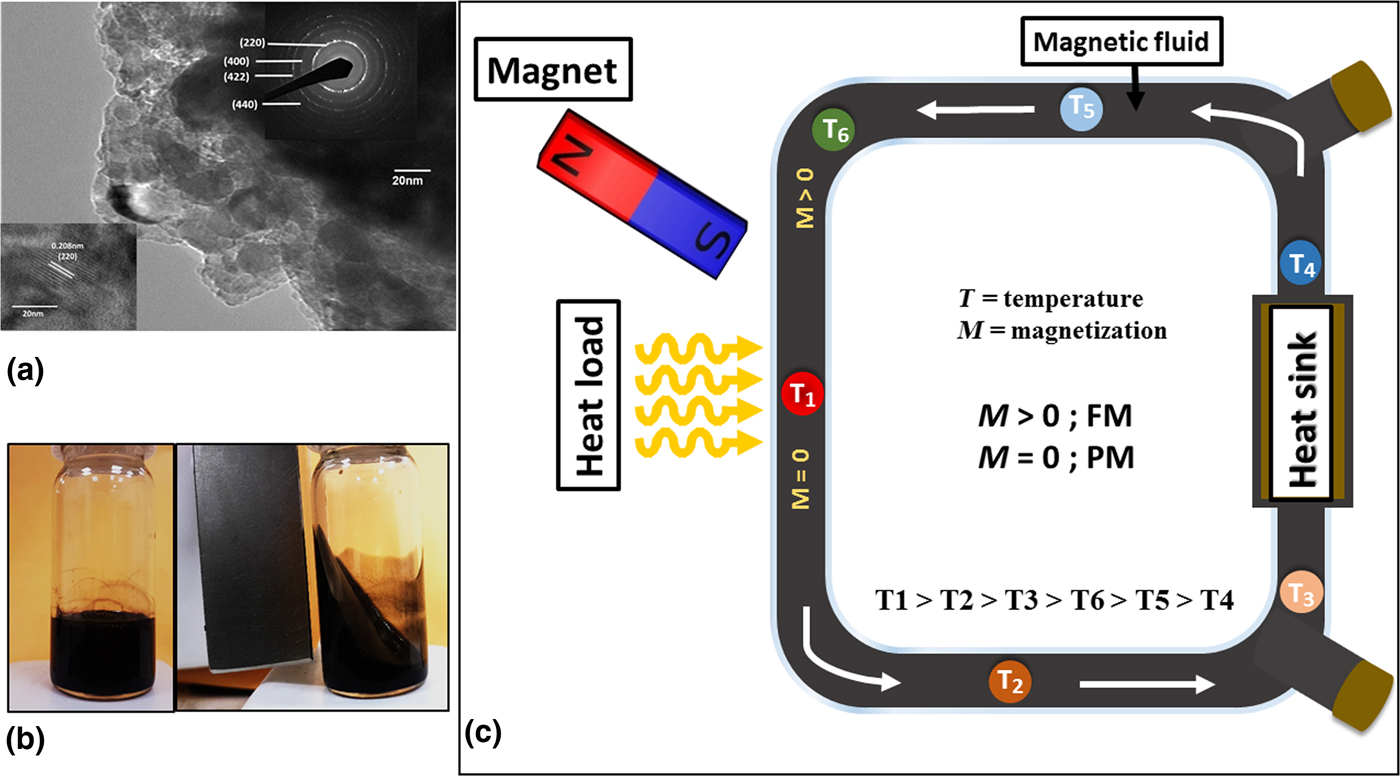
Representative TEM results for Cr-25 powder are shown [Fig. 3(a)]. The particles were equiaxed and exhibited a broad size distribution with an average size of ~28 nm. A typical high-resolution TEM (HRTEM) image of Cr-25 powder is shown in the inset of Fig. 3(a). Nanoscale grains were observed. A lattice spacing value of ~0.208 nm could be indexed to the (220) planes of Fe50Cr25Al25. The selected area diffraction pattern of the particles was indexed to the Fe50Cr25Al25 cubic crystal structure, with Fm3m space group [Fig. 3(a): inset].
(a) Bright-field transmission electron micrograph, for Cr-25 powder sample. Inset shows the HRTEM image with the planar orientation and lattice spacing value. The selected area diffraction (SAD) pattern is also shown which is indexed to Cr-25 powder sample FCC crystal structure. (b) Images of MF without magnetic field and with applied magnetic field. (c) Schematic representation of magnetic cooling prototype.

Magnetic cooling performance
Figure 3(b) shows the MF without any applied magnetic field as well as with an applied magnetic field of 0.3 T using an Nd–Fe–B magnet. MFs composed of Fe75−xCrxAl25 alloy nanoparticles in OA medium were employed as the coolant to remove waste heat from the heat load region. Figure 3(c) schematically depicts the geometry of the TMCD used for this study, the positions of the heat load, heat sink, and the permanent magnet. It also provides a schematic representation of the temperature distribution and magnetization profile of the MF around the tube, which is a key requirement for TM convection. To evaluate the cooling performance, the wall temperature was measured as a function of time by varying several parameters such as Cr content of the alloy nanoparticles, nanoparticle volume fraction (Φ p) in the MF, and applied power (P) at the heat load. The performance was also investigated by numerical modeling using COMSOL Multiphysics employing a single-phase flow model. Cr-19- and Cr-23-based MFs, despite their higher magnetization, were not selected for volume fraction and heat load studies because the particles tended to settle under an applied magnetic field. This might be due to stronger magnetic dipole–dipole interactions, which result in agglomeration, and higher settling of particles over time under an external magnetic field.[Reference Laherisheth, Parekh and Upadhyay30]
Effect of Cr content on the cooling performance
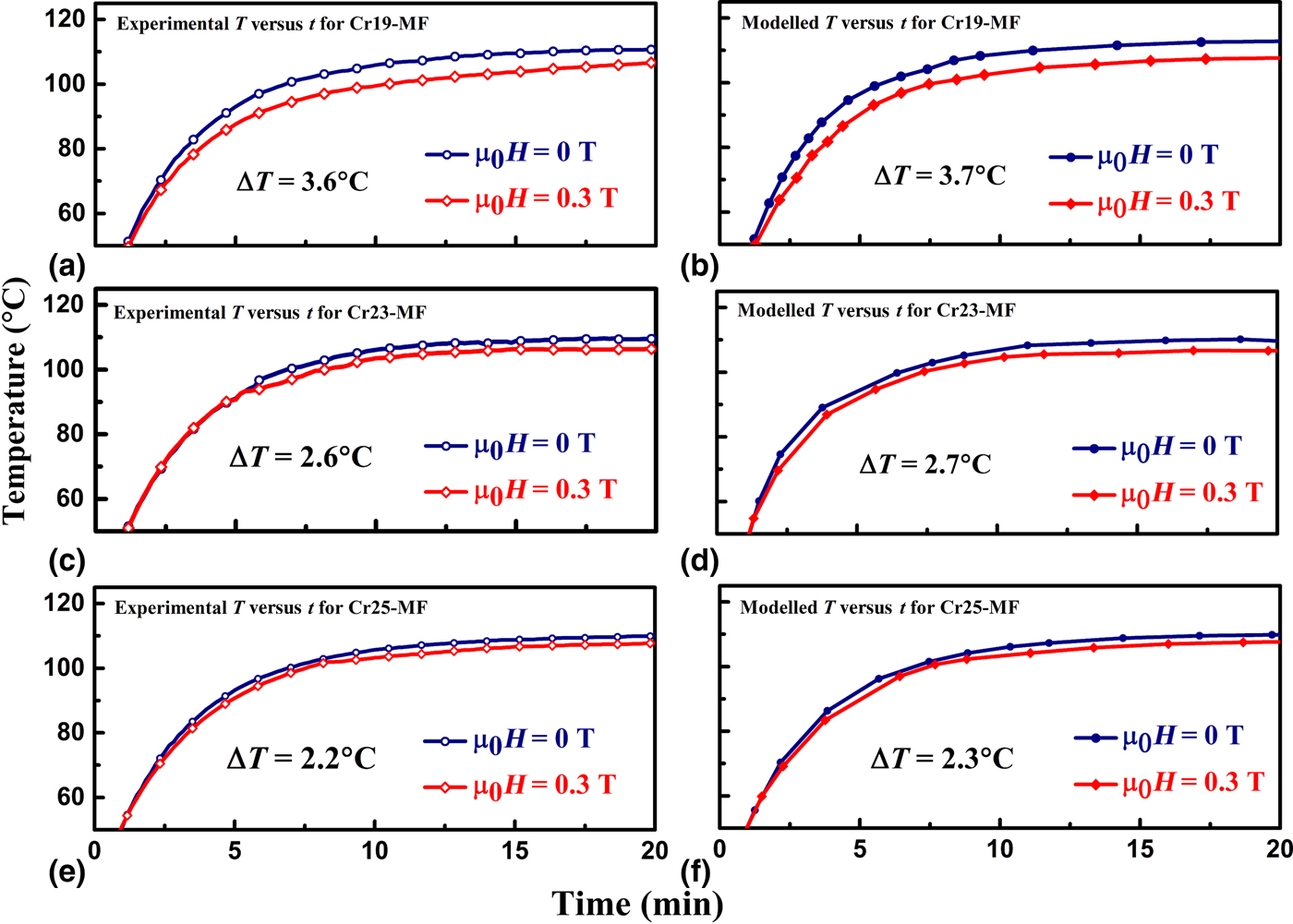
To evaluate the cooling performance of the MFs, experiments were performed at an applied heat load power of 4 W, on Cr-19 MF, Cr-23 MF, and Cr-25 MF. Figures 4(a), 4(c), and 4(e) represent the heat load temperature without and with magnetic field of 0.3 T, for Cr-19 MF, Cr-23 MF, and Cr-25 MF, respectively. The modeled temperature is provided in Figs. 4(b), 4(d), and 4(f). The results from numerical modeling were in good agreement with the observed temperature drop (ΔT) (<4% error). As can be seen from Fig. 4, the heat load temperature dropped when the magnetic field was applied, due to heat transfer by the fluid. From both experimental and modeling results, the value of ΔT is found to be higher for Cr-19 MF than that of Cr-23 MF and Cr-25 MF. The saturation magnetization of Cr-19 nanoparticles is higher than that of Cr-23 and Cr-25 nanoparticles due to an increase in the magnitude of antiferromagnetic interactions with increasing Cr content.[Reference McHenry, Willard and Laughlin22] Consequently, the driving force acting on the Cr-19 MF is greater than that of Cr-23 MF and Cr-25 MF, resulting in superior cooling performance.
Temperature of the heat load as a function of time for applied heat load power of 4 W without and with a magnetic field of 0.3 T for (a) Cr-19 MF, (c) Cr-23 MF, and (e) Cr-25 MF. Modeled temperature profile, without and with applied magnetic field strength of 0.3 T for (b) Cr-19 MF, (d) Cr-23 MF, and (f) Cr-25 MF.

Effect of volume fraction (Φp) on cooling performance
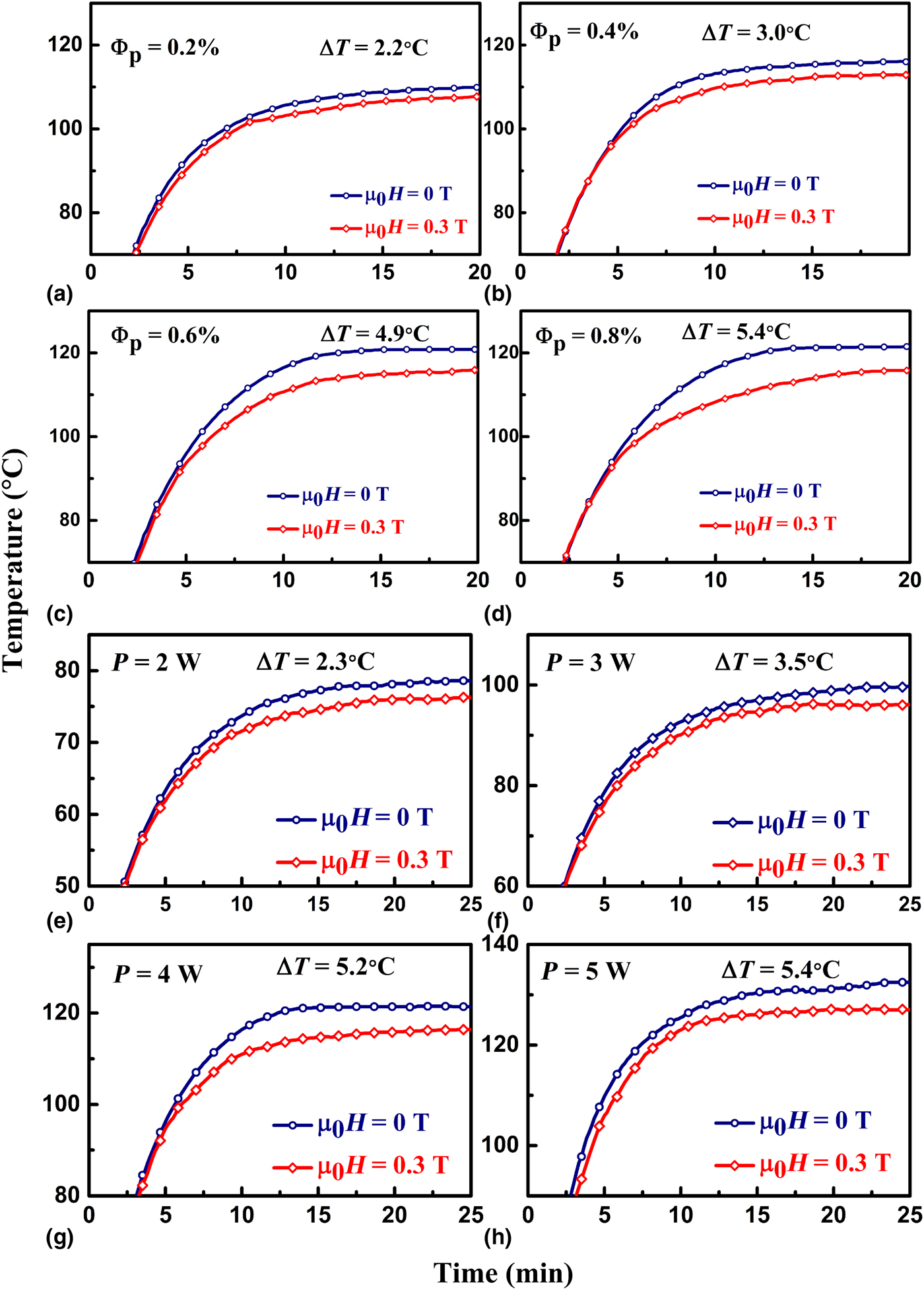
Cr-25 MF was used to study the effect of magnetic nanoparticle volume fraction in the carrier fluid on the cooling performance. Different fluids were prepared by varying the particle concentration (v/v %) in the OA in the range from 0.2% to 0.8%. These MFs were then tested in the device at an applied heat load power of 4 W. Figures 5(a)–5(d) represent the heat load temperature and the cooling performance for a range of Cr-25 MF concentrations. As expected, cooling (ΔT) increased for higher particle concentration. This improvement in cooling could be attributed to enhancement in the magnetic volume force acting on the MF with higher nanoparticle concentration. However, the change in cooling (ΔT) is not a linear function of Φ p. This effect could be related to the increase in viscosity of the MF as a function of nanoparticle concentration, which affects TM convection.[Reference Goharkhah and Ashjaee31]
Effect of Cr-25 nanoparticle volume fraction (Φ p) of (a) 0.2%, (b) 0.4%, (c) 0.6%, and (d) 0.8% on the cooling performance of the TMCD for applied heat load power of 4 W, without and with magnetic field of 0.3 T. Effect of applied heat load power (P) of (e) 2 W, (f) 3 W, (g) 4 W, and (h) 5 W, on the cooling performance of the TMCD for 0.8% Cr-25 MF, without and with 0.3 T magnetic field.

Effect of applied heat load power (P) on cooling performance
Cr-25 MF having 0.8% v/v volume fraction was chosen for cooling performance evaluation under varying heat loads due to its superior performance at 4 W. In Figs. 5(e)–5(h), the heat load temperature versus time is plotted for heat load power in the range of 2–5 W. It is evident that increasing power enhances cooling performance. Higher power results in a larger temperature difference between the heat load and the heat sink regions, increasing a magnetic volume force experienced by the MF, resulting in improved cooling. These results show the self-pumping and self-regulating nature of the TMCD. The device is self-pumping as it does not require a mechanical pump to move the MF. It is self-regulating; the cooling performance improves automatically when the heat load power is increased.
Conclusions
The magnetic and magnetocaloric properties of Fe75−xCrxAl25 bulk samples with L21 crystal structure were studied. With increase in Cr content, lattice compression in the x–y plane was observed. The partial substitution of Cr for Fe in Fe3Al resulted in a monotonic decrease in T c, with T c values attractive for near room temperature cooling. The industrially relevant performance metric of RCP/$ was calculated and was found to be superior compared with high entropy alloys or rare-earth-based MCMs, providing a critical advantage. An average particle size of ~25 nm was found for Fe50Cr25Al25 ball-milled powders. These powders were used to prepare MF. A maximum cooling of ΔT of 5.4°C was observed for Fe50Cr25Al25 MFs (0.8% v/v) under 0.3 T applied magnetic field and an initial temperature of ~125°C. The MFs, prepared from powders of these alloys, are attractive for low-grade waste heat recovery.
Supplementary material
The supplementary material for this article can be found at https://doi.org/10.1557/mrc.2018.122
Acknowledgment
This research is supported by grants from the National Research Foundation, Prime Minister's Office, Singapore under its Campus of Research Excellence and Technological Enterprise (CREATE) programme.