Mass gatherings (MG) have been defined by the National Association of Emergency Medical Service Physicians as “any event in which at least 1000 persons are gathered at a specific location for a defined period of time.”Reference Arbon1 For traditional MGs, the age range of the spectators and participants, event duration, crowd disposition, and attendance vary widely, thus yielding diverse crowd profiles. Large MGs summon worldwide interest and require extensive resource planning. The term special event medical care has been used to define “the provision of preventive, or definitive primary medical care or hospital referral to well persons attending or participating in major sports, recreational, or political events.”Reference Baker, Simone, Niemann and Daly2 This is in contrast to MG events resulting from displacements or disasters where a wider dispersion of health concerns exists.Reference Varon and Fromm3 This paper focuses on special event medical care that occurs at MGs.
MGs present problems for planning and emergency medical response due to the changing conditions and diverse crowds that are attracted to these large events. Furthermore, the medical care at MGs does not have a universally agreed upon set of priorities.Reference Michael and Barbera4 Emergency medical coordinators have used predicted attendance figures to forecast staffing of medical personnel at large events, but these staffing projections as well as the level of care needed (eg, emergency medical technician vs nurse) are ill-defined because they tend to focus mainly on the event attendance estimates. To better assess the number of patient encounters with medical personnel, many researchers have noted several key variables that impact patient presentation rates (PPRs) at MGs, which include a number of variables.Reference Arbon1, Reference Michael and Barbera4–Reference Green and Burnham13
In May 2004, the Fédération Internationale de Football Association (FIFA) chose South Africa (SA) as the first African country to be the host of the Soccer World Cup tournament. Emergency medical services (EMS) specialists working under the South African National Department of Health as part of the medical contingency plan for the 2010 FIFA World Cup used the SA medical resource model to prospectively predict the medical staffing needs for multiple MG events during the month-long, international sporting competition. The aim of this study was to analyze data from this large MG event and compare them with a locally developed model used to predict medical resources required for MG events in resource-limited settings.
METHODS
The SA mass gathering medicine (MGM) model is divided into 12 broad risk categories, which include the nature of the event, the nature of the venue, seated or standing, audience profile, past history of similar events, expected number of spectators, event duration, seasonal considerations, proximity to hospitals, profile of hospitals, additional hazards, and additional on-site facilities. Within each risk category, risk factors are listed and allocated a numerical risk score. The relevant risks for an event have been compared, and the single highest risk score was maintained for each category to determine the overall event risk score (ERS).14 The recommendations include the number of staff with basic life support (BLS), intermediate life support (ILS), advanced life support (ALS), nurse and doctor qualifications, as well as the number of ambulances, ambulance crew, and EMS coordinators recommended for the MG event.
A retrospective analysis was conducted using prospectively collected data from 12 public sites across the Western Cape province of SA during the 2010 FIFA World Cup. Data were gathered from events that took place at either Cape Town Stadium, Fan Walk, Fan Fest, or one of the 9 public viewing areas (PVAs). There were four PVAs within the Cape Town metropole (referred to as Metropole PVAs) and 5 additional PVAs in the outlying province (referred to as Provincial PVAs). The 9 PVAs were set up at existing locations (eg, local sports centers, rugby stadiums, cricket pitches) for spectators to view the games of the 2010 FIFA World Cup. All public viewing areas and additional sites were determined ahead of the tournament, and attendance predictions were made by considering the capacity of the venue and, when possible, past crowd sizes from previous events held at each location (using the SA medical resource mass gathering model (MGM) by Smith.Reference Smith15 The soccer matches themselves took place in the Cape Town Stadium with a 3.5-km stretch of walk (Fan Walk) leading up to the stadium.
All patient contacts that occurred at 1 of the 9 PVAs, Fan Fest, Fan Walk, or Cape Town Stadium (collectively referred to as the “study venues”) throughout the duration of the tournament held between June 10 and July 11, 2010, were recorded. Patients were included if they presented to an on-site medical facility (eg, first-aid station or medical center) during the month-long tournament.
Predictive Model Parameters
To predict the medical resources required at an event, the total minutes for BLS, ILS, and ALS were calculated (eg, number of BLS practitioners x hours of duty x 60 minutes). The duration of contact time that a practitioner was allotted per patient was stratified by level of care, where BLS services required 20 minutes, ILS required 30 minutes, and ALS required 35 minutes of total contact time.Reference Smith15 The required resources for each event were then determined by calculating the total number of patients seeking each level of care by the total contact time for that particular level of care. Therefore, if 12 patients required BLS care, 240 BLS minutes were required (12 BLS patients x 20 minutes required per BLS patient).
To predict the overall PPR, the following formula was used: total patients treated/total entries x 1000. The predicted overall transport to hospital rate (TTHR) was calculated using the formula: total transports to hospital/total entries x 1000. Intelligence collected for each study venue, along with peak attendance figures, provided the factors for risk assessment and the calculation of the ERS for each MG event.
Data Collection
All 12 venues included in this study were provided MG data collection forms designed by the 2010 FIFA Health Coordinators. These surveys asked medical personnel to enter the date, event start time, medical facility, and the time that the patient presented for treatment in free text format. Medical personnel were also asked to record sex, age, medical or trauma, complaint category, treatment level, and discharge status of the patient. Complaint categories were divided into 12 groupings and a “comments” section. Medical care providers were asked to indicate the level of care necessary to adequately treat the patient by selecting BLS, ILS, ALS, nurse, or doctor.
Overall attendance figures were provided by event coordinators. When available, peak attendance figures were used; otherwise, maximum capacity attendance was used to calculate predicted resourcing requirements.
Ethics
The University of Cape Town’s Health Sciences Faculty Research Ethics Committee, in compliance with the Ethical Standards for Clinical Research with the International Convention on Harmonisation Good Clinical Practice (ICH GCP) granted ethics approval to Drs Wayne Smith and Lee Wallis on August 13, 2009, for 1 year; ICH Harmonised Tripartite Guidelines E6: Note for Guidance on Good Clinical Practice (CPMP/ICH/135/95) and FDA Code Federal Regulation Parts 50, 56, and 312; record/reference number 326/2009.
RESULTS
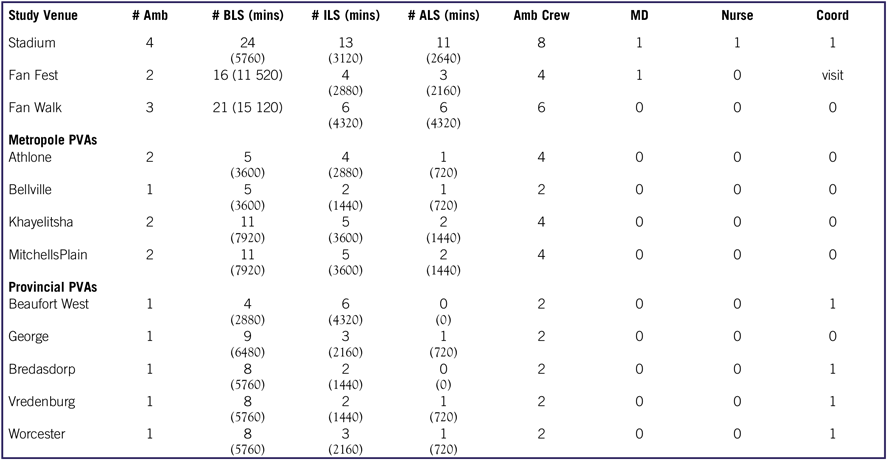
Data were collected between June 10 and July 11, 2010, on event days yielding 1631 patient contacts across all venues (Table 1). There was a total of 129 staffed MG events in the province during the study period, with an overall attendance of 1 916 116.
Daily On-Site Medical Resources for All Study Venues in the Western Cape During the 2010 FIFA World Cup

Note. Resources available on-site are reported in numbers of personnel required and total provider minutes available. These figures do not include on-site medical resources provided by the South African military for events at Cape Town Stadium and the Fan Fest. # = number; Amb = ambulance(s); Coord = coordinator; MD = doctor; mins = minutes; PVA = public viewing areas.
Patients Treated by Level of Care
BLS services were necessary for 78.4% (n = 1279) of all patients treated at a study venue (Table 2). ILS services were required for 14.0% (n = 228) of all patients, and ALS services were required for 3.1% (n = 51) of all patients treated. Thirty-five (2.1%) patients had no chief complaint indicated, and the EMS coordinators could not assess the minimum level of care required. Additionally, 0.1% (n = 2) patients required the services of a nurse, whereas 2.2% (n = 36) required the services of a doctor.
Patients Treated by Level of Care for All Venues Used on the Western Cape During the 2010 FIFA World Cup

ALS = advanced life support; BLS = basic life support; ILS = intermediate life support; MD = doctor; PVA = public viewing areas.
Venue Information
Cape Town Stadium hosted 8 matches over the month-long tournament. Each event took fewer than 4 hours, including queuing and egress. The Fan Fest was operational for 12 hours on 27 event days. The overall attendance for the 4 Metropole PVAs was 175 469 spectators. The overall attendance reported at 5 Provincial PVAs was 76 243 spectators.
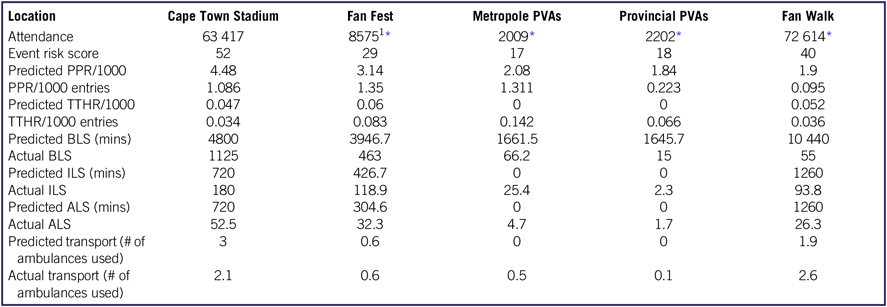
On game days, the Fan Walk accommodated a total of 580 913 people. Table 3 shows the predicted resources for each venue.
Comparison of Predicted Resources to Actual Resources Used

ALS = advanced life support; BLS = basic life support; ILS = intermediate life support.
PVAs = public viewing areas; *all attendances reported as averages for each event day.
DISCUSSION
The MGM predictive model consistently overestimated required resources. This was most evident at short duration events where predictable levels of attendance were known (see Table 3). The model was inconsistent in estimating resources for prolonged events with fluctuating numbers of attendees due to the static nature of the model. BLS services were performed for 78.4% of all presentations and were consistently overestimated for all venues using the predictive model. ILS and ALS presentations were overestimated at Cape Town Stadium. The predictive model underestimated the ALS and ILS resources, which were required at the PVAs in both the metropole and provincial venues. The model also showed varying levels of predictive ability for total transports to hospital, with an over-prediction at the Cape Town Stadium and an under-prediction at the PVAs (both provincial and metropole).
Using data from the 2010 World Cup, we have shown the limitations of a current predictive model. The model was able to predict ILS resources for Cape Town Stadium and the Fan Walk, 2 events with consistently high ERS (medians = 51 and 40, respectively) due to high attendance numbers. The Fan Fest and PVAs have variable attendance figures and ERSs; therefore, the model often predicted zero ILS needed. Similarly, the ALS resources were over-predicted for events at Cape Town Stadium and the Fan Walk, but were under-predicted for MG events at the Fan Fest and PVAs. These results are consistent with a previous retrospective review by Smith et al.Reference Smith15 (2008), which demonstrated that low attendance numbers lead to under-predicted ILS services.
A recent literature review looking at published rates of PPR and TTHR at MG events showed wide variability between events ranging from 0.013/1000 to 198.1/1000.Reference Ranse, Hutton and Keene16 Looking specifically at events that were conducted in areas were unbounded (in contrast to a bounded stadium area) for a long period of time with similar PPR and TTHR rates; closer to the ones found at the World Cup can be observed. For instance, the PPR for the Winter Olympic Games was quoted as 2.2/1000. Similarly, the Formula 1 Grand Prix PPR rate was quoted as 2.2/1000.Reference Ranse, Hutton and Keene16 Durban, another venue for the 2010 World Cup, had reported a PPR of 4.80/1000 for its stadium venue, which is slightly higher than what was seen in Cape Town.Reference Hardcastle, Naidoo and Samlal17 Other soccer venues have reported PPR rates of between 4.2 and 31/1000 people.Reference Bhangu, Agar, Pickard and Leary18 While crowd size is often cited as the biggest determining factor for patient load,Reference DeLorenzo7 others have shown a near-linear relationship between temperature and treatment rate.Reference Flabouris and Bridgewater12 Other factors such as weather, event type and duration, attendance, age of attendees, and alcohol and drug use contribute significantly to the impact on MG medical care.Reference Milsten, Maguire, Bissell and Seaman6, Reference Leonard, Nuji, Petrilli and Calabro19 Our analysis provides insight into the difficulties of planning for events, which remain unbounded, such as the PVA events. Previous literature suggests that unbounded events have a twofold to threefold higher relative risk than those that are bounded.Reference Locoh-Donou, Yan and Berry20 This continues to highlight the difficulties encountered in developing predictive models for resource allocation.
Ambulance Prediction
Due to the difficulty of calculating ambulance availability, predicting the number of ambulances required at an MG is rather difficult. During the 2010 World Cup tournament, patients requiring transport via ambulance were often sent with another transport patient, thereby allowing 2 patients to be transported by 1 available ambulance. For purposes of this study, after its first transport, an ambulance was considered unavailable for the remainder of the event. Often MG events cause traffic congestion and closed streets, which increase the time that an ambulance is away from an event site. This was the case for the Fan Fest in the center of the city of Cape Town. However, the ambulances did return to their original study venue and were used multiple times throughout the event when necessary. These factors are not reflected in our data, and therefore the model appears to under-predict ambulance resources for at least 1 event at each study venue. More ambulance over-predictions were prevalent at the stadium and Fan Walk than under-predictions; however, ambulance resources for the Fan Fest were under-predicted more often than over-predicted. The SA practice of doubling the number of patients in 1 ambulance was key to ensuring adequate coverage for emergency transportations. Additionally, the emergency department of the hospital directly adjacent to the Cape Town Stadium was not accepting patients via ambulances (diversion status) on event days to allow maximum attention of services for potential patients of a mass casualty incident.
Prospective Use of the South African Model
Maximum crowd capacity and known conditions (eg, seated or standing, proximity to hospital) of each venue provided the intelligence used to prospectively predict minimum EMS requirements using the South African MGM resource model. Site-specific amenities may be used to adjust the EMS staffing numbers. For example, Cape Town Stadium had 5 medical stations within the interior of the stadium. Although the model predicted a need for 3 ALS, this number was increased to at least 5 to distribute the quality of care equally throughout the stadium. To ease the burden on the planning committee and to simplify the schedules of the EMS providers, staff numbers were not adjusted for each day at 1 venue. Consequently, the number of staff numbers available at each venue was not an actual reflection of the predicted number that was generated by the MG matrix. For all venues, the minimum requirements predicted by the MGM were supplemented with additional EMS personnel as described previously. By using the venue’s maximum capacity, the predicted risk would be the greatest possible risk based on crowd size, thereby predicting the minimum requirements for the maximum crowd. Thus, the predicted EMS staff should have been adequate to provide care for any crowd with fewer than the maximum number of attendees. However, in assessing the validity of the MGM, maximum capacity was not used to predict the ERS or staff resources. Instead, the “peak attendance during the event” was used to calculate the “risk score as it relates to attendance number at an event.” This was done for the Fan Fest, Metropole PVAs, and the Fan Walk because the flux of the crowd was continuous. In addition to public broadcast of FIFA tournament games, concerts and activities were held throughout the day; therefore, spectators arrived at leisure and stayed for varying lengths of time. The Provincial PVAs did not report peak attendance statistics; therefore, maximum capacity was used to validate the model’s predicted resources. The peak attendance recorded during the event is a more stringent means of validating the matrix, compared with maximum attendance or maximum capacity figures.
Need for Outcomes-Based Research
This paper is a demonstration of a practical application and specific outcomes from a field-based assessment. A comparison of this resource model for medical and first responder assets in preplanning for large-scale MG events, such as sporting events, with other models is recommended. The need to change the focus of MGM resource modeling toward research that better determines the impact that a risk factor places on an MG event has been identified previously.Reference Arbon, Bridgewater and Smith9 Currently, the weighting of risk factors is highly empirical, yet risk scores are directly related to the resources allocated. Thus, the risk score allocated to each risk factor must reflect a proportionally relevant risk severity regarding EMS workload. For example, increased temperature and humidity are correlated with increased PPRsReference Perron, Brady, Custalow and Johnson21; therefore, MGM provider numbers should be altered under scientifically identified weather conditions.
Additionally, there is a need for research that is focused on the clinical outcomes of patients treated at MG events. It is unclear how the level of treatment that is provided at an MG event affects the following patient outcomes: morbidity, mortality, repeat presentation rate, hospital admission rate, and length of hospital stay. What is clear is that providing minimal resources and potentially understaffing an event, or only staffing minimally qualified professionals (ie, BLS), is an inexpensive approach, whereas overstaffing EMS personnel or staffing personnel with advanced training is expensive. However, these benefits and consequences are immature, and without outcomes-based research both the ethical and expense implications needed to verify each approach are unknown.
Limitations
The MGM provided some limitations. The use of standard data collection sheets may have led to misclassification of categories of medical care. Most significantly, “treatment level” was inappropriately checked off as the level of training the medical provider, rather than the actual level of care required to treat the patient’s condition. Because subsequent hospital or primary care provider treatment was not studied, it was not possible to examine the accuracy of care level designations.
Missing data caused a small percentage of the results to be undetermined. However, these instances did not negatively affect the overall study findings. Where resources were under-predicted for level of care (ILS and ALS), this was usually a result of zero services predicted (ie, lack of the predicted resource) and not due to complete utilization of all services (ie, insufficient resources available).
CONCLUSIONS
MGM resource models can be used to predict the health care resources for MG events but have inherent limitations. BLS resources are used to treat the majority of patients who present with injury or illness. The model used in this study over-predicted the BLS requirements for every venue, without regard to ERS. However, by using estimated attendance figures in pre-event planning, the model may not predict ILS or ALS requirements; therefore, these resources may be under-predicted for events with low attendance. The infrequent presentation of patients requiring these levels of care is anticipated to be too few to allow for resourcing. To allow for the prediction of MG resources, more accurate attendance prediction models or ticket sales data are needed. Likewise, research-based outcomes will illuminate the effect that risk factors have on EMS demand and will allow more accurate predictions of the medical needs at MGs.