Social conflict theory anticipates that democracies should be more likely than autocracies to redistribute.Footnote 1 Majority rule allows poorer citizens to exert greater influence over the political economy than economic elites, therefore narrowing the gap between rich and poor through progressive taxes and social spending. Indeed, because political equality is supposed to usher in greater economic equality once the franchise is universal, democracy represents a credible commitment by elites to redistribution. Yet inequality and democracy are much more compatible empirically than social conflict theory predicts. While the distribution of income is right skewed throughout the world, redistribution from the rich to the poor is not higher in democracies than autocracies.Footnote 2 It is therefore not surprising that, even at the highest levels of inequality, democracy is not associated with redistribution.Footnote 3
What explains the lack of a general relationship between democracy and redistribution? Despite the fact that there is often pressure from below for political reform,Footnote 4 concrete steps toward democracy – such as scheduling elections and relinquishing control over the security apparatus – are often initiated by the elites themselves.Footnote 5 Moreover, a democratic transition is more likely if elites manage to negotiate constitutional frameworks that continue to protect their interests after they exit.Footnote 6 In Western Europe during the nineteenth and early twentieth centuries, democratization proceeded in gradual, calculated steps that were intended to appease economic elites’ fear of radical political change.Footnote 7 Similarly, economically powerful elites accepted democracy in Latin America when conservative parties protected their interests.Footnote 8
There are two literatures that help us understand this puzzle. The first is a new generation of social conflict theory that argues that, even after a transition, elites may circumvent democratic institutions to capture policy making and block redistribution.Footnote 9 If elites’ de facto power persists after democratization, they can engage in vote buying or clientelism that fractionalizes the political power of the poor.Footnote 10 The second is power resources theory, a dominant explanation of variation in the size and scope of welfare states in Organisation for Economic Co-operation and Development (OECD) countries. Korpi, Stephens and others argue that what are needed are strong unions that compress wage and salary distributions, thus lowering market inequality, and social democratic parties that deliver redistributive social policy.Footnote 11 Yet in marked contrast to the OECD context, partisanship seems to have little explanatory power over redistribution in the developing world.Footnote 12 Moreover, the weaker bargaining position of labor in the developing world, alongside globalization, may limit the effect of democracy on redistribution.Footnote 13
This article draws on both social conflict theory and power resources theory to further our understanding of the relationship between democracy and redistribution. We unpack the democratization process to gain leverage on the question of why some democracies redistribute more than others. We make sense of the fact that democracy only sometimes empowers the poor in light of the realization that democracy is often captured by elites and may be no better than autocracy at leveling the playing field.
We introduce a theory that incorporates insights about the disproportionate influence of economic elites on democratic transition and policy making under democracy. Lacking recourse to reliable institutions to fully protect their rights under autocracy over the longer term, economic elites prefer democracy to autocratic rule if they can create and sustain roadblocks to redistribution under democracy. This can even be the case when under autocracy there are political parties or a legislature, given that these institutions may unevenly (or only temporarily) protect economic elites’ rights. By over-representing the wealthy in political institutions, inducing gridlock, imposing military veto power over policy and elite dominance over local politics, elites can complicate the ability of democratic politicians to orient public spending priorities toward the poor majority.Footnote 14 These tools can help economic elites secure a credible commitment to their rights and interests after the transition. We therefore hypothesize that there is a relationship between democracy and redistribution but only if democratization occurs when elites are relatively weak. Because this is relatively rare, we argue that democratization is frequently about allaying elite fears, and rarely aimed at preventing revolution.
We argue that in order to explain variation in redistribution among democracies, one must identify the conditions under which democracies were born. When a revolution or similar shock occurs, elites are caught off balance. This fear pressures elites to rush into a transition bargain more quickly than they would otherwise have done, thus decreasing their ability to manipulate the transition process to safeguard their interests after democratization. Yet absent such a shock, elites may bargain for transition on favorable terms. Their outsized influence is often codified in a constitution before a transition and bequeathed to a new democracy.
Empirically, we use a cross-national time-series dataset to evaluate whether the relationship between democracy and redistribution is conditioned by the strength of elites on the eve of the transition. We find that democratization induces greater redistribution when transition occurs in the wake of revolution or, alternatively, when elites are unable to impose a constitution under autocracy that persists after transition. If economic elites are strong on the eve of democratization, however, this result reverses. Further analysis of constitutions suggests why this relationship holds: constitutions under democracy that are inherited from a dictatorship shape the rules of the political game so that right-wing parties are likely to be more strongly represented, the political system is more prone to gridlock, the military is more powerful, and local governments lack autonomy. Compatible with several recent contributions to the literature, the relationship between elite strength and redistribution is conditioned by the distribution of income. The results are robust to the estimation strategy, different measures of both the dependent variable and the independent variable of elite strength upon transition, and to accounting for potential endogeneity.
We develop new data series to measure redistribution in three ways. The first is Social Spending (per cent of gross domestic product, GDP), which captures government expenditures on education, health and housing. The second is Welfare and Social Insurance Spending (per cent of GDP), which measures government expenditures on unemployment and disability insurance, health insurance and pensions, and welfare transfers. The third is Taxes on Income, Profits and Capital Gains (per cent of GDP), which proxies for the progressivity of the tax structure: the tax rates on these tax bases either increase with income or only apply to citizens at the upper end of the income distribution. By using both primary and secondary sources, we compile new and improved series for both developed and developing countries between 1972 and 2008.
Theoretical Framework
Three chief actors drive the dynamics over regime choice. The first is the economic elite. These individuals enjoy selective property rights that grant them special privileges and flows of rents in exchange for generating revenues. Their property rights can be withdrawn by political elites if political calculations drive them to do so, making their favorable position inherently tenuous. These are not merely rare or passing threats; political elites sometimes have strong incentives to expropriate and harass economic elites. This is not the case under democracy if economic elites have a strong hand in its design. While we agree with social conflict theory that economic elites seek first and foremost to protect their rights and interests, we disagree that autocracy can necessarily deliver them their most preferred outcomes. We argue that economic elites prefer ‘gamed’ democracy in their favor to rule of law autocracy, rule of law autocracy to full democracy, and any of these forms of government to unconstrained predatory autocracy.
The political elite, composed of key military players and civilian politicians, and headed by a dictator or junta under autocracy, is the second critical actor. While there may be conflicts and machinations even within this group, they share the power and organizational capacity to seize the reigns of government. Their credible threat of violence allows them to grant and withdraw property rights. While their incentives can sometimes be aligned to protect the rights and interests of the economic elite, their policy preferences are not always shared. And even if political elites protect the property rights of economic elites, leading to an overlap in policy preferences at a given time, these property rights can be rapidly withdrawn, eroding the policy overlap.
The frequent and irregular leader cycling that often characterizes autocracies are two pieces of evidence suggesting that a perfect overlap between political and economic elites is rare.Footnote 15 Short tenure in office and irregular exits may indicate that (1) economic elites are uniformly opposed to the policies of the ruling political elite and support an ouster; (2) a subset of economic elites desires a break with the current ruling political elite; (3) the military is acting independently of economic elites or (4) the identity or preferences of political elites is shifting while those of economic elites are relatively constant. None of these scenarios supports the notion that economic and political elites are united or monolithic.
The third important actor is the general population. The members of this group suffer from a serious collective action problem, and therefore typically depend on mobilization from above. The masses can help the political elite protract autocracy, either by being bought off through targeted exchanges or by supporting a populist regime that favors them at the expense of economic elites. By the same token, factions of the population can help the economic elite achieve democratization, particularly if they receive negligible benefits under dictatorship. They can do this by contributing to the leverage exercised by economic elites (for example, via strikes and protests) as the latter bargain for the regime's exit. While the masses may temporarily support a populist dictatorship, their optimal outcome over the long run is full democracy. As we argue below, they can obtain this outcome via a popular revolution, or if they successfully sweep out economic and political elites and codify a new democratic constitution.
The Politics of Autocracy
Although the economic elite under autocracy rely on political elites to represent their interests and protect their property rights, the political elite have interests of their own that may diverge from those of the economic elite. Indeed, the internal politics of the regime may lead the ruler to betray the pre-existing economic elite in order to reward key members of the organization that launched him into office. Why might political elites systematically seek to weaken economic elites or act against their interests? There are three fundamental difficulties that economic elites face in relying on political elites to implement their preferred policies under dictatorship: agency problems, uncertainty, and political incentives.
First, while economic elites need political partners to rule, and may aid their rise to office with some reasonable expectation of what policies they will implement, it is often difficult to control the behavior of political elites once they gain power. There are three reasons why this is the case when the principals are the economic elites and the agents are the political elites. First, the penalty that the principals can exact on their agents may be insufficiently costly. Although the economic elites can threaten to withdraw revenues or other types of financial support, there are often alternative sources of revenue that political elites can tap. Secondly, the expected gains of non-compliance by the political elites can be high in some contexts, especially when there are potential alternative sources of political support. Thirdly, because of the opaque or sophisticated nature of policies that regulate property rights, it may be prohibitively costly for economic elites to closely monitor political elites, making agency slippage a greater concern under autocracy.
The second fundamental difficulty that economic elites face in relying on political elites is that the political elites who seize power may deliberately not define their major political objectives prior to a coup attempt in order to avoid a debate that would make it more difficult to put together a winning coup coalition to begin with.Footnote 16 Strategic circumspection by the dictator and his political coalition about their intentions diminishes the ability of economic elites to predict his loyalty to them and his post-coup policies. As a result, members of the economic elite may fear that a dictator will transgress against their interests, and with good reason. For example, both Leguia and Odría in Peru and Castello Branco in Brazil harassed and imprisoned economic elites who helped launch them into office. While democratic institutions may be constructed to protect the rich, it is more difficult to forge a long-term commitment to property rights under autocracy.Footnote 17 Even if a particular dictator can be trusted, in the absence of a mechanism to rotate power, there remains uncertainty about the longevity of, or the successor to, the dictator – and thus uncertainty about property rights. Even in longer-lived rule of law autocracies, there is no guarantee that stability will be replicated in the future despite legislatures, political parties, constitutions or other tools used by the elites to defend their interests. This is in contrast to democracy: rotation in office via elections ensures that politicians cannot grow powerful enough to threaten elite rights.
The final reason why a dictator and his political coalition may be motivated to target economic elites is due to their fundamentally different political incentives. While a dictator's expropriation of economic elites may preserve his ability to act independently in the future by eliminating rivals with longstanding power, his support group can also benefit from this policy if its members are distinct from the economic elite when they gain power. In particular, a new dictator can redistribute away from current economic elites to signal his willingness to adopt property rights in the near future that are favorable to those who helped him grab power. This policy reveals that the dictator privileges the political support he obtains from the members of the group that brought him to power.
Large-scale expropriation, and the subsequent destruction of economic elites, illustrates the salient consequences of a divergence between economic and political elites. Albertus and Menaldo have shown that the majority of Latin American countries experienced at least one large-scale expropriation of land, banks, or natural resources under autocracy from 1950–2002.Footnote 18 The expropriation of land and capital under dictatorship is not unique to Latin America. Prominent cases of autocratic expropriation of land and capital outside the region include Egypt after 1952, Mugabe's expropriations of white landlords in Zimbabwe, and a host of examples during the late 1940s and early 1950s in East Asia, including Taiwan, North Vietnam, Indonesia, and the Philippines.
The Political Economy of Elite-Led Democratic Transition
The economic elite's uncertainty about their property rights, while not eliminated, can nonetheless be mitigated under democracy. Property rights can be codified and enforced in a way that does not depend on the capriciousness of the dictator and his political coalition. There are at least three ways that economic elites can effect a transition to democracy without having to face punitive rates of redistribution under the new regime. First, they can exchange the promise of economic growth and/or jobs in the government bureaucracy for citizen support of a transition,Footnote 19 especially when a rising middle class with aspirations of upward mobility or economic security can be counted on to act as a counterweight to the lower classes.Footnote 20 Creating a broad political party can unite the interests of these two groups.Footnote 21 Secondly, elites can divide and conquer the poor majority. For example, economic elites can use vote buying to their advantage, undercutting universal redistributive policies with moderate targeted exchanges. Thirdly, non-elites will support a transition if it promises increased protection of their property rights through an end to predatory dictatorship,Footnote 22 particularly if they can also be coaxed with patronage.
Mexico's democratization illustrates how economic elites who are betrayed by the political elites under dictatorship may support a transition to protect their interests. The Partido Revolucionario Institucional (PRI)'s expropriation of wealthy bankers and the erosion of northern industrialists’ rents following the 1982 financial crisis led to their defection to the Partido Acción Nacional (PAN), the chief opposition party. It also began a steep decline in PRI support, as disaffected economic elites began to increasingly fund PAN candidates or run for state and local offices themselves. By 1997, the PRI lost the lower house, and it lost the presidency in free and fair elections in 2000 to the PAN candidate, Vicente Fox.
The key variable that motivates economic elites’ willingness to abandon dictatorship and accept democracy is their relative ability to bargain for institutions under democracy that can provide a credible commitment to their rights and interests. When such a bargain can be forged, elites can mobilize a critical mass of citizens or strike a deal with political dissidents to generate the coalition they need to support a democratic transition.Footnote 23 Spain's democratization in the 1970s illustrates this point. Because the social bases of the left had been undermined by changes in Spain's social structure under Franco, conservative elites became convinced that democracy would not threaten their property rights or safety, which induced them to initiate moves toward democracy in 1976–1977.Footnote 24
Yet if economic elites fear being betrayed by political elites during autocracy, and thus are willing to support democracy, how is it the case that economic elites can find reliable principals during the moment of democratic transition? First, economic and political elites may be congruent in their present preferences. Although economic elites may push for transition because they fear that some future exogenous change will erode political elites’ incentives to be responsive to their interests under autocracy, their incentives are aligned in the present: both seek democratization that is favorable to their interests. Secondly, economic elites who are threatened by one faction of political elites can coordinate with another, more reliable faction to spearhead transition while gaining representation at a constitutional convention or other determinative transition processes, or even participating directly in these events.
The idea that the economic elite's fears under dictatorship may motivate them to support a transition contrasts with social conflict theory, which emphasizes elite fears of democracy. Acemoglu and Robinson and Boix, for example, argue that the level of inequality determines the expected rate of redistribution under democracy, and therefore conditions elite support for regime transition. This alternative argument suggests that regime type is endogenous to inequality. Yet these arguments fail to address the fact that under democracy, especially unequal democracies, economic elites may retain many of the advantages they enjoy under autocratic regimes that are friendly to their interests – or even enhance their power. Our view instead anticipates that elites who are powerful during transition will forge institutions that replicate their strength. So although we agree with social conflict theory that inequality can lead to higher redistribution under non-elite biased democracy, we argue that when inequality is high under gamed democracy, the power of economic elites increases and leads to even lower redistribution.
The Political Economy of Elite-Biased Democracy
There are several features of an elite-biased democracy that can be more beneficial to economic elites than a dictatorship, motivating them to support democratization. A large literature demonstrates that economic elites can effectively use their power to informally influence political outcomes. Elites can embrace vote buying and clientelism in an effort to undercut universal redistributive policies.Footnote 25 They can also effectively buy policies through powerful lobbying.Footnote 26 Yet economic elites can go beyond these ad hoc measures by strategically shaping a new democracy's institutions, for example by adopting rules that lead to institutional over-representation of their interests, inducing gridlock, maintaining military vetoes over policy, and exercising local political control.
First, elites can bargain during the transition process for rules or institutions that increase the odds that the politicians selected will be less hostile to their interests. Elites may support property qualifications for elected representatives or malapportionment that leads to their over-representation (for example, Argentina's 1957 constitution).Footnote 27 They can also impose restrictions on the franchise.Footnote 28 Literacy requirements in Brazil were only rescinded in 1985, in Peru in 1980, and in Ecuador in 1980.Footnote 29 Or they can ban socialist and communist parties, as in the 1956 Guatemalan constitution. The appointment of conservative senators is another common approach. The Pinochet government in Chile appointed a host of senators in a successful bid to limit the power of ascendant political parties that could push for redistribution following democratization. Economic elites can also push for electoral rules that make it easier for conservative parties to gain power. Chile's binomial electoral system is one example. Similarly, military juntas aligned with conservative parties in Latin America advocated for permissive electoral rules during transitional constitutional conventions to increase their chances of influencing politics under democracy.Footnote 30
Secondly, economic elites may shape democratic institutions in such a way as to induce gridlock.Footnote 31 Citing the 1946 and 1967 constitutions, for instance, the Ecuadorian Supreme Court and Congress repeatedly blocked legislation initiated by ‘populist’ presidents Arosemena (1961–1963) and Velasco (1968–1973) that was unfriendly towards elites, including higher corporate taxes and agrarian reform.Footnote 32 Of course, economic elites must first gain a foothold in the political system even when they are a small minority. Rokkan and Boix have argued that the move to proportional representation (PR) during the nineteenth and early twentieth centuries was an attempt by embattled right-wing parties (after the extension of the franchise) to survive the increasing threat of socialist parties that would have otherwise dominated majoritarian elections.Footnote 33
Thirdly, in the absence of institutional mechanisms to defend their interests, elites may rely on military allies. In many cases, elites forge alliances with the military under dictatorship that persist beyond the transition. This may take either of two forms. The first are explicit powers awarded to the military over civilian affairs.Footnote 34 For example, Honduras’ 1957 constitution stipulated that the military would select the chief of the armed forces, retain control over military command and selectively deny executive budgetary oversight. Other more subtle forms of military involvement can also deter elected politicians from dismantling institutions that block redistribution, such as ultimatums. Attempts by elected politicians under democracy to weaken or rescind anti-redistributive measures left behind by autocrats risk galvanizing the elite and inducing them to launch a coup. The elite's ability to coordinate such a collective response, triggered by a violation of the constitution, is an ‘off the path’ threat that deters elected politicians from undertaking redistribution.Footnote 35
Finally, democracies that inherit constitutions from autocracies may exhibit electoral rules and institutions that make it easier for powerful interests to assert local control. When local elites are likely to lose in free and fair elections at the local level, they will prefer centralized power over electoral voice and autonomy in local politics. Ziblatt, for instance, demonstrates that local administrators in Prussia following the adoption of universal male suffrage were often wealthy landlords appointed by the central government in collusion with the dominant Conservative party and local economic elites. They were ‘the “linchpin” of the Prussian system of public administration…[and were] the decisive pivot in the capture of the electoral process’.Footnote 36
This perspective is not necessarily incompatible with the popular view that federalism may buttress elite privilege by allowing elites in the periphery to set their own policies.Footnote 37 Even in a federal structure, elites in the periphery want to keep populists at any level of government from challenging an anti-redistributionist status quo. They may therefore support a national constitution that can protect their property rights across the nation uniformly, rather than risk transgressions by local policy makers. Southern oligarchs in the United States, for example, made sure to enshrine slavery at the federal level in the US Constitution.
How elite-biased institutions can be locked in
Although economic elites can influence the circumstances under which democracy is instituted, how can they lock in restrictions on redistribution over time? If elites in unequal societies bequeath conservative-biased institutions to new democracies, and these new democracies fail to produce income- and wealth-equalizing public policies, such as progressive taxation and social spending, then this will further reinforce inequality.Footnote 38 This can occur either directly through the de jure institutions created during the transition, or through de facto elite power that is enhanced due to these institutions and the policies they produce.
First, elite-biased electoral rules created during democratic transition can effectively serve to consolidate existing power structures as economic elites push for rules after democratization that further cement their electoral advantage. For example, elites can engineer a mapping of votes to seats in a way that favors them; for instance, they can gerrymander districts to produce even more skewed malapportionment to their advantage. The second mechanism is to use the power elites have gained from institutions biased in their favor to exercise greater influence than non-elites over the political system. Because the public policies adopted serve to widen inequality, this gives economic elites an advantage in terms of collective action, resources, and de facto power over the less well off. Elites can then gain favorable policies, either via legal means (such as lobbying and financing campaigns), or illegally, via corruption. Moreover, if economic elites can finance and support political parties and social actors such as the media, they can mobilize coalitions around issues that benefit them economically and politically.
Main Hypotheses
While an elite-friendly democracy may be better for economic elites in expectation than more uncertain autocratic rule, elites cannot always manipulate the timing and circumstances of a democratic transition. Unexpected moments of elite weakness may elicit pressure for democratization, leading to a transition despite the elite's inability to guarantee a credible commitment to their rights and interests under democracy. We therefore expect an increase in redistribution from elites to the poor after democratization only when the new democracy follows a transition process when elites are relatively weak and cannot manipulate the transition process.
Prominent examples of democratization amid elite weakness are transitions that occur following attempted or actual revolution, or when an incoming democratic regime can overturn the old order by writing a new constitution that empowers the majority. Under these circumstances, democracy will be redistributive. Yet when elites are strong, such as when transition occurs without a revolution, or if elites can impose a constitution from the outgoing dictatorship, the subsequent elite-biased democracy will be less redistributive than autocracy.
We also generate hypotheses about why elite-biased constitutions will reduce redistribution. These constitutions should be associated with the over-representation of elite interests, which leads to a greater probability of right-wing executives. They should also be associated with PR, in a bid to make it more likely that small conservative parties will gain a political toehold and induce gridlock. Moreover, they should favor larger militaries that may deter violations of elite property rights and interests. Finally, elite-biased constitutions should favor institutions and electoral rules that make it easier for powerful interests to assert their control in local politics.
Research Design and Measurement Strategy
The theory detailed above anticipates an increase in redistribution from elites to the poor after democratization only when the new democracy follows a transition process devoid of elite manipulation. We gain traction on this empirical implication by generating an original time-series, cross-section dataset with global coverage (1972–2008) that includes both developing and developed countries.
The Dependent Variable: Measuring Redistribution
We constructed three new variables that capture redistribution, each of which expands upon the cross-section and time-series coverage of existing variables in the literature. Two of these variables – Social Spending and Welfare and Social Insurance Spending – capture progressive government expenditures that tend to benefit individuals at the lower end of the income scale more than those with higher-than-median incomes. The third variable – Taxes on Income, Profits and Capital Gains – captures progressive government revenues that tend to tax individuals at the higher end of the income scale more than those who lie below the median income. To construct each variable, we follow the guidelines and coding rules set forth in the International Monetary Fund's (IMF) Government Finance Statistics Yearbook. In the online appendix we document all the primary and secondary sources we employed on a country-by-country basis.
Our first measure of redistributive spending is Social Spending (per cent of GDP),Footnote 39 which consists of government expenditures on education, health and housing. Social spending on education, health and housing is progressive because it involves (1) the transfer of social resources to alter inequality induced by market outcomes and (2) the attempt to equalize the life chances of poorer individuals via investments in human capital. Increased social spending narrows market inequality by boosting the income and life chances of the poor majority. Social spending is therefore redistributive in nature.Footnote 40 Social Spending is nearly normally distributed with a mean of 5.98 per cent of GDP, a standard deviation of 3.37 per cent, a minimum value of 0 and a maximum of 22.48 per cent of GDP (n = 2,878).
Our second measure of redistributive spending is Welfare and Social Insurance Spending (per cent of GDP) (henceforth, Welfare and Insurance). This consists of government expenditures on unemployment and disability insurance, health insurance and pensions, and welfare transfers. These expenditures constitute both in-kind transfers and in-cash transfers. This way of operationalizing redistribution is biased against our hypothesis; in many developing countries, this variable subsumes both transfers to poorer citizens, such as food stamps and unemployment insurance, as well as pension programs and other forms of social insurance that may target middle-class wage earners in the formal economy and unionized public employees.Footnote 41 Welfare and Insurance is nearly normally distributed with a mean of 5.13 per cent of GDP, a standard deviation of 5.52 per cent, a minimum value of 0 and a maximum of 22.56 per cent of GDP (n = 2,818).
The third way in which we measure redistribution is Taxes on Income, Profits and Capital Gains (per cent of GDP) (henceforth, Progressive Taxation). This variable addresses the potential shortcoming that public expenditures on social spending or social protection are not always tantamount to redistribution from the rich to the poor. If there is a regressive tax structure in place, then the poor majority bears the brunt of the fiscal burden and are ‘getting what they paid for’ if the government orients spending towards education, health, housing, welfare and insurance.Footnote 42
Income taxation serves as a proxy for the progressivity of the tax structure because tax rates on these sources either increase with income or tend to be levied on citizens at the upper end of the income distribution. Increasing marginal rates are the norm across both developing and developed countries and ensure that, at least from a de jure perspective, income taxation is progressive. Even nominally flat income tax rates can be progressive; both developing and developed countries tend to offer generous deductions and exemptions for taxpayers below the median income.Footnote 43 Finally, rampant evasion of direct taxes by the poor in developing countries means that the wealthy are often the only group of citizens that effectively pays any income taxes.Footnote 44 Capital gains taxes levied at flat rates also tend to be progressive: relatively wealthier citizens disproportionately tend to earn interest, dividends and profits on capital investments. Progressive Taxation is nearly normally distributed with a mean of 6.96 per cent of GDP, a standard deviation of 5.92 per cent, a minimum value of 0 and a maximum of 34.62 per cent of GDP (n = 3,493).
Because any cross-national measure of tax progressivity is inherently noisy, including our own, we focus primarily on the spending side of redistribution. Despite the imperfections of our tax-based measure, however, our results are robust to both treating redistribution as tax progressivity and to controlling for tax progressivity when we measure redistribution as progressive government spending.
Key Independent Variables
We focus on two separate circumstances that plausibly proxy for elite strength during transition: revolutions and constitutions. Because the proxies capture elite weakness at temporally different moments of the transition process, and since their salience may vary by context, they are not perfect substitutes in practice. We examine the logic of each in turn.
First, elite weakness is captured by revolutions/attempted revolutions that are followed by democratic transitions. We expect redistribution to increase after democratization that follows revolutions, because elites will have been caught off balance and be unable to impose their institutional preferences beforehand. Even a failed attempt may signal the possibility of future violence and the ability of a subset of the masses to overcome its collective action problem in the foreseeable future. This fear pressures elites to rush into a transition, which decreases their ability to manipulate the process and emboldens the disenfranchised to drive a harder bargain.Footnote 45
Secondly, we capture elite weakness by whether democracies create new constitutions upon transition. If elites are relatively strong on the eve of transition, they should be able to impose constitutions that were created under autocracy that protect their interests after transition.Footnote 46 Whereas democracies that inherit constitutions from their autocratic predecessors should witness decreases in redistribution because elites have been able to safeguard their interests, democracies that adopt new constitutions can create new rules for the political game that are more favorable to the majority.
We first code a binary variable called Democracy After Revolution if (1) the regime is coded as a democracy by Cheibub, Gandhi and Vreeland and (2) there are one or more successful or attempted revolutions in the year prior to the democratic transition.Footnote 47 Because we seek to examine how the conditions under which countries democratized affect their subsequent levels of social spending, this operationalization of elite weakness on the eve of transition is a legacy variable: the value that Democracy After Revolution takes under a democratic episode is constant across that episode, in order to capture the circumstances that prevailed during the transition process.
Our primary measure of revolution is from Banks, who defines it as ‘any attempted or successful forced change in the top governmental elite or any armed rebellion whose aim is independence from the central government’.Footnote 48 For robustness, we also use a revolution variable based on Goldstone. He defines revolutions as ‘irregular procedures aimed at forcing political change within a society…and lasting effects on the political system of the society in which they occurred’.Footnote 49 This measure is more conservative than that produced by Banks, in that it only includes ‘successful’ revolutions – not revolutions that are attempted but come up short.
Secondly, we code a binary variable called Democracy with Autocratic Constitution. A country is coded as having a democratic constitution if it creates a new constitution upon transition, operates according to a prior democratic constitution that was in place before the previous period of dictatorship, or passes a new constitution sometime after democratization. A country is coded as inheriting an autocratic constitution if it adopts and operates with a constitution created under dictatorship.Footnote 50 In some cases, autocratic constitutions that were adopted on the eve of democratic transition were later amended after democratization, creating provisions that rein in the power of outgoing elites in favor of non-elites. We treat these in two ways. First, we group them with autocratic constitutions, since a new constitution was not created. Secondly, we treat them as wholly distinct from either newly created democratic constitutions or constitutions that were inherited from autocracies but not amended. We call these Democracy Amends Autocratic Constitution. Data on the origins of constitutions are taken from the Comparative Constitutions Project, which codes the formal characteristics of written constitutions for nearly all independent states since 1789.Footnote 51
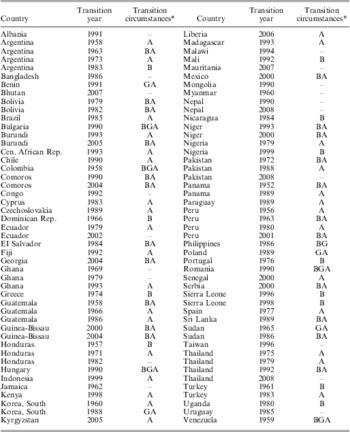
Table 1 lists all democratic transitions from 1950–2008. The majority of democratic transitions are the product of negotiations between political elites such as ruling parties, the military and opposition forces – not popular uprisings. Pressure for elites to rush into a transition bargain, as proxied for using Banks’ revolutions variable, only occurred in 43 per cent of the transitions in this period. A similar trend is apparent with respect to the constitutions that new democracies operate under after transition. Seventy per cent of new democracies during this period adopted constitutions that had been created under autocracy.
Cases of Democratic Transition, 1950–2008

Note: Includes all cases of democratic transition from 1950–2008 as coded by Cheibub, Gandhi, and Vreeland (2009). Data on revolutions as coded by Goldstone (Reference Goldstone1998) end in 1998. Data on constitutions as coded by Elkins et al. (Reference Elkins, Ginsburg and Melton2010) end in 2006.
*B: Revolution coded by Banks in year prior to transition. G: Revolution coded by Goldstone in year prior to transition. A: Autocratic constitution adopted prior to democratic transition.
Elite Weakness Upon Transition and Redistribution
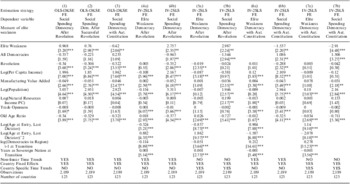
We begin by reporting a series of panel country fixed-effects models in Table 2, including both ordinary least squares (OLS) and two-stage least squares specifications. Redistribution is measured as Social Spending across these models. The inclusion of country fixed effects in the regressions controls for country-specific and time-invariant heterogeneity (for example, geography) that may jointly influence a country's propensity to experience a democratic transition under conditions of elite weakness and its degree of social spending.
Elite Weakness Upon Transition and Social Spending

*significant at 10%; **significant at 5%; ***significant at 1%
Note: DKSE = Driscoll Kraay Standard Errors; OLS = ordinary least squares; 2SLS = two-stage least squares. Intercepts were estimated but not reported: linear, quadratic, and cubic time trends were estimated but not reported. Country fixed effects were controlled for via within transformation for OLS-DKSE FE regressions. Robust t-statistics in brackets with a Newey West correction for serial correlation in Columns 1-3. IV-2SLS FE regressions robust to IV-GMM approach. All controls starting with log (Per Capita Income) lagged by one period. All Democracies instrumented with log (Democracies in Region) t-1 and Years as Sovereign Nation at Transition in Models 4–7; these Stage 1 regressions are not reported due to space limitations but are available upon request.
We use two different measure of elite weakness: (1) whether there was a revolution on the eve of democratization and (2) whether the new democratic regime inherits and operates under an autocratic constitution written by outgoing elites. If an autocratic constitution is inherited, elites set the stage for favorable policies that may be implemented under democracy. Conversely, new democracies that create their own constitutions indicate elite weakness upon transition.
Across the models, we seek to differentiate the impact made by these elite weakness measures on redistribution after democratization from the separate impacts of democracy and revolution. Therefore we include two additional terms in each regression, All Democracies and Revolution. All Democracies is coded 1 for each year that a country is democratic, regardless of how it transitioned. Revolution indicates whether there is an ongoing revolution in year t, irrespective of the country's regime type.
We also include a series of other time-varying determinants of redistribution whose omission may confound the results. The log of Real Per Capita Income is included because increases in wealth are expected to boost demand for public spending. We also include log(Population), from the Correlates of War 3.0, because the scope of government regulation and spending may be characterized by economies of scale. The log of Total Resources Income Per Capita (in thousands) is included because corporate taxes on the profits earned by oil, gas and mining firms may boost social spending and/or inflate the total income tax receipts collected by the government.Footnote 52 Trade Openness, measured as exports plus imports as a share of GDP (per cent) from the Penn World Tables 6.2, is included because it may influence redistributive transfers either positively or negatively. The Manufacturing Share (value added as per cent GDP), taken from the World Bank's World Development Indicators (WDI), is included because increases in the manufacturing sector represent greater taxable capacity and ease of tax collection. The Old Age Ratio, from the WDI, is the per cent of the population above sixty-five years of age; it captures the extent of demand for inter-generational transfers. We lag all of these controls by one period.
Other controls variables are as follows. We control for non-linear secular trends in redistribution because the global (unweighted) average of Social Spending increased steadily between 1972 and 1981, declined from 1982 to 1991 (following the global debt crisis) and returned to a steady growth trend starting in 1992. Both of these spurts coincided with a series of democratizations. We therefore introduce linear, quadratic and cubic time trends across the regressions. Additionally, in Columns 4–7 we include a set of instrumental variables to capture the exogenous variation in both our measures of elite weakness and in All Democracies. Finally, we also show that the results are robust to controlling for country-specific time trends.
Column 1 presents the results of an OLS model that includes the main control variables outlined above.Footnote 53 The coefficient on Democracy After Revolution captures the increase in social spending in countries that transitioned to democracy after revolution compared with the baseline of countries that peacefully democratized without revolution. The coefficient on All Democracies captures the increase in social spending in countries that peacefully democratized relative to countries that did not transition to democracy. Finally, adding the coefficient on Democracy After Revolution and All Democracies yields the increase in social spending in countries that transitioned to democracy after revolution compared to the baseline of countries that did not transition to democracy.
The results are consistent with theoretical expectations. Mirroring a key prediction of social conflict theory, democracies that follow a revolution have a statistically significantly higher social spending ratio by 0.968 percentage points versus those that transition without a revolution. This is a full 54 per cent increase over the within-country standard deviation for social spending among countries in the sample. Yet absent pressure from below, elites can game democracy to avoid redistribution. This helps to explain the lack of evidence for social conflict theory in the extant literature heretofore. A transition to democracy that does not follow a revolution is associated with a decrease in social spending of 0.357 percentage points relative to countries that did not transition to democracy. Adding the All Democracies and Democracy After Revolution coefficients indicates that countries that transition during revolution had 0.611 percentage points more social spending than countries that did not transition to democracy.
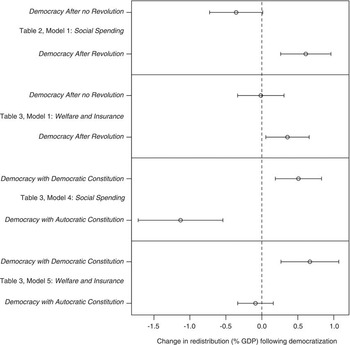
Figure 1 graphs the point estimates and confidence intervals for these coefficients relative to the baseline category of autocracies. These results correspond to the preference ordering over regimes attributed to economic elites in our theory: social spending is highest in revolutionary democracies, making these regimes most dangerous to the interests of economic elites, and lowest in gamed democracies, in line with the most preferred outcome for economic elites. Spending levels in autocracies fall between these two.
Democratic transition and predicted redistribution by transition conditions Note: Figure 1 shows the point estimates and 90 per cent confidence intervals for the variables indicated on the left-hand side. Predictions are based on the models indicated. The dashed line indicates the excluded baseline category of autocracy. The type of redistribution, whether Social Spending (% of GDP) or Spending on Welfare and Insurance (% of GDP), is listed along with the model numbers.

To examine whether the results are robust to the measure of Democracy After Revolution, Column 2 employs a version of Democracy After Revolution that draws from the Goldstone measure of revolution, the Archigos dataset (2009)Footnote 54 and secondary sources. This measure codes only successful revolutions. Democracy After Successful Revolution is positive and statistically significant. Meanwhile, the independent effect of Revolution on redistribution is positive but insignificant.Footnote 55
To examine whether the results are robust to the measure of elite weakness on the eve of transition, in Column 3 we substitute Democracy with Autocratic Constitution for Democracy After Revolution. We note that a democracy that inherits a constitution from its autocratic predecessor signifies that elites were relatively strong on the eve of transition and were able to impose their preferred institutions on the next regime. Therefore a democracy with an autocratic constitution should exhibit lower levels of social spending than one with its own constitution. The results are again consistent with our theory. Social spending in a democracy that inherits a constitution from its autocratic predecessor is an estimated 0.42 percentage points lower than the estimated spending in a democracy that adopts its own constitution upon transition.
Treating Elite Weakness as Potentially Endogenous
Are the results in Columns 1–3 affected by endogeneity bias, either as a result of omitted variables correlated with elite weakness on the eve of transition or reverse causation? To address these concerns, we turn to an instrumental variable (IV) approach designed to capture the exogenous variation in Democracy After Revolution and Democracy with Autocratic Constitution. All Democracies is possibly endogenous as well. Therefore we also estimate another first-stage regression across the IV models, in which we instrument All Democracies. The instruments across all of these potentially endogenous variables appear to satisfy the exclusion restriction, and are therefore valid ways of capturing their exogenous variation.
To capture the exogenous variation in elite weakness, we draw on Olson, who argues that dictators with long time horizons are more likely to act as economic stewards and deliver policies that are more beneficial to the population than a myopic, rent-seeking dictator.Footnote 56 Dictators with these longer time horizons should generate fewer grievances and have a firmer grip on power, thus reducing the likelihood that a shock will create a focal point that the opposition can exploit to organize collectively. It is therefore less likely that the country will experience a democratic transition in the midst of elite weakness, whether during a revolution or during a radically reformist process in which the (autocratic) constitution is overturned. To construct an exogenous measure of discount rates, we follow Popa, who uses the log of a leader's age when he took power and its squared term to identify leaders’ time horizons.Footnote 57 We use the variable Age at Entry, from Archigos, and expect the linear term to be negative and the squared term positive, indicating that time horizons increase as a leader ages, but then reverse course and get shorter once the dictator's age surpasses a critical threshold. Like Popa, we code the age of entry only for non-transitional dictators before democratization.
To instrument All Democracies, we follow the empirical research on the determinants of democratization. Our first instrument is the Number of Consolidated Democracies in the Region.Footnote 58 The logic is that a democracy is more likely to emerge and survive in a friendly environment where there are a greater number of democracies. As a second instrument for All Democracies, we follow Eichengreen and Leblang and use the years a country has been independent.Footnote 59 As these authors discuss, countries with a longer history of sovereignty are more likely to adopt institutions that are democratic.
As with our key independent variables that measure elite weakness, the instruments that we code for both elite weakness on the eve of transition and All Democracies also capture the legacies of the values observed upon transition.
Column 4a reports the coefficients calculated from the first-stage regression, where Democracy After Revolution is the dependent variable.Footnote 60 The relevant instrumental variables are the log of the age at which the outgoing dictator took power and its squared term. The control variables from Columns 1–3, the instruments for All Democracies, and country fixed effects are also included. The results reported in Column 4a conform to theoretical expectations: the coefficient on age at entry is negative and highly significant, whereas the squared term is positive and highly significant.Footnote 61 We also estimate, but do not report, the coefficients calculated from another first-stage regression, where All Democracies is the dependent variable.Footnote 62 These results also conform to theoretical expectations.
Column 4b reports the coefficients calculated from the second-stage regression, in which Social Spending is the dependent variable. The predicted values from the first-stage regressions are used for Democracy After Revolution and All Democracies, respectively. The results from the previous columns hold: Democracy After Revolution is a strong predictor of higher social spending under democracy. Importantly, the Sargan Test of the over-identifying restrictions returns a chi-square of 0.172 (p = 0.92); we therefore fail to reject the hypothesis that these instrumental variables are exogenous.
The Sargan Test increases our confidence that our instruments are valid. There remains a possibility, albeit remote, that if the first instrument is weakly correlated with the error term and is also correlated with systematic pre-transition trends in social spending that differ between countries that transition during revolution and those that do not, then the exclusion restriction may be violated. This concern is relevant if the countries that experience transitions under conditions of elite weakness have systematically higher or lower levels of social spending before transition than those that experience transitions under conditions of elite strength. Although a formal test of differences in pre-treatment trends does not reveal this to be the case once controls are added, Column 5 adds country-specific time trends to the Column 4 estimation. The results in both the first and second stages slightly strengthen, confirming the Column 4 findings.
Columns 6 and 7 present a set of IV estimations that is specified similarly to Columns 4 and 5, but that uses Democracy with Autocratic Constitution instead of Democracy After Revolution.Footnote 63 The instruments in the first-stage regressions are again strongly correlated with the potentially endogenous variables (Columns 6a and 7a). Furthermore, the second-stage regressions support the previous findings in the table: when elites are strong upon democratization, social spending under democracy is systematically lower (Columns 6b; the Sargan Test again fails to reject the null that the instruments are valid) and even lower when country-specific time trends are included (Column 7b).
The IV coefficients in Table 2 for both measures of elite weakness on the eve of transition (Columns 4–7) are notably larger than the OLS coefficients (Columns 1–3). Because the Sargan Tests indicate that the instruments are valid, the measures of elite weakness are most likely endogenous (see the diagnostics reported in the previous footnote), and the direction of bias is apparently against our hypothesis. One possible omitted factor in the OLS equation – which may confound the association between elite weakness and redistribution and lead us to underestimate the true effect – is the strength of political parties. Weak political parties may be positively correlated with elite weakness, making it less likely that oligarchs can organize to capture politics on the eve of transition. At the same time, weak parties may be negatively correlated with redistribution following democratization, since they tend to be less responsive to the preferences of the majority. Another factor that would act similarly is whether there is foreign pressure from creditors and international institutions for neoliberal reforms, because these may make social unrest more likely upon transition, while putting pressure on the government to keep spending low. Therefore accounting for these and other potential sources of endogeneity implicitly in the IV framework yields a more accurate estimate of the effect of Democracy After Revolution and Democracy with Autocratic Constitution on Social Spending.
Measuring Redistribution as Spending on Welfare and Social Insurance
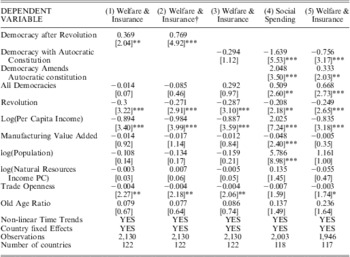
Do the Table 2 results reflect the impact of elite weakness on transition simply on social spending, or does the strength of elites also affect other forms of redistribution? Column 1, Table 3 repeats the same specification as Column 1, Table 2, but measures the dependent variable of redistribution as Welfare and Insurance. Figure 1 again plots the estimated effects. Democracies that follow a revolution have a statistically significantly higher ratio of spending on welfare and social insurance by 0.369 percentage points relative to those that do not follow a revolution. This is an estimated 19 per cent increase over the within-country standard deviation for spending on welfare and social insurance among countries in the sample. Democracies that follow revolution spend 0.356 percentage points more on welfare and social insurance than autocracies. A transition to democracy that does not follow a revolution is again negative relative to autocracies (−0.014 percentage points), but not statistically significant.
Elite Weakness Upon Transition and Spending on Welfare and Social Insurance

*significant at 10%; **significant at 5%; ***significant at 1%.
†Democracy After Revolution coded as ‘Successful Revolutions’.
Note: Linear, quadratic, and cubic time trends were estimated but not reported. Country fixed effects were controlled for via within-transformation technique. Driscoll-Kraay robust t-statistics in brackets with a Newey West correction for serial correlation. All controls starting with log(Per Capita Income) lagged by one period. Democracy After Revolution coded as ‘Successful Revolutions’.
As in Column 2 (Table 2), Column 2 (Table 3) likewise examines whether the Column 1 results are robust to the measure of Democracy After Revolution by coding only successful revolutions. Democracy After Successful Revolution is positive and highly significant.
In Column 3, Table 3, the key independent variable is Democracy with Autocratic Constitution rather than Democracy After Revolution. The results are weaker. Although Democracy with Autocratic Constitution is still negatively signed, it is not significant at conventional levels (p = 0.26). Yet the lack of statistical significance for Democracy with Autocratic Constitution in Column 4 may simply be because this is a very inclusive category that suffers from measurement error and therefore yields a noisy estimate of the causal effect of elite manipulation on welfare and social insurance spending.Footnote 64
Unraveling Elite-Biased Institutions: Democratic Amendments to Autocratic Constitutions
In Columns 4 and 5, we introduce Democracy Amends Autocratic Constitution, a variable that denotes whether the constitution inherited by a democracy from its autocratic predecessor was subsequently amended. This should therefore improve the fidelity of the ‘signal’ of the causal effect of elite manipulation on redistribution provided by Democracy with Autocratic Constitution. The results bear this out. In Column 4 we reintroduce Social Spending as the dependent variable. Compared to democracies that adopt their own constitutions upon transition, democracies with autocratic constitutions experience a 1.639 percentage point decrease in social spending, or a 92 per cent decrease over the within-country standard deviation for social spending among countries in the sample. And relative to autocracies, democracies that inherit autocratic constitutions have 1.13 percentage points less social spending. Figure 1 plots the estimated effects relative to the baseline category of autocracies. The results again correspond to the preference ordering of regimes attributed to economic elites in our theory: social spending is highest in democracies with their own constitutions and lowest in democracies with autocratic constitutions; spending levels in autocracies fall in between. Finally, for democracies that inherit a constitution from their autocratic predecessors but amend them at some point after the transition, the effect on social spending is, as predicted, positive, quite strong and highly significant.
In Column 5, the negative effect of Democracy with Autocratic Constitution on Spending on Welfare and Insurance is now stronger in magnitude and – unlike Column 3 – highly statistically significant. Compared to democracies that adopt their own constitutions during democratization, democracies with autocratic constitutions experience a 0.756 percentage point decrease in spending on welfare and social insurance, a 38 per cent decrease over the within-country standard deviation for Spending on Welfare and Social Insurance in the sample (see Figure 1 for effects relative to autocracy baseline). Conversely, for democracies that inherit a constitution from their autocratic predecessors but amend them at some point after the transition, the effect on Spending on Welfare and Social Insurance is positive and statistically significant (p = 0.05).Footnote 65
Measuring Redistribution as Progressive Taxation
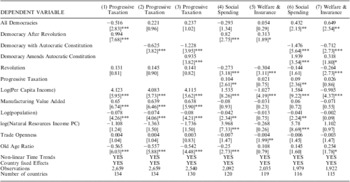
Are the results reported in Table 3 robust to measuring redistribution as the progressivity of the tax structure? In Table 4 we measure redistribution as Progressive Taxation and use model specifications similar to Table 3. In Column 1, the measure of elite weakness is Democracy After Revolution. The results are as expected: democracies that follow revolutions have an estimated 0.994 percentage point higher progressive taxation than those that do not. This is a 39 per cent increase over the within-country standard deviation in progressive taxation among countries in the sample. A transition to democracy that does not follow revolution actually reduces progressive taxation. In Column 2 we measure elite strength as Democracy with Autocratic Constitution. As expected, the coefficient is negative.Footnote 66 Also, as before, if we add Democracy Amends Autocratic Constitution (Column 3), it is positive and highly significant and the negative coefficient on Democracy with Autocratic Constitution strengthens (translating to a 48 per cent decrease over the within-country standard deviation in progressive taxation).Footnote 67
Elite Weakness Upon Transition, Progressive Taxation, and Redistribution

*significant at 10%; **significant at 5%; ***significant at 1%
Note: Linear, quadratic, and cubic time trends were estimated but not reported. Country fixed effects were controlled for via within-transformation technique. Driscoll-Kraay robust t-statistics in brackets with a Newey West correction for serial correlation. All controls starting with log(Per Capita Income) lagged by one period.
Redistribution, or are the Poor Simply Getting What they Paid For?
While elite weakness may generally make public spending or taxation more progressive, do countries with progressive tax structures also have progressive public spending? Failing to control for the structure of taxation may actually bias in favor of concluding that higher spending on social programs yields higher redistribution. This would be the wrong conclusion to draw if, for example, the tax structure is flatter when social spending is more progressive, which implies that perhaps the poor are paying a greater share of what they receive. Indeed, flat tax structures alongside progressive social spending has been increasingly common in developing states that have received IMF assistance and lowered marginal tax rates while maintaining their social safety nets. To address this concern, we now control for the progressivity of the tax structure. Because we include country fixed effects, we can hold the tax structure constant at each country's mean level of income taxation and therefore impose a more progressive tax structure during years in which they empirically exhibit relatively flatter tax structures and relatively higher social spending.
To evaluate this hypothesis in Columns 4–7 of Table 4, we introduce Progressive Taxation on the right-hand side of the equation. Democracy After Revolution remains positively associated with Social Spending (Column 4) and Welfare and Insurance (Column 5). Conversely, Democracy with Autocratic Constitution is negatively associated with both Social Spending (Column 6) and Welfare and Insurance (Column 7).
How The Game is Played: Mechanisms of Elite Control Following Transition
Our theory identifies several ways in which outgoing elites can manipulate a new democracy's constitution and safeguard their interests after the transition. First, constitutions inherited from autocracy may institutionalize the over-representation of economic elites, leading to a greater probability of right-wing executives. Secondly, these constitutions may usher in PR in a bid to make it more likely that small conservative parties will gain a political foothold and induce gridlock. Thirdly, these constitutions may be associated with larger militaries, which can deter violations of elite interests. Finally, democracies that inherit autocratic constitutions should exhibit electoral rules and institutions that make it easier for powerful interests to assert their control over local politics by depriving localities of electoral voice and autonomy.
In this section, we examine the empirical evidence for these mechanisms. The variables used to operationalize these hypotheses are taken from Beck et al.,Footnote 68 with the exception of military size, which is taken from the Correlates of War project. To operationalize the propensity of right-wing parties to control the executive branch we use ERLC, which is coded 1 if the executive is from a right-wing party, 2 if the executive is from a left-wing party and 3 if the executive is from a centrist party. To operationalize whether constitutions inherited from autocracy are associated with PR, we code PR as 1 if that system is used in any legislative chamber. To operationalize local autonomy we use two variables, MUNI and AUT. MUNI indicates whether municipal governments are locally elected. It is coded 0 if neither the local executive nor the local legislature is directly elected by the local population that they govern; 1 if either is directly elected and the other is indirectly elected or appointed; and 2 if they are both directly and locally elected. AUT is coded as 1 if sub-national governments have extensive taxing or regulatory authority, which might enable sub-national populists to challenge an anti-redistributionist status quo established at the national level.
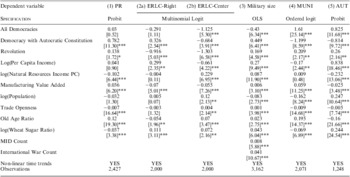
Table 5 reports a series of static panel models that use constitutions inherited from an autocracy as the key independent variable. The control variables from Table 3 are also included. We also follow Easterly and control for persistent structural inequality as log(per cent Land Suitable for Wheat to per cent Land Suitable for Sugar Cane), because this is an alternative explanation for conservative bias.Footnote 69 Those places with a history of wheat grown on family farms have had persistent egalitarian institutions, and places with a history of sugar cane grown on large plantations have had persistent inegalitarian institutions and policies.Footnote 70 In the regression in which the size of the military is the dependent variable, we also control for a running count of Militarized Interstate Disputes and a running count of International Wars from the Correlates of War database. To control for temporal dependence in the probit, multinomial logit and ordered logit models, we follow the literature by including linear, quadratic and cubic terms for years. In those models, contemporaneous correlation and heteroskedasticity are addressed by estimating robust clustered errors clustered by year. In the model with military size as the dependent variable, we again estimate an OLS model using Driscoll Kraay standard errors.
Mechanisms of Elite Control

*significant at 10%; **significant at 5%; ***significant at 1%
Note: Intercept estimated but not reported. Results robust to controlling for region dummies; linear, quadratic, and cubic time trends were estimated but not reported. Regressions estimated via maximum likelihood with standard errors clustered by year (Columns 1-2 and Columns 4-5). OLS regressions estimated using Driscoll-Kraay robust standard errors with a Newey West correction for serial correlation. All controls starting with log(Per Capita Income) lagged by one period. Robust t-statistics in brackets. Dependent variable in each model is the measure of elite bias.
In Column 1, Table 5, the dependent variable is ERLC. Because this is a nominal variable with three categories, we estimate a multinomial logit model with leftist party as the baseline category. While autocratic constitutions raise the probability of observing a right-wing party by 20 per cent, they reduce the probability of observing a centrist party by 21 per cent. In Column 2, the dependent variable is a binary measure of PR. We therefore estimate a probit model. Constitutions inherited from autocracy are positively associated with PR. These constitutions raise the probability of observing PR in a democracy by 23 per cent.Footnote 71 In Column 3, the dependent variable is log(Military Size per 100 People). A constitution inherited from a dictatorship increases the size of the military by 45 per cent. In Column 4, the dependent variable is MUNI. While a constitution inherited from a dictatorship raises the probability that either the local executive or the local legislature is indirectly elected by 14 per cent, it lowers the probability that both are directly and locally elected by 23 per cent. Finally, in Column 5 the dependent variable is AUT and we estimate a probit model. A constitution inherited from a dictatorship lowers the probability that sub-national governments will have extensive taxing, spending or regulatory authority by 31 per cent.
Conclusion
A host of eminent political thinkers has long equated democracy with fears that the masses will soak the rich and stoke class warfare (for example, Aristotle, de Tocqueville, Madison), leading to the repression of the poor under oligarchy. Social conflict theory largely echoes these claims. Yet there is little systematic evidence that democracy produces these results; indeed, recent work has shown that democracy need not threaten the rich, even under conditions of high inequality. This has made proponents of equality quite pessimistic about contemporary democracy's ability to promote social justice.Footnote 72 We demonstrate that the contradiction between the view that democracy is tantamount to rule by the poor and the view that democracy will be captured by the rich is more apparent than real.
Because political elites sometimes have strong incentives to harm economic elites, economic elites will prefer democracy to autocratic rule under the right circumstances, either due to the absence of revolutionary pressure or to the ability to control rulemaking after democratization through constitutional engineering. Our theory therefore anticipates a relationship between democracy and redistribution, but only if democratization occurs when economic elites are politically weak. More frequently, they bargain for transition on favorable terms and thus avoid redistribution after transition.
In support of our argument, we use panel data with global coverage to show that there is a positive relationship between democracy and redistribution when democratization occurs in the wake of revolution, or if a democracy resists inheriting a constitution from its autocratic predecessor. This relationship is dominated by countries that are more unequal. It is robust to country and year fixed effects, country-specific time trends, instrumental variables, and other econometric assumptions. It also holds across three different measures of redistribution: social spending, spending on welfare and insurance, and the progressivity of the tax structure. To the best of our knowledge, these data represent the most complete and comprehensive fiscal redistribution data available. We also provide empirical support for the mechanisms that elites who engineer democratic transition use to safeguard their interests.
Several important questions remain. Does the disproportional influence of economic elites over a democracy's taxing and spending also hold for the underlying structure of the economy and the strength of capitalism itself? What specific constitutional provisions are most effective at safeguarding elite interests as democracy matures? And, given the finding that the masses can sometimes weaken elite-biased institutions, what are the most propitious circumstances for doing so?