BACKGROUND
The Hawthorne Effect is a type of observer effect and it is often cited as a source of bias for observed behavioral changes among study participants or as a result of infection control interventions.Reference Haessler 1 , Reference Mayo 2 While the Hawthorne Effect is frequently mentioned in scientific literature, there is considerable inconsistency around the description and definition of the phenomenon. The most important and consistent concept of the Hawthorne Effect is a change in behavior due to a subjects’ awareness of being observed.Reference Jones 3 As such, the Hawthorne Effect is a threat to the accuracy of any study that collects data via direct observation.Reference Gittelsohn, Shankar, West, Ram and Gnywali 4 Moreover, the Hawthorne Effect could obfuscate the true impact of an intervention and reduce the internal and external validity of a study.Reference Haynes and Horn 5 The purposes of this review are (1) to describe the origin of the Hawthorne Effect, (2) to identify the use and misuse of the term in current scientific literature, (3) to describe the characteristics of the Hawthorne Effect and its application to infection control, and (4) to discuss methods to quantify and overcome limitations associated with the Hawthorne Effect.
Historic Origin
The Hawthorne Effect was named after a series of workforce productivity studies conducted at the Hawthorne Plant of the Western Electric Company (Chicago, IL) in the 1920–1930s. These studies were intended to observe changes in worker productivity when environmental factors were manipulated, including level of illumination, rest pauses, humidity, temperature, and work hours. The investigators at the Hawthorne plant found that “No matter what factors they manipulated, productivity went up. Even when work conditions were made worse than they were originally, the personnel worked harder and more efficiently.” Investigators concluded that the attention shown to the workers by the study personnel was the main variable that influenced their behavior,Reference Kompier 6 although this conclusion has since been challenged.Reference Parsons 7 , Reference Wickstrom and Bendix 8
Conclusions from the Hawthorne studies have spawned an entire branch of psychological study known as reactivity—the alteration of behavior with awareness of being observed.Reference Kompier 6 , Reference Wickstrom and Bendix 8 While the original studies at the Hawthorne plant were crucial in the recognition of observer effects, these Hawthorne studies were methodologically flawed based on contemporary standards, and the results should not be overinterpreted.Reference Kompier 6 For instance, no control groups were used, many study-related factors were uncontrolled, and only 5 female participants were selected from motivated volunteers.Reference Parsons 7 Furthermore, worker behavior was clearly influenced by pay incentives and environmental factors that were manipulated during the study; both aspects were minimized or ignored by the authors who favored social factors as the main determinants of behavior.Reference Kompier 6 Reanalysis of the original Hawthorne studies showed that the results did not substantiate the purported conclusions and led to some experts to describe the Hawthorne study simply as “a glorified anecdote.”Reference Kolata 9
Understanding the Hawthorne Effect
The meaning of the Hawthorne Effect has mutated over time and across different disciplines of scientific study. Cynically, some experts even suggest that the term Hawthorn Effect is used by researchers as a post hoc interpretation of any unexpected or undesirable study findings.Reference McCambridge, Witton and Elbourne 10 However, it is true that the meaning of the Hawthorne Effect has been distorted in scientific literature and common parlance in epidemiology. In fact, factors that can influence the outcomes of a study, such as, observer bias, the placebo effect, or self-selection bias, have all been erroneously categorized as or misattributed to the Hawthorne Effect.Reference McCambridge, Witton and Elbourne 10 Therefore, a brief descriptive distinction among these effects is worthwhile.
Observer bias is sometimes semantically confused with the Hawthorne Effect (or observer effect). Observer bias is the alteration of observations when the observer is aware of the desired outcome. In many cases, the observer is socially familiar with the participant being observed. In a study performed in two Michigan hospitals, investigators found that healthcare personnel who performed hand hygiene observation on their own units consistently reported statistically significantly higher hand hygiene compliance rates than those documented by independent auditors by approximately 20%.Reference Dhar, Tansek and Toftey 11 The authors concluded that the higher observed hand hygiene compliance reported by peer auditors was due to observer bias manifesting as feelings of allegiance to the unit and being more likely to adjudicate ambiguous hand hygiene opportunities as being complete.Reference Dhar, Tansek and Toftey 11
Both the Hawthorne Effect and the placebo effect cause changes in outcomes related to the actual interventions; these 2 effects differ in the cause of the change in outcome. The Hawthorne Effect is a behavioral change simply due to awareness of being observed; the placebo effect, however, describes an actual physiological or psychological response to an inert intervention (behavioral or pharmacological) regardless of observation.Reference Wickstrom and Bendix 8 , Reference Berthelot, Le Goff and Maugars 12 In health care, patients may reduce analgesic consumption due to the Hawthorne Effect when they are aware of observers, whereas a placebo effect is seen when an inert capsule gives patients a true decrease in pain perception due to expectancy effects and/or alterations in neurotransmitters in the brain.Reference Berthelot, Le Goff and Maugars 12
Self-selection is quite different than the Hawthorne Effect and can bias results of studies or interventions due to nonrandomized enrollment of participants. In epidemiology, the outcomes of many research studies and infection prevention collaboratives are influenced by voluntary participation and self-selection bias; thus, they are not representative of actual performance. Recent examples from the infection prevention field include statewide efforts to curb catheter-associated urinary tract infections,Reference Fakih, Watson and Greene 13 the Comprehensive Unit-based Safety Program (CUSP) initiatives,Reference Greene, Fakih and Fowler 14 and quality improvement projects for colorectal surgery.Reference Lee, Berenholtz, Hobson, Demski, Yang and Wick 15 Even at the national level, experts have expressed concerns for external validity of National Healthcare Safety Network (NHSN) data collected prior to 2010 due to self-selection bias because participation in NHSN was not yet a compulsory condition to receive CMS payment.Reference Braykov, Eber, Klein, Morgan and Laxminarayan 16
Nature of the Hawthorne Effect
The Hawthorne Effect alters the behavior of individuals and people within groups. In fact, the only required factor for behavioral alteration is the mere perception of being observed or watched. Even law enforcement agencies have used the Hawthorne Effect to deter undesirable social behavior. Cardboard images of police officers or police vehicles have been used at key roads, intersections, and shopping areas to successfully and substantially reduce speeding, reckless driving, and shoplifting. 17 , Reference Ghosh 18
The nature of the Hawthorne Effect has been well studied; four important characteristics of the phenomenon are outlined below.
-
1. The Hawthorne Effect follows a time-dependent curve. The magnitude and direction of behavioral change attributable to the Hawthorne Effect depends on the total time the participant is aware of the observation.Reference Chen, Carriker and Staheli 19 , Reference Muchinsky 20
-
2. Behavior change occurs after participants become aware of being observed. In a study conducted by Chen et al.Reference Chen, Carriker and Staheli 19 at a tertiary care medical center, the hand hygiene compliance of staff in an inpatient ward increased immediately as auditors arrived on the unit (Figure 1, blue line, point A).
-
3. The Hawthorne Effect has a performance ceiling. In the Chen et al. study mentioned above, the influence of the Hawthorne Effect on hand hygiene performance increased over time until this performance ceiling was reached.Reference Muchinsky 20 The compliance rate increased in the first 10 minutes of observations but started to flatten out at 95% as auditors stayed into their 15th minute on the ward (Figure 1, blue line, point B).
-
4. The performance impact attributable to the Hawthorne Effect wanes with continued observation past peak performance (Figure 1, blue line, point C).Reference Chen, Carriker and Staheli 19 – Reference Srigley, Furness, Baker and Gardam 22 In the hand hygiene study of Chen et al., reactivity began to diminish over time after the study in a process referred to in the behavioral science literature as habituation.
Idealized hand hygiene compliance rate (y-axis) over time (x-axis, minutes) of a high performing and a low-performing group.

Two important insights follow from the time-dependent nature of the Hawthorne Effect that can inform study design and data interpretation. Specifically, the influence of the Hawthorne Effect may be minimized by focusing on collecting data early in an observation field trip or by placing higher importance to the information collected early in a direct observation event. The application of these implications in infection control observations is discussed in sections that follow.
Other participant- and observer-based factors can also mediate the effects of observation on behavior and influence the magnitude of Hawthorn Effect. For example, the magnitude of the Hawthorne Effect also depends on the dynamics and characteristics of the group of participants (eg, demographics, baseline behavior, cohesiveness, culture and attitude).Reference Creedon 23 In the hand hygiene study by Chen et al., hand hygiene compliance increased more steeply when auditors arrived on wards that had poorer baseline hand hygiene compliance rates (Figure 1, red line) than did when observers came to wards with higher baseline hand hygiene performance (Figure 1, blue line).Reference Chen, Carriker and Staheli 19 Factors such as the novelty and other discriminative characteristics of the observers and the observation process that made them “stand out” could also get the attention of those being observed and increase the likelihood of behavioral reactivity.Reference Haynes and Horn 5
Characteristics of observers and the rigor of observations also modify the magnitude of the Hawthorne Effect (specifically, the frequency and intensity of observations or follow-up of participants). The influence of intensity of observation was demonstrated by McCarney et al.,Reference McCarney, Warner, Iliffe, van Haselen, Griffin and Fisher 24 who varied the follow-up schedule of individuals in the placebo arm of a randomized controlled study of Ginkgo biloba. They found that patients with more intensive follow-up had better behavioral outcomes compared with patients with few or no follow-up visits.
Components and Potential Causes of the Hawthorne Effect
First, participants of studies and healthcare interventions may alter their behavior in part because of the awareness that they are under observation and the understanding of the expectation of their role as participants.Reference Riggio and Porter 25 , Reference Quick and Nelson 26 It is important to note that the mere awareness of observation drives behavioral change in the Hawthorne Effect rather than the visibility of an observer or the presence of an electronic monitoring device. This form of reactivity also occurs when an individual observes their own behavior (ie, self-monitoring). In other cases, awareness of the study goals or being better educated about desired outcomes can change behavior.
Second, there is a large cache of research into the psychosocial etiologies of the Hawthorne Effect; many potential mechanisms have been proposed.Reference Olson, Verley, Santos and Salas 27 One proposed mechanism is that the novelty of the subject matter, of being observed, or of being in a group receiving special attention may drive behavioral changes.Reference Jex and Britt 28 Another mechanism, personal interest, works in a similar way as novelty and generates motivation for participation to be in alignment with desired goals.Reference Schmidt and Brown 29 Participants may also develop enhanced appreciation of the importance of their behavior under study and thus alter their behavior.Reference Ivancevich, Matteson and Konopaske 30 , Reference Newstrom and Davis 31 Finally, social desirability bias is also known to change and align participant behavior with the observer’s expectations.Reference McCambridge, Witton and Elbourne 10 Thus, if healthcare workers are aware of local efforts to improve hand hygiene or that reduction of healthcare-acquired infections is an institutional priority, then they may increase their hand hygiene behavior in the presence of an observer because they know the desired outcome.
The potential cause of the Hawthorne effect can also be due to the observers themselves. For example, the observers or tools used for observations (video cameras or radiofrequency identification tags) can serve as reminders or cues for a specific desirable behavior. Additionally, direct feedback from observers (verbal or nonverbal) can influence the behavior of the observed.Reference Storey, FitzGerald and Moore 32
THE HAWTHORNE EFFECT IN INFECTION CONTROL
Detecting the Hawthorne Effect in Infection Control
The Hawthorne Effect can be appreciated in many healthcare settings, specifically in the hospital epidemiology/infection prevention field. There are 3 common and predominant settings in the hospital where the Hawthorne Effect is often observed: hand hygiene compliance audits, environment of care rounds, and outbreak investigations.
Hand hygiene compliance is arguably the healthcare behavior that is most susceptible to the influence of the Hawthorne Effect. The propensity for hand hygiene compliance to change in the presence of observers is due to the combination of the high frequency of opportunities for hand hygiene, poor baseline hand hygiene compliance among healthcare workers, and the ease of performing the task.Reference Pronovost 33
Environmental safety audits, also known as environment of care rounds, are made frequently by infection prevention personnel to assess the safety of facilities and equipment and to identify opportunities for risk reduction and practice improvement. Environment of care rounds are also susceptible to the Hawthorne Effect for several reasons. First, such rounds are typically prearranged with advanced scheduling, thus allowing the unit being surveyed to undergo preparations. Additionally, healthcare workers of the surveyed unit may increase appropriate healthcare behavior in the presence of the auditor who is in a position of authority (a salient social stimulus) and to avoid negative feedback or sanctions at the individual or group (eg, unit) as a result of poor performance. In fact, any audit or feedback process could at least transiently alter healthcare staff behavior through the Hawthorne Effect.Reference Ivers, Jamtvedt and Flottorp 34
Finally, outbreak investigations can often uncover “staged” or “improved” healthcare practices that are not representative of baseline behavior prior to the investigation. This phenomenon may be due to staff’s fear of flaw detection, avoidance of blame, or simply behavioral changes due to the Hawthorne Effect. Furthermore, defective processes are usually rapidly corrected in real time as the investigation commences and evolves. Thus, not uncommonly, outbreak investigations uncover potential risky healthcare processes but rarely catch or observe it during the investigation.Reference Thomas 35 As an example, a public health investigation was conducted after 5 patients developed hepatitis C infection after receiving cardiac perfusion imaging at a clinic in North Carolina. Use of nuclear medicine vials for multiple patients was suspected as the point of failure following interviews with staff and review of medication purchase invoices; however, the putative risky behavior was not observed by the investigators.Reference Moore, Schaefer and Hoffmann 36
Measurement of the Hawthorne Effect
Several paradigms have been used to quantify the degree of behavioral reactivity associated with direct observation. These strategies include measuring behavioral changes over time to identify evidence for habituation to the observer’s presence, varying the level of the observer’s conspicuousness (eg, examining differences in behavior when the observer is visually present vs monitoring behavior remotely), and manipulating the level of the participants’ awareness of whether and when they will be observed.Reference Baum, Forehand and Zegiob 37 Using these and other techniques, investigators have attempted to measure the magnitude and impact of the Hawthorne Effect. However, a recent meta-analysis showed that a consistent quantitative estimate of the Hawthorne Effect was not possible. The investigators showed that the Hawthorne Effect existed; however, its magnitude varied depending on the setting and study.Reference McCambridge, Witton and Elbourne 10
Other researchers have attempted to quantify the magnitude of the Hawthorne Effect in infection control. The potential impact of the Hawthorne Effect on hand hygiene practices of healthcare staff has been studied most extensively. In short, the Hawthorne Effect appears to promote more frequent and more appropriate hand hygiene among healthcare staff. In one study, Canadian investigators found that the presence of observers increased the median frequency of hand hygiene from 1.48 to 3.75 times per hour (a 2.5-fold increase) even in the absence of other interventions.Reference Srigley, Furness, Baker and Gardam 22 In a separate study, a tertiary academic medical center found the proportion of correctly performed hand hygiene increased by 15% when its auditors arrived on the wards.Reference Chen, Carriker and Staheli 19 The same study found that the magnitude of the Hawthorne Effect on hand hygiene practice was inversely correlated with the average baseline hand hygiene performance, ie, units with lowest hand hygiene performance rates consistently had the largest improvements when auditors arrived, and vice versa.Reference Chen, Carriker and Staheli 19
Coping with the Hawthorne Effect
The Hawthorne Effect is pervasive in research and in practice; it is an inherent part of every study, intervention, and performance audit. Its direction, effect, and magnitude are unpredictable. The question is how might epidemiologists, scientists, and professionals in healthcare understand, appreciate, minimize, or even utilize the influences of the Hawthorne Effect.Reference Monahan and Fisher 38
Interpretation of Clinical Studies
For readers of research studies, we advise against reflexive dismissal of study results or implications of data simply due to potential influence from the Hawthorne Effect. It is important to remember that the Hawthorne Effect is omnipresent, and a responsible approach to evidence-based medicine is to factor in the Hawthorne Effect as a part of the limitations of any study. One practical way to do this is to consider multiple sets of data or studies or, alternatively, to seek out results of sensitivity analyses to ensure that conclusions are consistent between analyses.
Study Designs to Reduce the Hawthorne Effect
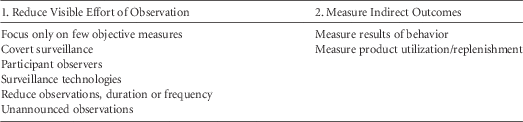
Certain strategies and study designs may reduce the Hawthorne Effect or its influence on the data. These strategies can be broadly categorized into two main approaches (Table 1). The first strategy is to reduce the visible effort to measure outcomes (recall that the Hawthorne Effect is greater with increased observer frequency and intensity). The key tactics with this strategy are to measure only what is objectively measurable, to measure only what one aims to control, and to employ covert measuring tactics. 39 These tactics reduce the measurement effort that is apparent to participants. The second approach is not to measure direct outcomes but instead measure indirect outcomes. For example, rather than measuring nursing education frequency and intensity, instead measure patient comprehension or satisfaction. More of these tactics will be further described in the sections below when applied to infection control studies and interventions in healthcare settings.
Approaches and Tactics to Reduce the Influence of Hawthorne Effect

Reducing the Hawthorne Effect in Infection Control Interventions
Strategies to reduce the Hawthorne Effect in infection control interventions mirror the research study designs recommended above, including changes to methods of observation and measurement of indirect outcomes.
Change the methodology for observations
The Hawthorne Effect can drastically dampen the ability to detect credible or significant impact of infection control interventions. The most common approach to reducing the Hawthorne Effect includes the use of covert surveillance. Students, assistants, staff, and even patients have participated in surreptitious measurement of different healthcare processes, including hand hygiene, safe injection practices, frequency of anesthesia monitoring, and even adherence to surgery safety checklists.Reference Pan, Tien and Hung 40 – Reference Ford, Birmingham, King, Lim and Ansermino 44 It is generally believed that covert auditors are a good way to minimize the Hawthorne Effect. Additionally, the use of “participant observers” who are already a normal part of the environment is particularly recommended; they are less likely to generate the type of attention and awareness of the observation process that can facilitate the Hawthorne Effect.Reference Haynes and Horn 5 The disadvantages of covert surveillance include the potential of auditors to be exposed, fewer obtainable observations due to need for discretion, decreased cohesiveness amongst work colleagues due to suspicions about covert surveillance, and the potential for observer bias. Another threat is the potential for covert observation to be “uncovered” and “suspected,” leading to the erroneous belief on the part of investigators that their data have not been affected by reactivity. Thus, covert observers should be trained against a standard operating procedure to ensure use of uniform criteria for assessment to minimize bias and to reduce the potential for being exposed.
Electronic systems have been proposed and tested as more covert technologies for surveillance of hand hygiene compliance. While radio-frequency identification (RFID) tags,Reference Pineles, Morgan and Limper 45 sensors, and video recordersReference Armellino, Hussain and Schilling 46 may still give staff the awareness that they are being observed, data show that the Hawthorne Effect is generally less with these omnipresent surveillance systems compared with the traditional method of direct human observers.Reference Srigley, Furness, Baker and Gardam 22
Reducing the observation duration, frequency, or intensity can reduce the impact of the Hawthorne Effect. This strategy specifically incorporates the understanding of the temporal variation in magnitude of the Hawthorne Effect as described above. Several studies have now demonstrated that shorter but defined periods of direct observation can achieve a balanced goal of getting an adequate number of observations for robust data analysis while minimizing the Hawthorne Effect (Figure 1, somewhere between points A and B). Several studies have shown that observation periods of between 10–20 minutes are optimal for direct hand hygiene observations.Reference Chen, Carriker and Staheli 19 , Reference Yin, Reisinger and Vander Weg 47
Another way to minimize performance improvement due specifically to preparation and anticipated audits/observation is to perform unannounced visits and rounds.Reference Van Wart 48 – Reference Comeau and Lowry 50 Many credentialing organizations and oversight bodies use unannounced visits to reduce staged performances for their observers. The ability of unannounced rounds to reduce the Hawthorne Effect is limited and short-lived. However, when used appropriately and sparingly, unannounced rounds are far more likely to uncover practices and processes that are more representative of baseline performance than are announced or scheduled visits.
Measure indirect outcomes
Measurement of indirect outcomes is less likely to result in data affected by the Hawthorne Effect because human behavior is no longer being directly measured. Instead, measurement is being performed on the result, that is, the consequence of healthcare staff behavior. A good example of this strategy can be seen in measuring the quantitative consumption of hand hygiene products in different parts of the hospital.Reference Haas and Larson 51
Potential Use of the Hawthorne Effect in Infection Control
The Hawthorne Effect has been used in industrial psychology for several decades as a strategy for enhancing human performance, industrial productivity, and even health-related behaviors.Reference Usichenko, Julich and Wendt 52 , Reference Feil, Grauer, Gadbury-Amyot, Kula and McCunniff 53 Consider, too, that many infection prevention interventions probably exert their influence through the Hawthorne Effect. Indeed, some experts argue that checklists and audits derive part of their effectiveness through the Hawthorne Effect (ie, the behavior and the performance of the healthcare staff is checked and observed). Thus, it is interesting to consider the potential ways to utilize the Hawthorne Effect to improve healthcare behaviors continuously. Is it possible that a continuous Hawthorne Effect could induce a permanent change in the culture, behavior, and attitudes of healthcare staff?Reference Lied and Kazandjian 54 Or would such an intervention result in active resistance among observed staff? There is currently a major technological revolution in electronic surveillance technologies which is coupled with the rapid establishment of networks of smart devices connected to the Internet (also known as the Internet of Things).Reference Clark 55 Thus, we suspect that the era of a pervasive Hawthorne Effect might already be here.Reference Gershenfeld, Krikorian and Cohen 56
ACKNOWLEDGMENTS
Financial support. No financial support was provided relevant to this article.
Potential conflicts of interest. All authors report no conflicts of interest relevant to this article.