Many experts consider referendums problematic and even dangerous. These general votes often reduce complex issues to a yes or no question (Stanley and Holiday Reference Stanley and David2002); parties involved can adapt their narratives and appeal only to emotion; and voters can see them as an opportunity to voice their discontent with issues unrelated to the question posed (LeDuc Reference LeDuc2015). Yet referendums are more popular than ever. According to Altman (Reference Altman2010), mechanisms of direct democracy are used twice as frequently today as 50 years ago. To cite only a few high-profile examples, 2016 and 2017 saw the “Brexit” referendum on whether the United Kingdom should leave the European Union; in Hungary, an anti-immigration and antirefugee referendum; referendums on amending the constitution in both Italy and Turkey; and in Colombia, a national referendum to ratify the peace agreement with Colombia’s largest insurgent group, the Revolutionary Armed Forces of Colombia (FARC).
In examining the processes by which individuals form and express political opinions, Zaller argues that “every opinion is a marriage of information and predisposition: information to form a mental picture of the given issue, and predisposition to motivate some conclusion about it” (Reference Zaller1992, 6). Therefore, theories explaining the relationship between predispositions and opinion formation state that individuals hold different values, beliefs, and experiences that affect their willingness to accept new information and then to form an opinion related to a particular issue (Berinsky Reference Berinsky2007; Zaller Reference Zaller1992). In this sense, underlying predispositions may have a relatively strong influence on how citizens make decisions in a referendum.
Polls before the Colombian plebiscite/referendum predicted that the population would affirm the agreement with a comfortable 66 percent of the vote share.Footnote 1 Surprisingly, the proposed peace agreement was narrowly defeated, with 50.2 percent of votes cast against the accord. This article takes up the relationship between political predispositions and voting behavior by addressing how citizens used previously structured beliefs to shape their political preferences around the peace agreement.
Most research on obstacles to the settlement of civil wars has focused on the incentives for the main parties involved in the conflict (Doyle and Sambanis Reference Doyle and Nicholas2006; Cederman et al. Reference Cederman, Gleditsch and Wucherpfennig2017). We know much less, however, about what influences individual attitudes toward peace agreements. This is an important gap, for several reasons. First, the public holds an increasing expectation that peace agreements should be subject to some kind of popular vote (Matanock Reference Matanock2017). Second, citizens’ participation may contribute to peace because their “tiredness” with the conflict can influence both rebels and governments to move toward ending a conflict (Stedman et al. Reference Stedman, Rothchild and Cousens2002; Zhukov Reference Zhukov2013). Third, even if peace agreements are not put to a formal vote, civilians’ attitudes toward peace processes have a crucial impact on their success, particularly in democratic regimes, mainly because public support legitimates the government’s efforts to end the conflict (Newman Reference Newman, Thomas and Donnan2012).
We argue that citizens’ earlier structured political predispositions and attitudes clustered into specific types of voters and shaped their willingness to endorse the proposed agreement with the FARC. We draw on a nonrepresentative, combined survey—including a face-to-face sample in Bogotá and an online sample—conducted before the referendum. Using principal components analysis (PCA), we identify three robust components with profiles reflecting whether an individual is a progovernment citizen, a right-conservative voter, and a citizen with an evangelical religious identity. To address the sampling limitations of our surveys and to rule out the possibility that our findings simply reflect idiosyncrasies of our dataset, we replicate the PCA exercise using a representative national sample from the 2016 LAPOP AmericasBarometer survey. Additionally, we not only assess voters’ choices in the plebiscite based on these cleavages, but also examine how these profiles may predict voters’ opinions on specific concessions in, and beliefs about, the agreement.
The findings of this study contribute to the literature that contends that in highly partisan or ideological referendums, voters rely on strongly held political predispositions, but also on issues that are not closely related to the real referendum subject. The study also hints at the implications for the communication and political strategies of the parties seeking to influence voters. In highly politically polarized contexts, voters might evaluate the peace deal using their existing beliefs, tending to disregard new information available, which can cause the efforts to generate consensus around the agreement to backfire.
The remainder of this article proceeds as follows. The second section briefly examines the context of the Colombian peace process. The third section explains the factors that help identify individual attitudes toward peace agreements, particularly in the Colombian case. The fourth section discusses the analytical framework and how we expect attitudes to cluster in voter profiles. The fifth and sixth sections present the survey design and empirical analysis, respectively. The conclusions discuss the importance and implications of the case.
The Context of the Colombian Peace Process
Colombia has experienced one of the longest-running armed conflicts in the world, leaving more than 8 million victims: almost 6 million displaced persons, 220,000 homicides, and more than 25,000 forced disappearances (Centro Nacional de Memoria Histórica 2012). Four significant efforts to reach a peace agreement with the FARC have been launched over the last 30 years.
Three earlier peace processes with the FARC failed. In 1984, They included one during the government of the President Belisario Betancur (1982–86); in 1987, with President Virgilio Barco’s attempt to negotiate with the Coordinadora Guerrillera Simón Bolívar, a bloc formed by members of multiple leftist guerrilla groups, including the FARC, EPL, M-19, and ELN (1986–90); and in 1998, with President Andrés Pastrana’s demilitarized zone (1998–2002). After an intense escalation of violence, the government of President Alvaro Uribe (2002–10) launched a strong military offensive against the FARC and signed a peace process agreement with the paramilitary groups in 2005 (Botero Reference Botero2007). By doubling the size of the military and targeting specifically the FARC guerrilla fronts, the weakening of the guerrilla’s offensive capabilities allowed for the consideration of new strategies for ending the conflict (Pachón Reference Pachón2009).
President Juan Manuel Santos (2010–18) informed the public of the ongoing talks with FARC leaders in 2012 and promised to hold a referendum for the agreement’s final approval (Batlle and Duncan Reference Batlle and Gustavo2013). After four years of negotiations in Havana, Cuba, an agreement was reached in August 2016. The deal included six points. The FARC would disarm and demobilize into camps set up by the United Nations to begin the process of reintegration into civilian life. A special jurisdiction would be created to deal with crimes committed during the conflict (Jurisdicción Especial para la Paz), and a truth and reconciliation commission would be created as well. The accord proposed a new approach for decreasing illicit crops. The FARC agreed to stop drug production in areas under its previous control, and the government decided to focus its efforts on the weakest links in the drug-trafficking chain, further promoting and intensifying programs for voluntary substitution of illicit crops.
Regarding the social and economic conditions of the rural population, the agreement prioritized the reduction of rural poverty in the 250 municipalities most affected by the conflict. Specific efforts would be made to establish land ownership for the rural poor, improve essential services, and provide financial aid as mechanisms to close the gap with urban areas. Finally, as the primary purpose of the deal was “bullets for ballots,” the FARC created a new political party, which would be allocated ten guaranteed seats in Congress over the next two constitutional periods as the FARC’s mechanism for overseeing the implementation of the peace process.
Attitudes Toward the Colombian Peace Agreement
Existing research has emphasized two core factors that may affect attitudes toward the peace agreement in Colombia. First, drawing on the literature on conflict and political attitudes, one might expect that greater exposure to the conflict should shape individual attitudes toward a peace settlement. Reflecting the idea that the costs of conflict are higher to those who have experienced it, one would expect that being affected by violence should increase support for negotiating. At the aggregate level, the results of the 2016 referendum indicate that areas with more combatants, and with more civilians displaced by the conflict, had a higher share of yes votes (Arjona Reference Arjona2016; Fergusson and Molina Reference Fergusson and Carlos2016; Weintraub Reference Weintraub and Meléndez2016). Scholars have also analyzed how historical levels of violence affected vote shares in the 2014 election, which was essentially a referendum on the peace talks, as former president Santos was running for re-election with the peace process as his central campaign promise (Weintraub et al. Reference Weintraub, Fernando Vargas and Flores2015).
However, aggregate correlations at the municipal level do not necessarily reflect individual attitudes. In a 2013 survey carried out by the National Center of Historical Memory (Centro Nacional de Memoria Histórica) and Social Foundation (Fundación Social), Nussio et al. (Reference Nussio, Rettberg and Ugarriza2015) explored whether there are differences in attitudes toward transitional justice mechanisms between victims and nonvictims. Contrary to the aggregate municipal results, they did not find statistically significant differences between the two groups. Similarly, using LAPOP survey data from 2015, Matanock and Garbiras-Díaz (Reference Matanock and Garbiras-Díaz2018) found no evidence that conflict exposure, as measured by self-reported victimization, had any relationship to variation in support for the peace process. Yet other scholars have found that living in conflict zones correlates positively with stronger preferences in favor of peace negotiations, even if this might require some concessions to the guerrillas (Liendo and Braithwaite Reference Liendo and Braithwaite2018; Tellez Reference Tellez2018).
A second perspective contends that attitude change in public opinion responds to shifts in the intensities of competing messages by political elites (Zaller Reference Zaller1992). Thus, some scholars have argued that opposition to the peace agreement was driven primarily by elite polarization. Matanock and García-Sánchez (Reference Matanock and García-Sánchez2017) claim that the deteriorating relationship between President Santos and former president Uribe, beginning in 2011, helped to drive Uribe’s opposition to the peace accord. Uribe increasingly sought to undermine Santos—his former political ally, who had served as his defense minister—by portraying the peace process as “unpatriotic,” claiming that the concessions from the FARC were “too weak,” and emphasizing the FARC’s unpopularity among many Colombians. Thus the authors demonstrate how attitudes toward the peace process shifted as elite competition intensified, with Uribe supporters becoming increasingly skeptical of the peace agreement.
Voting Choice in Referendums: Predispositions and Information
Most research on voting behavior tends to focus on presidential or parliamentary elections at the national level or state-level legislative elections (De Vreese and Semetko Reference De Vreese2004). However, less attention has been paid to voting decisions in the context of national referendums, despite the increase in the incidence of this form of direct democracy (Altman Reference Altman2010). Unlike elections, in which candidate names or political parties appear on the ballot, in any referendum, voters need to disentangle a complex policy issue into a yes or no vote decision. In other words, sometimes voters are presented with alternatives that they are unfamiliar with or that lack efficient and reliable voting cues to make a simple binary choice (LeDuc Reference LeDuc2002). Moreover, referendums are usually characterized by close races with a volatile electorate, in which voters might give greater importance to the campaign events or other issues of government performance unrelated to the topic of the referendum to form their preferences (De Vreese and Semetko Reference De Vreese2004).
When parties take well-known and distinct positions, or the public debate unmistakably follows ideological lines in a referendum, scholars contend that the voting choice is explained mostly by strongly held predispositions, reinforced through the course of the campaign (LeDuc Reference LeDuc2002). However, predispositions come in various types. Although political values are the most common type, individuals possess a “variety of interests, values, and experiences that may greatly affect their willingness to accept persuasive influences” (Zaller Reference Zaller1992, 22). This study refers to all these factors as indicators of political predispositions. Thus, partisan and ideological attachments, core and prior beliefs, and previous voting choices, as well as the association of the referendum issue to prominent political actors or parties involved, are examples of predispositions affecting the voting decision in a referendum.
Moreover, short-term political factors, which are unrelated to the question posed by the referendum, can also influence the decision (LeDuc Reference LeDuc2002). Since most citizens are relatively uninformed about political matters (Bartels Reference Bartels1996; Boudreau and Lupia Reference Boudreau, Arthur, Druckman, Green and Kuklinski2011), the information environment in referendums can play a crucial role. Voters might take cues from campaign events and media and rely on them to form a preference toward the referendum issue (Lupia and McCubbins Reference Lupia and McCubbins1998).
Therefore, the 2016 Colombian peace plebiscite provides an excellent opportunity to contribute to the literature on the factors that influence the voting choice in a national and high-profile referendum. Given that the peace deal was a highly divisive referendum, in which political elites took well-known and opposite positions, we contend that citizens used these political predispositions to shape their preferences and attitudes toward the peace agreement. However, as the context in which a referendum takes place changes, we also argue that short-term political factors that were not directly related to the referendum issue also affected the voting choice to endorse the peace deal.
Thus, following the previous literature on candidate choice and referendum voting (see De Vreese and Semetko Reference De Vreese2004), we identify at least four broad dimensions individuals could have relied on to shape their preferences toward the 2016 plebiscite. We expand on these factors and how they cluster on a smaller number of identifiable types of voters, which, in turn, are related to systematic differences in support or opposition to the peace process.
First, since the government was the leading party seeking ratification of the deal it negotiated, we expect that government performance and trust in institutions were associated with the referendum issue. Assessment of government performance is an often-used indicator for a referendum outcome. Put simply, a popular government is more likely to see its initiatives approved than an unpopular one. Thus, many would argue that support for the peace process was also influenced by government performance outside the process itself, such as the state of the economy or other social policy indicators.Footnote 2
Moreover, citizens may use trust in institutions as a cue when deciding to support or oppose the peace deal. Specifically, it is important to identify whether citizens trust the institutions that would enforce a ten-year peace agreement, transcending the signing government; for example, how trust in the judiciary translates into attitudes about how to administer justice in a transitioning context. Thus, trust in institutions was a critical matter for convincing people to vote yes. Those who trusted institutions (i.e., the judicial system, the president) were probably more likely to believe government claims about the benefits of a risky decision such as a peace agreement with the FARC.
Second, two of the most prominent political figures in the country were directly involved in the referendum. Since former president Uribe and sitting president Santos took opposite sides, we expect voters to use cues from political elites and ideological divisions to decide whether to support or oppose the peace agreement. As previous research asserts, attitudes toward the peace agreement were highly correlated with the level of polarization around the battle of narratives between Uribe and Santos (i.e., Matanock and García-Sánchez Reference Matanock and García-Sánchez2017). We contend nonetheless that citizens’ attitudes toward the peace settlement were not only structured on the Uribe-Santos dimension. Elite cues, combined with other political predispositions, should cluster on more structured dimensions, allowing us to identify other voters’ cleavages beyond the ideological elites’ divisions.
Third, though votes in a referendum may be swayed by issues not closely related to the real subject, the emergence of these issues is often not accidental, as they are actively promoted by parties involved in the referendum campaign. Some political analysts argue that for some of the opponents of the peace settlement, the plebiscite was not really about the peace process with the FARC (see, e.g., Casey Reference Casey2016). Very often, political leaders aim to reframe a referendum in their narratives. In this case, the most conservative political and religious sectors of Colombian society saw in the agreement an imposition of a new definition of family and gender that supported nontraditional Christian values. Thus, a narrative of “gender ideology” supplanting traditional values was promoted by the religious and conservative parties in the lead- up to the vote.Footnote 3 This parallel framing worked as a cue for citizens with strong conservative religious values and beliefs.
Last but not least, Venezuela’s economic and humanitarian crisis raised fears about the peace agreement. In the previous months of the referendum campaign, the No promoters argued that the FARC’s participation in political life would bring radical left-wing castrochavismo to power.Footnote 4 This narrative increased over time and was intensified by different leaders of the opposition.Footnote 5 Thus, voters confronted a scenario where apprehensions about “Venezuela’s nondemocratic experience” created an emotional frame for voters to reject the peace deal. However, it should be stressed that peoples’ willingness to accept this elite narrative was greatly influenced by factual events occurring around Venezuela’s severe economic and social problems. Between 2010 and 2014, approximately 28,000 Venezuelans emigrated to Colombia. The number of Venezuelans migrating almost doubled in just two years, with nearly 50,000 immigrants entering in 2015 and 2016. The majority of these individuals settled around Bogotá (see figures II-3, II-4 in the appendix). Therefore, we expect this emotional frame to be clustered with the other factors discussed.
Survey Design and Data
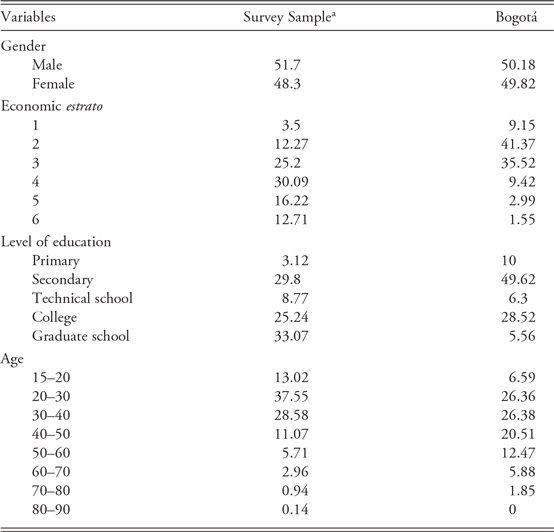
We conducted a nonrandom survey before the 2016 referendum to identify voter profiles. The survey contains two different samples, with 335 face-to-face interviews, as well as 1,050 responses to the survey collected online. The face-to-face interviews were conducted the weekend before the referendum (September 24–25), and the internet sample was collected the Tuesday before the referendum (September 27). The surveys were administered in the historic center of Bogotá (in the corridor of Carrera 7, between the Plaza de Bolívar and 26th Street).Footnote 6 This area of the city is visited mostly during the work week by students and people who work there, but the advantage of surveying during the weekend is that we had access to a more diverse sample of individuals (i.e., not only college students; see table 1).
The internet survey was administered sharing a Google form on our personal Facebook and Twitter accounts, which some members of our networks replicated in their accounts with a link to the survey.Footnote 7 A shortcoming of this strategy, discussed in more detail below, is a selection bias induced by the fact that the population of the internet sample has a higher level of education and lives in a higher socioeconomic estrato (stratum) than the face-to-face sample.
The survey contained 40 questions (see appendix I for the full questionnaire). In addition to eliciting respondents’ voting intentions for the peace agreement referendum and a series of questions about the referendum itself, we recorded a set of standard demographic characteristics. Table 1 displays the distribution of the survey in terms of gender, age, level of education, and estrato (a standardized classification of social and economic status determined by neighborhood). It also compares our sample with the available data for Bogotá from the LAPOP 2016 survey and the District Planning Secretary (Secretaria de Planeación Distrital).
Distribution of Standard Demographic Characteristics, Prereferendum Survey and Data for Bogotá (percent)

a N = 1,382
Note: The available data for Bogotá come from two sources. Gender, level of education, and age come from the 2016 LAPOP survey, which interviewed 207 respondents in Bogotá. The data on socioeconomic strata were drawn from the records of the District Planning Secretary (Secretaria de Planeación Distrital).
Although we conducted a nonrepresentative survey, our sample resembles Bogotá’s population in some demographic characteristics, such as gender and age. However, our sample is more highly educated and lives, on average, in a higher socioeconomic estrato. Specifically, our sample includes a smaller percentage of respondents with a high school diploma than does the city’s population (29.8 percent vs. 49.62 percent) and a larger percentage of respondents with some graduate school degree (33.07 percent vs. 5.56 percent). Regarding the socioeconomic estrato, 30 percent of our sample lives in estrato 4, overrepresenting the population residing in this socioeconomic group. While 41 percent of Bogotá’s population lives in estrato 2, only 12 percent of our sample’s respondents do.
These sample characteristics and the two polling strategies implemented represent a selection bias that may limit the conclusions we can draw from statistically significant associations between the political predispositions and the preferences toward the peace agreement. Moreover, these are relevant considerations when assessing the generalizability of our results. Therefore, to provide external validity to our main findings—that is, to show that they do not merely reflect idiosyncrasies of our data—our empirical analysis replicates our estimates with the national representative 2016 LAPOP survey.
To determine political predispositions, we first asked about placement on the left-right political scale and vote choice in the first round of the 2014 presidential election. We then asked about the respondent’s confidence in institutions (the judicial system, the president, the army, and the national police). We also asked whether respondents agreed with a series of statements about religious beliefs, violence as a vehicle for justice, and foreign politics, particularly if they believed that Venezuela is a democracy.
A key element of the survey was a set of questions eliciting the respondent’s agreement with specific aspects and beliefs associated with the implementation of the peace agreement. We asked respondents if they agreed with the FARC’s getting ten reserved seats in Congress and its members’ avoiding jail time. Regarding beliefs about the content and implications of the agreement, we asked whether respondents thought the FARC would declare all its economic assets; if the FARC would effectively demobilize if the deal were passed; whether a victory of the No would lead to more violence; and whether the peace agreement could not be modified after getting ratified.
Empirical Strategy and Results: Principal Component Analysis
Principal component analysis (PCA) is, in essence, a data reduction technique to examine whether a larger number of variables or items can be reduced to a smaller number of components that summarize the overall variance in the data. Rather than examining how each variable separately explains attitudes toward the peace process, we use PCA analysis, in which we begin with a large number of variables, and we expect these variables to cluster on hypothetical constructs (components). Still, we do not have an explicit previous hypothesis about how they lump together. In other words, we use PCA analysis to reveal the patterns of interrelationships among the variables and to determine whether the dimensionality of variables could be reduced to specific voter profiles.
Therefore, we interpret the PCA outcome (components) as types of voters. PCA allows us to identify components that summarize the variation in the data with the specific items that load positive or negative on the components. Since we are ultimately interested in categories of voter profiles, one might argue that some type of cluster analysis identifying discrete categories would seem a more logical approach here. However, other researchers have shown that common varieties, such as K-means cluster analysis, are discrete approximations of the continuous components from PCA (see Ding and He Reference Ding and Xiaofeng2004). Since the PCA factor scores retain more information in degree than the discrete outcomes in K-means cluster analysis, we prefer to conduct PCA here.
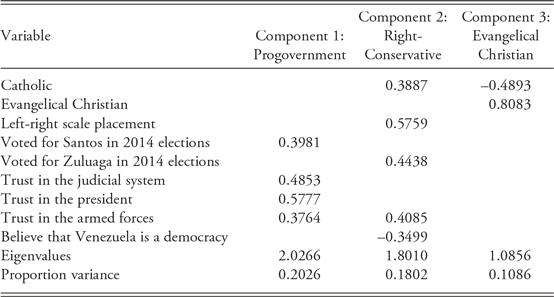
The analysis can be justified as evidence for more general voter profiles if the components can be given a clear substantive interpretation, can predict vote choice, and do not simply reflect idiosyncrasies of the data. We discuss each of these questions in turn. Table 2 shows the variables with significant factor loadings for the first three components from the PCA analysis, using the combined survey. We report only the components with eigenvalues above 1, and with significant factor loadings (above 0.3).Footnote 8 The three components jointly explain 49 percent of the total variance. The separate results for the internet and face-to-face samples do not differ notably (see tables II-2 and II-3 in the appendix), so we focus only on the aggregate sample here.
Three First PCAs of the Prereferendum Survey

N = 1,376
Notes: Only items with significant loadings shown. Another variable included in the analysis was the question of whether respondents believed that violence was a mechanism to obtain justice, but only variables with loads above 0.3 are reported.
By including only ten variables in the analysis (of the 40 questions included in the survey), our expectation is fulfilled: different previous political predispositions or attitudes are clustered into a series of clearly identifiable voter cleavages.
We interpret the first component as a progovernment citizen. Unsurprisingly, since the government was the leading party seeking ratification of the deal, we expected support for the incumbent government, and trust in institutions is associated with the referendum issue. Progovernment voters are more likely to have voted for President Santos in the first round of the election in 2014. They are also more likely to trust in the judicial system, the president, and the armed forces. One concern is that in the Colombian context, these four variables may be capturing very similar concepts and thus may be collinear. However, PCA analysis is a good strategy to prevent multicollinearity (Perez Reference Perez2017) and to collapse these covariates to one single variable that broadly captures support for the government.
The second profile can be interpreted as a right-conservative voter. These respondents are much more likely to be Catholics, and they are more likely to place themselves on the right on the political scale. Like progovernment citizens, these voters have confidence in the armed forces. However, they do not believe that Venezuela is a democracy. Thus, the first component (a progovernment voter), and the second component (a right-conservative voter), are dimensions (ideal types of voters) that capture these voters’ stance concerning the incumbent government, their beliefs about democratic institutions, and their voting choices.
The third component is clearly a religious dimension, given that there are no other variables with significant loadings. On this factor, there is a high likelihood that respondents self-report a religious affiliation as Evangelical Christians.
Together, these three components encompass a set of possible factors that may influence preference toward the peace agreement.
Plotting the Voter Profiles
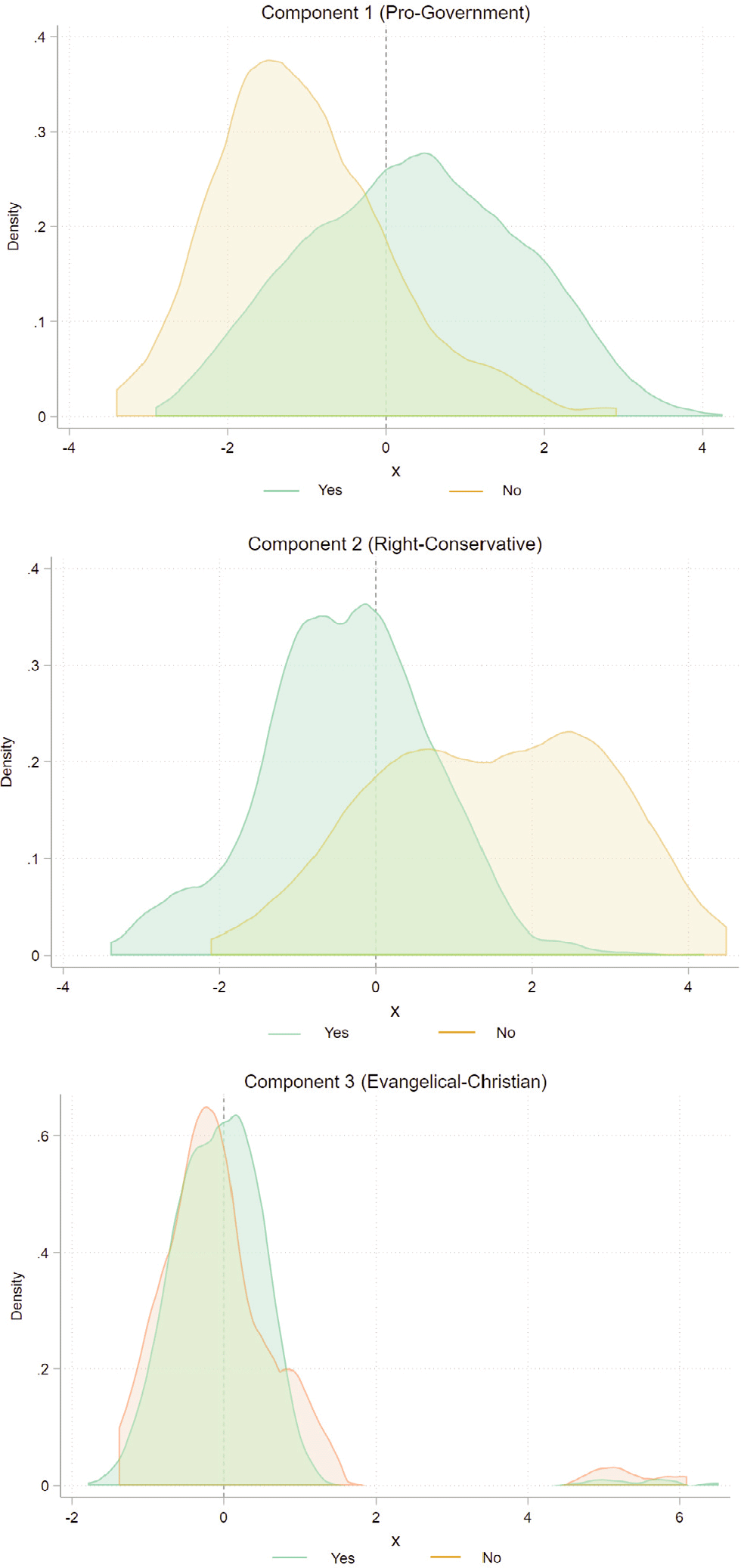
We now move to examine patterns in the data to see if these profiles differ on vote choice in the plebiscite. Figure 1 plots a series of K-density charts showing the distribution of PCA scores by vote choice in the referendum. The peaks of the density plot help display where values are concentrated over the interval.
Distribution of the First Three PCAs by Vote Choice in the Referendum

As the figure shows, there is a clear distinction between the first and the second component by vote choice in the referendum. On the top left of the chart, those who had the intention of voting yes on the plebiscite are more likely to have a positive score on the first component. By contrast, respondents who reported that they were going to vote no are more likely to have a negative score on the first component. The average scores on the first component for the yes and no voters are 0.355 and –1.050, respectively.
On the top right of the chart, those who had the intention of voting yes on the plebiscite are less likely to have a positive score on the second component. In contrast, respondents who reported they were going to vote no are more likely to have a positive score on the second component. The average scores on the second component for the yes and no voters are –0.372 and 1.442, respectively.
Regarding the third component, no significant difference appears between vote choices in the referendum. The average scores on the third component for the yes and no voters are –0.007 and 0.058, respectively.
Because components are orthogonal by construction (Jolliffe Reference Jolliffe2002), no correlation appears between them. This characteristic allows us to include them as independent variables, each separately, in the regression model.
Predicting Vote Choice: Linear Probability Model
OLS models can also yield results in terms of probability changes, as standard Maximum Likelihood Estimation methods do. Although the misspecified functional form of the model is the most critical issue when using linear regression with a binary dependent variable (Long Reference Long1997), as long as we are not interested in the nonlinearity of the relation per se, a linear probability model (LPM) is entirely appropriate (Mood Reference Mood2010). Since we are not interested in exploiting the advantages of not assuming nonlinearity, it is reasonable to choose LPM over a logit model.Footnote 9 The LPM is captured by
 $Y_i = {\beta _0} + {\beta _1}{X_{1i}} + {\beta _2}{X_{2i}} + {\beta _3}{X_{3i}} + {\varepsilon _i}$
where Y i is the estimated probability that the dependent variable equals 1. Specifically, it estimates the likelihood that a voter intends to vote yes in the plebiscite. Ps are the coefficients capturing the effect of the three voter profiles previously identified on Y i, and εi is an error term for the observations. We also included some sociodemographic controls, such as age (the reference category is individuals who are over 50 years old), sex, educational level (the reference category is individuals who have an educational level above secondary school), and estrato (reference category is individuals who live in estrato 4 or above).
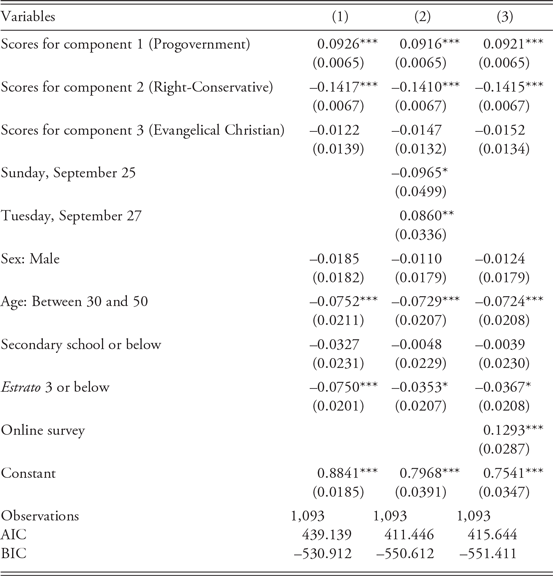
Table 3 reports the predicted probability. In column 1, a positive score on the first component has a significant and positive relationship with voting yes. Unsurprisingly, being a progovernment citizen increases the probability of voting in favor of the referendum, by 9 percent on average. Being a right-conservative voter decreases the likelihood of voting in support of the peace agreement by 14 percent on average. Column 2 includes fixed effects for the days the surveys were applied. The direction and strength of the relationship between the first two components and the vote choice do not change. But it is observed that individuals who took the survey the weekend before the plebiscite have a lower probability, almost 10 percent less on average, of voting in favor. Those who were surveyed the Tuesday before the referendum have a higher likelihood, nearly 8 percent on average, of supporting the peace agreement.
Linear Probability Model of Vote Choice

***p < 0.01, **p < 0.05, *p < 0.1
Robust standard errors in parentheses.
However, as discussed earlier, the face-to-face interviews were conducted the weekend before the referendum (September 24–25), and all the internet sample was collected the Tuesday before the referendum (September 27). Then, by including fixed effects of the dates, what is being controlled is the method through which the survey was conducted. To prove this, column 3 includes a dummy for whether the respondent was internet-based or in person. As the column shows, having answered the survey online increases the likelihood of supporting the peace agreement by almost 13 percent, on average.
Regarding the sociodemographic controls, we expect that poorer and less educated sectors of the population will be less likely to support the agreement. Column 1 shows that being between 30 and 50 years old and living in estrato 3 or below both have a significant and negative association with voting yes. They decrease the probability of supporting the peace agreement by 7.5 percent, on average. That is, respondents belonging to a lower socioeconomic estrato are less likely to support the peace agreement, which is consistent with the actual results of the plebiscite in Bogotá.
Figure IV-1 in the appendix plots a map with the exit poll results of the referendum by polling place station and socioeconomic strata in Bogotá. Clearly, in almost all the polling places located in estratos 1 and 2 (the poorest), the percentage of vote share supporting the peace agreement is low compared to patterns exhibited in estratos 4, 5, and 6 (the richest). Our individual survey results are not directly comparable with the results of aggregated municipal data, due to different analysis levels. However, our findings suggest that it is crucial to analyze the relationship between socioeconomic strata (a proxy of income) and support for the peace agreement within each municipality.
Additionally, we do not find that the religious dimension has an effect on the probability of vote choice, which makes sense if we keep in mind that Evangelical Christians account for only 3 percent of the sample.
These results support our expectations about how predispositions can shape citizens’ preferences about the peace deal. Here, these types of voters are drawing on their existing predispositions, attitudes, and experiences to simplify their decision. Although the first profile might seem “obvious,” accounting for this single variable that broadly captures support for the government allowed us to learn about the distinctiveness of the second and third profiles. These are groups of citizens who do not seem to vote exclusively on this more proximate measure of support for the government.
We now turn to an analysis of how our respondents reacted to different parts of the peace agreement.
Attitudes Toward Specific Concessions: OLS Model
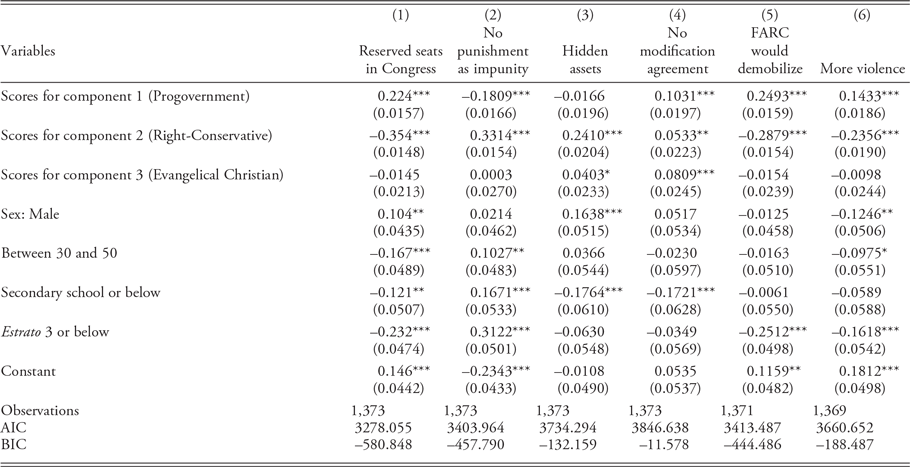
A key element of the survey was a set of questions eliciting the respondents’ agreement with specific concessions and beliefs associated with the implementation of the peace agreement. We estimated an OLS model to see how voters’ profiles can explain attitudes toward specific parts of the peace agreement, and we sought to disaggregate what it means when some voters have a greater or lesser inclination to accept the peace agreement. The model is captured by
 $Y_i = \beta_0 + \beta_1 X_1i + \beta_2 X_2i + \beta_3 X_3i, + \varepsilon_i$
where Y i captures the change on the scale of agreement separately by each of the questions related to the peace process. The scale ranges from 1 to 7, in which 1 means strongly disagree or do not believe, and 7 means strongly agree or do believe (see appendix I for the full questionnaire). βs are the coefficients capturing the effect of the three voter profiles on Y i, and ε i. is an error term for the observations. We included the same sociodemographic controls as in the previous models.
Table 4 reports the results of the model. The first column shows respondents’ attitudes toward the FARC’s political participation in Congress. It asks if respondents agree with the proposal to reserve congressional seats for the FARC candidates. Being a progovernment voter increases support for the government’s commitment to guarantee the FARC’s political participation by 0.22 standard deviation units. On the other hand, fitting the right-conservative profile decreases support by about 0.35 standard deviation units. These results are an extension of the willingness of progovernment voters to support the deal, as we noted above. Signing an agreement with a guerrilla group that waged war against the state for more than 50 years means exchanging “bullets for ballots.” The sociodemographic controls are all significant for this provision of the peace agreement. Households in estrato 3 or below have lower support for this concession by almost 0.23 standard deviation units.
OLS Model: Specific Concessions and Beliefs Associated with the Implementation of the Peace Agreement

***p < 0.01, **p< 0.05, *p< 0.1
Robust standard errors in parentheses. Coefficients are reported in standard deviation.
Another important point of the peace agreement has to do with reparations to victims of the conflict and penalties for crimes committed by the FARC. As part of the deal, certain types of pardons and reduced sentences were established. To gauge how support and opposition to this provision varied by profile, respondents were asked if they believed that some members of the FARC receiving no jail time was a symbol of impunity. Column 2 displays the results for this question. Being a progovernment voter who trusts the judicial system decreases by 0.18 standard deviation units the belief that this represents impunity. Unsurprisingly, right-conservative voters see this point of the agreement as a “big toad to swallow,” and scoring positive on this component increases the perception of impunity by 0.33 standard deviation units.
The next four columns do not assess specific chapters of the peace process, but instead seek to evaluate citizens’ opinions on some common beliefs about the consequences of the peace deal. Column 3 asks respondents if they agree that the FARC has resources and assets, gained from drug trafficking, that it has not reported. Since this group financed much of its armed conflict through criminal activities, it is expected that some voters will be skeptical about the surrendered list of assets. Scoring positive on the right-conservative and Evangelical Christian cleavages increases the perception that the FARC might be lying about hidden assets—not reporting all its monetary benefits from drug trafficking—by 0.24 and 0.04 standard deviation units, respectively.
The next column contains a tricky question. During the previous months of the plebiscite, the legal formula to protect the final agreement was one of the thorniest and most divisive issues between the government and the opposition (see, e.g., Noticias RCN 2016). Many constitutional experts debated how controversial and atypical was the decision of the government and the FARC to include the agreement as part of the “constitutional block”—a body of Colombian law that is integrated into the constitution. The content of the deal would then have the same status as the constitution.
We expect that the three types of voters are going to be more likely to believe that once the deal is incorporated into the constitution, it would be very difficult to modify. If the accord had the same status as the constitution, it would be harder to move an amendment through Congress.Footnote 10 Thus, being a progovernment and a right-conservative voter, as well as scoring positive on the Evangelical Christian component, increases the likelihood of believing that it would have been more challenging to modify the accord by about 0.10, 0.05, and 0.08 standard deviation units, respectively.
Many experts have estimated that at least 30 percent of the FARC members will opt out of the peace deal to maintain their criminal activities, such as drug trafficking (Yagoub Reference Yagoub2016). Column 5 assesses whether respondents believe that the majority of FARC members will demobilize. Being a progovernment voter increases the belief that the FARC fighters would leave behind their illegal activities by almost 0.25 standard deviation units. On the contrary, being a right-conservative citizen and living in a household in estrato 3 or below decreases this belief by 0.28 and 0.25 standard deviation units, respectively.
Four months before the vote, President Santos, as part of a strategy to persuade voters, warned that there was information indicating that the FARC guerrillas would begin an urban war if a peace agreement were not reached (see, e.g., Noticias Caracol 2016). Therefore, we asked respondents if they believed that more violence would occur if the plebiscite were defeated. Column 6 shows that progovernment voters did perceive Santos’s warning as a real threat. Scoring positive on the progovernment component increases agreement with this belief by 0.14 standard deviation units. Interestingly, men, compared to women, did not fear that the conflict would intensify if the deal were defeated (being a man decreases agreement by 0.12 standard deviation units).
Confirmatory Principal Component Analysis: LAPOP Survey
We have argued that the value of the PCA exercise also depends on stability, and our confidence in these profiles would be strengthened if we could show that they also appear in other data sources. To examine this, we turned to the LAPOP survey. The closest wave of this survey was carried out between August and October 2016. This is a national representative survey that asks about opinions, beliefs, attitudes, and perceptions regarding structural and recent events in the institutions and the functioning of the Colombian government.
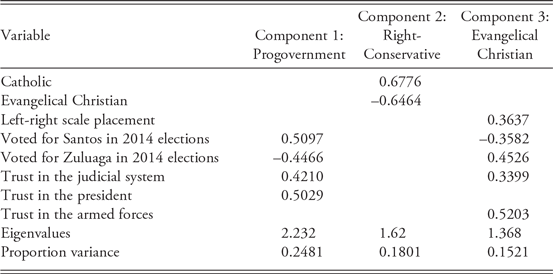
Table 5 provides the results of PCA with the LAPOP dataset. We find very similar components in this survey. These results strengthen our confidence that the voter profiles we identify pertain to more enduring attitude-behavioral cleavages. The first three PCAs represent 58 percent of the total variation, close to the cumulative variance of the profiles of our set of data. Consistent with the results reported above, we interpret the first component as representing progovernment citizens. This cleavage is more likely to trust the justice system and the president and less likely to have voted for Zuluaga.
Three First PCAS of LAPOP Survey

N = 724
Notes: Only items with significant loadings shown. Another variable included in the analysis was the question of whether respondents believed that violence was a mechanism to obtain justice, but only variables with loads above 0.3 are reported.
The second component here is a religious profile, like the third component found in our dataset. However, this component shows us a Catholic citizen, not an Evangelical Christian voter. The third component is a right-conservative voter. These respondents are more likely to place themselves on the right of the political scale and to have trust in the armed forces. Although the LAPOP survey does not contain any questions related to Venezuela, such a citizen is more likely to vote for Zuluaga (endorsed by Uribe in 2014), as the component loads highly on this variable.
Thus, even though our main findings are drawn from a nonrepresentative sample, the information gleaned from this study helps us to predict what the result would be for a representative survey. Put differently, our confidence in these voters’ profiles is strengthened by finding our local estimates duplicated in a broader sample. Moreover, we replicated the regression analysis to test if certain identified voters’ profiles are more likely to support the peace process (see table III-2 in the appendix). Instead of asking respondents how they would vote in the plebiscite, we used a question that captures the percentage of Colombians who support a negotiated solution to the conflict with guerrillas, compared to a military solution. Consistent with our expectations, progovernment voters were more likely to support a negotiated solution (a peace agreement), and right-conservative voters were more likely to support a military solution (voting no in the referendum).
Conclusions
The Colombian peace agreement plebiscite adds to the long list of proposed referendums by governments that seek citizens’ approval but encounter more popular controversy than anticipated. While most research on obstacles to settlement of civil conflicts has focused on the incentives for the main parties involved in the conflict (Doyle and Sambanis Reference Doyle and Nicholas2006; Cederman et al. Reference Cederman, Gleditsch and Wucherpfennig2017), we know much less about what influences individual attitudes toward peace agreements. This study is an attempt to address this issue by examining how voters used their structured political predispositions and the influence of elite cues to shape their preferences around the peace agreement.
The findings suggest that voters were heterogeneous, and that different political predispositions and attitudes clustered in specific types of voters, which, in turn, shaped these voters’ willingness to endorse the proposed peace agreement. We found three consistent profiles, reflecting whether an individual was a progovernment voter, a right-conservative voter, or a citizen with an evangelical religious identity.
This study contributes to the body of literature that contends that in highly partisan or ideological referendums, voters rely on strongly held political predispositions. Yet it also provides insights on how issues that are not closely related to the real subject can affect the vote in a referendum. To the extent of our knowledge, there has been very limited research that tries to measure the influence of these short-term political events on attitudes toward Colombia’s 2016 peace agreement, despite the conventional wisdom suggesting that these issues swayed the plebiscite.
These findings also suggest a number of implications for the communication and political strategies of parties seeking to influence citizens’ votes in a highly polarized context. Empirical evidence has shown that psychological biases can lead to motivated reasoning, in which citizens raise the evidentiary bar for information that is contrary to their previously held beliefs while lowering this standard for evidence that reinforces their initial opinions (Druckman et al. 2009; Dancey and Sheagley 2013). Thus, when people face counterintuitive information, the common reaction is a boomerang effect (see Byrne and Hart Reference Byrne and Hart2009). A message that is strategically constructed to generate consensus around an issue may end up provoking more dissenting views. While the empirical evidence in this study is limited to Colombia, it suggests that the salience of similar issues related to the effectiveness and consequences of peace agreements should lead governments and leaders to use direct democracy mechanisms more strategically.
Although the 2016 plebiscite was employed partly in an effort to add legitimacy to the peace process, it actually ended up increasing the level of political polarization around the deal, effectively undermining it. After the defeat, the government opted to renegotiate with the opposition leaders, going this time through Congress. Although Uribe’s Centro Democrático Party and some Conservative party leaders explicitly opposed the new agreement, expressing their skepticism for the modifications made and arguing for the need to respect the plebiscite results, the final document was still approved by the Colombian Congress. As a consequence, in the 2018 presidential campaign, Uribe’s endorsed candidate and the current president, Iván Duque, came to power on a promise to modify the peace deal between the government and the FARC.
Supporting Information
Additional supporting materials may be found with the online version of this article at the publisher’s website: Appendix. For replication data, see the authors’ file on the Harvard Dataverse website: https://dataverse.harvard.edu/dataverse/laps