Psychiatric epidemiologists have long noted that social roles are strongly associated with psychoactive substance use problems (Galea et al., Reference Galea, Nandi and Vlahov2004; Bachman et al., Reference Bachman, O'Malley, Schulenberg, Johnston, Bryant and Merline2014). Marriage provides a key example of this. Getting married remains one of the most common social role transitions in early to middle adulthood (Geiger and Livingston, Reference Geiger and Livingston2018), and being and staying married (compared to being single or divorced/separated) is associated with lower rates of licit and illicit substance use and substance use disorders (Yamaguchi and Kandel, Reference Yamaguchi and Kandel1985; Staff et al., Reference Staff, Schulenberg, Maslowsky, Bachman, O'Malley, Maggs and Johnston2010; Goodwin et al., Reference Goodwin, Pagura, Spiwak, Lemeshow and Sareen2011; Horn et al., Reference Horn, Xu, Beam, Turkheimer and Emery2013; Pennanen et al., Reference Pennanen, Broms, Korhonen, Haukkala, Partonen, Tuulio-Henriksson, Laatikainen, Patja and Kaprio2014; Grant et al., Reference Grant, Goldstein, Saha, Chou, Jung, Zhang, Pickering, Ruan, Smith, Huang and Hasin2015; Hasin et al., Reference Hasin, Kerridge, Saha, Huang, Pickering, Smith, Jung, Zhang and Grant2016). The associations between marriage and substance use are typically explained in terms of two non-mutually exclusive processes (Yamaguchi and Kandel, Reference Yamaguchi and Kandel1985): healthier individuals get and stay married; and being and staying married has a causal, protective effect on health. Distinguishing between these alternative explanations has important clinical implications. In particular, if marital transitions alter substance use patterns, then this ‘ordinary magic’ (Masten, Reference Masten2001) can be used to appropriately time substance-related prevention and intervention efforts.
In a series of prior studies using quasi-causal designs in Swedish population registers, we found that marriage protected against the development of alcohol use disorder (AUD) (Kendler et al., Reference Kendler, Lönn, Salvatore, Sundquist and Sundquist2016), while the loss of marriage through divorce/widowhood increased the risk for AUD (Kendler et al., Reference Kendler, Larsson Lönn, Salvatore, Sundquist and Sundquist2017). A limitation of this work is that registry-based measures of AUD (which come from medical, legal, and pharmacy records) represent an extreme clinical endpoint of a disease process that develops over time. This underscores the need for complementary data to understand whether marriage impacts milder outcomes, like substance use, and the temporal dynamics underlying marriage effects. To this end, our goals in this paper are to examine the associations between marital status and psychoactive substance use (alcohol, tobacco, and cannabis); determine how substance use changes across the transition to marriage; and evaluate whether these associations are likely to reflect causal effects of marriage, or whether they are confounded by factors that lead healthier individuals to become and stay married. To do this, we examine the following questions in a population-based sample of male–male twin pairs:
(1) Is there an association between marital status and substance use?
(2) How does substance use change across the transition to marriage?
(3) Can we determine, using a co-twin comparison design, whether familial factors (e.g. genetics and rearing environment) confound the associations between marital status and substance use, and changes in substance use across the transition to marriage?
(4) Can we determine, using a within-person design, whether stable differences between individuals (e.g. genetics, rearing environment, temperament/personality) confound the associations between marital status and substance use, and changes in substance use across the transition to marriage?
Method
Sample and procedures
This report is based on data collected in the third wave of interviews in a study of members of adult male–male twin pairs from the Virginia Twin Registry. The sample is described in detail elsewhere (Kendler et al., Reference Kendler, Karkowski, Neale and Prescott2000). In brief, twins were eligible to participate in the study if one or both twins were successfully matched to birth records, a member of a multiple birth with at least one male, Caucasian, and born between 1940 and 1974. Of 9417 eligible individuals for the first wave (1993–1996), 6814 (72.4%) completed the initial interviews. At least 1 year later, we contacted those who had completed the initial interview to schedule a second interview. In total, 5629 (82.6%) of those who had completed the first interview also completed the second (1994–1998). Only members of male–male twin pairs completed the third interview wave, or ‘MM3’ (1998–2004). Individuals were only eligible for the MM3 if they were from a male–male pair and if both members were interviewed in wave 2. In total, 1791 twins, aged 24–62 years (m = 40.26, s.d. = 9.01) participated. This included 466 monozygotic (MZ) and 285 dizygotic (DZ) twin pairs and 289 incomplete twin pairs (MZ = 152, DZ = 137).
Most subjects were interviewed by telephone. A small number were interviewed in person because of participant preference, residence in an institutional setting (usually jail), or not having a telephone. The Virginia Commonwealth University institutional review board approved this project. Subjects were informed about the goals of the study and provided informed consent before interviews. Interviewers had a Master's degree in a mental health-related field or a Bachelor's degree in this area plus 2 years of clinical experience. The two members of a twin pair were always interviewed by different interviewers who were blind to information about the co-twin. Zygosity was determined using a combination of self-report measures, photographs, and DNA analysis (Kendler et al., Reference Kendler, Karkowski, Neale and Prescott2000).
We used a Life History Calendar (LHC) method to increase the validity of our retrospectively collected data (Freedman et al., Reference Freedman, Thornton, Camburn, Alwin and Young- DeMarco1988). This method is based on evidence that although human memory is relatively poor at free recall, it can be improved significantly when probed after questioning about specific time periods and associated events. These periods were assessed sequentially after the development of a calendar tracing major developmental events from ages 1 to 30 years, with the present report focusing on ages 18–30. Interviewers began each new period with specific memory prompts taken from events in the calendar, thereby cuing the respondent into the relevant ‘memory files.’ For variables assessed at the MM3 interview, test–retest reliability was assessed from evaluations of 141 subjects interviewed an average of 29 days apart, and measures demonstrated moderate to high reliability (Gillespie et al., Reference Gillespie, Kendler, Prescott, Aggen, Gardner, Jacobson and Neale2007).
Measures
Marital status
In the MM3 calendar data, each subject reported on any changes in marital status and the ages at which these changes occurred. From this, we constructed a file tracking each subject's marital status by year up to age 30. The categories included single, partner cohabitation (unmarried), married, separated (but still married), divorced, and widowed. In terms of substance use, we found single males with partner cohabitation were more similar to single males than married males and those who were married but separated were more similar to divorced males than married males. We thus created three categories for these analyses: (1) single with or without partner cohabitation, (2) married, and (3) divorced/separated. The widowed category was too rare to be useful and therefore was not used.
Alcohol, tobacco, and cannabis use
In the MM3 calendar data, each subject reported typical substance use (measured as drinks per month, cigarettes per day, cannabis joints per month, and converted to annual use) and ages at which there were any changes in use along with the new rate of usage. Thus data for these substance use measures were available for each year from their age at initiation to the age at interview. We note that observations were censored at the age of interview. Thus, participants interviewed before age 30 were missing data for the later person years.
Preliminary analyses indicated that the substance use measures were right skewed and were associated with cohort, age, and zygosity. Patterns of substance use by age differed across substances and across cohorts and were often not monotonic but complex in nature. To normalize the data and control for these effects, we applied a log transformation to each substance use measure, and regressed out the effects of cohort, age, and zygosity (treated as categorical predictors) to obtain residualized measures. Cohort classes were based on birth year with 1 = 1940–1951, 2 = 1952–1959, 3 = 1960–1966, and 4 = 1967–1974. We z-scored the residuals to obtain standardized substance use measures adjusted for age, cohort, and zygosity.
Analytic plan
Our analyses proceeded in a series of steps where we first characterized the associations and patterns of interest (i.e. the associations between marital status and substance use and patterns of substance use across the transition to marriage) in the overall sample. Next, we used co-twin comparison and within-person designs to evaluate whether observed marriage effects were likely causal, or whether they were confounded with differences between families or between individuals that led healthier individuals to get and stay married. These designs offer increasingly strict control of potential confounders. The co-twin comparison method controls for confounding due to familial factors, including genetic and rearing environmental factors (e.g. parental marital and substance use problems and socioeconomic status). The within-person design controls for familial factors, as well as other time-invariant individual confounders, such as personality and adolescent substance use. In what follows, we refer to these as between-persons, co-twin comparison, and within-person models, respectively. For all analyses, the outcome variables were the substance use measures adjusted for cohort, age, and zygosity.
Substance use as a function of marital status
In the between-persons models, we examined substance use as a function of marital status using multilevel regression in SAS PROC MIXED (SAS version 9.4) and data from ages 18 to 30. Multilevel models accounted for the nesting of observations (across years) within twins, and twins nested within twin pairs. For each person-year, the participant was classified as single, married, or divorced/separated. Marital status was treated as a nominal categorical variable with married as the reference group.
In the co-twin comparison models, we examined the associations between substance use and marital status within pairs for the person-years where twins were discordant for marital status. Analyses were run using conditional logistic regression with twin pair defined as the strata. Two marital status contrasts were of interest: single v. married, and divorced/separated v. married. The within-person models were run as fixed-effects regression models (Allison, Reference Allison2009) in SAS PROC GLM. In these models, we compared individuals' substance use during the person-years where they were single or separated/divorced to the person-years during which they were married, using the ABSORB statement to remove between-person effects.
Substance use across the transition to marriage
In the between-persons models, we examined the mean levels of substance use in the 3 years leading up to and the 3 years after marriage. The analytic sample included twins married between the ages of 18 and 30. Thus we had observations (across years) nested within twins, and twins nested within twin pairs as our levels. Year relative to marriage was treated as a categorical variable and used as the predictor, with age at first marriage as a covariate. If a twin was separated or divorced within the 3 years after marriage, measurements were converted to missing from the year of separation/divorce.
In the co-twin comparison models, we examined the associations between substance use and marital status leading up to and following marriage for pairs where twins were discordant for marital status. Because these analyses of substance use across the transition to marriage rely on the contrast between twins who are discordant for marital status in the same person-year, some modifications to the analyses were necessary for feasibility. First, only the single v. married contrast was informative for these analyses, as there were too few person-years where one twin was divorced while his co-twin transitioned to marriage. Second, we limited our analyses to the year prior to and following marriage, as there were too few person-years where one twin was single while his co-twin transitioned to marriage. The within-person analyses were run as fixed-effects regression models (Allison, Reference Allison2009) to examine individuals' substance use in the 3 years leading up to and following marriage to their substance use in the year in which they were married, using the ABSORB statement to remove between-person effects.
Results
Descriptive statistics
Descriptive statistics for the marital status and substance use measures are shown in the online Supplementary material (ST1).
Substance use as a function of marital status
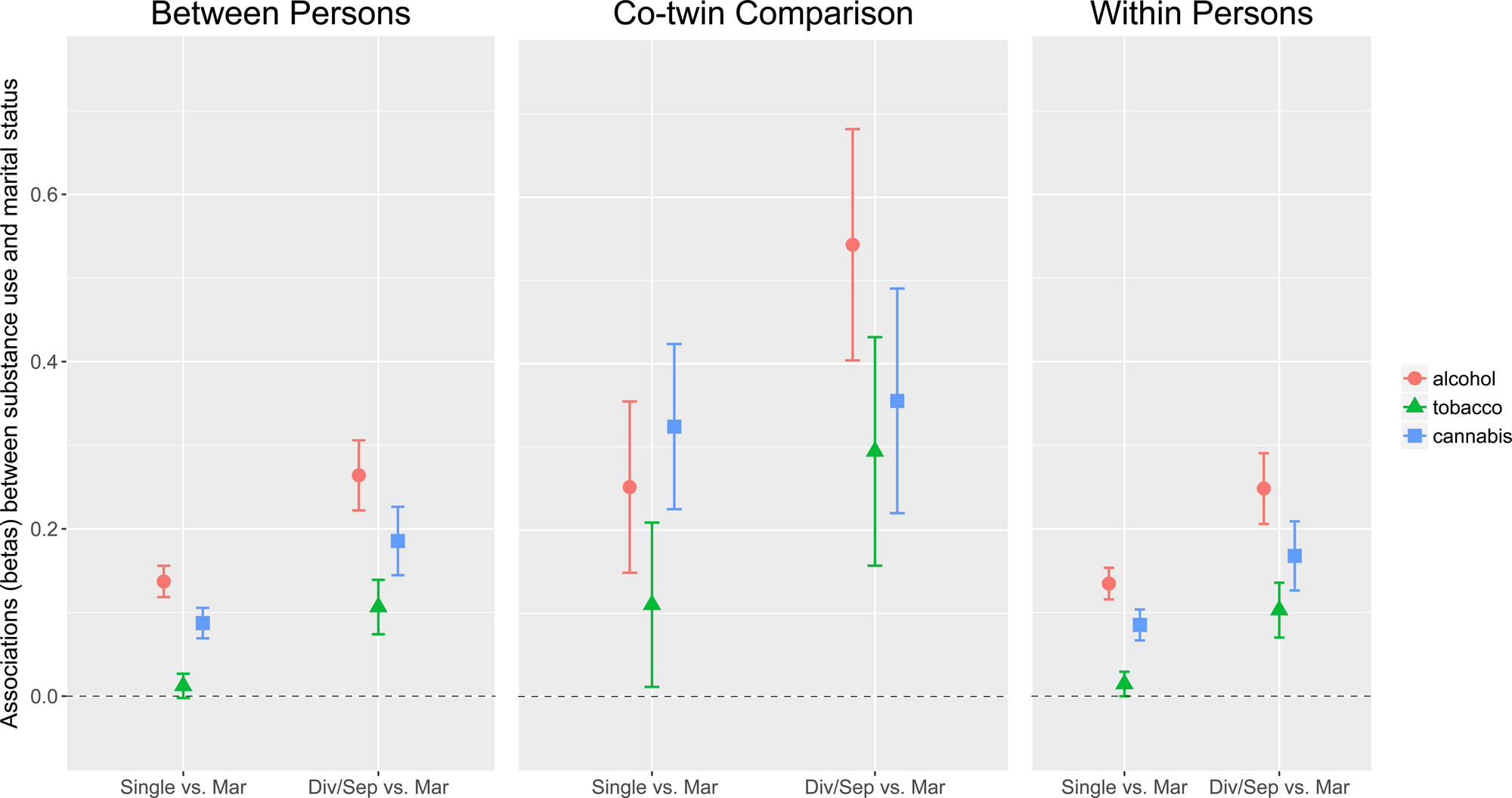
In the between-persons models of substance use as a function of marital status, when men were single or divorced/separated, they reported more alcohol, tobacco, and cannabis use compared to when they were married (Fig. 1, left; and online Supplementary material ST2). The only exception to this trend was that tobacco use did not differ between marrieds and singles. For the co-twin comparison analyses, where the goal was to examine if differences in substance use as a function of marital status were robust after controlling for familial confounding, we identified 1176 person-years where one member of a twin pair was married and the other was single, and 590 person-years where one member of a pair was married and the other was divorced/separated. After controlling for the genetic and rearing environmental factors that twin siblings share, we found that in the years where one twin was single or divorced/separated, he used more alcohol, tobacco, and cannabis than his married co-twin (Fig. 1, middle; and online Supplementary material ST3). In the within-person analyses, where the goal was to examine if differences in substance use as a function of marital status were robust after controlling for individual confounding, we continued to find that when a participant was single or divorced/separated, he used more alcohol, tobacco, and cannabis compared to when he was married (Fig. 1, right; and online Supplementary material ST4). However, this effect was only borderline significant for tobacco in the single v. married comparison (p = 0.051).
Associations between alcohol, cannabis, and tobacco use and marital status, with ‘married’ set as the reference group. The left, center, and right panels depict the between-person, co-twin comparison, and within-person effects, respectively. Error bars denote 95% confidence intervals of the estimates. Mar, married; Div/Sep, divorced/separated.

Substance use across the transition to marriage
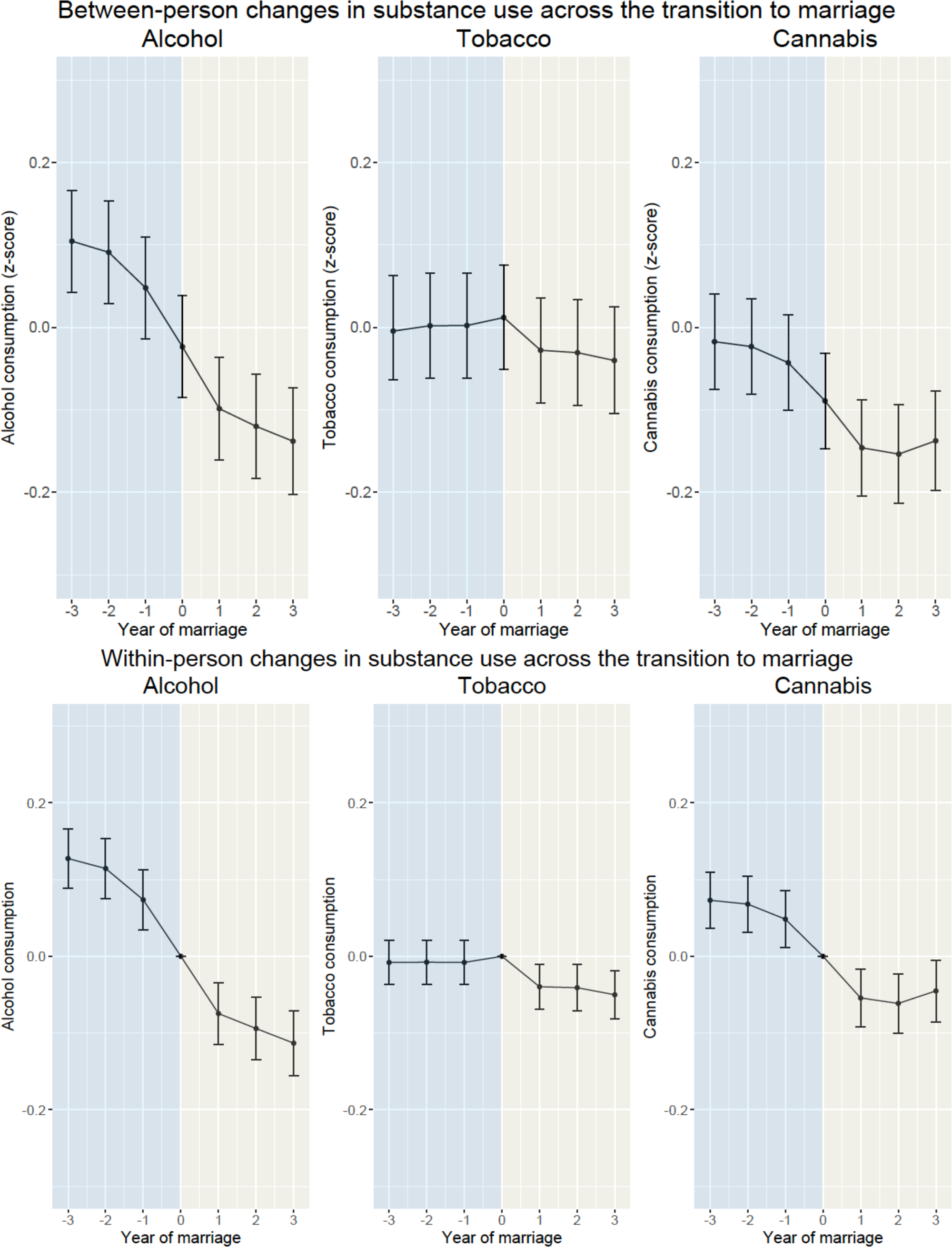
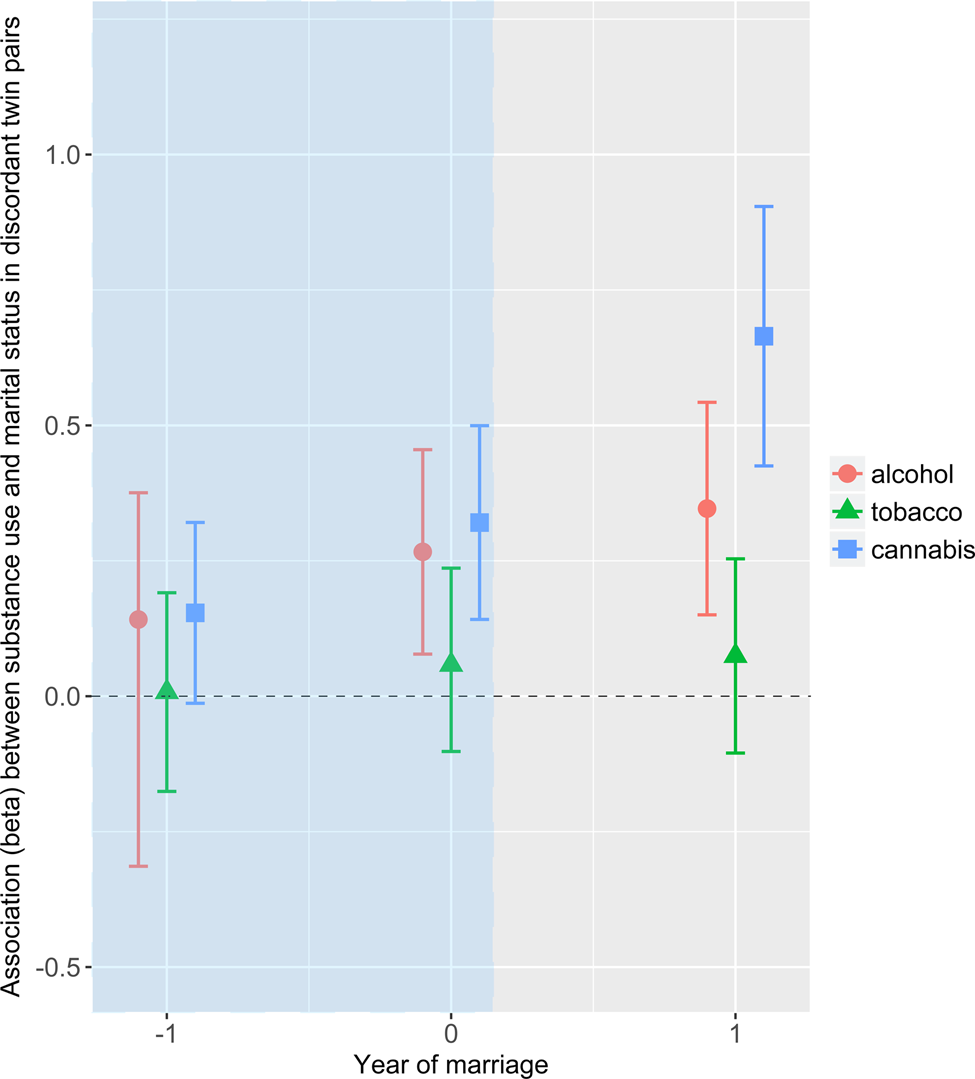
In the between-persons repeated measures analyses, we found that men substantially decreased their alcohol and cannabis use in the years leading up to marriage (Fig. 2, top; and online Supplementary material ST5). Alcohol use continued to decrease in the 3 years following marriage, while the decrease in cannabis use leveled off after the first anniversary. In contrast, men decreased their tobacco use only after marriage, but not before. For the co-twin comparison analyses, where the goal was to examine whether changes in substance use across the transition to marriage were robust after controlling for familial confounding, we identified 2330 person-years where one member of a twin pair was transitioning to marriage (+/− 1 year) and the other was single. After controlling for the genetic and rearing environmental factors that twin siblings share, we found that the twin transitioning to marriage used less alcohol and cannabis in the year of marriage and in the year following marriage compared to his co-twin who remained single (Fig. 3 and online Supplementary material ST6). In contrast, there were no co-twin differences in alcohol or cannabis in the year prior to marriage. There were no differences between co-twins in their tobacco use across the transition to marriage. In the within-person analyses, where the goal was to examine whether changes in substance use across the transition to marriage were robust after controlling for individual sources of confounding, we continued to find that men decreased their alcohol and cannabis use leading up to and following marriage, and decreased their tobacco use following marriage (Fig. 2, bottom; and online Supplementary material ST7).
Alcohol, tobacco, and cannabis consumption across the transition to marriage. The top panel depicts the average change in substance use across this transition. Substance use measures were z-scored for the entire sample; accordingly, values <0 indicate consumption lower than the average in the overall sample. The bottom panel depicts the within-person change in substance use across the transition to marriage, and is depicted relative to substance use during year of marriage (set to 0 as reference). Error bars denote 95% confidence intervals of the estimates.

Associations between alcohol, cannabis, and tobacco use and marital status (single v. married) across the transition to marriage (+/−1 year) in twin pairs discordant for marital status. Error bars denote 95% confidence intervals of the estimates.

Discussion
In a population-based sample of male–male twin pairs, we sought to examine the associations between marital status and psychoactive substance use; determine how substance use changed across the transition to marriage; and evaluate whether these associations reflected causal effects of marriage, or whether they were confounded by familial or individual factors that lead healthier individuals to become and stay married.
First, using regression models, we found associations between marital status and substance use. Consistent with prior epidemiological evidence (Duncan et al., Reference Duncan, Wilkerson and England2006; Staff et al., Reference Staff, Schulenberg, Maslowsky, Bachman, O'Malley, Maggs and Johnston2010; Horn et al., Reference Horn, Xu, Beam, Turkheimer and Emery2013), married men used less alcohol and cannabis compared to those who were single or divorced/separated. Married men also used less tobacco than men who were divorced/separated; however, tobacco use did not differ between married and single men. This suggests that there may be more conflict between the conventional expectations associated with marriage and alcohol and cannabis use compared to tobacco use, perhaps due to the greater impairments associated with alcohol and cannabis. This finding may also reflect the fact that the typical tobacco user is often physically dependent, whereas the typical alcohol or cannabis user is not.
After establishing that marriage was associated with reduced substance use, our second goal was to examine the temporal dynamics underlying these effects and how individual patterns of substance use changed across the transition to marriage. We found, using repeated measures analyses, that alcohol and cannabis use decreased prior to marriage. These reductions prior to marriage mirror theory and evidence that individuals begin to alter their behavior to reduce conflict with social norms and expectations in anticipation of a social role change (Yamaguchi and Kandel, Reference Yamaguchi and Kandel1985; Miller-Tutzauer et al., Reference Miller-Tutzauer, Leonard and Windle1991). Consistent with prior work showing that substance use typically decreases after marriage (Bachman et al., Reference Bachman, O'Malley and Johnston1984; Miller-Tutzauer et al., Reference Miller-Tutzauer, Leonard and Windle1991), we also found that alcohol and cannabis use decreased in the years immediately following marriage. Tobacco use did not decrease prior to marriage, but did decrease by the third anniversary. Thus, both the anticipation of and the adoption of the marital role were associated with reductions in substance use.
Finally, our third goal was to examine whether confounding factors accounted for the associations between marital status and substance use, and in the reductions in substance use across the transition to marriage. We used co-twin comparison and within-person models to examine familial and individual factors as two potential sources of confounding. These refer to differences between families and between individuals that act as third variables to explain the associations between marriage and substance use behavior. At the familial level, these could include factors like low parental education and socioeconomic status, or a family history of marital or substance use problems (Wolfinger, Reference Wolfinger1998, Reference Wolfinger2005); and at the individual level, these could include factors like adolescent substance use problems and traits and behaviors like low levels of conscientiousness or high levels of antisocial behavior (Johnson et al., Reference Johnson, McGue, Krueger and Bouchard2004; Burt et al., Reference Burt, Donnellan, Humbad, Hicks, McGue and Iacono2010).
The associations between marital status and substance use were largely robust even after controlling for confounding at the familial and individual levels. Likewise, the reductions in alcohol and cannabis use across the transition to marriage were generally robust in analyses controlling for familial confounding, and fully robust in analyses controlling for individual confounding. The somewhat weaker effects observed in the co-twin analyses of familial confounding across the transition to marriage are likely attributable to the fact that this analysis relied on the contrast between twins who were discordant for marital status, and there were relatively few person-years that were informative for this comparison. Taken as a set, our co-twin comparison and within-person models provided strong support, within the context of observational data, for the hypothesis that the anticipation and attainment of marriage has a causal, deterrent effect on substance use. Such findings are also consistent with two prior studies using co-twin comparison and within-person models that found that marriage had a causal effect on alcohol and other substance use (Horn et al., Reference Horn, Xu, Beam, Turkheimer and Emery2013; Staff et al., Reference Staff, Greene, Maggs and Schoon2014).
Limitations
Our results should be considered in the context of several potential limitations. First, our sample was limited to white males born in Virginia. Although this sample is representative of the US male population in terms of substance use (Kendler et al., Reference Kendler, Karkowski, Neale and Prescott2000), it is not known whether the same pattern of effects would be observed in women. Substance use tends to be higher among men than women, and there is some evidence that men benefit more from the salutary effects of marriage compared to women (Kiecolt-Glaser and Newton, Reference Kiecolt-Glaser and Newton2001), although we have found the opposite for AUD (Kendler et al., Reference Kendler, Lönn, Salvatore, Sundquist and Sundquist2016). Relatedly, we recognize that our sample includes a range of birth cohorts and that there have been substantial secular changes in marital behavior since the 1980s, including increases in cohabitation, a decline in marriage, and an increase in age at first marriage. Yet, we note that our pattern of effects is quite consistent with findings from the younger National Study of Adolescent Health sample in demonstrating that marriage has a causal, protective effect on substance use (Horn et al., Reference Horn, Xu, Beam, Turkheimer and Emery2013). Thus, even though marriage may be delayed for younger cohorts compared to older cohorts, the data are consistent in suggesting that marriage continues to confer health benefits.
Second, our data came from retrospective reports using an LHC method. This method is informed by cognitive psychology principles to enhance accuracy and produces data with high test–retest reliability (Gillespie et al., Reference Gillespie, Kendler, Prescott, Aggen, Gardner, Jacobson and Neale2007) and modest to high correspondence with prospectively collected data (Koenig et al., Reference Koenig, Jacob and Haber2009), but recall bias cannot be ruled out. To address this possibility in our data, we examined the correlations between participants' self-reports of current alcohol and tobacco use (cannabis data were not available) from their Wave 2 assessment and the corresponding person-year data from the LHCs. The correspondence was high (r = 0.73 and r = 0.84 for alcohol and tobacco, respectively), minimizing recall bias concerns.
Third, we focus on marital role transitions and their association with substance use, but we were unable to account for the substance use behavior of the spouse. Spouse behavior is an important influence on health outcomes and one's persistence v. desistance in substance use and problems (Merline et al., Reference Merline, Schulenberg, O'Malley, Bachman and Johnston2008; Kendler et al., Reference Kendler, Larsson Lönn, Salvatore, Sundquist and Sundquist2018). This may be particularly true for tobacco use, for which the protective effects of marriage were the weakest and for which prior studies show moderate evidence of assortative mating (Agrawal et al., Reference Agrawal, Heath, Grant, Pergadia, Statham, Bucholz, Martin and Madden2006; Reynolds et al., Reference Reynolds, Barlow and Pedersen2006). We speculate that marriage would be less protective among men who marry partners higher in substance use, as we have found previously (Kendler et al., Reference Kendler, Lönn, Salvatore, Sundquist and Sundquist2016). Relatedly, although we interpret our effects as evidence that the social role expectations associated with marriage reduce substance use, we recognize that they may also reflect spousal convergence for these behaviors (Leonard and Das Eiden, Reference Leonard and Das Eiden1999). Discriminating between these two hypotheses would be possible in a dataset with longitudinal data on both spouses. Such a dataset would also shed light on the sex-specific pathways through which marriage and partner characteristics influence substance use.
Fourth, in our co-twin comparison analyses, we analyzed monozygotic and dizygotic twins together, as we did not have sufficient statistical power to test for co-twin differences in each zygosity group separately. Accordingly, these analyses controlled for environmental factors that twins shared, and approximately 75% of their shared genetic influences. Finally, we were not able to establish the specific mediational processes through which marriage is protective against substance use. This likely reflects multiple mechanisms, including changes in socializing and time allocation (Bachman et al., Reference Bachman, O'Malley, Schulenberg, Johnston, Bryant and Merline2014), as well as direct efforts by spouses to monitor and control health-related behaviors (Umberson, Reference Umberson1992).
Conclusions
In a population-based sample of male–male twin pairs for whom we had high-resolution LHC data, we found that married men tended to use less alcohol, tobacco, and cannabis compared to men who were single or divorced/separated, and that changes in substance use typically began in anticipation of marriage, and continued throughout the early years of marriage. These effects were largely robust in co-twin comparison and within-person models, which are two powerful designs for quasi-causal inference. Thus, the convergent results across divergent methods suggest that marriage reduces men's psychoactive substance use.
Supplementary material
The supplementary material for this article can be found at https://doi.org/10.1017/S0033291719002964
Financial support
This work was supported in part by the National Institutes of Health (K.S.K., grant numbers R37AA011408, P20AA017828, R01AA023534, R01DA030005, and P50AA022537) and (J.E.S. grant number K01AA024152). The Virginia Twin Registry, now part of the Mid-Atlantic Twin Registry (MATR), is supported by the National Institutes of Health (grant number UL1RR031990). The content is solely the responsibility of the authors and does not necessarily represent the official views of the National Institutes of Health.
Conflict of interest
None.
Ethical standards
The authors assert that all procedures contributing to this work comply with the ethical standards of the relevant national and institutional committees on human experimentation and with the Helsinki Declaration of 1975, as revised in 2008.