There is widespread recognition of the potentially critical role of gene–environment interplay in the evolution of psychiatric disturbance in children and adults (Rutter & Silberg, Reference Rutter and Silberg2002), beginning in early childhood (Harold et al., Reference Harold, Leve, Barrett, Elam, Neiderhiser and Natsuaki2013; Leve et al., Reference Leve, Kerr, Shaw, Ge, Neiderhiser and Scaramella2010). Attention has increasingly focused on gene–environment correlation (rGE) as an etiologically important mechanism in the development of psychopathology. rGE refers to a range of processes in which an individual's social environment is associated with his or her genotype. Studies of rGE may help uncover some of the potentially modifiable environmental processes by which genetic effects have their impact on risk for maladjustment. Yet the majority of existing research on rGE has not examined how these processes unfold in very early development or their role in directly mediating genetic effects related to psychopathology. In the current study, we therefore investigated the role of rGE in the first 2 years of life using a prospective cohort of children adopted at birth and their adoptive parents assessed at 9, 18, and 27 months. To examine early appearing, psychiatrically relevant rGE, measurements of proximal factors in young children's family environments and child outcomes were then related to indicators of genetic risk in the form of detailed diagnostic and symptom-level measurements of birth mother psychopathology.
Three distinct processes are subsumed by the term rGE (Plomin, DeFries, Knopik, & Neiderhiser, Reference Plomin, DeFries, Knopik and Neiderhiser2013; Plomin, DeFries, & Loehlin, Reference Plomin, DeFries and Loehlin1977; Scarr & McCartney, Reference Scarr and McCartney1983). Passive rGE occurs when the same set of genes that influence parental care also, when passed from parent to child, influence child behavior. This form of rGE represents a confounding of putative environmental effects by genes and, as such, must be taken into account when investigating the environment. In typical developmental studies, for example, parental behavior and child outcomes may correlate because of genes that are inherited and shared by parents and their children. Adoption designs are particularly powerful for ruling out passive rGE because they cleanly separate the genes that are passed from birth parent to child from the environment provided by the adoptive parent. Active rGE refers to the tendency for genetically influenced traits to affect the kinds of environments that individuals select and choose, such as a peer group or romantic partner. Active rGE may be increasingly important during development, and the consequences of these choices could affect subsequent risk for psychopathology. Evocative rGE occurs when genetically influenced traits or behaviors evoke systematic responses from the environment. For example, if a child is irritable or aggressive, both genetically influenced characteristics, a parent may respond to these characteristics with anger, criticism, or rejection. Such changes in the quality of parental care could directly impact subsequent maladaptive development and therefore mediate the effects of genes, or these environmental responses might amplify or compound genetic effects on a risk-related trait and thereby increase risk for child maladjustment. There is good reason to believe that evocative rGE, the focus of the current inquiry, may be the most important form of rGE in early development because opportunities for the active selection of environments may be quite limited at this stage and child effects on parental well-being and parenting have been identified in a number of studies (Bell, Reference Bell1968; Shaw & Bell, Reference Shaw and Bell1993).
When considering what aspects of children's early environments might be most important in the development of psychopathology, and in rGE in particular, parental behavior and emotions are key starting points. Several aspects of parenting have been the focus of past developmental research, including distinct parenting dimensions such as warmth, overreactivity, hostile/rejecting parenting, and inconsistent discipline (e.g., O'Leary, Slep, & Reid, Reference O'Leary, Slep and Reid1999) as well as perceived stresses and negative emotions related to parenting (Crnic & Greenberg, Reference Crnic and Greenberg1990; Teti & Gelfand, Reference Teti and Gelfand1991). The negative facets of parental behavior and emotions have often been found to correlate, and they may reflect global negative schemas that parents develop regarding their child and their own efficacy as parents (Jones & Prinz, Reference Jones and Prinz2005). For example, lab studies suggest that this cluster of parenting behaviors and feelings (which we refer to collectively hereafter as “parental negativity”) aggregate in large part because negative parental perceptions of the child underlie overreactive parenting and feelings of anger/frustration and helplessness (see O'Leary et al., Reference O'Leary, Slep and Reid1999; O'Leary & Vidair, Reference O'Leary and Vidair2005). A number of studies have suggested that parental negativity correlates with, and precedes the emergence of, children's emotional and behavioral problems (O'Leary et al., Reference O'Leary, Slep and Reid1999; Snyder, Cramer, Afrank, & Patterson, Reference Snyder, Cramer, Afrank and Patterson2005; Weaver, Shaw, Dishion, & Wilson, Reference Weaver, Shaw, Dishion and Wilson2008).
However, a critical question is whether the child's genetic predispositions play a role in the emergence of parental negativity. In view of the role played by parental perceptions of the child in these processes, it is plausible that the parents’ responses are partly driven by characteristics of the child or that they represent the reciprocal interplay between parent and child (Bell, Reference Bell1968; Del Vecchio & Rhoades, Reference Del Vecchio and Rhoades2010; Verhoeven, Junger, van Aken, Dekovic, & van Aken, Reference Verhoeven, Junger, van Aken, Dekovic and van Aken2010). Only genetically informative studies can directly test whether heritable traits in the child evoke negative responses in the parent. Behavioral genetic studies of parenting have produced quite consistent evidence of rGE, particularly in relation to affective aspects of parenting such as warmth and negativity/hostility (Kendler & Baker, Reference Kendler and Baker2007; Rowe, Reference Rowe1981). For example, a study using a parent–offspring adoption design similar to the current report found that children aged 12–18 years whose birth mothers evidenced multiple indicators of externalizing problems received more negative and harsh parenting from their adoptive parents than those children whose birth mothers did not (Ge et al., Reference Ge, Conger, Cadoret, Neiderhiser, Yates and Troughton1996). Recent work using extended twin designs has examined the distinct roles of evocative and passive rGE in parenting (Marceau et al., Reference Marceau, Horwitz, Narusyte, Ganiban, Spotts and Reiss2014; Narusyte et al., Reference Narusyte, Neiderhiser, Andershed, D'Onofrio, Reiss and Spotts2011; Neiderhiser, Reiss, Lichtenstein, Spotts, & Ganiban, Reference Neiderhiser, Reiss, Lichtenstein, Spotts and Ganiban2007). The extended children of twins design makes it possible to distinguish among passive rGE, evocative rGE, and direct environmental effects on associations between parenting and child constructs. This design requires a sample of adult twins and their children and a second sample of child twins and their parents. Inclusion of both samples in the same model permits estimation of parent-based and child-based genetic influences on behavior simultaneously and allows for the identification of direct (not genetically influenced) environmental effects of parenting on child constructs. Results from these studies suggest that evocative rGE, but not passive rGE, contributes to mothers’ negativity and emotionality overinvolvement (McAdams et al., Reference McAdams, Neiderhiser, Rijsdijk, Narusyte, Lichtenstein and Eley2014).
Although fewer studies have been conducted in early childhood, Deater-Deckard (Reference Deater-Deckard2000) found evidence of evocative rGE for mothers’ reports of child-focused negative and positive affect as well as directly observed responsiveness in a sample of 3.5-year-old twins (for similar findings with a large twin sample, see Larsson, Viding, Rijsdijk, & Plomin, Reference Larsson, Viding, Rijsdijk and Plomin2008). Less still is known about the extent of rGE in the first 3 years of life. Twin studies employing direct observations of global dimensions of parenting, such as sensitivity, have tended not to detect rGE during in the first 2 years of life (DiLalla & Bishop, Reference DiLalla and Bishop1996; Fearon et al., Reference Fearon, van IJzendoorn, Fonagy, Bakermans-Kranenburg, Schuengel and Bokhorst2006; Roisman & Fraley, Reference Roisman and Fraley2008). However, in a large population-based twin study, Boivin et al. (Reference Boivin, Perusse, Dionne, Saysset, Zoccolillo and Tarabulsy2005) found evidence of genetic influences on self-reports of parental negativity (particularly overreactive parenting) as early as 5 months of age, which, in keeping with studies of older age groups, suggests that rGE may be particularly important in the emergence of parental negativity in early development.
The etiological significance of heritable evocative effects for the development of psychopathology is suggested by several lines of inquiry. First, in Ge et al.'s (Reference Ge, Conger, Cadoret, Neiderhiser, Yates and Troughton1996) adoption work, birth parent antisocial behaviors (e.g., drug/alcohol use and antisocial personality disorder) were used to characterize children's genetic risk for externalizing problems, in effect restricting the scope of genetic effects to those specifically linked to adult externalizing disorder. Second, twin findings have shown that genetic influences on negative parenting overlap with genetic influences on child externalizing symptoms during adolescence (Narusyte et al., Reference Narusyte, Neiderhiser, D'Onofrio, Reiss, Spotts and Ganiban2008; Neiderhiser, Marceau, & Reiss, Reference Neiderhiser, Marceau and Reiss2013; Pike, McGuire, Hetherington, Reiss, & Plomin, Reference Pike, McGuire, Hetherington, Reiss and Plomin1996) and childhood (Jaffee et al., Reference Jaffee, Caspi, Moffitt, Polo-Tomas, Price and Taylor2004). In addition, genetic influences on parenting predict children's later behavioral problems, after accounting for variance in children's earlier behavioral problems (Burt, McGue, Krueger, & Iacono, Reference Burt, McGue, Krueger and Iacono2005; Larsson et al., Reference Larsson, Viding, Rijsdijk and Plomin2008; Neiderhiser, Reiss, Hetherington, & Plomin, Reference Neiderhiser, Reiss, Hetherington and Plomin1999). However, no genetically informative studies have thus far tested the independent contribution of rGE to child development in the first 3 years of life.
Studies of rGE have almost exclusively focused on main effects of genes on the social environment. However, recent work has drawn attention to the potentially important role of environmental moderation of rGE (rGE × E; see Horwitz & Neiderhiser, Reference Horwitz and Neiderhiser2011; Reiss & Leve, Reference Reiss and Leve2007). Moderated rGE could arise in two ways. First, rGE may appear in response to child traits that are under the control of G × E mechanisms. In other words, rGE may be most pronounced when certain genotypes and environments co-occur because these circumstances give rise to evocative traits in the child. A number of social–environmental variables have been found to moderate genetic effects on child behavior and adjustment, including marital disharmony and family conflict (Button, Scourfield, Martin, Purcell, & McGuffin, Reference Button, Scourfield, Martin, Purcell and McGuffin2005; Cadoret, Yates, Woodworth, & Stewart, Reference Cadoret, Yates, Woodworth and Stewart1995; Feinberg, Button, Neiderhiser, Reiss, & Hetherington, Reference Feinberg, Button, Neiderhiser, Reiss and Hetherington2007; O'Connor, Caspi, DeFries, & Plomin, Reference O'Connor, Caspi, DeFries and Plomin2003; Rhoades et al., Reference Rhoades, Leve, Harold, Neiderhiser, Shaw and Reiss2011; Rice, Harold, Shelton, & Thapar, Reference Rice, Harold, Shelton and Thapar2006), parental depression (Tully, Iacono, & McGue, Reference Tully, Iacono and McGue2008), and economic adversity (Cloninger, Sigvardsson, Bohman, & von Knorring, Reference Cloninger, Sigvardsson, Bohman and von Knorring1982; South & Krueger, Reference South and Krueger2011; Tuvblad, Grann, & Lichtenstein, Reference Tuvblad, Grann and Lichtenstein2006). To the extent that such child traits lead to associated responses in the social environment, one would expect to observe moderated rGE. Second, moderated rGE could occur as a result of environmental conditions directly altering how susceptible a parent is to being affected by, or reacting to, a genetically influenced child trait. Accordingly, it is notable that data suggest that early negative parental reactions may be more pronounced under conditions of marital conflict (O'Leary & Vidair, Reference O'Leary and Vidair2005), economic distress (Mills-Koonce et al., Reference Mills-Koonce, Propper, Gariepy, Blair, Garrett-Peters and Cox2007), or parental depressed or anxious mood (Lorber & Slep, Reference Lorber and Slep2005). Thus, via either of these pathways, we would hypothesize that rGE may be moderated by the presence or extent of marital problems, economic distress, and parental affective symptoms. Direct evidence in support of this has been reported by Ulbricht et al. (Reference Ulbricht, Ganiban, Button, Feinberg, Reiss and Neiderhiser2013), who found greater child-based genetic influences on maternal parenting negativity (i.e., greater rGE) under conditions of poorer marital quality in a sample of adolescent twins and siblings and their parents.
In the current report, using data from a prospective adoption study, the Early Growth and Development Study (EGDS; see Leve et al., Reference Leve, Neiderhiser, Shaw, Ganiban, Natsuaki and Reiss2013), we aimed to test the role of rGE in relation to parental negativity in the first 2 years of life. We sought to focus specifically on rGE mechanisms linked to psychopathology in two ways: by restricting the scope of genetic effects to those related to birth mother psychopathology and by examining the longitudinal association between rGE and child emotional and behavioral problems. In so doing, we directly tested the role of evoked rearing parent negativity in mediating the effects of psychopathology-relevant genes on child maladjustment. Finally, we examined the extent to which these rGE effects were moderated by family context, with a particular focus on adoptive family characteristics that are likely to play a moderating role, as we have just reviewed: marital problems, economic distress, and adoptive parent affective disturbance. The use of a prospective adoption design allowed us to test these key questions concerning gene–environment interplay in early development while ruling out any effects of passive rGE.
Methods
Participants
The participants were 561 families recruited as part of the EGDS, an ongoing multisite longitudinal adoption study (Leve et al., Reference Leve, Neiderhiser, Shaw, Ganiban, Natsuaki and Reiss2013). Participants were recruited from adoption agencies across the United States if they met the following criteria: adoption was domestic, the baby was placed within 3 months postpartum, the baby was placed with a nonrelative adoptive family, the baby had no known medical conditions, and the adoptive and birth parents were able to read or understand English at an eighth-grade level. The mean child age at adoption placement was 6.2 days (SD = 12.4 days). The adoptive parents were typically college educated, middle- to upper-class families. The adoptive mother mean age was 37 years (SD = 5.64). Ninety-one percent of the adoptive mothers were Caucasian. Birth mothers typically had less than a college education and had household annual incomes less than $25,000. Birth mother mean age was 24.8 (SD = 8.51). Seventy percent of the birth mothers were Caucasian. Detailed information regarding the composition and representativeness of the sample is presented in Leve et al. (Reference Leve, Neiderhiser, Shaw, Ganiban, Natsuaki and Reiss2013). The adoptive parents contributed questionnaire data regarding parenting during home visits conducted when the children were 9, 18, and 27 months of age. In this report, we focus exclusively on adoptive mothers’ reports for assessing parenting negativity. Adoptive fathers’ reports were used to obtain independent information regarding the child's temperament, so that we could examine whether temperament accounted for any observed rGE effects. We chose this strategy for two reasons. First, to maximize power, we sought to conduct the smallest possible number of statistical tests, focused on the strongest hypothesized effects. Investigating rGE effects in relation to paternal negativity would have doubled the number of hypothesis tests. Second, this strategy allowed us to independently measure temperament in a way that limited potential bias associated with the effects of shared method variance. Data on birth mother psychopathology were obtained through a diagnostic interview and via repeated assessments of symptom scores when the infant was 18 and 27 months of age. A subset (n = 25, 4.4%) of adoptive families included divorced single fathers or two adoptive fathers. In these families, the father deemed the primary caregiver completed the measures labeled as “adoptive mother.” Space precluded repeatedly qualifying the use of the label “adoptive mothers.”
Measures
Adoptive mother parenting negativity
At all three times of assessment (9, 18, and 27 months), we collated data from adoptive mothers using three well-validated scales (from three different questionnaires) relating to negative parenting behavior and feelings: the Parenting Scale, the Parenting Self-Efficacy Scale, and the Parenting Daily Hassles Scale. The Parenting Scale (Arnold, O'Leary, Wolf, & Acker, Reference Arnold, O'Leary, Wolf and Acker1993) is a widely used and well-validated instrument that asks parents to endorse the extent to which they use a range of ineffective parenting strategies on a 7-point scale. The overreactive parenting subscale includes negatively and positively worded items related to parents’ tendencies to endorse becoming angry, irritable, and harsh when their child misbehaves or is otherwise challenging. Negative examples include “I raise my voice or yell” or “I get so frustrated that my child can see I'm upset.” Positive examples include “I handle it without getting upset” or “Things don't get out of hand.” Internal consistencies of the scales (Cronbach α) at 9, 18, and 27 months were 0.70, 0.78, and 0.79, respectively. The Parenting Self-Efficacy Scale (Teti & Gelfand, Reference Teti and Gelfand1991) is a 10-item questionnaire measuring feelings of competence as a parent in relation to several caregiving areas, such as knowing what a child wants or needs and how to manage his or her distress. Each item is rated on a 4-point scale reflecting a parent’s degree of confidence in each area, from not good at all to very good. Scale scores are composed of the sum of these 10 items. Internal consistencies at 9, 18, and 27 months were 0.73, 0.72, and 0.74, respectively. The Parenting Daily Hassles Scales (Crnic & Greenberg, Reference Crnic and Greenberg1990) is a 20-item questionnaire measuring the extent to which parents feel hassled and stressed in the parenting role and in their daily dealings with their children. Parents rate the frequency of individual items (5-point scale) and whether it represents a problem for the parent (yes or no). In the current study, we focused solely on the frequency of hassles. In terms of content, the instrument has been used as two intercorrelated scales comprising 8 items reflecting hassles and stress associated with daily duties and chores associated with parenting and 7 items reflecting hassles specifically associated with the child's challenging behavior. Because the Parenting Daily Hassles Scale was originally devised for toddler and preschool-age children, it was not surprising to find that 5 of the 15 items were rated as “not applicable” by more than 15% of the sample when administered to parents at 9 months, including items such as “being nagged, whined, or complained to,” “child doesn't listen without being nagged,” or “referee needed for sibling fights” (this last item being deemed not applicable in many cases across all ages). Thus, to ensure consistency of scaling across ages (which is necessary for the growth curve analyses used in this report; see Stoel, van den Wittenboer, & Hox, Reference Stoel, van den Wittenboer and Hox2004), these items were excluded. The remaining 10 items were combined into a single scale, which had acceptable levels of internal consistency at each wave of testing (9 months α = 0.81; 18 months α = 0.76; and 27 months α = 0.76).
Birth mother psychiatric diagnosis
The Composite International Diagnostic Interview (see Andrews & Peters, Reference Andrews and Peters1998) is a comprehensive, fully standardized diagnostic interview based on the DSM-IV criteria devised to be used by nonclinical staff. The test–retest reliabilities reported in the literature for each disorder range from κ = 0.45 to 0.63. Birth mothers were interviewed in person by trained research staff when the infants were 18 months of age. In the current sample, 13.8% of birth mothers received a lifetime diagnosis of social phobia, 22.0% specific phobia, 28.9% major depression, 1% panic disorder, 7.5% generalized anxiety disorder, 3.7% agoraphobia, 7.3% antisocial personality disorder, 26.5% drug abuse, and 30.3% alcohol abuse.
Birth mother psychiatric symptom inventories
To create a robust multimethod operationalization of birth mother liability to externalizing and internalizing psychopathology, the above diagnostic data were supplemented with diagnostically relevant self-report data, all except one of which (novelty seeking) were obtained on two separate occasions (4 and 18 months postpartum), standardized, and then averaged. These self-report instruments were the Beck Anxiety (BAI) and Depression (BDI) Inventories. The BAI is a widely used, 21-item self-report measure of anxiety with acceptable reliability and validity. Respondents are asked to indicate the degree to which they are bothered by specific symptoms of anxiety (i.e., terrified or afraid, numbness, or sweating) in the past week on a 4-point scale ranging from not at all to severely. The internal consistency of the BAI was 0.91 and 0.92 at the two assessment points. The BDI is a well-established and widely used measure of depressive symptoms with acceptable reliability and validity. Participants are asked to choose one of four statements that range from positive to depressed feelings about life in the past week. Internal consistencies were 0.92 and 0.91 at the two assessment points. Because the BAI and BDI scales were highly correlated (r = .70), they were standardized and averaged to create an overall index of affective symptomatology. The Elliot Youth Questionnaire Revised (Elliott, Huizinga, & Ageton, Reference Elliott, Huizinga and Ageton1985) is a 38-item self-report questionnaire examining the extent to which adults engage in a range of delinquent or antisocial behavior (e.g., stealing, damaging property, and carrying a weapon; αs = 0.75 and 0.68, respectively). Finally, we chose the Novelty Seeking Scale of the Temperament Character Inventory (Cloninger, Svaric, & Przybeck, Reference Cloninger, Svaric and Przybeck1993) as a continuous trait linked to substance abuse. This scale assesses adults’ tendencies to seek highly exhilarating sources of stimulation as well as impulsiveness and excitability. The scale's internal consistency was satisfactory (α = 0.72). It is important to note that, although birth father data was collected in this study, we chose not to use it for this paper a priori because of the high rates of missing data (<50% of cases had data from birth fathers).
Family context moderators
We measured three areas of the adoptive family's context that previous research indicated may moderate genetic effects on caregiving or child development: economic distress, parent affective symptoms, and marital problems. Economic distress was computed as the standardized average of three scales obtained over the three assessment periods (9, 18, and 27 months) of a questionnaire regarding family satisfaction with their financial situation (Conger, Ge, Elder, & Simons, Reference Conger, Ge, Elder and Simons1994). The items concerned whether or not (on a 5-point scale) families experienced difficulties buying essential family items (e.g., clothes or food), making ends meet (e.g., paying bills), or making financial cutbacks in the last year. The internal consistency of the combined scale was satisfactory (α = 0.82). Parent affective symptoms were computed as the average of adoptive mother and father's standardized scores for anxiety and depression (using the aforementioned Beck questionnaires) over the three assessment periods (α = 0.86). Marital problems was computed as the average across three waves and across adoptive mothers’ and fathers’ reports of marital harmony using the Marital Relationship Questionnaire (Booth, Johnson, & Edwards, Reference Booth, Johnson and Edwards1983). The internal consistency of the combined scales was α = 0.91.
Children's emotional and behavioral problems
The Child Behavior Checklist (Achenbach & Rescorla, Reference Achenbach and Rescorla2000) is a widely used and well-validated instrument for the assessment of children's emotional and behavioral problems. Adoptive mothers and fathers completed the checklist when the child was 27 months. The scale consists of 99 items, each scored from 0 to 2, indicating whether a problem behavior is not true, sometimes true, or very true with respect to the child. Items are summed and age-normed scaled to create two overall factors reflecting internalizing problems (e.g., “too fearful and anxious”) and externalizing problems (e.g., “hits others,” “disobedient at school,” or “argues a lot”). In the current study, internal consistencies were good for the internalizing (mother α = 0.73, father α = 0.77) and externalizing (mother α = 0.87; father α = 0.88) scales.
Temperament
To identify temperamental traits that might account for any observed rGE effects, adoptive fathers’ ratings on two questionnaires regarding infants’ temperament were obtained when the infants were 9 months old: the Infant Behavior Questionnaire (Rothbart, Reference Rothbart1981) and the Infant Characteristics Questionnaire (Bates, Freeland, & Lounsbury, Reference Bates, Freeland and Lounsbury1979). The Infant Behavior Questionnaire yields six scales reflecting activity level (α = 0.81), distress to limitations (α = 0.85), distress to novel stimuli (α = 0.71), duration of orienting (α = 0.77), smiling and laughter (α = 0.86), and soothability (α = 0.78). The Infant Characteristics Questionnaire was used to obtain an overall index of infant difficulty (irritable or prone to negative emotions α = 0.87). Both instruments are well validated, and the scales demonstrate good internal consistency. Given the focus of this paper on evoked negativity in adoptive parents, we focused on the two distress scales from the Infant Behavior Questionnaire (distress to novel stimuli and distress to limitations) and the overall difficultness score from the Infant Characteristics Questionnaire.
Adoption openness
To account for the possibility that contact between adoptive and biological families could confound any apparent genetic effects, we assessed the degree of openness in the adoption arrangements using a composite measure of perceived adoption openness averaged across the three waves (9, 18, and 27 months) from biological mothers and adoptive mothers and fathers (see Ge et al., Reference Ge, Natsuaki, Martin, Leve, Neiderhiser and Shaw2008). Interrater agreement was high (r range = .72–.85, ps < .001).
Perinatal risk
A further threat to the validity of detected genetic effects in the adoption design are perinatal factors; thus we conducted detailed assessments of perinatal obstetric complications using birth mothers reports of maternal/pregnancy complications (e.g., illness or exposure to drugs), labor and delivery complications (e.g., prolonged labor or cord complications), and neonatal complications (e.g., prematurity or low birth weight) using a pregnancy screener and a pregnancy calendar method developed for the study (derived from Caspi, Moffitt, Thornton, & Freedman, Reference Caspi, Moffitt, Thornton and Freedman1996). A comprehensive coding system for perinatal risk was devised for scoring the data based on the McNeil–Sjostrom Scale for Obstetric Complications (McNeil & Sjostrom, Reference McNeil and Sjostrom1995; see Marceau et al., Reference Marceau, Hajal, Leve, Reiss, Shaw and Ganiban2013, for more detail). The original Obstetric Complications scale has established reliability and validity (McNeil, Cantor-Graae, Sjostrom, Reference McNeil, Cantor-Graae and Sjostrom1994).
Missing data
Because not all participants provided complete data, and because excluding such cases can undermine statistical power and bias parameter estimates (Allison, Reference Allison2003), we employed the full information maximum likelihood method, which uses all the available data to estimate the parameter estimates of a model (by calculating the log-likelihood of the data for each observational unit separately). This approach is clearly superior to mean substitution and listwise deletion and of comparable performance to multiple imputation (Allison, Reference Allison2003; Schafer & Graham, Reference Schafer and Graham2002). The primary source of missing data was missing psychiatric information concerning the birth mothers. All analyses were conducted using Mplus version 7 (Múthen & Múthen, Reference Muthén and Muthén1998–2012).
Data analysis
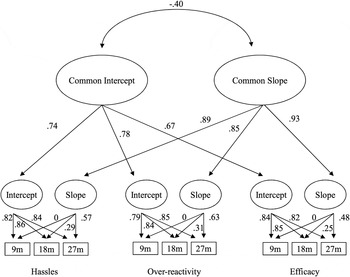
Latent growth curve (LGC) analysis is a structural equation modeling approach to longitudinal data that estimates parameters representing the initial level (or intercept, usually the first time point) of a measure and its linear or nonlinear growth over time. These overall effects are modeled as latent variables whose means represent the grand average at Time 1 (the intercept) and the average growth (slopes) over time, respectively. LGC models also allow estimation of each individual's intercept and trajectory, which are captured by individual-level variance in the latent variables representing the intercept and slopes. Once estimated, the variances (or individual differences) in the intercepts and slopes may then be related to a range of other constructs (e.g., correlated with other measured or latent variables). In the current paper, we employed three separate indicators of parental negativity, and so multivariate latent growth curve modeling was used. This extension of LGC analysis simultaneously estimates a latent growth curve for each measurement and then models the interrelations among their respective intercepts and slopes. These interrelations are assumed to reflect two underlying factors related to common variance in their intercepts and common variance in their slopes. The two factors therefore represent the extent to which the intercepts of each measure correlate with each other and the extent to which the slopes of each measure correlate with each other and could be assumed to reflect the growth of a general tendency or common factor (i.e., manifesting across multiple measures/domains) unfolding over time. In so doing, the model minimizes measurement error in both the estimate of the intercept and the slope of the common factor and efficiently summarizes the shared properties of several measurements taken repeatedly over time. These error-free latent variables can then be related to other constructs of interest. In the current paper, we regressed these latent intercept and slope variables on our key indices of genetic influence, environmental moderators, and their interaction. A schematic diagram describing the statistical model is shown in Figure 1.
Multivariate latent growth curve model of adoptive mother parental negativity.

After checking model fit using standard indices (comparative fit index [CFI] and root mean square error of approximation [RMSEA]), our main hypotheses were tested by comparing models where the key regression paths were estimated freely with a nested submodel in which they were constrained to zero. The difference in the likelihood ratio statistic between the two models was used to derive significance tests. Individual model regression/path coefficients are also reported.
In this study, our primary hypotheses concerned rGE and moderated rGE, which translates analytically into genetic main effects and gene–environment interactions on environmental outcomes (the parenting negativity latent intercept and slope). To minimize the Type I error rate, we tested all hypotheses using a joint test (2 degrees of freedom) of association between genetic indices or variables representing Gene × Environment (G × E) interaction in relation to the latent intercept and slope of parental negativity. Follow-up analyses were only conducted when the joint test was significant. In all, we tested eight such joint tests: two tests of genetic main effects for internalizing and externalizing adult psychopathology and six tests of gene–environment interaction (birth mother internalizing and externalizing liability against each of three environmental moderators). Because the terms representing these effects were correlated (in some cases quite strongly), we employed a Bonferonni adjustment corrected for the level of correlation among the tests (the average correlation across all eight predictor variables was r = .43). Using this correction, overall family-wise error rate is maintained at <0.05 if the per-test alpha level is set to 0.016 (see Perneger, Reference Perneger1998).
Results
Overview
Before performing our primary analyses, we took a number of steps to develop our indices of genetic risk, check for genetic effects (as indicated by birth mother psychopathology) on our main environmental moderators (economic distress, marital problems, and adoptive parent affective symptoms), and establish our model for describing the growth of parental negativity from 9 to 27 months of age. These sections are presented first, before turning to the main analyses, where we tested the effects of birth mother psychopathology and its interaction with environmental moderators on the growth of parenting negativity over time.
Genetic risk: Birth mother psychiatric diagnoses and symptom scales
The lifetime psychiatric diagnoses (social anxiety disorder, specific phobia, panic disorder, generalized anxiety disorder, major depression, agoraphobia, antisocial personality disorder, alcohol abuse, and drug abuse) and the current symptoms measures (anxiety/depression, antisocial behavior, and novelty seeking) were used to create overall indices of birth mother psychiatric liabilities for internalizing and externalizing problems (Kendler, Prescott, Myers, & Neale, Reference Kendler, Prescott, Myers and Neale2003). A two-factor structural equation model, with diagnoses specified as dichotomous indicators of two continuous factors, fit the data fairly well, χ2 (53) = 95.72, p < .001, RMSEA = 0.038, CFI = 0.94. Allowing residual correlation between two of the symptom measures (anxiety/depression and antisocial behavior) further improved model fit, χ2 (52) = 76.45, p = .015; RMSEA = 0.029, CFI = 0.97. The two birth mother psychopathology latent variables were estimated to correlate with each other at r = .45 (SE = .071, p < .001). Estimated individual factor scores derived from this latter model for each participant were then used in subsequent analyses as indicators of genetic effects related to birth mother internalizing and externalizing psychopathology.
Genetic associations with environmental moderators
To establish that the putative environmental moderator variables were not directly influenced by the children's genetic predispositions, we ran a series of correlations between our indices of genetic risk (i.e., the birth mother psychopathology variables) and our proposed family-context environmental moderators (i.e., adoptive family marital problems, economic distress, and affective symptoms). The correlations were all nonsignificant and numerically small (e.g., rs = –.04 to .02).
Modeling the growth in parental negativity
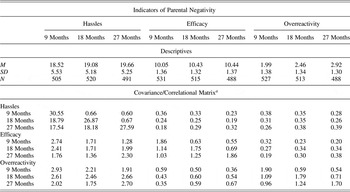
The means, standard deviations, correlations, and covariances of the indicators of mothers’ parental negativity at each time point are shown in Table 1. Fitting the multivariate latent growth curve model initially with no exogenous predictors showed that the model had acceptable fit, χ2 (30) = 66.14, p < .001, CFI = 0.98, RMSEA = 0.047. Results from this analysis indicated that there was significant interindividual variance in the common factors representing the initial level (intercept variance = 0.75, SE = 0.11, p < .001) and slope (slope variance = 0.12, SE = 0.02, p < .001) in parental negativity and that overall parental negativity increased from 9 to 27 months (linear slope mean = 0.47, SE = 0.03, p < .001). The latent growth curve model with standardized parameter estimates is shown in Figure 1.
Descriptive statistics and variance–covariance matrix of indicators of parental negativity from 9 to 18 months

a Correlations are presented in the upper triangle of the correlation/covariance matrix, and covariances in the lower triangle. Variances appear along the diagonal.
Testing genetic influences on parental negativity
Having established our model describing the initial level and growth of adoptive mother parental negativity, we next tested for the presence of rGE and rGE × E by examining birth mother psychopathology main effects and interactions with family context in relation to adoptive mother parental negativity. To test for rGE main effects, we regressed the initial level and slope factors of parental negativity on the two birth mother psychopathology indices, controlling for adoption openness, obstetric risk, and child sex. A likelihood ratio test of the significance of the birth mother psychopathology effects was computed by comparing model fit when the effects of interest were free to be estimated with when they were forced to be zero. Such estimates of genetic effects on the intercept and slope of adoptive mother parental negativity were nonsignificant for the birth mother externalizing factor, joint test: Δχ2 (2) = 1.76, ns; genetic effect on intercept: B = –0.073, SE = 0.119, β = –0.034; genetic effect on slope: B = –0.042, SE = 0.054, β = –0.049, and for the birth mother internalizing factor, joint test: Δχ2 (2) = 0.85, ns; genetic effect on intercept: B = 0.091, SE = 0.102, β = 0.050; genetic effect on slope: B = –0.029, SE = 0.047, β = –0.039.
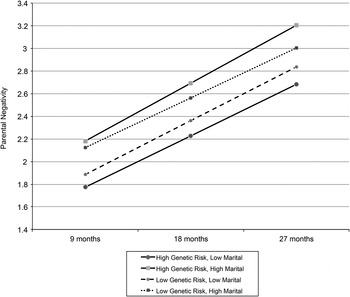
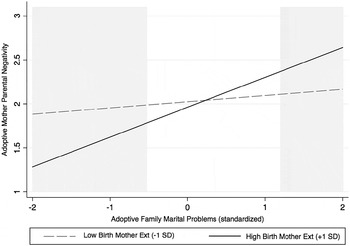
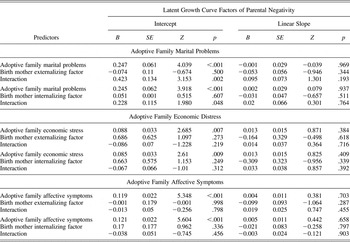
We then tested the full rGE × E model, in which genetic, environmental, and Gene × Environmental-Context interaction effects were included in the prediction of adoptive mother parental negativity, again controlling for obstetric risk, adoption openness, and infant gender. This model was run separately for each combination of genetic indicator (birth mother externalizing and internalizing psychopathology) and environmental-context variable. Considering birth mother externalizing psychopathology first, the rGE × E model revealed significant interactions with adoptive family marital problems, Δχ2 (2) = 15.84, p < .001. The model parameter estimates are summarized in Table 2. The interaction term showed a significant effect on the intercept (B = 0.423, SE = 0.134, p = .002, β = 0.150) but not the slope (B = 0.095, SE = 0.073, ns, β = 0.083) of adoptive mothers’ parental negativity. To examine the form of the interaction, the predicted values for adoptive mothers' parental negativity were plotted for high and low scores on the birth mother externalizing psychopathology factor (±1 SD) and for high and low marital problems (±1 SD). This plot is shown in Figure 2. As can be seen in the plot, even at the earliest age, the association between marital problems and adoptive mothers’ parental negativity was larger for infants whose birth mothers scored high on externalizing psychopathology and this effect persisted over time. When we examined these effects on the intercept (i.e., just at 9 months), we found no significant effect of marital problems on adoptive mother parental negativity when birth mother externalizing liability was low (B = 0.095, SE = 0.086, β = 0.083, ns); but when the externalizing liability score was high, the effect of marital problems on parental negativity was substantial (B = 0.442, SE = 0.092, β = 0.39, p < .001). To further understand the nature of this interaction, we examined the interaction between birth mother externalizing psychopathology and adoptive family marital problems at the 9-month time point and examined regions of significance of the genetic effect at varying levels of adoptive family marital problems. This plot is shown in Figure 3, with the regions of significance of the genetic effect (at p < .05) shown in gray. The figure illustrates that infants whose birth mothers had high levels of externalizing psychopathology experienced higher levels of maternal negativity in the context of high marital problems but less parental negativity when marital problems were low.
Latent trajectories of adoptive mother parental negativity by birth mother externalizing disorder liability and adoptive family marital problems.

Interaction between adoptive family marital problems and birth mother externalizing psychopathology in relation to parental negativity at 9 months (regions of significance of genetic effect shaded in gray).

Results of multivariate growth curve modeling with genetic and environmental predictors of common intercept and slope

Note: All parameters are corrected for the effects of child gender, obstetric risk, and adoption openness.
The models including the other two interaction terms (Birth Mother Externalizing × Adoptive Family Economic Distress and Adoptive Family Affective Symptoms) yielded no evidence of interaction, economic distress Δχ2 (2) = 1.28, ns; affective symptoms Δχ2 (2) = 0.65, ns.
Turning to birth mother internalizing psychopathology, none of the joint tests of interaction were significant, Birth Mother Internalizing × Marital Problems Δχ2 (2) = 5.12, p = .078; Birth Mother Internalizing × Economic Distress Δχ2 (2) = 1.35, ns; Birth Mother Internalizing × Affective Symptoms: Δχ2 (2) = 1.08, ns.
It is important to note that all findings reported were quite robust to variations in analytic approach. In standard regression analyses, findings were essentially the same as those reported above when a dependent variable was computed as the standardized sum of the three indicators of parental negativity at 9 months (rG × E interaction p = .007) or as a standardized sum of these indicators across all three time points (rG × E interaction p < .001). Finally, it is important to note that, in addition to the rGE × E effect noted above, very robust associations were observed between all three domains of environmental context and parental negativity, even after genetic main effects and rGE × E interactions were taken into account (see Table 2).
Does infant temperament account for children's evocative effects?
A series of analyses was conducted with the aim of identifying the evocative characteristic in the child that was associated with the effects we observed on adoptive mother parental negativity. However, in no case could we find evidence that the moderated rGE effect could be explained by father reports of infant temperament (difficultness, distress to novel stimuli, or distress to limitations). To check that this was not simply because we had relied on father reports of temperament, we repeated the analyses with maternal ratings. Again, no evidence was found that the moderated rGE could be accounted for by maternal ratings of the specific temperament variables examined at 9 months.
Parental negativity as a mediator of genetic risk on child behavior problems at 27 months
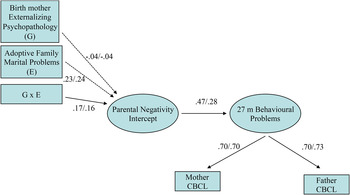
Finally, we investigated the extent to which adoptive mothers’ parental negativity might mediate the effect of the G × E interaction (Birth Mother Externalizing Psychopathology × Adoptive Family Marital Problems) on adoptive children's behavioral problems at age 27 months. To do this, we estimated two final models in which a latent variable representing mothers’ and fathers’ reports of child externalizing and internalizing symptoms were included as dependent variables, respectively. The latent variable representing child outcome was regressed on the maternal negativity intercept, which was regressed on the genetic and environmental main effects and interaction (see Figure 4). From this model, we then tested mediation by estimating the indirect effect of the G × E interaction on child behavioral problems via the maternal negativity intercept using bootstrapped standard errors and confidence intervals (1,000 bootstrapped samples were taken). For both child externalizing and internalizing problems, the indirect effects were small but significant (externalizing indirect effect B = 1.98, β = 0.070, p = .004; internalizing indirect effect B = 1.28, β = 0.050, p = .009). The path estimates for both models are shown in Figure 4. It is also noteworthy that, for all three domains of environmental context, parental negativity significantly mediated family context effects on child emotional and behavioral problems. For child externalizing problems, the indirect paths between environmental context and child outcome via parental negativity were as follows: marital problems B = 0.91, β = 0.11, p < .001; economic distress B = 0.31, β = 0.07, p = .008; and affective symptoms B = 0.37, β = 0.14, p < .001. For internalizing problems, the same effects were as follows: marital problems B = 0.51, β = 0.07, p = .004; economic distress B = 0.18, β = 0.05, p = .023; and affective symptoms B = 0.18, β = 0.07, p = .008.
(Color online) Longitudinal models testing the role of parental negativity in mediating Gene × Environment effects on child adjustment. Paths for model testing effects on externalizing problems and internalizing problems, respectively, shown separated by a slash (/). Here, G refers to genetic effects estimated from birth mother measures; E refers to environmental effects, estimated from adoptive family context measures; and G × E refers to their statistical interaction.

Discussion
This study yielded evidence that genes involved in the development of psychopathology may manifest themselves very early in life by evoking, under certain circumstances, maladaptive reactions in mothers. The finding adds to a number of emerging, broadly convergent results that also attest to the potential significance of rGE in early development and in risk for psychopathology (e.g., Boivin et al., Reference Boivin, Perusse, Dionne, Saysset, Zoccolillo and Tarabulsy2005; Harold et al., Reference Harold, Leve, Barrett, Elam, Neiderhiser and Natsuaki2013). A wealth of past studies, using quantitative genetic methods, have highlighted the potential significance of rGE in human development, but, until quite recently, few studies have been specifically designed to observe their emergence in very early childhood; fewer still have used an adoption design, which can rule out complicating effects of passive rGE, or used a broad and robust multimethod approach to characterizing birth parent psychopathology, so that inferences regarding the psychopathological relevance of any observed genetic effects are relatively secure. In this paper, we also examined a novel but potentially important manifestation of rGE: moderated rGE (Horwitz & Neiderhiser, Reference Horwitz and Neiderhiser2011; Leve et al., Reference Leve, Neiderhiser, Ge, Scaramella, Conger and Reid2007).
The findings of the study indicated that genetic factors related to adult psychopathology, evidenced via birth mother psychiatric diagnoses and symptom measures, may be capable of evoking a series of interlinked negatively toned reactions in adoptive mothers, characterized jointly by a tendency to overreact to challenging behavior, feelings of powerlessness in the parenting role, and perceptions of stress in daily dealings with the child. This outcome, from the point of view of the parent, likely represents the accumulation of numerous “microparenting” events that gradually lead the parent into an exasperated, helpless, or antagonistic state of mind with respect to the child. A host of studies indicate that these parenting processes impact negatively on the child's emotional and behavioral development (Johnson, Cohen, Kasen, Smailes, & Brook, Reference Johnson, Cohen, Kasen, Smailes and Brook2001; Jones & Prinz, Reference Jones and Prinz2005; Miller-Lewis et al., Reference Miller-Lewis, Baghurst, Sawyer, Prior, Clark and Arney2006; Teti & Gelfand, Reference Teti and Gelfand1991; Weaver et al., Reference Weaver, Shaw, Dishion and Wilson2008) and are the target of several intervention programs (Sanders, Markie-Dadds, Tully, & Bor, Reference Sanders, Markie-Dadds, Tully and Bor2000; Webster-Stratton & Hammond, Reference Webster-Stratton and Hammond1997). Critically, the data from our study suggest that these evoked processes may emerge as early as 9 months of age. Consistent with previous adoption studies (Ge et al., Reference Ge, Conger, Cadoret, Neiderhiser, Yates and Troughton1996), we found that adoptive mother parental negativity was specifically associated with birth mother externalizing psychopathology and not with internalizing psychopathology. Furthermore, the genetic effects involved in these early appearing rGE processes (as indicated by birth mother externalizing psychopathology) appeared linked (via maternal parenting negativity) to the child's subsequent behavioral problems, as reported by adoptive mothers and fathers at 27 months.
However, it is essential to note that we did not find evidence of direct genetic main effects of birth mother psychiatric status on adoptive mother negativity. Instead, the evoked parenting processes were only observed when the adoptive parents’ marital relationship was also experiencing stress and difficulty. Seemingly, the results indicate that marital problems may be particularly and selectively important in increasing the sensitivity of mothers to react negatively to the child's heritable traits. These moderated rGE findings are highly complementary to those reported by Ulbricht et al. (Reference Ulbricht, Ganiban, Button, Feinberg, Reiss and Neiderhiser2013) in adolescents as well as an earlier report from the EGDS sample showing that adoptive family marital problems were more strongly associated with toddler (18-month) anger/frustration when birth mothers scored highly on temperamental frustration (Rhoades et al., Reference Rhoades, Leve, Harold, Neiderhiser, Shaw and Reiss2011).
A further important feature of the results of our study was that genetic effects did not appear to represent simple “risk factors” for negative parenting. Instead, children whose birth mothers had histories of externalizing disorder appeared most likely to receive negative parenting when the adoptive family experienced higher levels of marital distress but least likely to do so when marital quality was high. Thus, these findings suggest that children from biological parents with externalizing problems may evoke maladaptive care when environmental circumstances are unfavorable but more optimal care when environmental conditions are supportive. We might refer to this phenomenon as “parental differential reactivity” (cf. “child differential susceptibility”; Belsky & Pluess, Reference Belsky and Pluess2009). One plausible hypothesis is that infants with birth mothers who have elevated externalizing problems may be perceived by their rearing mothers as very engaging, interactive, and rewarding but, in the context of marital strain, are experienced as overwhelming or frustrating. In that regard, it was notable that we were unable to identify specific dimensions of child temperament involved in evoking more or less negativity among mothers in this sample using both fathers’ and mothers’ ratings of infant difficultness or negative affect (distress to novelty and distress to limitations). Future research may therefore benefit from a consideration of other domains of child behavior that are not captured by the indices of infant temperament measured here, such as context-sensitivity, social engagement, or attentional control. For example, child exuberance may be a positive and engaging characteristic when there is little stress within the family, but it may be a strain on parents when there is a high degree of stress. Our results are consistent with other findings from this study that suggest that children of birth parents who have elevated psychopathology do not inherit a simple deficit of perceptual or behavioral adaptation. Rather, they may inherit a particular style of reacting to or influencing their caretaking environment. For example, these children show positive adjustment if parents are highly structuring in cleanup situations but poor adjustment if there is little structure; the reverse is true for children whose birth parents show low levels of psychopathology (Leve et al., Reference Leve, Harold, Ge, Neiderhiser, Shaw and Scaramella2009).
These results add to a growing body of evidence that testifies to the close interplay between genes and environments in the development of psychopathology. Much work is still needed before a thorough understanding of the specific genetic mechanisms involved is achieved. Our data suggest that the environmental moderation and mediation of genetic effects associated with adult externalizing psychopathology may begin very early in development and may center on the mothers’ perceptions of parenting and of the child, which may partially mediate the effect of risk-related genes on children's behavioral adjustment. These adjustment problems may represent an early appearing pathway in the etiology of adult externalizing psychopathology (Moffitt, Caspi, Dickson, Silva, & Stanton, Reference Moffitt, Caspi, Dickson, Silva and Stanton1996). The close interplay between genes and environments in these unfolding developmental processes may imply that the observed genetic effects are malleable to environmental modification. If the effects observed in this study can be shown to be causal, new and important modes of intervention suggest themselves. Our research could indicate that effective early intervention for adult externalizing disorder may be achieved by disrupting processes of rGE by directly supporting parenting in the early toddler years, by treating the marital relationship, or both. There is quite good evidence that marital interventions can have positive effects on both parenting and child outcomes (Cowan & Cowan, Reference Cowan and Cowan2002), and we speculate that these treatment effects may work, partially or entirely, by strengthening the capacity of couples to support each other's parenting, thereby dampening the potentially negative effects of evocative child characteristics, some of whose origins lie in the child's genotype.
In addition to the moderated rGE effect, the current study also highlighted the strong associations between the adoptive family environment (marital problems, socioeconomic disadvantage, and parental affective symptoms) and maternal negativity. These effects were highly robust even after child-based rGE and moderated rGE effects were controlled for in the analyses. It is important to consider, however, that such analyses cannot rule out the role of the adoptive parents’ genes, which could affect their parenting and the environment they provide for the adoptive children. Further, we cannot rule out the possibility that other unmeasured, child-driven rGE effects could explain some of this association. Nevertheless, the data from this study are consistent with the view that the family social context may have an impact on parental negativity, in line with findings from other studies (e.g., O'Leary & Vidair, Reference O'Leary and Vidair2005). Furthermore, these environmental features were robustly associated with the child's emotional and behavioral problems. These latter associations cannot be due to genes shared between the rearing parent and the child by virtue of the adoption design; environmental mechanisms are highly likely to be responsible (although, as we noted already, some unmeasured evocative rGE could also be at play).
Despite the positive findings reported in this paper, the current study had several limitations that need to be considered. First, the results rely on parental reports of parenting behavior, which, though well suited for detecting the tendencies and affective experiences associated with parental difficulties in childrearing, are susceptible to reporter bias. Furthermore, while they index relevant processes in the emergence of child emotional and behavioral problems, they may only indirectly identify the interaction patterns most proximally implicated in them. Further work combining parental reports of negativity with direct observations of parent–child interactions would be invaluable in refining our understanding of the interactive processes involved. However, with this limitation in mind, our use of fathers as reporters of both the magnitude of moderating factors and child behavior at 27-months avoids, in large measure, common source effects that are typically associated with parental self-reports. Second, the choice of an adoption design brings with it several notable strengths, particularly the clean separation of genetic from environmental influences and the capacity to rule out passive rGE, but it carries with it some inherent limitations. The range of adversity in the adoptive family environment is more limited than the general population, so the findings of the current study may not apply to more disadvantaged contexts. In addition, although the infants in this study were placed in the adoptive families very early in life, we cannot rule out antenatal effects such as maternal antenatal stress or exposure to toxins or drugs. This is particularly important given the relatively high rates of alcohol and drug abuse that we observed in the birth mothers involved in this study. Efforts were made to collect high-quality data from birth mothers regarding alcohol and drug use during pregnancy, as well as a range of other indicators of obstetric risk, so that these could be controlled for in our analyses. However, such measures cannot be assumed to be without limitations. Further, the adoption design approach captures genetic effects through measures collected about the birth parent. As a consequence, it inevitably underestimates total genetic effects (including rG × E) because not all possible phenotypic measures have been administered. This underestimate of genetic effects is further exacerbated in this study by the reliance solely on birth mother data (and not birth father data, which effectively halves the detectable genetic effects) and by the inability of this design to estimate nonadditive genetic influences. As such, similar to candidate gene studies that only measure a subset of possible genetic polymorphisms, our findings are likely to be very conservative estimates of genetic influence. This limitation may account for our inability to discern direct genetic main effects on parental negativity, which might have been expected given prior findings of rGE in other studies (e.g., Ge et al., Reference Ge, Conger, Cadoret, Neiderhiser, Yates and Troughton1996; O'Connor, Deater Deckard, Fulker, Rutter, & Plomin, Reference O'Connor, Deater Deckard, Fulker, Rutter and Plomin1998). However, an equally plausible possibility is that rGE effects are less consistent and pervasive in the infancy and toddler period than they are in childhood and adolescence. Because so few studies of rGE have been done in early development, it is not possible to conclude strongly either way. Finally, the findings of the current study need to be replicated and would benefit from replication using alternative designs, such as longitudinal twin designs or even longitudinal cohorts employing genome-wide complex trait analysis or related methods (Yang et al., Reference Yang, Manolio, Pasquale, Boerwinkle, Caporaso and Cunningham2011).
In summary, the current study found evidence that genes involved in the development of externalizing disorder manifest themselves in the first 2 years of life “outside the skin” as a spectrum of negative maternal behaviors and feelings toward the child. The study suggests that the marital relationship may play a critical gate-keeping role in the family system by increasing or decreasing mothers’ liability to this genetically driven reaction. Identifying the behavioral processes driving this early-appearing rGE is an important goal for future research.