Introduction
For each attempted suicide, it is estimated that 7–8 individuals have thoughts of suicide without attempting (Crosby, Gfroerer, Han, Ortega, & Parks, Reference Crosby, Gfroerer, Han, Ortega and Parks2011a; Nock et al., Reference Nock, Borges, Bromet, Alonso, Angermeyer, Beautrais and Williams2008; Piscopo, Lipari, Cooney, & Glasheen, Reference Piscopo, Lipari, Cooney and Glasheen2016). Prevailing theories on the ideation-to-action framework of suicide conceptualize distinct etiologic factors leading to the development of suicidal thoughts v. suicidal behaviors (Klonsky, Qiu, & Saffer, Reference Klonsky, Qiu and Saffer2017). While there is increasing empirical support for distinct etiologic factors (Klonsky et al., Reference Klonsky, Qiu and Saffer2017; Klonsky & May, Reference Klonsky and May2015; Klonsky, Saffer, & Bryan, Reference Klonsky, Saffer and Bryan2018), biological correlates of suicidal thoughts alone v. behaviors remain an understudied area in suicide prevention (Barredo et al., Reference Barredo, Bozzay, Primack, Schatten, Armey, Carpenter and Philip2021; Desmyter, van Heeringen, & Audenaert, Reference Desmyter, van Heeringen and Audenaert2011; Huang, Rootes-Murdy, Bastidas, Nee, & Franklin, Reference Huang, Rootes-Murdy, Bastidas, Nee and Franklin2020; Jollant, Lawrence, Olie, Guillaume, & Courtet, Reference Jollant, Lawrence, Olie, Guillaume and Courtet2011; Serafini, Pardini, Pompili, Girardi, & Amore, Reference Serafini, Pardini, Pompili, Girardi and Amore2016; van Heeringen & Mann, Reference van Heeringen and Mann2014). Exploring biological correlates of suicide risk, especially through means like neuroimaging, provides insight into potential differences between those who only think about suicide v. those who subsequently progress from suicidal ideation to suicidal action(s) (Barredo et al., Reference Barredo, Bozzay, Primack, Schatten, Armey, Carpenter and Philip2021).
Imaging studies have found differences among individuals with v. without lifetime suicide-related thoughts and behaviors (STBs), though specific findings vary widely by control group, sample size, and imaging methods (Schmaal et al., Reference Schmaal, van Harmelen, Chatzi, Lippard, Toenders, Averill and Blumberg2020). Recent meta-analyses have shown differences in brain activation when comparing individuals with suicidal thoughts and behaviors to healthy controls (Chen, Chen, & Zhang, Reference Chen, Chen and Zhang2021; Huang et al., Reference Huang, Rootes-Murdy, Bastidas, Nee and Franklin2020), but few consistent differences have emerged among studies using psychiatric or suicide-related controls. Based on a meta-analysis relying on data from 533 individuals from both task and resting-state modalities, Huang et al. (Reference Huang, Rootes-Murdy, Bastidas, Nee and Franklin2020) found hyperactivation in the temporoparietal junction among those with lifetime STBs when compared to psychiatric controls (i.e. those without STBs but with psychiatric diagnosis or clinical symptom threshold). Using a less stringent control group referred to as ‘nonsuicidal,’ Chen et al. (Reference Chen, Chen and Zhang2021) pooled results across 17 studies in their meta-analytic study (totaling 381 individuals with lifetime STBs compared to 642 healthy controls) and found hyperactivation in the bilateral superior temporal gyrus, left middle temporal gyrus, and right inferior parietal lobe and hypoactivation in the left insula and right cerebellum among individuals with lifetime suicide attempt(s) when compared to healthy controls.
Prevailing psychosocial theories of suicide conceptualize distinct etiologic factors leading to the development of suicidal thoughts v. behaviors (Klonsky et al., Reference Klonsky, Qiu and Saffer2017, Reference Klonsky, Saffer and Bryan2018; May & Klonsky, Reference May and Klonsky2016). Such theories posit that dispositional contributors, including biological factors like brain activation, may uniquely differentiate those at risk for suicidal behaviors v. suicidal thoughts alone (Klonsky & May, Reference Klonsky and May2015). Neuroimaging studies of suicide have lagged behind psychosocial research, as only a few studies to date have compared individuals with suicide attempt histories to those with other STBs (Barredo et al., Reference Barredo, Bozzay, Primack, Schatten, Armey, Carpenter and Philip2021). In a small sub-analysis, 18 individuals with current suicidal ideation and lifetime suicide attempt(s) had marginally higher connectivity between the dorsal posterior cingulate cortex and the left inferior frontal gyrus compared to 16 individuals with current suicidal ideation without lifetime suicide attempt(s) (Chase et al., Reference Chase, Segreti, Keller, Cherkassky, Just, Pan and Brent2017). Furthermore, lifetime suicide attempt(s), compared with suicidal ideation alone is associated with altered frontal brain function during tasks in several small imaging studies (Ai et al., Reference Ai, van Tol, Marsman, Veltman, Ruhe, van der Wee and Aleman2018; Minzenberg et al., Reference Minzenberg, Lesh, Niendam, Yoon, Cheng, Rhoades and Carter2015; Minzenberg, Lesh, Niendam, Cheng, & Carter, Reference Minzenberg, Lesh, Niendam, Cheng and Carter2016).
Examination of altered functional networks may aid our understanding of suicide risk. Neuroscientists have increasingly recognized the brain is organized into intrinsic functional networks, or networks of regions that are commonly correlated or anticorrelated with each other at a given time (Buckner & DiNicola, Reference Buckner and DiNicola2019; Fornito, Zalesky, & Breakspear, Reference Fornito, Zalesky and Breakspear2015; Fox, Zhang, Snyder, & Raichle, Reference Fox, Zhang, Snyder and Raichle2009; Schaefer et al., Reference Schaefer, Kong, Gordon, Laumann, Zuo, Holmes and Yeo2018; Yeo et al., Reference Yeo, Krienen, Sepulcre, Sabuncu, Lashkari, Hollinshead and Buckner2011). As recommended by Uddin, Yeo, and Spreng (Reference Uddin, Yeo and Spreng2019), an anatomical taxonomy should be used to refer to these networks rather than a functional taxonomy to enable greater reproducibility and consistency between studies. For example, utilizing traditional cognitive nomenclature like ‘attention network’ diminishes the role of these networks in other tasks and reduces reliability between research groups. Thus, an anatomical taxonomy will be emphasized in this paper (e.g. ‘dorsal frontoparietal network’ rather than ‘attention network’).
The Triple Network Theory (Menon, Reference Menon2011) posits that three networks support the majority of cognitive and emotional processes and are central to clinically-concerning psychological dysfunction. First, the medial frontoparietal network (M-FPN; functionally referred to as the ‘default mode network’) consists of multiple smaller networks and includes parts of the mPFC, PCC, inferior parietal lobule, precuneus and retrosplenial cortex, and hippocampus. This network is involved in self-referential processing, autobiographical memory retrieval, and future-oriented thinking (Buckner & DiNicola, Reference Buckner and DiNicola2019; Buckner, Andrews-Hanna, & Schacter, Reference Buckner, Andrews-Hanna and Schacter2008). Second, the lateral frontoparietal network (L-FPN; functionally referred to as the ‘cognitive/executive control network’) consists of lateral prefrontal regions along the middle frontal gyrus including the rostral and dorsolateral prefrontal cortex and the anterior inferior parietal lobule. This network is involved in goal-directed responses, emotion regulation, and some attentional processes (Cole, Repovs, & Anticevic, Reference Cole, Repovs and Anticevic2014; Seeley et al., Reference Seeley, Menon, Schatzberg, Keller, Glover, Kenna and Greicius2007; Uddin et al., Reference Uddin, Yeo and Spreng2019). Third, the mid-cingulo-insular network (M-CIN; functionally referred to as the ‘salience network’) consists of the dACC, bilateral anterior insula, and anterior midcingulate cortex. This network is involved in the detection of behaviorally relevant environmental stimuli and coordinating responses (Seeley et al., Reference Seeley, Menon, Schatzberg, Keller, Glover, Kenna and Greicius2007; Uddin et al., Reference Uddin, Yeo and Spreng2019).
Two studies to date have directly tested the triple network theory in relation to suicide risk. Ordaz, Goyer, Ho, Singh, and Gotlib (Reference Ordaz, Goyer, Ho, Singh and Gotlib2018) examined the relationship between approximate M-FPN, L-FPN, and M-CIN within-network coherence and lifetime suicidal ideation severity in a sample of 40 adolescents diagnosed with major depressive disorder. Within-network functional connectivity was less coherent among those reporting more severe lifetime severity of suicidal ideation. Within-network coherence was not associated with previous suicide attempts in exploratory analyses. Malhi et al. (Reference Malhi, Das, Outhred, Bryant, Calhoun and Mann2020) compared network connectivity of 25 individuals with mood disorders and lifetime suicide attempt(s) against 54 individuals with mood disorders and no lifetime suicide attempt(s) in each of the three networks and the basal ganglia network. Findings also revealed that increased posterior M-FPN activity was associated with past-month STBs, linking recent suicidality to default mode activity and potentially self-referential thinking (Malhi et al., Reference Malhi, Das, Outhred, Bryant, Calhoun and Mann2020). Unfortunately, the lack of a suicidal ideation control group limits interpretations as M-FPN connectivity differences could be related to ideation, behavior, or both. Both studies represent important contributions to the scientific literature, highlighting the roles of multiple brain networks and importance of well-validated suicide measures.
Only around 7% of imaging studies of suicide have compared individuals with lifetime suicide attempt(s) to controls with suicidal ideation alone (Huang et al., Reference Huang, Rootes-Murdy, Bastidas, Nee and Franklin2020), which limits possible conclusions regarding the transition from suicidal ideation to behavior. Of those studies utilizing control groups with suicidal ideation or attempts, studies have largely been underpowered and lacked covariates. To address gaps in the scientific literature, we examined differences in resting-state functional brain network connectivity using a large subsample from the UK Biobank. Specifically, we compared individuals with lifetime suicide attempt(s) v. those with lifetime suicidal and/or non-suicidal self-injurious ideation [hereafter referred to as ‘self-directed violence thoughts,’ SDVT per CDC nomenclature recommendations (Crosby, Ortega, & Melanson, Reference Crosby, Ortega and Melanson2011b)] alone. The study aims were to compare resting-state connectivity both within (aim 1), and between (aim 2) M-FPN, L-FPN, and M-CIN network regions across the two study groups. We hypothesized that individuals with lifetime suicide attempt(s) in comparison to those with lifetime SDVT alone would demonstrate (1) greater connectivity within the M-FPN and M-CIN networks but lower within-network connectivity among L-FPN regions, and (2) lower between-network connectivity among the M-FPN, L-FPN, and M-CIN network regions. Between-group differences in additional networks throughout the brain were additionally explored.
Materials and methods
Participants
The UK Biobank is a population-based biomedical study of roughly 500 000 individuals from Great Britain (England, Scotland, and Wales) between the ages of 40 and 69 (Miller et al., Reference Miller, Alfaro-Almagro, Bangerter, Thomas, Yacoub, Xu and Smith2016). Individuals enrolled in the UK Biobank answered demographic and medical questions and several weeks later, completed an online mental health follow-up questionnaire packet. Those who answered ‘yes’ to the question ‘Have you deliberately harmed yourself, whether or not you meant to end your life?’ (UK Biobank field 20 480) were prompted to answer further detailed questions regarding ‘harm behaviours,’ regardless of their current mental health symptoms. Among those questions were ‘Have you harmed yourself with the intention to end your life?’ (suicide attempt history; UK Biobank field 20 483). All UK Biobank participants who completed the mental health follow-up questionnaire packet were asked ‘Have you contemplated harming yourself (for example, by cutting, biting, hitting yourself, or taking an overdose)?’ (suicide-related thought history; UK Biobank field 20 485). For the purposes of this study, this latter endorsement has been defined as ‘self-directed violence thoughts’ (SDVT) in line with the U.S. Centers for Disease Control and Prevention (CDC) self-directed violence classification system (Crosby et al., Reference Crosby, Ortega and Melanson2011b). These items were chosen to maximize sample size available for analyses and increase temporality (e.g. use of ‘lifetime’ measures). A subsample of participants underwent magnetic resonance imaging (MRI) neuroimaging procedures, including structural and functional imaging (Miller et al., Reference Miller, Alfaro-Almagro, Bangerter, Thomas, Yacoub, Xu and Smith2016). Participants were excluded from MRI imaging if they reported neurological conditions/incidents (Miller et al., Reference Miller, Alfaro-Almagro, Bangerter, Thomas, Yacoub, Xu and Smith2016). A brief overview of UK Biobank selection and branching logic is included in online Supplementary Materials.
This study utilized data from a subsample of 4013 individuals who either had a lifetime SDVT alone (n = 3447) or in combination with suicide attempt(s) (n = 566) with valid functional neuroimaging data. A flowchart leading to the final study sample is depicted in Fig. 1. Of those included in the final sample, 14.1% reported lifetime suicide attempt(s) and 85.9% reported lifetime SDVT alone.
Flowchart of case selection.

MRI acquisition and processing
MRI data were acquired in a Siemens Skya 3 T scanner using a standard Siemens 32-channel head coil (Miller et al., Reference Miller, Alfaro-Almagro, Bangerter, Thomas, Yacoub, Xu and Smith2016). Briefly, 3D T1-weighted MPRAGE were acquired at 1 × 1 × 1 mm [208 × 256 × 256 field of view (FOV) matrix] and 2 × 2 × 2 (104 × 104 × 72 FOV matrix), respectively. Preprocessing was done using FSL tools by the UK Biobank team (https://fsl.fmrib.ox.ac.uk/fsl/fslwiki). Initial preprocessing included ‘defacing’ for participant anonymity via linear transformation to mask out facial structures. Preprocessing of T1 data included skull stripping, bias field correction, warping to MNI space using FNIRT (Andersson, Jenkinson, & Smith, Reference Andersson, Jenkinson and Smith2007), and tissue-type segmentation using FAST (Zhang, Brady, & Smith, Reference Zhang, Brady and Smith2001) to differentiate cerebrospinal fluid, gray, and white matter volumes and generate 139 image-derived phenotypes (IDPs). For further information, detailed UK Biobank data acquisition and preprocessing protocol (https://www.fmrib.ox.ac.uk/ukbiobank/protocol/V4_23092014.pdf) and associated documentation (http://biobank.ctsu.ox.ac.uk/crystal/docs/brain_mri.pdf) are freely available online.
For resting-state functional MRI (rsfMRI) procedures, UK Biobank participants were instructed to ‘keep their eyes fixated on a crosshair, relax, and think of nothing in particular.’ Resting-state fMRI data were acquired using a resolution of 2.4 × 2.4 × 2.4 (88 × 88 × 64 FOV matrix) with TR = 0.735 s, TE = 39 ms, and GE-EPI with x8 multislice acceleration, no iPAT, flip angle 52° over 6 min (490 timepoints) (Miller et al., Reference Miller, Alfaro-Almagro, Bangerter, Thomas, Yacoub, Xu and Smith2016). Data preprocessing, group-independent components analysis (ICA) parcellation, and connectivity estimation were carried out by UK Biobank with FSL packages. These included motion correction with MCFLIRT (Jenkinson, Bannister, Brady, & Smith, Reference Jenkinson, Bannister, Brady and Smith2002), grand-mean intensity normalization with a single multiplicative factor, high pass temporal filtering with a Gaussian-weighted least squares straight line fitting (sigma as 50.0 s), EPI unwarping using field map scanned before collection, gradient distortion correction unwarping, and removal of structural artefacts using ICA + FIX processing following by an ICA-based X-noiseifier (Ritchie et al., Reference Ritchie, Cox, Shen, Lombardo, Reus, Alloza and Deary2018). With regard to latter step, FIX was hand-trained on a subset of UK Biobank rfMRI datasets following standard methodology, demonstrating high accuracy for noise/non-noise components (Alfaro-Almagro et al., Reference Alfaro-Almagro, Jenkinson, Bangerter, Andersson, Griffanti, Douaud and Smith2018; Griffanti et al., Reference Griffanti, Douaud, Bijsterbosch, Evangelisti, Alfaro-Almagro, Glasser and Smith2017). Follow-up evaluation demonstrated that removal of structured artifacts substantially reduced the correlation between 1/tSNR and head motion to minimal levels (1% of variance explained by head motion). Gross preprocessing failures were visually inspected by UK Biobank and removed (Miller et al., Reference Miller, Alfaro-Almagro, Bangerter, Thomas, Yacoub, Xu and Smith2016). Group-ICA parcellated preprocessed EPI images were fed into the MELODIC tool of FSL to generate a 21 × 21 matrix of ICA components, used for analyses (https://www.fmrib.ox.ac.uk/ukbiobank/protocol/V4_23092014.pdf) (Ritchie et al., Reference Ritchie, Cox, Shen, Lombardo, Reus, Alloza and Deary2018; Shen et al., Reference Shen, Cox, Adams, Howard, Lawrie, Ritchie and Whalley2018).
Analyses
Time series data from the 21 components were used for connectivity analysis, using each component as a node. A 21 × 21 partial matrix of fully-normalized partial temporal correlations were derived for each participant, as they represent direct connections better than full temporal correlations and control for the strength of other connections (Ritchie et al., Reference Ritchie, Cox, Shen, Lombardo, Reus, Alloza and Deary2018; Shen et al., Reference Shen, Cox, Adams, Howard, Lawrie, Ritchie and Whalley2018). For each component, a larger number indicates stronger temporal connectivity while positive or negative values represent valence. Prior to analysis, the strength of each connection was multiplied by the sign of its group mean (Smith et al., Reference Smith, Nichols, Vidaurre, Winkler, Behrens, Glasser and Miller2015). This allowed for investigation of the degree to which temporal connectivity differed by history of suicide attempt without combining positive and negative effects and losing information about the absolute magnitude (Ritchie et al., Reference Ritchie, Cox, Shen, Lombardo, Reus, Alloza and Deary2018).
The association between history of attempted suicide and the strength of connections was tested using the glm function in R, controlling for age, sex, ethnicity, and body mass index (BMI) based on the scientific literature (Alfaro-Almagro et al., Reference Alfaro-Almagro, McCarthy, Afyouni, Andersson, Bastiani, Miller and Smith2021; Klinitzke, Steinig, Bluher, Kersting, & Wagner, Reference Klinitzke, Steinig, Bluher, Kersting and Wagner2013; Kullmann et al., Reference Kullmann, Heni, Veit, Ketterer, Schick, Haring and Preissl2012; May & Klonsky, Reference May and Klonsky2016; Ritchie et al., Reference Ritchie, Cox, Shen, Lombardo, Reus, Alloza and Deary2018; Smith & Nichols, Reference Smith and Nichols2018). According to the UK Biobank, sex was acquired from central registry at recruitment, but in some cases was updated by the participant. BMI was calculated as weight (kg)/height2 (m). To compare within-network connectivity, 14 general linear regressions were performed comparing the two groups for within-network nodes representing the three networks of interest (one regression per pair within a given network). To compare between-network connectivity, 31 general linear regressions were performed comparing the two groups for between-network nodes representing the three networks of interest. To compare groups on additional brain networks, 165 general linear regressions were performed comparing the two groups on the remaining 11 nodes (165 comparisons). False discovery rate (FDR) correction was applied over each set of tests (14 tests for within-network, 31 for between-network, and 165 for exploratory analyses) using the p.adjust function in R, setting q < 0.05 as the significance level (Shen et al., Reference Shen, Cox, Adams, Howard, Lawrie, Ritchie and Whalley2018). Considering the sample size (n = 4013), adjusted FDR, power of 0.8, and covariates, analyses were powered to detect small effect sizes of approximately β = 0.08. Sensitivity analyses were conducted evaluating Aims 1 and 2 without covariates. We have provided our scripts for conducting our analyses online (https://github.com/CNPsyLab/UKB-Suicide-Resting-State-Network-Analyses) to facilitate replication and extension of these findings with additional participants and novel analyses.
Results
Demographics
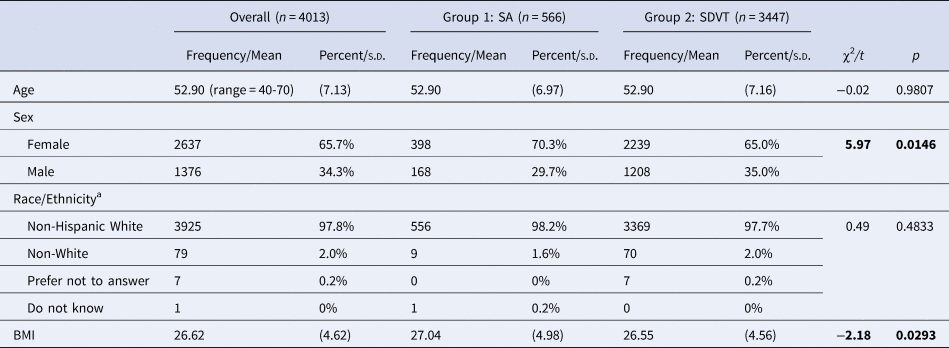
Data from a total of 4013 individuals were included in analysis of neuroimaging correlates. Individuals included were on average 52.90 years old (s.d. = 7.13, range = 40–70 years old) at the time of initial study visit. Women represented 65.7% of the sample (n = 2637) and 97.8% of the sample were non-Hispanic White. Those with lifetime suicide attempt(s) were more likely to be female, χ2 (1, 4013) = 5.97, p = 0.0146, compared with those with lifetime SDVT alone. Groups did not differ significantly based on age or ethnicity. Demographic characteristics for the overall sample and by group are presented in Table 1.
Demographic characteristics for the overall sample and by group.

Note. Data reported as n (%), unless otherwise specified. Group 1 (SA), Lifetime Suicide Attempt(s); Group 2 (SDVT), Lifetime Self-Directed Violence Thoughts (SDVT) Alone.
a One participant in Group 2 was missing data on race/ethnicity and was coded as ‘prefer not to answer’ for subsequent analyses. Due to expected counts <5, race/ethnicity chi-square analysis was conducted using only Non-Hispanic White and Non-White categories without ‘Prefer not to answer’ or ‘Do not know.’
Within-network connectivity
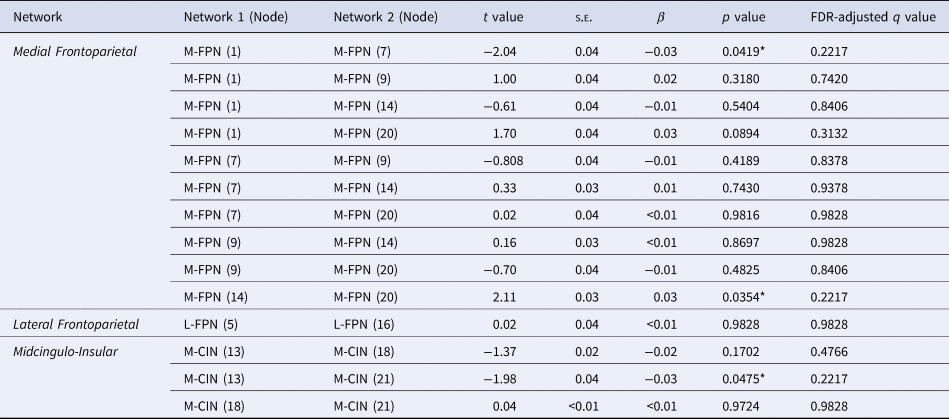
As shown in Table 2, no models revealed statistically significant differences between groups after adjusting for multiple corrections (FDR q > 0.05). Subsequent sensitivity analyses conducted without covariates similarly did not reveal statistically significant differences between groups after adjusting for multiple corrections (FDR q > 0.05).
Comparisons of two selected groups on within-network resting-state connectivity among the medial frontoparietal, lateral frontoparietal, and midcingulo-insular networks

Note. Group 1 (SA), Lifetime Suicide Attempt(s); Group 2 (SDVT), Lifetime Self-Directed Violence Thoughts (SDVT) Alone; BMI, body mass index; s.e., standard error; FDR, false discovery rate; M-FPN, medial frontoparietal network; L-FPN, lateral frontoparietal network; M-CIN, midcingulo-insular network. All models adjusted for age, sex, ethnicity, and BMI.
M-FPN within-network connectivity
Prior to FDR correction for multiple comparisons, two of the ten models showed altered connectivity within the M-FPN. Participants with history of suicide attempt(s) had lower connectivity between node 1 and node 7 in comparison to those with a history of SDVT alone, t(1, 4013) = −2.04, p = 0.0419, FDR q = 0.2217. These nodes included connectivity between areas of the ventromedial prefrontal cortex (node 1) with areas of the retrosplenial and medial temporal cortices (node 7). Participants with lifetime suicide attempt(s) had greater connectivity between node 14 and node 20 in comparison to those lifetime SDVT alone, t(1, 4013) = 2.11, p = 0.0354, FDR q = 0.2217. These nodes include connectivity between areas of the anterior cingulate and orbitofrontal cortices (node 14) with areas of the posterior precuneus and posterior cingulate cortex (node 20). Online Supplementary Fig. S1 depicts significant between-network group differences prior to FDR correction.
L-FPN within-network connectivity
One model examined group differences on connectivity between nodes associated with the L-FPN. As shown in Table 2, this model did not reveal statistically significant differences between groups.
M-CIN within-network connectivity
Prior to FDR correction for multiple comparisons, one of the three models showed differences in connectivity within the M-CIN. Individuals with lifetime suicide attempt(s) had lower connectivity between node 13 and node 18 in comparison to those with lifetime SDVT alone, t(1, 4013) = −1.98, p = 0.0475, FDR q = 0.2217. As depicted in Fig. 2c, these nodes include connectivity between areas of the left cingulo-opercular cortex (node 13) with areas of the putamen, striatum, and basal ganglia (node 18).
Between-network connectivity
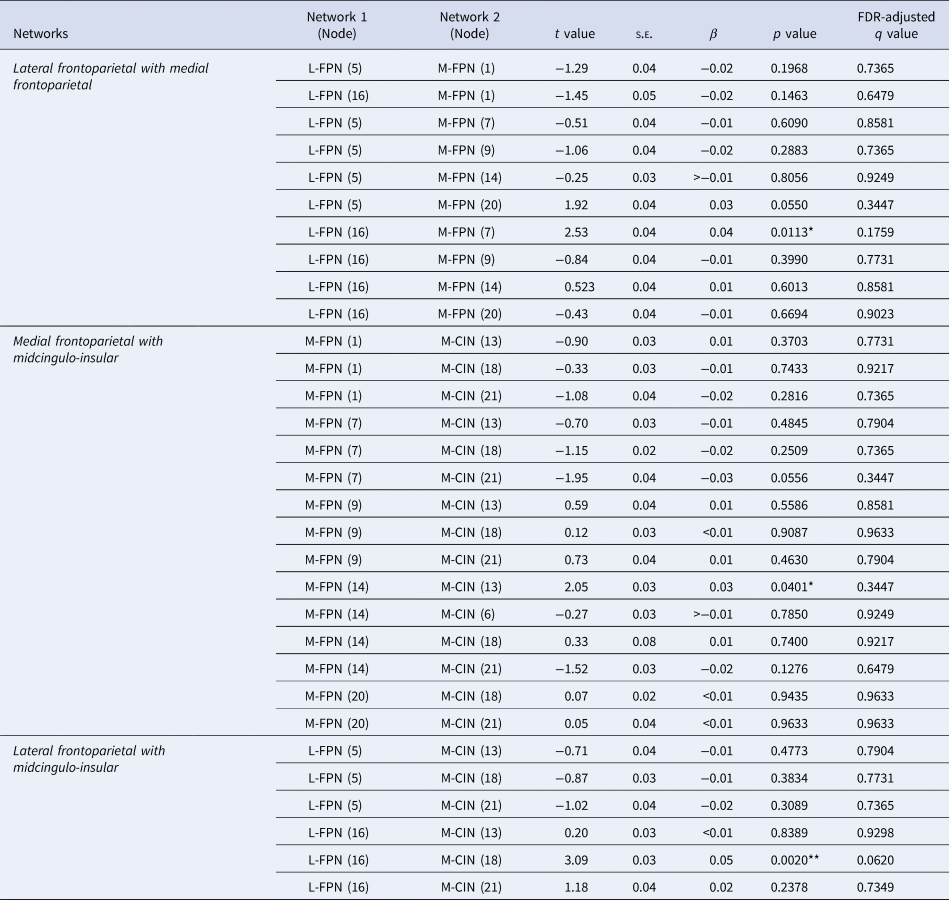
As shown in Table 3, no models revealed statistically significant differences between groups after adjusting for multiple corrections (FDR q > 0.05). Subsequent sensitivity analyses conducted without covariates similarly did not reveal statistically significant differences between groups after adjusting for multiple corrections (FDR q > 0.05).
Comparisons of two selected groups on between-network resting-state connectivity among the medial frontoparietal, lateral frontoparietal, and midcingulo-insular networks

Note. Group 1 (SA), Lifetime Suicide Attempt(s); Group 2 (SDVT), Lifetime Self-Directed Violence Thoughts (SDVT)Alone; BMI, body mass index; s.e., standard error; FDR, false discovery rate; M-FPN, medial frontoparietal network; L-FPN, lateral frontoparietal network; M-CIN, midcingulo-insular network. All models adjusted for age, sex, ethnicity, and BMI.
L-FPN with M-FPN
Prior to FDR corrections for multiple comparisons, one of ten models showed altered connectivity between nodes associated with the L-FPN with nodes associated with the M-FPN. Individuals with lifetime suicide attempt(s) had increased connectivity between node 16 (L-FPN) and node 7 (M-FPN) in comparison to those with lifetime SDVT alone, t(1, 4013) = 2.53, p = 0.0113, FDR q = 0.1759. These nodes include connectivity between areas of the anterior and dorsolateral prefrontal cortex (node 16) with areas of the retrosplenial and medial temporal cortices (node 7).
M-FPN with M-CIN
Prior to FDR corrections for multiple comparisons, one of fifteen models showed altered connectivity between nodes associated with the M-FPN with nodes associated with the M-CIN. Individuals with lifetime suicide attempt(s) had greater connectivity between node 13 and node 14 in comparison to those with lifetime SDVT alone, t(1, 4013) = 2.05, p = 0.0401, FDR q = 0.3447. These nodes include connectivity between areas of the left cingulo-opercular cortex (node 13) with areas of the anterior cingulate and orbitofrontal cortices (node 14).
L-FPN with M-CIN
Prior to FDR corrections for multiple comparisons, one of six models examined group differences on connectivity between nodes associated with the L-FPN with nodes associated with the M-CIN. Participants with lifetime suicide attempt(s) had greater connectivity between node 16 (L-FPN) and node 18 (M-CIN) in comparison to those with lifetime SDVT alone, t(1, 4013) = 3.09, p = 0.0020, FDR q = 0.0620. These nodes include connectivity between areas of the anterior and dorsolateral prefrontal cortex (node 16) with areas of the putamen, striatum, basal ganglia, and thalamus (node 18). Online Supplementary Fig. S2 depicts significant between-network group differences prior to FDR correction.
Whole-brain connectivity
No models revealed statistically significant differences between groups after adjusting for multiple corrections (FDR q > 0.05).
Discussion
In the largest functional imaging study of suicide behavior to date, we compared resting-state connectivity both within and between M-FPN, L-FPN, and M-CIN network regions among individuals with lifetime suicide attempt(s) v. those with lifetime SDVT alone. Contrary to our hypotheses, no significant between-group differences were found after correcting for multiple comparisons. Specifically, we found no significant group differences in within- or between-network connectivity among nodes of the M-FPN, L-FPN, or M-CIN. Further, there were no significant group differences on exploratory whole-brain connectivity analyses.
Despite its sample size powered to detect small effects, this study did not find significant within-network, between-network, or whole-brain connectivity differences after correcting for multiple comparisons. These results contrast with several smaller studies that previously found resting-state differences between those with lifetime suicide attempt(s) and suicidal ideation or psychiatric controls (Cao et al., Reference Cao, Chen, Kuang, Ai, Fang, Gan and Wang2015; Kang et al., Reference Kang, Na, Choi, Kim, Son and Lee2017; Malhi et al., Reference Malhi, Das, Outhred, Bryant, Calhoun and Mann2020), but are consistent with pooled findings in meta-analyses (Chen et al., Reference Chen, Chen and Zhang2021; Huang et al., Reference Huang, Rootes-Murdy, Bastidas, Nee and Franklin2020). Lack of findings supporting hypotheses are consistent with growing trends in brain science research showing reduced effects upon replication in larger samples (Button et al., Reference Button, Ioannidis, Mokrysz, Nosek, Flint, Robinson and Munafo2013; Marek et al., Reference Marek, Tervo-Clemmens, Calabro, Montez, Kay, Hatoum and Hendrickson2022). Functional neuroimaging studies have, in particular, been underpowered (David et al., Reference David, Ware, Chu, Loftus, Fusar-Poli, Radua and Ioannidis2013; Szucs & Ioannidis, Reference Szucs and Ioannidis2020), with an inverse relationship between sample size and number of significant findings. The average sample size of neuroimaging studies of suicide risk is around 48 (Huang et al., Reference Huang, Rootes-Murdy, Bastidas, Nee and Franklin2020), which indicates that many previously found differences may be inflated or spurious. Taken together, results from this study highlight the need for studies with large sample sizes (Jiao et al., Reference Jiao, Lai, Kang, Gong, Ma, Jia and Feng2022) as well as studies with more robust experimental designs (Gratton, Nelson, & Gordon, Reference Gratton, Nelson and Gordon2022) to detect smaller effect sizes and reduce spurious associations (Marek et al., Reference Marek, Tervo-Clemmens, Calabro, Montez, Kay, Hatoum and Hendrickson2022).
Null findings in the present study may suggest a more complex relationship between dispositional factors of suicide risk, like brain circuitry, and the transition from suicide-related thoughts to behaviors. Rather, the ideation-to-action theoretical framework would necessitate that an examination of the complex interaction among biopsychosocial factors – more specifically, dispositional (biological, genetic), acquired (learning), and practical aspects (knowledge of and access to lethal means) (Klonsky & May, Reference Klonsky and May2015) – is needed to fully understand how individuals with lifetime self-directed violence thoughts alone may differ from those who eventually progress to suicide attempts.
With regards to within-network connectivity, there was limited evidence to support differences between individuals with lifetime suicide attempt(s) v. those with lifetime SDVT alone after correcting for multiple comparisons. Malhi et al. (Reference Malhi, Das, Outhred, Bryant, Calhoun and Mann2020) found within-network connectivity differences in the M-FPN when comparing those with attempted suicide to healthy controls, but did not find differences when those with attempted suicide were compared to those diagnosed with a mood disorder (Malhi et al., Reference Malhi, Das, Outhred, Bryant, Calhoun and Mann2020). Similarly, a recent study comparing 35 depressed adolescents with lifetime suicide attempt(s) to 18 adolescents with mood disorder without lifetime suicide attempt(s) did not find within-network differences when looking at regions within the M-FPN and M-CIN (Cao et al., Reference Cao, Ai, Chen, Chen, Wang and Kuang2020). This suggests that within-network differences may be too subtle to detect when using psychiatric or SDVT controls.
With regards to between-network connectivity, this study did not find significant differences between-group differences after correcting for multiple comparisons. This is consistent with Malhi et al. (Reference Malhi, Das, Outhred, Bryant, Calhoun and Mann2020) who did not find between-network connectivity when comparing those with attempted suicide to healthy controls or individuals diagnosed with a mood disorder. In their meta-analysis, Huang et al. (Reference Huang, Rootes-Murdy, Bastidas, Nee and Franklin2020) found that, compared to all controls (healthy and psychiatric), those with prior suicidal ideation and behaviors collectively showed hyperactivation of the right posterior cingulate cortex and superior frontal gyrus during pooled affective tasks, suggesting potential alterations between the M-FPN and L-FPN during affective processes. In similar meta-analysis of functional imaging studies, Chen et al. (Reference Chen, Chen and Zhang2021) (Chen et al., Reference Chen, Chen and Zhang2021) found hyperactivation of the bilateral superior temporal gyrus in pooled studies among those with suicide attempt compared to all controls. Larger studies are needed to more fully investigate potential between-network differences during cognitive, affective, and social tasks (Malhi et al., Reference Malhi, Das, Outhred, Gessler, John Mann and Bryant2019).
Finally, this study did not find other significant whole-brain connectivity between-group differences. Results are consistent with recent meta-analyses of event-related potential studies, which found small or no effects in larger studies comparing those with suicide attempt to suicidal ideation alone (Gallyer et al., Reference Gallyer, Dougherty, Burani, Albanese, Joiner and Hajcak2021). Alternatively, it may be the case that history of suicidal ideation, as suggested by Ordaz et al. (Reference Ordaz, Goyer, Ho, Singh and Gotlib2018), is associated with brain network alterations rather than attempts as conceptualized in the current study, Regardless, null findings across methodologies using stringent control groups may reflect the need for more nuanced investigation and interpretation of the interplay between biopsychosocial factors to differentiate those with lifetime history of suicide attempt(s) from SDVT alone (Klonsky & May, Reference Klonsky and May2015). Differentiating factors uniquely associated with suicide attempt has been a challenge within the field of suicidology (Franklin et al., Reference Franklin, Ribeiro, Fox, Bentley, Kleiman, Huang and Nock2017).
Covariate use in neuroimaging studies is highly diverse, with some studies reporting use of zero covariates and others using as many as 14 covariates in analyses (Hyatt et al., Reference Hyatt, Owens, Crowe, Carter, Lynam and Miller2020). Smith and Nichols (Reference Smith and Nichols2018) highlight how large datasets, in particular, are especially susceptible to artifactual associations due to confounding effects in neuroimaging research. Several research groups caution careful consideration of covariates, particularly in relation to IDP imaging data in the UK Biobank (Alfaro-Almagro et al., Reference Alfaro-Almagro, McCarthy, Afyouni, Andersson, Bastiani, Miller and Smith2021; Dutt et al., Reference Dutt, Hannon, Easley, Griffis, Zhang and Bijsterbosch2022). Both research groups suggest motion correction and noise removal to reduce imaging-related artifacts in analysis, both of which were conducted prior to these analyses. Further, near duplication of findings after sensitivity analyses in this study conducted without covariates increases confidence that lack of robust findings was not due to covariate selection.
There are several noteworthy limitations to this study. Without baseline neuroimaging data and long-term follow-up data on suicidal attempts, we cannot discern a causal relationship between functional connectivity differences and suicide attempts. Individuals examined in this study were 53 years old, on average, thus suicide attempt(s) and SDVT could be distal events. Functional markers may be better than structural anatomical markers at clinically differentiating those who are acutely suicidal, as suicide thoughts are typically time-limited (Balcioglu & Kose, Reference Balcioglu and Kose2018; Rudd, Reference Rudd2000). Future studies can incorporate time since suicide attempt(s) and SDVT to account for potential differences in time.
Relatedly, without a comprehensive lifetime suicide history and risk assessment, there are several confounding variables. Using a SDVT control group, we were unable to parse those with lifetime suicidal v. non-suicidal self-directed violence ideation. While a SDVT control group is a strength compared to previous studies, there may be important distinctions between those who have thoughts of suicidal (e.g. thinking about using a firearm to kill oneself) v. non-suicidal (e.g. thinking about non-lethal cutting or scratching) self-directed violence (Ren et al., Reference Ren, You, Zhang, Huang, Conner, Sun and Lin2019). Further, we were unable to differentiate among individuals with single v. multiple suicide attempts. Those with multiple lifetime attempts have distinct features, including impulsivity and borderline personality disorder traits and associated symptoms, that may reflect differences in functional neuroimaging markers (Boisseau et al., Reference Boisseau, Yen, Markowitz, Grilo, Sanislow, Shea and Morey2013). We are similarly limited in survivorship bias and cannot extend findings to those who have died by suicide. Though our study used a stringent control group, there may be variability within functional connectivity within suicidal groups. Future studies can advance our understanding of potential differences among individuals with lifetime suicidal v. non-suicidal self-directed violent ideation, as well as single v. multiple suicide attempts.
Results should be interpreted in the context of neuroimaging parameters utilized by the UK Biobank. This study utilized a particular preprocessing pipeline that incorporated robust methods, however, it is well known that there is no single optimal pipeline and the impact of different decisions can impact results (e.g. ICA-FIX v. ICA-AROMA for motion artifact removal), particularly those with smaller effect sizes (Pruim et al., Reference Pruim, Mennes, van Rooij, Llera, Buitelaar and Beckmann2015). The UK Biobank utilizes shorter and more efficient scanning sessions compared to smaller studies, which while valid, may impact results (Miller et al., Reference Miller, Alfaro-Almagro, Bangerter, Thomas, Yacoub, Xu and Smith2016). Relatedly, our use of ICA component nodes reduced the number of statistical comparisons used and may have achieved a balance between Type I and Type II errors.
Despite these limitations, strengths of this study include its sample size, use of a SDVT control group, and corrections for multiple comparisons to avoid spurious findings. This study utilized empirically-supported anatomical markers for network nodes, IDP markers for network connectivity which have been validated in previous studies (Ritchie et al., Reference Ritchie, Cox, Shen, Lombardo, Reus, Alloza and Deary2018; Shen et al., Reference Shen, Cox, Adams, Howard, Lawrie, Ritchie and Whalley2018), and comparison of groups were based on both theory- (within- and between-network comparisons) and data-driven (whole-brain comparisons) outcomes. Use of a carefully defined SDVT control group increases understanding of those at high risk for suicide. This study on within- and between-network connectivity in those with lifetime suicide attempt(s) adds to the growing literature of biological correlates of suicide risk. In light of low base rates for suicidal thoughts and behaviors, future directions and replication of this work may take two approaches. Larger studies may reduce spurious findings and may be best suited to detect small effect sizes in populations, particularly when utilizing SDVT control groups (Marek et al., Reference Marek, Tervo-Clemmens, Calabro, Montez, Kay, Hatoum and Hendrickson2022). Additionally, well-designed smaller studies which maximize signal and minimize noise may detect larger effect sizes among individuals (Gratton et al., Reference Gratton, Nelson and Gordon2022), which may best inform clinical care of suicide-related thoughts and behaviors. Smaller, well-designed studies are important for enabling improved methodology (e.g. longer resting state sessions, multiple scans to enable within-person analysis, scanning participants more proximal to suicidal ideation and attempts) that can increase effect sizes and overcome many limitations inherent in larger biobank fMRI studies.
Conclusions
In the largest neuroimaging study examining suicide attempts, individuals with lifetime suicide attempt(s), when compared to those with lifetime self-directed violent thoughts alone, did not demonstrate within- or between-network connectivity differences in the M-FPN, L-FPN, M-CIN or other subnetworks after controlling for multiple comparisons. Findings highlight the need for well-powered neuroimaging studies of suicide behavior using stringent control groups. Dispositional risk factors, like those measured by functional neuroimaging, may be less straightforward and rather may interact with psychosocial risk factors (e.g. access to means) in differentiating those at risk for SDVT from suicide attempt(s). Overall, this provides support for further study into the complex relationship between brain function and suicidality.
Supplementary material
The supplementary material for this article can be found at https://doi.org/10.1017/S0033291723001356.
Acknowledgments
We thank the UK Biobank participants who donated their time and efforts to this research. We also thank the UK Biobank clinical and scientific teams.
Financial support
This study was supported by the New Faculty Startup Package from the Uniformed Services University of the Health Sciences provided to J.C.G. R.C.H.P. and C.B.B. are supported by grant funding from the National Institute on Drug Abuse (R01DA042742). M.F.T. is supported by grant funding from the National Institute of Mental Health (1F31MH129104-01A1) and a Graduate Student Fellowship from the Center for the Study of Traumatic Stress (CSTS). The research used the UK Biobank resource (application number 31187).
Authors’ contributions
M.F.T conceptualized the study, analyzed the data, and wrote the manuscript. J.C.G. and M.G.H. contributed to study conceptualization. C.B.B. and R.H.C.P. contributed towards data acquisition and consolidation. K.U.P. contributed to data analysis. M.F.T, J.C.G., and M.A.M., wrote the syntax. M.F.T. and K.U.P. created the tables. M.F.T, M.G.H., M.A.M., K.U.P, C.B.B., R.H.C.P., and J.C.G. revised the manuscript.
Competing interests
The authors have no conflicts of interest to disclose. No authors nor their family members claim financial interest in any commercial product, service, or organization providing financial support for this research.
Disclaimer
The opinions and assertions expressed herein are those of the author(s) and do not necessarily reflect the official policy or position of the Uniformed Services University the Department of Defense, or the Henry M. Jackson Foundation for the Advancement of Military Medicine, Inc.