Despite the fact that India is no longer an agricultural economy and is the third largest economy in the world, 70 % of people who live in rural India still depend on agriculture and agriculture-related livelihoods. Many local cattle breeds are crossbred with exotic breeds without utilising the full potential of the whole genomic information of cattle, resulting in genetic erosion. The state of Maharashtra is located in the western region of India and is the second most urbanised state in India. The geographical position of Maharashtra makes it an interaction zone between the north and south of India. Conventional agricultural practices and errant monsoon followed by frequent crop failure have made a larger part of the state prone to drought. According to a report released by the National Crime Records Bureau, Maharashtra recorded the highest number of farmer suicides (37·8 %) in the country. Many nondescript cattle breeds, such as Gaolao, Deoni, Dangi, Khillari, and Lal Kandhari, are the major local cattle breeds of Maharashtra. In recent years, substantial attention has been focused on functional gene variants, such as milk proteins, because of their considerable economic importance in dairy science. The majority of these functional genetic variants are related to milk composition, milk production, and their effects on the technological properties of milk (Gustavsson et al. Reference Gustavsson, Buitenhuis, Johansson, Bertelsen, Glantz, Poulsen, Lindmark Mansson, Stalhammar, Larsen, Bendixen, Paulsson and Andern2014). In cattle, at least 39 variants of 4 casein proteins (αs1, β, αs2, and K-casein) have been described thus far. Many of these variants affect the production, cheese-making properties, and nutritive value of milk (Gallint et al. Reference Gallinat, Qanbari, Drogemuller, Pimentel, Thaller and Tetens2013). The K-casein protein is crucial for the production and aggregation of casein micelles, which have considerable economic significance in dairy production, particularly in cheese production (Prinzenberg et al. Reference Prinzenberg, Gutsher, Chessa, Caroli and Erhrdt2005). By using the polymerase chain reaction (PCR)-single-strand conformation polymorphism method, up to 10 genetic variants (A, A 1, B, C, E, F, G, H, I, and J) have been identified in Bos taurus indicus and Bos taurus taurus (Prinzenberg et al. Reference Prinzenberg, Jianlin and Erhardt2008). Considering the pace at which local breeds are becoming extinct, characterisation of functional gene variants in local breeds with its implication on adaptive variation is necessary. By using mitochondrial DNA typing, a study provided insights into the domestication of B. taurus indicus in the Indian subcontinent (Chen et al. Reference Chen, Lin, Baig, Mitra, Lopes, Santos, Magee, Azevedo, Tarroso, Sasazaki, Ostrowski, Mahgoub, Chaudhuri, Zhang, Royo, Goyache, Luikart, Boivin, Fuller, Mannen, Bradley and Pereira2010). However, only one study has targeted functionally important genes, such as CSN3, in cattle from India by using sequencing and the haplotype inference approach (Deb et al. Reference Deb, Singh, Kumar, Singh, Sengar and Sharma2014). In India, most of the cattle belong to the nondescript category, and previous studies on the K-casein gene have focused on the two most common breeds, namely Sahiwal and Tharparkar from northwest India (Deb et al. Reference Deb, Singh, Kumar, Singh, Sengar and Sharma2014). Under a high selection pressure, the casein family exhibits a high structural polymorphism at the molecular level by forming many genetic variants. In the present study, we tested the hypothesis that local cattle breeds harbour enormous diversity at the functional gene level and hold the key to the sustainable development of livestock.
Materials and methods
Tissue samples of local cattle breeds were collected from remote villages of Maharashtra (locations given in Supplementary Fig. S1) using an ear plucker. A total of 32 samples were collected from the following 8 local cattle breeds: Gaolao (B. taurus indicus, n = 3), Gir (B. taurus indicus, n = 4), Deoni (B. taurus indicus, n = 4), Khillari (B. taurus indicus, n = 4), Dangi (B. taurus indicus, n = 4), Lal Kandhari (B. taurus indicus, n = 4), and Hariana (B. taurus indicus, n = 5). For comparison, we also sampled the exotic breed Jersey (B. taurus taurus, n = 4). While sampling, precautions were taken to avoid sampling related individuals. Genomic DNA was extracted using an extraction kit (Genetix Miniprep Kit, Genetix, Rome, GA). A PCR reaction was performed in a total reaction mixture of 17 µl, which consisted of 3 µl of deionised water, 8 µl of Dream Taq Mastermix (Thermo Scientific, Waltham, MA), 1·5 µl of 2·5 mm MgCl2, 1 µl of 0·3 % bovine serum albumin, 0·5 µl of 5 U/μl of Taq polymerase (Thermo Scientific), and 1 µl each of a forward primer (ExIV#1, 5′-AGA AAT AAT ACC ATT CTG CAT-3′) and a reverse primer (551#2, 5′-GTT GAA TTC TTT GAT GTC TCC TTA GAG T-3′) (Prinzenberg et al. Reference Prinzenberg, Krause and Erhardt1999). This PCR reaction was performed to amplify the CSN3 exon IV in the Veriti 96-well thermal cycler (Applied Biosystems, Waltham, MA). For PCR, an initial denaturation of 10 min at 95 °C followed by 40 cycles of 30 s at 95 °C, annealing for 30 s at 52 °C, extension for 45 s at 72 °C, and a final extension for 5 min at 72 °C was employed. PCR products were purified and sequenced directly for both strands by using the ABI PRISM BigDye™ Terminator Cycler Sequencing Ready Reaction protocol (Applied Biosystems). ABI trace files were edited and aligned using SeqMan Pro 7·1·0 (LaserGene, DNASTAR, Madison, WI). Haplotypes were inferred using DnaSP v 0·5.l (Librado and Rozas, Reference Librado and Rozas2009), and newly generated haplotypes were deposited in the GenBank (KY368689-KY368691). A neighbour-joining (N-J) phylogenetic tree was constructed using newly investigated haplotypes along with previously reported alleles. In this phylogenetic dataset, the reference sequence of CSN3 (X14908) was also combined under the P-distance model by using water buffalo as an outgroup, according to the method implemented in MEGA7 (Kumar et al. Reference Kumar, Stecher and Tamura2016).
Results and discussion
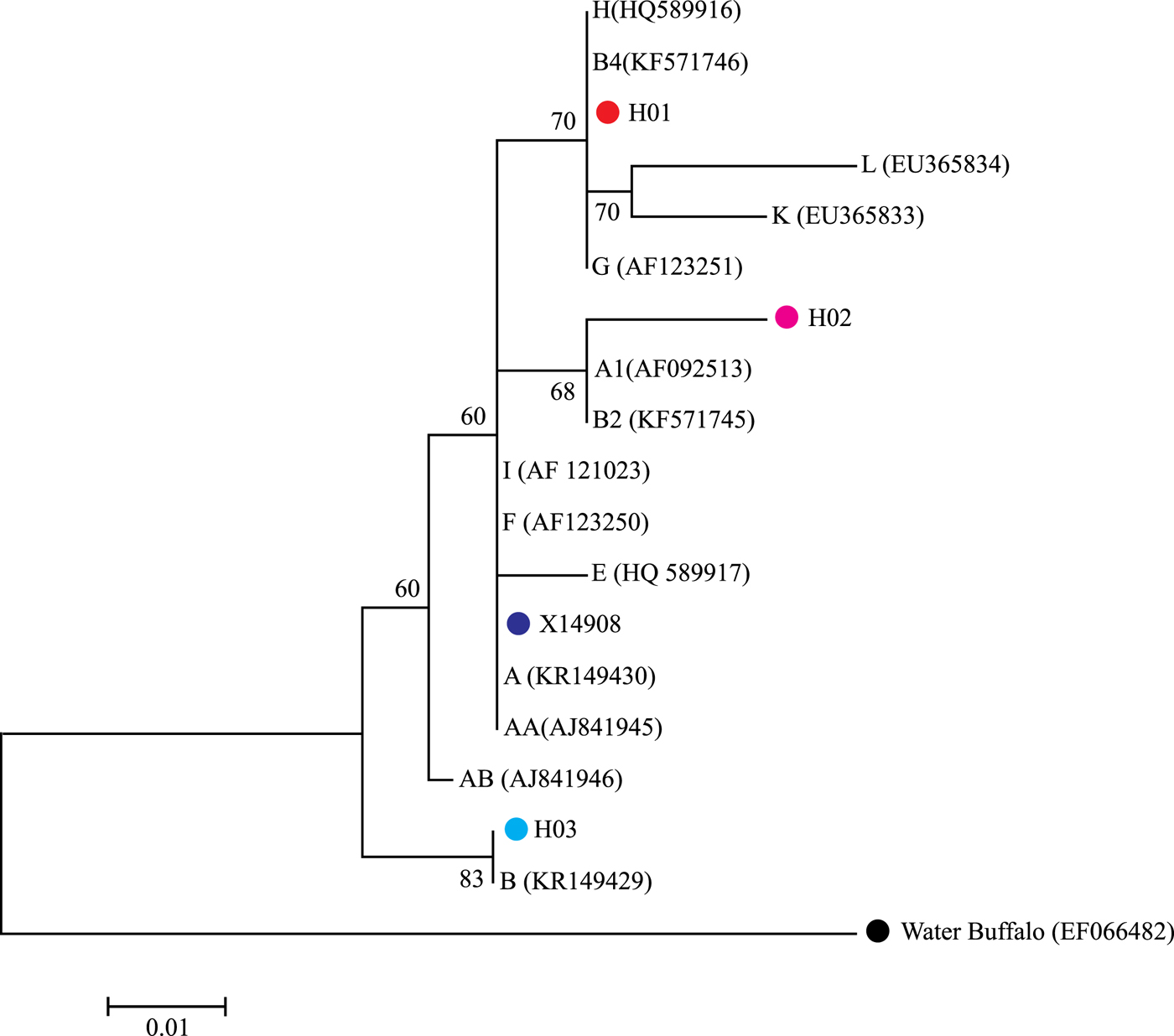
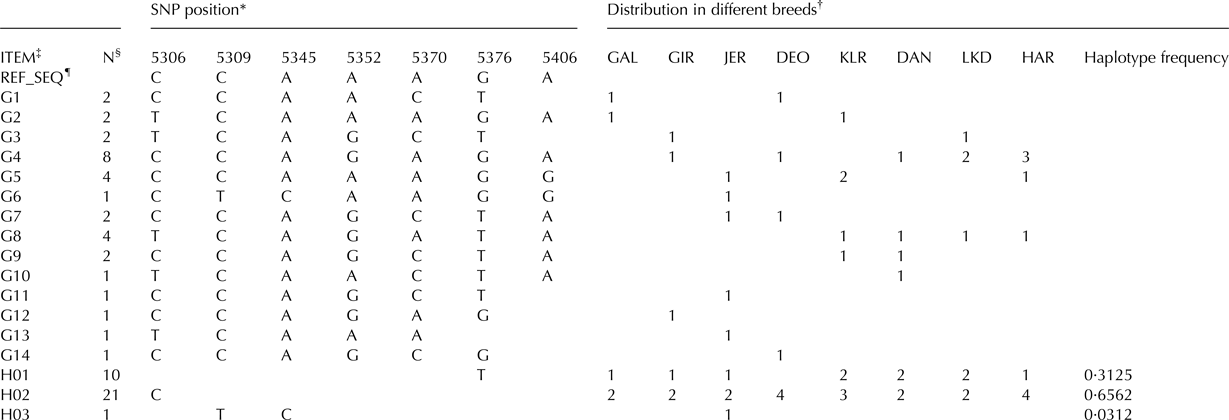
Because molecular data on CSN3 variants in cattle from South Asia, including India, are scant, we sequenced the highly recommended exon IV in 32 tissue samples obtained from 8 local zebu cattle breeds of Maharashtra. In a small panel of 32 samples, 14 different genotypes (G1–G14) defined by 7 SNP's were found. From these 14 genotypes, 3 haplotypes (H01–H03) were reconstructed, and their frequencies were estimated (Table 1). Of these 3 haplotypes, 2 haplotypes (H01 and H03) corresponded to more common cattle alleles, CSN3*B4 and CSN3*B, and less common alleles, CSN3*H and CSN3*G, respectively. Furthermore, of these 3 haplotypes, one new haplotype (H02) was found in all 8 investigated breeds (Table 1). The new haplotype H02 differed from CSN3*B4 and CSN3*B and CSN3*H and CSN3*G alleles by one nonsynonymous mutation at the position (C5306T-Ile100Thr). Moreover, the haplotype H02 differed from the H01 haplotype by one nonsynonymous mutation (G5376T-Glu123Asp) and from the haplotype H03 by two nonsynonymous mutations (T5309C-Thr101Ile and A5345C-Asp113Aln). Two nonsynonymous mutations found in the Jersey breed sample were identical to the allele (KR149429) reported in crossbred cattle from Kerala, India (Lali et al. 2015, unpublished). The N-J tree constructed on the basis of the haplotype information revealed clustering of the H01 haplotype with B4, G, and H alleles reported previously in the Jersey breed B. taurus taurus (Fig. 1). Furthermore, the new haplotype and allele H02, which is reported for the first time in the current study, falls under the clade comprising A1 and B2 alleles. However, at the same time, H02 differed from A1 and B2 alleles by a nonsynonymous mutation (T5306C-Ile100Thr). The tree also showed clustering of the third haplotype H03, which originated from the Jersey breed with a B allele (KR149429) of B taurus indicus from Kerala, India (Fig. 1). The occurrence of identical CSN3 alleles in morphologically identified zebu and taurine cattle may be due to either sharing of the allele or excessive hybridisation occurring in local cattle in the remote villages of India. This finding is well reflected in the 19th livestock census conducted in 2012, which indicated a 34·78 % increase in crossbred cattle compared with a 0·17 % increase in local dairy cattle in entire India. This census report also indicated a 5·29 % decrease in both cattle and buffalo in Maharashtra. Although we included a small sample size and a small geographical region in this study, our results demonstrate the importance and economic significance of exploring gene variants in local zebu cattle breeds before they become eroded due to indiscriminate introgression. The finding of one new allele in a small panel of 32 samples obtained from a single state of India corroborates the hypothesis that local breeds harbour enormous diversity in functional genes and thus hold the key to the sustainable development of livestock.
Neighbour-joining tree constructed out of newly generated and retrieved haplotypes. Water buffalo was used as outgroup.

Observed genotypes (G01 to G14) with their distribution and inferred haplotypes (H01 to H03) with estimated frequencies

* Single Nucleotide Polymorphism (SNP) position
† GAL-Gaolao, GIR-Gir, JER-Jersey, DEO-Deoni, KLR Khillar, DAN-Dangi, LKD-Lal-Khandari, HAR-Hariana
‡ Observed genotype
§ Indicates the number of observed individuals
¶ Reference sequence of Kappa casein gene (X14908). H01, H02 & H03 are identified haplotype and their position
Supplementary material
The supplementary material for this article can be found at https://doi.org/10.1017/S0022029917000656.
Dr Mumtaz Baig is thankful to Department of Science and Technology, (DST) India for providing financial assistance under the Indo-Portuguese Research Cooperation in science and technology Grant No. INT/PORTUGAL/P-03/2009.