Introduction
The title of the painting Der Jungbrunnen (Figure 1), by Lucas Cranach the Elder, means ‘the fountain of youth’. On the left of the picture, we see withered hags arriving at a pool following a journey through a barren countryside. Following an inspection by a physician, they descend into the rejuvenating water, where rosy cheeks and flowing locks replace their wrinkles and grey hair. They are welcomed on the other side by a knight, and are re-clothed in new robes before they eat, dance and flirt with young noblemen in a lush landscape. The picture may be fantastical but its theme, our desire for eternal youth, is still applicable over 450 years later.
Der Jungbrunnen by Lucas Cranach the Elder (1546). Gemäldegalerie, Berlin.

Humanity has always craved youthfulness and good looks; indeed, the two terms have become almost interchangeable. For some, the desire to stay looking young drives them to seek aesthetic surgery, and the nose is a common area of concern. What follows is a discussion of the place of rhinoplasty in the ageing face. This review is not an analysis of operative technique, but rather an examination of how rhinoplasty relates to age in biological, psychological and social contexts.
Biological aspects of ageing
It is necessary to begin by trying to define ageing in biological terms. The human aspects of advancing age are so familiar to us in our daily life that this apparently simple task is surprisingly difficult. Although technically we start to age from the moment we are conceived, the term ageing implies a process of irreversible deterioration following a peak in function. However, this deterioration affects different organ systems and tissues at different rates in the same person (for example, gonadal development finishes after puberty, while a decline in musculoskeletal function does not start until approximately the third decade). Such a deterioration occurs at different rates in different individuals, and it can be examined at various levels, from the body as a whole down to its molecular processes.Reference Pathy1, Reference Bond, Briggs and Coleman2 Because there are so many facets to biological ageing, it is difficult to define the moment at which the developmental peak is reached and ageing begins, with reference to the person as a whole. In the face and nose, the effects become apparent relatively early. It has been suggested that changes start in the late teens but do not become obvious until the mid-twenties, when subtle alterations in the structure of the skin and underlying tissues start to be influenced by extrinsic factors such as sun damage, smoking and alcohol.Reference Patterson3 However, it tends not to be until mid-life that our appearance has altered to an extent that prompts some to seek surgical assistance. It is therefore less important to put a figure in years on what constitutes ‘the ageing face’, than to recognise the typical changes that occur.
Ageing and the nose
Age-related structural changes in the nose are predictable, although the extent to which they will affect a particular individual is not.
Microscopically, there is a reduction in dermal collagen synthesis and an increase in the number of disorganised elastic fibres, resulting in thinner, less elastic skin. Meanwhile, despite an overall reduction in sebum production, the size of sebaceous glands in the nasal tip increases, making it heavy and bulbous. There is loss of support from the soft tissues, due to muscle atrophy and fat infiltration, and from cartilage, which softens excessively or ossifies.Reference Moody and Ross4, Reference Rohrich and Hollier5
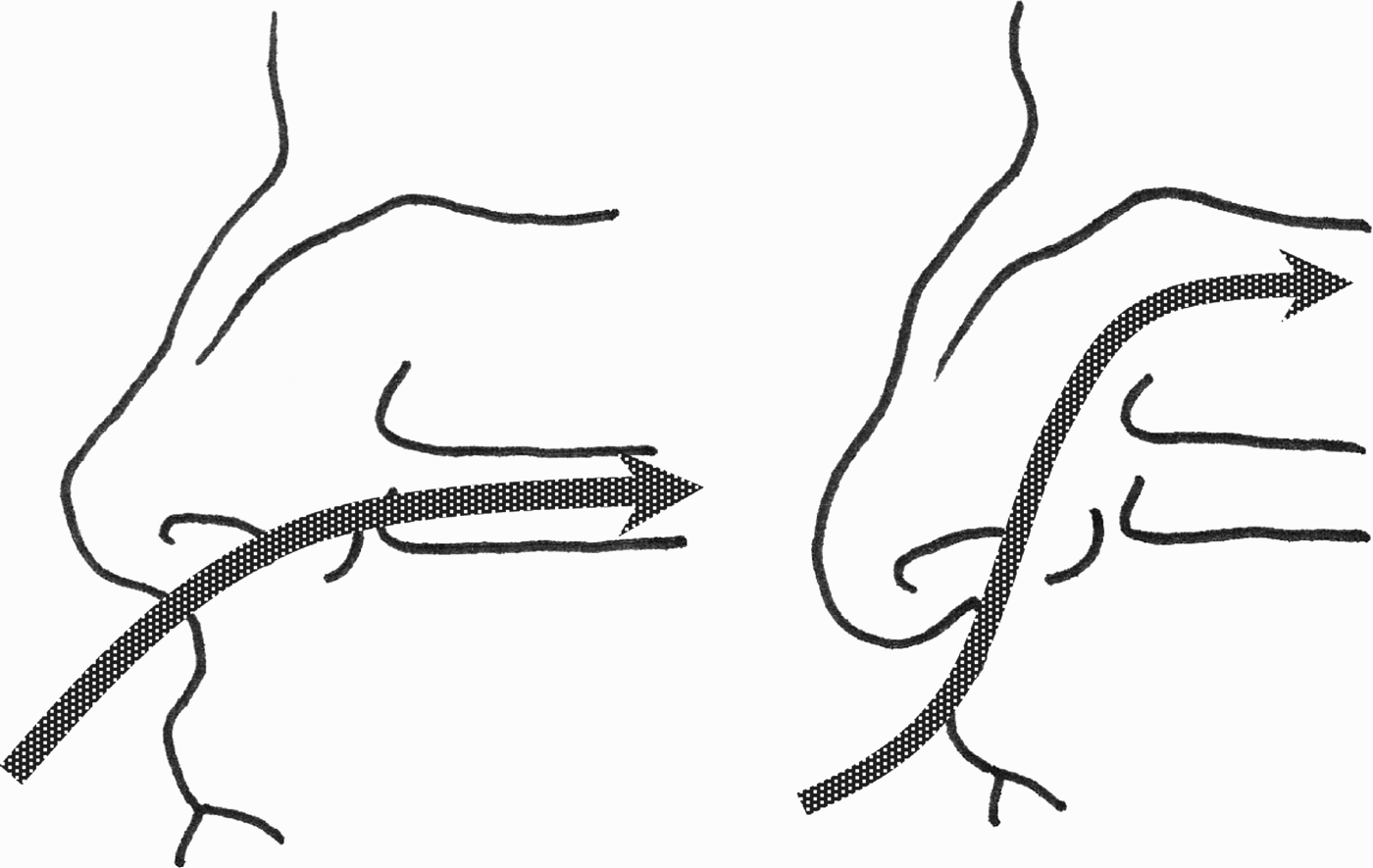
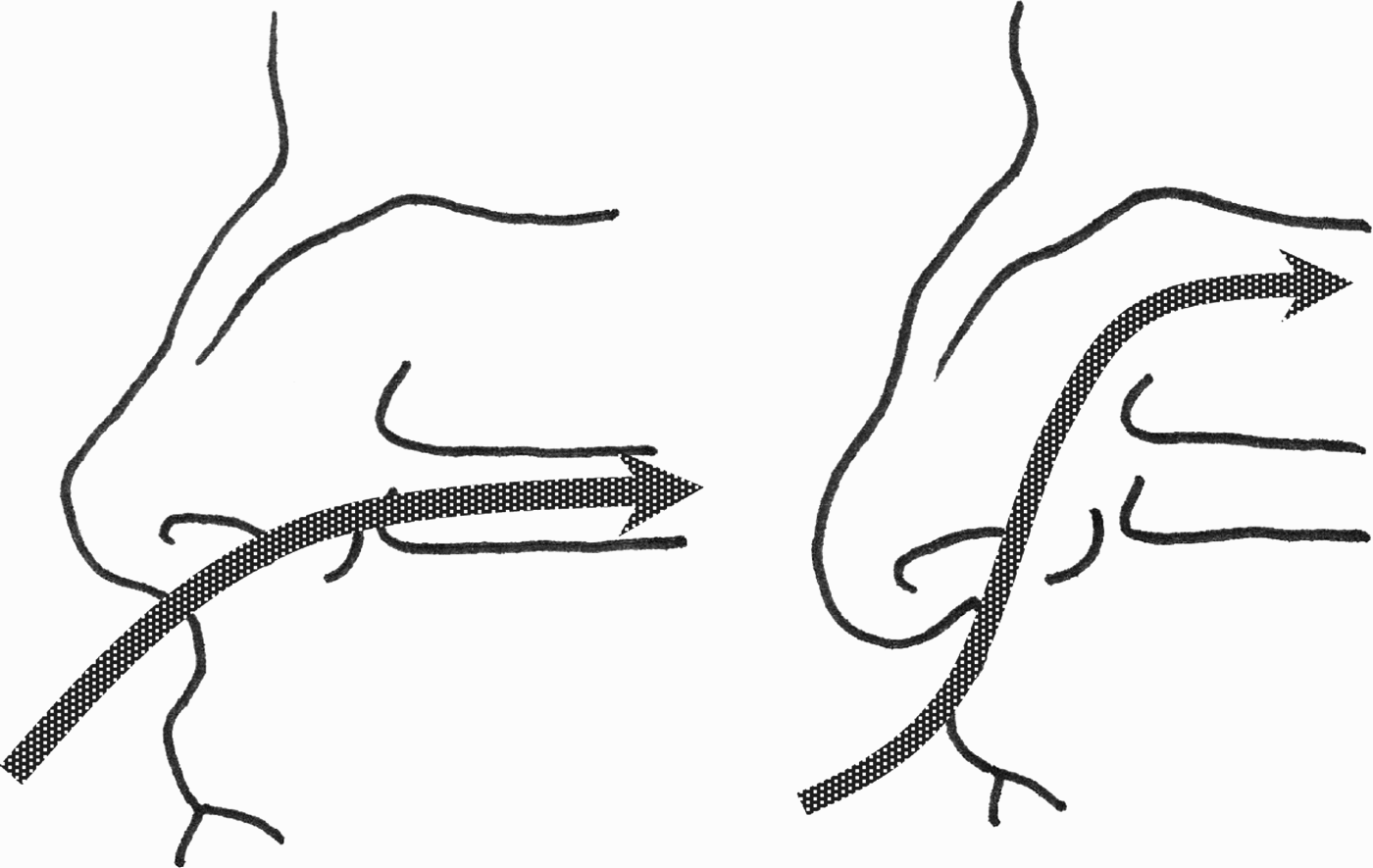
The macroscopic effect is downward migration of the lateral crura of the lower lateral cartilages and an unfurling of the scroll area, leading to drooping of the nasal tip. In addition, maxillary alveolar bone resorption causes posterior displacement and divergence of the medial crura, exaggerating the already acute columellar angle. Not only is the overall effect aesthetically unacceptable to some patients, but the sagging tip diverts airflow superiorly into the narrow vestibule area, causing obstructive symptoms that may be aggravated by internal or external valve collapse (again, due to degenerative loss of cartilage support) or by pre-existing septal deviation (Figure 2).
Age-related ptosis of the nasal tip causes diversion of airflow into the vestibule.5
An in-depth discussion of surgical methods to address these age-specific problems is beyond the scope of this review; for further reference, the papers by Rohrich and Hollier, Cochran et al., and Richter all give an excellent overview.Reference Rohrich and Hollier5–Reference Richter7
Aesthetic considerations in the ageing face
One critical anatomical concept to appreciate in the ageing face is aesthetic balance. Part of our perception of beauty depends on the presence of proportion and specific mathematical relationships between the component parts. This idea is not new: as far back as the Renaissance, Leonardo da Vinci illustrated how facial proportions may be represented by numerical ratios, and he demonstrated how the vertical height of the aesthetically pleasing face is divided into equal thirds.Reference Richter7
Age-related changes alter this balance. The hairline recedes and the nasal tip droops (i.e. ptosis), lengthening the upper two-thirds of the nose and creating a dorsal pseudo-hump (Figure 3).Reference Rohrich and Hollier5 Meanwhile, the lower third is shortened by maxillary and mandibular bone resorption, most notably in the edentulous patient. Thus, even if the ptotic nasal tip is corrected, further attention may be required in the form of restorative dentistry, mentoplasty or brow lift to restore a harmonious sense of vertical proportion.Reference Rohrich and Hollier5
Change in facial proportions with age, demonstrating development of a dorsal pseudo-hump.5

At the same time, the overall effect of other afflictions of facial ageing must be considered, such as baggy eyes, jowls, neck wattle and elongated pinnae.Reference Patterson3, Reference Cochran, Ducic and DeFatta6 Patients will be variably affected by these, so any change in nasal shape must be in context.Reference Patterson3 Cosmetic change is often a by-product of a functional rhinoplasty, so the surgeon must be mindful that secondary changes in nasal shape do not upset the aesthetic equilibrium. In order to prevent an end result which is discordant with its surroundings or which exaggerates any shortcomings of the rest of the face, the aim is conservative surgery, not drastic change.
Psychological significance of the nose
Psychologically, any change to the nose will affect our self-image.Reference Goin8 Certain nasal shapes are identified with certain ethnic groups, religions or cultures, and possessing a nose that is identifiable with a particular group helps the individual to ‘fit in’. This concept is also deeply rooted in the way in which we relate to our family: most of us resemble our parents, and this shared similarity plays a part in creating strong emotional bonds within the family unit. The nose, our most prominent facial attribute, is a major factor in forging this bond, and is subconsciously interlinked with our feelings towards our parents. Self-image is ingrained in these ethnic, cultural and family foundations, and is moulded with age by other factors (e.g. strong positive or negative feelings towards a parent) and events (e.g. derogatory or complimentary remarks about one's nose). An operation which alters facial appearance, either as a primary aim (e.g. cosmetic rhinoplasty) or a secondary effect (e.g. functional rhinoplasty), will destabilise the patient's self-image and alter their way of relating to the world around them. This disequilibrium appears more marked in older patients undergoing rhinoplasty, who have had many years to develop their self-image, and for whom their nose may be a strong yet unacknowledged link to loved ones.Reference Goin8, Reference Thomson, Knorr and Edgerton9
Because of the nose's profound psychological significance, a good physical result may not equate to a good emotional outcome, and the older patient may even require a long period of adjustment, akin to a period of grieving.
Knorr states that older patients who have not disliked their nose since adolescence have the greatest potential to be dissatisfied with the outcome of rhinoplasty.Reference Thomson, Knorr and Edgerton9, Reference Knorr10 The reason for this is that, if their reason for change was superficial (e.g. wanting to look better for a wedding), then the strong subconscious associations with race and family will be upset by surgical correction, leading to feelings of disconnection from their social group.Reference Thomson, Knorr and Edgerton9, Reference Knorr10
Conversely, Rohrich and Hollier state that those older patients with a long-standing dislike for their nose may not only have unrealistic expectations about what surgery can achieve, but may also feel guilty – either about changing a feature that has strong family associations, or for seeming vain by electing to have a cosmetic procedure. Operating on such patients may thus cause significant emotional upset.Reference Rohrich and Hollier5
Either way, it is imperative that any surgeon considering rhinoplasty on middle-aged or older patients should recognise the psychological impact that the operation may cause, and as a result err towards subtle changes rather than radical surgery. It is equally essential to recognise the emotionally unstable patient, and to think carefully before considering surgery. However, Thomson points out that everyone has a degree of emotional volatility, and that many procedures would not be performed if equanimity was a strict condition for rhinoplasty.Reference Thomson11 The main consideration is to judge the patient's level of emotional reserve, since this will help guard against post-operative dissatisfaction.
Motivation for rhinoplasty in the older patient
Just as the importance of the patient's psychological relationship with their nose should not be underestimated, neither should their motivation for rhinoplasty. This applies particularly to the older patient. The aim of the operation is generally airway improvement, cosmesis or a combination of the two.
In those patients with a purely functional problem, the motivation is usually clear.
However, in those with a cosmetic complaint, the motivation may not be so obvious. In a study of over 5000 rhinoplasty patients of all ages, Shulman found that, for older patients, the final decision to proceed was usually triggered by positive factors, such as financial success or a new job.Reference Shulman, Westreich and Shulman12 There was, however, a subset of older patients whose motivation for rhinoplasty was negative: the death of a spouse, divorce, feeling ugly or feelings of sexual inadequacy. The sexual symbolism of the nose is interesting: it is widely accepted that a nose is rarely just a nose in anyone's subconscious mind, and a patient's desire for rhinoplasty may reflect veiled feelings of sexual insecurity.Reference Goin8
These are feelings that many older people confront as they find themselves faced in the mirror with bodies that are ageing in other ways. Yet fixing their nose will neither restore this lost feeling of youth, nor bring back their departed spouse, nor mend their broken marriage, however skilful the surgeon.
Although it is convenient to neatly categorise a patient's motivation for rhinoplasty in this way, real life is rarely so simple, and the real driving forces for wanting an operation may be vague, particularly in the older generation.Reference Moody and Ross4 Similarly, an older patient's expectations may be ill-defined or unrealistic, and the onus is thus on the surgeon to clarify exactly what is being requested and the reasons for it, and to be entirely frank about what can realistically be achieved within the limitations of ageing tissues and aesthetic balance.Reference Rohrich and Hollier5
Rhinoplasty, older patients and the National Health Service
Rhinoplasty in the ageing patient has implications for the National Health Service (NHS) of the twenty-first century, specifically its appropriateness in an overstretched system. Cosmetic rhinoplasty is rarely offered within the NHS, regardless of age, but it is routinely performed for airway obstruction or following nasal trauma.
Both nasal obstruction and poor cosmesis are distressing, and a number of authors have tried to quantify improvements in quality of life (QOL) following rhinoplasty.Reference McKiernan, Banfield, Kumar and Hinton13–Reference Litner, Rotenberg, Dennis and Adamson15 McKiernan's group used the Glasgow Benefit Inventory, a validated questionnaire with a range of outcomes between −100 (maximum harm) to +100 (maximum benefit), to show that rhinoplasty improves health-related QOL.Reference McKiernan, Banfield, Kumar and Hinton13 Interestingly, they found that when the indication was function alone the improvement was +27.7, while when cosmesis was the main complaint the score was +52.7. In their original paper on the GBI, Robinson et al found that when cosmesis and function were addressed together, the score was +58.3 (as a comparison, tonsillectomy scored +49.9).Reference Robinson, Gatehouse and Browning14 Litner et al. used a different questionnaire to assess peri-operative QOL in patients undergoing various cosmetic procedures, and found not only that cosmetic rhinoplasty improved QOL significantly more than other procedures for the ageing face, but also that the greatest improvement in QOL was seen in patients over 50.Reference Litner, Rotenberg, Dennis and Adamson15
Although it is difficult to analyse the cost–benefit significance of rhinoplasty, patient satisfaction is being increasingly regarded as a key indicator of performance. It is difficult to say whether older patients get satisfaction from rhinoplasty because of the surgical changes, or because they feel better about themselves and take more care over their appearance in general. Nevertheless, there seems to be evidence that rhinoplasty improves QOL, and that older patients derive the greatest benefit from it. We can perhaps surmise from this that rhinoplasty in the ageing face is a worthwhile operation in terms of patient satisfaction, and that it would have a place within the NHS in an ideal world.
Conclusion
Rhinoplasty has a definite place in the ageing patient, and has the potential to give beneficial results. However, as discussed above, a good sense of aesthetic balance is fundamental in creating a nose that is in harmony with the rest of the face. Furthermore, exploring patient motivation and expectation is critical, possibly even more so than in younger patients.
A final inspection of Cranach's painting reveals that on top of the fountain in the centre of the pool sit two figures, Cupid and Venus. We must remember that we may be able to make someone look younger with the scalpel, but making them feel younger is probably beyond our control.
Acknowledgements
I would like to thank Mr D Skinner, Consultant ENT Surgeon at Royal Shrewsbury Hospital, for his advice on this subject. Figures 2 and 3 reproduced form Otoloaryngologic Clinics of North America 32(4);755-73. Rohrich RJ, Hollier LH. Rhinoplasty with advancing age: characteristics and management. Copyright 1999. With permission from Elsevier.