Introduction
In recent decades, ample studies have demonstrated that the gut microbiota is implicated in the pathogenesis of a wide range of diseases (Lynch and Pedersen, Reference Lynch and Pedersen2016), including cancer and diseases associated with inflammation, metabolic, autoimmune, neurologic, and mental disorders. Bidirectional ‘microbiota–gut–brain axis’ communication has mostly been explored and proved to be a robust model (Collins and Bercik, Reference Collins and Bercik2009; Cryan and O'Mahony, Reference Cryan and O'Mahony2011; Bravo et al., Reference Bravo, Julio-Pieper, Forsythe, Kunze, Dinan, Bienenstock and Cryan2012). Cross-sectional studies showed that imbalances in the composition and functions of the intestinal microbes were observed in patients with mental disorders (Rogers et al., Reference Rogers, Keating, Young, Wong, Licinio and Wesselingh2016; Dickerson et al., Reference Dickerson, Severance and Yolken2017; Bambury et al., Reference Bambury, Sandhu, Cryan and Dinan2018; Bruce-Keller et al., Reference Bruce-Keller, Salbaum and Berthoud2018; Groen et al., Reference Groen, de Clercq, Nieuwdorp, Hoenders and Groen2018; Butler et al., Reference Butler, Cryan and Dinan2019), particularly in major depressive disorder (MDD) (Cheung et al., Reference Cheung, Goldenthal, Uhlemann, Mann, Miller and Sublette2019). As probiotics, Bifidobacterium and Lactobacillus, which may be beneficial to patients with MDD (Akkasheh et al., Reference Akkasheh, Kashani-Poor, Tajabadi-Ebrahimi, Jafari, Akbari, Taghizadeh, Memarzadeh, Asemi and Esmaillzadeh2016; Kazemi et al., Reference Kazemi, Noorbala, Azam, Eskandari and Djafarian2019; Rudzki et al., Reference Rudzki, Ostrowska, Pawlak, Malus, Pawlak, Waszkiewicz and Szulc2019), were also found to be altered in schizophrenia (Yuan et al., Reference Yuan, Zhang, Wang, Liu, Li, Kumar, Hei, Lv, Huang, Fan and Song2018) and autism spectrum disorder patients (Kaluzna-Czaplinska and Blaszczyk, Reference Kaluzna-Czaplinska and Blaszczyk2012; Tomova et al., Reference Tomova, Husarova, Lakatosova, Bakos, Vlkova, Babinska and Ostatnikova2015; Shaaban et al., Reference Shaaban, El Gendy, Mehanna, El-Senousy, El-Feki, Saad and El-Asheer2018). In addition, the fecal microbiota transplantation studies (Bercik et al., Reference Bercik, Denou, Collins, Jackson, Lu, Jury, Deng, Blennerhassett, Macri, McCoy, Verdu and Collins2011; Vrieze et al., Reference Vrieze, Van Nood, Holleman, Salojarvi, Kootte, Bartelsman, Dallinga-Thie, Ackermans, Serlie, Oozeer, Derrien, Druesne, Van Hylckama Vlieg, Bloks, Groen, Heilig, Zoetendal, Stroes, de Vos, Hoekstra and Nieuwdorp2012; Ridaura et al., Reference Ridaura, Faith, Rey, Cheng, Duncan, Kau, Griffin, Lombard, Henrissat, Bain, Muehlbauer, Ilkayeva, Semenkovich, Funai, Hayashi, Lyle, Martini, Ursell, Clemente, Van Treuren, Walters, Knight, Newgard, Heath and Gordon2013; Kelly et al., Reference Kelly, Borre, O'Brien, Patterson, El Aidy, Deane, Kennedy, Beers, Scott, Moloney, Hoban, Scott, Fitzgerald, Ross, Stanton, Clarke, Cryan and Dinan2016; Zheng et al., Reference Zheng, Zeng, Zhou, Liu, Fang, Xu, Zeng, Chen, Fan, Du, Zhang, Yang, Yang, Meng, Li, Melgiri, Licinio, Wei and Xie2016; De Palma et al., Reference De Palma, Lynch, Lu, Dang, Deng, Jury, Umeh, Miranda, Pigrau Pastor, Sidani, Pinto-Sanchez, Philip, McLean, Hagelsieb, Surette, Bergonzelli, Verdu, Britz-McKibbin, Neufeld, Collins and Bercik2017) in animal models strongly demonstrated that the microbiota plays a causal role in physical diseases and mental disorders from the perspective of the ‘ecological Koch's postulates (Vonaesch et al., Reference Vonaesch, Anderson and Sansonetti2018)’, suggesting that alterations in gut microbiota may induce depression and anxiety through the microbiota–gut–brain communication route. For the potential biomechanism of the microbiota–gut–brain axis, a variety of pathways, including the hypothalamic–pituitary–adrenal axis, immune modulation, microbial production of various neuroactive compounds, and the tryptophan (Trp) metabolism pathway, have been proposed (Cryan and Dinan, Reference Cryan and Dinan2012; Dinan et al., Reference Dinan, Stanton and Cryan2013; Forsythe et al., Reference Forsythe, Bienenstock and Kunze2014; O'Mahony et al., Reference O'Mahony, Clarke, Borre, Dinan and Cryan2015; Butler et al., Reference Butler, Cryan and Dinan2019). Among them, the Trp-related pathway is considered to play a vital role in neurotransmission, immune homeostasis, and gut–brain signaling (Agus et al., Reference Agus, Planchais and Sokol2018).
Trp metabolism follows three major pathways in the gastrointestinal tract, of which the serotonin [5-hydroxytryptamine (5-HT)] production pathway is a crucial one (Agus et al., Reference Agus, Planchais and Sokol2018). Exhaustion of the 5-HT and dysfunction of 5-HT receptors are believed to play a critical role in MDD pathogenesis (Fakhoury, Reference Fakhoury2016). Trp is the precursor of 5-HT, where 5-HT is converted from Trp to 5-hydroxytryptophan (5-HTP) by trphydroxylase and then converted to 5-HT by 5-HTP decarboxylase (González-Flores et al., Reference González-Flores, Belén, Garrido, Gonzalez-Gomez, Lozano, Ayuso, Barriga, Paredes and Rodriguez2011). Plasma Trp depletion is one of the most well-replicated biomarkers in MDD patients (DeMyer et al., Reference DeMyer, Shea, Hendrie and Yoshimura1981; Xu et al., Reference Xu, Fang, Hu, Chen, Chen, Li, Lu, Mu and Xie2012; Ogawa et al., Reference Ogawa, Fujii, Koga, Hori, Teraishi, Hattori, Noda, Higuchi, Motohashi and Kunugi2014; Doolin et al., Reference Doolin, Allers, Pleiner, Liesener, Farrell, Tozzi, O'Hanlon, Roddy, Frodl, Harkin and O'Keane2018; Ogawa et al., Reference Ogawa, Koga, Hattori, Matsuo, Ota, Hori, Sasayama, Teraishi, Ishida, Yoshida, Yoshida, Noda, Higuchi and Kunugi2018). However, 5-HT cannot pass the blood–brain barrier (BBB), and only Trp and 5-HTP (precursor of 5-HT) can pass through the BBB and become the precursors of 5-HT in the brain. Moreover, some bacteria, such as Enterococcus, Lactobacillus, Oscillibacter, Blautia, and Intestinimonas, which encode Trp synthase genes, are found in the human gastrointestinal tract (Zelante et al., Reference Zelante, Iannitti, Cunha, De Luca, Giovannini, Pieraccini, Zecchi, D'Angelo, Massi-Benedetti, Fallarino, Carvalho, Puccetti and Romani2013; Li et al., Reference Li, Evivie, Jin, Meng, Li, Yan, Huo and Liu2018; Chen et al., Reference Chen, Chen, Liu, Zhang, Vaziri, Zhuang, Chen, Feng, Guo and Zhao2019). There are two main sources of Trp: one is through food intake, and the other is through gut microbial biosynthesis. Dietary Trp supplements may be beneficial to patients with depression, whereas less dietary Trp caused a recurrence of depressive symptoms (Booij et al., Reference Booij, Van der Does, Benkelfat, Bremner, Cowen, Fava, Gillin, Leyton, Moore, Smith and Van der Kloot2002). Furthermore, as for the microbial metabolites of Trp, indole and its derivatives are ligands for the aryl hydrocarbon receptor (AhR) (Hubbard et al., Reference Hubbard, Murray and Perdew2015; Alexeev et al., Reference Alexeev, Lanis, Kao, Campbell, Kelly, Battista, Gerich, Jenkins, Walk, Kominsky and Colgan2018), which plays multiple roles in the gastrointestinal tract, immunity (Zelante et al., Reference Zelante, Iannitti, Cunha, De Luca, Giovannini, Pieraccini, Zecchi, D'Angelo, Massi-Benedetti, Fallarino, Carvalho, Puccetti and Romani2013; Schiering et al., Reference Schiering, Wincent, Metidji, Iseppon, Li, Potocnik, Omenetti, Henderson, Wolf, Nebert and Stockinger2017), mucosa barrier permeability (Metidji et al., Reference Metidji, Omenetti, Crotta, Li, Nye, Ross, Li, Maradana, Schiering and Stockinger2018; Rothhammer and Quintana, Reference Rothhammer and Quintana2019), and peripheral and central nervous system inflammation (Rothhammer et al., Reference Rothhammer, Mascanfroni, Bunse, Takenaka, Kenison, Mayo, Chao, Patel, Yan, Blain, Alvarez, Kebir, Anandasabapathy, Izquierdo, Jung, Obholzer, Pochet, Clish, Prinz, Prat, Antel and Quintana2016, Reference Rothhammer, Borucki, Tjon, Takenaka, Chao, Ardura-Fabregat, de Lima, Gutierrez-Vazquez, Hewson, Staszewski, Blain, Healy, Neziraj, Borio, Wheeler, Dragin, Laplaud, Antel, Alvarez, Prinz and Quintana2018; Natividad et al., Reference Natividad, Agus, Planchais, Lamas, Jarry, Martin, Michel, Chong-Nguyen, Roussel, Straube, Jegou, McQuitty, Le Gall, da Costa, Lecornet, Michaudel, Modoux, Glodt, Bridonneau, Sovran, Dupraz, Bado, Richard, Langella, Hansel, Launay, Xavier, Duboc and Sokol2018), and yet, these issues are all closely related to MDD (Foster and McVey Neufeld, Reference Foster and McVey Neufeld2013; Dash et al., Reference Dash, Clarke, Berk and Jacka2015; Kiecolt-Glaser et al., Reference Kiecolt-Glaser, Derry and Fagundes2015; Strawbridge et al., Reference Strawbridge, Arnone, Danese, Papadopoulos, Herane Vives and Cleare2015; Hayley et al., Reference Hayley, Audet and Anisman2016; Kim et al., Reference Kim, Na, Myint and Leonard2016; Miller and Raison, Reference Miller and Raison2016; Sherwin et al., Reference Sherwin, Sandhu, Dinan and Cryan2016; Wohleb et al., Reference Wohleb, Franklin, Iwata and Duman2016; Dinan and Cryan, Reference Dinan and Cryan2017; Rieder et al., Reference Rieder, Wisniewski, Alderman and Campbell2017; Groen et al., Reference Groen, de Clercq, Nieuwdorp, Hoenders and Groen2018; Stevens et al., Reference Stevens, Goel, Seungbum, Richards, Holbert, Pepine and Raizada2018; Winter et al., Reference Winter, Hart, Charlesworth and Sharpley2018; Valles-Colomer et al., Reference Valles-Colomer, Falony, Darzi, Tigchelaar, Wang, Tito, Schiweck, Kurilshikov, Joossens, Wijmenga, Claes, Van Oudenhove, Zhernakova, Vieira-Silva and Raes2019). Hence, the exploration of the integrated Trp pathway from gut microbial biosynthesis to metabolism in MDD patients is imperative.
Based on the above findings, we hypothesized that compared with the healthy controls (HCs), (1) alterations in the gut microbiota could be observed in the MDD group and (2) lower abundances of Trp synthesis and metabolism-related genes would be found and may be related to depressive symptom severity. Notably, compared to the 16S rRNA sequencing method, shotgun metagenomics sequencing (SMS) allows researchers to comprehensively probe organisms at a higher taxonomic and functional resolution level (Franzosa et al., Reference Franzosa, Hsu, Sirota-Madi, Shafquat, Abu-Ali, Morgan and Huttenhower2015). Considering these advantages, SMS was performed to determine the differences in the gut microbiota taxa and the Trp pathway of MDD v. HC.
Materials and methods
The authors assert that all procedures contributing to this work comply with the ethical standards of the relevant national and institutional committees on human experimentation and with the Helsinki Declaration of 1975, as revised in 2008. The protocol of this study was approved by the Human Ethics Committee of Shenzhen Kangning Hospital, and written informed consent was obtained from all subjects.
Participants
In total, 26 patients with the Diagnostic and Statistical Manual of Mental Disorders (DSM-5) (American Psychiatric Association, 2013) diagnosis of MDD were recruited from the inpatient and outpatient units of Shenzhen Kangning Hospital (Shenzhen, Guangdong, China). The Mini-International Neuropsychiatric Interview (Sheehan et al., Reference Sheehan, Lecrubier, Sheehan, Amorim, Janavs, Weiller, Hergueta, Baker and Dunbar1998) was used to preliminarily screen the pre-existing psychiatric disorders, and then a structured interview related to the DSM-5 (SCID-5-CV) (First and Williams, Reference First and Williams2016) was conducted by an experienced psychiatrist to reach the final diagnosis. All patients completed the Hamilton's Depression Scale-17 (HAMD) (Hamilton, Reference Hamilton1960) and met the requirement of a HAMD score over 17, which is indicative of clinically significant depression. For a clinical rating of the severity of anxiety and mania symptoms, patients also completed the Hamilton's Anxiety Scale (HAMA) (Hamilton, Reference Hamilton1959) and Hypomania Checklist (HCL-32) (Angst et al., Reference Angst, Adolfsson, Benazzi, Gamma, Hantouche, Meyer, Skeppar, Vieta and Scott2005). Furthermore, 29 HCs from the nearby communities were screened using a semi-structured clinical interview to confirm that they were free of any psychiatric or physical illnesses.
Finally, the following exclusion criteria were established for both groups: psychoactive substance abuse; acute or chronic diseases (including stroke, epilepsy, hypertension, endocrine disease, diabetes mellitus, fatty liver disease, or severe cardiovascular disease); combined neurological or physical illness confirmed by a detailed physical examination, especially a neurological examination, routine blood test, and a brain computed tomography scanning if necessary; specific dietary habits, such as a weight loss diet or completely vegetable-based; specific treatments within 6 months, such as transcranial magnetic stimulation or electroconvulsive therapy; use of antibiotic, probiotic, prebiotic, or synbiotic within the past month; body mass index (BMI) over 24; pregnancy or breast feeding; and significant abnormal results of physical examination, neurological examination, or routine blood tests.
Stool sample collection and DNA extraction
Stool samples were collected after the participants completed the questionnaire assessments and immediately frozen at −80 °C prior to Imunobio Co. Ltd (Shenzhen, China) for DNA extraction. DNA was extracted from stool samples using a StoolGen DNA kit (CWBiotech Co., Beijing, China).
Shotgun metagenomic sequencing
The SMS was performed according to our previous studies (Rong et al., Reference Rong, Xie, Zhao, Lai, Wang, Xu, Liu, Guo, Xu, Deng, Yang, Xiao, Zhang, He, Wang and Liu2019; Wang et al., Reference Wang, Wan, Rong, He, Wang, Zhou, Cai, Wang, Xu, Yin and Zhou2019; Zhou et al., Reference Zhou, Wang, He, Qiu, Wang, Wang, Zhou, Zhou, Cheng, Zhou, Xu and Wang2019). In brief, shotgun metagenomic libraries were constructed with a TruSeq DNA Sample Preparation kit (Illumina, San Diego, CA, USA). The libraries that passed QC (>3 ng/μl) were sequenced using an Illumina Hiseq2500 sequencer (Illumina) for 6 Gb raw data output per sample. The gut microbiota composition was obtained using MEGAN5 (Huson et al., Reference Huson, Auch, Qi and Schuster2007).
Gut microbiota composition
To achieve a robust result, the features with a prevalence less than 80% in all samples or variance based on an interquartile range lower than 20% were discarded. The α-diversity was calculated by the Fisher index and Shannon index, and Mann–Whitney U tests were used to detect the differences between the two groups. Furthermore, the β-diversity was calculated by using the Bray–Curtis index as the distance method and reported according to the principal coordinate analysis (PCoA), and the permutational multivariate analysis of variance (PERMANOVA) was used to test the difference between the two groups. Because medications may influence the microbiota composition in MDD, we further divided the MDD patients into four subgroups: SSRIs (n = 12), SNRIs (n = 7), other drugs (n = 2, mirtazapine and trazodone), and drug-free (n = 5). As there were only two patients who received other drugs, we analyzed the α- and β-diversity among the remaining three groups (SSRI, SNRI, and drug-free group).
A linear discriminant analysis (LDA) effect size (LEfSe) (Segata et al., Reference Segata, Izard, Waldron, Gevers, Miropolsky, Garrett and Huttenhower2011; Afgan et al., Reference Afgan, Baker, Batut, van den Beek, Bouvier, Cech, Chilton, Clements, Coraor, Gruning, Guerler, Hillman-Jackson, Hiltemann, Jalili, Rasche, Soranzo, Goecks, Taylor, Nekrutenko and Blankenberg2018) test was performed to explore the differences in microbiota between the MDD patients and the HCs. Because the high-dimensioned character of gut microbial data might cause a high false-positive rate (FDR) (Kim et al., Reference Kim, Hofstaedter, Zhao, Mattei, Tanes, Clarke, Lauder, Sherrill-Mix, Chehoud, Kelsen, Conrad, Collman, Baldassano, Bushman and Bittinger2017), LDA tests with a rigorous effect-size threshold of 3.0 and FDR [Benjamini and Hochberg method (Benjamini and Hochberg, Reference Benjamini and Hochberg1995)] adjusted p value (FDR.p) under 0.05 were used to detect the gut microbial differences at phylum, class, order, genus, and species levels.
Kyoto Encyclopedia of Genes and Genomes (KEGG) based microbial tryptophan biosynthesis and metabolism pathway (MiTBamp) analysis
All gene sequences were annotated into the KEGG orthology (KO) database (Kanehisa and Goto, Reference Kanehisa and Goto2000). The Trp biosynthesis map and the Trp metabolism map (map00400 and map00380) were chosen for further analysis. In addition, the metagenomeSeq test (with zero-inflated Gaussian fit statistical model, FDR.p < 0.05) (Paulson et al., Reference Paulson, Stine, Bravo and Pop2013; Dhariwal et al., Reference Dhariwal, Chong, Habib, King, Agellon and Xia2017) was performed to explore different KOs between the two groups.
Random Forest classification
To determine which gut microbiota might be biomarkers for discriminating MDD patients from HCs at the genus level, a Random Forest (RF) and Boruta machine learning algorithm (Breiman, Reference Breiman2001; Kursa and Rudnicki, Reference Kursa and Rudnicki2010) were applied, and the area under the receiver operating characteristic curve (AUC) (Bradley, Reference Bradley1997) was adopted to evaluate the classification performance, which provides a good estimation for the generalizability of the classifiers. To obtain a robust result, the mean relative abundance cut-off values at the genus and species levels were set at >0.1% and >0.01%, respectively. The RF classification and validation were performed using R 3.5.3 (https://www.R-project.org/).
Statistical analyses
For comparisons of the general data, we used the χ2 test for sex and independent t test for age and BMI. For comparisons of the gut microbiota community and KOs, specific matched statistics methods with multiple comparison corrections were used as mentioned above.
Results
General data
In total, 26 MDD patients (age range: 32–52 years) and 29 HCs (age range: 28–51 years) were enrolled in the analyses. No significant differences in age, sex, and BMI were found between the two groups. The MDD patients took drugs, including SSRIs, SNRIs, atypical antipsychotics, and other antidepressants. The detailed demographic and clinical characteristics are shown in Table 1.
Descriptive data of included subjects in the study

MDD, major depressive disorder; HC, health control; s.d., standard deviation; BMI, body mass index; HCL-32, Hypomania Check List-32; HAMD, Hamilton's Depression Scale; HAMA, Hamilton Anxiety Scale.
Table 1 details basic information by diagnosis for all study subjects included in the analyses. p Values are given for group comparisons using χ2 test (for gender) and t test (for age and BMI).
Results of the microbiome community profiling
Phylum-level relative abundance profiling
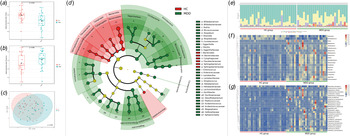
The general overview of the abundances at the phylum level is shown in Fig. 1e.
Results of diversity and taxonomy. (a and b) The boxplots of α-diversity of Fisher (a) and Shannon index (b) respectively, the difference of Fisher index was significant between the two groups (Mann–Whitney test, Z = 2.984, p = 0.003), but the difference of Shannon index was insignificant (Mann–Whitney test, Z = 1.838, p = 0.066). (c) Result of β-diversity visualized using principal coordinate analysis [PCoA, the Bray–Cuitis index as distance method, permutational multivariate analysis of variance (PERMANOVA), F = 4.508, R 2 = 0.078; p = 0.002]. (d) The cladogram at different taxonomic levels, the taxa of higher relative abundance in major depressive disorder (MDD) or healthy control (HC) group were presented in green or red, respectively. (e) The stacked bar plots at phylum level, the differences of relative abundance of phylum Bacteroidetes (LDA = −5.93, FDR. p = 0.01) and Actinobacteria (LDA = 5.76, FDR.p < 0.001) were significant between MDD and HC groups. (f and g) Relative abundance heatmaps of significant genera (f) and species (g) with both LDA value more than 3.0 and FDR.p value <0.05, the relative abundances were transferred to Z scores in order to get a better visibility.

The α-diversity
For the α-diversity comparison, the Fisher index was significantly different between the two groups (Mann–Whitney U test, Z = 2.984, p = 0.003), but the result of the Shannon index did not reach the statistically significant threshold (Mann–Whitney U test, Z = 1.838, p = 0.066). The boxplots of the Fisher and Shannon indexes are shown in Fig. 1a and b.
The β-diversity
The PCoA plots of β-diversity are shown in Fig. 1c (PERMANOVA test, F = 4.508, R 2 = 0.078; p = 0.002).
Taxonomic results
The LEfSe analysis was used to identify the differential microbial relative abundances between the two groups. At the phylum level, the relative abundance of Actinobacteria was significantly higher in the MDD group, but the abundance of Bacteroidetes was significantly lower. Consistent with this result, an increase in Actinobacteria was also observed at the genus level, as seven of the top 19 enriched genera (Slackia, Eggerthella, Coriobacterium, Olsenella, Atopobium, Rothia, and Bifidobacterium) belonged to Actinobacteria. Meanwhile, of the species or subspecies that increased the most in MDD, Bifidobacterium adolescentis, Bifidobacterium longum, Bifidobacterium dentium, Bifidobacterium bifidum, and Bifidobacterium breve were from the genus Bifidobacterium and also belonged to Actinobacteria. The cladogram of significantly different taxa is shown in Fig. 1d, and an overview of the relative abundances at the phylum, genus, and species levels is shown in Fig. 1e–g. Detailed results of each taxonomic level are presented in the online Supplementary Material STable 1.
Subgroup analysis
For α-diversities, the difference in the Shannon index among the three subgroups was non-significant (online Supplementary Material SFig. 1A, Kruskal–Wallis H = 0.127, p = 0.939), and the difference in the Fisher index was non-significant (online Supplementary Material SFig. 1B, Kruskal–Wallis H = 2.409, p = 0.300). For β-diversity: F = 0.887; R 2 = 0.078; p = 0.589 (online Supplementary Material SFig. 1C).
Functional results of the MiTBamp analyses
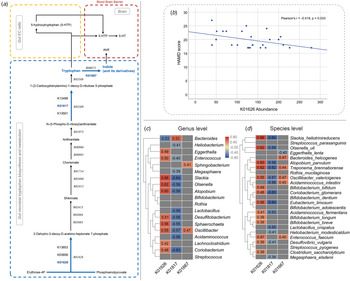
For the Trp biosynthesis (KEGG map00400) and metabolism (KEGG map00380) pathways, we identified that three KOs (K01817, K11358, and K01626 in the Trp biosynthesis pathway map00400) and one KO (K01667 in the Trp metabolism map00380) were significantly lower in the MDD group, and three KOs (K03781, K00382, and K00658 in the Trp metabolism map00380) were significantly higher in the MDD group (for detailed results, please see the online Supplementary Material STable 2). Among them, three lower KOs (K01626, K01817, and K01667) were at the direct gut MiTBamp (Fig. 2a), and we found a significant negative correlation between the K01626 (3-deoxy-7-phosphoheptulonate synthase) abundance and the HAMD scores in the MDD group (Pearson's r = −0.419, p = 0.033, Fig. 2b), but the correlation between the K01817 or K01667 abundance and the HAMD scores was not significant (Pearson's r = 0.152, p = 0. 459; and Pearson's r = −0.093, p = 0.650). For HAMA scores, a significant positive correlation between the K01817 (phosphoribosylanthranilate isomerase) abundance and the HAMA scores was found (Pearson's r = 0.441, p = 0.024); the correlation between the K01626 or K01667 abundance and the HAMA scores was not significant (Pearson's r = −0.335, p = 0.094; and Pearson's r = −0.152, p = 0.459)
Results of Gut Microbial Functional Pathway Analyses. (a) The gut microbial tryptophan biosynthesis and metabolism pathway (MiTBamp), the significant lower Kyoto Encyclopedia of Genes and Genomes (KEGG) orthologies (KOs) by using the metagenomeSeq test were presented in blue. (b) The scatter plots of K01626 abundance and the Hamilton's Depression Scale-17 (HAMD) scores in the major depressive disorder (MDD) group (spearman r = −0.394, p = 0.046). (c and d) The heatmaps of spearman correlation coefficient matrix between three significant lower KOs in the MiTBamp and the abundances of significant genera (c) or species (d), the insignificant spearman correlation coefficients after the FDR corrections were presented with gray blocks. Abbreviations: Gut EC cell: gut enterochromaffin cell; KO list: K01626: 3-deoxy-7-phosphoheptulonate synthase (EC:2.5.1.54); K03856: 3-deoxy-7-phosphoheptulonate synthase (EC:2.5.1.54); K13853: 3-deoxy-7-phosphoheptulonate synthase/chorismate mutase (EC:2.5.1.54 5.4.99.5); K13501: anthranilate synthase/indole-3-glycerol phosphate synthase/phosphoribosylanthranilate isomerase (EC:4.1.3.27, 4.1.1.48, 5.3.1.24); K01817: phosphoribosylanthranilate isomerase (EC:5.3.1.24); K13498: indole-3-glycerol phosphate synthase/phosphoribosylanthranilate isomerase (EC:4.1.1.48 5.3.1.24); K01667: tryptophanase (EC:4.1.99.1); R01826: Phosphoenolpyruvate:D-erythrose-4-phosphate C-(1-carboxyvinyl)transferase (phosphate hydrolyzing, 2-carboxy-2-oxoethyl-forming); R03083: 2-Dehydro-3-deoxy-D-arabino-heptonate 7-phosphate phosphate-lyase (cyclyzing); R03804: 3-Dehydroquinate hydro-lyase; R02413: Shikimate: NADP + 3-oxidoreductase; R02412: ATP:shikimate 3-phosphotransferase; R03460: Phosphoenolpyruvate:3-phosphoshikimate 5-O-(1-carboxyvinyl)-transferase; R01714: 5-O-(1-Carboxyvinyl)-3-phosphoshikimate phosphate-lyase (chorismate-forming); R00985: chorismate pyruvate-lyase (amino-accepting; anthranilate-forming); R00986: Chorismate pyruvate-lyase (amino-accepting); R03509: N-(5-Phospho-beta-D-ribosyl)anthranilate ketol-isomerase; R03508: 1-(2-Carboxyphenylamino)-1-deoxy-D-ribulose-5-phosphate carboxy-lyase(cyclizing); R00673: L-tryptophan indole-lyase (deaminating; pyruvate-forming).

RF classification
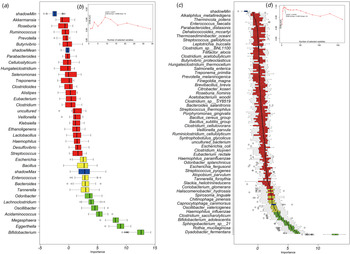
We constructed an RF classification based on genus level, which can achieve an AUC of 0.890. The importance levels of the selected nine features (genera) are shown in Fig. 3, and most features (genera) belong to the phyla Firmicutes, Actinobacteria, and Bacteroidetes. The RF classification based on the species level achieved a higher AUC of 0.997. The detailed results of this RF classification are presented in online Supplementary Material STable 3.
Results of Random Forest classification. Boruta and Random Forest (RF) algorithm was performed at the genus and species level. (a and c) Boruta result plot for the relevant feature selection at genus level (a) and species level (c). Blue boxplots correspond to minimal, average, and maximum Z score of a shadow attribute. The important Z scores of the confirmed and the rejected attributes are represented by green and red boxplots, respectively. The yellow boxplots represent the tentative attributes. RF classification for gut microbiota in the two groups. (b and d) The best RF model with the highest area under the receiver operating characteristic (ROC) curve (AUC) when observer for nine genera in the healthy control (HC) – major depressive disorder (MDD) comparison at genus level (b) and species level (d).

Discussion
In the present study, we first detected several different genera or species mainly belonging to the phyla Bacteroidetes and Actinobacteria in the MDD group. Second, we found impairments in the functional gut MiTBamp in MDD patients. Third, we also built a robust genus-level RF classification of MDD that achieved an AUC of 0.890.
Microbiota composition
The microbiota composition results were quite inconsistent in published studies. A recent systematic review (Cheung et al., Reference Cheung, Goldenthal, Uhlemann, Mann, Miller and Sublette2019) on depressed patients summarized the data as follows: at the phylum level, Actinobacteria: Chen et al. (Reference Chen, Li, Gui, Zhou, Chen, Yang, Hu, Wang, Zhong, Zeng, Chen, Li and Xie2018) and Zheng et al. (Reference Zheng, Zeng, Zhou, Liu, Fang, Xu, Zeng, Chen, Fan, Du, Zhang, Yang, Yang, Meng, Li, Melgiri, Licinio, Wei and Xie2016) found increased abundance of Actinobacteria in the depressed sample, and Jiang et al. (Reference Jiang, Ling, Zhang, Mao, Ma, Yin, Wang, Tang, Tan, Shi, Li and Ruan2015) obtained the opposite result; Bacteroidetes: Jiang et al. (Reference Jiang, Ling, Zhang, Mao, Ma, Yin, Wang, Tang, Tan, Shi, Li and Ruan2015) and Naseribafrouei et al. (Reference Naseribafrouei, Hestad, Avershina, Sekelja, Linlokken, Wilson and Rudi2014) found increased abundances, while the results of Chen et al. (Reference Chen, Li, Gui, Zhou, Chen, Yang, Hu, Wang, Zhong, Zeng, Chen, Li and Xie2018) and Lin et al. (Reference Lin, Ding, Feng, Yin, Zhang, Qi, Lv, Guo, Dong, Zhu and Li2017) were decreased; Firmicutes: Chen et al. (Reference Chen, Li, Gui, Zhou, Chen, Yang, Hu, Wang, Zhong, Zeng, Chen, Li and Xie2018) and Lin et al. (Reference Lin, Ding, Feng, Yin, Zhang, Qi, Lv, Guo, Dong, Zhu and Li2017) obtained increased results; on the contrary, Jiang et al. (Reference Jiang, Ling, Zhang, Mao, Ma, Yin, Wang, Tang, Tan, Shi, Li and Ruan2015) found decreased abundances in the depression group. Furthermore, the results at the lower taxonomic levels (i.e. class, order, family, genus) had more heterogeneity [for a detailed summary at each taxonomic level, please see Cheung et al. (Reference Cheung, Goldenthal, Uhlemann, Mann, Miller and Sublette2019)]. The heterogeneity of the microbiome research is considered to be related to many factors, such as the sample size, dietary intake, demographic characteristics of the participants, clinical status, sequencing methods, statistical methods, and/or the statistical significance threshold chosen to determine the disease-associated gut microbiota. In order to reduce heterogeneity, in the present study, all included patients were in the acute phase, and we excluded participants according to various conditions, such as specific dietary habits (such as a weight loss diet or completely vegetable-based) and the use of antibiotics, probiotics, prebiotics, or synbiotics within the past month. Furthermore, by using SMS, which has a high resolving power and a very strict statistical significance boundary (both LDA score >3 and FDR.p < 0.05), our findings have consistently demonstrated that the alterations in gut microbiota composition are associated with MDD, and we hope to see more relevant studies.
As an advantage of SMS, the differences in species were identified in MDD instead of unidentified genera by using 16S rRNA sequencing. Notably, increased abundances of Bifidobacterium were found in the MDD group in the present study. Some species or strains of Bifidobacterium are often used as probiotics and have been shown to have lower scores on anxiety or depression scales after regular consumption (Messaoudi et al., Reference Messaoudi, Lalonde, Violle, Javelot, Desor, Nejdi, Bisson, Rougeot, Pichelin, Cazaubiel and Cazaubiel2011a, Reference Messaoudi, Violle, Bisson, Desor, Javelot and Rougeot2011b; Kazemi et al., Reference Kazemi, Noorbala, Azam, Eskandari and Djafarian2019). In addition, Aizawa et al. reported that Bifidobacterium and Lactobacillus are decreased in patients with MDD compared with levels in HCs (Aizawa et al., Reference Aizawa, Tsuji, Asahara, Takahashi, Teraishi, Yoshida, Ota, Koga, Hattori and Kunugi2016). Interestingly, in contrast, a higher Bifidobacterium abundance was found in ankylosing spondylitis (an arthritic disease) patients (Wen et al., Reference Wen, Zheng, Shao, Liu, Xie, Le Chatelier, He, Zhong, Fan, Zhang, Li, Wu, Hu, Xu, Zhou, Cai, Wang, Huang, Breban, Qin and Ehrlich2017). Moreover, B. bifidum and B. longum have been shown to induce a TH2-driven immune response (Young et al., Reference Young, Simon, Baird, Tannock, Bibiloni, Spencely, Lane, Fitzharris, Crane, Town, Addo-Yobo, Murray and Woodcock2004), and the glycopolymers of B. bifidum play a possible role in the pathogenesis of autoimmune thyroid diseases through the mechanism of molecular mimicry (Kiseleva et al., Reference Kiseleva, Mikhailopulo, Sviridov, Novik, Knirel and Szwajcer Dey2011, Reference Kiseleva, Mikhailopulo, Novik, Szwajcer Dey, Zdorovenko, Shashkov and Knirel2013). Low-grade inflammation may play an important role in the pathogenesis of depression (Kiecolt-Glaser et al., Reference Kiecolt-Glaser, Derry and Fagundes2015; Strawbridge et al., Reference Strawbridge, Arnone, Danese, Papadopoulos, Herane Vives and Cleare2015; Kim et al., Reference Kim, Na, Myint and Leonard2016; Miller and Raison, Reference Miller and Raison2016; Wohleb et al., Reference Wohleb, Franklin, Iwata and Duman2016); therefore, whether Bifidobacterium plays a positive or negative role in the immune system deserves further study.
Gut MiTBamp
In the present study, we displayed a MiTBamp jigsaw by integrally merging the results of Trp biosynthesis and metabolism pathways. Under physiological conditions, 5-HT cannot pass through the BBB, but Trp and 5-HTP can cross the BBB and be used as precursors for the production of 5-HT in the brain (Agus et al., Reference Agus, Planchais and Sokol2018). Additionally, lower plasma Trp (DeMyer et al., Reference DeMyer, Shea, Hendrie and Yoshimura1981; Xu et al., Reference Xu, Fang, Hu, Chen, Chen, Li, Lu, Mu and Xie2012; Ogawa et al., Reference Ogawa, Fujii, Koga, Hori, Teraishi, Hattori, Noda, Higuchi, Motohashi and Kunugi2014, Reference Ogawa, Koga, Hattori, Matsuo, Ota, Hori, Sasayama, Teraishi, Ishida, Yoshida, Yoshida, Noda, Higuchi and Kunugi2018; Doolin et al., Reference Doolin, Allers, Pleiner, Liesener, Farrell, Tozzi, O'Hanlon, Roddy, Frodl, Harkin and O'Keane2018) concentrations and decreased availability of 5-HT and its transporter (SERT) in the brain have been confirmed as key features in MDD pathogenesis (Bonvicini et al., Reference Bonvicini, Minelli, Scassellati, Bortolomasi, Segala, Sartori, Giacopuzzi and Gennarelli2010; Karg et al., Reference Karg, Burmeister, Shedden and Sen2011; Mahar et al., Reference Mahar, Bambico, Mechawar and Nobrega2014; Kohler et al., Reference Kohler, Cierpinsky, Kronenberg and Adli2016; Kraus et al., Reference Kraus, Castren, Kasper and Lanzenberger2017). Since Trp is an essential amino acid that cannot be produced by human cells, the source of Trp is basically from two ways: one from the diet, and the other from gut microbial biosynthesis. In the present study, in the direct MiTBamp, two lower KO abundances were found in the Trp biosynthesis pathway, and one lower KO was found in the Trp metabolism pathway. Additionally, a negative correlation between the K01626 abundance and the HAMD scores was found in the MDD group, and we also found a positive correlation between K01817 abundance and the HAMA scores in the MDD group. Previous studies have reported that anxiety symptoms are also related to Trp (Robinson et al., Reference Robinson, Overstreet, Allen, Pine and Grillon2012; Hsiao et al., Reference Hsiao, Tsai, Chi, Chen, Chen, Lee, Yeh and Yang2016), and serotonin levels are positively associated with the symptoms of both anxiety and depression in the discharged patients with anorexia nervosa (Gauthier et al., Reference Gauthier, Hassler, Mattar, Launay, Callebert, Steiger, Melchior, Falissard, Berthoz, Mourier-Soleillant, Lang, Delorme, Pommereau, Gerardin, Bioulac, Bouvard, Group and Godart2014). Hence, our results indicated that the dysfunction of the Trp system in MDD patients should be a focus.
Indole and its derivatives, as the direct transformations of Trp by the gut microbiota, are ligands for the AhR (Hubbard et al., Reference Hubbard, Murray and Perdew2015; Alexeev et al., Reference Alexeev, Lanis, Kao, Campbell, Kelly, Battista, Gerich, Jenkins, Walk, Kominsky and Colgan2018). AhR signaling plays a key role in intestinal immune balance (Zelante et al., Reference Zelante, Iannitti, Cunha, De Luca, Giovannini, Pieraccini, Zecchi, D'Angelo, Massi-Benedetti, Fallarino, Carvalho, Puccetti and Romani2013; Schiering et al., Reference Schiering, Wincent, Metidji, Iseppon, Li, Potocnik, Omenetti, Henderson, Wolf, Nebert and Stockinger2017), intestinal homeostasis (Lamas et al., Reference Lamas, Natividad and Sokol2018), intestinal barrier permeability (Metidji et al., Reference Metidji, Omenetti, Crotta, Li, Nye, Ross, Li, Maradana, Schiering and Stockinger2018; Rothhammer and Quintana, Reference Rothhammer and Quintana2019), and suppression of peripheral and central nervous system inflammation (Rothhammer et al., Reference Rothhammer, Mascanfroni, Bunse, Takenaka, Kenison, Mayo, Chao, Patel, Yan, Blain, Alvarez, Kebir, Anandasabapathy, Izquierdo, Jung, Obholzer, Pochet, Clish, Prinz, Prat, Antel and Quintana2016; Natividad et al., Reference Natividad, Agus, Planchais, Lamas, Jarry, Martin, Michel, Chong-Nguyen, Roussel, Straube, Jegou, McQuitty, Le Gall, da Costa, Lecornet, Michaudel, Modoux, Glodt, Bridonneau, Sovran, Dupraz, Bado, Richard, Langella, Hansel, Launay, Xavier, Duboc and Sokol2018; Rothhammer et al., Reference Rothhammer, Borucki, Tjon, Takenaka, Chao, Ardura-Fabregat, de Lima, Gutierrez-Vazquez, Hewson, Staszewski, Blain, Healy, Neziraj, Borio, Wheeler, Dragin, Laplaud, Antel, Alvarez, Prinz and Quintana2018), and these issues are all closely related to the pathogenesis of MDD (Foster and McVey Neufeld, Reference Foster and McVey Neufeld2013; Dash et al., Reference Dash, Clarke, Berk and Jacka2015; Kiecolt-Glaser et al., Reference Kiecolt-Glaser, Derry and Fagundes2015; Strawbridge et al., Reference Strawbridge, Arnone, Danese, Papadopoulos, Herane Vives and Cleare2015; Hayley et al., Reference Hayley, Audet and Anisman2016; Kim et al., Reference Kim, Na, Myint and Leonard2016; Miller and Raison, Reference Miller and Raison2016; Sherwin et al., Reference Sherwin, Sandhu, Dinan and Cryan2016; Wohleb et al., Reference Wohleb, Franklin, Iwata and Duman2016; Dinan and Cryan, Reference Dinan and Cryan2017; Rieder et al., Reference Rieder, Wisniewski, Alderman and Campbell2017; Groen et al., Reference Groen, de Clercq, Nieuwdorp, Hoenders and Groen2018; Stevens et al., Reference Stevens, Goel, Seungbum, Richards, Holbert, Pepine and Raizada2018; Winter et al., Reference Winter, Hart, Charlesworth and Sharpley2018; Valles-Colomer et al., Reference Valles-Colomer, Falony, Darzi, Tigchelaar, Wang, Tito, Schiweck, Kurilshikov, Joossens, Wijmenga, Claes, Van Oudenhove, Zhernakova, Vieira-Silva and Raes2019). Additionally, AhR deficiency may lead to neurogenesis impairments in the hippocampus (Latchney et al., Reference Latchney, Hein, O'Banion, DiCicco-Bloom and Opanashuk2013; Di Giaimo et al., Reference Di Giaimo, Durovic, Barquin, Kociaj, Lepko, Aschenbroich, Breunig, Irmler, Cernilogar, Schotta, Barbosa, Trumbach, Baumgart, Neuner, Beckers, Wurst, Stricker and Ninkovic2018), and the neurogenesis impairments in the hippocampus are considered to be closely related to the pathology of depression (Snyder et al., Reference Snyder, Soumier, Brewer, Pickel and Cameron2011; Surget et al., Reference Surget, Tanti, Leonardo, Laugeray, Rainer, Touma, Palme, Griebel, Ibarguen-Vargas, Hen and Belzung2011). We speculate that there may be a sequential process as follows: as ligands for the AhR, the deficiency of indole and its derivatives may induce depression by downregulating hippocampal neurogenesis. In our study, the lower abundance of K01667 (tryptophanase; for the detailed pathway, please see Fig. 2a) in the MDD group suggested that the hypothesis of impairment of indole and the AhR system should be further examined.
Several genera or species were also detected as they have connections with the MiTBamp. Among them, Enterococcus and Lactobacillus are very common genera: Enterococcus faecium has been widely used as a probiotic (Franz et al., Reference Franz, Holzapfel and Stiles1999; de Roos and Katan, Reference de Roos and Katan2000), and some strains, such as E. durans KLDS 6.0933, can facilitate the whole biosynthesis pathway of Trp (Li et al., Reference Li, Evivie, Jin, Meng, Li, Yan, Huo and Liu2018). Studies on the regulation of Lactobacillus and Trp metabolism noted that Lactobacillus could convert the carbon source from sugar to Trp and produce AhR ligands, thereby promoting intestinal immune balance (Natori et al., Reference Natori, Kano and Imamoto1990; Zelante et al., Reference Zelante, Iannitti, Cunha, De Luca, Giovannini, Pieraccini, Zecchi, D'Angelo, Massi-Benedetti, Fallarino, Carvalho, Puccetti and Romani2013), and Lactobacillus also played an important role in the intestinal 5-HT system as the 5-HT producer (O'Mahony et al., Reference O'Mahony, Clarke, Borre, Dinan and Cryan2015). Additionally, in a randomized controlled trial, Lactobacillus helveticus and B. longum supplements significantly reduced the Beck Depression Inventory (BDI) scores in MDD patients (Kazemi et al., Reference Kazemi, Noorbala, Azam, Eskandari and Djafarian2019). In summary, our results suggest that the role of MiTBamp in MDD may be worthy of further exploration. Because the number of in vivo studies on MiTBamp in MDD patients is relatively small, we plan to focus on this topic in the future.
The significance of RF-based classification
In order to obtain a robust classification, we initially used a mean abundance cut-off value of 0.1% to avoid the influence of the low abundance genera. Second, although overfitting issues are popular among machine learning fields, RF is a widely used tree-based ensemble machine learning tool that is highly data adaptive and applies to ‘large p, small n’ problems (Pamer et al., Reference Pamer, Serpi and Finkelstein2008; Hong et al., Reference Hong, Dong, Jiang, Zhu and Jin2011; Chen and Ishwaran, Reference Chen and Ishwaran2012; Loh, Reference Loh2012). In addition, large amounts of evidence have shown that the results of RF always converge, so the non-overfitting characteristic is an advantage of the RF algorithm (Breiman, Reference Breiman2001); therefore, we chose it to build our classification. Third, it is well known that the AUC can be used as a ‘single number’ measure to evaluate and compare classifiers (Ling et al., Reference Ling, Huang, Zhang, Xiang and Chaib-draa2003), where values of <0.70 are poor, 0.70–0.79 are fair, 0.80–0.89 are good, and 0.90–1.00 are excellent (Cicchetti, Reference Cicchetti2001). The AUC of the present model is calculated as 0.89 and 0.83 from cross-validation, which indicates good discrimination and robustness. We also built a species-level RF classifier that achieved a better result, suggesting that higher sequencing levels are more effective at distinguishing MDD patients and HCs. However, considering the cost-effectiveness, in our opinion, the results of the genus-level RF classifier are also good enough to be acceptable. Machine learning approaches were successfully used in our study. Six selected genera (Bifidobacterium, Eggerthella, Megasphaera, Acidaminococcus, Oscillibacter, and Lachnoclostridium) were also found in the gut microbial composition analyses, and all had significantly higher relative abundances in MDD patients relative to those of HCs. The role of the interaction between gut microbiota and systemic inflammation in depression pathogenesis is sophisticated. Intriguingly, most of the six genera were closely related to inflammatory conditions. Eggerthella and the species of Eggerthella were shown to be more abundant in patients with immune-mediated inflammatory diseases (Forbes et al., Reference Forbes, Chen, Knox, Marrie, El-Gabalawy, de Kievit, Alfa, Bernstein and Van Domselaar2018), in type II diabetes (Qin et al., Reference Qin, Li, Cai, Li, Zhu, Zhang, Liang, Zhang, Guan, Shen, Peng, Zhang, Jie, Wu, Qin, Xue, Li, Han, Lu, Wu, Dai, Sun, Li, Tang, Zhong, Li, Chen, Xu, Wang, Feng, Gong, Yu, Zhang, Zhang, Hansen, Sanchez, Raes, Falony, Okuda, Almeida, LeChatelier, Renault, Pons, Batto, Zhang, Chen, Yang, Zheng, Li, Yang, Wang, Ehrlich, Nielsen, Pedersen, Kristiansen and Wang2012) and in Crohn's disease bacteremia subsequent to ileocecal resection and other disseminated infections (Thota et al., Reference Thota, Dacha, Natarajan and Nerad2011; Salameh et al., Reference Salameh, Klotz and Zangeneh2012). A preclinical study demonstrated that Oscillibacter could produce anti-inflammatory metabolites and play a pivotal role in the maintenance of gut barrier integrity (Lam et al., Reference Lam, Ha, Campbell, Mitchell, Dinudom, Oscarsson, Cook, Hunt, Caterson, Holmes and Storlien2012). The abundance of Oscillibacter was also significantly increased in patients with depression (Naseribafrouei et al., Reference Naseribafrouei, Hestad, Avershina, Sekelja, Linlokken, Wilson and Rudi2014; Jiang et al., Reference Jiang, Ling, Zhang, Mao, Ma, Yin, Wang, Tang, Tan, Shi, Li and Ruan2015). Cheung et al. even hypothesized that depression might lead to a decreased ability to digest protein, leading to an increase in residual protein in the colon, which favored the proliferation of protein-matrix microorganisms (such as Oscillibacter), leading to greater dysfunction and inflammation (Cheung et al., Reference Cheung, Goldenthal, Uhlemann, Mann, Miller and Sublette2019). Additionally, overgrowth of the family Acidaminococcaceae has been reported in patients with active depression (Jiang et al., Reference Jiang, Ling, Zhang, Mao, Ma, Yin, Wang, Tang, Tan, Shi, Li and Ruan2015), in men with chronic traumatic paraplegia (Zhang et al., Reference Zhang, Zhang, Zhang, Jing, Yang, Du, Gao, Gong, Chen, Li, Liu, Qin, Jia, Qiao, Wei, Yu, Zhou, Liu, Yang and Li2018) and in obese rats (Zhao et al., Reference Zhao, Zhang, Ma, Tian, Shen and Zhou2017). It is worth noting that Acidaminococcus sp., of the genus Acidaminococcus, use glutamate as the only carbon source and energy source, so the concentration of Acidaminococcus may lead to loss of glutamate and disorder of amino acid metabolism, nitrogen balance, and barrier function (Gough et al., Reference Gough, Stephens, Moodie, Prendergast, Stoltzfus, Humphrey and Manges2015). Above all, in our RF classifiers for MDD, these selected features were considered to be potential markers of MDD due to their pro- or anti-inflammatory properties.
Limitations
Our research had several limitations. First, because 5-HT cannot pass through the BBB, we could not directly test the 5-HT concentration in the brain. Therefore, we anticipate the development of some new non-invasive methods that can test the metabolite concentrations in the brain. Second, in the gastrointestinal microbiota studies, as the exaggeration of conclusions and overestimation of the causalities (Hooks et al., Reference Hooks, Konsman and O'Malley2018) is common, the results of this study need to be treated with caution, and repetition of related microbial metabolomics and 5-HT transcriptome studies in vivo is desired to further clarify the role of the MiTBamp in the pathological process of MDD. Third, this research is a cross-sectional study, and the nature of cross-sectional studies limits the ability to discover the dynamics between the gut microbiota and depression. We are preparing a prospective cohort trial to show the longitudinal changes in the depression-associated microbiota. Fourth, the geographical distribution and related different dietary habits (e.g. Chinese, Japanese, Western, Latino, etc.) are potential confounders, which may influence the composition of the gut microbiota (Smits et al., Reference Smits, Leach, Sonnenburg, Gonzalez, Lichtman, Reid, Knight, Manjurano, Changalucha, Elias, Dominguez-Bello and Sonnenburg2017; Lam et al., Reference Lam, Zhang and Zhao2018; Zmora et al., Reference Zmora, Suez and Elinav2019). Although all participants were Chinese Han people, the generalization of our findings requires further validation in other countries and regions. Fifth, antidepressant medications may influence the microbiota composition and the Trp system. SSRIs could induce constipation by reducing peristaltic activity (Leroi et al., Reference Leroi, Lalaude, Antonietti, Touchais, Ducrotte, Menard and Denis2000) or increasing colonic motility (Tack et al., Reference Tack, Broekaert, Corsetti, Fischler and Janssens2006) via altering 5-HT signaling in the gut (Mawe and Hoffman, Reference Mawe and Hoffman2013). Additionally, SSRIs have antimicrobial effects on Trp producers, such as Enterococcus (Munoz-Bellido et al., Reference Munoz-Bellido, Munoz-Criado and Garcia-Rodriguez2000). Although in the subgroup analysis we did not find significant differences in α-diversity and β-diversity (perhaps due to the small sample size), our results should be further validated using drug-free samples. Sixth, SSRIs not only affect CNS AhR function but also might diminish SERT activity in the gut via AhR (Manzella et al., Reference Manzella, Singhal, Alrefai, Saksena, Dudeja and Gill2018). In an ideal case, the gastrointestinal and peripheral Trp system should be studied separately, and we intended to use fecal and serum/plasma Trp targeted metabolomics to further explore the differences between the Trp-related metabolites quantitatively in depressive patients. Seventh, another point that needs to be mentioned is that the MDD sample from the hospital, not randomly selected from the communities, will have a higher AUC of hospitalization samples, as in general, patients with more severe conditions might have a stronger willingness to visit a doctor, and we look forward to further exploring the differences between community and hospital samples in other real-world studies. Eighth, due to the complexity of the intestinal microbiota, the correlations do not imply causalities (Cani, Reference Cani2018); for this present study, rather than answering a question, we proposed new issues by exhibiting the correlations between the alteration of the gut MiTBamp and depression: Does the MiTBamp play a dominant or supporting role in the pathogenesis of MDD? What is its potential as a new therapeutic target?
Conclusions
Our study demonstrated that the gut microbiota and related gut MiTBamp may be involved in the pathogenesis of MDD. Furthermore, several specific genera picked up by the machine learning algorithm RF may have the potential to be biomarkers of MDD.
Supplementary material
The supplementary material for this article can be found at https://doi.org/10.1017/S0033291719003027
Authors' contributions
HR and XHX conducted the study and supervised the whole study. DX, YYG, JZ, and YHL collected the data; MBW and FSH performed the microbiome sequencing; WFD, WTL, and JZ analyzed the data. WTL and SXX drafted the manuscript. SXX, XHX, WFD, SWY, QFY, TBL, YLZ, SW, MZL, YJY, and HR revised the manuscript. All authors read and approved the final manuscript.
Financial support
This work was supported by the Sanming Project of Medicine in Shenzhen (Grant Number: SZSM201812052), Science and Technology Program of Huizhou (Grant Number: 2018Y128), Science and Technology Program of Shenzhen (Grant Numbers: JCYJ20160429190927063 and JCYJ20170413101017457), and Chinese National Natural Science Foundation (Grant Number: 81201047). This work has not received funding/assistance from any commercial organizations. The funding sources had no roles in the design of this study and will not have any roles during the execution, analyses, interpretation of the data, or decision to submit results.
Conflict of interest
None.