INTRODUCTION
Predation is one of the main factors affecting behavioural and reproductive decisions in wild populations (Lima Reference LIMA2009). Animals use different strategies, such as alarm calling, distraction displays and attack responses to inhibit predators (Montgomerie & Weatherhead Reference MONTGOMERIE and WEATHERHEAD1988). In birds, unrelated conspecifics and even different species often join together to mob a predator by assembling around a predator and emitting short loud calls (Caro Reference CARO2005). Although mobbing can be costly due to energy expenditure (Collias & Collias Reference COLLIAS and COLLIAS1978) and heightened predation risk (Curio & Regelmann Reference CURIO and REGELMANN1986, Forsman & Mönkkönen Reference FORSMAN and MÖNKKÖNEN2001, Motta-Junior Reference MOTTA-JUNIOR2007), the possible benefits of mobbing likely outweigh the costs. However, it is not clear how mobbing behaviour has evolved. Several studies have consistently demonstrated the potential benefits of cooperation under increased predation risk. Larger groups of prey individuals are more effective at detecting (Cresswell Reference CRESSWELL1994, Godin et al. Reference GODIN, CLASSON and ABRAHAMS1988, Pulliam Reference PULLIAM1973) and driving away approaching predators (Flasskamp Reference FLASSKAMP1994, Mori & Saito Reference MORI and SAITO2004, Picman et al. Reference PICMAN, LEONARD and HORN1988). Besides, prey individuals may mob at higher intensity with increasing group size (Krams et al. Reference KRAMS, BĒRZIŊŠ and KRAMA2009) owing to the dilution effect (Hamilton Reference HAMILTON1971). However, to date, few empirical studies have examined the relationship between mobbing behaviour and perceived predation risk. Krams et al. (Reference KRAMS, BĒRZIŊŠ, KRAMA, WHEATCROFT, IGAUNE and RANTALA2010) showed experimentally that breeding individuals of the pied flycatcher (Ficedula hypoleuca) exhibit a stronger mobbing response when local predation pressure is high. In contrast, forest passerines breeding near the predator nest reduced their mobbing response when compared with more distant birds (Forsman & Mönkkonen Reference FORSMAN and MÖNKKÖNEN2001, Rytkönen & Soppela Reference RYTKÖNEN and SOPPELA1995). In tropical birds, the only available study reported that mobbing responses were stronger in locations where predators were more common (Sandoval & Wilson Reference SANDOVAL and WILSON2012). Hence, there is a need for more experimental studies to clarify this relationship.
In this study, we tested experimentally whether mobbing behaviour in birds varies in relation to increased perceived predation risk in tropical rain forests of French Guiana. First, we expected that prey individuals increase the intensity of mobbing after repeated encounters with the predator. We increased the perceived predation risk by repeatedly presenting two different predator species, Amazonian pygmy-owl (Glaucidium hardyi Vielliard, 1990) and ferruginous pygmy-owl (Glaucidium brasilianum (Gmelin, 1788)), to tropical forest birds in the same locations. Second, we assumed that mobbing response is positively related to the abundance of local predators. Amazonian pygmy-owl is a common species in the region while the presence of ferruginous pygmy-owl is uncertain (http://www.birdlist.org/french_guiana.htm). Hence, we assumed the former owl species can be perceived by prey as a more dangerous predator than the latter.
METHODS
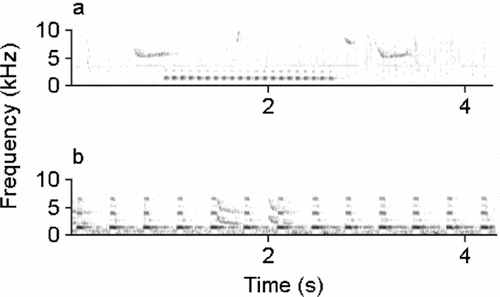
We conducted the experiment in the Kaw-Roura Nature Reserve in French Guiana during the dry season on 16–28 October 2013. The study area is located on the Mountain of Kaw (04⁰32′N, 52⁰09′W) at an altitude of more than 300 m asl. The study area is located in one of French Guiana's wettest areas. In total 24 sites were chosen for the experiment and located at forest edges. The distance between different sites varied from 300 m up to 5 km. The Amazonian pygmy-owl is a year-round resident of French Guiana and is common in the study area (Holt et al. Reference HOLT, BERKLEY, DEPPE, ENRÍQUEZ ROCHA, OLSEN, PETERSEN, RANGEL SALAZAR, SEGARS, WOOD, del Hoyo, Elliott and Sargatal1999). The Amazonian pygmy-owl is frequently active during the day, inhabiting the canopy of tall humid lowland forest. The song of Amazonian pygmy-owl is a short rapid series of whistled notes (Figure 1a), forming almost a trill of 10–20 notes per 2 s (in one phrase), given from a perched position (Hilty Reference HILTY2003, Holt et al. Reference HOLT, BERKLEY, DEPPE, ENRÍQUEZ ROCHA, OLSEN, PETERSEN, RANGEL SALAZAR, SEGARS, WOOD, del Hoyo, Elliott and Sargatal1999). The minimum and maximal frequency of songs varies between 100–5600 Hz based on recordings downloaded from online databases. This species overlaps geographically with the ferruginous pygmy-owl, but the presence of the latter is not confirmed in the Kaw area of French Guiana (http://neotropical.birds.cornell.edu/portal/species/overview?p_p_spp=212056). The Amazonian pygmy-owl hunts for invertebrates (arthropods, cicadas) and small vertebrates including birds, but there is very little information available about its biology (Holt et al. Reference HOLT, BERKLEY, DEPPE, ENRÍQUEZ ROCHA, OLSEN, PETERSEN, RANGEL SALAZAR, SEGARS, WOOD, del Hoyo, Elliott and Sargatal1999). The ferruginous pygmy-owl is a year-round resident, sometimes is active by day, although it is primarily crepuscular (Hilty Reference HILTY2003). The song of the ferruginous pygmy-owl (Figure 1b) differs dramatically from the song of the Amazonian pygmy-owl consisting of from nine up to 30 or more notes in the phrase with a rate about 2–2.5 notes s−1 (Hilty Reference HILTY2003). The minimum and maximal frequency of songs varies between 100–7100 Hz based on downloaded recordings and is centred at around 620 Hz. Between bouts of calling the ferruginous pygmy-owl usually is silent for several seconds or more. Ferruginous pygmy-owls prey on large insects and small vertebrates, including small birds that may be almost as large as the owl (Motta-Junior Reference MOTTA-JUNIOR2007). During our playback we confirmed that the ferruginous pygmy-owl occurs in the Kaw Nature Reserve. This species responded to the playback of previously recorded conspecific song from a loudspeaker, approaching the source of playback. Both owl species share similar greyish-brown plumage pattern but the Amazonian pygmy-owl is slightly smaller and with the crown dotted, not streaked (Hilty Reference HILTY2003).
A representative sonogram (one phrase shown) of the Amazonian pygmy-owl (a) and the ferruginous pygmy-owl (b). Sonograms include some alarm calls given by passerines in response to the pygmy-owl.

Playbacks and predator presentation
The increased predation risk was created by presenting the pygmy-owl model and broadcasting acoustic stimulus (songs by Amazonian or ferruginous pygmy-owl) for 10 min over 5 consecutive days (one treatment per day) at each of the study sites at exactly the same place at a random time between 7h00 until 12h00 with non-rainy weather. Given that the two owl species are similar in body size and pose a high threat to small birds, we used the same plastic model of the ferruginous pygmy-owl to represent the shape for both pygmy-owl species. This assumption was based on previous evidence that (1) small predators, such as pygmy-owls, pose the highest risk to prey individuals because of their agility and effectiveness to capture small birds (Nocera & Ratcliffe Reference NOCERA and RATCLIFFE2010, Templeton et al. Reference TEMPLETON, GREENE and DAVIS2005), (2) the birds are unable to discriminate between different raptor species with similar body size (Tvardiková & Fuchs Reference TVARDIKOVÁ and FUCHS2012). Hence, we assumed that in life-threatening situations prey species do not pay attention to small differences in the plumage coloration of similar-sized predators and they mainly recognize Amazonian and ferruginous pygmy-owls by their very different voice.
In order to imitate the presence of a particular pygmy-owl species, we created species-specific playback stimuli consisting of owl songs and owl songs combined with mobbing calls. In total, 12 different playbacks were generated, six versions per owl species. For both owls, three different playbacks were produced with an owl song only and three different versions of playbacks with owl song and mobbing calls. Each experimental day the playback file was chosen randomly from the available set (six versions for both owls) of playbacks to represent the natural variation in owl songs. The owl songs and mobbing calls were obtained from online databases of avian sounds (http://www.xeno-canto.org/ and http://ibc.lynxeds.com/locality/neotropical/french-guiana). Only the forest birds occurring in French Guiana were included in mobbing call playbacks. From downloaded files, 10–60-s-long song bouts were selected for further processing (Avisoft SASlab Pro version 4.40, Avisoft Bioacoustics, Berlin, Germany). These recordings were cut into fragments of song bouts, pauses were inserted and these repeats were copied to construct a playback file. Recordings were played for 10 min. According to example files downloaded from online databases, the Amazonian pygmy-owl had the song rate about 5–6 notes s−1 and the bouts of song lasted about 2–3 s, while the ferruginous pygmy-owl had the song rate about 2–3 notes s−1 with bouts lasting 3–5 s. Given that in both species the pauses between consecutive song bouts varied from 2–9 s in different examples, we also inserted the pauses (silence or the bout of mobbing calls) of different lengths when preparing alternative versions of playbacks. Hence, the predator-presentation files mimicked intra-individual differences in pygmy-owl singing patterns to increase the generality of our findings (Kroodsma Reference KROODSMA1989).
Mobbing calls used in the playback files belonged to (1) multispecies flock (fulvous shrike-tanager (Lanio fulvus), fulvous-crested tanager (Tachyphonus surinamus), speckled spinetail (Cranioleuca gutturata) and several unidentified passerines), (2) silver-beaked tanager (Ramphocelus carbo) or (3) fulvous shrike-tanager. The complete playback files were saved as mp3 files (44.1 kHz sampling rate, 16-bit amplitude encoding) and transferred to mp3 players (Odys Nero) for the playback in the field. We also constructed four different control playback files to measure baseline response of forest birds prior to experimental phase. Each control recording contained a song by one of these local songbirds: silver-beaked tanager (0.15 phrases s−1, 6 syllables per phrase), screaming piha (Lipaugus vociferans; 0.2 syllables s−1), fulvous shrike-tanager (0.65 syllables s−1) and black-crested antshrike (Sakesphorus canadensis (Linnaeus, 1766); 0.15 phrases s−1, 18 syllables per phrase).
The experiment consisted of a control phase, the predator-presentation phase and post-predator phase. Prior to the control phase, a loudspeaker (Yamaha B-11 portable speaker) was attached to a bush or tree branch about 1.5 m above the ground in close proximity to vegetation. Digital voice recorder (Olympus DS-50, sampling frequency: 44.1 kHz, stereo microphone ME53S) was also attached to a bush or tree branch about 2–4 m from the speaker to record the birds’ mobbing behaviour. The observer connected the loudspeaker to a digital playback device (mp3 player) and selected randomly one of the four control recordings. In the control phase, the playback was broadcast through the loudspeaker at about 75 dB (measured 2 m from the loudspeaker with a mini sound-level meter, model Center 325; the level range 50–100 dB, A-filter frequency weighting and fast-response setting). After starting the playback, the observer immediately retreated to a concealed location at least 50 m away in order to avoid the observer's effect on birds’ response. The birds’ response to control sounds was recorded with a digital voice recorder for 10 min. In the end of control phase, the observer silently approached the place of experiment, switched off the control playback and attached the predator model to a tree trunk. The pygmy-owl model sitting in the perched position on a pole was attached to a tree trunk about 3 m above the ground. In the predator-presentation phase, the observer started the experimental playback that was randomly chosen out of six versions for a particular owl species and immediately retreated to a concealed location. The mobbing response to experimental playback was recorded for 10 min. After the predator-presentation phase, the observer silently approached the place of experiment, removed the predator model, switched off the playback and again retreated to a concealed location. Digital voice recorder recorded the birds’ mobbing response for 10 min after the experimental playback (post-predator phase).
On the first experimental day the species of pygmy-owl for each site was selected randomly by flipping a coin. On the last experimental day (day 5), in each site the same type of a predator was presented as on the first day, while the playback file was chosen randomly out of six different possibilities specific for that owl species. Different playback files were chosen to simulate the natural variation of different owls giving calls and prevent habituation to the same calls. In the meantime (days 2–4), the type of the predator was changed each day to prevent habituation (Coleman Reference COLEMAN1987, Tilgar & Kikas Reference TILGAR and KIKAS2009). We compared mobbing behaviour on the first day with that on the last day. Each day the control playback was chosen randomly out of four different possibilities. No mobbing response was observed in the control phase, except some occasional alarm calls related to setting up of the experiment.
Three behavioural traits were used as indicators of mobbing behaviour. First, the latency to mob was defined as the delay of regular mobbing calls (min) starting from the presentation of a predator. Note that the mobbing was defined as at least one bird giving regular alarm calls. Second, the duration of mobbing (min) was defined as the total time when at least one individual mobbed regularly. The time periods when mobbing was interrupted were subtracted from the total time spent mobbing. This trait was calculated separately for the predator-presentation and the post-predator phase. Third, the mobbing score in the predator-presentation and post-predator phases was defined as the maximum number of species giving alarm calls at the same time moment: 0 – no response, 1 – one species giving calls irregularly (randomly), 2 – two or three species giving calls irregularly, 3 – one species mobbing regularly (the interval between consecutive calls less than 2 s), 4 – two species mobbing regularly, 5 – three or more species mobbing regularly. Initially, we calculated the mobbing score separately for the predator-presentation phase (score values of 0–5) and for the post-predator phase (score values of 0–5). Given that these scores were significantly correlated with each other (day 1: r = 0.43, P = 0.039; day 5: r = 0.47, P = 0.029, N = 22 sites, both pygmy-owl species combined), we calculated average values of these scores over the predator-presentation and the post-predator phase (hereafter called mobbing score with values of 0–5).
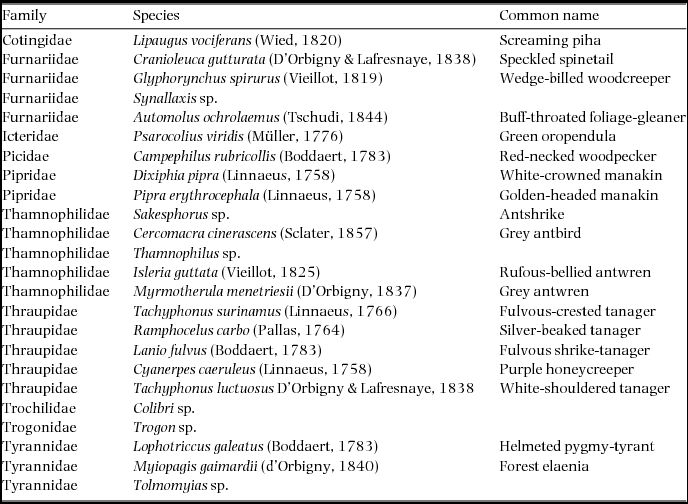
Avian responses to the predator presentation were quantified as sonograms by using the software Avisoft SASLab Pro version 4.40 (Avisoft Bioacoustics, Berlin, Germany). Given that avian species responding to the predator presentation were mainly determined from sonograms, we were unable to determine the species for every bird that participated in the mobbing. However, 24 bird species from 11 families (Table 1) were identified on the basis of sonograms or by visual inspection.
Details of species identified during playback experiments in the Kaw-Roura Nature Reserve in French Guiana.
Statistical analysis
Repeated-measures linear models (GLM) were used to test the effect of repeated encounter with a predator to mobbing behaviour. In the initial model, experimental day (hereafter called ‘time’) was used as a repeated factor (the first versus last day of experiment) and pygmy-owl species (Amazonian versus ferruginous pygmy-owl) and observer as factors. The same observer always conducted the first- and last-day presentation in the same site. The effect of playback type (owl song only versus owl song with mobbing calls) on mobbing behaviour was tested on the first and last day of the experiment. We could not include this factor in the repeated-measures model because the playback file was chosen randomly from the set of playback files for the same owl species and therefore it often differed on the first and last day of experiment. Preliminary analyses revealed that the duration of mobbing was highly correlated to the mobbing score (both traits averaged over experimental days) (predator-presentation phase: r(partial) = 0.61, P < 0.001, N = 22 sites, corrected for owl species: P = 0.01; post-predator phase: r(partial) = 0.91, P < 0.001, N = 22 sites, corrected for owl species: P = 0.8). No significant correlation was revealed between the latency to mob and the mobbing score (both traits averaged over experimental days) (r(partial) = −0.35, P = 0.12, N = 22 sites, corrected for owl species: P = 0.7). Hence, to avoid conducting multiple non-independent tests, we ran analyses with two response traits: the mobbing latency and the mobbing score. Both traits were normally distributed (Kolmogorov–Smirnov and Lilliefors test for normality; latency: Kolmogorov–Smirnov d = 0.11, P = n.s., Lilliefors P = n.s., mobbing score: Kolmogorov–Smirnov d = 0.12, P = n.s., Lilliefors P = n.s.) and no transformation was necessary prior to statistical analysis. Data of two sites out of 24 were removed from final analysis because of heavy rain, the final model included data of 22 sites.
RESULTS
Presenting songbird songs did not cause mobbing in the control phase. The predator presentations elicited mobbing behaviour (at least one individual giving regular alarm calls) in 15 out of 22 trials on the first day of experiment and in 20 out of 22 trials on the last day of experiment.
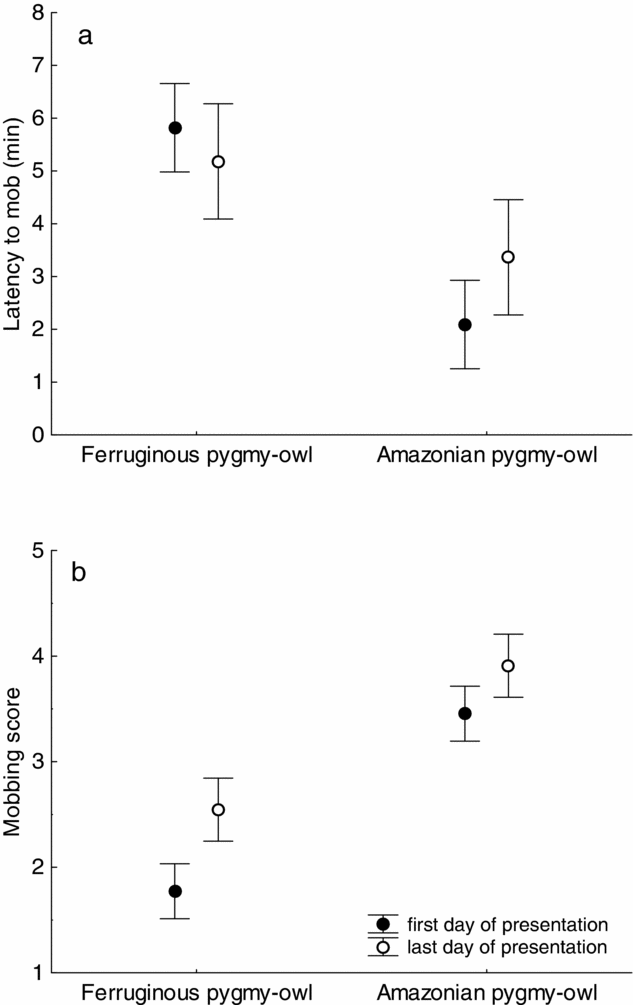
The presentation of different predators influenced the latency of mobbing significantly (GLM, F1, 20 = 5.8, P = 0.026; Amazonian pygmy-owl: mean ± SD = 2.73 ± 0.8 min; ferruginous pygmy-owl: 5.5 ± 0.8 min, mobbing latency averaged over the first and last day of experiment), while the latency was not affected by 5-d-long repeated presentation of the predator model (Figure 2a, repeated-measures GLM, time: F1, 20 = 0.2, P = 0.8, time × pygmy-owl species: F1, 20 = 1.60, P = 0.2).
The mobbing latency (a) defined as the delay of regular mobbing calls starting from the presentation of a predator and the mobbing score (b) defined as the maximum number of species giving alarm calls simultaneously (score values 0–5) of forest passerines in the Kaw-Roura Nature Reserve in French Guiana in response to the presentation of the Amazonian or the ferruginous pygmy-owl on the first and the fifth (last) day of the experiment. Whiskers denote standard errors.
The mobbing score was highly dependent on the presentation of pygmy-owl species (GLM, F1, 20 = 24.5, P < 0.001, mobbing score averaged over the first and last day of experiment). It was strong in the case of Amazonian pygmy-owl (Figure 2), the common species in the region, and much weaker in the case of ferruginous pygmy-owl that is supposedly uncommon species in French Guiana. Repeated presentation of the predator model increased the mobbing score significantly (Figure 2b, repeated-measures GLM, time: F1, 20 = 6.04, P = 0.023, time × owl species: F1, 20 = 0.4, P = 0.5, post hoc comparisons, day 1 versus day 5; ferruginous pygmy-owl: P = 0.022, Amazonian pygmy-owl: P = 0.3). The playback type (songs of pygmy-owl versus songs of pygmy-owl with mobbing calls) had no effect on mobbing score on the first day (GLM, playback type: F1, 19 < 0.1) or on the last day of experiment (F1, 18 = 1.08, P = 0.3, both pygmy-owl species combined, playback type × pygmy-owl species n.s.).
Moreover, we found that mobbing response recorded on the first experimental day predicted the response on the last day (GLM, mobbing latency: F1, 20 = 5.75, P = 0.026, r (partial) = 0.47, N = 22 sites, pygmy-owl species n.s.; mobbing score: F1, 20 = 8.08, P = 0.01, r (partial) = 0.54, N = 22 sites, pygmy-owl species n.s.).
DISCUSSION
Increased predation risk enhances mobbing behaviour
In this study we demonstrated experimentally that repeated encounters with a predator in the same location increased mobbing behaviour in tropical forest birds. This pattern was similar irrespective of the pygmy-owl species, suggesting that birds perceived repeated presentation of a predator as a cue of risky environment. Hence, our results are consistent to the prediction that adverse environmental conditions such as high predation risk improve cooperation among animals (Andras et al. Reference ANDRAS, ROBERTS, LAZARUS and Alonso2003, Emlen Reference EMLEN1982). This behaviour may have evolved to deter predators from the mobber's territory. An aggressive flock of birds may confuse a predator and force it to move on (Curio Reference CURIO1978, Knight & Temple Reference KNIGHT and TEMPLE1986). Mobbing might also increase the probability that the predator will not return to an area where it has been unsuccessful in obtaining prey (Lima Reference LIMA2002). If the predator avoids the particular area in the future, collective mobbing would benefit all local birds. However, previous case studies in this field have yielded contradictory results. Forsman & Mönkkönen (Reference FORSMAN and MÖNKKÖNEN2001) reported that mobbing calls attracted more species the lower the predation risk, while Krams et al. (Reference KRAMS, BĒRZIŊŠ, KRAMA, WHEATCROFT, IGAUNE and RANTALA2010) showed that birds approached the stuffed predator more closely and mobbed the predator at a higher intensity in areas where the perceived predation risk was experimentally increased. Hence, it is likely that the costs and benefits of being a member of a mobbing group may vary according to the imminent risk of predation. If frequent encounters did not lead to real threat as in our study, the birds may learn that the costs of mobbing are decreased. This situation might occur when the predator is hunting its prey away from its own nest and the predation risk can be perceived by prey individuals as temporal or short-term (Krams et al. Reference KRAMS, BĒRZIŊŠ, KRAMA, WHEATCROFT, IGAUNE and RANTALA2010, Sandoval & Wilson Reference SANDOVAL and WILSON2012). In this case, local birds may increase the sensitivity to the same stressor and harass the predator more vigorously to better localize the potential danger. If prey individuals have settled in the proximity of the predator nests, the predation risk is heightened permanently and they are more vulnerable to predation than those breeding further away, especially at the nestling stage (Newton Reference NEWTON1986). As the costs of mobbing increase, decreased mobbing should be favoured in the vicinity of the predator nest to avoid direct contact with a predator (Montgomorie & Weatherhead Reference MONTGOMERIE and WEATHERHEAD1988) that might explain the findings by Forsman & Mönkkönen (Reference FORSMAN and MÖNKKÖNEN2001).
Although mobbing response to the predator stimulus increased with repeated encounters, we found that this behaviour was highly predictable in time. Previous studies have shown that feeding and breeding territories of tropical forest birds are relatively small, ranging usually around 1–2 ha (Duca et al. Reference DUCA, GUERRA and MARINI2006, Kikuchi Reference KIKUCHI2009). Hence, it is likely that bird communities are spatially relatively stable and nearly the same number of individuals responded to the predator presentation on the consecutive days of experiment. It is important to note that we conducted the experiment during the non-breeding season when bird communities include resident as well as migratory birds. However, we believe that mobbing responses mainly reflect the behaviour of resident birds. First, previous studies have shown that migrating birds generally avoid confronting predators and seldom participate actively in mobs (Nocera et al. Reference NOCERA, TAYLOR and RATCLIFFE2008). Second, post-breeding residents regularly participate in the mobs and many of them have small stable territories year round (Duca & Marini Reference DUCA and MARINI2014, Duca et al. Reference DUCA, GUERRA and MARINI2006). In this context, it is also important to mention that all identified bird species responding to the playback were resident birds, several of them potentially breeding during the time of experiment (e.g. green oropendula (Fraga Reference FRAGA, del Hoyo, Elliott and Christie2011), tanagers (Hilty Reference HILTY, del Hoyo, Elliott and Christie2011a), purple honeycreeper (Hilty Reference HILTY, del Hoyo, Elliott and Christie2011b), white-crowned manakin (Snow Reference SNOW, del Hoyo, Elliott and Christie2004)). Hence, predictable mobbing response over time may imply that birds settled close to a predation event did not abandon their territories after short-term encounters with a predator or, alternatively, they abandoned the territory but were substituted by other individuals from the nearby areas.
Differences in predator effects
Our study revealed that the latency and intensity of mobbing response varied in relation to the predator species. Tropical forest birds responded significantly faster and stronger to the playback of Amazonian pygmy-owl songs than that of ferruginous pygmy-owl. The most likely explanation is that mobbing behaviour is adjusted to the abundance of local predators (Krams et al. Reference KRAMS, BĒRZIŊŠ, KRAMA, WHEATCROFT, IGAUNE and RANTALA2010, Sandoval & Wilson Reference SANDOVAL and WILSON2012). The Amazonian pygmy-owl is a common predator in the region, while the other owl species is rare or uncommon in French Guiana. Although antipredator behaviour is known to have a strong genetic basis in birds (Bize et al. Reference BIZE, DIAZ and LINDSTRÖM2012), the fine-tuning of this behaviour is partially experience-dependent (Curio Reference CURIO1978, Curio & Regelmann Reference CURIO and REGELMANN1985). For instance, animals living in environments devoid of predators (e.g. islands) often do not express appropriate antipredator behaviours, but can learn to recognize introduced predators (Čapek et al. Reference ČAPEK, POŽGAYOVÁ, PROCHÁZKA and HONZA2010, Griffen et al. Reference GRIFFEN, BLUMSTEIN and EVANS2000). In our study, birds can be cognitively adapted to monitor and mob more actively familiar predators such as the Amazonian pygmy-owl because they have less experience with a ferruginous pygmy-owl. Hence, we cannot rule out that forest birds repeatedly facing the ferruginous pygmy-owl in the same place increased the mobbing intensity because they learned to perceive this predator as a potential danger. On the other hand, the change in the mobbing response was in the same direction for the more common predator species, the Amazonian pygmy-owl, and perhaps we were unable to detect it owing to small sample sizes. Moreover, the ferruginous pygmy-owl cannot be regarded as a new species because it was still present in our study area. Hence, it is beyond the scope of the current study to disentangle the effect of learning from the effect of increased perceived predation risk induced by repeated encounters with a predator.
In order to increase the generality of our findings, we used multiple examples of acoustic stimuli in our experiments representing owl songs alone or owl songs together with mobbing calls. Here we found that the playback of owl songs had similar effects to mobbing behaviour of local birds as the combined effect of owl song plus mobbing calls. Previously, it has been found that the playback of mobbing calls seems to have a stronger effect on mobbing behaviour because alarm calls give information not only on the presence of the predator, but also on the response of other prey species perceiving the situation as threatening (Sandoval & Wilson Reference SANDOVAL and WILSON2012). However, in contrast to the above-mentioned study we always presented acoustic stimulus together with the predator model. Hence, it may be that the playback of mobbing attracts other individuals from the vicinity, but after locating the predator themselves, forest birds mainly rely on visual and acoustic cues of a predator, not paying so much attention on social information any more.
In conclusion, our findings support the recently proposed prediction that increased predation risk can promote mobbing behaviour in birds (Krams et al. Reference KRAMS, BĒRZIŊŠ, KRAMA, WHEATCROFT, IGAUNE and RANTALA2010), and the risk assessment also depends on the abundance of a local predator species.
ACKNOWLEDGEMENTS
We thank an anonymous reviewer for valuable comments on the manuscript. The study was financed by the Estonian Science Foundation (grant number 8376 to VT), Estonian Doctoral School of Earth Sciences and Ecology 2009–2015, the Estonian Ministry of Education and Science (institutional research grant IUT34-8) and the European Regional Developmental Fund (Centre of Excellence FIBIR).