On February 17, 1922, five prostitutesFootnote 1 in La Catalina brothel in San Julián, Argentina, chased soldiers involved in a recent massacre from their working premises, hitting them with brooms and shouting, “murderers, criminals, we will not sleep with you.”Footnote 2 It was the last act of resistance in a rebellion that became known as the Patagonia Rebelde, during which a province-wide protest in support of arrested workers from the Sociedad Obrera (Worker's Society) turned into a strike for better wages and working conditions. The rebellion lasted two years and was brutally crushed by the Argentinean army. Fifteen hundred workers and strikers died from the summary executions imposed by General Varela under the direction of President Hipólito Yrigoyen.Footnote 3 In contrast to the spontaneous uprising of the women in the Rebelde Patagonia, in the mid-1990s, sex worker resistance emerged in Argentina in a more organized form. Meeting in bars and cafés in Buenos Aires, women working on the streets began to discuss the ways in which they could resist police harassment and abuse. The group was to become Asociación de Mujeres Meretrices de la Argentina (AMMAR), the female sex workers' association of Argentina, which has continued the long history of sex workers' political resistance, seventy years after San Julián.
This essay draws on questionnaire data, participant observation, and in-depth interviews with union and nonunion sex workers and members of the Central de Trabajadores Argentinos (CTA) (Argentine Workers' Center), the umbrella union federation of which they are a part, across ten cities in Argentina. In doing so, it traces the relationship between AMMAR and the CTA to examine how they have successfully organized workers in an infamously exploitative, precarious, and vulnerable labor sector. It asks what these experiences can contribute to debates about the regeneration of the trade union movement and new forms of unionism.Footnote 4
I begin by broadly outlining the current impasse in the labor movement, particularly in relation to informal workers. Second, I examine approaches to sex worker organizing and argue that although analyses have been pessimistic about the first two waves of organizing, a third wave is emerging, which is experiencing considerable success. Third, I consider the CTA, exploring its emergence and its parameters of membership eligibility. I examine the relationship between AMMAR and the CTA, explaining how the CTA was able to create space for sex workers and exploring their practices of cooperation. I conclude by showing how AMMAR has contributed to the CTA, by clarifying understandings of work and class and transforming attitudes toward other social identities, including gender and sexuality.
Labor Organizing at the Impasse
That trade unions are in crisis and that they must renew and revitalize to overcome this impasse is now a widely rehearsed dictum among labor theorists and practitioners alike.Footnote 5 It is perhaps surprising, then, that despite the yearning for trade union renewal, little attention has been paid to extant examples of organizing among informal, contingent, and precarious workers, who now represent a majority of the world's workers.Footnote 6 There is both unpreparedness and resistance in responding to the existential challenge that the “new majority” of workers present to orthodox trade unionism.Footnote 7 Many unions appear trapped in a “factory paradigm” stymied by an insistence on parameters for eligibility that no longer reflect the realities of contemporary work and employment.Footnote 8 Industrial unionism, or the “factory paradigm,” no longer seems appropriate for many low-paid service sectors, migrants, ethnic minorities, women, part-time workers, and particularly informal workers, who increasingly constitute a larger proportion of the workforce in the changed structures of work and employment.Footnote 9
Some unions in Europe and North America, such as the Textile, Clothing and Footwear Union of Australia (TCFUA), Unite in Canada, Federazione Italiana Lavoratori Tessili Abbigliamento Cuoio Calzature (FILTEA-CGIL) in Italy, and Federatie Nederlandse Vakbeweging (FNV) in the Netherlands, have taken up the mantle and are organizing informal workers. Most, however, have been slow to respond and have limited organizing to home workers. In contrast, there is a strong cohort of unions in the Global South that are engaging with the struggles of “atypical” workers, particularly female informal workers.Footnote 10 In particular, the Self-Employed Women's Association (SEWA) in India and Self-Employed Women's Union (SEWU) in South Africa have organized large numbers of street vendors and home workers with considerable success.Footnote 11 However, even in contexts in which these organizations have made considerable headway in improving conditions for informal workers, and despite the shared issues and challenges, they have generally not connected with or supported the organization of sex workers. Even when a decision was made in 1994 by SEWU to organize commercial sex workers, it was later abandoned, seemingly due to strong Christian values among SEWU's leadership and staff.Footnote 12
Sex Worker Organizing: The First and Second Waves
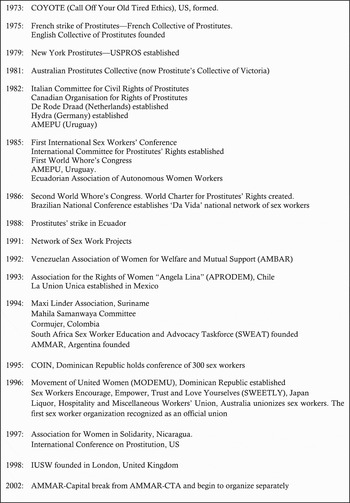
During the nineteenth century and the first part of the twentieth century, sex workers organized and protested their maltreatment across the world, from India and Costa Rica to Guatemala and Puerto Rico.Footnote 13 However, the establishment of COYOTE (Call Off Your Old Tired Ethics) in San Francisco in 1973 and a strike of French prostitutes in 1975, which saw the establishment of the French Collective of Prostitutes, signaled the beginning of the first significant wave of sex worker organizing. By the 1980s, these largely national prostitutes' movements had spilled over borders, establishing international relationships with other movements and meeting internationally at events such as the First and Second Whores' Congresses in 1985 and 1986 in Amsterdam and Brussels.Footnote 14
A second wave of organization emerged in the late 1980s and early 1990s, spurred on in part by the conceptualization of prostitution as sex work.Footnote 15 It was constituted first by health organizations responding to the HIV/AIDS crisis and secondly by the formal trade unionization of sex workers, creating connections with the existing labor movement. In 1988, in Ecuador, the Association of Autonomous Female Workers called a sex workers' strike to protest against conditions, and organizations emerged to lobby for sex workers' rights in Malaysia, Thailand, South Africa, and Uruguay, among others. One of the most striking successes is the Durbar Mahila Samanayay Committee (DMSC) or “Sonagachi Project,” which represents between 40,000 and 60,000 female sex workers in West Bengal, India. Between 1992 and 1998 condom use rocketed from just three percent to over ninety percent, due to the project's awareness raising. A self-regulatory board regulates the entry of young girls into the profession, ensuring that minors and individuals subject to coercion are not working in the area. It has trained women in self-defense, offered microcredit and microenterprise schemes, and fought for workers' rights and decriminalization.Footnote 16 Similarly, in Pune City, a collective established in 1998 now has five hundred members and a collective kitchen and has increased condom usage to ninety-five percent.Footnote 17
Most significantly, a number of organizations have adopted a trade union approach, affiliating to broader trade union confederations. In the United Kingdom, the International Union of Sex Workers (IUSW) developed from a small grassroots group to become a branch of the United Kingdom's General Workers' Union (GMB),Footnote 18 in the Netherlands De Rode Draad (Red Thread) affiliated to the Federatie Nederlandse Vakbeweging (Dutch Union Federation) (FNV), while in Australia and the US, sex workers' organizations affiliated with the Liquor, Hospitality and Miscellaneous Workers Union (LHMWU) and Service Employees International Union (SEIU), respectively.Footnote 19 The numbers of organizations, collectives, and trade unions have increased exponentially, and the sex workers' rights community is now made up of a wide range of groups, including trade unions, collectives, pressure groups, service providers, health care organizations, and support groups (see Figure 1).Footnote 20
Global Sex Workers' Organization.

The first wave of sex worker organizations has been categorized as part of “deviance liberation” movements alongside other movements, such as those for gay rights and abortion, which emerged in the 1970s.Footnote 21 It is argued that in contrast to the other movements, these prostitutes' collectives were unable to mobilize material and human resources and were undermined by a poverty of moral, material, and human capital.Footnote 22 Others argue that, beyond resources, the success or failure of sex workers' movements should be understood more broadly, in terms of the balance of interests between other actors involved in the regulation of sex work, including local government, the police, and community groups.Footnote 23 They similarly conclude that the organizations of both waves have had little influence in the United States and the United Kingdom and only slightly more in New Zealand, the Netherlands, and Australia, but that all cases represent little more than liberal reform. Indeed, the general consensus about sex workers' organizations has generally been pessimistic, calling their outcomes “uncertain or disappointing,” disqualifying them from trade union status and labeling them instead as pressure groups. It is claimed that the coherence of the movement is illusory, that the movements have lacked mass bases, depending instead on lone organizers and charismatic leaders, and that they have failed to establish alliances with other labor or social movements.Footnote 24
For sex workers, organizing in trade unions has often proven to be particularly problematic. Labor movement responses have ranged from indifference to hostility, despite the institutionalization of the right to organize in national and international treaties.Footnote 25 In some cases, unions have directly rejected sex workers' right to unionize. At the Trade Union Congress (TUC) Women's Conference in the United Kingdom in 2009, delegates voted against Motion 39, which called for the decriminalization of the sex industry and supported the trade unionization of sex workers. Instead a motion was passed in favor of the criminalization of the purchase of sex. This prioritization of the criminalization of clients over solidarity with women in the sex industry is emblematic of current attitudes toward sex workers in the labor movement in the UK and beyond. Numerous additional problems also remain, such as violence and harassment from family, police, and management when sex workers try to organize collectively.Footnote 26
To the Third Wave?
Alongside these first two waves of sex workers' organizing, a third wave appears to be emerging, in particular from countries of the Global South, most significantly in India and Argentina. The Karnataka Sex Workers Union, established in 2006, has specifically constituted itself as a trade union, affiliating with the New Trade Union Initiative (NTUI), which has also been organizing other informal workers. It has assisted women in enrolling on the electoral register, struggled against the criminalization of clients, produced research, lobbied the government about violence against sex workers, and built links and alliances with other progressive organizations besides the NTUI.Footnote 27
In Argentina, AMMAR too has asserted itself explicitly as a trade union, allying with and becoming part of the trade union umbrella confederation Central de Trabajadores Argentinos (CTA). Their initial demand was simply not to be rearrested and detained within twenty-four hours of release from a police station. Since 1994, their demands have expanded to include an end to abuse against sex workers, the repeal of the Codigos de Faltas and Codigos Contravencionales (provincial codes that enable abuse), for violence against sex workers to be taken seriously, and for access to healthcare and other welfare benefits. Like other sex worker organizations, their central demand is for recognition of sex work as work. The members of AMMAR identify their oppression as emerging from three sources: as women in patriarchal society, as members of the working class in an unjust and unequal capitalist world, and as sex workers in a hypocritical society with a double standard.
The women locate themselves firmly within the working class, stating that “we recognize ourselves as part of the working class because our work feeds our families” and by identifying as “women who without opportunities, nevertheless choose to … do this work.”Footnote 28 This emphasis on choice within limitations goes some way in bridging the polarized sex work/prostitution debate, introducing a more structural analysis of sex work that still allows for sex workers' agency. The assertion of parity with other workers is practical as well as ideological. It enables demands for equal application of the law and access to benefits enjoyed by other workers, such as pensions and social benefits, documentation, housing, and healthcare. Such a class identity has been extremely important for linking their particular struggle to a broader political project and for making the women feel legitimate in their demands, as they recognize that their problems are also shared by miners, cleaners, nurses, and all other workers.Footnote 29
In 2007 AMMAR was legally recognized as a not-for-profit organization, gaining the status of Personería Juridica. They are currently struggling to convert Juridica status into Personería Gremial, which would recognize sex work as work and would bestow rights on AMMAR to distribute pensions, healthcare, and other benefits in line with other unions in Argentina. The union counts between two thousand and four thousand affiliates across ten provincial branches and is in contact with an estimated thirty thousand sex workers a year. The women it represents are over eighteen and work on the street independently and of their own free choice. Although “free choice” is complex in conditions of structural constraint, it is used as a category to distinguish them from those working due to force, coercion, trafficking, threats, or deceit. As well as seeking legal reform, AMMAR has enabled access to healthcare through accords with hospitals and the Sandra Cabrera Health Centre in La Plata, the first clinic specifically designed for sex workers.
The successes of AMMAR and other organizations, such as those in India, suggest the beginnings of a third wave of sex worker organizing, which requires a reassessment of previous pessimistic conclusions. In light of this, the next section considers some of the ways in which, through an alliance with the CTA, AMMAR has achieved social and political change for sex workers in Argentina. It begins with a discussion of the genesis of the CTA and the development of the relationship between the two organizations and then considers some of the ways in which they have collaborated and developed mutual support and solidarity.
The Emergence of the CTA
On December 17, 1991, in the midst of intense neoliberal economic restructuring, a group of union leaders, organizations, and representatives met in Burzaco, Buenos Aires. Deregulation, privatization, and liberalization of the Argentine economy had resulted in a twenty-three percent drop in GDP per capita between 1981 and 1989, and by 1995 unemployment hit twenty percent in metropolitan Buenos Aires. Across the country fifty percent of the population was living in extreme poverty, and forty-five percent of the working population was unemployed or underemployed.Footnote 30Piquetes (pickets) sprung up across the country as piqueteros (unemployed workers whose survival had been decimated by the juggernaut of crisis) blockaded main arteries and highways, demanding welfare, jobs, and governmental support. In 1997 alone, seventy-seven roadblocks brought the country to a standstill. Alongside the unemployed, some of the worst affected were state employees. Enraged by nonpayment, reductions in wages, and unemployment due to privatization and retrenchment, state employees joined the piqueteros on the blockades. Standing together on the picket lines, the two groups began to identify similarities between their struggles and to recognize the impotence of the corporatist trade union system in helping them with the changed situation they found themselves in.Footnote 31
When the teachers, public employees, unemployed workers, independent potters, metallurgical workers, and mechanics met in Burazco, they agreed that the new configuration of power between state, capital, and labor had fostered a culture of survival that exposed the limits of the current structure of the labor movement and represented a fundamental challenge to it.Footnote 32 Condemning the active manipulation of the economy for the benefit of the economically dominant and the complicity of the existing trade union movement, they proposed an alternative political project that would be able to account for the changed circumstances faced by the working class.Footnote 33 A year later, in 1992, with public sector workers from Asociación de Trabajadores del Estado (ATE, or the Association of State Workers) and teachers from La Confederación de Trabajadores de la Educación de la República Argentina (CTERA, or the Argentinean Confederation of Education Workers) at the helm, a number of unions disaffiliated from the historic union federation Confederación General de Trabajo (GCT, or General Confederation of Labor), which had been institutionalized under Perón in the 1940s. The CTA was born. Its objective was to create “a space for the reorganization of forces for one hundred percent of the working class,” in contrast to the previous system in which “seventy-five percent remain outside.”Footnote 34
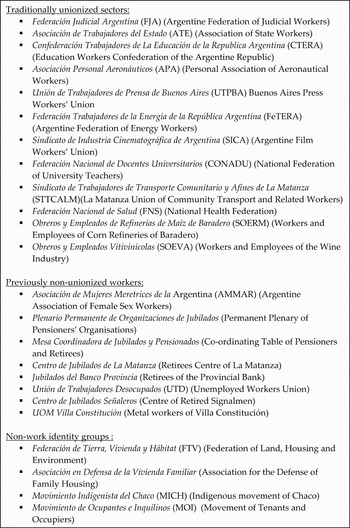
To move beyond “the power of the pen,”Footnote 35 to organize workers who did not have the ability to sign collective agreements and therefore represent one hundred percent of the working class, the CTA had to rethink the entrenched structure of union politics in Argentina and the prevailing understandings about the nature of work. Firstly, the CTA began with the assertion that workers were workers regardless of their current working status, particularly whether they were in employment or not. A second feature related to their relationship to exploitation. If an individual lived only from his or her labor and not from the exploitation of others, the individual was considered a worker. A worker was “someone that lives from their work, someone who lives off their work, simply from their work.”Footnote 36 Such a conceptualization enabled the inclusion of traditionally unionized sectors as well as piquetero organizations such as Unión de Trabajadores Desocupados (UTD, or Unemployed Workers Union), pensioners' organizations including the Centro de Jubilados de La Matanza (Retirees Center of La Matanza) and Jubilados del Banco Provincia (Retirees of the Provincial Bank), and organizations committed to broader issues of social justice, including Federación de Tierra, Vivienda y Hábitat (FTV, or Federation of Land, Housing, and Environment) and Movimiento Nacional de los Chicos del Pueblo (Children's National Movement). (See Figure 2.)
Organizations of the CTA.

Becoming Working-Class Subjects: AMMAR and the CTA
Despite the cessation of systematic state terror after 1983 with the fall of the military junta, repression against sex workers continued at full pace. As well as subjecting sex workers to routine bribes and assault, police used local provincial codes to arbitrarily detain women for up to thirty days. In 1994, Elena Reynaga—now AMMAR general secretary—and a number of other women working on the corners of Constitución, Buenos Aires, began to meet. Their meetings attracted attention, and repression against them intensified. Even when they met in their homes, the police would arrive, arrest them, take them away, and detain them in inhumane and dirty cells. Two anthropologists who had been researching sex work in the city were struck by the intensity of the repression and put the women in contact with a member of the public employees union, ATE. ATE had a branch in Constitución, and the members offered the space to women as a place to meet. Yet the police continued to target them. Now, however, they had a degree of protection, and when the police threatened to take away the chairs, the computers, and the contents of the office, the ATE general secretary was intransigent: “over my dead body will they take anything from here, this is yours now, they can't come in here.”Footnote 37
In March 1995, following negotiations with ATE and members of the CTA, the women were given a small office in the cellar of the CTA building. It contained only some worn chairs and a barely functioning telephone. For two years they stayed there on their own, with little attention from others in the Central and often facing discrimination and exclusion when the women did interact with other members of the CTA. Eventually, two men began coming downstairs, drinking maté and talking to them.Footnote 38 During the course of their conversations, Victor de Gennero and Nestor Piccone began to provide the women with some political education, asking them about their demands and their reasons for organizing. Reynaga says she was so ignorant, she did not even know the meaning of the word “demands.” They had so little awareness of what it meant to be in a workers' federation, “it was like we came out of the sky.”Footnote 39
When Reynaga and her colleagues arrived at the CTA they did not arrive, therefore, with a political program, but instead developed their political identity through interaction with CTA compañeros and attendance at meetings. By patient listening, they began to get involved. In La Plata, Martinez attended for two years without saying a word. “I would listen and not say anything,” she said, “until one day when I opened my mouth … and now they can't stop me.”Footnote 40 Through such interactions, not only has AMMAR developed a critique of conditions in the sex industry, but its members have also framed this within a broader analysis of exploitation, gender discrimination, and class oppression, linking their work and struggle to all forms of exploitation, spanning spaces from the maquiladora and the bordello to the street. The answer to exploitation, they argue, is not to seek to abolish industries (including the sex industry), but to give the exploited the tools to organize themselves and to create conditions in which all workers are free of economic and physical coercion. In light of this, AMMAR states that it primary objective is:
That one day there are no more women that exercise this work for necessity.Footnote 41 However, as we are not owners of the truth we leave open the discussion as to whether—in the future that we dream of—there will be women that all the same want to do this work.Footnote 42
AMMAR thus abandons any ideological debate about the moral basis of sex work and engages instead with a much broader and exigent political project to change the distribution of resources and power, with the hope of enabling workers to make real decisions over their lives and labor.
The political education CTA offered therefore went beyond simply providing the women with an understanding of class and class identity. The CTA also explained theories and experiences of organizing and retold the history of working class organization and labor struggle. Beyond this, the women also learned about collectivism and comradeship: “they taught us so much about what it means to be a collective, what it is to work in a group, the importance of compañerismo.”Footnote 43
Cooperation and Compañerismo in the CTA
In 2001, AMMAR became an official member of the CTA, but internal widespread support was not instantaneous, and the organization was not welcomed with open arms by all members of the federation. Discrimination against sex workers was the order of the day inside the CTA as well as outside, and its inclusion tested the limits of openness.Footnote 44 Many of the federation members thought that De Gennaro was “mad” and complained, asking, “What's he doing bringing prostitutes to the CTA? What the hell have they got to do with it?”Footnote 45 Even members of CTA who were inclined to support AMMAR experienced a tension between their ideological solidarity and a practical desire to distance themselves from sex workers. In 2002, the Second National AMMAR March took place in Mar del Plata, a seaside town in Buenos Aires province. Thirty-two sex workers had been murdered over three years in the city. All of the cases remained unresolved and had received little attention from the state or media. AMMAR organized a march to demand freedom from violence for sex workers and an end to impunity for the murderers. Members of AMMAR were accompanied on the march by Asociación de Trabajadores del Campo (ATC, or the Association of Rural Workers), Unión de Trabajadores de la Educación (UTE, or the Union of Education Workers), and the youth movement of the CTA from La Plata and Buenos Aires. Maghy Panno, a member of ATE, accompanied the march, but as she did so, she realized that she harbored a number of reservations. Choosing a chaleco (union bib) from a pile to wear during the march, she found herself insistent on wearing the ATE vest. She wore it as it represented her place in the union she belonged to, but it also occurred to her that although she wanted to accompany the women, “it was like I needed to identify myself as not a sex worker.”Footnote 46
This conflict was not confined only to female members, seeking to avoid the contagion of whore stigma, but was also expressed by a number of men.Footnote 47 Fabio Basteiro, secretary general of the aeronautical union, was one of the first CTA members to accompany the women on marches. Yet, when demonstrating in front of the Police Department, he stayed at a distance. Although he supported their struggle, “you were with the whores and travestis … and even though I went with them, I was not at the front. One couldn't be seen to be there.”Footnote 48 However, it was not solely a sense of shame or embarrassment that blocked CTA activists' cooperation with AMMAR, but also a sense of uncertainty about the new politics that it brought with it. Basteiro said he wasn't “totally convinced” by the argument that sex worker struggle could be included alongside that of public employees, aeronautical workers, and others within the politics of the CTA. Similarly, Carlos Sanchez, an administrative assistant for AMMAR, said that he too questioned the appropriateness due to prior ideological conceptions of work, but through debate and seeing the “concrete facts of their everyday lives” he began to understand that “yes, it is work.”Footnote 49
AMMAR recognized these resistances and anxieties and turned to consciousness raising inside the union, providing talks and organizing workshops to inform members of the reasons for their struggle and to prove that they had not “come to steal their husbands or compañeros.”Footnote 50 As they engaged with the activists and spoke about their experiences, with the support of some of the more committed members, such as De Gennero and Piccone, the women won over more members of the CTA.
After this investment of time and labor, a decade later, in 2007, local organizations of the CTA joined with AMMAR on December 1, International Sex Workers' Day, to celebrate the struggle to end violence against sex workers. In Córdoba, AMMAR and CTA members distributed information while musicians and bands provided the soundtrack. Meanwhile, in La Plata, CTA Youth, community organizations, and pensioners distributed condoms, leaflets, and information during a street party.
In 1977, when the Madres de la Plaza de Mayo cracked open the public space that had been shut down by the junta, the importance of public space became institutionalized in Argentina's contentious political repertoire. The emergence of piquetes, the upspring of neighborhood asambleas, and the ongoing protests, demonstrations, and street art of the Madres, the HIJOS (Hijos por la Identidad, la Justicia, contra el Olvido y el Silencio, or Children for Identity, Justice, Against Forgetting and Silence), and other anarchist, feminist, and labor movements have further entrenched public protest as a principal method in contention and resistance. Therefore, public events in particular benefit from support from CTA, providing solidarity for women for whom public protest is a complex engagement. The stigma of sex work means that many women are unable to join protests with AMMAR, even when wearing masks to conceal their identities. The CTA therefore has helped by providing “feet on the ground” and enabling the women to occupy public space in a striking and meaningful way, even with a small number of people. As well as regular presence outside police stations and provincial legislatures, nine thousand people marched to demand justice for Sandra Cabrera, the AMMAR activist assassinated in 2004.Footnote 51 AMMAR and the CTA have also collaborated using other protest methods to create spectacles and attract attention. Perhaps most effectively, AMMAR and the actors' union organized a paraguazo (umbrella protest), using brightly colored, artistically painted umbrellas. Although only fifty people attended, the aesthetic tactics and novelty caught the eye of the media: “Imagine that! The actors' association with the sex workers, now that was really something.”Footnote 52
AMMAR is now firmly integrated into nine branches of the CTA in cities across Argentina. In the provinces of Entre Ríos, Córdoba, Rio Negro, Jujuy, Salta, Mendoza, Buenos Aires, Santa Fe, and the Metropolitan city of Buenos Aires, AMMAR has been provided with offices and social and political contacts through integration with the local branch of the CTA. The availability of space inside CTA buildings has enabled the establishment of a primary school which is attended by both sex workers and their children, provided a safe place for HIV testing and holding workshops, and offered a consistent place for women to meet. As well as offering to provide protection, the provision of physical space also enabled the creation of social and political networks. Such connections have been imperative in AMMAR's achieving a number of significant victories, most importantly in terms of legal struggle. Since initially organizing against police corruption and abuse, the repeal of articles in local provincial codes has been at the center of AMMAR's campaigns and objectives. In La Plata, AMMAR has allied with the Movimiento Anti Discriminación de La Matanza (MAL, or the Anti-Discrimination Movement of La Matanza), whose members recognize the broader issues relating to the provincial codes that are also largely used against transgender women, youth, the homeless, and unemployed workers making their living on the street. In Mendoza, Rio Negro, and Córdoba, the official CTA representatives and other organizations within the CTA have similarly supported campaigns to repeal the articles, albeit generally with limited success.
The repeal of Article 45 of Provincial Law 3815 of the Codigo Contravencionales, which penalized prostitution in Entre Ríos, has, however, been AMMAR's greatest victory to date. In 2003, CTERA union members, lawyers in the CTA, and AMMAR began to lobby the provincial legislature to repeal the provincial code in Entre Ríos. They faced strong resistance. Evangelical pastors claimed that the repeal would sanctify sin, and the police arrested over twenty women over one weekend in May, acting on the spurious claim that residents in the working vicinity had called them to restore order. When the women contacted members of the legislature to discuss the intensifying repression and the effect of the codes on their well-being, the legislators refused. When CTA members contacted them to speak about the law, however, they agreed to meet. Without their support, Claudia Carranza, branch secretary of AMMAR-Entre Ríos, believes they would have been unable to achieve the repeal. The CTA opened doors for the women because “for the officials, the CTA is a better word. It's workers.”Footnote 53
When the law was finally passed in the legislature, the executive vetoed it—though this was later overturned—and sectors of the police said their departments would refuse to respect it. Yet women now work in the city of Paraná and in the province of Entre Ríos without harassment by the state and free from blackmail, bribes, and police assault. Many travel forty minutes on buses from the nearby Santa Fé to work in Paraná, due to the relative safety and improved conditions that it provides. During a similarly successful campaign to overturn the Edictos Policiales (Police Edicts) in Buenos Aires in 1996, AMMAR formed a group called Neighbors for Peaceful Coexistence with a number of organizations that were part of or linked to the CTA, including the Madres de Plaza de Mayo—Linea Fundadora. As well as lobbying senators and government officials, the group developed a strategy of direct action, mobilizing group members to call police stations when women were detained.Footnote 54 In 1998 the Neighbors won the repeal of the Edictos Policiales, since which no woman in Buenos Aires has been detained for practicing sex work. Similar tactics to those used in the capital are now replicated across the country. On a daily basis, CTA members are alerted when a woman is arrested, and the police station detaining the woman soon receives phone calls from CTA representatives ranging from concerned members to general secretaries, such as Oscar Mengarelli in Córdoba. The tactic worked, Mengarelli said, because “when they see that there is an organization behind them, they treat them differently, they let them go.”Footnote 55
When AMMAR activists were continually targeted for detention in Jujuy in 2008, the branch secretary was accompanied by Anabella Yananci, CTA-Jujuy Secretary of Human Rights, to a meeting with a number of judges to support AMMAR's complaint against the police.Footnote 56 Yet beyond the provincial scale, CTA national board members have also used their positions to lend support. In 2005, a number of women working on the streets were murdered in Córdoba, including Andrea Machado, who disappeared while working. The state responded with apathy and indifference, and the murderers have never been brought to justice. Alongside local CTA officials, high-profile members of the national board traveled by bus to attend a march calling for justice for those killed and to demonstrate their solidarity with sex workers. Three years later, on April 12, 2008, Carlos Garcia was convicted of the murder of Andrea Rosa Machado. The case was a landmark. No one before had been convicted for the murder of a sex worker in Argentina. During the trial, Hugo Yasky, general secretary of CTA, traveled ten hours from Buenos Aires to Córdoba to attend the sentencing alongside the secretaries of AMMAR. His presence was intended to “leave no one … in any doubt. They are our comrades, we support them, we love them, and we will defend them to the death[.]”Footnote 57
Although not a wealthy organization, CTA has provided a series of resources of which the women have been able to take advantage, including offices, schools, education, computers, and social events. In Buenos Aires, AMMAR has pooled resources with CTERA, the Movimiento Territorial de Liberación (MTL), and CTA youth to develop a microenterprise, making school uniforms for workers seeking to find work, change occupation, or supplement their income. In addition to material resources, they have also shared a variety of different knowledge and skills. CTA activists assist with technical knowledge, building websites and designing AMMAR leaflets, and have provided media training to counteract some of the journalistic practices that make the women vulnerable to misrepresentation. Journalists in the CTA have offered the women advice on managing the media, teaching them selection, negotiation, and presentation techniques. All these skills proved extremely important, Reynaga said, “because one minute of television is worth a march of five thousand people.”Footnote 58
In addition to educating the women in dealing with the media, members of the CTA have also enabled access to it. In the initial moments of AMMAR's entry to the CTA, Nestor Piccone would insolently slip news items about the organization into the internal CTA newsletter, without the consent of the central committee and often to its chagrin.Footnote 59 Unions such as El Círculo Sindical de la Prensa y la Comunicación de Córdoba (CISPREN, or the Córdoban Press and Communication Union Circle) have similarly helped place stories about AMMAR into local and national newspapers and gain attention and respect for the women. AMMAR is now capable of gaining publicity of its own accord, most strikingly demonstrated by the photograph of Elena Reynaga talking at the International AIDS conference in Mexico, on the front page of Clarín, one of the most important Argentine daily newspapers, in August 2008.
Membership in the CTA has thus been invaluable to AMMAR not only in terms of the provision of material and political space, but also in relation to institutional support, respect, and recognition. It has gained them access to powerful individuals and spaces, including legislatures, bishops, and local and national senators. This not only enables them to translate complex legal systems and to explain the idiosyncrasies of particular processes and conventions, but also lends institutional weight. However, a number of problems remain. AMMAR branches continue to depend on sympathetic figures at the provincial scale. In the conservative city of Santiago del Estero, despite having been allocated an office within the CTA, AMMAR activists were asked to leave by members of the local organization who were unwilling to cooperate with the women. Moreover, some argue more broadly that the CTA has been weakened by the defection of the FTV from the CTA executive and by disagreements within the leadership over support for the Peronist Kirchner governments.Footnote 60 Further, the CTA remains limited in its ability to provide full union services to members. At the time of writing, the CTA is still engaged in a struggle for union status, and the CGT remains the only confederation with Gremial status, which is not simply of symbolic importance, but continues to deny it the right to distribute welfare and benefits payments.
Reciprocity: AMMAR's Contribution
AMMAR has persuaded the CTA of the appropriateness of their inclusion not only through dialogue but also with concrete political commitment. AMMAR branch secretaries have taken on responsibilities as elected members of the CTA, often providing provincial gender and equality secretaries, and Reynaga is the minutes secretary of the national board. At the trial of Menendez, a brutal general of the military junta, members of AMMAR-Córdoba stood shoulder to shoulder with the general secretary of the CTA, members of CTA Youth, and the provincial board, as they demanded justice for the disappeared. AMMAR has led educational campaigns within the CTA on HIV/AIDS and has trained members of the CTA to be “health multipliers,” who inform and educate others about sexual health, reciprocating the educative process and embedding sexual health as an important health issue for all workers. In Salta, activists from AMMAR have cooperated with the Federacion de Tierra y Vivienda (FTV, or Federation of Land and Housing) and Movimiento Territorial de Liberacion (MTL, or Territorial Movement for Freedom) to build cooperative housing. As a result, although in the early days support for the women depended on strong and supportive individuals in the organization, AMMAR's acts of solidarity have won them a broader base of respect among the compañeros of the CTA and entrenched their status as political allies and compañeras.
Perhaps most importantly, the inclusion of AMMAR has also produced new forms of solidarity in the CTA. Although CTA's broad definition of workers was necessary to enable AMMAR's entry, its presence has clarified and fortified this conceptualization. Some CTA activists stated that it helped them open their minds and leave behind the dogmatism of what constituted a job, while others stated that it had helped them regain an enriched sense of solidarity.Footnote 61 Many members also said the incorporation of these workers had played an important definitive role in reinforcing their understanding of how to organize, drawing more clearly the conception around which the organization is based and clarifying its political position in relation to labor and class identity. Even activists with long histories of left wing activism and in progressive organizations told me, “I have a conception of class … and I tell you, they have helped me to rediscover this question of class, who is part of the class.”
The inclusion of sex workers has also transformed some elements of union culture. CTA members testified that AMMAR had reinforced the organization's sense of openness and belonging and challenged many of its machista attitudes. Megarelli expressed how his intolerance about homosexuality and gender identity had been challenged through the arrival of sex workers and that he now recognized a broader range of people “with whom you can walk together toward this dream of transforming society.”Footnote 62 By challenging exclusionary homophobic and sexist attitudes in the union, the inclusion of sex workers opened up space for individuals and groups that had previously been excluded or may have felt uncomfortable, as well as for other workers with atypical relations or those whose labor is not generally recognized as work. Alejandra Angriman, CTA gender secretary, reflected that the experience of AMMAR had given them a greater sense of strategy. Using the example of the cartoñeros, Footnote 63 whom the CTA are just beginning to organize, she reasserted the right to organize as the foundational principle of the CTA. Beyond that, she said, “If you start to argue if it's work, or it's not work, then you start to complicate it.”Footnote 64
Conclusion: Lessons from Argentina
AMMAR has decriminalized sex work in the province of Entre Ríos, established police accords in Buenos Aires, and developed a number of services for sex workers. The discourse of sex work is increasingly displacing that of prostitution in the mass media and political culture, and AMMAR activists have seats on provincial HIV/AIDS programs and a voice in national policy making. Thus, the tendency of commentators to find or predict failure in sex worker organizing seems premature. Such analysis has excluded the most successful examples of organizing in the Global South and is based on approaches that tend to ignore the actual structures and labor process of sex work, often reflecting ambivalence about including sex workers in labor struggles and organizations. Most of all, such analyses have often relied on outdated, static models of industrial unionism that are now frequently inappropriate not only for sex workers, but for a large proportion of workers.Footnote 65
The provision of material and symbolic space within the CTA has been essential for these achievements, by sharing resources, institutionalizing AMMAR, and engendering connections with other actors and organizations around issues of social, economic, and political justice. Perhaps most importantly, it has supported their recognition as workers, provided legitimation, and enabled access to spaces they were unable to enter alone. It was the broad definition of work and workers advocated by CTA that enabled CTA to integrate AMMAR into the confederation. In defining and embracing women in the sex industry as workers, the CTA prioritized their right to organize and engage in immediate concrete struggles above squeamishness, embarrassment, and abstract and arduous debates about the status of sex work.Footnote 66
This relationship reflects a growing trend in the Global South, but it remains one that unions and labor movements in the Global North have been slower and more reticent to take up. The CTA has challenged the ossified theories and practices of eligibility for union membership that have persisted in many contemporary labor movements and that continue to preclude revitalization and growth. It has moved beyond a fixation on formal contracts, fixed workplaces, and direct relationships with employers as indicators not only of eligibility for the labor movement but also of organizability. As work becomes increasingly precarious, informal, casual, contingent, and “non-standard,” there is an increased urgency for recognizing new successful and imaginative strategies of organizing and collective action to reach such workers, such as those exhibited by AMMAR and the CTA. Yet achieving this partnership between AMMAR and the CTA has required a significant degree of openness and flexibility, not only within the organizational structure, but also in the minds of other unionists, as well as considerable efforts by sex workers to educate the labor movement and raise awareness about their struggle.
This essay begins to chart a hidden history of organizing in the sex industry that has largely been absent from working-class women's histories. Sex workers in Argentina and beyond are making their histories visible through political action, often in the face of extreme and violent repression. It is unions' role as representatives of the working class to develop organizations, structures, and approaches that can include, integrate, and foster solidarity with sex workers, but as labor theorists and historians, it our job to revive these histories from the margins and inscribe them firmly into the narratives of working-class activism.