Introduction
This study arose out of an experience of psychological contract breach. One of the authors was a sailor in the Australian Navy and having heard familiar stories of broken promises from others, began to wonder whether this issue was endemic to military organisations. Having transitioned into a psychology undergraduate degree and learned more broadly about the ubiquity of psychological contract breach in all contexts, this study was initiated by a sense of wanting to understand more about the essence of the composite experiences that influenced psychological contract formation, and resultingly, more about how such contracts were established in the unique context of the military.
A career as a sailor, soldier, or airman is distinct from several forms of paid work (O'Donnell & Shields, Reference O'Donnell and Shields2002). In countries such as the USA, UK, and Australia, the military is an all-volunteer force, where the model of recruitment relies on staff retention. In 2007, the North Atlantic Treaty Organisation identified problems with military retention strategies (NATO, 2007), and years on, staff turnover issues have not abated (Barno & Bensahel, Reference Barno and Bensahel2015; Hogg, Reference Hogg2001; Malone, Reference Malone2016; Parliament of the Commonwealth of Australia., 2000; Treseder, Reference Treseder2015). In the Australian Defence Force (ADF), the cost of recruiting has tripled from $7,000 per enlistment to almost $22,000 per enlistment, with the total cost of turnover for the ADF estimated at $1.5 billion (Australian Human Rights Commission, 2012). In the USA, a relatively recent recruiting crisis (Perry, Reference Perry2018) provoked calls to ‘clearly understand why service members are electing to get out of the military and to understand what would have kept them in the service’ (Grisales, Reference Grisales2019). In 2001, an Australian Senate Committee reported issues with ADF retention that started with initial recruitment. A witness at HMAS Stirling told the Committee: ‘When I was in, I did two years down at Cerberus and, when [new recruits] came to us at the CAT schools, the kids said, “We're going to get this, this, this and this. This is what the recruiting officer told us.” I said, “No, you're not. This is what the Navy is going to give you, not what the recruiting officer told you.” So they did their four years and said, “We're jack of this. We came in under false pretences; we're not going to get it,” and so they bail out’ (Hogg, Reference Hogg2001, pp. 30–31). More recently, Australian military organisations have been accused of failing to deliver on ‘promises of trade training’ and qualifications, with employees alleging they were ‘tricked’ into enlisting (Malone, Reference Malone2016). Such experiences draw links to unwritten expectations of the employment relationship and therefore, invoke conceptualisations of the psychological contract – the employee's idiosyncratic beliefs regarding reciprocal commitments made and exchanged in relation to their employment (Coyle-Shapiro & Kessler, Reference Coyle-Shapiro and Kessler2002; Robinson & Morrison, Reference Robinson and Morrison1995; Rousseau, Reference Rousseau1989; Schmidtchen, Reference Schmidtchen1999). The 2001 Senate Committee gave 31 recommendations to improve recruitment and retention, yet in 2007–2009, the ADF was only able to meet 77 to 76% of their recruitment target and was struggling to retain personnel (Australian Human Rights Commission, 2012; Hogg, Reference Hogg2001).
Breaches in psychological contracts are said to occur when an organisation is perceived to have broken promises it has made (Turnley, Bolino, Lester, & Bloodgood, Reference Turnley, Bolino, Lester and Bloodgood2003), or simply, failed to fulfil the terms of its exchange, regardless of whether they were oral, written, explicit, or implicit (Montes & Zweig, Reference Montes and Zweig2009). Changes in behaviour, attitudes, and emotions in response to psychological contract breach can be understood from the perspective of social exchange theory (Blau, Reference Blau1964). Within this framework, outcomes are dictated by the norm of reciprocity (Gouldner, Reference Gouldner1960). The psychological contract is based on a mutual exchange relationship, where both the employee and employer have obligations to each other (Rousseau, Reference Rousseau1989). Depending on whether the obligations are met or not, both parties reciprocally alter their contribution to the exchange either negatively or positively (Blau, Reference Blau1964; Gouldner, Reference Gouldner1960; Rousseau, Reference Rousseau1989). Large meta-analyses have illustrated the impact of unmet expectations. Wanous, Poland, Premack, and Davis’ (Reference Wanous, Poland, Premack and Davis1992) meta-analysis showed that psychological contract breach had larger effect sizes in magnitude on job satisfaction, turnover intentions, and in-role performance compared with the impact of met expectations. They showed that it is not enough for an employer to meet expectations, but it is essential that they avoid unmet expectations. Modern psychological contracts differ from those in the 1960s in that they are frequently less focused on stability and job security (needed for long-term employment) but rather, emphasise training and career development for future employability (Pate, Martin, & Staines, Reference Pate, Martin and Staines2000). Noting this transition, Rousseau (Reference Rousseau2000) split psychological contacts into four types: relational, balanced, transactional, and transitional. Relational is based on trust and loyalty, balanced have rewards based on performance, transactional are based on economic exchange, and transitional are short-term contracts related to organisational change. Recently, it has been argued (Soares & Mosquera, Reference Soares and Mosquera2019) that relational and balanced contracts positively impact work engagement, whereas transactional and transitional contracts impact it negatively.
In the military, psychological contract breaches have been found to erode trust (Clinton & Guest, Reference Clinton and Guest2014), but because the military is seen as ‘more than a job’, the issue has inherent complexity (Schmidtchen, Reference Schmidtchen1999). The cost of military training and internalised norms of service can easily induce feelings of moral obligation. In a study of Belgian soldiers, Pohl, Bertrand, and Ergen (Reference Pohl, Bertrand and Ergen2016) found organisational commitment contributed positively to job fulfilment in contracts with socioemotional features, such as perceived employer trustworthiness, and fulfilment of obligations for employee career support. As employee expectations are considered important for career progression and job security (Kraak, Lakshman, & Griep, Reference Kraak, Lakshman and Griep2020; Thomas & Anderson, Reference Thomas and Anderson1998), offering (or ‘promising’) career support, new skills and training (in a transactional manner) may invariably encourage soldiers to feel more obligated.
On the contrary, it is possible that employees perceive and/or misconstrue communications and actions as promises, when in fact they are not meant as such. In a thorough analysis and conceptual exploration, Bankins (Reference Bankins2014) distinguished between promises and other rhetorical devices, such as assertions and opinions which conveyed different meaning from promises but could easily be perceived as such through discourse. Bankins (Reference Bankins2014) also suggested that as implicit promises developed over time through the accretion of exchange events and experiences, they were more likely to go unspoken.
Before enlistment/appointment, prospective candidates engage with a multi-stage process involving the development and submission of applications, decisions on modes of entry, and attendance at opportunities and assessment sessions. They interact with military representatives, encounter several hundreds of potential roles and absorb large amounts of information (Department of Defence, 2016). However, based on how antecedents of psychological contracts are activated (Rousseau, Reference Rousseau2001), an accretion of formative experiences far earlier than military employment could shape their desire and appeal for military careers. This may in turn have bearing on (or influence the stability of) their psychological contract. Individuals may hold beliefs about occupations and careers that lead to particular kinds of recruitment and military experiences.
Although research has begun focusing on the development of strategies to minimise the negative effects of contract breach at an individual level (e.g., Costa & Neves, Reference Costa and Neves2017), there is a surprising dearth of empirical or even conceptual investigation into the formation of psychological contracts. Less still is a complete understanding of the experiences involved in the formation of contracts in a military organisational context. Understanding employee decisions to leave their organisation by examining the experiences underpinning how their contracts were formed and the trajectory they take may lend rich insights. This knowledge may then be used to improve how we identify specific circumstances that promote their maintenance more effectively. For military organisations, it would be beneficial to understand what experiences lead to a desire for military careers, and instructive to understand how such experiences influence interactions and beliefs during and after enlistment, and potentially lead to perceptions of communication and actions as promises.
This study draws on psychological contracts as theoretical constructions of actual and imagined interactions in military social contexts. This supports the view that military employees will hold beliefs about careers and occupations that lead to particular kinds of experiences. The units of knowledge reflecting such concepts, relationships, and multifactorial interactions are characterised by schema theory (first formal definition attributed to Bartlett, Reference Bartlett1932). Here, mental templates built from experience direct how we perceive information and interact with the world. Thus, a schema denotes an organised mental pattern of thoughts or behaviours to help organise world knowledge (Neisser, Reference Neisser1976). Also referred to as frames (Weick, Reference Weick1995), scripts (Abelson, Reference Abelson1981), and mental models (Klein, Reference Klein2008), links between contracts and schemas have been drawn (e.g., De Vos, Buyens, & Schalk, Reference De Vos, Buyens and Schalk2005; De Vos & Freese, Reference De Vos and Freese2011; Rousseau, Reference Rousseau2001). Schemas embody beliefs about the environment and a schema of military employment is developed through substantive experiences. In our study, we focused on the experience and context for psychological contract formation with the intent to uncover the structural invariants of the lived experiences of ex-military personnel who had experienced psychological contract breach (also indicating a contract had formed). Although findings are discussed in light of schema theory, we asked questions probing experiences with the military, decisions to join the organisation and decisions to leave, from which we developed a description of the essence of the experience of psychological contract formation using phenomenological research methods.
The phenomenological approach
We chose a phenomenological approach (Creswell, Reference Creswell2013) as a lens through which to investigate the ‘structures of consciousness as experienced from the first-person point of view’ (Smith, Reference Smith2006), in order to ‘see the inherent logic of human experience and to articulate that logic or sense faithfully [and] without distortion’ (Dukes, Reference Dukes1984). This was done with the goal to give the reader an accurate understanding of the essence of the experience (Moustakas, Reference Moustakas1994), in this case, what ex-military personnel who have experienced contract breach have as common experiences in their formation. To this end, using phenomenology allowed us to obtain rich and substantive insights into the decision processes, experiences, perceptions, and opinions of a social unit (Cane, McCarthy, & Halawi, Reference Cane, McCarthy and Halawi2010; Curry, Nembhard, & Bradley, Reference Curry, Nembhard and Bradley2009; Ferroff, Mavin, Bates, & Murray, Reference Ferroff, Mavin, Bates and Murray2012; Naweed, Stahlut, & O’Keeffe, Reference Naweed, Stahlut and O’Keeffe2021). This detailed research enquiry was matched to the problem, namely, to understand what meaning ex-military personnel ascribed to their experience of psychological contract formation and breach at major military organisations.
Existing literature draws predominantly on survey research to extend what is known about psychological contracts (e.g., Chambel & Oliveira-Cruz, Reference Chambel and Oliveira-Cruz2010; Clinton & Guest, Reference Clinton and Guest2014; De Clercq, Sun, & Belausteguigoitia, Reference De Clercq, Sun and Belausteguigoitia2021; Jordan, Schraeder, Feild, & Armenakis, Reference Jordan, Schraeder, Feild and Armenakis2007; Schreuder, Schalk, & Batistič, Reference Schreuder, Schalk and Batistič2019). Although such approaches are crucial for generating necessary statistical associations and population generalisations, qualitative methods have more utility for capturing individual lived experiences. Such methods are supported by other research in the military domain, which have unearthed rich and revelatory findings on topics where the boundaries between phenomenon and context are not clearly defined and evident (e.g., Cane, McCarthy, & Halawi, Reference Cane, McCarthy and Halawi2010; Parco, Levy, & Spears, Reference Parco, Levy and Spears2015). In other domains, qualitative applications to psychological contract research have engendered a deeper understanding of how employees and employers experience and interpret reciprocity (Bankins, Reference Bankins2011; Trybou, Gemmel, & Lieven, Reference Trybou, Gemmel and Lieven2015).
Aims
Understanding how contract formation contributes to and influences the stability of the contract is paramount in order to improve the overall understanding of contract breach. Given concerns around management and promotion of recruitment and retention in military organisations, coupled with the limited body of research on psychological contract formation, this study sought to gather first-hand experiences from those who had transitioned into and then out of the armed forces in Australia. As this study is to our knowledge, the first to explore these interstices in the military organisational context, a phenomenological approach was used to develop a schematised account of the formation and trajectory of the contract. Thus, the purpose of our phenomenological study was to explore what meaning ex-military personnel ascribe to the experience of psychological contract formation and its trajectory of development at major military organisations, with the aim that such insights could benefit military practice and inform further research.
Method
Study design
Semi-structured one-to-one interviews were conducted using the critical decision method (Klein, Calderwood, & Macgregor, Reference Klein, Calderwood and Macgregor1989). This comprised of broad and specific probing questions (Whiting, Reference Whiting2008) to elicit retrospective knowledge and pinpoint decisions. This method of interviewing was used because of its effectiveness at collecting information about decision-making in situations difficult to recall or to communicate with accuracy (Ebright, Patterson, Chalko, & Render, Reference Ebright, Patterson, Chalko and Render2003; Shirey, McDaniel, Ebright, Fisher, & Doebbeling, Reference Shirey, McDaniel, Ebright, Fisher and Doebbeling2010). Similar methods have been applied to psychological contracts in other contexts (e.g., Herriot, Manning, & Kidd, Reference Herriot, Manning and Kidd1997).
Sample
We interviewed a stratified convenience sample of ex-military personnel from the ADF. All subjects were recruited through a specifically created Facebook page and contacted the page through private messages. A total of 69 individuals ‘liked’ the page and 35 indicated a willingness to speak with us. We screened and requested interviews from 14 of the 35 respondents based on the following criteria: (1) prior experience within a military organisation in a service role; (2) no current employment in a military organisation; (3) exit from the military for nonmedical reasons; (4) exit from the military by one's own volition; and (5) no diagnosis of a psychological disorder. Of the 14 potential subjects identified by our protocol, we conducted nine phone-based interviews yielding a 64% response rate. Interviews yielded 611 min of digitally recorded data with individual interviews averaging 68 min in length and ranging from 45 to 80 min. Of the 21 subjects not interviewed, eight had not exited from the military of their own volition, 10 had exited for medical reasons, and three had received a diagnosis of a psychological disorder.
Participants
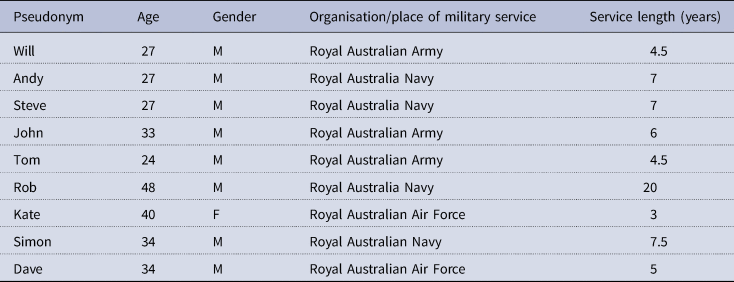
Despite being a convenience sample, respondents spanned the three main service branches. The sample pool included army (3), navy (4), and air force (2). The average age of the sample was 32.8 years, with a range of 29–46 years. The average length of service in the organisation was 7.2 years with a range of 3–20 years. One participant identified as female and the rest as male. Demographic information for each participant is presented in Table 1, with pseudonyms.
Participants’ demographics

In comparison with other qualitative methods, a low sample size does not serve as a limitation of phenomenological research, particularly as a focus on obtaining full and rich personal accounts disassociates the need for saturation (Saunders et al., Reference Saunders, Sim, Kingstone, Baker, Waterfield, Bartlam and Jinks2018). In this case, nine subjects fell within the range recommended by Creswell (Reference Creswell2013) who supports ‘4–12 people’ (Creswell, Reference Creswell2020) and used nine subjects in his own seminal phenomenological research (Brown, Sorrell, McClaren, & Creswell, Reference Brown, Sorrell, McClaren and Creswell2006). The sample size was also in line with similar studies: in their phenomenological study of military training experience, Cane, McCarthy, and Halawi (Reference Cane, McCarthy and Halawi2010) interviewed four individuals; in their study of career-change driven by a sense of calling, Ahn, Dik, and Hornback (Reference Ahn, Dik and Hornback2017) interviewed eight individuals; and in their study of adults with an autism spectrum disorder, Waisman-Nitzan, Gal, and Schreuer (Reference Waisman-Nitzan, Gal and Schreuer2019) interviewed 11 individuals.
Procedure
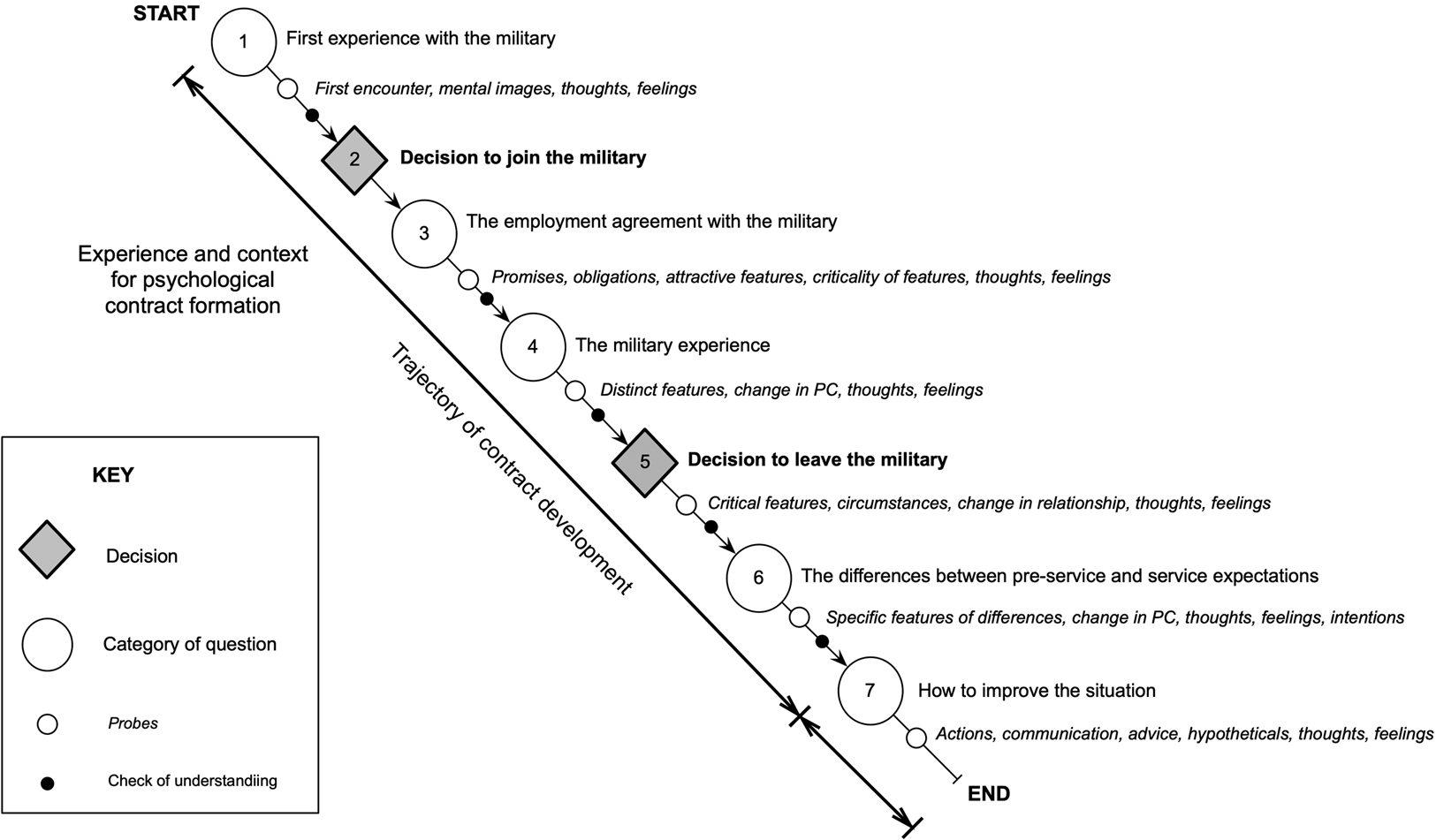
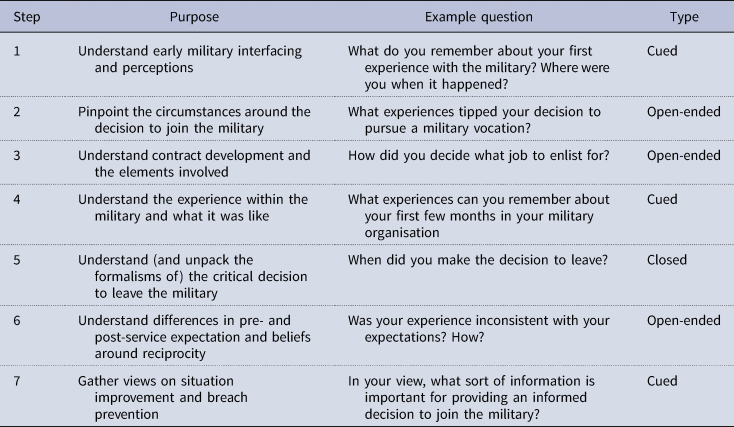
An initial interview protocol was developed based on the key topic areas of interest and the conventions of the critical decision method (Klein, Calderwood, & Macgregor, Reference Klein, Calderwood and Macgregor1989), which features frequent probes on retrospective accounts and checks of understanding with the participant to ensure accuracy of timeline information. This initial interview protocol was then piloted twice with two different individuals to determine flow, coverage of topics, and further refinement. Figure 1 shows an overview of the interview protocol trajectory used during the interviews. The protocol featured 28 questions (not including probes), organised into seven classes. Some questions were closed, but others were open-ended to encourage consideration of new ideas. Several cued questions were also asked, calling for short answers in a narrower range. The protocol led participants through their experiences, building progressively towards decisions to leave. Each step was followed by a check of understanding before moving to the next. Table 2 expands on Figure 1 by summarising the purpose of each step with example questions.
Overview of the interview protocol developed from Critical Decision Method. Each step was followed by probes and checks of understanding

Overview of interview content

Example questions are illustrated for each step, and the type of question is given in parentheses.
Interviews lasted up to 80 min, were audio-recorded, and conducted over the phone to accommodate national participation. The interviewer was not professionally connected to any of the research participants. All audio-recordings were transcribed verbatim. To preserve anonymity, identifying information was removed at the point of transcribing and pseudonyms were introduced to tag data and maintain confidentiality. All participants provided consent, and the study was approved by a university ethics committee (Approval No. H15/09-220).
Research team
The research team consisted of three investigators, all male. Two were current faculty members, one senior researcher with expertise in psychology, and an early-career researcher in neurocognition. The third member was an undergraduate in a psychology programme. The senior member had a career in academia and had never been in the military. The remaining members had previous ADF military careers in the Navy, one as an officer and the other as a sailor. All three researchers discussed their own assumptions and possible biases on the research topic at length (Creswell, Reference Creswell2020) and all members were also familiar with the concept of psychological contracts.
Data analysis
Data were analysed using the procedures of phenomenology described by Creswell (Reference Creswell2013, Reference Creswell2020). In line with its focus on eliciting an idiographic interpretation of a lived experience (as opposed to an objective record), data gathering led to a focused analysis of textual and structural descriptions, designed to understand common experiences by reflecting on essential themes and what constituted the essence of the experience. A description of the phenomenon was assembled by reducing the information to significant quotes and combining them into themes with visualisations to capture essences. Specifically, the analysis was undertaken over five steps, during which the senior researcher stayed close to the data, and repeatedly checked the understanding of the meaning of units of data in context, supported through input by the other researchers:
(1) We read each transcript to obtain a general sense of meaning and listed every expression relevant to the experience in the process of horizontalisation where we treated all elements of the experiences equally and refrained from placing meaning units in hierarchies or in order of importance.
(2) We found the invariant constituents by reducing and eliminating overlapping significant statements and made meaning units from them. Our goal here was not to disrupt the original meanings but to discern the meaning by reflecting on verbatim statements.
(3) We clustered meaning units and developed themes from them. Themes were verified by checking if the phenomenon was the same if a certain theme was changed or deleted.
(4) Themes were composed into a composite textual description focusing on ‘what’ was experienced and structural qualities focusing on the ‘context’ of the experience. These were integrated into a universal structural description considering the context of each experience.
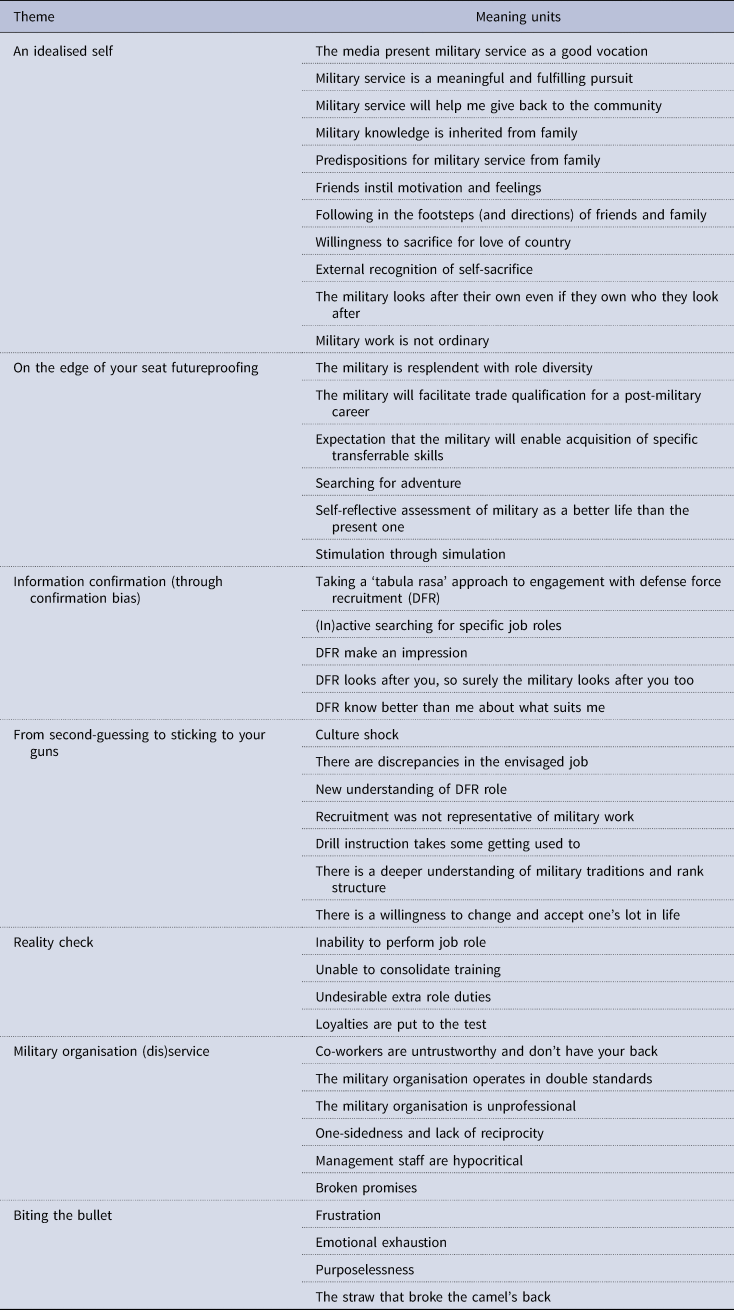
(5) Finally, we developed a composite description of the essence of the experience that represented the group as a whole. The process resulted in a set of 7 themes and 43 meaning units (see Table 3).
Emerging themes and corresponding meaning units

Trustworthiness and rigour
Steps were taken to assure rigour and trustworthiness in the study with credibility, applicability, and consistency as key criteria (Hammarberg, Kirkman, & De Lacey, Reference Hammarberg, Kirkman and De Lacey2016). As mentioned in the Section ‘Procedure’, the protocol was used only after refinement through two iterations of piloting. Regular checks of understanding featured in the critical decision method went some way towards maintaining a connection with the experience of participants in the logistics of interviewing and during analysis. Repeated checks of the researcher's understanding of the meaning of the participants' experiences during the interviews also assisted with the process of verification. Phenomenology allowed research findings to be interpreted in several ways with verbatim quotes supporting points where necessary and pseudonyms serving as ID tags. The sampling approach was adopted to obtain maximum insight and promote applicability. Researchers remained reflexive (i.e., cognizant and self-aware) throughout the process of subjectivity and exposure, and understood their role as a ‘research instrument’ and requirements for setting aside their views. To fully describe how participant experiences shaped their contracts/schemas, researcher(s) ‘bracketed out’ their own experiences when engaging with data and evolving findings (Creswell, Reference Creswell2013, Reference Creswell2020; Fischer, Reference Fischer2009), but as two members of the team had a priori military experiences which could influence the study, the data analysis, writing and organisation of the work was carried out by the senior researcher (i.e., member with no military service experience or background) with the other two members of the team reviewing descriptions of the themes. The involvement of researchers with military backgrounds ensured dependability.
Results
From significant statements and meaning units, a set of themes was constructed, along with a structural and textural description, and an essence. The list of themes and meaning units is presented in Table 3. The structure of the experience can be understood as ‘what happened’ surrounding the central experience of simulating a life of and beyond military service. The following seven themes emerged: idealised self, on the edge of your seat futureproofing, information confirmation (through confirmation bias), from second-guessing to sticking to your guns, reality check, military organisation (dis)service, and biting the bullet.
Idealised self
Military service represented a distinct form of work and created a particular sense of vocation for all. Tom said: ‘You see on the news like tanks cruising around and like the infantry boys […] I thought yeah that's what I want to do’. Although it was believed to offer fewer tangible benefits than other careers, a military career was perceived to provide unique freedoms and opportunities. Steve envisioned prospects ‘…to live in different places and to travel’. Reasons for enlisting also reflected a need to see oneself doing something with intrinsic value. Kate expressed:
‘I wanted to wake up every single day and actually know that I was doing something worthwhile, something that meant something […] I think fulfilment of the soul is the way I look at it’.
The belief of military employment engendered visions of a future self-driven by a sense of community and civic virtue. Tom said:
‘I never [joined] for the coin […] I knew there was not much goin’ on [in my hometown] but if I can go out and do something positive then I might be able to come home one day and give back’.
Early exposure to the military happened through friends and family members, the latter through tradition. Kate said:
‘My grandpa was in the second world war, so I knew a fair bit about it. I was fairly knowledgeable before I joined up because I had friends that had already joined up beforehand so, and I hung around with them a lot’.
Kate also described her experience as a pull towards a vicarious experience, saying: ‘I wanted to feel the same way as my friends’. Rob retold:
‘My uncle served in the navy around the 60's and 70's and on submarines as well. He was a torpedo handler, he was the one that initially got into my ear when I was about, I think 11 or 12 […] I do have a very early memory but it's a very vague memory of mum taking me down to my uncle's submarine’.
In Rob's case, this was linked with a desire for approval: ‘I think there would have been a feeling of wanting to please dad and my uncle’. Tom talked about imitating his uncle: ‘My uncle was in telecommunications and I decided that telecommunications was what I wanted to go in the army’. Dave was encouraged to join by a friend: ‘It wasn't until I had spoken to a friend who had joined the air force about three-six months earlier and um spoken to him about what's going on and he was like just join the air force, just join’.
An enthusiastic desire to ‘fight’ for one's country was common, for example, John said: ‘I was pretty patriotic, East TimorFootnote 1 was just happening’. Although patriotism was conceptualised as a construct that exceeded typical relationships, there was a belief that such an investment and corresponding sacrifice would be recognised. Steve expressed: ‘I guess my belief was that [the military] would look after me, um yeah, physically and financially’. Such a view was relevant for deployment and obligations to work outside conventional hours, as Tom indicated: ‘I knew I always had to be ready to go no matter what they told me – at the drop of a hat’. Uncertain work hours were balanced against job security and pay, as Will reported: ‘…what was consistent was what you would get out of [the job] by way of job security and a pay cheque every fortnight’. All participants went into the military with a conceptual understanding that ensuring their country's freedom through military service required them to sacrifice their own. Most reflected that they had transferred ownership of themselves.
On the edge of your seat futureproofing
Will said about joining the military: ‘I just hoped it would be an adventure’. Numerous participants expressed a belief that such a vocation would also offer excitement. For a lot of cases, this was juxtaposed retrospectively (or prospectively) against past (or alternate future) experiences that were felt (or imagined to be) devoid of these features. For example, Dave, who was drawn to being a pilot, worked at a furniture store after completing school. Will said: ‘I didn't really fancy going to Uni so I hoped that I would learn from whatever the army could teach me’. When asked about how he felt at the prospect of joining, Rob said: ‘Excitement you know knowing I was [joining] and nervousness of course knowing that I was trying to get a job or career that was gonna get me out of home’.
Simon talked about the role saying: ‘It sounded quite exciting working with sonar, radar, weapons systems and things like that and also there was a little bit about working with computer systems and communication systems’. John said he was excited to begin his career: ‘[I felt] very keen, very eager to get my career started’. Kate envisaged: ‘…moving around, meeting different people, experiencing different things’. Thus, participants described images of what their life would be like in the military, relative to the life they were leading or could go on to lead. This promoted self-reflection, but also provided stimulation in an ostensibly under-stimulated state.
Military vocations were connected with perceived flexibility in role, role diversity, and potential to transfer. Dave said about his experience:
‘One thing I liked about [the idea of joining] the syscom roleFootnote 2 was that there were about three or four different streams within that so if I got sick of one, I could transfer in training to others or get posted out or whatever. And the other thing was doing the [information technology] role I could go anywhere in Australia rather than if I was an aircraft tech I would have to go where the F/A-18'sFootnote 3 were’ [sic].
Andy indicated: ‘I pretty much only joined up because [the military] train you, so it was basically because you got a trade out of it’. Tom said something similar: ‘That's what I was really looking for, like qualifications or something I can use post-career’. Rob indicated this as a priority: ‘Aside from the job security that was the primo reason I joined the military, to get that trade’. For some, the choice was strategic. Steve, turned down an option to study engineering in favour of military service, expecting to gain skills to build on later:
‘I always had an interest in studying engineering. I actually applied [to University] as well as applying for the Navy, and got accepted, but chose the Navy. So, I thought it was something I could get and build on later’.
Performing the envisaged role was therefore vital for those wanting a specific trade. Tom said: ‘…it was a six-year contract and you got a trade, oh not a trade but you got a technical skill with it so that's what made me decide to join’.
Information confirmation (through confirmation bias)
Although some participants drew from the experiences of friends and family, knowledge and understanding of the military were also informed by (un)official reading material and library books (the latter more so in the pre-internet era). For some, such as Steve, this verified information about ‘pay, salary amounts, length of service and qualifications’, and for others, like Tom, what could be expected:
‘I knew from what me mate's brother told me of just a little bit here and there of [sic] like you get your dentals looked after, your medicals looked after, pays pretty good, and you get looked after a lot’.
However, some participants went to Defence Force RecruitingFootnote 4 (DFR) with a purposefully limited understanding, relying on the experience to fill them with the requisite knowledge. As Dave said: ‘I didn't know how much time I would have to sign up for or anything like that, um that was pretty much the extent of [my understanding of the military] before I got in’. Similarly, Steve said that prior to meeting DFR, he: ‘didn't have much [knowledge] at all’. Rob described his knowledge on a numerical scale: ‘one-hundred being knowing everything and zero being knowing absolutely nothing, I would probably say 25–30%’. A renewed understanding was gained following the first experience with DFR. Will said: ‘I sort of went in with little to no knowledge apart from some very general information, but I found that the organisation has a lot of different jobs and roles’. Despite this, most participants actively sought job-specific information. For example, Simon: ‘I guess I knew the initial contract was for six years so I wanted to find a bit more about the job and where it might take me and where I might go and what I might be doing’.
Explicit information about payment conditions was seen to be readily available pre-enlistment, but eligibility for benefits and the actual application processes for obtaining said benefits were comparably vague. Will added: ‘It wasn't till later in my military service that you sort of learnt what you were entitled to and how to apply for those sorts of things’. At pre-enlistment, there was a need to understand what the individual was getting themselves into, but while the information gathered was limited and piecemeal, it was sufficient to render a decision. Andy reported: ‘I knew enough to know what I was getting in for but obviously, I didn't know specifics’. An understanding of some aspects of the military was greater than others, as Steve illustrated: ‘I didn't really understand how the whole military functions. I only saw a very small part, and […] it was administration side of things’.
During recruitment, DFR staff looked ‘very well presented’, provided some indication of what could be expected, and actively guided potential recruits into certain roles. Simon said:
‘[DFR] just explained to me the recruitment process pretty much. I knew that I had to go through psychological evaluation, medical. I was also given more information on specific roles…’
Some participants said that they felt impressionable to such advice and indicated it not only influenced their decisions but altered their course. Kate said of her experience:
‘I was supposed to join the army to begin with and then an army recruiter and a RAAFFootnote 5 recruiter sat down with me and the army recruiter said “you are too pretty for the army, go to the RAAF” […] It was kind of weird cause I had the purpose of going in the Army but I had to shift gears because they told me to go in the RAAF and they said I was more suited to it’.
DFR personnel contributed to a certain military image. Tom said that ‘you could ask them anything and they could tell you straight answers’. For some, such as John, this was motivational and enhanced his experience: ‘The more and more I learnt about it, the more and more I wanted to join’. Will said that DFR affirmed his expectation for adventure:
‘I was told that I would get to go on these types of adventures and get to go overseas […] I remember being excited [by the experience with DFR], it was sort of a whole new thing for me and my eyes were sort of wide open at everything I saw’.
From second-guessing to sticking to your guns
An understanding of military organisational citizenship and expectations of military standards-based experiences were first encountered in the context of organisational socialisation. This included formal elements of the role, such as obeyance to military discipline, teamworking, adherence to scheduling, and training to competency. However, it also included informal socio-cultural norms, such as relinquishing control, accepting reduced freedoms, and adopting traditional military values – in comparison with the more conceptual transference of ownership experienced when deciding to join (see Section ‘Idealised self’), here relinquishing of control was experienced more tangibly during socialisation when in the organisation. Early on, participants began second-guessing their decisions to join. Will said: ‘I remember the first couple of weeks and even the first few days I wondered if I had made the right decision’. Kate said something similar: ‘In the first couple of weeks I had to re-evaluate whether [the job] was exactly what I wanted’. Some of this was about experiences of drill instruction. Kate added: ‘the yelling and all that at recruits. Yeah that's a bit of shock to the system’. Tom indicated: ‘[DFR] never said that you were gonna be yelled at, that you would be constantly on the go from 6 till 10 every night sort of thing, that was never really mentioned. And that was a bit of a culture shock’.
In later stages, discrepancies between what participants had perceived about their job and what they were experiencing were held under scrutiny: Steve said:
‘It got to a point where the job was so different from what I signed up to do that I didn't want to do it, I didn't want to do that job. I wanted to do the job I signed up for’.
Having entered the military, participants reflected that their recruitment experience inaccurately represented what military service was actually going to be like. Simon said: ‘Okay so recruiting and the real navy I suppose you call it might as well be two different universes’. Although the decision to join was believed to be an informed one at the time, the subsequent perception that access to important information was deliberately withheld created feelings of deceit. Will said:
‘[DFR] would know at that particular point in time the likelihood and the reality of say, the particular Corp I was in being able to perform their role wasn't going to be very high [sic]. So, I believe that they could have been a bit more forthcoming with that and I may have perhaps looked at doing something else within the Army’.
As gradual socialisation into their organisation introduced participants to military life, the physical requirements of the role and difficulties adjusting to military training became incongruent with a priori expectations, and putative knowledge did not deter that reality. Tom said: ‘I knew it would be tough, I knew it was gonna be like getting yelled at all the time and stuff, but I thought like you would get that down time’. Kate said something similar: ‘…the mind games they played at the beginning, I actually thought it was going to be quite easy in the beginning, you actually had to get your head around it in the first couple of weeks’. Andy indicated that there was also pressure to perform to avoid impeding progress: ‘[I was] trying to not get back classed. Because that you have to [sic], like it delays, I guess your whole career so to speak, your pay rises and your promotions and everything’. Rob reflected on his experience by drawing comparisons on his knowledge of previous candidates: ‘the intake before me suffered it quite badly’. Experiences of military socialisation embedded participants into a culture that was invariably difficult to appreciate fully, or accurately, until directly engaged. John said: ‘[The early stages] gave me a deeper understanding of the traditions’. Kate also described: ‘I started to [understand] some of the camaraderie that my friends had with their (military) mates’.
Military culture was also considered to stress strict adherence to rules and codes of conduct. Steve said:
‘There was a rank structure, you follow it, but I didn't, I didn't really know what to believe to be honest. That's all I knew, but I didn't realize that, that you know, they are the law’.
In practice, experiences during early socialisation meant adapting to unfamiliar rules and hierarchies, adopting attitudes compatible (and compliant) with new work practices, and undergoing a transformation of the self into a different self – one that had not been envisaged or idealised. Despite this, Rob described willingness to: ‘accept the new knowledge and to bend to the rules and bend to the way they wanted me to be’. It also meant relinquishing control to accomplish employment goals, as Kate put it: ‘…someone else was in control of me and I didn't like it, so I had to get over that’. Here, retrospective experiences focused on disconnects between a priori expectations, the experience being lived, and reluctant acceptance. As Dave said: ‘I didn't get what I wanted, I still had the idea that, well this could have happened anyway so just make do with it’.
An observed mismatch between expectation and lived experience appeared to erode other aspects of the role, such as teamwork. Andy said: ‘You don't realize how often I guess you end up helping another department out with something that isn't technically your job’. For Will, such resistance was explained by employment beliefs developed during recruitment, subsequently perceived to be deliberately dishonest and manipulative:
‘[DFR] tell you if that you sign up for this job you will do this training and then you will go overseas, and you will perform this role. So, I guess throughout your whole application process and your initial training that you're sort of fed and led to believe that you will get to go and do what you have been trained for but that actually isn't a fact’.
Once in the military, the reality of the lived experience felt much less exciting or diverse than had been imagined and believed, which created new questions and strengthened misgivings. John described his experience as a groundhog-day like state of existence in which events were being continually repeated: ‘[I was] doing things, then doing them again the next day and doing them again the next day and you can only do that so many times before you start asking, why am I doing it?’
Reality check
Tom said of DFR: ‘they told me I would learn how to be a diesel mechanic – that was another lie’. Performing an envisaged role was considered important and for most, perceived not to have happened. Will said: ‘I had a perception that I would get trained up to do something and then I would get to go out and do my job but that never eventuated’. John's experience was similar: ‘So we all did the training, we all got very good at our jobs, and yeah we were all just sort of waiting to get posted overseas’. Envisioned roles were not always technical or engineering related. Simon's decision to leave was linked with an inability to transition into a military writing role:
‘…(DFR) said you will have the opportunity to transfer to a different category if you wish at a later time and at that middle of my career [sic], just before then I actually had done some work experience in a different category and then I wasn't able to transfer, it was rejected straight away, um so I guess it wasn't as flexible as they had promised’.
Recollecting his decision to leave, Will drew comparisons with being in school: ‘I remember that I was thinking about it one day […] it was almost like being back in school and I sort of said to myself that you need to go out and get a new job’. Training, preparation, and monotonous work without purpose was frustrating and ‘mind numbing’. Kate said that in her role she: ‘had to stare at a screen 12 h of the day and watch little pictures go around on a radar screen’. In other contexts, frustration was similarly expressed, for example, John said: ‘We started questioning why we were training in an area where we weren't going to be sent’. The amount of ‘collateral’ (i.e., incidental) duties that participants needed to perform daily failed to meet expectations and an inability to perform the envisioned job was problematic, encouraging revisions of the employment terms. For Will, this influenced his decision to leave:
‘I wanted to go out and do my job, but I found that we never really got to go out and do it, so I had made the decision that once I had finished my tenure I was going to get out’.
Intentions to leave were also invoked when experiences deviated from beliefs in ways that drove a sense of futility and anxiety-linked preponderance about the passage of time. Will emphasised his experience as:
‘I was worried that I had dedicated a portion, a chunk of my life and my time, to training to do something and the fact that I possibly wasn't going to do that led me to believe that this wasn't what I wanted to do anymore’.
When able to perform their role, higher levels of satisfaction were experienced. Steve said of his experience: ‘I was happy [when I was] doing [my role], it made me work harder […] it made me want to stay in’.
Military organisation (dis)service
Trusting co-workers in the military to ‘have your back’ was seen as an important feature of teamworking and interpersonal support. For some participants, their experiences engendered distrust and resistance to teamwork, and influenced their decisions to leave. As Kate put it:
‘Half the people I worked with, I didn't want to be around or have anybody have my back because I didn't trust them. When you think someone's word is their word, and that is how it is and then it's not, it's hard to actually rebuild a foundation from that. So, I'd say my perceptions were completely shattered […] I pretty much at that point in time I knew I wasn't supposed to stay’.
Observing varied treatment towards others relative to treatment received created perceptions of double standards: Tom said: ‘A lot of boys [were] getting away with murderFootnote 6 and some boys [were] getting hauled over the coals for doing similar or less acts […]’. Tom also said:
‘We had a sister platoon and you see them doing stuff differently to you and like they go on the frontline and you guys are polishing brass in the hallway […] I thought fuck it, it's just a game, I've gotta play it, do it, it will get better in the end sort of thing’.
However, Tom continued to perceive unfairness: ‘it was always the same dudes going on exercise’, which contradicted his expectations, ‘I thought it would be a lot more professional’.
The perception that one's input was devalued or unreciprocated engendered feelings of one-sidedness. John said: ‘I was putting a lot of effort in and I think that at the time I probably wasn't getting a lot back’. What managerial staff communicated to others was also felt to contradict their actions. Simon said:
‘[Superiors] talk about teamwork and being team players but management, at times, not all of them I guess, during that posting during that time they sort of looked out for themselves, threw other people under the bus’.
These perceptions extended to expectations of reward and professional development following operational service, as Tom illustrated:
[The military says] ‘yep, you blokes have been overseas’, ‘cause you have experience you guys will be looking at doing courses this year, oh cool cool’ and it was complete polar opposite.
Although limited control over employment decisions was recognised relatively early, for some, it turned into a competitive relationship with implications for inevitable failure.
Biting the bullet
As a response to situations of being blocked from reaching desired goals or outcomes, frustration was a common emotion ahead of decisions to leave. As Will put it: ‘I guess me, and a lot of other people sort of got a bit frustrated that we would always have to go out do all this training, but we never got to go and do our job’. An ostensible lack of recognition for one's efforts also came as a surprise. John described it thusly: ‘I just expected that they would want to please their diggersFootnote 7 a bit more than what they did’. This effort-reward imbalance induced frustration; Tom said: ‘…a lot of us were like working hard and like weren't really getting any notice for it’. Kate said something similar, describing the accretion over time: ‘I started to just get a little frustrated I suppose, every morning …’ For John, this experience directly impacted his critical decision to leave:
‘When they told me I'd only be [in Timor] for a few weeks and then when they left me there for the entire, um, for the entire six months, that was, that was when I definitely decided. Then I handed my resignation in halfway through that tour’.
Dave shared a similar experience of being posted to an undesired location:
‘Yes I signed up for that but the impression given at recruiting was generally you get your first preference because there is always spots and you know if you don't get your first you get your second […] I was confident at the time that I wouldn't get stuck in place that was just the middle of nowhere and not where I wanted to be but it came to the end of training and it was like yeah you're going to [Location A], it's like you've gotta be joking!’
Tom was jaded by his experiences: ‘My heart's no longer in it, no point hanging around being that jaded dude in the corner’. Similarly, Will said: ‘We never got to go and do our job, so I guess we sort of got jaded with the job’. John said that not being able to do what they were trained to do was: ‘jading a lot of people’. All participants perceived their military organisation to have broken promises, and feelings of deception and betrayal were common. Simon was cynical about his organisation's agenda: ‘I felt like a little bit duped I suppose you would call it, by recruiting. It looked like they were just trying to meet their quota or whatever’. John said: ‘I was pretty bitter, I think, because they told me one thing and then did something else’. Decisions to exit their organisation were therefore not limited to a single event but an accretion of multiple events that simply became harder to endure. As Kate put it: ‘that was my breaking point I think […] I learnt that I can only take so much’. Dave said his role became too tedious: ‘doing the same thing day in day out and thinking to myself at that time, there has got to be something more to life’. The feeling that a tipping point was reached was a common experience. As Andy put it: ‘I think it was just once the right number of factors built up, I guess, it was the straw that broke the camel's back, so to speak. There was enough reason to get out at that point’.
Composite structural description: factors that contribute to the experience of psychological contract formation and its trajectory of development
The experience of forming a psychological contract of the military is framed by both the pre-enlistment experience of envisioning an idealised self that imitates others, escapes the trappings of a conventional future, and attains meaningful work with financial security, and subsequent socialisation into the organisation. Participants initially experience a pull towards a military career, often involving friends, family, a desire for approval, and an appraisal of what an envisioned future within the military career may offer in comparison with what they have in the here and now, or how the experience gained from military life could carry over to other occupations beyond. Their experiences evoke an external locus of control. They are inspired/motivated/encouraged to apply by the people and circumstances around them, and as a consequence, engage with DFR primed to hear things that support what they have simulated for their future with a fuzzy contract that looks to solidify this simulation. Needless to say, DFR are likely to present a favourable view and paint an image of what the hopeful and unfailingly impressionable person wishes to hear.
Participants experience a jolt to their contracts when they enter into the organisation and encounter a harsher environment then they had imagined. This shockwave ripples throughout the contract, highlighting a naiveté, but it stabilises, and participants accept their experiences in socialisation as part of a temporary transference of ownership of their self, to make room for the idealised self that they believe will follow. Following this trial by fire, inconsistencies with the envisioned job and ways of working materialise and cause fissures in participant contracts and the employment relationship. Nearly all experiences begin to fall short of what was imagined and reinforced through DFR, and the reality of their military organisation as one that features one sidedness, unprofessionalism, double standards, distrust, and hypocrisy, falls short of the participants' idealised job and self.
By definition, participants simulate combat without experiencing it, making meaningful and purposeful work a constant consideration. An accretion of negative experiences and emotional turbulence exhausts remaining resolve, and an awareness that what was imagined has not been attained calls into question whether it ever will be.
Composite textual description: the meaning of simulating
From an appraisal of the current self and an assessment of a better future emerges a simulation of an idealised self that walks in the footsteps and the approval of friends, family, community, and country. The contract is fuzzy because it is in essence, a simulation, and because all experiences at pre-enlistment are experienced or reframed in a way that supports this simulation. As the self is surrendered to the military organisation, simulation takes on new meaning, and they themselves become a simulacrum, devoid of the subjective experience of adventure, the excitement that had in some sense been promised by their contract. They experience themselves as forever simulating, devoid of a supportive environment. Lifegoals that relied on an acquisition of certain skills or capabilities beyond the military are challenged. Military life is being lived, but it no longer rings true to the way it sounded to them based on descriptions they heard from others, nor what they expected, hoped, envisioned, thought, idealised, imagined – simulated. According to Moustakas (Reference Moustakas1994), the essence of an experience is an integration of the composite textural and structural descriptions. By way of representing the final step of the analysis, a description of the essence of simulating a military job in relation to contract formation and the breach is presented below.
Essence: the ontology of simulating in military psychological contract formation and breach
Simulating was the essence of contract formation, but also featured across all participant experiences, evoking recent conceptualisations about how the way that people think about work, and the way work is actually done, are not necessarily one and the same (Hollnagel, Reference Hollnagel, Shorrock and Wiliams2016). At pre-enlistment, participants simulated a role involving an idealised version of themselves – someone who was giving back to their community, sacrificing for love of country, acquiring skills for future work, travelling the world, gaining personal fulfilment, embarking on exciting adventures, and so on. These experiences led participants to envisage their future role and themselves in a particular way. Upon joining, participants were thrust into drill instruction, undertook combat training exercises, learnt how to fire weapons – all simulated activities designed to prepare the participant for a role in defence. Although confronting, such experiences updated participant schemas with yet more simulations of their future role. Beyond early socialisation, however, participants faced a reality that was different from what had been simulated pre-enlistment – a version of themselves devoid of the intrinsic rewards they imagined, or the promise of trade qualifications that would underpin their career, or the opportunity to perform their imagined job role, or even to ‘fight’ for their country. What remained was service-as-done – the fundamental reality of the military occupation. In the majority of cases, participants tolerated the conditions for some time, through feelings of obligation or through their own resilience. Ironically, the latter may have developed partly as a result of military training. In practice, the common experience was one of frustration, which is associated with job performance and absenteeism (Ayoko, Callan, & Härtel, Reference Ayoko, Callan and Härtel2003), and jadedness.
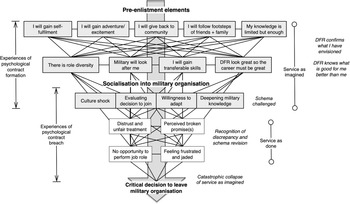
We arranged the findings into a succinct visualisation, presenting a schematised account of the essence of military contract formation and breach (see Figure 2) in this study. Given that the nature of military employment is to train and to remain prepared for deployment, Figure 2 distinguishes between the fundamental service-as-imagined and service-as-done aspects of participant experiences (Hollnagel, Reference Hollnagel, Shorrock and Wiliams2016). The first has two layers: the service that was envisaged/expected before joining the military but also a purposeful application of the experiences and skills acquired during military training/drill instruction. The latter, service-as-done, therefore convey experiences antithetical to what were envisaged/expected, with a focus on breach across different dimensions of the contract.
A schematized account and conceptualization of study findings

General discussion
The ADF, similar to several around the world, is currently going through technological changes with a new generation of ships, submarines, planes, and land vehicles, as well as advancements in communications, cyber, and artificial intelligence technologies.
These changes mean that the ADF must recruit candidates with higher aptitudes and give them more training investment than in the past. Understanding and addressing long-standing issues of psychological contract breach within the ADF is more imperative now than ever. The problem that framed this study was the early exit of personnel from military organisations based on assertions that employment promises were not kept. An examination of the lived experiences of ex-military personnel who had exited the military through their own volition followed. We chose a phenomenological approach, in which the experiences of these ex-military personnel could be explored fully to understand how their contracts were formed. During the study, all descriptions given of decisions to leave were consistent with contract breach as a dominating reason for their exit.
The experiences suggest that in the context of military vocations, an initial ‘fuzzy’ contract was formulated by a combination of intrinsic reward-seeking (e.g., need for fulfilment and search for adventure) and attraction to tangible benefits (e.g., financial security, qualifications, and post-military career trades). The contract was shaped by external influences (e.g., experiences of family and friends) but defined through exposure with military representatives in recruitment settings (i.e., DFR). Typically acquired in an ad hoc and piecemeal fashion, participants possessed a novice and/or naïve understanding of their chosen vocation when joining. Despite this, the contract was established with terms that included the fuzzier elements as much as the perceived promises/pathways provided by the military representatives, and attainment of both appeared key to the trajectory of the contract.
The importance of ensuring that applicants have sufficient information about a job during recruitment and selection has been highlighted (Carless, Reference Carless2005). For participants, information about the military was gleaned mainly from friends and family and recruitment literature with DFR filling information gaps and increasing familiarity. Higher familiarity has been found to lead to a higher attractiveness of the military (Lievens, Hoye, & Schreurs, Reference Lievens, Hoye and Schreurs2005); however, the ad hoc nature of information gathering at pre-enlistment coupled with the agenda/biases of recruiters (e.g., the need to fill monthly recruitment quotas, William, Reference William2006) meant that jobs were tailored to participants ideals, with certain features enhanced/embellished, therefore likely to differ from the actual role/military experience. As participants were prepared to sign a lengthy contract with limited information about the nuances of their role, engagement with DFR appeared to validate prior employment beliefs, and information received was subject to confirmation bias.
Contract formation was underpinned by self-directed tenets for satisfying and rewarding employment. All participants in this study felt obliged and expected to sacrifice their freedom, suggesting that even at formation, the contract had access to large proportions of life space, brought on by simulations of what the future could entail. Reasons for joining were multifaceted but seldom dominated by patriotism. In some cases, it was simply a path to a different trade, and in others, a mechanism to leave home and travel, gain new experiences and establish oneself. An awareness of the reality of the risks involved in military work (e.g., conflict and battle) was rarely mentioned. Previous research identifies the family as a major influence on social pressures in career decisions experienced by youth when considering enlistment. Parental intentions to recommend the military are likely to translate into behaviours that reflect positive regard for military careers, including tacit communication of preferences and beliefs through social role modelling (Gibson, Griepentrog, & Marsh, Reference Gibson, Griepentrog and Marsh2007). In general, parents are a major source of children's knowledge and beliefs about occupations (Bryant, Zvonkovic, & Reynolds, Reference Bryant, Zvonkovic and Reynolds2006).
Willingness to tolerate breach conditions, change and accept one's ‘lot’ was evident by the emergent theme ‘From second-guessing to stick to your guns’. Decisions to leave vied against attempts to change, breeding internal conflict, but several reached a tipping point, encountering the proverbial ‘straw that broke that camel's back’. This metaphor has been used by other studies in this area (Parzefall & Coyle-Shapiro, Reference Parzefall and Coyle-Shapiro2011, p. 18) and reinforced the view that, although not unlimited, participants possessed some capacity to tolerate negative events (Rigotti, Reference Rigotti2009; Rousseau & Tijoriwala, Reference Rousseau and Tijoriwala1999). Although it is difficult to determine whether explicit promises were given by DFR or other military personnel, whatever was heard during DFR engagement corresponded well enough with all that had been envisioned as part of contract formation. Thus, what was created from idealisation and simulation underpinned the subsequent idiosyncratic beliefs regarding reciprocal commitments concerning their future employment. A second metaphor that can be evoked here with a focus on contract formation is ‘house of cards’, that is to say, the formation of participant contracts had a shaky foundation to begin with, and the very nature of military work introduced an additional fragility that rendered them prone to collapse. Thus, it is perhaps more accurate to describe the decision to leave the military occurring as a result of a catastrophic collapse of service as imagined, than as a breach of a contract.
The in-depth study of participant experiences undertaken in this research suggests that the perception of explicit or implicit promises made by the organisation is important, and influenced breach and decisions to leave. However, the participants’ own expectations and dreams of a military life conceptually occupied a sizeable space in the contract, played a key role in its formation and trajectory, and contributed to breach by predisposing an idealised but false or inaccurate creation of what it would be like. From a military organisation perspective, these findings suggest that participants with such contracts may interpret reciprocity a certain way, and their ability to endure the reality of the job relies on various factors. These may include a better exchange of information during DFR engagement, where DFR themselves take steps to explore the ‘service-as-imagined’ realm of the person. At the other end, the organisation may look to foster support so that experiences that may be influenced or controlled are managed more effectively. It is important to recognise that the ADF has been implementing initiatives to create a workplace that reflects contemporary expectations and needs to address retention concerns, as well as having greater transparency and flexibility in their joining contracts (Department of Defence, 2019). An example of this is the ADF's ‘Try Before You Buy’ initiative, which allows Year 12 graduates the opportunity to sign up for a single year (marketed as a gap year) (Department of Defence, 2019). This may help establish more realistic psychosocial contracts in recruits. Participants’ experiences reported within this study may be indicative of past recruitment strategies, however it is also possible that initiatives such as 'Try Before You Buy' may function as a year-long recruitment exercise, and in-practice, contribute in different, unpredictable and potentially maladaptive ways to the development of fuzzy psychological contracts in military careers. The next 5–10 years will show whether psychological contract breaches remain a core issue within the ADF.
Practical implications
In the past, the ADF had several issues delivering on promises/expectation of its servicemen and servicewomen (Australian Human Rights Commission, 2012; Grisales, Reference Grisales2019; Hogg, Reference Hogg2001; Malone, Reference Malone2016). Although the ADF has taken steps to address this in recent years (Department of Defence, 2019), the results from this study suggest that failed expectations are still the major contributor to contract breaches and turnover. The lived experiences of those in this study and enriched understanding of how contracts are formed in this context offer several directions for practitioners to explore minimisation and mitigation of contract breach.
DFR could explore actively engaging (i.e., investigating) recruits' simulation of their service-as-imagined. Although current recruiters in Australia and other countries attempt to offer recruits simulations of their service, doing the reverse may equip the ADF with the type of information found across our sample; identifying the tangible benefits that shape the foundations of the psychological contract for each individual. These data may then enable the ADF to do two things: first, allow DFR to reshape expectations if they are unrealistic. Second, allow the ADF to reshape itself by proposing reforms that aim to deliver the benefits and expectation that first drew the personnel to join.
Following the socialisation phase and into defence employees' careers at critical milestones, the foundations of the contracts should be reinvestigated. This could be conducted within job role contexts, as has been attempted in other literature studies (e.g., Kraak, Lakshman, & Griep, Reference Kraak, Lakshman and Griep2020). This information can further help reform the ADF to provide for its employees, continue to reshape employees' expectations, and allow the ADF to respond to possible breaches more proactively. Given the dynamic nature of military life, it is likely that there will still be breach-inducing incidents and occasions for defence employees. Understanding the tangible foundations of the psychological contract will allow the ADF to anticipate and react better, enabling them to repair and re-establish psychological contracts with their employees to foster long and rewarding defence careers.
Theoretical implications of the essence of the experience: simulation of work and self
In aiming to study the psychological contract timeline, starting at the formation and culminating in the decision to leave, we found that the elements underlining contract formation were the most important factors. Participants' expectations played a key role in contract formation and these expectations were played out in what we identified as ‘simulations’. A novel consideration here is that the prospective employee is simulating two representations: an idealised version of their work and an idealised version of themselves which is undertaking the work. This duality appeared to be essential in participants’ simulations during the formation of the contract and during contract breach. From the observations in these data, we theorise that psychological contract breach does not culminate in the critical decision to leave when simulated idealised work is refuted, but when the simulated idealised version of themselves is nullified. Each participant described multiple breaches before deciding to leave, but the breaking point was reached once the participants' vision of themselves could not be met. Research has shown that psychological contract beach can lead to negative emotions, attitudes, and behaviours (Rousseau, Reference Rousseau1989), and our theory is consistent with that cognitive framework. However, our findings suggest that it is not so much that participants' emotions, attitudes, or behaviours changed (i.e., became jaded or cynical), but that the change was incongruent with their idealised self (i.e., they did not want to be, or to be seen to be, a jaded or cynical person). It is possible that this mediates the direction of the behavioural reaction to the breach that have been mapped by other cognitive frameworks, such as Hirschman's (Reference Hirschman1970) Exit-Voice-Loyalty-Neglect (EVLN) theory. Future research would need to consider whether this theory holds for psychological contracts in other military contexts as well as nonmilitary contexts, and for different types of psychological contracts, such as relational, transactional, balanced, and ideological psychological contracts (Jones & Griep, Reference Jones and Griep2018; Morrison & Robinson, Reference Morrison and Robinson1997; Rousseau & McLean Parks, Reference Rousseau, McLean Parks, Cummings and Staw1993; Thompson & Bunderson, Reference Thompson and Bunderson2003).
Strengths and limitations
This study represents an in-depth examination of contract formation in the military context and offers a better understanding of how psychological contracts are formed, shaped, and evolved at various points over the course of military engagement, together with the bearing this has on decisions to transition out of a military career. Combining the critical decision method (Klein, Calderwood, & Macgregor, Reference Klein, Calderwood and Macgregor1989) with phenomenology (Creswell, Reference Creswell2013) was an effective way of tracing lived experiences coincident with psychological contracts. However, although this approach garnered richness and completeness of understanding of the employment agreement, the individual circumstances that data were collected from cannot be generalised to the population in a traditional way. Effort was taken to ensure the diversity of participants, but information was not collected on other factors known to influence career choices in important ways, including current family make-up and family of origin (Whiston & Keller, Reference Whiston and Keller2004), or vocational privileges such as socioeconomic status, financial freedom, and level of education. Although some effort was taken in bracketing and managing bias, the study nevertheless carries an inherent limitation and concern for bias.
Broad future research directions
Qualitatively derived knowledge has a unique value for follow-up methods that measure impact through quantitative orientations. Follow-up research is therefore needed, and results provide some direction for gathering information about how contract formation relates to career change decision making. Although conceptual in nature, the schematised account of findings conveying the essence of the experience and elements that may be examined further, for example, to determine whether significant differences exist for certain military roles or individuals with certain predispositions. Future research can examine these factors but also seek further diversity as this will provide a much richer context for interpretation. The use of quantitative research (e.g., surveys) may be able to collect these data and draw links on their role statistically and more explicitly.
Although this study was focused on the individual level, contract formation was a systems experience, involving interactions with several extrinsic elements and external influences. The findings from this research may be usefully expanded to include additional decision-makers and stakeholders (e.g., DFR). Introducing data or representation from the employer perspective of the contract in conjunction with the employee may further examine employment beliefs, and highlight the differences between employees and employers in the context of military vocations, as well as help discern strategies to promote the formulation of more enduring psychological contracts.
Anjum Naweed is an Associate Professor at Central Queensland University where he is Cluster Lead in Human Factors and Operational Readiness at the Appleton Institute. He has over 15 years of experience in human factors and cognition across a range of industry sectors and organisational settings. He holds a PhD in Psychology and is a Certified Professional Ergonomist at the Human Factors & Ergonomics Society of Australia, and an Associate Member of the Chartered Institute of Ergonomics and Human Factors, UK. Anjum has previously held visiting fellow positions at the University of Central Florida, USA and Queensland University of Technology, Australia. He is also a Scientific Editor of the journal Applied Ergonomics. His interests focus on trying to understand and enhance the way that people perform in complex, often highly safety-critical environments and his research seeks to advance theories of applied attention and develop new methods for describing and understanding human performance.
Luke Hodgkinson completed his Master of Clinical Psychology with Central Queensland University and currently works as a Psychologist in private practice. He uses his knowledge of mental health to assess, diagnose and treat psychological problems across the lifespan. Luke has over 9 years of experience in the Royal Australian Navy including roles in technical trades and workforce management. His professional and research interests include neurodevelopmental disorders, trauma and stressor-related disorders, military psychology and Aboriginal and Torres Strait Islander mental health.
Raymond Matthews has previously worked as a sleep, fatigue, and human factors researcher and lecturer of psychology at Central Queensland University, and currently works as a Research Fellow at the University of South Australia. Dr. Matthews' research interests stem from a background in military aviation with the Royal Australian Navy, with a primary focus on the effects of sleep and circadian rhythms on operational performance, in high-intensity environments.