

Since the seminal works of Mark Granovetter, Getting a Job (1995 [1974]) and “The Strength of Weak Ties” (1973), research in social science has increasingly emphasized the uniquely informational dimension of networks in job search and job mobility. Theoretically the weak ties versus strong ties argument has been simplified into a more structural approach, with the alternate diversified versus redundant ties, implied by the structural hole argument (Burt Reference Burt1992). Therefore contacts are viewed mainly, if not exclusively, especially in economic models, as information processors passing on to oneself, at a rate depending on the network structure and new information about job vacancies (Boorman Reference Boorman1975; Montgomery Reference Montgomery1994; Ioannides and Datcher Loury Reference Ioannides and Datcher Loury2004). Thus contacts play the benevolent role of job agencies or that of head-hunters providing potential employers and employees with valuable, reliable information (Finlay and Coverdill Reference Finlay and Coverdill2002; Lin Reference Lin2001).
However, empirical research on the value of the informational network provided mixed results (Granovetter Reference Granovetter1983, Reference Granovetter1995, Reference Granovetter2005; Lin Reference Lin1999; Ioannides and Datcher Loury Reference Ioannides and Datcher Loury2004). Several studies find a correlation between weak ties and job (Yakubovich Reference Yakubovich2005), final status or wage, but one that often appears to be mediated through a third variable such as the status of the contact (Lin et al. Reference Lin, Ensel and Vaughn1981; Wegener Reference Wegener1991). Other studies based on a nation-wide sample find no clear relationship between the strength of ties and pay (Bridges and Villemez Reference Bridges and Villemez1986; Mouw Reference Mouw2003). This overemphasis on information has also been challenged by research that claims that strong ties can also be helpful, for different reasons than weak ties: strong ties, although providing possibly less original information, might be more likely to support and to influence the decision-makers (Bian Reference Bian1997; Obukhova Reference Obukhova2012). We might have two mechanisms working in parallel, informing weak ties and supporting strong ties, producing a rather undetermined relationship between the strength of the ties and the value of the job.
Nevertheless, both approaches are similar in the way they view contacts in the context of changing jobs. They both fail to link job-searching periods and working periods. The typical situation involves an unemployed person or a person unhappy at work, who is trying to find a new job and who is asking contacts either for information or for support (or both). In this scenario, contacts, although they may be willing to help, remain more or less indifferent to the firm where an individual will find a job. They provide information because providing information is not very costly and they can expect information in return or they are helping someone with whom they have some bond and they can expect some kind of future reciprocity. This type of approach does not enable us to understand why the contact is so often a work contact, such as a former colleague or a former client, who moreover frequently holds in part, if not totally, the power to recruit (Granovetter Reference Granovetter1995 [1974]; Bridges and Villemez Reference Bridges and Villemez1986; Yakubovich Reference Yakubovich2005). Work ties such as former colleagues are generally classified as weak ties. This statement is correct if measured by emotional intensity, but it can be challenged if measured by the amount of time spent when the individual and the contact worked together. But classifying work contacts in weak/strong tie terms obscures the fact that work contacts cannot be seen as independent from the object of the quest. In cases where a colleague helps to hire a former colleague, what is at stake is nothing less than the pursuit of a fruitful work collaboration. It is therefore not surprising to see that in Bridges and Villemez (Reference Bridges and Villemez1986) the distinction between work and communal ties is more relevant than the classical weak/strong ties in order to explain wage levels. Its effect is significant at least for an important subsample such as Manager-Professional-Technical workers.
The financial industry is a good observatory for studying the impact of collaboration ties. As regards the importance of network and social ties, finance offers the media two conflicting images: one of a world of selfishness and of great solitude, and another of a closed network of closely-bound insiders. A way of reconciling these two views is to see that finance is structured not by strong emotional ties but by highly-structured collaboration ties that studies deem important for success (Roth Reference Roth2006; Burt Reference Burt1997). Finance is also a sector where pay and inequalities have been rising tremendously, benefiting from a wage premium that remains unexplained (Philippon and Resheff Reference Philippon and Reshef2012; Kaplan and Rauh Reference Kaplan and Rauh2010). In previous work (Godechot Reference Godechot2007, Reference Godechot2008a), we argued that those wages were due to the financial operative's ability to stage a hold-up, that is to effectively threaten to move the firm’s key assets to a competitor. Within our framework, assets such as knowledge, technology and clients are appropriated by financial employees and multiplied by collaboration ties, leading to some spectacular team moves (Godechot Reference Godechot2008a, Reference Godechot, Savage and Karel2008b). This paper intends to strengthen the theoretical link between moveable assets and collaboration ties and to offer a statistical exploration of its importance based on data from an eFinancialCareers.fr online survey carried out in September 2008.
The paper is organized as follows. In the initial section, we first develop a theoretical framework that, in finance, links the importance of collaboration ties with the appropriation of key moveable assets. The second section presents the questionnaire on job mobility in the financial industry, and the main variables. We confirm in the third section our hypothesis linking moveable assets and collaboration ties, and those related dimensions to a job position at the core of financial markets and to higher wages. In the final discussion section, we analyze how collaboration ties are related to classical measures of network structure.
Towards a theory of collaboration ties
Weak or work?
It is quite common to link Granovetter’s theory on weak ties (1973) and Getting a Job (1995 [1974]), his study of job searches in a Boston suburb. An individual’s different strong ties are very likely to be connected to one another, whereas an individual’s weak ties are more likely to exist in different and relatively unconnected groups. While persons linked by strong ties would share more or less the same information, weak ties on the contrary serve as a bridge between various circles and may provide the individual with new and valuable information.
Granovetter relies partly on his 1974 study on contacts in order to establish his general claim explaining that weak ties are a very valuable means of getting a job. Who are the contacts that are generally involved in Granovetter’s survey? They are mainly work contacts.
Although Granovetter does not state explicitly that a proxy of weak ties could be work contacts and that one of strong ties could be family and friends, such a shortcut is suggested. 31% of the contacts are coded “family-social” and 69% “work” relations, among which we find 21% of former teachers, 36% of former employers or supervisors, and 33% of former colleagues (ibid.: 46). Those work ties seem valuable since they are more likely to be associated with a better salary. Moreover those former colleagues are much more likely than other contacts to become the new employer or the new supervisor (ibid.: 47). To put it in a nutshell, former colleagues hire former colleagues.
The reason for such a feature may be quite different from the weak tie argument. The weak tie argument relies on the value of new information provided at time t by weak ties. If your former supervisor quits, goes to work for another firm and three months later invites you to work for him again in his new firm, would we say that it is a weak tie? This “dormant tie” (Levin et al. Reference Levin and Walter2011) may not be a strong tie, since this may be quite a low-intensity emotional relationship. But since the working contacts were regular before quitting, the supervisor and the subordinate already shared quite a lot of information about one another, and in this phone call neither the former nor the latter learns much beyond the possibility of working together again.
Although it could still be possible to analyze this case according to the information ties model, it is tempting to provide another reason why these types of working ties work: they are collaboration ties. We can talk of collaboration ties when people use ties based on previous work collaboration. A rationale for doing so is that people linked in such a manner enjoy complementarities. They will produce more together than separately. Complementarities refer not only to complementarities of skill, as in Kremer’s framework (Kremer Reference Kremer1993), but also to personal complementarities. Two co-workers learn to coordinate and to share work, and they only become productive over time. The importance of cooperation, its network conditions (cohesive networks when it is required), and its impact on innovation and performance has been emphasized in many network studies (Podolny and Baron Reference Podolny and Baron1997; Hansen et al. Reference Hansen, Podolny and Pfeffer2001; Uzzi and Spiro Reference Uzzi and Spiro2005) but its link to labor market matchmaking has not really been investigated.
Collaboration is also effective on the labor market because cooperation at work becomes a productive asset that two co-workers may will be willing to preserve. That is why if one moves and has the opportunity of favoring the recruitment of the other, he/she will do so rather than learning at some expense to cooperate with a stranger. Cooperating with co-workers is quite common and if we were to state this phenomenon alone, for instance on a national sample (Bridges and Villemez Reference Bridges and Villemez1986), it is likely that it would have rather modest consequences. What we need to do now is to identify a key factor that helps to turn cooperation relations into collaboration ties in the labor market.
Collaboration ties and moveable assets in finance
Let us now advance a theoretical model based both on qualitative research into finance (Godechot Reference Godechot2007, Reference Godechot2008a, Reference Godechot, Savage and Karel2008b) and on existing literature that analyses the factors that actively encourage collaboration ties.
Collaboration ties are more likely to be significant when two persons linked together share a common asset, when they organize a division of labor in order to exploit and value this shared asset, and when it is possible to move this asset from one firm to another. By moveable asset, we mean productive assets that can be moved from one firm to another outside the scope of classical transaction contracts. Those assets, whose movement transgresses classical property rights, are more likely to be immaterial ones, less subject to rival appropriation and less protected by property rights legislation. They can be human assets such as knowledge, know-how or routines, electronic assets such as algorithms, software, databases, or even computers, and social assets such as reputation, contacts and clients. At some point collaboration ties, and especially productive teams, can also be considered as being part of moveable assets. But as we try to analyze the conditions for the reuse of past collaboration ties in the labor market in relation with some favorable conditions such as other shared assets, we will maintain the distinction between the two notions throughout the paper.
Before developing the model, let us consider an example of this link. John and Peter are sales staff working in a derivatives team for Bank A, selling financial products to Mike in firm F. We consider here that the commercial relationship to Mike in firm F is the key moveable asset that one of the sellers will partially keep if he moves to another bank. John and Peter might think of moving together to another bank if the fraction of business they can move together is bigger than the business that is moved if they move separately.
In order to understand such phenomena let us express this dilemma as a very simple combination of five main factors: A the value of the asset, r the rate of return, c the level of complementarity of collective work on the asset, m the movability of this asset, and D the discussion and coordination costs. The individual return of a collective move can be expressed as follows [m.r.A + w – D – T] and compared to that of an individual move [(1 – c) m.r.A + w – T], where w is the ordinary labor market wage, and T the ordinary transaction cost.Footnote 1 A financial operative will favor a collective move if its return outperforms the return of an individual move. That is if c.m.r.A > D, the return of the marginal fraction of the asset moved through collective move is more important than discussion and coordination costs. Among observed turn-over, collective moves—and more generally the use of collaboration ties in order to get a new job—will be more likely than individual moves if c the complementarity of work, m the movability of the asset, r the rate of return and A the volume of the asset are high and if D the discussion and coordination cost is low. We will explain why those conditions are more likely to hold within the financial industry than elsewhere and more precisely among jobs at the core of financial markets—typically front office jobs such as traders and salespeople—than among back office jobs and more traditional finance.
As we have shown in a previous analysis (Godechot Reference Godechot2008a), the financial industry is a sector where employees tend to accumulate key assets of the firm and to move them from one firm to another. Although the financial industry hires people with an important human capital, what people move from one firm to another is not limited to individual talent. They also take with them moveable assets. Therefore, in the long run, employees in finance are paid a rent that classical human capital variables fail to reduce (Philippon and Resheff Reference Philippon and Reshef2012; Kaplan and Rauh Reference Kaplan and Rauh2010). Although good ideas are commonly seen as the pure product of an individual mind, network sociology has shown that they also rely on a collective context and a network structure (Collins Reference Collins1998; Burt Reference Burt2004). Both insider accounts of the financial industry (Lewis Reference Lewis1989) and scholars have shown the importance of mentors (Roth Reference Roth2006) in the financial industry from whom one learns both the job and valuable tips on how to survive in this rather competitive universe. The trading room, with its characteristic open space, is a locus where people learn much from one another through informal conversations (Beunza and Starck Reference Beunza and Stark2004).
However, moveable assets are not limited to acquired knowledge, experience and on-the-job training. Knowledge is often embedded in electronic devices that may be easy to move from one firm to another. For instance, a trader interviewed in 2002 explained that when he moved from a small French broker in Paris to a major American investment bank in London, bringing his laptop to the new firm was a key issue: inside the laptop was a piece of software that he developed with others at his previous firm. The software allowed him to carry out innovative pricing of convertible bonds, which are complex financial derivatives (Godechot Reference Godechot2007). One classical element that is often moved from one firm to another is the client relationship. Brokers and salespeople progressively build an idiosyncratic relationship with their clients both through formal and informal, professional and non-professional conversations. One of the issues involved in building of those relationships, that may rely on exogenous similarities such as those of gender or of social background (Roth Reference Roth2006), is the building up of a shared vision of the market between salespeople and the client (Smith Reference Smith1999; Ortiz Reference Ortiz2005). If a salesperson moves to another firm, the client might be willing to continue to discuss business matters with him/her, listen to his/her advice and to do business with him/her. Moreover, with standardized products, priced very similarly in different markets, what can clinch a deal is the complex “chemical reaction” that transforms the customer of the firm into a client of the salesperson.
Jobs in the financial sector differ in the amount of assets an employee can appropriate and in the extent to which those assets are moveable. We may think that jobs at the core of financial markets, front office traders and salespeople, are jobs where assets are more appropriable and easier to move. The first reason is that front office jobs are highly specialized (Rajan, Zingales Reference Rajan and Zingales2001). You are more likely to appropriate a key asset if you have been working long-term with such assets. If you start as a derivatives trader, it is likely that you will remain a trader in the same area as long as you can, working with the same financial products. However, if you are a back office manager, as part of your overall job you will probably move around every few months from one project to another (building new software, reorganizing the unit, cost cutting, etc.) and every few years move internally from one job to another inside the support departments of the same firm (back office, accounting, HR, IT). The second reason is that the organization of work is fairly standardized in front offices whereas it is more firm-specific in support departments. The more similar the organizations, the easier it is to move assets and to value them inside a new environment. The organization of trading and sales activities, is quite similar. This isomorphism eases the recruitment of external traders and salespeople while also enabling some internal traders and salespeople to quit and thereby relocate key assets accumulated during their work within the firm. On the other hand, in the back office, even if you can more or less appropriate an asset through a long-term involvement with it (for instance in some IT jobs when you create a piece of internal software), it might be less valuable to move this asset if it is not compatible with the systems of the new firm. We may therefore sum up these elements in the following hypothesis:
H1: Working at the core of financial markets favors the accumulation of moveable key assets.
When individuals move independently, they might not move all the key assets that they were holding in the previous firm. This is especially prevalent when assets are shared among several co-workers. In such cases, moving in teams, with co-workers sharing the same assets, increases the average asset moved per capita. Groysberg et al. (Reference Groysberg, Lee and Nanda2008) have therefore shown that financial analysts generally suffer a loss of reputation when they move alone from one firm to another, but that this loss disappears when they move in teams with other colleagues. In our interpretation, reputation can be viewed as a collective asset based on a combination of the financial analyst’s individual initial skill, experience acquired on the job and also the quality of the surrounding team supporting him in his analysis, the quality of customer service, the trust relationship built with customers, etc. Alone, a financial analyst moves part of this idiosyncratic bundle and suffers a loss of reputation. But with colleagues those assets are much more portable.
Collaboration relations therefore do matter, since they enable collective movements of assets. The first and most common thing to be moved is all the idiosyncratic routines that members have been collectively building together in order to coordinate. When moving alone, rebuilding coordination with new colleagues can be costly and timely. When moving collectively, efforts invested in those activities are saved and this enables rapid productivity in the new environment. Moreover, the idiosyncratic routines of division of labor will set productive complementarities within the team (among traders, among salespeople, between a trader or a salesperson and his assistant) with a valuable division of tasks, of knowledge, of products, of clients and sharing of information and expertise. Finally, some underlying assets are even more deeply shared among co-workers. The same client may be shared for different products among various sales staff, some selling derivatives, others selling stocks. The valuation of a financial products such as equity or credit derivatives also involves the combination of trading teams (that manage financial portfolios) and sales teams (that manage clients). Heads of trading rooms who can, through collaboration ties, move both teams more or less capture the power needed to transfer the financial activity itself (Godechot Reference Godechot, Savage and Karel2008b).
In the financial industry, moving in teams and hiring teams are quite common phenomena (Godechot Reference Godechot2007, Reference Godechot, Savage and Karel2008b). Groysberg et al. (Reference Groysberg, Lee and Nanda2008) remark that investment bankers commonly refer to this as “block trading in people”. Of the 366 analyst moves collected in their database, 100 are team moves involving colleagues categorized as “other ranked analysts, junior analysts, institutional salespeople, and traders”. This figure is all the more impressive since the job of financial analyst would not at first sight appear to be a team-based one compared to other jobs such as traders or salespeople. Although, to my knowledge, we do not have a precise estimation of such collective moves, cases reported in the newspapers show the extent of the phenomenon. For instance Frank Quattrone in Private Equity is reported to have moved from Morgan Stanley to Deutsche Bank Securities with 8 colleagues in 1996 and to have then moved again with two other bankers and their 100-strong team in 1998 to Crédit Suisse.Footnote 2 Team moves are also at the origin of most hedge funds. John Merriwether launched ltcm in 1994 with a team of former colleagues working under his direction at Salomon Brothers (MacKenzie 2003).
But collaboration ties are not only involved in very spectacular and dramatic one-shot collective moves. The latter are valuable but difficult to set up considering the high level of coordination required. Another way of using collaboration ties is to use them over time. When you develop an activity and meet new recruitment needs, you can pick a person from among former colleagues or business relations that you know to be a good productive match. These elements thus lead us to build two new, closely interrelated hypotheses.
H2a: When people change jobs, moveable key assets and collaboration ties are highly correlated.
Although it will be difficult to test in this paper, we do think that the correlation given above in H2a is the product of a dynamic causal system. Holding moveable key assets at time t leads you to develop collaboration ties at time t + 1 in order to achieve a more complete appropriation of the assets. The reverse relation is also true. When you have collaboration ties with co-workers at time t, you will also increase in t + 1 the key assets you can move, since the type of social capital we are coining may be seen as a multiplier of assets (Bourdieu Reference Bourdieu and Richardson1986; Lin Reference Lin2001). To the assets you hold may be added the assets held by some of your collaboration ties.
The strong correlation we hypothesize between moveable key assets and collaboration ties has a simple consequence. The factors that cause the former, i.e. working at the core of financial markets (H1), also cause the latter, which is why we expect moveable key assets and collaboration ties to be correlated. But we also think that working at the core of financial markets independently encourages the building and the use of collaboration ties on the financial labor market. One reason for this is that, together, the strong autonomy and high specialization at the core of financial markets favors the creation of a united team ready for defection. Meanwhile, in the support departments a lower level of specialization and, as in some law firms (Lazega Reference Lazega2001), policies dealing with internal mobility from one department to another prevent the formation of such teams. So for those two reasons we can expect the following relation:
H2b: Working at the core of financial markets favors the use of collaboration ties.
Enjoying the power of moving both assets and people through collaboration ties is highly valuable on the labor market since it leads to higher wages. In our previous work (Godechot Reference Godechot2008a) we characterize this phenomenon with the neo-Williamsonian concept of hold-up (Williamson Reference Williamson1985; Malcomson Reference Malcomson1997). We rely on a detailed case study where a the head of an equity derivatives trading room and his deputy were respectively granted 10 and 7 million euros in bonuses for the year 2000. The year before, those two heads had resigned and given their bank 48 hours in order to match the offer of a rival bank granting them a very high proportion of the bonus pool (15% for the two). They were threatening their bank by warning that, if it did not match the rival offer, they would move their teams very shortly to the rival bank. Finally, under urgent pressure, the bank applied the conditions of the rival bank and they both, at the end of a great year on the market, were able to earn such exceptional bonuses (Godechot Reference Godechot2008a). In this case, the price paid is not just the usual price of a market bidding process for individual talent. This is not a situation where people take out from a job no more than what they brought in. Here the price paid is that of the assets they are able to move from one firm to another through collaboration ties—assets that were paid through the investment of a whole community (shareholders, workers) but that are appropriated and moved by a few. This element of opportunism and unequal exchange therefore allows us to conceptualize this exchange more as a hold-up (although legal here) than as a classic market bid.
In this case of successful renegotiation, as in many other cases of successful collective departure, we have a combination of moveable assets and collaboration ties. This combination enables workers to earn a major wage premium that, in our view, accounts for most of the wage differential puzzle between various jobs in finance and notably between Wall Street and Main Street (Philippon and Resheff Reference Philippon and Reshef2012; Kaplan and Rauh Reference Kaplan and Rauh2010). Moreover, according to the findings of Groysberg et al. (Reference Groysberg, Lee and Nanda2008), firms that are trying to poach teams are very often overestimating the assets the teams are moving, and are overbidding in order to get the full package. These two arguments, ie that of asset moving through collaboration ties and that of overbidding, converge in the case of mobile financial operatives. They entail on the one hand high levels of wages and on the other hand a strong correlation between salaries and the expectation of assets moved through such collaboration ties. We will sum up our argument with this simple hypothesis:
H3: The moving of key assets, collaboration ties and notably the combination of these two dimensions all increases wages.
An Internet questionnaire on mobility in the French financial industry
The questionnaire
The survey is based on a collaboration between the author and eFinancialCareers.fr, the French branch of eFinancialCareers.com, the leading global career site network for professionals working in the financial sectors. The website provides financial services professionals with job opportunities, job market news and analysis, salary surveys and career advice. Recruiters and employers can post jobs targeting specific sectors within the financial services industry, both buy-side and sell-side, and can search the resume database for highly qualified and specialized professionals.
The questionnaire, launched during three weeks in September 2008, is divided into three parts. The first twenty questions focus on the last move in finance for those who changed jobs at least once within that industry. The next dozen questions concern the desire to move, but only for those that had never changed jobs within financeFootnote 3. The questions dealing with the desire to move are formulated in very similar terms to those concerning past mobility. And the final dozen questions are general socio-economic questions for the whole sample relating to the respondents’ social background and current situation in the financial industry.
With 995 answers to the first question and emphasizing its scientific goal, the questionnaire was, according to eFinancialCareers.fr, a success when compared to the quick questionnaires they conduct from time to timeFootnote 4. This flattering appreciation also shows the relevance of the questions. But carrying out lengthier questionnaires on the Internet (approximately 10-15 minutes) has a down side: we see a quite significant attrition effect. After the first question on the number of job changes in finance, 22% of the sample stopped answering. Only 66% of the 995 continued to the end of the poll. Therefore we can rely on 454 complete and 78 incomplete questionnaires for those who did change jobs, and 209 complete and 28 incomplete questionnaires for those who never changed jobs.
Due to the fact that there is no random sampling here, it is important to know to what extent our data is representative of the financial industry beyond the fact that it presumably represents those visiting the eFinancialCareers.fr website. The respondents mainly work in Paris (66%). 12% work in the rest of France, 5% in London, 5% in the rest of Europe, and the rest elsewhere. They work mainly for banks (47%), for other financial firms (asset management, brokerage) (16%), or for insurance firms (4%). 22% work in a business that serves the financial industry such as legal, consulting or IT firms and 10% among other types of firms.
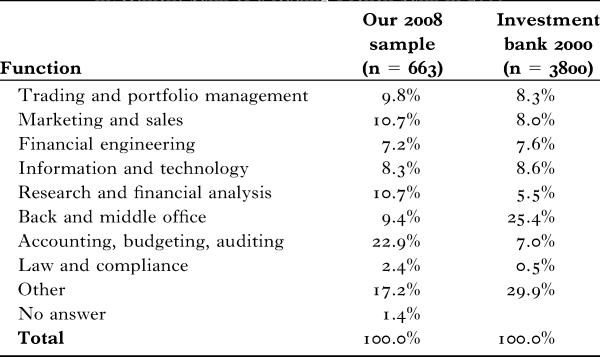
The comparison with data from a leading bank that we were able to gather during our fieldwork (Godechot Reference Godechot2007) shows that our sample provides a fairly accurate representation of the financial industry at large (Table 1). We must not forget that for a famous trader and a sales agent in the front office, we need to count four or five further employees working in various support positions. We do find some differences between our data and those of a major bank (in 2000), but they are limited to back and middle office on the one hand and accounting, budgeting and audit on the other hand, domains where the nominative differences are somewhat fuzzy.
Comparison between our sample and the job composition of the investment bank of a leading French bank in 2000

Note: 9.8% of the 663 respondents were working in trading or portfolio management functions. This figure is quite close to the 8.3% working in trading functions in 2000 in a major French investment bank. Comparison data were gathered during fieldwork.
Furthermore, our wages (Q1 = 47,000 euros, median = 58,000 euros, Q3 = 83,000, P9 = 146,000) are rather similar to those we find in Calyon’s 2008 bilan social (social reportFootnote 5): Q1 = 37,770 euros, median = 55,243 euros, Q3 = 93,529, P9 = 171,143. One difference can be explained by the standard deviation that seems lower in our sample.
The greatest bias of our sample (which may account for the above discrepancies) is that of age. In our sample, 7% are under 25, 64% are between 25 and 34, 19% between 35 and 44, and 9% over 45. At Calyon’s bank, 5% are under 25, 29% between 25 and 34, 28% between 35 and 44, and 36% are over 45. Several reasons may account for those differences. Older employees in finance might move less, use IT less to look for a job, and may rely more on head hunting or direct contacts to get a job. Therefore it is very likely that our sample will not allow us to analyze the most spectacular collective moves organized by the more senior employees such as the heads of trading rooms described above.
Variables
• Moveable assets
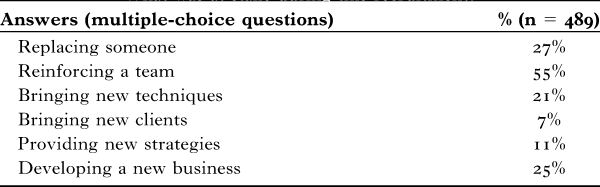
Asking questions on key moveable assets held by employees is not an easy task since the concepts are highly abstract and may sound unfamiliar to the respondents; moreover, employees may not always be conscious that in a sense they can appropriate the firm’s assets. For this reason, we have tried to find a proxy by asking some questions on the elements that were at stake during the recruitment process (Table 2).
What was at stake during this recruitment?
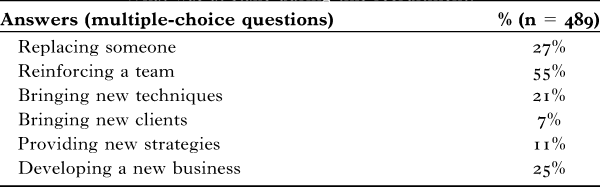
Note: 27% of the 489 respondents that changed jobs in finance at least once answered that replacing someone was at stake during their last recruitment.
We have interpreted the four last answers of this question as a proxy of the assets held by the employees. If the aim of the recruitment was to bring something “new” to their employer—whether it be “new techniques”, “new clients”, “new strategies” or a “new business”—it is most likely that those assets were based on assets acquired during the career in finance. It is true that some of the elements, such as new techniques, could also be partly due to general knowledge and talent acquired before the start of the financial career. But it is very unlikely that talent and general knowledge alone can enable someone to bring new strategies, and moreover new business or new clients, without an on-the-job accumulation of financial experience, and of what we call key moveable assets.
In order to rely on a robust measure of key moveable assets, we construct an index aimed at reflecting the various dimensions of asset moving. We therefore add the last four standardized items, so that each dimension has the same weight on the overall index:
 $${\rm{Asset}}{{\rm{s}}_{\rm{0}}}{\rm{ = Tech/s}}{{\rm{d}}_{{\rm{Tech}}}}{\rm{ + Clients/s}}{{\rm{d}}_{{\rm{Clients}}}}{\rm{ + Strat/s}}{{\rm{d}}_{{\rm{strat}}}}{\rm{ + Bus/s}}{{\rm{d}}_{{\rm{Bus}}}}$$
 $${\rm{Assets = Asset}}{{\rm{s}}_{\rm{0}}}{\rm{/s}}{{\rm{d}}_{{\rm{Assets0}}}}$$
• Collaboration ties
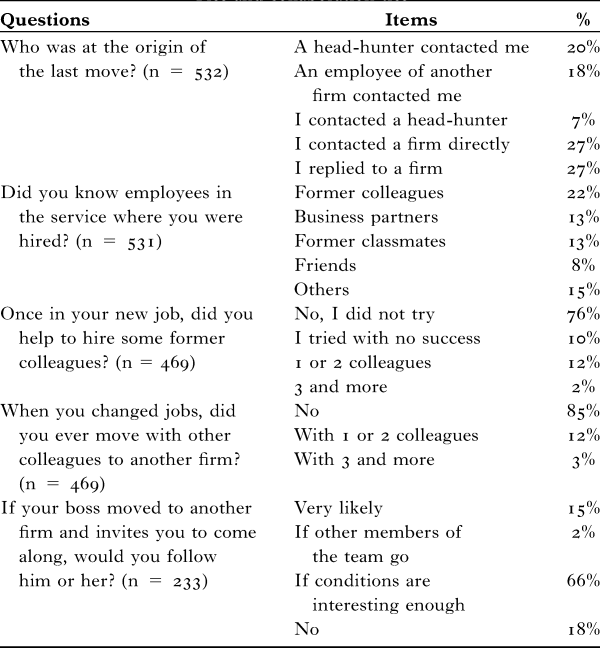
In order to measure collaboration ties, we rely mainly on four questions in the past mobility questionnaire, and on one question on the desire to move. Moving in teams, hiring former colleagues and, for those who did not experience any job change in finance, being very likely to follow one’s boss are clear examples of collaboration ties (Table 3). Those cases reveal situations where people are somehow more productive when they work with contacts with whom they are used to collaborating than with other colleagues, should they share idiosyncratic routines, or more fundamental assets such as knowledge, technology, market share or customers. Although our sample is somewhat biased in favor of junior workers, it is significant that 14% of those who moved had helped to hire former colleagues and that 15% of them had already moved in teams. Although the collective aspect of financial recruitment is generally limited to small numbers (a team of two or three members) and we do not include the most spectacular ones, its prevalence makes it worth further study.
Ties and collaboration ties
Note: 20% of those who moved were first contacted by a head-hunter. The first four questions were asked to those who had experienced a job-change and the final one to people had who had never changed job.
The question on contacts also informs us about the types of ties used in the financial industry in order to get jobs. Professional contacts such as former colleagues and business partners are people with whom a person has been cooperating and are therefore more aptly classified as collaboration ties. But classmates and other contacts on the one hand and friends on the other would more appropriately fall within the Granovetterian weak ties versus strong ties dichotomy. Also, in the first question, although the link is rather weaker, being first contacted by an employee of the firm might also reveal a use of collaboration ties.
As previously for assets, we construct an index of collaboration ties as an addition of the standardized minimum number of people involved in a team move, the standardized minimum number of the former colleagues hired and the number of types of professional contacts known in the service where one was hiredFootnote 6.
 $${\rm{Coll\_Tie}}{{\rm{s}}_{\rm{0}}}{\rm{ = Team\_move/s}}{{\rm{d}}_{{\rm{Team\_move}}}}{\rm{ + Hire\_coll/s}}{{\rm{d}}_{{\rm{Hire\_coll}}}}{\rm{ + Pro\_Cont/s}}{{\rm{d}}_{{\rm{Pro\_Cont}}}}$$
 $${\rm{Coll\_Ties = Coll\_Ties}}{{\rm{ }}_{\rm{0}}}{\rm{/s}}{{\rm{d}}_{{\rm{Coll\_Ties0}}}}$$
• Other variables
- Compensation. Compensation variables are our main dependant variables that enable us to see the impact of asset moving and use of collaboration ties. For those who changed jobs, we first asked for details of the percentage of wage increase obtained during the last move. And we asked all respondents for their present annual fixed wage and bonus. As compensations are personal and something some people might not want to reveal in an Internet poll, a range of salaries range rather than the exact numerical amounts were proposed. For the fixed wage, the following categories were used: 1) Less than 40,000 euros a year; 2) 40,000 to 60, 000; 3) 60,000 to 80,000; 4) 80,000 to 100,000; 5) 100,000 to 150,000; 6) 150,000 to 300,000; 7) over 300,000. For the variable wage, the following categories were used: 1) Less than 10% of the fixed wage; 2) from 10% to 25%; 3) from 25 % to 50 %; 4) from 50 % to 100%; 5) from 1 to 2 times the annual fixed wage; 6) from 2 to 5 times; 7) more than 5 times. On the basis of those two variables, it is possible to calculate the intervals of the total compensation. For instance, someone with a fixed wage of between 40,000 and 60,000 euros, and a bonus of between 50% and one year of fixed wage has a total compensation of between 60,000 and 120,000 euros. The full information of this variable may be extrapolated through interval regression.
- Position in the financial industry. We used two types of variable in order to describe the position within the financial industry: first the “function”, described in Table 1, and second, a sector question divided into 10 items: 1) Markets: Equity; 2) Markets: Forex, fixed income and commodities; 3) Mergers and acquisitions; 4) Financing; 5) Private banking; 6) Retail banking; 7) Asset management; 8) Private Equity/Venture Capital; 9) Consulting; 10) Insurance; 11) Others. We consider that at the core of financial markets we find front office functions (trading and portfolio management, marketing and sales) and the investment bank sector (markets division, M&A, private equity) (Godechot Reference Godechot2001).
- Human capital. As the financial industry is a sector which is highly intensive in human capital (Philippon and Resheff Reference Philippon and Reshef2012), it is important to have a detailed variable capable of describing the hierarchy of diplomas more subtly than the traditional “years of schooling” variable (Mincer Reference Mincer1974). In our survey we asked for the diploma that best describes the schooling curriculum. We suggested 9 items of possible answers: 1) top-grade engineering school; 2) top-grade business school; 3) French doctorate, PhD; 4) other engineering school; 5) other business school; 6) French university Masters (i.e. “DEA”, “DESS” and Masters); 7) other university Masters; 8) university degree (i.e. “Licence”, “Maîtrise”, “IUT”, “bachelor”); 9) two-year years of college diploma (“Deug”, “BTS”, “Bac + 2”) or lower-rank diploma. This nomenclature is based on the domination of French Grandes Écoles (Bourdieu Reference Bourdieu1998) over universities and inside the financial industry on the domination within the financial industry of a small elite of top-grade engineering Grandes Écoles such as Polytechnique, Mines, Centrale, Ponts, ENSAE and, to a lesser extent, top-grade business schools such as HEC, ESSEC or ESCP (Godechot 2001).
We asked exactly when people started in the financial industry to allow us to calculate financial experience, a form of experience that is more valuable in this sector of high turn-over than the usual seniority within firm variable. We use also the classic age and sex variables.
Combining assets and people
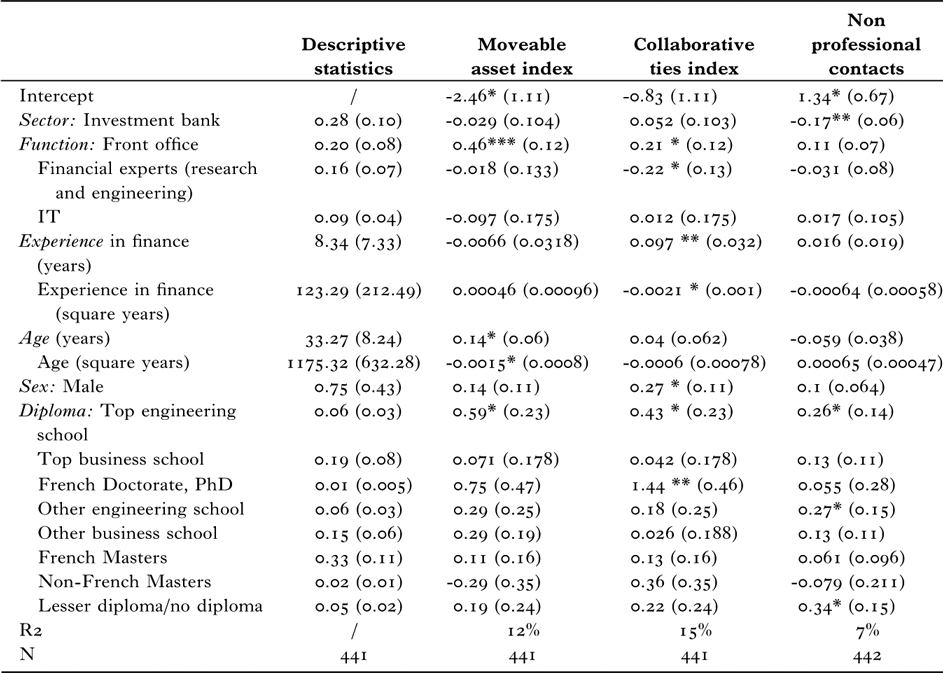
Table 4 enables us to test whether working at the heart of the financial market favors the dual accumulation of key moveable assets and collaboration ties (H1 and H2b). If we were to think that key moveable assets and collaboration ties were only a by-product of human capital, ie that talented people are per se creative of assets and that they attract many people who are willing to collaborate, we would have expected mainly the classic human capital variables, such as diploma, age and financial experience, to be significant and other proxies for the core of financial markets to have very little explanatory power. It is true that diplomas, especially top engineering school diplomas, age for moveable assets and experience for collaboration ties have a major impact. But the impact of working in front office jobs is very significant and almost as influential as that of an elite engineering diploma. Therefore, in order to acquire moveable assets or collaboration ties, it is not only a question of initial talent and general experience but also a matter of where you work.
Human capital, front office position and the accumulation of moveable assets and collaborative ties
Note: The first column contains means and standard deviations of explanatory variables. All models are ols regression. Standard errors are in parenthesis.
*p < 0.1, **p < 0.01, ***p < 0.001. The reference categories for sector, function, sex and diploma are respectively other sector, back office, support and other functions, female and bachelor diploma.
It is also interesting to contrast collaborative ties with other types of ties. We can see that non-professional contacts such as friends, classmates and “other contacts” are not used by the same persons as collaborative ties. Those types of ties are more effective outside investment banks than at their heart. The argument is not to say that financial people per se have a different nature of sociability that makes them more indifferent to traditional friendship and university ties. It is more to recall that being in a sector where the key to success is to appropriate, value and move key assets that may be shared among several partners, leads to greater use of collaboration ties compared to other types of ties which they may also have.
Globally, the analysis of Table 4 clearly confirms the link, stated in Hypotheses 1 and 2b, between working at the core of financial markets and accumulating key assets on the one hand, and collaboration ties on the other. Holding moveable key assets and collaboration ties also seems to be quite correlated. Is this global correlation due to the similarity of the causes of our two concepts shown by Table 4? Or is it more profound?
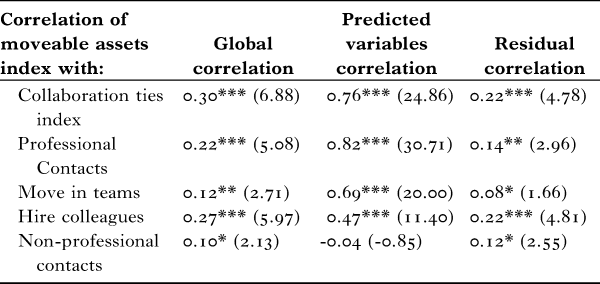
Table 5 suggests that moveable assets and collaboration ties are strongly correlated not only because of the high level of similarity of their prediction based on the same set of variables, but also because of the correlation of their residualsFootnote 7. The partial correlation of 0.22 indicates that when one of the two variables moves by one standard deviation, the other moves by a little more than one-fifth of a standard deviationFootnote 8. The importance and the significance of the three correlations apply when we turn to the relation between moveable assets and different types of collaboration ties. It is interesting to note that the correlation of moveable assets with non-professional contacts, although positive and significant, is much lower than with collaboration ties. Those results therefore provide clear support to our hypothesis of a correlation between collaboration ties and moveable assets. Therefore, when you share assets with a co-worker, it is worth collaborating with him to valuate those assets. Or, in other words, when you collaborate with someone, you end up holding a greater amount of assets.
Complete and partial correlation between moveable assets and various measures of collaboration ties
Note: Pearson correlation coefficients are computed, and the nullity of correlation is tested. Student’s T statistics are in parenthesis.
*p < 0.1, **p < 0.01, ***p < 0.001. N = 441.
The global correlation between the moveable assets index and the collaborative ties index is 0.30. The correlation of their prediction calculated regressions with the same explanatory variables is 0.76. The correlation of their residuals, also called a partial correlation coefficient, is 0.22. The explanatory variables used to calculate predicted variables correlations and residual correlations are the same as those used in Table 4.
What is the impact of this double accumulation on compensation? In Table 6, we analyze the impact of our two indexes, first on the pay increase (in percentage terms) obtained during the last move, and then on total compensation at the time of the survey.
Effects of moveable assets and collaboration ties on compensation
Note: In the first four columns we model the percentage of compensation increase during the last move with ols regressions. In the last four columns we model the logarithm of present compensation with interval regression. Standard errors are in parenthesis.
*p < 0.1, **p < 0.01, ***p < 0.001. The reference categories for sector, function, sex and diploma are respectively other sector, back office, support and other functions, female and bachelor diploma.
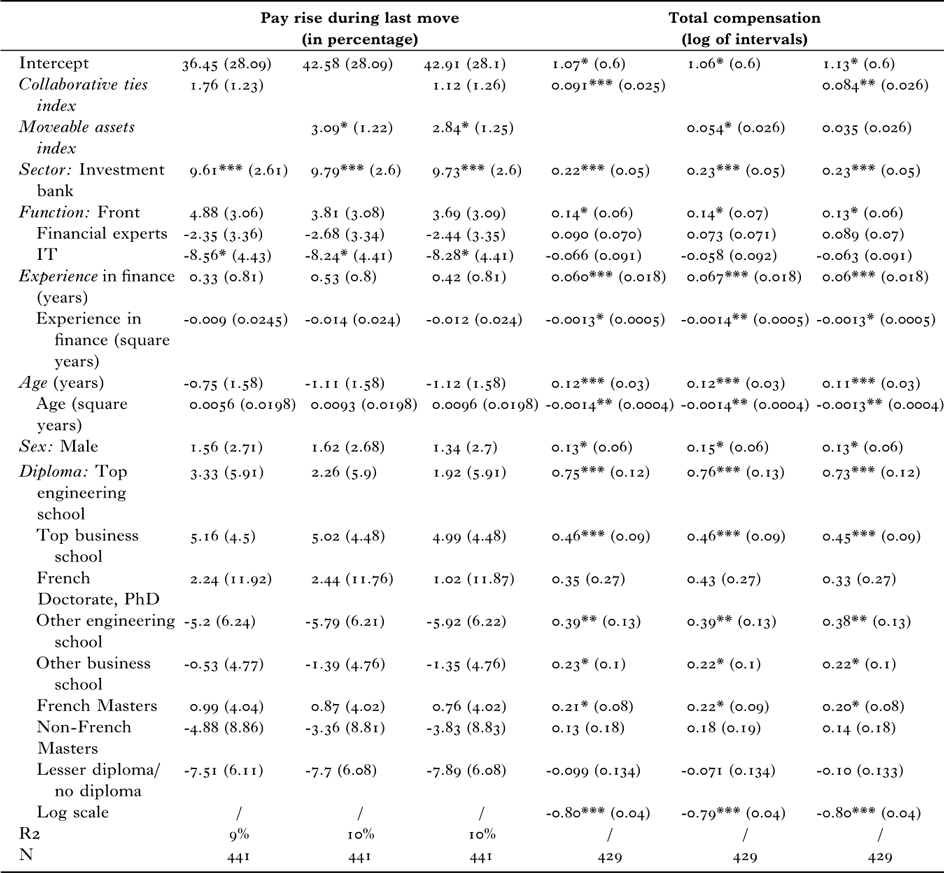
The average pay rise obtained during the last move amounted to 25%. Modeling this increase is rather difficult. One reason is that the pay rise in percentage terms may be quite a heterogeneous phenomenon: some pay rises may be large because the incumbents had a strong position on the market, for instance by holding key assets and many collaboration ties; others may be sizeable only because the incumbents previously received a very low wage. Therefore, traditional variables of wage equations such as age, experience and diploma do not seem to play a significant role. Nevertheless, in the financial industry, position is a key factor: moving in (or to) an investment bank increases the pay rise by 10 percentage points, and working in a front office also increases the pay rise by 4 or 5 points. That deviation is not significantly different from that of support functions, but differs significantly from IT jobs. A standard deviation variation of the collaborative ties index increases the pay rise by almost 2 points. But our variable is not very significant (p = 0.16). A standard deviation of our asset moving index has here a stronger and much more significant effect (+ 3 points).
Analyzing the logarithm of total compensation provides more classic results similar to many wage-equation estimations (Mincer Reference Mincer1974). Although it is not possible to calculate a classic R2 with interval regressions, we expect our model to provide an adequate pictureFootnote 9. As usual in wage equations, human capital, especially with our detailed grid of French diplomas, age and experience, has a high explanatory power. Students from the top engineering schools command a double the salary (exp (0.75)) of a bachelor diploma (“licence” degree in France). But those human capital equations do not fully explain the variance. Working in front office functions, and notably in investment, gives leads to a wage rent respectively of 14% and 25%. Finally our index of collaborative ties has a strong and significant impact on wages. A standard deviation in collaboration ties raises wages by 9%. At a slightly lower 5%, the moveable assets index also has a significant impact. Measuring simultaneously the effect of the two variables shows both similar figures and highlights the fact that collaboration ties have a rather long-term impactFootnote 10.
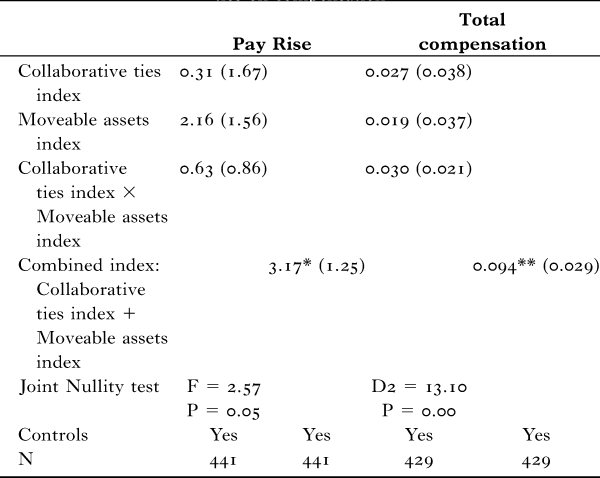
In Table 7 we test various combinations of collaborative ties and moveable assets. We find a positive effect of the interaction of collaboration ties and moveable assets on both pay rise and total compensation. But, in both cases, the interaction controlled by the non-interacted variables is not significant. It should be noted nevertheless that estimating highly-tied variables on a rather small sample may lead to some autocorrelation that increases standard estimates and leads all three variables to become non-significant. Although the joint nullity test shows that the three variables jointly add some significant information, the effect of the three variables becomes difficult to disentangle.
Effects of the combination of moveable assets and collaboration ties on compensation
Note: We model the impact of different types of relations on pay rise and on total compensation. All four models contain the following control variables: sector, function, experience in finance, age, sex and diploma. We model the percentage of compensation increase during last move with OLS regressions. We model the logarithm of present compensation with interval regression. Standard errors are in parenthesis.
*p < 0.1, **p < 0.01, ***p < 0.001.
The difficulty of disentangling collaborative ties and moveable assets leads us to build a combined index as the standardized sum of moveable assets and collaborative ties. This combined index has an even stronger effect on immediate pay rise than the moveable assets alone. Similarly, it has a stronger effect than collaboration on total compensation.
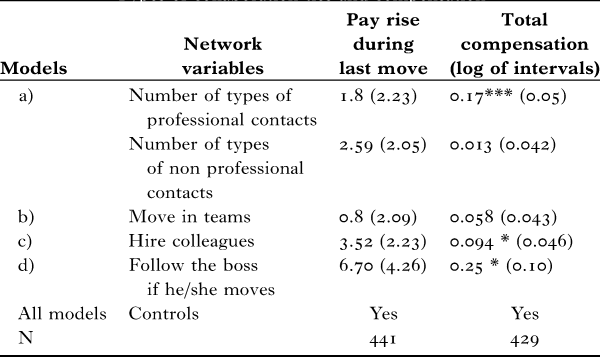
Finally Table 8 enables us to see the different dimensions of collaboration ties. We find the same difficulty in explaining the immediate pay rise with various forms of collaboration ties. Some variables are nevertheless borderline significant (p = 0.11): helping to hire one former colleague increases the pay rise by 3.5 points. Similarly, among those who have never moved, those who are ready to follow their boss expect a pay rise that is 6.7 points higher than the others.
Types of collaboration ties and compensation
Note: We model the impact of different types of relations on pay rise and on total compensation. All eight models contain the following control variables: sector, function, experience in finance, age, sex and diploma. We model the percentage of compensation increase during last move with OLS regressions. We model the logarithm of present compensation with interval regression. The two models in line d) concern people that have never moved. The pay rise is therefore the expected pay rise. The independent variable is readiness to follow the boss if the latter moves and invites to join. Standard errors are in parenthesis.
*p < 0.1, **p < 0.01, ***p < 0.001.
The long-term impact of various collaboration ties on pay is much more significant. Almost all collaboration ties have a positive and significant impact (at a 10% significance threshold) on pay. Knowing at least one business partner or one former colleague in the hiring team raises pay by 17%. The difference with non-professional ties is striking here. Those non-collaborative ties, whether be they strong (friends) or weak (classmates, others) add virtually nothing. Similarly, compensation increases by 9.5% per former colleague recruited. Among those who have never moved, those who are ready to follow their boss obtain 25% more.
These results globally allow us to consider that our last hypothesis, ie that moveable key assets, collaborative ties and a combination of the latter increase salary, is clearly confirmed by our data. If we compare fieldwork analysis and statistical surveys, we could have expected a more impressive premium in favor of those two closely related dimensions. This nuance calls for a few remarks. First, our sample, with its junior bias, does not enable us to capture the most spectacular hold-ups. Second, our measure of collaboration ties, and moreover of key moveable assets, is far from precise. This classical error in variables leads to an attenuation effect that reduces the absolute value of regression parameters. Third, the amplitude of the effect is not that small. If hiring a former colleague increases wages by 10%, a head of desk who hires his whole team of 10 employees increases his wages by 100%. And we can imagine that two heads of a trading room, as in our previous example, moving potentially 100 traders and sales agents, could multiply their wages by 5.
Concluding remarks
We have shown that, within the financial industry, position at the core of financial markets leads to a double accumulation of moveable assets and collaboration ties and that these two factors, dynamically reinforcing one another, contribute to successful job moves and to higher salaries. These factors contribute to solving part of the financial industry wages puzzle. This statistical demonstration knows some limitations. As in many studies, we did not identify any evident exogenous instrumental variable, and our result could still be due to some unobserved heterogeneity. Nevertheless, although empirical demonstration is not perfect and although it needs further work, confirmation of our results—even when we control for a detailed human capital nomenclature and for position within the firm—pleads in favor of the robustness of our argument.
Collaboration ties are not only important for the study of the financial industry: they are relevant in other sectors. We can expect their role to increase with the cooperative nature of work and its idiosyncratic nature, and with the moveable assets at stake. Therefore those relations will play a role in sectors that are not adequately protected by enforceable property rights or by patents, especially in service to business. Although work contacts may still be viewed as informational weak ties or deliberate and influential strong ties, and they help to find a job without being personally involved in some kind of pursuit of past collaboration, it is likely that part of the work contacts usually viewed as weak or strong are in fact collaboration ties. In this paper, we have considered work contacts mainly as dyads and we did not explore the broader form of network that makes collaboration ties valuable. Must they be relatively cohesive or non-redundant? This issue is partly contingent on technology and the way it coordinates people (Podolny, Baron Reference Podolny and Baron1997; Hansen et al. Reference Hansen, Podolny and Pfeffer2001) but also on the position in the group. In the financial industry, building closed and tied networks creates a strong group solidarity and builds a team ready for defection on the one hand (Lazega Reference Lazega2001). On the other hand, for the leading head of desk or head of trading room, maintaining some structural holes between the main deputies avoids the possibility that the deputies form a coalition against the leader and maintains his/her preeminence and his/her indispensability for engineering a collective move. This analysis therefore suggests a tradeoff between brokerage and closure (Godechot Reference Godechot, Savage and Karel2008b) that is slightly different from that established by Burt (Reference Burt2005). Further research is needed in order to establish the factors that determine equilibrium in the collaboration ties framework.