1. INTRODUCTION
In 1772, a Worcester newspaper included a notice which read:
It may be necessary to caution the Public against the impositions of a Scots Genius, who has figured away here as a Major on Half-pay. He goes to mercers shops, bespeaks fine cloaths, and gives orders to tailors, hatters etc and then takes the opportunity of slipping off without settling his accounts. He is a tall genteel fellow, about five feet ten inches, long visaged, with his hair dressed in the macaroni taste, and when he went off from hence had only an old black coat and waistcoat, a white cloth waistcoat laced with silver, white ticken breeches, and silk or thread stockings.Footnote 1
The apparent concern over these fraudulent acts underlines the finely graded and highly fluid nature of English society in the eighteenth century. Of particular significance to the problems of social classification was a relaxation of the definition or even, for traditionalists, a debasement of gentility. Shifts across class boundaries, particularly between merchants and the landed elite, are familiar from earlier periods, but many commentators have suggested that they became more pervasive and more corrosive of genteel status in the seventeenth and eighteenth centuries.Footnote 2 Traditional notions of birth remained important, and few could argue with the status conferred by a coat of arms. If some minor gentry were uncomfortable with the idea of living up to the expectations and unwilling to engage in the expense which active use of such honours often entailed, many others sought out these distinctions, buying into country estates either as status symbols or safe financial investments.Footnote 3 Marriage as well as heredity could cement or confer status, but this made the provincial elite a highly permeable group, as title was wedded to money – a social phenomenon remarked upon by many contemporaries, including Daniel Defoe.Footnote 4
Penelope Corfield has argued that rival interpretations of gentility (Tory and Whiggish, traditional and progressive, restrictive and inclusive) were vigorously debated in the contemporary literature and played out in the practicalities of everyday life. She suggests that traditional lines of demarcation became increasingly blurred from the seventeenth century, not least as the heralds were increasingly by-passed.Footnote 5 In the absence of such established markers, what was it that bound together the elite of provincial England? In a modern context, Michael Woods has argued that the three crucial factors in elite definition are their access to resources, discursive construction and networking.Footnote 6 Resources or income has always been critical in determining status, with its source as well as its magnitude being significant. Traditionally, the gentry and nobility drew their wealth from unearned income, most especially from their landed estates, and they thus had the ability to ‘live idly’.Footnote 7 This emphasis on lifestyle became increasingly widespread in the eighteenth century, overshadowing more traditional measures of status, so that, as Corfield argues, a gentleman was defined by his manners, accomplishments and appearance, rather than his birth.Footnote 8 As one contemporary commentator with a Whiggish perspective put it: anyone with ‘either a liberal, or genteel education, that looks gentleman-like … and has wherewithal to live freely and handsomely, is by the courtesy of England usually called a gentleman’.Footnote 9 One aspect of this was a material culture which emphasised the display of wealth, taste and discernment, both on the body and in the home. Another was the growing emphasis on a ‘liberal education’ and on politeness and/or sensibility.Footnote 10 On bases such as these, distinctions of status were often slender. They were made even more difficult to judge by the increase in social mobility brought about by ‘new’ sources of income (commerce, industry, military pensions and the like) and the growing commercial availability of goods and services. If status was judged, inter alia, in terms of material possessions and personal attributes which could effectively be purchased (or, in the case of our ‘Scots genius’, affected), then gentility was attainable by a broad section of society. Under such circumstances, who was to be deemed genteel, and what made them so?
These anxieties greatly occupied writers from at least the seventeenth century, with particular concern focusing on the ‘city’ or ‘town’ gentry who had few pretences of land ownership or armorial dignity.Footnote 11 For the early modern period, this group has been equated with the corporation, its identity in effect being constructed discursively through their engagement with public office. Francois-Joseph Ruggiu has argued this for Chester, paralleling John Beckett's suggestion that both aristocrats and newcomers to the landed gentry sought advancement through the honours or acceptance from their established neighbours through serving in public office. It also echoes the more general suggestion that office-holding was important in bolstering the social standing of individuals in the national, regional and local context.Footnote 12 It is true that, in the corporation records of many towns, councilmen were referred to as ‘gentlemen’ and aldermen as ‘esquires’. However, the extent to which these labels held credence outside the council chamber is uncertain and, in any case, the situation after 1660 was far more complex and fluid than this simple equation would allow. For Alan Everitt, the urban gentry comprised townspeople of independent means, including retired merchants and professionals, who styled themselves ‘gentleman’ without necessarily adopting the lifestyle of the landed gentry. Corfield has placed greater emphasis on those actively engaged in trade or professions, including the military, the church and especially the law.Footnote 13 Some contemporary commentators, though, drew a clear distinction between these two groups. John Locke argued that trade was ‘wholly inconsistent with a gentleman's calling’, whilst Joseph Addison remarked that impecunious younger sons would rather ‘be starved like Gentlemen, than thrive in a trade or profession that is beneath their quality’.Footnote 14
Many modern scholars have followed this lead, John Smails arguing that the northern middling sort defined themselves largely in opposition to the gentry, a viewpoint which echoes the earlier conclusions of Leonora Davidoff and Catherine Hall about the middling sorts in Suffolk, Norwich and Birmingham.Footnote 15 Yet, as Corfield has argued, the emergence of the urban gentry blurred these boundaries in polemic and practical terms, not least because they drew their membership from both constituencies. The recent emphasis on the upwardly mobile professionals and tradesmen, and the routes by which they rose the social ladder, has meant that few have attempted to link this ‘arrivistes’ group to the members of the landed gentry living in the town, and thus to view the urban gentry as a whole.Footnote 16 Thus, we know surprisingly little about their collective position in urban society; their role in mediating between town and country, or between traditional and new forms of social interaction and material culture; or even their identity. Like the minor gentry studied by Amanda Vickery, they seem to ‘inhabit a social no-man's land’ between the landed gentry and the urban middling sorts.Footnote 17
Recovering the complete history of this social stratum is clearly beyond the scope of a single paper. My aim here is more modest: to examine the identity and social worlds of the ‘urban gentry’ of Chester between 1680 and 1760. I do not suggest that Chester is necessarily representative of England as a whole, but it did experience a set of economic, social and political changes that were seen across many provincial towns. Its status as head-port for the region was lost to Liverpool and many of its traditional industries were in slow decline. In their place grew a range of commercial and cultural functions, characteristic of what Angus McInnes calls leisure towns. The service sector expanded significantly – especially in terms of professional services and the provision of luxury or semi-luxury goods – and the built environment was improved both through street cleansing and lighting, and through a widespread architectural makeover. Chester was thus at the heart of Peter Borsay's English urban renaissance.Footnote 18 If population growth was comparatively slow, the city was increasingly seen as a prosperous and attractive place. It formed a service centre for a hinterland that incorporated much of north Wales as well as Cheshire and parts of neighbouring counties; an administrative centre for the county; a garrison town, and the seat of an extensive diocese.Footnote 19 There was, therefore, both ample opportunity for the socially ambitious tradesman or professional to prosper, and much to draw in the gentry (or their sons) from the surrounding countryside. Chester was a different kind of place from the growing industrial towns that often form the subject of analyses of (middle) class formation. It lacked a large and coherent body of wealthy industrialists of the kind who dominated economic, social and political life in eighteenth-century Leeds, and even the manufacturers of more modest means who played such a pivotal role in the social transformation in towns such as Halifax and Birmingham.Footnote 20 Indeed, its corporation even resisted moves towards industrialisation in the early nineteenth century.Footnote 21 Conversely, the corporation offered another route to social advancement that was absent in many industrialising towns, albeit one that was complicated by the variable and shifting relationship between local and national politics, especially in the Restoration period.Footnote 22
Given the absence of an emergent industrial bourgeoisie, the first issue to address is the extent and socio-economic make-up of the urban gentry. Were they primarily men who had risen through the ranks of society on the basis of their ‘political engagement within municipal institutions’, as Ruggiu argues, or were they a more heterogeneous group, as Corfield suggests?Footnote 23 In short, can they be defined in terms of their construction through political engagement or their resources? Building on this, my second aim is to reconstruct something of their social affiliations. Who did they know and trust – were kinship, friendship or professional ties most evident? How did they mix with other members of Chester's elite: merchants, professionals and the like? Linking the answers to these questions with ideas from social network theory can provide important insights into the identity and consciousness of this section of the urban elite. It allows us to assess the extent to which members of the urban gentry were defined through their social connections – perhaps in a way similar to that experienced by the middling sorts.Footnote 24
2. DEFINING THE URBAN GENTRY
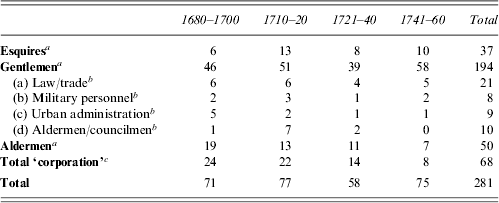
I begin my analysis by allowing the urban gentry to be defined by themselves or their close family and friends, taking status designations from the probate records for Chester between 1680 and 1760. The study group comprises all those listed as gentleman in the probates proved at the consistory court in Chester or the prerogative courts at York and Canterbury. It numbers 194 gentlemen (plus 37 esquires and 50 aldermenFootnote 25): around two-thirds of whom left wills, the others having inventories and/or administration bonds (Table 1). This is by no means a comprehensive listing of all the ‘gentlemen’ living in Chester through this period. Internal evidence from the probate documents points to the existence of other Chester residents (recipients of bequests and executors of estates amongst them) who were styled ‘gentleman’ and yet did not leave any probate records themselves. Moreover, a number of those for whom no status or occupation was recorded on their probate record were part of the urban gentry. Most significantly, the sample does not include gentlewomen: undoubtedly a significant body in towns such as Chester. Whilst they sometimes made wills, these women were never accorded any status labels beyond widow or spinster and so are impossible to identify using this methodology. Taking these figures at face value, there were between 50 and 70 gentry families (plus 12–18 families of esquires) living in Chester at any one time. This compares with Ruggiu's estimates of 22 gentlemen in 1665 (Hearth Tax), 40 in 1704 (Land Tax), 54 in 1747 (Poll Book) and 75 in 1781–2 (directory),Footnote 26 suggesting that these documents offer a more inclusive measure of gentry status than do taxation records.
The number and ‘occupations’ of urban gentry in Chester, 1680–1760

a Numbers for esquires, gentlemen and aldermen reflect status as given in the probate records.
b Subdivisions (a)–(d) are ‘occupations’ apparent from the Assembly Books and/or internal evidence from the probate records.
c Total ‘corporation’=aldermen+(c) urban administration+(d) aldermen/councilmen.
Sources: Probate records for Chester, 1680–1760; Chester Assembly Books.
To what extent were these men engaged in and defined by the civic life of Chester? As in many other corporate towns, Chester's corporation comprised an inner core of 24 aldermen and 40 councilmen who together made up the Assembly – Chester's formal corporation.Footnote 27 The councilmen were involved in civic business and some were members of committees charged with particular aspects of governance. It was the aldermen, though, who effectively ran the city: they had powers to make bye-laws, predominated at meetings of the Assembly, and elected the mayor from amongst their number – a crucial privilege given the influence invested in the mayor by the Great Charter granted to Chester by Henry VII in 1506. The obvious corollary of this was that the mayoralty reflected the social composition of the aldermen: they ranged from baronets such as Sir Richard Grosvenor (1715) and Sir Watkin Williams Wynn (1736), to shopkeepers including John Parker (1726) and Roger Massey (1734), with little discernible trend over time, except perhaps for the declining importance of merchants.Footnote 28 The corporation, and especially the aldermen, comprised a de facto political elite: one with considerable political power. Yet political engagement spread beyond members of the corporation: a significant number of the gentry took one of the numerous administrative roles within the town, especially in the late seventeenth century (Table 1). George Buckley, for example, served first as deputy clerk and then as clerk to the Pentice between 1659 and 1689, whilst Richard Adams filled a similar range of posts from 1691 to his death in 1712.Footnote 29 Several served in a succession of different posts, Isaac Sharp being notary public and then proctor of the consistory court.Footnote 30
Whilst important, this politically based aggrandisement does not appear to have underpinned the entirety of the ‘new’ urban gentry. Even if we assume that the majority of those listed in the probate records as ‘aldermen’ could also be styled ‘gentlemen’ (and there is strong evidence that at least some were known by their trade rather than being accorded ‘gentry’ status), the numbers are still easily out-weighed by those with no direct involvement in the political life of the town. The ratio of aldermen to gentry was greatest in the 1680s and 1690s. If we add together all those listed in the probate records as aldermen; those labelled as gentlemen, but who were also aldermen, and gentlemen acting in other administrative roles, the ratio was about 3:2, falling to 2:1 in the early eighteenth century and more rapidly to 7:1 by the 1740s and 1750s (Table 1). This is not to argue that political activity played no role in the construction of an urban gentry, but it does appear that such a focus seems too narrow and time-specific. As with the aristocracy and landed gentry, there was a growing number of routes by which individuals might enter the ranks of the town's gentry.Footnote 31
One possibility, already highlighted, was via the professions. Law, along with the clergy, was often favoured for the younger sons of landed gentry. This was the case for Henry Prescott and probably Edward Cooke and John Farrar.Footnote 32 Yet, even if attorneys were not gentry by birth, then their profession, wealth, connections and attributes often made them de facto gentlemen. Indeed, when enrolling before the law courts, all lawyers were designated as gentlemen, making the claim to this status strong and widespread. Corfield notes that nobody voting at the 1734 election in Norwich called himself an attorney: 22 of the city's 30 enrolled lawyers did vote, but each one styled himself ‘gentleman’.Footnote 33 Similarly, the probate records for Chester quite legitimately mask many attorneys as gentlemen. Another significant group often accorded genteel status were military men, either active or retired. Being a garrison town, Chester had many of these, including John Robartson, a captain of the garrison, and Thomas Sheppard, an ensign in the company of invalids. As with law, commissions in the military were a favoured option for placing younger sons in remunerative and relatively high-status positions.Footnote 34 This seems to have been the case for John Wickstead, whose father was a gentleman from Chester, and Thomas Parker, who named a kinsman, also a gentleman, as executor. Others, though, were career soldiers and appear to have risen from more lowly backgrounds. Again, it was the position that these men held, rather than their birth, that gave them claims to be gentlemen.
Notwithstanding Locke's assertion, success in trade offered an alternative route to urban gentry status.Footnote 35 A large number of Chester gentlemen appear to have been actively engaged in trade and probably sought (and gained) aggrandisement on the basis of their wealth and connections in Chester and beyond. These men were the embodiment of the kind of mercantile ambition voiced in a 1722/3 play by Richard Steele: ‘we merchants are a Species of Gentry, that have grown in the World this last Century’.Footnote 36 Typical of their number was Matthew Anderton, a merchant in the trade with Ireland. He had a house and shop on Bridge Street, £70 of silver plate and £10 of table and bed linen, and counted gentlemen, merchants and shopkeepers amongst his friends. Despite his trade, he was acknowledged as a gentleman. So too were Henry Jackson, who appears to have plied an extensive trade in slate and coal, and John Hicock, who traded in malt and owned a kiln worth £50.Footnote 37 Two things were significant about such men. The first is that few of them had apparent direct links to the political or administrative life of Chester. The second is that they were rising to the ranks of the gentry from the late seventeenth century – well before the switch from a political to a cultural–economic definition of urban gentry, identified by Ruggiu as occurring from the 1740s.Footnote 38 Indeed, as early as the 1680s there were as many gentry engaged in trade or the law as in urban administrative functions, the proportion in trade rising significantly from the 1720s. This reflects an even earlier trend in London: Corfield notes that the 1172 ‘gentlemen’ presented to the heralds in 1633–5 included at least 696 merchants, 67 lawyers, 29 medical men, 14 city officials and four churchmen.Footnote 39
Of course, the most obvious route into the urban gentry – and the one that appears to have been most common in Chester – was to be drawn from the families of the landed gentry. To the likes of George Booth, whose father and grandfather were both knighted, and John Grosvenor, the brother of Sir Thomas Grosvenor of Eaton Hall, we might add men such as Richard Minshull, who appointed three kinsmen, all esquires, as his executors.Footnote 40 Such men were living in the town from preference or for economy, but formed part of an essentially leisured group whose wealth derived from land and/or investments.Footnote 41
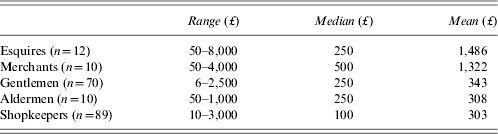
The socio-economic diversity amongst urban gentry is reflected in their widely different levels of wealth (Table 2). These values are taken from probate inventories that include personal goods, stock-in-trade, book debts, bonds and so on, but generally exclude real estate.Footnote 42 As such they are significant, if variable, underestimates of what these men were worth.Footnote 43 Moreover, as probate records rarely indicate the stage of lifecycle when people died, it is impossible to know whether an individual was at the height of their economic power or in more straightened pecuniary circumstances, perhaps linked to old age. Despite these shortcomings, they are useful in allowing an insight into wealth levels and comparative figures for other social groups. The first thing to note is that, on average, gentlemen were distinctly less wealthy than both esquires and merchants. They were in the second tier of wealth, broadly comparable with aldermen and shopkeepers. For example, John Kenrick (gentleman), William Starkey (alderman) and Joseph Bowker (draper) were each estimated to be worth about £2,000 on their decease.Footnote 44 This lack of a clear financial distinction was compounded by the huge range of personal wealth recorded in each group. Just as there were substantial and lesser shopkeepers and merchants, there were wealthy and impecunious gentlemen. Several were worth well over £1,000 in personal property and had extensive holdings of real estate. For example, Peter Cotton's inventory ran to a total of £1,290 8s 6d, in addition to his land holdings, whilst John Ridge had land in Tattenhall in Cheshire and Denbighshire as well as personal property of about £630, including £200 in ready money. At the other extreme, Isaac Tipping's administrators estimated that he was worth just £20; John Vernon had only £16 8s of property, £4 10s being ‘money oweing from prisoners within ye Castle of Chester’, and Seth Mort could muster only £5 15s 10d.Footnote 45
Wealth levels of selected social and occupational groups in Chester, 1680–1760

Source: Probate inventories for Chester, 1680–1760.
The financial standing of these various gentlemen was clearly very different from one another and undermines any simple equation of resources with social status. As Thorstein Veblen and Pierre Bourdieu have argued, what mattered was the nature, and not simply the level of spending.Footnote 46 At a basic level, it is apparent that certain modes of spending and types of goods allowed an individual to accumulate and display their taste, and thus distinguish themselves from other social groups. For Bourdieu, what marked out those with high levels of cultural capital was not their ownership of costly items, but of goods which could only be appreciated by individuals with the right knowledge and education. In this way, gentility can be linked to certain modes of consumption (including an appreciation of the arts and literature), and particular cultural values: elegance, civility and propriety.Footnote 47
It is not my intention here to explore in detail the consumption patterns of the gentry or other social groups.Footnote 48 However, two points are worth noting. The first is that Lorna Weatherill's aggregate analysis suggests that members of the gentry were important consumers, but not necessarily distinctive in their consumption practices. The goods that they owned differed relatively little from those of wealthy tradesmen and professionals, who were perhaps the most innovative consumers. That said, and this is my second point, some small but significant distinctions do emerge in terms of the goods owned by gentlemen, and their placement within the house. These were often more ‘traditional’ goods – objects which had long been associated with the landed gentry. Guns and swords, whilst rare across the range of social groups, were most frequently found amongst the urban gentry. Swords had long been a badge of gentility, to be worn in public and used in the defence of honour. Both practices were in decline, especially amongst the polite urban classes, but in 1755 the Gentleman's Magazine could still rail against the ‘Men of Honour, who make fighting their business, and cannot let their swords rest quietly in their scabbards’.Footnote 49 Whilst this is a caricature of metropolitan experiences, it is clear that the ownership of swords persisted amongst the gentry of provincial towns.Footnote 50 Guns, meanwhile, were becoming more common. Their chief use was in sport, thus linking the urban gentry to the leisure pursuits of their landed rural counterparts. The personal nature of both items is apparent from John Farrar's inventory, a lengthy list of household goods concluding with three fowling pieces worth £3, wearing apparel worth £5, and a rapier worth £1 10s.Footnote 51 Silverware was another traditional marker of status which, whilst it was far from being the exclusive domain of gentlemen, appears more often and in greater quantities than in the inventories of other groups.Footnote 52 John Ridge had £33 7s of silver plate; John Hicock had £49 11s 4d, and Matthew Anderton about £70 – over half the total value of his personal estate. In comparison, the wealthy upholsterer, Abner Scholes, had rather less (£19 4s), whilst the grocer, Thomas Moreton, apparently possessed none.Footnote 53
Books were also well established as markers of status, but were also linked to the world of learning and were thus symbols of social distinction. They were unusually prominent and numerous in the inventories of gentlemen (and not just gentlemen-attorneys), their relatively low value masking the large numbers that were often owned. William Raven's 42 octavo, 29 quarto and three other books were together worth £4 14s 9d, which gives a measure of the sheer size of Francis Harpur's collection which was valued at £30. What was most interesting and distinctive about the gentry's ownership of books was their frequent placement in a specifically itemised closet. John Ridge had books, shelves, and a table and chair ‘in the closet’, whilst William Cooke's contained chairs, boxes of drawers, curtains, books, a desk and pewter standish.Footnote 54 These closets were the forerunners of the library in many country houses, and formed dedicated and private spaces for reading and study as well as repositories for some of the most personal and cherished goods.Footnote 55 In constructing such domestic material culture and spaces, the urban gentry were echoing the cultural and social practices of their country cousins, and perhaps distancing themselves from their shopkeeping neighbours, despite – or perhaps because of – their own origins amongst such people.
It is clear that members of the urban gentry were defined by many different criteria: by their wealth and material culture, and in terms of their self and collective construction as gentlemen. Such identity might be expressed through subjective notions of virtue, manliness and honour, and performatively, through behaviour as gentlemen.Footnote 56 It was also articulated through the labels that they and others accorded them on official documents, and through their holding of ceremonial and administrative offices in the town. Yet, as Woods suggests, collective identity was also constructed through and reflected by their social bonds: who they trusted and counted as friends. It is to these social affiliations that we turn to next.
3. FRIENDSHIP AND TRUST: SOCIAL NETWORKS OF THE URBAN GENTRY
Social networks are problematical objects of historical enquiry. Conceptually, we must ask ourselves how a network is to be defined: who were members and what made them so; where do the boundaries of a network lie; were networks multifaceted or discrete?Footnote 57 Social network theory offers a number of possibilities in this regard, from the so-called ‘six-degrees of separation’, used by economists to explore the ‘small world’ phenomenon, to complex computer-generated reconstructions of whole networks.Footnote 58 The latter have proved more attractive to historians, who have focused on mapping the members (or nodes) of a network and the ties that bound them together, and on understanding the ways in which networks comprise key social structures.Footnote 59 My approach here follows a similar course, as I seek to reproduce something of the web of connections that enmeshed individuals and articulated the construction of the urban gentry in Chester. This brings the practical problem of finding evidence of social links. Church wardens' and corporation accounts, diaries and correspondence, membership lists and business accounts have all been used for this purpose. Here, I follow Shani d'Cruze and others in using probate records to identify at least some of the ties between Chester's urban gentry.Footnote 60 The nature and use, as well as some of the drawbacks of these documents, have been discussed in detail elsewhere.Footnote 61 Briefly, the executors, witnesses and the recipients of legacies and post-mortem gifts identified in probate records form a useful proxy for the core friendship networks of individuals and a good picture of the networks of close social and economic interaction which bound together individuals and places.
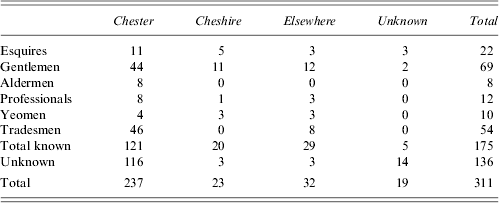
To further analyse the probate links of Chester's gentry, Table 3 presents the socio-economic status and geographical location of those named as executors or administrators in the probate records of gentlemen. Unsurprisingly, it was other gentlemen that predominated, accounting for about 39 per cent of executors for whom occupations are known, rising to 52 per cent if esquires are included. Of these, the majority were neighbours in Chester. The urban gentry thus drew on a circle of trusted friends that were spatially and socially proximate to carry out a task that necessarily brought them into social and economic intimacy with the testator and his family. Much the same was true of other groups in Chester. The shopkeepers of Eastgate Street were enmeshed in a particularly intense network, nearly half identifying executors from amongst their neighbours. Unsurprisingly, perhaps, it was other shopkeepers that dominated: of those whose occupation can be traced, half were retailers, another fifth being craftsmen.Footnote 62 The much smaller group of merchants were, of necessity, forced to look outside their own group of fellow businessmen rather more. Yet one-quarter still turned to other merchants to act as their executors.Footnote 63 In network terms, this ‘bonding capital’ – that is, links between people of the same gender, social background or ethnicityFootnote 64 – gave a degree of cohesion to different social groups. Whilst individuals clearly had multiple strands to their identity, this evidence suggests that the urban gentry were at least aware of their status as gentlemen and sought out others of a similar standing perhaps as friends, certainly as people to trust with the delicate and personal task of administering their estate post mortem.
Executorial links of Chester gentry, 1680–1760, by status and location of contact

Source: Probate records for Chester, 1680–1760.
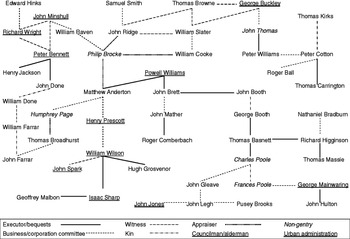
The structure of the network of urban gentry is illustrated by Figure 1, which includes a range of different types of social ties. Some individuals were linked into the network largely through executorial duties (for example, Thomas Basnett), whilst others were tied in because they operated as appraisers for several gentlemen (Philip Brocke). Most enjoyed a variety of links, as exemplified by Matthew Anderton who received a bequest from Powel Williams, had his will witnessed by Henry Prescott and Humphrey Page, whilst Philip Brocke acted as an appraiser of his estate. Such links highlight the importance of direct relationships between individuals in building up a network. However, the diagram also illustrates the way in which indirect relationships (those effected through mutual friends) linked people and helped to provide a distinctive social milieu to the urban gentry. Certain individuals appear to have played particularly important roles in bringing together the network of urban gentry. Peter Cotton, William Slater, William Wilson and Peter Bennett all stand out, having links with four or more other members of the gentry. These might be seen as ‘community brokers’ whose reputation was enhanced by their centrality to bonds of trust and regard. But we can also follow Bourdieu in viewing them in more self-interested terms: as individuals who boosted their own power through their centrality to social networks and their accumulation of social capital.Footnote 65 For example, William Wilson (gentleman, alderman and deputy registrar of the consistory court) served on an Assembly committee alongside his fellow alderman John Spark; named Hugh Grosvenor, esquire, as one of his executors and had his will witnessed by Henry Prescott, a notary and deputy registrar of Chester diocese.Footnote 66 In reality, their role was probably less pivotal than this centrality implies: most gentlemen had recorded ties with at least two others and it might be argued that ‘bridging’ links tying together separate branches of the network were as important as these apparently central ‘hubs’. Most obvious in this regard is the link between John Brett and John Booth, without which the network of urban gentlemen would be split into two halves. Significantly, for my argument about the relationship between networks and status, these bridges could be made by links with the non-gentry, as with John Thomas and Charles Poole.
Structure of the network of urban gentry in Chester, c. 1680–1760.

This points to the complexity of the networks that enmeshed the urban gentry. Figure 1 is drawn too neatly: the network which enmeshed Chester's urban gentry had infinitely more connections and loose ends; its social and geographical boundaries were highly permeable. Links with individuals outside Chester were recorded for many gentlemen, with ties to the countryside being particularly significant (Table 3). Many testators appointed executors from surrounding villages, notably in north Wales, where a number of Chester's elite had their origins.Footnote 67 Some marked their obligations and affiliations by leaving bequests to relations and friends, charities and churches in the countryside. George Mainwaring, for example, gave token gifts to seven named individuals spread across central Cheshire; Thomas Browne left money for the poor of Heswall on the Wirral, and Peter Cotton gave a total of £150 to the school, church and poor of Witton, near Northwich.Footnote 68 Others amongst the urban gentry had more sustained contact with the surrounding countryside. John Farrar's inventory, sadly half missing, itemises hundreds of small debts that linked him to a network of individuals across Cheshire and north Wales. The precise nature of many of these debts, and therefore Farrar's relationship with his debtors, remains unclear. Some are marked as bonds and bills, but the vast majority, for sums ranging from 1s 4d to £39 13s 8d, are simply described as ‘desperate’, and probably reflect book debts of some kind.Footnote 69
In these respects, of course, the urban gentry were not unusual. Several of Chester's merchants left legacies to the church or the poor of their ‘home’ parish and many shopkeepers had customer networks that incorporated rural as well as urban consumers.Footnote 70 However, their links with the surrounding districts had a more direct bearing on the social identity of Chester's urban gentry and on their standing in the town. Indeed, it is possible to see this ‘linking’ social capital (i.e. bonds with ‘unlike people in dissimilar situations’Footnote 71) as central in defining gentry status and identity. One aspect of this was the tendency for urban gentry to possess land in the surrounding countryside as well as houses in Chester itself. This frequently involved buying or leasing property from other gentlemen, rural squires and baronets, but also from yeomen farmers. Thus, John Gleave leased his tenement and messuage in Acton from Sir Robert Cotton; Edward Hinks purchased houses in Fleshmongers' Lane from Sir Peter Warburton and Sir Roger Mostyn, and William Wilson purchased land in Aldford and Churton from the yeomen George Bostock and Peter Fletcher. Some, in turn, leased their property to tradesmen, as appears to have been the case with George Buckley's tenement in Chester.Footnote 72
A second, and still more revealing insight into the importance of rural links can be gained from the 1709 funeral arrangements of Peter Williams. These both reflected and reinforced his social status and his wide connections. The coffin, corpse and mourners were carefully prepared: £2 18s 6d was spent on making and lining the coffin; £9 16s went on a crêpe suit for the corpse and on scarves and hat bands for the mourners; a further £6 15s went on gloves, and £3 4s on buying and carving the gravestone, and interring the body. More telling in the context of the current discussion, £5 3s was laid out on ‘provisions for friends many persons of Quality that came from ye Countrey to ye funerall’. A further 13s was paid to Thomas Leigh for ‘ordinarys and drink and hay for ye vulgar sort that came out of ye Countrey besides ye Gentry provided for at ye testators house’.Footnote 73 This was more than an exercise in conspicuous consumption, although it clearly formed an impressive display of wealth, taste and influence. It also acknowledged and celebrated Williams' links with the gentry and the ordinary people from his home area, and his importance to them: they felt the need to come into town for his funeral. These things were clearly important in cementing his identity as part of the patrician classes in Chester.
Rural links were clearly significant in defining the identity and social worlds of Chester's urban gentry, but the broader patterns of their everyday interaction underline the essentially urban milieu within which they moved. Urban tradesmen accounted for 31 per cent of executorial links with men whose occupation is known (Table 3), suggesting that the urban gentry enjoyed close social ties with the emerging middling sort of the town. Moreover, numerous tradesmen appointed members of the gentry as their executors: 16 per cent of Eastgate shopkeepers and 37 per cent of Chester's merchants.Footnote 74 As we have seen already, the occupational and social distinctions between the urban gentry and the middling sorts were far from being clear cut, and for individuals, the open nature of their social worlds is readily apparent. For instance, George Ball, with an estate estimated at £1,000, appointed as his executors a clergyman and merchant as well as a gentleman, and Thomas Haddock asked a gentleman and a tanner to look after his affairs post mortem.Footnote 75 Further evidence of this bonding of the urban gentry and tradesmen comes from the wills of shopkeepers and merchants. Charles Mytton was particularly well connected, appointing his wife, a Chester gentleman and Richard Grosvenor, then one of the city's members of Parliament; but even a gardener, William Littleton, was confident in nominating two of the city's gentry as executors. That said, the strength of such bonds could sometimes be overestimated: the two gentlemen appointed by the silversmith, George French, renounced their authority.Footnote 76
The links revealed in the probate records reflect a wide range of different forms of interaction between the urban gentry and the middling sort. Some of this was an inevitable outcome of proximity: important even in a town of relatively modest proportions. Whilst a number of landed gentry owned houses in Chester, these were situated primarily on Lower Bridge Street, in the lanes west of Bridge Street and Northgate Street, and along Foregate Street.Footnote 77 In contrast, the urban gentry mostly lived on the principal thoroughfares – Eastgate Street, Northgate Street, Watergate Street and Bridge Street – along with shopkeepers, artisans, professionals and merchants. This spatial proximity was reinforced by public and private sociability, and by the patronage of shops – matters to which we shall return later – but also by professional, business and administrative connections. Those actively engaged in business sought out partners from amongst the gentry, but also worked with a wide range of tradesmen and professionals. The gentlemen John Ridge, William Slater and Thomas Browne were in business together in the early 1680s; whilst Richard Adams, then the town clerk, joined with another gentleman, Jonathan Robinson, in petitioning the corporation for permission to prospect for lead on land which it owned at Minera in north Wales.Footnote 78 These business arrangements, and the buying or leasing of property, also brought urban gentry into personal contact with local attorneys, who organised the conveyancing and, where necessary, arranged finance. The detailed personal and financial information held by attorneys perforce brought them close in social terms.Footnote 79
We have already noted the mixed social composition of Chester's corporation, which was characterised by a growing preponderance of tradesmen as the eighteenth century progressed. Serving in public office thus afforded the opportunity for building contacts and alliances, and for formal and informal sociability. Urban gentry served alongside merchants on committees established in the early eighteenth century to report on the silting of the river Dee and to co-ordinate subsequent attempts to introduce and manage navigation schemes.Footnote 80 They also sat alongside shopkeepers on committees charged with inspecting the corporation's expenses or considering the problems of unlicensed trading.Footnote 81 This drew these men together into a shared network of interest, the focus of which was the town itself. One apparent corollary of this was that sections of the urban gentry had a closer identity with the town, as manifest in their sometimes post-mortem gifts to urban institutions. Thus, Richard Adams and Thomas Cowper gave money towards the construction of the new town hall; Peter Cotton bequeathed £500 to the Blue Coat School; Robert Murrey left money to the Infirmary, and George Mainwaring and William Francis gifted silver plate to the corporation.Footnote 82 Attachment to place was also clear at a more local level, as a number of Chester's gentry left money to the poor of their particular parish. This was true of Edward Hinks (St Mary's), George Buckley (St Michael's and St Bridget's) and Geoffrey Malbon (Holy Trinity and St Olave's), whilst Peter Cotton made a gift of £10 to each of Chester's nine parishes.Footnote 83
These gifts indicate that at least some of the urban gentry were firmly embedded into their localities and felt a moral obligation towards them as communities. In this regard, as with so many others, they reflected the values of the gentry – loyalty to community and duty towards those less fortunate – but also those of their neighbours in town – for example, a sense of pride in urban institutions and traditions.Footnote 84 We should be wary, therefore, of placing town and country, or the landed gentry and urban middling sorts, as social worlds between which the urban gentry were forced to choose. They were able to bridge these seeming divides through their links with family and friends recorded in probate documents. There is much evidence that they did the same in their everyday lives.Footnote 85
Their intermediate and variegated social standing meant that the urban gentry – both as a collective grouping and as individuals – were in regular social contact with the landed gentry, the middling sorts and even the ordinary townsfolk. Ruggiu notes that George Booth was on good terms with the Earl of Warrington – their daughters appear to have been especially fond of one another – yet also mixed easily with aldermen and tradesmen in Chester.Footnote 86 Such sociability took place in and around formal settings such as courts of law, assemblies and social clubs, but also in less formal contexts: at shops, inns, coffee shops and friends' houses. The ease with which individuals moved between these social spheres and mixed with different social groups is best illustrated through the activities of Henry Prescott.Footnote 87 His professional duties brought him into regular contact with the great and the good of the town, the diocese and beyond. On 7 November 1704, he dined ‘at the Mayors in a great Company’; on 20 May 1705, he went with Sir Henry Bunbury and a number of aldermen to the shire hall for the parliamentary election, and on 13 June 1705 went with the mayor and aldermen to greet the Bishop, who was making a visitation to his diocese. This mixing with grandees was not restricted to formal occasions, however. Prescott's diary is littered with accounts of his drinking bouts with friends amongst the elite. On 26 November 1706, he dined at the mayor's ‘in a full company’ and then went to the Rose and Crown with a group of aldermen and gentry. Three days later, he was celebrating the 30th birthday of Sir Henry Bunbury at the baronet's house with a circle of mutual friends drawn from the elite of the town. These gatherings were often sizeable. On 18 May 1705 he went to The Raven with ‘Sir Tho. Billot, Sir Roger Mostyn, Sir H. Bunbury, Mr. Egerton, Mr. Shakerley, Mr. Bruen & 20 men, minor Gent. The near Elecion confusedly talkt on; 9 Bottles drunk, the company dissolv'd’. What is notable here is the easy nature of his social mixing and the distinctions he drew between baronets and his close circle and the more anonymous ‘minor gentry’.
Prescott was clearly a highly sociable creature and he easily found kindred spirits amongst his fellow urban gentry and members of county society. Yet his socialising was not limited to evenings spent drinking in local inns (and mornings spent regretting it: he often wrote of his ‘indisposicion’ or that ‘the wine hurt only by Quantity’). He regularly took tea or coffee with male and female friends, sometimes in company with his wife, Suzy, but often on his own. Thus, on 15 December 1706 he recorded that ‘after prayers Mr. Davies takes a dish of tea with mee, wee discourse matters’, and on 26 January 1709 he called on Lady Soames, where ‘my Suzy meets mee. Wee are treated with good Coffee, thence to dinner’. Rather like his London contemporary John Verney, Prescott mixed easily with various different social groups, including the middling sort.Footnote 88 He was on good terms with a range of shopkeepers, several of whom he counted amongst his friends. When his upholsterer Mr Croxton (who also acted as an appraiser, drawing up probate inventories of a number of the urban gentry) died in March 1717, Prescott attended his funeral at St John's. Significantly, he did not go on his own, but was accompanied by Alderman Hodson and others, suggesting that Croxton was a reasonably important figure and that his passing should be marked by the elite of the town. Prescott also had important links with the ordinary people of the town. His professional duties included the examination of witnesses, many of whom were drawn from the lower sections of society. But it is clear that his interest and compassion did not stop there. Numerous passing references are made to the fate and fortunes of his less wealthy neighbours. Many of them seem to be almost asides, as when he ends his entry for 11 November 1704 by noting that ‘John Cross the Joyner after 15 months absence in Scotland, returns to his Mother’. If Prescott was in any way typical of the urban gentry, they maintained a keen awareness of their own status and that of others, yet mixed freely with other social groups and acted with a generosity of spirit to those less fortunate than themselves.
4. CONCLUSIONS
The urban gentry were far from being an homogeneous or discrete social group. Nor, as both Corfield and Woods suggest, did they achieve their status through one single route. Political activity was important in promoting professionals and tradesmen into the urban elite, but so too was economic or professional success – a route which was, significantly, open from at least the Middle Ages and may have been trodden by growing numbers from the late seventeenth century. Regardless of their route up the social ladder, these men formed part of a broad urban elite that encompassed landed gentry, merchants, tradesmen and professionals. They ranged enormously in their material resources, from wealthy individuals with prominent and well-furnished houses to those with few possessions who were remarkably poor. By no means were all of them of independent means and many appear not to have owned land. Yet all styled themselves ‘gentleman’ and/or were seen as such by close friends and family. In part, their social standing was reflected in and signalled by their material culture which appears to have valued established symbols of taste, wealth and status. More significant in this regard, however, was their networking and their social capital. Chester's resident gentry in the late seventeenth and early eighteenth centuries drew their most trusted friends from a variety backgrounds and contexts, most notably other members of the urban gentry, but also the landed gentry, professionals and tradesmen. Links to the countryside remained strong and were important in cementing the status of resident gentlemen within urban society. Rural friends and relatives gave weight to (often implicit) claims to gentility and certainly bolstered displays of wealth and status, for example at funerals. However, the everyday contacts with townsfolk from all walks of life locked the urban gentry into the urban milieu. It was fellow residents with whom they primarily did business, shared interests and socialised. In arguing this, it is important to remember that – regardless of the rhetoric of political and social commentators at the time, and that of scholars today – for many individuals, these two worlds were not in conflict with one another. The urban gentry stood with a foot in two camps: those of the landed gentry and the urban middling sorts. They appear to have been quite comfortable with this position.
ACKNOWLEDGEMENTS
I would like to thank Penelope Corfield and Matthew McCormack for their helpful comments on an earlier draft of this paper.