1. Introduction
Tonalite–trondhjemite–granodiorite (TTG) suites, constituting up to 80 % of Archaean terranes worldwide, are critical components of the ancient continental crust (Martin et al. Reference Martin, Smithies, Rapp, Moyen and Champion2005). Moreover, TTG magmatism represents an important transition in a terrane that links the original mafic crust with the subsequent crust of a potassic granitic composition (Glikson, Reference Glikson1979), because it is commonly considered that TTG rocks are generated by partial melting of hydrated basalts and are the parent rocks of many potassic granites. Therefore, TTGs represent an essential element in the ‘protocontinental’ stage of crustal growth and evolution (Barker, Reference Barker and Barker1979), and thus can provide vital insights into understanding the crustal evolution and geodynamic regime.
A series of constraints from experimental petrology, phase equilibrium and geochemical studies have revealed that Archaean TTGs were generated by melting of hydrous metabasalts, but it is difficult to distinguish between melting of amphibolitic, garnet-amphibolitic or eclogitic sources (Arth & Hanson, Reference Arth and Hanson1972; Beard & Lofgren, Reference Beard and Lofgren1991; Rapp et al. Reference Rapp, Watson and Miller1991, Reference Rapp, Shimizu and Norman2003; Foley et al. Reference Foley, Tiepolo and Vannucci2002, Reference Foley, Buhre and Jacob2003; Xiong, Reference Xiong2006; Moyen & Stevens, Reference Moyen, Stevens, Benn, Mareschal and Condie2006; Moyen, Reference Moyen2011). In addition, the geodynamic setting for TTGs is still debated, and no consensus has been reached between various models, which include: hot subduction (Drummond & Defant, Reference Drummond and Defant1990; Peacock et al. Reference Peacock, Rushmer and Thompson1994; Martin, Reference Martin1999; Martin et al. Reference Martin, Smithies, Rapp, Moyen and Champion2005), thickened lower crust (Atherton & Petford, Reference Atherton and Petford1993; Smithies, Reference Smithies2000; Whalen et al. Reference Whalen, Percival, McNicoll and Longstaffe2002; Condie, Reference Condie2005; Nair & Chacko, Reference Nair and Chacko2008; Nagel et al. Reference Nagel, Hoffmann and Münker2012), delamination at the base of an oceanic plateau (Zegers & van Keken, Reference Zegers and van Keken2001; Bedard, Reference Bedard2006) or the possible involvement of a mantle plume (Arndt & Goldstein, Reference Arndt and Goldstein1989; Kröner, Reference Kröner1991; Kröner & Layer, Reference Kröner and Layer1992; Condie, Reference Condie2005; Willbold et al. Reference Willbold, Hegner, Stracke and Rocholl2009), and, furthermore, a new model involving the subduction of oceanic plateaus (Martin et al. Reference Martin, Moyen, Guitreau, Blichert-Toft and Le Pennec2014).
The North China Craton (NCC), the largest and oldest cratonic block in China (3.8 Ga; Wu et al. Reference Wu, Zhang, Yang, Xie and Yang2008; Zhai & Santosh, Reference Zhai and Santosh2011; Zhai, Reference Zhai2014 and references therein), carries a widespread Precambrian crystalline basement that predominantly comprises TTG gneisses. Therefore, the NCC is one of the best natural laboratories to study ancient crustal growth and evolution. In terms of substantive structural, geological, geochemical, geochronological and P–T data, the basement of the NCC can be tectonically divided into the Eastern Block (EB), the Western Block (WB) and the Trans-North China Orogen (TNCO) (Zhao et al. Reference Zhao, Sun, Wilde and Li2005). Previous studies have focused on the TTGs in specific areas of the NCC (see online Supplementary Material Tables S1–S4) and have proposed respective models to account for the petrogenesis and tectonic settings. However, a synthesis of the TTGs with different ages in each block is lacking, which hinders understanding the overall formation mechanism of the TTGs with different ages in each block and the geodynamic regime of crustal growth and reworking in the NCC. Therefore, in this study, we compile and synthesize the published geochemical data available, including whole-rock major and trace elements and zircon Lu–Hf isotopes of the TTGs with different ages from the basement rocks of the three blocks, in order to discuss the respective source and tectonic setting of these TTGs and then evaluate the crustal growth and evolution of the NCC. The results can possibly provide important constraints on the tectonic subdivision of the NCC.
2. Geologic setting
The NCC, the Chinese part of the Sino-Korean Craton, is the oldest and largest craton in China, with ancient crustal nuclei as old as 3.8 Ga (Liu et al. Reference Liu, Nutman, Compston, Wu and Shen1992; Wu et al. Reference Wu, Zhang, Yang, Xie and Yang2008; Zhai & Santosh, Reference Zhai and Santosh2011; Zhai, Reference Zhai2014 and references therein). It covers an area of c. 1 500 000 km2 and is bounded by the early Palaeozoic Qilianshan Orogen to the west, the late Palaeozoic Tianshan-Xing’an Mongolian Orogen to the north and the Qinling–Dabie–Sulu ultrahigh pressure (UHP) metamorphic belt to the south. Although remarkable advances have been achieved by recent studies and a broad consensus has been reached in understanding the crustal evolution of the NCC, the tectonic subdivision and timing of amalgamation of the NCC remain disputed issues (Wu et al. Reference Wu, Geng, Shen, Wan, Liu and Song1998; Zhao et al. Reference Zhao, Wilde, Cawood and Lu1998, Reference Zhao, Wilde, Cawood and Lu1999 a,b, Reference Zhao, Cawood, Wilde, Sun and Lu2000, Reference Zhao, Wilde, Cawood and Sun2001, Reference Zhao, Sun, Wilde and Li2005; Zhai et al. Reference Zhai, Bian and Zhao2000; Kusky & Li, Reference Kusky and Li2003; Kusky et al. Reference Kusky, Li and Santosh2007; Trap et al. Reference Trap, Faure, Lin, Bruguier and Monie2008, Reference Trap, Faure, Lin, Monie, Meffre and Melleton2009; Santosh, Reference Santosh2010; Santosh et al. Reference Santosh, Zhao and Kusky2010; Kusky, Reference Kusky2011; Zhai & Santosh, Reference Zhai and Santosh2011; Zhao & Cawood, Reference Zhao and Cawood2012; Zhao & Guo, Reference Zhao and Guo2012; Zheng et al. Reference Zheng, Xiao and Zhao2013). One of the most common subdivision methods is to divide the NCC into three major units: the EB (Eastern Block), WB (Western Block) and TNCO (Trans-North China Orogen) (Fig. 1; Zhao et al. Reference Zhao, Sun, Wilde and Li2005). The WB and EB were both formed by amalgamation of two crustal blocks, of which the WB is subdivided into the Yinshan Block in the north and the Ordos Block in the south by the E–W-trending Khondalite Belt (Fig. 1; Xia et al. Reference Xia, Sun, Zhao and Luo2006 a,b, Reference Xia, Sun, Zhao, Wu, Xu, Zhang and He2008; Zhao, Reference Zhao2009; Zhao et al. Reference Zhao, Wilde, Guo, Cawood, Sun and Li2010; Wang et al. Reference Wang, Li, Chu and Zhao2011). Similarly, the EB is taken as a collage of the Longgang Block to the north and the Nangrim Block to the south along the Jiao–Liao–Ji belt (Li et al. Reference Li, Zhao, Sun, Wu, Liu, Hao, Han and Luo2004, Reference Li, Zhao, Sun, Han, Luo, Hao and Xia2005, Reference Li, Zhao, Sun, Han, Zhao and Hao2006, Reference Li, Zhao, Santosh, Liu and Dai2011 b; Zhao et al. Reference Zhao, Sun, Wilde and Li2005; Li & Zhao, Reference Li and Zhao2007; Luo et al. Reference Luo, Sun, Zhao, Ayers, Li, Xia and Zhang2008).
Geological sketch map of the North China Craton (modified after Zhao et al. Reference Zhao, Sun, Wilde and Li2005). Abbreviations: YB – Yinshan Block; KB – Khondalite Belt; OB – Ordos Block; WB – Western Block; TNCO – Trans-North China Orogen; EB – Eastern Block; SJ – Southern Jilin; WL – Western Liaoning; NL – Northern Liaoning; SL – Southern Liaoning; CD – Chengde; DF – Dengfeng; MY – Miyun; NH – Northern Hebei; EH – Eastern Hebei; WT – Wutai; HS – Hengshan; FP – Fuping; HA – Huai’an; ZH – Zanhuang; LL – Lvliang; ES – Eastern Shandong; TH – Taihua; WS – Western Shandong; ZT – Zhongtiao.

2.a. Eastern Block
The Eastern Block is composed of the Eastern Hebei, Miyun–Chengde, Eastern Shandong, Western Shandong, Western Liaoning, Southern Liaoning, Northern Liaoning and Southern Jilin domains (Fig. 1). The basement rocks of the EB consist primarily of pre-tectonic felsic gneisses (mainly TTG gneisses), syntectonic granitoids and minor supracrustal rocks that include ultramafic to mafic volcanic rocks and sedimentary rocks (including banded iron formations). Among the basement rocks are a large per cent of Neoarchaean lithological assemblages, with minor Eoarchaean to Paleoarchaean (3.8 Ga to 3.3 Ga) rocks (Jahn et al. Reference Jahn, Auvray, Cornichet, Bai, Shen and Liu1987, Reference Jahn, Auvray, Shen, Liu, Zhang, Dong, Ye, Zhang, Cornichet and Mace1988; Liu et al. Reference Liu, Nutman, Compston, Wu and Shen1992; Song et al. Reference Song, Nutman, Liu and Wu1996; Nutman et al. Reference Nutman, Wan and Liu2009, Reference Nutman, Wan, Du, Friend, Dong, Xie, Wang, Sun and Liu2011; Wan et al. Reference Wan, Liu, Dong, Nutman, Wilde, Wang, Xie, Yin and Zhou2009 a). All of them were metamorphosed at greenschist- to granulite-facies conditions at 2.50–2.48 Ga with anticlockwise isobaric cooling (IBC)-type P–T paths (Wu et al. Reference Wu, Zhao, Sun, Yin, Li and Tam2012). Geochronological data show that the dominant age ranges of the TTG gneisses and volcanic rocks are from 3.5 to 2.5 Ga (Zhao et al. Reference Zhao, Wilde, Cawood and Lu1998, Reference Zhao, Wilde, Cawood and Sun2001 and references therein), whereas the syntectonic granitoids were emplaced only at 2.5 Ga. In addition, 3.8 Ga crust has been identified in the Eastern Hebei and Anshan areas (e.g. Liu et al. Reference Liu, Nutman, Compston, Wu and Shen1992; Song et al. Reference Song, Nutman, Liu and Wu1996), considered to be the oldest crustal remnants and the most primitive continental crust of the NCC.
2.b. Western Block
The Western Block is subdivided into the Yinshan Block in the north and the Ordos Block in the south by the Palaeoproterozoic Khondalite Belt that trends E–W and extends from western Helanshan and Qianlishan, through Daqingshan and Wulanshan, to the eastern Jining area (Zhao et al. Reference Zhao, Sun, Wilde and Li2005, Reference Zhao, Li, Sun and Wilde2011; Zhao, Reference Zhao2009; Santosh, Reference Santosh2010; Li et al. Reference Li, Yang, Zhao, Grapes and Guo2011 a; Santosh et al. Reference Santosh, Liu, Tsunogae and Li2012). Investigations from Wu et al. (Reference Wu, Li, Gao and Dong1986) showed that the Ordos Block is completely covered by the younger Ordos Basin. Therefore, the basement rocks of the WB are primarily exposed in the Yinshan Block and Khondalite Belt, including the Guyang–Wuchuan, Helanshan–Qianlishan, Daqingshan–Ulashan, Sheerteng and Jining areas (Fig. 1).
Represented by the Guyang and Wuchuan areas, the Yinshan Block is predominantly composed of late Archaean granitic (mainly TTG) gneisses and minor supracrustal rocks, all of which were metamorphosed at greenschist to granulite facies at 2.5 Ga (Zhao et al. Reference Zhao, Wilde, Cawood and Lu1999 b and references therein). The Khondalite Belt was the belt along which the Ordos and Yinshan blocks amalgamated to form the uniform WB at 1.95–1.92 Ga (Zhao et al. Reference Zhao, Sun, Wilde and Li2005, Reference Zhao, Li, Sun and Wilde2011; Santosh et al. Reference Santosh, Sajeev and Li2006, Reference Santosh, Wilde and Li2007, Reference Santosh, Wan, Liu, Dong and Li2009; Wan et al. Reference Wan, Song, Liu, Wilde, Wu, Shi, Yin and Zhou2006, Reference Wan, Liu, Dong, Nutman, Wilde, Wang, Xie, Yin and Zhou2009 a,b; Yin et al. Reference Yin, Zhao, Sun, Xia, Wei, Zhou and Leung2009, Reference Yin, Zhao, Guo, Sun, Xia, Zhou and Liu2011; Zhao, Reference Zhao2009; Li et al. Reference Li, Yang, Zhao, Grapes and Guo2011 a), the metamorphic evolution of which is characterized by clockwise isothermal decompression (ITD) P–T paths (Zhao et al. Reference Zhao, Wilde, Cawood and Lu1999 b, Reference Zhao, Sun, Wilde and Li2005, Reference Zhao, Li, Sun and Wilde2011). However, the protolith age of the basement rocks in the Khondalite Belt remains controversial (Zhang et al. Reference Zhang, Dirks and Passchier1994; Lu et al. Reference Lu, Xu and Liu1996). Some workers consider it could be Archaean (Qian & Li, Reference Qian and Li1999), whereas others take it to be Palaeoproterozoic (Zhao et al. Reference Zhao, Wilde, Cawood and Lu1999 b; Wan et al. Reference Wan, Liu, Dong, Xu, Wang, Wilde, Yang, Liu, Zhou, Reddy, Mazumder, Evans and Collins2009 b).
2.c. Trans-North China Orogen
The Trans-North China Orogen, including the Dengfeng, Fuping, Hengshan, Huai’an, Lvliang, Northern Hebei, Wutai, Zanhuang and Zhongtiao domains (Fig. 1), is separated from the EB and WB by major faults. It has been considered to be the collisional zone between the Eastern and Western blocks at 1.8 Ga (Zhao et al. Reference Zhao, Wilde, Cawood and Sun2001). It is composed predominantly of Neoarchaean to Palaeoproterozoic basement rocks metamorphosed at greenschist to granulite facies. According to the lithology and metamorphic grade, the basement rocks of the TNCO have been divided into high-grade gneisses containing the Fuping, Hengshan and Huai’an areas and low-grade granite–greenstone belts including the Dengfeng, Lvliang, Wutai, Zhongtiao and Zanhuang domains (Zhao et al. Reference Zhao, Cawood, Wilde, Sun and Lu2000). The available geochronological data suggest that emplacement of the TTG and granitic plutons and eruption of mafic to felsic volcanic rocks mainly took place at 2.5–1.9 Ga with a major peak at 2.5 Ga and a minor peak at 2.1 Ga (e.g. Zhao et al. Reference Zhao, Cawood, Wilde, Sun and Lu2000, Reference Zhao, Wilde, Cawood and Sun2001, Reference Zhao, Wilde, Sun, Guo, Kröner, Li, Li and Zhang2008; Guo et al. Reference Guo, Sun, Chen and Zhai2005; Kröner et al. Reference Kröner, Wilde, Li and Wang2005, Reference Kröner, Wilde, Zhao, O’Brien, Sun, Liu, Wan, Liu and Guo2006). Interestingly, all the basement rocks in the TNCO, regardless of their composition, protolith age and metamorphic grade, are characterized by clockwise ITD-type P–T paths, possibly related to the collision between the EB and WB (Zhao et al. Reference Zhao, Cawood, Wilde, Sun and Lu2000, Reference Zhao, Wilde, Guo, Cawood, Sun and Li2010; Xiao et al. Reference Xiao, Wu, Zhao, Guo and Ren2010). Extensive zircon SHRIMP U–Pb, monazite U–Pb, and mineral Ar–Ar and Sm–Nd dating indicate that the metamorphism in the TNCO happened at 1.85 Ga (Guo & Zhai, Reference Guo and Zhai2001; Guo et al. Reference Guo, Sun, Chen and Zhai2005; Liu et al. Reference Liu, Zhao, Wilde, Shu, Sun, Li, Tian and Zhang2006; Wan et al. Reference Wan, Song, Liu, Wilde, Wu, Shi, Yin and Zhou2006; Zhao et al. Reference Zhao, Wilde, Guo, Cawood, Sun and Li2010, Reference Zhao, Li, Sun and Wilde2011 and references therein).
3. Data sources, filtering and illustration
Previous studies demonstrated that the magmatic ages of the TTGs in the EB and TNCO are predominantly 2.5 Ga and 2.7 Ga, whereas those in the WB are mostly concentrated around 2.5 Ga (online Supplementary Material Fig. S1; Zhai & Santosh, Reference Zhai and Santosh2011). Therefore, the comparative studies conducted here are between the two phases of TTGs in the three blocks.
To accurately depict the TTGs in the three blocks of the NCC, we compiled geochemical analyses from a wide range of literature. A large database of Archaean gneissic and plutonic TTGs, including grey gneisses, TTG orthogneisses and TTG plutons was compiled for analysis. To make sure all the data used for the calculations and discussions agreed with the definition of TTGs, we filtered the database based on the TTG definition from Barker (Reference Barker and Barker1979). The filtered data for each block are listed in online Supplementary Material Tables S1–S3.
For consistency, the compiled zircon Hf isotopic data for magmatic zircons from the TTGs (online Supplementary Material Table S4; summarized in online Supplementary Material Fig. S1) were recalculated by adopting the same reference values: 176Hf/177HfDM,0 = 0.28325, 176Lu/177HfDM,0 = 0.0384 (Griffin et al. Reference Griffin, Pearson, Belousova, Jackson, Achterbergh, Suzanne and Shee2000), 176Lu/177HfCHUR,0 = 0.0332, 176Hf/177HfCHUR,0 = 0.282772 (Blichert-Toft & Albarède, Reference Blichert-Toft and Albarède1997) and λ = 1.867 × 10⁻¹¹ (Söderlund et al. Reference Söderlund, Patchett, Vervoort and Isachsen2004). Moreover, a 176Lu/177Hf value of 0.015 was adopted for the average continental crust (Griffin et al. Reference Griffin, Wang, Jackson, Pearson, O’Reilly, Xu and Zhou2002) to recalculate two-stage model ages (TDM2). The recalculated values are listed in online Supplementary Material Table S4.
4. Results
4.a. Major and trace elements
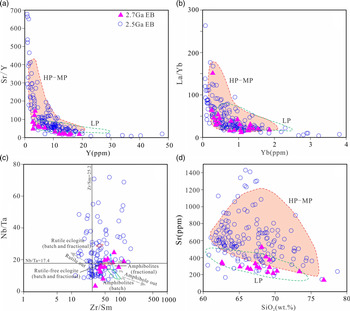
In the An–Ab–Or geochemical classification diagram proposed by Barker & Arth (Reference Barker and Arth1976), the rocks classify as tonalitic, trondhjemitic and granodioritic (online Supplementary Material Fig. S2), clearly showing their affinity with the TTG suite of rocks. All of the samples plot in the metaluminous–peraluminous domains on the A/NK–A/CNK diagram (online Supplementary Material Fig. S3) and display a trondhjemitic trend in the K–Na–Ca plot (online Supplementary Material Fig. S2). In the three blocks, the 2.5 Ga TTGs exhibit similar A/NK and A/CNK values to those of the 2.7 Ga TTGs (online Supplementary Material Fig. S3), indicating that they are all Al-rich. In summary, major-element compositions of the TTG gneisses in the three blocks of the NCC share a number of similarities with Archaean TTG suites around the world (Martin et al. Reference Martin, Smithies, Rapp, Moyen and Champion2005, Reference Martin, Moyen and Rapp2009). Generally speaking, the 2.5 Ga TTGs in the EB show higher Sr and Sr/Y than those of the TNCO and WB, while the 2.7 Ga TTGs in the EB show lower Sr, Sr/Y and ΔSr than those of the TNCO (Figs 2–5). Moreover, the two phases of TTGs in the EB show distinct Nb/Ta ratios while those TTGs in the TNCO possess similar Nb/Ta values (Figs 2, 3, 6). Detailed similarities and distinctions between the TTGs of different ages from the different blocks are described in the online Supplementary Material.
(a) Sr/Y–Y, (b) (La/Yb)N–YbN, (c) Sr–SiO2 and (d) Nb/Ta–Zr/Sm diagrams for the TTG gneisses from the TNCO of the NCC (melting curves are from Drummond & Defant, Reference Drummond and Defant1990; HP, MP and LP TTGs are from Moyen, Reference Moyen2011). Note that the sample (10HXL-01) with remarkably high Sr/Y and two samples (12ZHF-02 and 12ZHF-04) with extremely high Nb/Ta ratios are not shown in (a) and (d), respectively.

(a) Sr/Y–Y, (b) (La/Yb)–Yb, (c) Nb/Ta–Zr/Sm and (d) Sr–SiO2 diagrams for the TTG gneisses from the EB of the NCC (melting curves are from Drummond & Defant, Reference Drummond and Defant1990; HP, MP and LP TTGs are from Moyen, Reference Moyen2011).

(a) (La/Yb)–Yb, (b) (La/Yb)N–YbN, (c) Sr–SiO2 and (d) Sr/Y–Y diagrams for the TTG gneisses from the WB of the NCC (melting curves are from Drummond & Defant, Reference Drummond and Defant1990; HP, MP and LP TTGs are from Moyen, Reference Moyen2011).

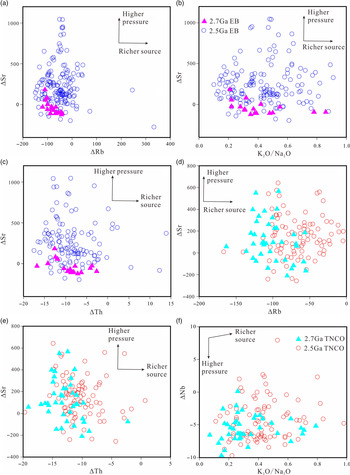
Diagrams showing both source composition/enrichment and melting depth/pressure for the 2.5 and 2.7 Ga TTG gneisses from the (a–c) EB and (d–f) TNCO. (a) and (d) ΔSr versus ΔRb; (b) ΔSr versus K2O/Na2O; (c) and (e) ΔSr versus ΔTh; (f) ΔNb versus K2O/Na2O. For element X, ΔX = X − (aSiO2 + b); constants of a and b and vectors to show the trends of higher pressures and richer sources are from Moyen et al. (Reference Moyen2009).

Geochemical modelling ((a) Nb/Ta versus Zr/Sm and (b) Nb/Ta versus Gd/Yb) for the 2.5 and 2.7 Ga TTGs in the TNCO (melting curves are based on Shan et al. (Reference Shan, Zhai and Dey2016)). Symbols are the same as those in Fig. 2. Note that two samples (12ZHF-02 and 12ZHF-04) with extremely high Nb/Ta ratios are not shown.

4.b. Hf isotopes of magmatic zircons
The Hf isotopes of magmatic zircons from the 2.5 and 2.7 Ga TTGs from the TNCO and EB are depicted in Figures 7 and 8, respectively. The TDM2 histogram for the 2.5 Ga TTGs in the TNCO is consistent with a Gaussian normal distribution, with the TDM2 ages varying between 2348 Ma and 3022 Ma and a single major peak at 2.69 Ga (Fig. 7a). The εHf(t) values show relatively large ranges (+0.33 to +10.70, +5.28 on average; online Supplementary Material Table S4), mostly plotting between the crustal evolution curves of 2.5–3.0 Ga (Fig. 9a). In contrast, the 2.7 Ga TTGs from the TNCO show more complex Hf patterns than the 2.5 Ga TTGs in the TDM2 histogram. The TDM2 ages vary from 2680 Ma to 3424 Ma, with a predominant peak at 2.81 Ga and a subordinate peak at 3.06 Ga (Fig. 7b). The εHf(t) values (−3.85 to +7.87; online Supplementary Material Table S4) are relatively more negative than those of the 2.5 Ga TTGs.
Histograms showing zircon TDM2 model ages for the magmatic zircons from the (a) 2.5 Ga and (b) 2.7 Ga TTG gneisses in the TNCO of the NCC.

Histograms showing zircon TDM2 model ages for the magmatic zircons from the (a) 2.5 Ga and (b) 2.7 Ga TTG gneisses in the EB of the NCC.

The TDM2 model ages of the 2.5 Ga TTGs from the EB are mainly concentrated between 2.5 Ga and 3.1 Ga, with a single peak at 2.74 Ga, and the εHf(t) values range between −2.56 and +12.60 (average +4.59) (Fig. 8a; online Supplementary Material Table S4). However, the magmatic zircons of the 2.7 Ga TTGs from the EB show εHf(t) values of −13.89 to +8.61 (average +3.76) and TDM2 model ages mainly concentrating between 2.7 Ga and 3.2 Ga, with a major peak at 2.83 Ga and a subordinate peak at 2.94 Ga (Fig. 8b).
Limited Hf isotopic data from the WB are available, so the description of them is omitted here.
5. Discussion
5.a. Source material
It is commonly considered that TTG magmas were formed by partial melting of meta-basaltic rocks under a variety of conditions (e.g. Rapp & Watson, Reference Rapp and Watson1995; Martin et al. Reference Martin, Smithies, Rapp, Moyen and Champion2005). As different sources influence the compositions of TTG melts differently, the trace-element concentrations of juvenile TTGs can be employed to constrain their actual source compositions (Hoffman et al. Reference Hoffmann, Carsten, Næraa, Rosing, Herwartz, Garbe-Schonberg and Svahnberg2011).
For TTG magma, experimental studies show that the heavy rare earth elements (HREEs) are buffered mainly by garnet and/or amphibole, thus the HREE concentrations and patterns of the TTG melt can be used to speculate the stability of garnet/amphibole in the residue phase (Beard & Lofgren, Reference Beard and Lofgren1991; Rapp et al. Reference Rapp, Watson and Miller1991, Reference Rapp, Shimizu, Norman and Applegate1999, Reference Rapp, Shimizu and Norman2003; Foley et al. Reference Foley, Tiepolo and Vannucci2002, Reference Foley, Buhre and Jacob2003; Moyen & Stevens, Reference Moyen, Stevens, Benn, Mareschal and Condie2006). Generally, HREEs are strongly compatible within garnet, while medium rare earth elements (MREEs) are strongly enriched within amphibole (Rollinson, Reference Rollinson1993). Therefore, the melting products derived from the melting of basaltic rocks in equilibrium with garnet residue should show very high fractionations between light rare earth elements (LREEs) and HREEs, while the counterpart equilibrated with amphibole residue would have a concave-upward normalized REE pattern (Rollinson, Reference Rollinson1993). In addition, plagioclase is the main phase controlling Sr concentrations and Eu anomalies (Martin, Reference Martin1987; Springer & Seck, Reference Springer and Seck1997). Therefore, it is not hard to imagine that the melt would have high Sr contents and positive Eu anomalies if plagioclase breaks down during the melting process. Moreover, YbN–(La/Yb)N and Sr/Y–Y diagrams are generally used to discriminate the possible source of TTGs (Martin, 1986, Reference Martin1987; Defant & Drummond, Reference Defant and Drummond1990; Moyen, Reference Moyen2009). The trace-element modelling results from Martin (Reference Martin1986) showed that low Yb and Y concentrations would result in high (La/Yb)N and Sr/Y ratios, which require garnet in the residue phase. Experimental studies show that high field strength elements (HFSEs) and their ratios can reflect the partition behaviour of elements into different mineral phases (e.g. amphibole, rutile, ilmenite and titanite); therefore, they can be employed as good tracers for distinguishing different sources. It is commonly considered that rutile and amphibole play significant roles in buffering Nb and Ta, in which they possess opposite partition behaviour for Nb and Ta (Foley et al. Reference Foley, Tiepolo and Vannucci2002; Rapp et al. Reference Rapp, Shimizu and Norman2003). However, no consensus has been reached over which is the main mineral phase in the residue (Foley et al. Reference Foley, Tiepolo and Vannucci2002; Rapp et al. Reference Rapp, Shimizu and Norman2003; Xiong et al. Reference Xiong, Adam and Green2005, Reference Xiong, Adam, Green, Niu, Wu and Cai2006, Reference Xiong, Keppler, Audetat, Gudfinnsson, Sun, Song, Xiao and Yuan2009).
Based on a series of geochemical distinctions, Moyen (Reference Moyen2011) divided the compiled TTG data from previously published literature into three subgroups: high-pressure (HP) TTG (20 %), medium-pressure (MP) TTG (60 %) and low-pressure (LP) TTG (20 %). The HP TTGs are characterized by high Al2O3, Na2O and Sr but low Y, Yb, Ta and Nb; LP TTGs are enriched in HREEs and show low Sr, Sr/Y and La/Yb values, consistent with low-Al TTGs proposed by Barker (Reference Barker and Barker1979), and MP TTGs fall in between. On the basis of geochemical modelling results, Moyen (Reference Moyen2011) proposed that these three subgroups of TTG magmas were generated at different melting depths and thus with different residue phases: HP TTGs were formed at pressures ≥ 20 kbar, with residues of garnet and rutile but without amphibole and plagioclase; MP TTGs were generated at pressures of 15 kbar, with amphibole and a significant amount of garnet but without rutile and plagioclase; and at 10–12 kbar, LP TTGs were in equilibrium with residues of plagioclase–pyroxene–amphibole, with little garnet and no rutile.
5.a.1. TTGs from the EB
The 2.5 Ga TTGs in the EB are enriched in LREEs and depleted in HREEs, with very high Sr/Y and (La/Yb)N values (Fig. 3; online Supplementary Material Fig. S7; online Supplementary Material Table S1), indicating residues of garnet and/or amphibole (Beard & Lofgren, Reference Beard and Lofgren1991; Rapp et al. Reference Rapp, Watson and Miller1991, Reference Rapp, Shimizu, Norman and Applegate1999, Reference Rapp, Shimizu and Norman2003; Foley et al. Reference Foley, Tiepolo and Vannucci2002, Reference Foley, Buhre and Jacob2003; Moyen & Stevens, Reference Moyen, Stevens, Benn, Mareschal and Condie2006). The Y/Yb (mostly around 10.0, average 12.39) and (Ho/Yb)N ratios (0.40–2.47, average 1.23) for the 2.5 Ga TTGs in the EB indicate relatively flat HREE patterns and the residues of both garnet and amphibole. In addition, these rocks show high Sr contents (141–1431 ppm, 598 ppm on average) and nearly negligible Eu anomalies (Eu/Eu* = 1.44 on average), indicating that plagioclase does not exist in the residue phase. Their Nb/Ta ratios and the Nb/Ta–Zr/Sm diagram collectively indicate rutile is one of the residue phases for most of the samples. Additionally, the negative Nb, Ta and Ti anomalies (online Supplementary Material Fig. S7b) for the 2.5 Ga TTGs in EB can also be explained by rutile and amphibole residues (Xiong et al. Reference Xiong, Adam and Green2005, Reference Xiong2006, Reference Xiong, Keppler, Audetat, Gudfinnsson, Sun, Song, Xiao and Yuan2009; Xiong, Reference Xiong2006). Moreover, the 2.5 Ga TTGs in the EB resemble the HP–MP TTGs proposed by Moyen (Reference Moyen2011) (Fig. 3), corroborating the residues inferred.
The 2.7 Ga TTGs in the EB are characterized by LREE enrichment and HREE depletion (online Supplementary Material Fig. S7c, d; online Supplementary Material Table S1), suggesting that garnet and/or amphibole exist in the residue (Beard & Lofgren, Reference Beard and Lofgren1991; Rapp et al. Reference Rapp, Watson and Miller1991, Reference Rapp, Shimizu, Norman and Applegate1999, Reference Rapp, Shimizu and Norman2003; Foley et al. Reference Foley, Tiepolo and Vannucci2002, Reference Foley, Buhre and Jacob2003; Moyen & Stevens, Reference Moyen, Stevens, Benn, Mareschal and Condie2006). The Y/Yb (7.30-14.87, average 10.63) and (Ho/Yb)N ratios (0.89–1.82, average 1.28) for the 2.7 Ga TTGs indicate relatively flat HREE patterns and the residues of both garnet and amphibole. These samples show negative to positive Eu anomalies, indicating that plagioclase exists in some samples but not in others. This can also provide an interpretation for the generally low Sr/Y ratios of the 2.7 Ga TTGs (Fig. 3; online Supplementary Material Table S1). Their Nb/Ta ratios (3.60–24.64) indicate, except for minor samples, that most samples do not contain rutile in the residue phase (Fig. 3c). Moreover, they are broadly similar to the LP TTGs of Moyen (Reference Moyen2011), providing a further line of evidence for the above inference. Therefore, the 2.7 Ga TTGs in the EB are considered to have been formed at lower pressures than those of the 2.5 Ga TTGs, which is also demonstrated by the pressure-controlled ΔX parameters (Fig. 5).
In summary, the 2.5 Ga TTGs in the EB are mainly formed by partial melting of rutile-bearing eclogite or garnet-amphibolite at higher pressure, while the 2.7 Ga TTGs were generated by partial melting of garnet-amphibolite or granulites at lower pressure.
5.a.2. TTGs from the TNCO
Similarly, the 2.5 and 2.7 Ga TTGs in the TNCO are also enriched in LREEs and depleted in HREEs (online Supplementary Material Fig. S5; online Supplementary Material Table S2), indicating garnet and/or amphibole residues (Beard & Lofgren, Reference Beard and Lofgren1991; Rapp et al. Reference Rapp, Watson and Miller1991, Reference Rapp, Shimizu, Norman and Applegate1999, Reference Rapp, Shimizu and Norman2003; Foley et al. Reference Foley, Tiepolo and Vannucci2002, Reference Foley, Buhre and Jacob2003; Moyen & Stevens, Reference Moyen, Stevens, Benn, Mareschal and Condie2006). The 2.5 and 2.7 Ga TTGs in the TNCO have Y/Yb ratios of 6.47–20.43 and 7.82–21.74, and (Ho/Yb)N ratios of 0.90–1.93 (average 1.27) and 0.60–1.88 (average 1.29), indicating relatively flat HREE patterns and the residues of both garnet and amphibole. Both the two phases of TTGs display high Sr contents and positive or negligible Eu anomalies, suggesting plagioclase breakdown during the process. Their Nb/Ta ratios range from 0.40–113 (average 13.49) and 2.04 to 37.00 (average 12.14), suggesting rutile existed in the residue phase of some, but not all, samples. This is also evidenced by the Nb/Ta–Zr/Sm diagram (Fig. 2d) that shows part of these two phases of the TTG samples plot in the garnet-amphibolite field and others in the eclogite domain, indicating that the 2.5 and 2.7 Ga TTGs in the TNCO were formed under conditions of garnet-amphibolite facies to eclogite facies. In the comparison diagram with the HP–MP–LP TTGs of Moyen (Reference Moyen2011), such as Sr–SiO2, (La/Yb)N–YbN and Sr/Y–Y plots (Fig. 2a, b, c), the 2.5 and 2.7 Ga TTGs in the TNCO both plot in the HP–MP TTG domain and are strikingly distinct from LP TTGs, indicating formation conditions of garnet-amphibolite facies to eclogite facies. In addition, their Nb, Ta and Ti anomalies (online Supplementary Material Fig. S5b, d) can possibly be explained by residues of rutile and amphibole (Xiong et al. Reference Xiong, Adam and Green2005, Reference Xiong2006, Reference Xiong, Keppler, Audetat, Gudfinnsson, Sun, Song, Xiao and Yuan2009; Xiong, Reference Xiong2006). Therefore, the source material of the 2.5 and 2.7 Ga TTGs in the TNCO is garnet-amphibolite or eclogite. This assertion can be further certified by the modelling results (Fig. 6), in which, except for two samples ZHF12-02 and ZHF12-04 with very high Nb/Ta ratios that are not shown in the modelling results, other samples of the 2.5 and 2.7 Ga TTGs in the TNCO can be well explained by polybaric melting of garnet-amphibolite or eclogite (Hoffman et al. Reference Hoffmann, Carsten, Næraa, Rosing, Herwartz, Garbe-Schonberg and Svahnberg2011). But it is noteworthy that garnet-amphibolite predominates over eclogite in the source of the 2.7 Ga TTGs, while the two are nearly equal for the 2.5 Ga TTGs, suggesting generally deeper sources for the 2.5 Ga TTGs than those of the 2.7 Ga TTGs. Additionally, the source composition-controlled parameters (ΔRb, ΔTh and K2O/Na2O) shown on the horizontal axes of the diagrams (Fig. 5) indicate a more enriched source for the 2.5 Ga TTGs compared with that of the 2.7 Ga TTGs in the TNCO.
5.a.3. TTGs from the WB
The 2.5 Ga TTGs in the WB have high Sr contents and positive or negligible negative Eu anomalies, suggesting no plagioclase in the residue phase. The Y/Yb (7.09–31.00, average 13.01) and (Ho/Yb)N ratios (0.63–2.08, average 1.41) for the 2.5 Ga TTGs in WB indicate relatively flat HREE patterns (online Supplementary Material Fig. S9) and the residues of both garnet and amphibole. These TTGs show similarities to HP–MP TTGs in comparison diagrams, such as Sr–SiO2, (La/Yb)N–YbN and Sr/Y–Y (Fig. 4). As the number of Nb/Ta ratios is too small, it is not discernible whether there is rutile or not. Based on the above information, it can be inferred that the source material of the 2.5 Ga TTGs in the WB was possibly garnet-amphibolite or eclogite, but this requires corroboration.
5.b. Tectonic setting
As to the tectonic setting of the TTGs, there is an ongoing controversy over whether they were formed by subduction, lower crustal thickening or delamination of an oceanic plateau (Smithies, Reference Smithies2000; Zegers & van Keken, Reference Zegers and van Keken2001; Whalen et al. Reference Whalen, Percival, McNicoll and Longstaffe2002; Condie, Reference Condie2005; Martin et al. Reference Martin, Smithies, Rapp, Moyen and Champion2005; Bedard, Reference Bedard2006). Delamination of an oceanic plateau is not likely, because up to now there is no evidence of Archaean delamination in the NCC. According to experimental studies, partial melting of purely hydrous basalts would yield low Mg# values (< 45) and Ni contents (< 10 ppm), regardless of melting pressure (Rapp & Watson, Reference Rapp and Watson1995; Rapp et al. Reference Rapp, Shimizu, Norman and Applegate1999; Wang et al. Reference Wang, Xu, Jian, Bao, Zhao, Li, Xiong and Ma2006). Melting of mafic rocks under a thickened lower crust will also have low Mg# values (< 45) and Cr (< 20–30 ppm) and Ni (< 20 ppm) contents (Atherton & Petford, Reference Atherton and Petford1993; Petford & Atherton, Reference Petford and Atherton1996; Wang et al. Reference Wang, Xu, Jian, Bao, Zhao, Li, Xiong and Ma2006). In contrast, melts from the partial melting of a subducting slab will generally have higher Mg# and Cr and Ni concentrations (Martin, Reference Martin1999; Smithies, Reference Smithies2000; Martin & Moyen, Reference Martin and Moyen2002; Martin et al. Reference Martin, Smithies, Rapp, Moyen and Champion2005; Moyen, Reference Moyen2009), resulting from interaction of slab melts with the overlying mantle wedge (Rapp et al. Reference Rapp, Shimizu, Norman and Applegate1999, Reference Rapp, Norman, Laporte, Yaxley, Martin and Foley2010). In addition, TTG melts from slab melting and thickened lower crust are characterized by distinct isotopic features. For example, TTG melts from slab melting will be equivalent to modern adakites in most aspects. If formed in an oceanic arc, TTG melts will have juvenile initial Nd and Hf isotopes; if generated in a continental arc, they will possess a large range of initial Nd and Hf isotope values from juvenile to evolved. In contrast with slab melts, the melts from thickened lower crust will have evolved features of initial Nd and Hf isotopes. Based on the above distinctions, the tectonic settings of the two phases of TTGs from the three blocks will be discussed in detail as follows.
5.b.1. TTGs from the EB
Compared with those magmas that originated from pure partial melting of thickened lower crust, the 2.5 Ga TTG gneisses in the EB show relatively high MgO contents, Mg# and Cr and Ni concentrations (online Supplementary Material Table S1), similar to TTG melts produced by slab melting (online Supplementary Material Fig. S6; Martin, Reference Martin1999; Smithies, Reference Smithies2000; Martin & Moyen, Reference Martin and Moyen2002; Martin et al. Reference Martin, Smithies, Rapp, Moyen and Champion2005; Moyen, Reference Moyen2009) and show distinct differences from pure partial melting of hydrous basalts (Rapp & Watson, Reference Rapp and Watson1995; Rapp et al. Reference Rapp, Shimizu, Norman and Applegate1999) and melts from thickened lower crust (Atherton & Petford, Reference Atherton and Petford1993; Petford & Atherton, Reference Petford and Atherton1996; Wang et al. Reference Wang, Xu, Jian, Bao, Zhao, Li, Xiong and Ma2006). Therefore, they are identical to many 2.5 Ga TTGs worldwide (e.g. Martin & Moyen, Reference Martin and Moyen2002; Martin et al. Reference Martin, Smithies, Rapp, Moyen and Champion2005). Given these observations, the 2.5 Ga TTG gneisses in the EB are more likely to have formed by partial melting of subducted oceanic crust, followed by interaction with the overlying mantle wedge during ascent. The above inferences are also confirmed by the Hf isotopic data for magmatic zircons in Figure 8a, in which the initial Hf isotopes of the 2.5 Ga TTGs are characterized by juvenile to evolved signatures.
Compared with the 2.5 Ga TTGs in the EB, the 2.7 Ga TTGs show lower MgO contents (average 1.39 wt %), Mg# (average 43.71), Cr (average 14.93 ppm) and Ni (average 12.60 ppm) concentrations (online Supplementary Material Table S1), identical to adakites generated by thickened lower crust (online Supplementary Material Fig. S6; e.g. Martin & Moyen, Reference Martin and Moyen2002; Martin et al. Reference Martin, Smithies, Rapp, Moyen and Champion2005; Wang et al. Reference Wang, Xu, Jian, Bao, Zhao, Li, Xiong and Ma2006) but distinct from TTGs formed by slab melting (Martin, Reference Martin1999; Smithies, Reference Smithies2000; Martin & Moyen, Reference Martin and Moyen2002; Martin et al. Reference Martin, Smithies, Rapp, Moyen and Champion2005; Moyen, Reference Moyen2009). Their TDM2 model ages are concentrated between 2.9 Ga and 3.2 Ga with minor ages between 2.7 Ga and 2.8 Ga, which are diagnostic of initial Hf isotopes of thickened lower crust (Fig. 8b). Given these observations, the 2.7 Ga TTG gneisses in the EB are more likely to have formed by partial melting of thickened lower crust, without interaction with the overlying mantle wedge during ascent.
5.b.2. TTGs from the TNCO
Similar to the 2.5 Ga TTGs in the EB, the 2.5 Ga TTGs in the TNCO have high Mg# and Cr and Ni concentrations (online Supplementary Material Table S2), identical to many worldwide TTGs at 2.5 Ga and TTGs generated by slab melting (online Supplementary Material Fig. S4; e.g. Martin, Reference Martin1999; Smithies, Reference Smithies2000; Martin & Moyen, Reference Martin and Moyen2002; Martin et al. Reference Martin, Smithies, Rapp, Moyen and Champion2005; Moyen, Reference Moyen2009). Furthermore, the TDM2 histogram shows that nearly half of the TDM2 ages are concentrated between 2.5 Ga and 2.7 Ga and another half between 2.7 Ga and 2.9 Ga, representative of juvenile to evolved characteristics (Fig. 7a). Therefore, given these observations, the 2.5 Ga TTG gneisses in the TNCO are more likely to have formed by partial melting of subducted oceanic crust, followed by interaction with the overlying mantle wedge during ascent.
In contrast, the 2.7 Ga TTGs in the TNCO have relatively high Mg# but low Cr and Ni contents (online Supplementary Material Table S2), which seems to contradict each other, as high Mg# values indicate possible slab melting while relatively low Cr and Ni might be attributed to a lower crust origin. However, Getsinger et al. (Reference Getsinger, Rushmer, Jackson and Baker2009) proposed that felsic melts would not be emplaced and condensed right away following their formation. Therefore, during their stay in the magma chamber, interaction would possibly occur between them and the melt residue in the lower crust, which would increase the Mg# of the melts, but it is hard to increase the Cr and Ni contents. Therefore, the most feasible explanation is a lower crust origin. Moreover, the isotopic evidence also supports this interpretation. The TDM2 model ages mostly range from 2.9 Ga to 3.2 Ga with minor ages lying between 2.7 Ga and 2.9 Ga, indicating evolved characteristics. Therefore, it is proposed that the 2.7 Ga TTGs in the TNCO were formed by lower crustal genesis.
5.b.3. TTGs from the WB
Different from both the EB and the TNCO, the WB has yet to yield any exposed 2.7 Ga TTGs. The 2.5 Ga TTGs in the WB have high Mg# and Cr and Ni concentrations (online Supplementary Material Table S3), identical to adakites generated by slab melting (online Supplementary Material Fig. S8; e.g. Martin & Moyen, Reference Martin and Moyen2002; Martin et al. Reference Martin, Smithies, Rapp, Moyen and Champion2005; Wang et al. Reference Wang, Xu, Jian, Bao, Zhao, Li, Xiong and Ma2006). Given these observations, the 2.5 Ga TTG gneisses in the WB are more likely to have formed by partial melting of subducted oceanic crust, followed by interaction with the overlying mantle wedge during ascent. Nonetheless, this interpretation requires more data (e.g. isotopes) for confirmation.
5.c. Constraints on the crustal growth and evolution in the NCC
5.c.1. Magma nature of the 2.5 Ga and 2.7 Ga TTGs
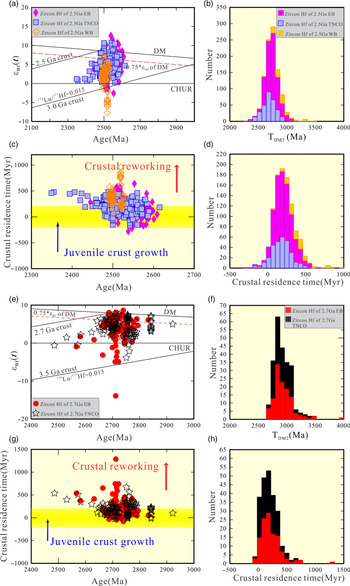
Regarding the definition of crustal growth, there are several viewpoints. Some researchers consider that if the εHf(t) of zircons is ≥ 0.75 times the Hf of the depleted mantle (DM) curve, they can be identified as recording ‘crustal growth’ (Belousova et al. Reference Belousova, Kostitsyn, Griffin, Begg, O’Reilly and Pearson2010). In addition, the difference between the Hf model ages of magmatic zircons and U–Pb ages is referred to as the crustal residence time (CRT; Griffin et al. Reference Griffin, Belousova, Walters and O’Reilly2006; Belousova et al. Reference Belousova, Reid, Griffin and O’Reilly2009). Therefore, a short CRT (< 200 Myr) means these rocks were derived from the DM or remelting of newly formed crust, which is called crustal growth by other scholars (Belousova et al. Reference Belousova, Kostitsyn, Griffin, Begg, O’Reilly and Pearson2010; Hawkesworth et al. Reference Hawkesworth, Dhuime, Pietranik, Cawood, Kemp and Storey2010). The CRT of some zircons is > 200 Myr, leaving the rest < 200 Myr, suggesting that the 2.5 Ga TTG magmas of the whole NCC derived from both older crustal reworking and juvenile crustal growth (Fig. 9c). On the εHf(t) versus age diagram (Fig. 9a), some εHf(t) values of the 2.5 Ga TTGs from the three blocks plot near the DM evolution curve and above the 0.75 * εHf of DM curve, with most data points below this curve, demonstrating that the 2.5 Ga TTG magmas were mainly formed by remelting of older crust with a subordinate amount from juvenile crust. On the whole, most of these εHf(t) values plot between the crustal evolution curves of 2.5–3.0 Ga (Fig. 9a); therefore, it can be inferred that these crustal materials were extracted from the mantle during 3.0–2.5 Ga, or even older. A TDM2 model age histogram for all the 2.5 Ga data shows a major peak concentrated at 2.7–2.8 Ga (Fig. 9b), implying the 2.5 Ga TTG magmas in the NCC were related mainly with reworking of 2.8–2.7 Ga crust and relatively less with juvenile crustal growth during 2.6–2.5 Ga.
(a, e) εHf(t) versus 207Pb/206Pb age (Ma), (b, f) histograms showing zircon TDM2 model ages, (c, g) crustal residence time (Myr) versus 207Pb/206Pb age (Ma) and (d, h) histograms showing crustal residence time (Myr) for the magmatic zircons from the (a–d) 2.5 Ga and (e–h) 2.7 Ga TTG gneisses of the NCC. DM – depleted mantle; CHUR – chondritic uniform reservoir.

Generally, the 2.5 Ga TTGs from the EB and the TNCO show similar εHf(t) ranges, whereas those from the WB commonly have lower values on the whole (Fig. 9a), resulting in older TDM2 ages and a longer CRT for the 2.5 Ga TTGs in the WB (Fig. 9b, c, d). On one hand, this suggests that some of the 2.5 Ga TTGs from the WB were derived from reworking of relatively much older continental crust. More significantly, on the other hand, it implies that old continental crust as old as 3.5 Ga might exist in the WB, which has significant implications for the crustal evolution of the WB in early times.
Similar to the 2.5 Ga TTG magmas, a portion of the CRT values of the 2.7 Ga TTGs are < 200 Myr while the remaining are > 200 Myr, indicating that both crustal reworking and juvenile crustal growth were involved in the generation of the 2.7 Ga TTGs (Fig. 9g, h). Moreover, some data are distributed on or near the DM evolution curve and above the 0.75 * εHf of DM, with TDM2 ages nearly equal or very close to the magmatic crystallization ages (Fig. 9e, f), thus representing juvenile crustal growth. However, most εHf(t) values plot far away from the DM evolution curve and below the 0.75 * εHf of DM, with TDM2 model ages (2.9–3.4/3.5 Ga) much older than their magmatic crystallization ages (Fig. 9e, f), indicating that they were derived from the remelting of 3.4/3.5–2.9 Ga crust. In addition, their εHf(t) values plot between the crustal evolution curves of 2.7–3.5 Ga (Fig. 9e), representative of the time of mantle extraction of crustal material in the NCC. As a whole, the 2.7 Ga TTGs in the EB and TNCO show similar Hf isotopic features, implying a consistent or similar magmatic evolution for the EB and TNCO at 2.7 Ga, which is also the case with the 2.5 Ga EB and TNCO.
In summary, both the c. 2.5 Ga and c. 2.7 Ga TTG magmas can be interpreted as dual events involved with both crustal growth and crustal reworking, and both of them are dominated by crustal reworking over juvenile crustal growth. Additionally, the EB and TNCO might have witnessed a consistent or similar magmatic evolution at 2.7 Ga and 2.5 Ga, and some of the 2.5 Ga TTGs from the WB were derived from reworking of relatively much older continental crust.
5.c.2. Neoarchaean crustal evolution of the three blocks and the whole NCC
As there are only limited data from the WB, the discussions here focus on the TNCO and EB. Zircon Hf isotopes from the TNCO show that the TDM2 model ages mainly range from 2.5 Ga to 3.1 Ga with a peak at 2.7–2.8 Ga (Fig. 10a), and εHf(t) values mostly plot between the crustal evolution curves of 2.5–3.1 Ga (Fig. 10b). All these data suggest that crustal growth in the TNCO mainly took place during 3.1–2.5 Ga, with the dominant growth period at 2.8–2.7 Ga. Similarly, the Hf isotopic data for the EB display a main range of TDM2 model ages of 2.5 Ga to 3.2 Ga with a peak at 2.7–2.9 Ga (Fig. 10c). Most of the εHf(t) data points lie between the crustal evolution curves of 2.5–3.2 Ga (Fig. 10d). These data suggest that a crustal growth event existed during 3.2–2.5 Ga and was concentrated between 2.9 Ga and 2.7 Ga. Finally, all the data were plotted on a εHf(t) versus age diagram and TDM2 model age histogram (Fig. 11). The plots show that the TDM2 model ages are mainly concentrated between 2.7 and 2.9 Ga and subordinately concentrated at 2.5 Ga and 3.0/3.1 Ga (Fig. 11b), indicating that the whole NCC witnessed a major crustal growth event at 2.9–2.7 Ga and a minor growth at 3.0/3.1 Ga and 2.5 Ga. The εHf(t) values display a relatively large range that mainly plot between the crustal evolution curves of 2.5–3.2 Ga, also indicating a mantle extraction event occurred at 3.1–2.5 Ga (Fig. 11a).
(a, c) Histograms showing zircon TDM2 model ages and (b, d) εHf(t) versus 207Pb/206Pb age (Ma) for the magmatic zircons from the TTG gneisses in the (a, b) TNCO and (c, d) EB of the NCC. Symbols are the same as those in Figure 9. DM – depleted mantle; CHUR – chondritic uniform reservoir.

(a) εHf(t) versus 207Pb/206Pb age (Ma) and (b) histograms showing zircon TDM2 model ages for the magmatic zircons from the TTG gneisses of the NCC. Symbols are the same as those in Figure 9. DM – depleted mantle; CHUR – chondritic uniform reservoir.

6. Conclusions
-
(1) The source material of the 2.5 Ga TTGs in the EB is rutile-bearing eclogite or garnet-amphibolite at higher pressure, possibly formed by partial melting of a subducting slab, while the 2.7 Ga TTGs from the EB were derived from melting of garnet-amphibolite or granulite at lower pressure, perhaps at the base of thickened lower crust.
-
(2) The 2.5 and 2.7 Ga TTGs from the TNCO were formed under garnet-amphibolite- to eclogite-facies conditions by partial melting of a subducting slab and thickened lower crust, respectively, with a deeper and more enriched source for the former compared with that of the latter; the 2.5 Ga TTGs from the WB were generated by melting of a subducting slab with source materials of garnet-amphibolite or eclogite.
-
(3) Both the c. 2.5 Ga and c. 2.7 Ga TTG magmas can be interpreted as dual events involved with both crustal growth and crustal reworking, and both of them are predominated by crustal reworking over juvenile crustal growth. Additionally, the EB and TNCO might have witnessed consistent or similar magmatic evolution at 2.7 Ga and 2.5 Ga; some of the 2.5 Ga TTGs from the WB were derived from reworking of relatively much older continental crust.
-
(4) The major crustal growth in the TNCO was concentrated between 2.8 Ga and 2.7 Ga, while that for the EB occurred during 2.9–2.7 Ga. The whole NCC witnessed a major crustal growth event at 2.9–2.7 Ga and a minor growth at 3.0/3.1 Ga and 2.5 Ga.
Acknowledgements
Dr YY Zhou is especially thanked for the suggestions given during preparation of the original draft. This study was funded by the China Postdoctoral Science Foundation (Grant Nos. 2018T110139 and 2017M620901), Open Research Fund of the Key Laboratory of Mineral Resources, Chinese Academy of Sciences (No. KLMR2017-05), and programme from the National Natural Science Foundation of China (Grant No. 41890834).
Supplementary material
To view supplementary material for this article, please visit https://doi.org/10.1017/S0016756820000618