Introduction
According to the World Economic Forum, in developed and developing countries alike, the poorest half of the population often controls less than 10% of its wealth. Consequently, uneven distribution of income within a society has numerous implications for the society. For example, income inequality is a threat to human fitness and as a result has a negative effect on labour productivity (Stiglitz, Reference Stiglitz2012). Corak (Reference Corak2013) documented that societies with rampant levels of inequality have decreasing inter-generational mobility, which implies that parents’ earnings become the most important antecedent of wages of their offspring. Furthermore, at the macro-societal level, income inequality has been linked with crime (Kelly, Reference Kelly2000), unhappiness (Schneider, Reference Schneider2012) and even suicide rates (Andres, Reference Andres2005). Therefore, understanding the causes and consequences of income inequality has been a paramount object of research in the scholarly literature (Dabla-Norris et al., Reference Dabla-Norris, Kochhar, Suphaphiphat, Ricka and Tsounta2015).
A review of the extant literature shows that there are numerous variables associated with income inequality. Indeed, a substantial review of the economic literature on the long-run determinants of income inequality was conducted by Roine et al. (Reference Roine, Vlachos and Waldenström2009), but since then the empirical literature on the causes of income inequality has proliferated.
First, these studies view economic development as a macro-economic remedy for income inequality. According to the famous Kuznets hypothesis (Kuznets, Reference Kuznets1955), ‘at low levels of per capita income, inequality increases with rising per capita income and decreases only in the later stages of development – resulting in an inverted U-shaped relationship between per capita income and income inequality’ (Deininger & Squire, Reference Deininger and Squire1997, p. 38). Kuznets (Reference Kuznets1955) collected long time-series data of inequality levels for the UK and the US. In his study, he argued that, in countries with a predominant agricultural sector, income is more homogeneously distributed than in countries driven by the industrial sector. Thus, a shift from agrarian to industrial society will increase income inequality, as a larger share of labour force moves into a more productive sector with higher wages. However, income inequality declines as industry becomes a dominating economic sector and most economic agents receive similar wages. Consequently, ‘virtually all of the studies that have explored the relationship between inequality and level of development have been testing the Kuznets curve’ (Frazer, Reference Frazer2006, p. 1459). While a number of cross-country studies have found support for the Kuznets curve phenomenon (Eusufzai, Reference Eusufzai1997; Vicente & Borge, Reference Vicente and Borge2000; Huang, Reference Huang2004), a separate group of scholars have rejected the existence of an inverted U-shaped link between GDP per capita and income inequality across countries (Li et al., Reference Li, Squire and Zou1998; Higgins & Williamson, Reference Higgins and Williamson1999). Further, earlier studies that have tested the non-linear link between economic development and income inequality have been criticized for the incomparability of the data across countries and the parametric form used.
A second group of studies have argued that income inequality is a purely political phenomenon (Boix, Reference Boix2003; Reuveny & Li, Reference Reuveny and Li2003). This strand of empirical literature based on the median voter model by Meltzer and Richard (Reference Meltzer and Richard1981) attempts to explore the link between democracy and income inequality. According to these studies, in countries with high income inequality, distribution of wealth is skewed to the right, indicating that mean income is consistently above the median income. Therefore, the median voters constantly have motivation to support policies that favour higher redistribution and taxation of higher incomes. Indeed, in democratic societies, all citizens have equal rights to civic participation; thus, bureaucrats will design policies aimed at more equitable distribution of incomes within society to satisfy the median voter. As a result, democratic regimes are more likely to be associated with greater income equality. However, empirical studies that test the median voter hypothesis have produced mixed results. For example, Milanovic (Reference Milanovic1999) argued that greater redistribution of wealth towards marginalized segments of society is driven, not by the median voter, but by relative income or by another variable that fosters redistributive policies but which is omitted in the theoretical frameworks. Segura-Ubiergo (Reference Segura-Ubiergo2007) further suggested that those on the lowest step of the economic ladder demand higher levels of redistributive policies when they are the recipients of increased social spending. Moreover, Ringen (Reference Ringen2007) concluded that, although the middle classes are concerned with the accumulation of wealth and efficiency, they are also concerned with helping the poor as poverty threatens the established order and it is a nuisance in an otherwise well-established middle-class life. Finally, the main economic concern for the middle class is efficiently functioning institutions and markets, greater economic freedoms, independent courts and protection of property and contracts. Thus, middle-class voters are not the main actors favouring higher redistribution.
Turning to the direct effect of democracy on income inequality, the evidence is also inconclusive. For example, Milanovic et al. (Reference Milanovic, Gradstein and Ying2001) examined the determinants of income inequality in a sample of 126 countries in 1960–1998. The authors found that democratization leads to greater income equality. Sylwester (Reference Sylwester2002) tested the hypothesis that changes in income inequality are the function of democracy and democratization. The study found that income inequality is lower in less democratic nations; however, the negative relationship becomes weak when a sample is restricted to developing countries. More recently, Burkhart (Reference Burkhart2007) investigated the causal link between democracy, ideology and income inequality using 50 countries over the period 1978–1993. Using a measure of capitalism as an instrument in pooled 2SLS regression, the study concluded that ‘there is a weak parabolic relationship between democracy and income inequality’. In a similar vein, a number of other studies found that democratization has an inverted U-shaped association with income inequality (Acemoglu & Robinson, Reference Acemoglu and Robinson2002; Bergh & Bjørnskov, Reference Bergh and Bjørnskov2014; Rose & Viju, Reference Rose and Viju2014). There is also evidence that the relationship is bi-directional. For example, Wagle (Reference Wagle2009), using data from the five major historically and culturally similar South Asian countries for the years 1980–2003, showed that greater income inequality leads to democratization, and at the same time, inclusive democracies are associated with more uneven distribution of wealth within society. Bollen and Jackman (Reference Bollen and Jackman1995) regressed current levels of democracy on initial level of democracy, income inequality and a set of control variables. The study found that income inequality had a significant negative effect on democratization, concluding that ‘inequality serves as a rough proxy for intermediate levels of democracy’.
Apart from the effect of civil liberties and political rights, a number of studies have explored the effect of economic freedom on income inequality. For example, Bennet and Nikolaev (Reference Bennet and Nikolaev2016) contributed to the research on the antecedents of income inequality in a number of ways. First, they provided a survey of existing literature by highlighting mixed results with respect to the effect of economic freedom on income inequality. Second, they used a number of proxies for income inequality and a set of 112 countries over the period 1970–2010, to explore the economic freedom–inequality nexus. Their results suggested that the effect was mixed, even after they applied GMM estimator to take into account potential endogeneity of economic freedom. In a follow-up study, Bennet and Nikolaev (Reference Bennet and Nikolaev2016) showed that income inequality may be driven by the factor endowments that determine the quality of institutions.
Finally, apart from economic and political variables ‘societal arrangements [cultural norms, psychological factors], and attitudes that develop over time (and that may or may not be codified in laws [and social norms]) might have powerful effects in determining inequities or the distribution of income that exists across countries’ (Tanzi, Reference Tanzi1998, p. 5). Thus, some studies have highlighted the importance of ethnic diversity (Menkyna, Reference Menkyna2014; Sturm & De Haan, Reference Sturm and De Haan2015), religion (Elgin et al., Reference Elgin, Goksel, Gurdal and Orman2013) and culture (Mushinski & Pickering, Reference Mushinski and Pickering2000).
With the publication of the national intelligence dataset by Lynn and Vanhanen (Reference Lynn and Vanhanen2002), a separate strand of interdisciplinary literature has emerged that aimed to establish the associations between intelligence and measures of socioeconomic development (Lynn & Vanhanen, Reference Lynn and Vanhanen2012a). These studies show that intelligence is significantly and positively associated with GDP per capita and economic growth (Kanazawa, Reference Kanazawa2006; Hunt & Wittmann, Reference Hunt and Wittmann2008; Rindermann, Reference Rindermann2012; Stolarski et al., Reference Stolarski, Zajenkowski and Meisenberg2013). Cross-national studies have also discovered a negative correlation between intelligence and income inequality. For example, Rindermann (Reference Rindermann2008) showed a correlation of −0.51 in a sample of 148 countries. Kanazawa (Reference Kanazawa2009), using sample of 112 nations, showed that national IQ has a significantly negative effect on the nation’s income inequality (b=−0.43, p<0.01). More recently, using a revised national IQ dataset, Meisenberg (Reference Meisenberg2012) found that the correlation between national IQs and distribution of income, measured by the Gini index, was −0.58 (n=126).
While there now appears very strong evidence that average cognitive ability of a population is negatively associated with income inequality across nations, it is not clear why. Why do nations with higher average cognitive ability have lower levels of income inequality? What is the mechanism that explains the association? This study explores whether redistributive policies (institutions) are the channel through which intelligence is linked with income inequality. Particularly, it puts forward a hypothesis that countries with higher national intelligence have larger welfare states and greater income transfers, and thus lower income inequality.
While past studies have mainly been concerned with direct effects of different socioeconomic variables on income inequality, this study contributes to the growing literature on the moderating policy channels with respect to income inequality. For example, Edgar and Reed (2017) showed that monetary policy is the channel through which financial development is linked to income inequality. They found ‘that economies at the highest stages of financial development (economies in which money, bonds and claims to capital are traded) experience the highest amount of capital formation and social welfare as long as inflation is low.’ Lin and Fu (Reference Lin and Fu2016) explored the role of democracy in channelling the effect of trade openness on income inequality. Surprisingly, their study reported that trade reduces income inequality in non-democratic states. Their argument is based on the evidence that the largest share of the export basket in autocratic states belongs to primary goods and these states follow the Stolper–Samuelson theorem, while democracies export value-added products.
There are numerous reasons to anticipate that relationship. First, income inequality and poverty are deep-rooted in discriminative institutions and social injustice. Populations with higher average intelligence may adopt more inclusive institutions (Kanyama, Reference Kanyama2014) that eradicate discrimination and offer greater liberties and rights to marginalized groups of society (Solon, Reference Solon2014). For example, Salahodjaev and Azam (Reference Salahodjaev and Azam2015), using data from 107 countries, documented that intelligence has a direct and significantly positive effect on both formal and informal institutions that foster gender equality, even after controlling for culture, religion, type of political systems and level of development. Similarly, Nikolaev and Salahodjaev (Reference Nikolaev and Salahodjaev2016) reported that cognitive abilities, proxied by intelligence levels or scores from vocabulary knowledge tests, lead to more equal distribution of national happiness both across countries and US states. Therefore, it is possible to hypothesize that societies with higher average intelligence may be more likely to escape institutional inequality traps. Moreover, while there is evidence that income inequality exists when ‘members of the better-off social group broadly share a taste for discrimination against the social group populated by the poor’ (Mogues & Carter, Reference Mogues and Carter2005, p. 194), a number of studies have shown that cognitively able societies are more likely to exhibit tolerance (Rashidova & Salahodjaev, unpublished), vote for democratic parties and take part in political activities (Deary et al., Reference Deary, Strand, Smith and Fernandes2007).
Second, while previous articles have argued that ‘poorest groups in a country may benefit from redistribution’ (Deininger & Squire, Reference Deininger and Squire1997; Doerrenberg & Peichl, Reference Doerrenberg and Peichl2014), recent evidence shows that countries with higher cognitive capital more efficiently redistribute public goods such as health care (Lv & Xu, Reference Lv and Xu2016) or environmental benefits (Salahodjaev, Reference Salahodjaev2016), leading to more equal distribution of well-being within society (Nikolaev & Salahodjaev, Reference Nikolaev and Salahodjaev2016). Indeed, McKay et al. (Reference McKay2003) argued that the relative size of redistributive policies and higher taxation on the wealthier strata of the society depend on the capacity of the low-income class to organize themselves, which in turn may be a function of cognitive abilities (Proto et al., Reference Proto, Rustichini and Sofianos2014). While Kenworthy and McCall (Reference Kenworthy and McCall2008) suggested that government is more likely to implement redistributive policies when voters express their preferences for state spending priorities via voting, public polls or referendum, there is evidence that high-IQ individuals are more likely to participate in boycotts, sign petitions and vote in elections (Deary et al., Reference Deary, Strand, Smith and Fernandes2007).
Third, a common aspect of societies with higher levels of income inequality is when ‘productive resources are diverted toward appropriative activities, resulting in a misallocation of resources in the economy [the so-called rent-seeking phenomena]’ (Chakraborty & Dabla-Norris, Reference Chakraborty and Dabla-Norris2005, p. 3). Countries in which rent-seeking activities are followed by corruption, underground activities and government bureaucracy tend to establish institutions that neglect property rights and economic freedoms. National institutions that refuse to provide economic agents with greater sense of liberties and power of choice lead to uneven distributions of income and wealth. In contrast, one may anticipate that the ruling elite in countries with higher cognitive capital are more likely to support redistributive policies as ‘more intelligent people demonstrate less of a preference for smaller, immediate rewards versus larger, delayed rewards’ (Shamosh & Gray, Reference Shamosh and Gray2008). In this vein, research has shown that intelligence is negatively correlated with corruption (Potrafke, Reference Potrafke2012) and shadow economy (Salahodjaev, Reference Salahodjaev2015) and positively correlated with the provision of financial resources to the private sector (Kodila-Tedika & Asongu, Reference Kodila-Tedika and Asongu2015).
Finally, to date, Kanazawa (Reference Kanazawa2009) is the only study that has offered a specific explanation for the link between intelligence and redistribution policies. The theory that Kanazawa (Reference Kanazawa2009) put forward – the Savanna-IQ Interaction Hypothesis – suggests that more intelligent individuals are more likely to acquire and espouse evolutionarily novel preferences and values that our ancestors did not possess. Concerns for the underprivileged outsiders that are not part of in-group circles such as blood-relatives, tribal members or repeated exchange partners are clearly evolutionarily novel. Early humans, when they were spreading around the world, used to settle in small groups of about 150 individuals and thus did not possess altruistic values towards out-group strangers. Large countries inhabited by ethnically diverse populations and political systems that pursue inclusive developmental agenda are evolutionarily novel. The Savanna-IQ Interaction Hypothesis would therefore predict that more intelligent individuals are more likely to espouse evolutionarily novel concerns for the welfare of genetically unrelated others and the willingness to contribute larger proportions of private resources for the welfare of such others than less intelligent individuals are (Kanazawa, Reference Kanazawa2009).
Methods
The main dependent variable in the study was income inequality, measured by the Gini coefficient, and obtained from the World Income Inequality Database (WIID). The WIID collects and stores information on income inequality for developed, developing and transition countries and provides the most comprehensive set of income inequality statistics available. In this study, income inequality ranges from 22.9 in Norway to 64.3 in Comoros.
To test the link between cognitive abilities and income inequality, the study used country-level cognitive capital from Lynn and Vanhanen (Reference Lynn and Vanhanen2012b). Lynn and Vanhanen, in their 2002 book IQ and the Wealth of Nations, initiated a research programme to explore whether economic development across nations may be explained by the variations in cognitive abilities. Their study was based on existing evidence that intelligence is a robust antecedent of earnings at the individual level (Brown & Reynolds, Reference Brown and Reynolds1975; Ceci & Williams, Reference Ceci and Williams1997; Zagorsky, Reference Zagorsky2007). They reviewed existing studies that presented the results from administering IQ tests and found useable data for 81 countries. Then, they estimated the national IQs by setting IQ in Britain at 100 (standard deviation=15) and the IQs for other countries were rescaled to this metric. They found that there was a high correlation between intelligence and GDP per capita, and cognitive abilities explained more than half of cross-national differences in economic development. In their follow-up study, Lynn and Vanhanen (Reference Lynn and Vanhanen2006) estimated IQs for 32 additional countries and showed that updated IQs correlated significantly with life expectancy, democratization and literacy rates. Furthermore, to show the validity of national IQs, a number of scholars have shown that the correlation between national IQs and scholastic assessments results is nearly 0.9 (Deary et al., Reference Deary, Strand, Smith and Fernandes2007; Lynn & Mikk, Reference Lynn and Mikk2007; Lynn et al., Reference Lynn, Meisenberg, Mikk and Williams2007; Johnson et al., Reference Johnson, Deary and Iacono2008).
On the other hand, a number of scholars have criticized the national IQs compiled by Lynn and Vanhanen (Reference Lynn and Vanhanen2002). For example, Barnett and Williams (Reference Barnett and Williams2004) alleged that intelligence scores are ‘virtually meaningless’, while Volken (Reference Volken2003) concluded that national IQs are highly deficient. However, a growing strand of empirical literature views national IQs positively. Weede and Kämpf (Reference Weede and Kämpf2002) concluded that ‘there is one clear and robust result: average IQ does promote growth’. Palairet (Reference Palairet2004) asserted that ‘Lynn and Vanhanen have launched a powerful challenge to economic historians and development economists who prefer not to use IQ as an analytical input’. Even Earl Hunt, who at first rejected Lynn and Vanhanen’s (Reference Lynn and Vanhanen2002) work as futile, has more recently confirmed that ‘in spite of the weaknesses in several of their data points Lynn and Vanhanen’s empirical conclusion was correct’ (Hunt & Wittmann, Reference Hunt and Wittmann2008). As a result, a separate strand in the empirical literature has emerged, showing that intelligence is a robust predictor of economic growth (Jones & Schneider, Reference Jones and Schneider2006), corruption (Potrafke, Reference Potrafke2012), the shadow economy (Salahodjaev, Reference Salahodjaev2015), entrepreneurship (Hafer & Jones, Reference Hafer and Jones2015) and environmental sustainability (Obydenkova & Salahodjaev, Reference Obydenkova and Salahodjaev2016; Obydenkova et al., Reference Obydenkova, Nazarov and Salahodjaev2016).
In their final dataset, Lynn and Vanhanen (Reference Lynn and Vanhanen2012b) estimated the average cognitive abilities for a sample of 192 countries. For countries with missing data, cognitive capital was recovered from the results reported in international school assessment tests.
The main mediator variable was welfare state redistribution. The size of national redistributive effort is measured by transfers and subsidies as a percentage of GDP. The data were from Gwartney et al. (Reference Gwartney, Lawson and Hall2015). This variable ranges from 0 (in Rwanda) to 30.08% (in France).
In line with extant literature, the study controlled for a number of variables that are related to income inequality in order to reduce omitted variable bias. In particular, GDP per capita and its squared term were added to control for the Kuznets hypothesis (Kuznets, Reference Kuznets1955; Nielsen & Alderson, Reference Nielsen and Alderson1997). Additionally, GDP growth rates were included as a proxy for successfulness of economic policies. For example, Gyimah-Brempong (Reference Gyimah-Brempong2002) showed that economic growth is an important antecedent of income inequality in both developed and developing countries. Similarly, economic growth rates have been used in a number of studies to model the Gini coefficient empirically (Lee, Reference Lee2008; Wu & Li, Reference Wu and Li2013; Das et al., Reference Das, Sinha and Mitra2014).
Democracy and its squared term were included as cross-country literature lends support to the existence of an inverted U-shape association between political regime types and income inequality – the so-called political Kuznets curve (Chong, Reference Chong2004; Nikoloski, Reference Nikoloski2015). The explanation is simple: as societies become more democratic, economic wealth gravitates towards the working middle class, increasing income inequality between rural and urban population as a result. As countries pass the democratic transition peak, ‘the urban working class and rural population catch up in acquiring income, increasing income equality’ (Burkhart, Reference Burkhart1997, p. 152). Moreover, the political Kuznets curve has been documented for income inequality even at the sub-national level. For example, Obydenkova and Libman (Reference Obydenkova and Libman2015) showed that democracy has an inverted U-shape association with a wide range of socioeconomic variables in Russia.
Finally, the regression model includes a binary variable for socialist countries as poverty rates and income inequality are lower in countries that adopted socialist legal traditions (Lelkes et al., Reference Lelkes, Medgyesi, Tóth and Ward2009).
To explore the relationship between cognitive abilities, redistributive policies and income inequality, the following econometric equation was estimated:
 $${\rm Gini}_{i} =\alpha {\plus}\beta {\times}{\rm CA}_{i} {\plus}\gamma {\times}{\rm REDISTRIBUTION}{\plus}X\lambda _{i} {\plus}{\varepsilon}_{{i,}} $$
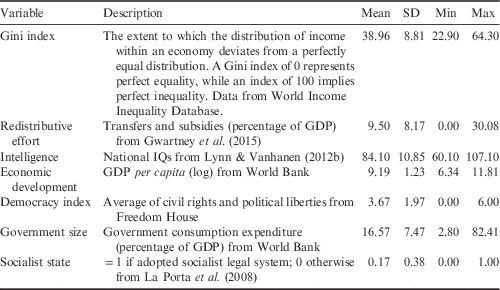
where Gini is the income inequality in country i, CA is cognitive abilities, proxied by country-level cognitive capital, and REDISTRIBUTION denotes transfers and subsidies normalized by GDP; X represents a vector of control variables. The descriptive statistics and the data sources are presented in Table 1.
Descriptive statistics and data sources

Results
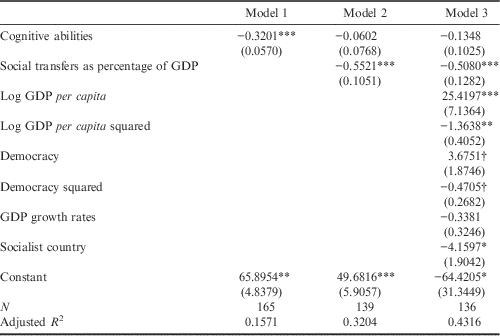
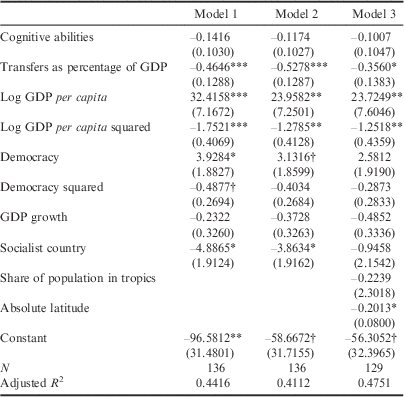
Table 2, Model 1, shows that, replicating the results of past studies (Rindermann, Reference Rindermann2008; Kanazawa, Reference Kanazawa2009; Meisenberg, Reference Meisenberg2012), intelligence has a significantly negative association with income inequality (b=−0.305, p<0.001). Table 2, Model 2, shows, however, that national IQ is no longer significantly associated with income inequality once social transfers as a percentage of GDP are statistically controlled. This does not change, even when democracy (and its squared term), GDP per capita (and its squared term), GDP growth and socialism dummy are further controlled in the regression.
Dependent variable: the Gini index

Standard errors in parentheses.
Model 1: bivariate association between income inequality and cognitive abilities; Model 2: social transfers as a mediator; Model 3: inclusion of control variables.
†p<0.1; *p<0.05; **p<0.01; ***p<0.001.
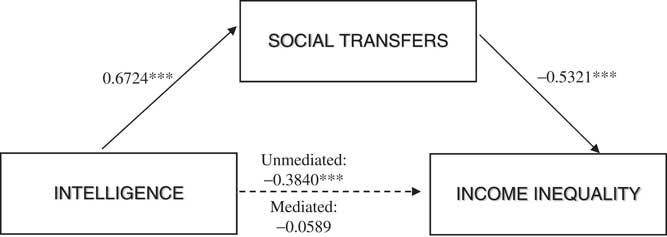
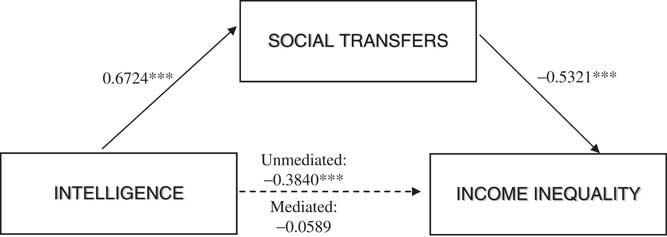
Figure 1 shows the mediation of the association between national IQ and income inequality by social transfers. It shows that national IQ has a significantly negative effect on income inequality when social transfers as a percentage of GDP are not statistically controlled (path coefficient=−0.3840, p<0.001). However, once social transfers are controlled, national IQ no longer has a significant effect on income inequality (path coefficient=−0.0059, p=0.538). National IQ has a significant direct effect on social transfers (path coefficient=0.6724, p<0.001), which in turn has a significant direct effect on income inequality (path coefficient=−0.5321, p<0.001). The Sobel test shows significant mediation (z=−4.935, p<0.001).
The association between intelligence and income inequality mediated by social transfers. ***p<0.001.
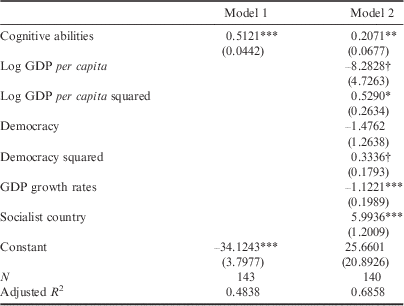
What then determines the society’s level of social transfers? Table 3, Model 1, shows the significant association between national IQ and social transfers, and, even though controlling for economic development, democracy, government size and socialist state halves the size of the effect of national IQ on social transfers, it remains statistically significant (b=0.185, p<0.002), as shown in Model 2.
Dependent variable: social transfers

Standard errors in parentheses.
Model 1: bivariate association between social transfers and cognitive abilities; Model 2: inclusion of control variables.
†p<0.1; *p<0.05; **p<0.01; ***p<0.001.
The robustness tests for the association between intelligence and redistributive policies are reported in Tables 4–6. Model 1 of Table 4 examines whether the link between intelligence and social transfers is spuriously caused by some influential countries (observations) that are substantially different from all other nations. The model re-estimates Eqn (1) using a Robust Regression (RREG) estimator that first eliminates gross outliers before estimating regression parameters and then performs Huber iterations followed by biweight iterations (Li, 1985). The coefficients are almost identical to the baseline results.
Robustness tests: additional controls

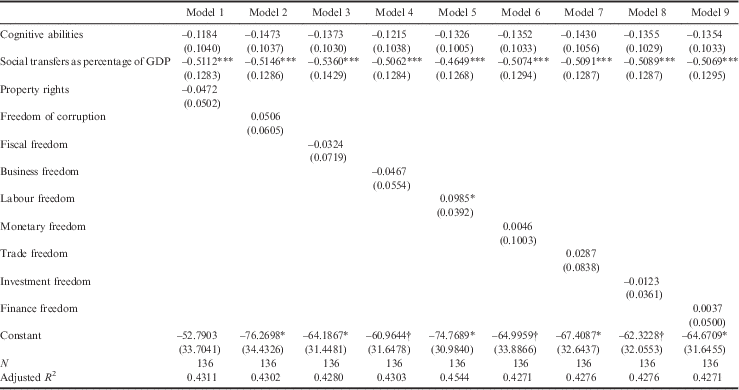
Robustness tests: sub-dimensions of economic freedom

Standard errors in parentheses; all models include the controls from the main specification in Table 2.
Model 1: inclusion of property rights as a control; Model 2: inclusion of freedom from corruption as a control; Model 3: inclusion of fiscal freedom as a control; Model 4: inclusion of business freedom as a control; Model 5: inclusion of labour freedom as a control; Model 6: inclusion of monetary freedom as a control; Model 7: inclusion of trade freedom as a control; Model 8: inclusion of investment freedom as a control; Model 9: inclusion of finance freedom as a control.
†p<0.1; *p<0.05; **p<0.01; ***p<0.001.
Robustness tests: sub-samples

Standard errors in parentheses. All models include the controls from the main specification in Table 2.
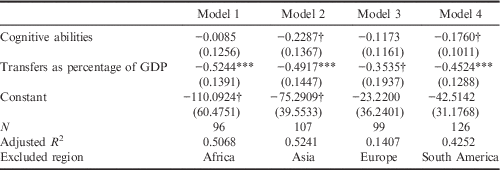
Model 1: African nations excluded from the sample; Model 2: Asian nations excluded from the sample; Model 3: European nations excluded from the sample; Model 4: South American nations excluded from the sample.
†p<0.1; *p<0.05; **p<0.01; ***p<0.001.
In Model 2 the sensitivity of the results are tested when each of the observations is assigned a weight based on its logged population size. Research suggests that in large countries such as Russia or China there are difficulties in estimating true income and inequality statistics (Henderson et al., Reference Henderson, McNab and Rózsás2005; Wang & Woo, Reference Wang and Woo2011). Moreover, research shows that in some regions intelligence is a predictor of the quality of national statistics (Kodila-Tedika et al., Reference Kodila-Tedika, Asongu and Azia-Dimbu2017).
Again, the coefficient for intelligence is very similar to the OLS estimate. Finally, Model 3 checks whether inferences are sensitive to inclusion of geographic and climatic endowments: latitude and share of population living in the tropics. Intelligence is positive and statistically significant, at the 1% level. Therefore, the results reported in Tables 3 and 4 suggest that intelligence is positively associated with redistributive policies.
Next, models presented in Table 5 test whether the baseline results are sensitive to various sub-dimensions of economic institutions. A number of studies have shown that economic freedom has a significant influence on income inequality (Carter, Reference Carter2007; Bergh & Nilson, Reference Bergh and Nilsson2010; Apergis et al., Reference Apergis, Dincer and Payne2014; Bennet & Nikolaev, Reference Bennet and Nikolaev2016). Moreover, Scully (Reference Scully2002) argued that economic freedom and government policies may have a joint effect on income inequality and economic growth. It is also important to control for this variable, as Rindermann (Reference Rindermann2008) showed that intelligence is positively correlated with economic freedom index. Therefore, models presented in Table 5 use nine sub-dimensions of economic freedom: property rights, freedom from corruption, fiscal freedom, business freedom, labour freedom, monetary freedom, trade freedom, investment freedom and financial freedom. Again, estimates for IQ and redistributive policies are similar to the baseline results.
Finally, models presented in Table 6 re-estimate the main model by excluding African (Model 1), Asian (Model 2), European (Model 3) and South American (Model 4) countries. The results remain robust.
Discussion
The aim of this study was to explore the mechanism through which countries with higher cognitive capital achieve lower income inequality. Based on prior theoretical considerations, the hypothesis that was put forward was that the intervening variable might be the size of social transfers. Consistent with related literature, the results show that, while cognitive capital is significantly negatively associated with income inequality, the association is entirely mediated by social transfers. Once the size of social transfers (as percentage of GDP) is statistically controlled, cognitive abilities are no longer significantly correlated with income inequality, and further controls for democracy, economic development, economic growth and socialism do not alter this conclusion. It appears that societies with greater cognitive capital make greater income transfers from the wealthy to the poor, and this appears to be the primary mechanism through which such societies achieve lower income inequality.
The findings in this study have a number of policy implications. While previous studies have documented that cognitive abilities have an indirect effect on income inequality via GDP per capita growth, health care expenditure, entrepreneurial activities and quality of institutions, this study instead shows that voters and policymakers in societies with higher average cognitive ability are more likely to support redistributive policies that target the poorest groups in society.
In addition, the main findings may indicate that, if policymakers in less developed countries put into action welfare policies aimed at eradicating income inequality, intelligence may serve as a credible proxy for the level of approval for such policies. Indeed, as discussed earlier, the Savanna-IQ Interaction Hypothesis suggests that more intelligent individuals are more likely to understand the negative consequences of income inequality, and thus approve the redistributive welfare policies because they are evolutionarily novel. Moreover, these results are consistent with Kanazawa (Reference Kanazawa2009), who showed that intelligence is a significant predictor of the highest marginal tax rate on individual income and income inequality, and Rashidova and Salahodjaev (unpublished), who linked intelligence to tolerance.
One of the main limitations of this study concerns issues associated with the data. The study was based on cross-sectional data; therefore, the results may be caused by interdependence between intelligence, welfare policies and income inequality. Taking into account the fact that the Gini index and IQs are not available annually, more complex statistical tools such as panel data estimators are unavailable. Therefore, this remains an agenda for future research.
Future studies should also test the hypothesis that cognitively able individuals favour redistributive policies using micro (individual) data or by conducting experimental replications. For example, Kanazawa (Reference Kanazawa2010) showed that more intelligent individuals in the United States are more likely to be liberal, and Rashidova and Salahodjaev (unpublished) have shown that cognitively able societies are associated with greater tolerance. Thus, intelligent individuals may be more likely to support pro-poor policies.
Another limitation is that the study deals with macro-level variables and cross-country analysis. While this approach is traditional, the recent literature specifically indicates that, even at the country level, variations across subnational regions can be significant. There is abundant work on subnational and regional heterogeneity (Obydenkova, Reference Obydenkova2008, Reference Obydenkova2012; Libman & Obydenkova, Reference Libman and Obydenkova2015; Lankina et al., Reference Lankina, Libman and Obydenkova2016a, Reference Lankina, Libman and Obydenkova2016b). For example, Obydenkova and Libman (Reference Obydenkova and Libman2015) demonstrated that corruption levels are highly different within a country. Some studies have shown that intelligence and other socioeconomic variables may vary at regional levels as well. For example, Lynn (Reference Lynn2010) showed that subnational levels of cognitive abilities are significantly correlated with income, human capital and quality of life. Similar results were reported by Kura (Reference Kura2013) for Japan. This limitation of the study remains and serves as an avenue for future research.