

Published online by Cambridge University Press: 25 April 2006
I spent the 2004–2005 academic year in France, culminating with theMay 29th referendum on the European Union constitutionaltreaty. Fifty-five percent of voters rejected it. Three days later,62% of Dutch voters followed suit. These were unexpected results,especially in France, a country where 80% declare themselves infavor of European integration. In other member states, a simple rulegenerally applies: those whose priority is to strengthen the EU areon the “yes” side, while the “no” is identified with those whoemphasize national interests. In the Netherlands, though the murderof filmmaker Theo van Gogh by an Islamic radical was a factor, the“no” forces won essentially because they persuaded enough peoplethat the direction the Constitution would take the Netherlands wentagainst Dutch interests. To do so, they played on the resentmentthat Brussels took their money but ignored Dutch concerns—“the samepeople who fooled you with the euro are fooling you now with thisconstitution.”
I spent the 2004–2005 academic year in France, culminating with the May 29th referendum on the European Union constitutional treaty. Fifty-five percent of voters rejected it. Three days later, 62% of Dutch voters followed suit. These were unexpected results, especially in France, a country where 80% declare themselves in favor of European integration. In other member states, a simple rule generally applies: those whose priority is to strengthen the EU are on the “yes” side, while the “no” is identified with those who emphasize national interests. In the Netherlands, though the murder of filmmaker Theo van Gogh by an Islamic radical was a factor, the “no” forces won essentially because they persuaded enough people that the direction the Constitution would take the Netherlands went against Dutch interests. To do so, they played on the resentment that Brussels took their money but ignored Dutch concerns—“the same people who fooled you with the euro are fooling you now with this constitution.”
In France, however, many proponents of the “non” sounded more pro-Europe than those of the “oui.” Thousands of posters and hundreds of op-eds told us: “Oui à l'Union; non à la Constitution.” While most “non” voters were expressing their fears of expansion of the EU to the cheap-labor east, and the potential inclusion of Islamic Turkey, taking their cues primarily from various far-right opponents of the Treaty, the Constitution could not have been defeated without a large number of left-wing voters who, in principle, favored EU integration.
It is not simply a matter of people holding uninformed or contradictory positions on what is a complex document. Especially in the last six weeks of the campaign, the level of political discussion was intense. In a mid-May poll asking respondents if they had discussed the issue in the last week, five out of six said “yes.” The debate roused my Sorbonne general arts students out of their usual apolitical stance, and most opted for the “non.” But my students were not anti-EU; they saw their vote as a statement of hope for a better France, a better Europe, indeed a better world. If we wish to make sense of the French decision, we need to understand this phenomenon, the pro-Europe “non.”
The best way to understand how three of five French citizens voted to arrest progress of European integration is to view them as having taken part in two simultaneous referenda. The first, the formal one, was easily won by the “oui.” Those who voted in it perceived that the EU and its member states would, on balance, be better off if the Treaty were ratified than if it were not. They approved of the statement setting out the goals and values of social justice and cohesion, international peace, and sustainable development in Part I, and of fundamental rights in Part II. They saw the provisions setting out new voting procedures and membership rules as needed to enable an EU of 25 members to function effectively.
In essence, this is the case presented by the French political and economic establishment, right and left, and debated in well-reasoned essays in the national press. It is fair to say that for those who followed it, the case was largely persuasive. (It is also true, however, that only a small, largely Paris-based minority reads the national press.) This is not to suggest that there are no weaknesses in the Treaty: as a compromise document it is deliberately vague or even contradictory in areas where there is no real agreement, which leaves too large a scope for the unelected judges in the European Court. This is an argument made by Former Socialist Prime Minister Laurent Fabius, by far the best-known establishment figure on the “non” side. Fabius also expressed concern that once approved, the Constitution would be extremely difficult to change, which would make it harder to undertake “coopérations renforcées,” under which some countries can move forward on their own.
Fabius' opposition gave the “non” some needed credibility. But he maintained a fairly low profile once a Socialist party internal referendum in late 2004 failed to support him, spending several key weeks of the campaign on a lecture tour in the U.S. Ultimately, the real opposition from the left lay elsewhere. The Treaty's opponents, in effect, posed a different question. As the Communist Party's referendum pamphlet—“Which question should we answer on May 29th?” —told us: “In fact, the real question is what kind of society we want, to follow the lines along which Europe is being constructed … or to carve out a different path?” (My translation).
A “non” to this question was something altogether different from a “non” to the first question. In answering it, the French were indirectly casting a vote on their national leaders' support for further EU expansion to Turkey and further liberalization of trade among the existing 25. The response to such a question could be affirmative in a country where the net economic benefit of EU participation is obvious—Spain for example, which voted “si” in a referendum early in 2005—but not in the Netherlands and France, or even Germany had the choice gone to a referendum.
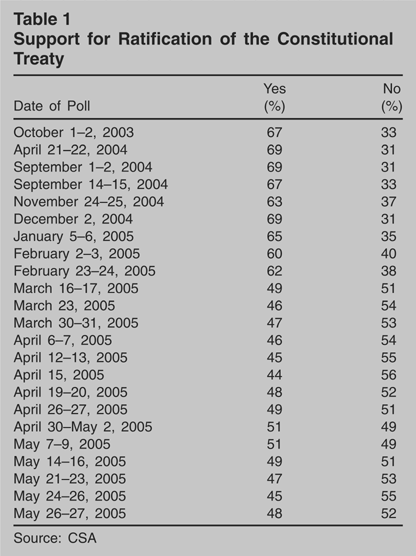
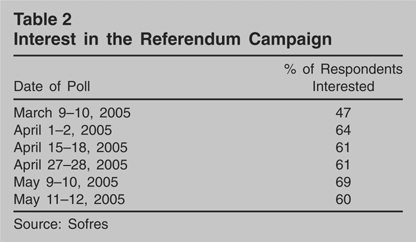
It was in March 2005—at the height of mobilization against the EU Commission's Bolkenstein Directive on the opening of the services market (see below)—that the redefinition of the question took hold. Shocked by the sudden reversal in the polls (see Table 1), the political elites angrily accused their opponents of demagogy, warning of dire consequences if the Treaty was not ratified. But in so doing, they raised the tempo of the debate. The other side responded in kind, accusing the elites of failing to respect the ability of the people to make up their own minds. As we can see in Table 2, interest in the campaign suddenly rose, coinciding with a surge in “non” support. Dramatizing the issue had brought into the fray discontented but generally passive citizens who would normally have abstained. The high turnout sealed the fate of the “oui” campaign.
Support for Ratification of the Constitutional Treaty

Interest in the Referendum Campaign

The above paragraphs apply to the Dutch vote. Even more than in France, in the Netherlands the leadership took victory for granted and panicked when faced with increasing support for the opposition. They sought to raise the stakes, attempting to convince the people that a “no” on their part would set back the course of European history. Objectively they had a point, as illustrated by the incapacity of the EU members to agree on a budget in the months following the vote. Nevertheless, this was a difficult proposition to sell, and it became moot once the French voted “non.” For most Dutch voters, the referendum was an opportunity, as the “no” side put it, to send a message to Brussels to pay more attention to Dutch concerns.
To defeat the Treaty in France however, there had to be something more: merely sending a negative message would not have been enough for my students. This positive element was provided by left-wing opponents of the Treaty who claimed that a “non” vote constituted a statement of hope about the kind of EU France wanted—as expressed in the title of the Communist Party pamphlet: “le NON: Un vote d'espoir.” Or, as a professional-looking flyer inviting us to a May 14 public discussion at the Sorbonne put it: rejecting the treaty “is the condition of a new start of cooperation among states and peoples on a truly democratic foundation and freed of ideological fantasies but abandoning not at all the goal of Europe as a space of prosperity and a multinational collectivity carrying its weight in shaping the world's destiny.”
The words sound less incongruous in French, but the very notion of “another Europe” —as boldly stated in the title of the brochure and the event, “UNE AUTRE EUROPE”—does belong to the world of fantasy. Such rhetoric was very much present in the public debate, in the speeches of the leaders of leftist factions in the Socialist Party and, especially, the various groups further to the left.
While the leaflets espousing the NON-for-a-better-EU position objected to specific passages of the Treaty, especially the reference to an internal market in which competition is free and unobstructed (I: 3–2), they relied mainly on a generalized charge that it reflected an “Anglo-Saxon” free-market vision of Europe, violating the “social” vision of Europe associated with France. Strategically the “non” forces were wise to avoid any effort at a comprehensive critique. Part III is a consolidation of constitutional provisions from previous treaties that were already in force. The rights and principles set out in Parts I and II, for full employment, social and territorial cohesion, and sustainable development, are closer to the left than the right in their inspiration. Moreover, the new voting system for the EU Council, a key component of the Treaty, could not be criticized since its effect was to raise the weight of France's vote. It was also difficult to object to the Treaty's provisions strengthening the position of the EU Commission chair and creating a foreign minister.
But these provisions seemed to be drowned in the document's many pages. While consolidating existing provisions in Part III made administrative sense, its 448 articles of legalistic text invited accusations that the fine-print contained a hidden free-market agenda. Since few read the document textually, the more demagogic among the “non” forces could thus interpret it as they chose.
What mattered in the end was the context. The Constitution was defeated because a large enough group of left-of-center voters sympathetic to European integration accepted the standard against which it was to be judged advanced by the far left, i.e., not the existing state of affairs which the Treaty sought to improve, but an undefined and indeed unattainable ideal of “l'Europe sociale.” In this, they were aided by the “oui” forces. Not only the leadership of the Socialist Party, but also the mainstream center-right, claimed that the Constitution was a step toward “l'Europe sociale.” The rhetoric of Jacques Chirac, and his preferred successor (and current prime minister) Dominique de Villepin, was replete with contrasts between a European “social” and an Anglo-Saxon “ultra-liberal” model.
It so doing, however, they were carving out territory more effectively occupied by the pro-Europe “non” when it came to interpreting this long and unwieldy document. As is inevitable in a compromise designed to suit 25 sovereign and diverse nations, some articles seem more “liberal” (i.e., market-oriented), others more “social” in spirit. The opposition forces proved adept at linking the liberal elements with much noticed plant closings, claiming ratification of the Constitution would facilitate “social dumping.” It seized upon the EU Commission's draft Services Directive associated with former Commissioner Frits Bolkenstein. The directive, which raised fears of low-paid Polish plumbers taking the jobs of French tradesmen, proved a godsend to the “non” forces. Bolkenstein became the Frankenstein of the “non,” and the directive's repudiation by the Chirac government gave credence to the alleged link of the directive with the Treaty.
While left-wing “non” spokespersons could not attack Polish plumbers per se, their counterparts on the right faced no such constraints. Defeat of the Treaty was won by an “objective alliance” of radical right-wing nationalists attacking the EU for social dumping and a radical left-wing that promised that a different EU, one that protected existing jobs against market pressures, would rise from the Constitution's ashes.
Supporters of the radical left are by no means exclusive to France, but France's institutions exaggerate their importance. Though sharing executive power with the prime minister, the president dominates the political system much as does his American counterpart. Yet almost anyone can get on the first ballot in a presidential election, as it takes only 500 signatures from among the hundreds of thousands of elected officials. In France during the campaign leading up to the April 2002 first presidential ballot, I had the dubious pleasure of watching every night on national (public) television long interviews with one of the more than 15 minor or fringe figures from the left and right who, as official candidates, were entitled to the exposure, just as were the standard-bearers of the Conservatives (Jacques Chirac) and Socialists (Lionel Jospin). However marginal or extreme, each was courteously interviewed.
Everyone in France remembers the result: the fringe candidates took enough votes on the left from Jospin that the far right candidate, Le Pen, made it to the second round, with non-Conservative voters forced to rally to Chirac in the second ballot. Between ballots, hundreds of thousands rallied in the streets to disassociate themselves from Le Pen. Yet the mobilization soon ended, with no visible effort to learn from this experience of institutional failure.
It was “déjà vu all over again” as I watched the speeches and debates in the weeks before the EU Treaty referendum. This time, Olivier Besancenot, the young Trotskyist, and Marie-Georges Buffet, the old-line Communist, as well as the nationalist sometime-Socialist Jean-Pierre Chevènement, starred on our TV screens taking on various members of the government and the Socialist leadership. With an equal number of representatives of both sides operating under the same rules as in 2002, the extreme and the mainstream were again on an equal footing. Except that the “non” advocates, with no record in government to defend and no fear of actually having to put their arguments into practice, were able to put their opponents on the defensive, forced to defend their records against sweeping condemnations. It should be added that they were hampered in this by the absence of coordinated efforts to win support for the Constitution. In order to ward off attacks from the far left, the Socialist leadership went out if its way to avoid cooperating with President Chirac, often denouncing the ruling Conservatives in the same harsh language used by the far left.
The networks could have invited representatives of the major civil society organizations, such as employers' representatives and trade unions—all of the former and the majority of the latter favored the Treaty—to participate in the debates. But to do so would have given ammunition to those denouncing the media as biased in favor of the establishment, something they bent over backwards to avoid. The result was and is a highly articulate but skewed public debate that obscures the link between the expression of ideas and their implementation in the real world. What distinguishes extremists in political debate is the absence of any obligation to address whether the ground from which they criticize their opponents is firm. If the extreme and the mainstream are given equal legitimacy, then the need to test ideas against the “bottom line” itself becomes a matter of debate.
The problem lies less with the media than with political choices. Why should fringe candidates have easy access to the presidential ballot? Why, in the case of the Treaty, was a referendum called in the first place? Unlike their German counterparts, French leaders succumbed to pressure to “let the people decide.” Yet here the decisive political choices were made at the EU level, among the Europhiles who drafted the document. Parliaments are normally called upon to ratify treaties to restructure trans-national institutions, but once these treaties are termed constitutions, referenda become the norm: even the Dutch found themselves voting in a national referendum, something they hadn't done for more than 200 years. A constitution is expected to meet the highest standards—even when these standards are contradictory. For example, while most feminists supported the Treaty as a real advance, radical groups denounced the absence of a guaranteed right to abortion, contraception, sexual orientation, and a life free from violence. A similar pattern could be found among environmentalists and pacifists.
I am not arguing against ratification of constitutions by referenda. But certain minimal conditions must be in place. One is that the consequences of a “yes” or “no” be clear. This is impossible when the document is a long and complex treaty among many countries and the vote is taken in one country at a time. It is too easy to play down the long-term positive consequences of ratification and play up short-term negatives. A new treaty incorporating changes required to incorporate the 10 new members, most from Eastern Europe, could have been ratified in the usual way, by votes in national parliaments. But the dislocations associated with the recent enlargement made it foolhardy not to wait until the integration of the new members had reached the appropriate stage before setting out fundamental rights and principles in a constitution.
The fundamental problem revealed by the referendum defeat is not that the EU emperor has no clothes, but that he is a respectable commoner whom his Europhile defenders insist on parading as an emperor. The EU embodies a profound European desire to resolve differences through peaceful cooperation based on mutual respect and to never again resort to war. This is no small thing, of which Europeans are justifiably proud. But Europhiles create a myth that cannot be lived up to in portraying the 25-member EU as a “soft power” alternative, defending multilateralism against the United States' unilateral exercise of “hard power.” Beyond this, Treaty opponents in France skillfully used continental discomfort with Anglo-Saxon unilateralism to vaunt an ill-defined EU socioeconomic project fundamentally different from the Anglo-Saxon market model. It is equally a myth that such a project could be realized through the institutions of a 25-plus member Union. The achievable goal is a union of states benefiting from a framework in which they are able to pursue projects consistent with their own social and economic priorities. The EU's role is to make manageable and predictable rules to allow for this. This is no small virtue, but it is hardly the stuff of a European social project.
In this context, a saving grace of the setback would be if the Treaty's defeat brought the Constitution's backers to take a more realistic look at their own ambitions. This was not the first reaction of the Europhiles. In various post-mortems, the response of the Treaty's drafters in Brussels and beyond was to blame national politicians who, whenever anything goes wrong, make the EU the scapegoat. There is certainly substance to this critique; but could they really expect politicians not to act as politicians?
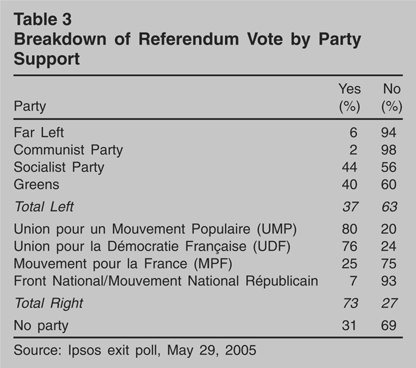
By, in effect, inviting people to cast a vote as to whether the EU was living up to its notices, the drafters of the EU “constitution” reaped the whirlwind. The first victim was the Treaty itself; but the mainstream national political leaders were also its victims. President Chirac's credibility plummeted to new lows; but it was the Socialist leadership that lost the most. With 70% of France's registered 41.8 million voters casting ballots, it was they who failed to deliver. Eighty-one percent of blue-collar workers voted “non.” Over half of those planning to vote Socialist rejected the position of their party (see Table 3), compared to only a quarter of supporters of the governing Conservative party, the Union pour un Mouvement Populaire (UMP). This was an endorsement less of Chirac or the Raffarin government than of Nicolas Sarkozy, the party's chairman (and rival to de Villepin for the presidency).
Breakdown of Referendum Vote by Party Support

Sarkozy was the only leading figure in the debate to argue that EU institutions provide a necessary complement to the French social model, a useful corrective to keep it from becoming moribund. He embraced rather than rejected the imposition of market discipline on EU member countries, stating that France would benefit from being submitted to such discipline in sectors where it was falling behind, distancing himself from Chirac's claim that strengthening the EU would strengthen the “modèle français” against the predations of the liberal Anglo-Saxons. If the defeat of the Constitution brings such a more realistic discourse to the fore in Paris and in Brussels, it will not have been, entirely, in vain.

Support for Ratification of the Constitutional Treaty

Interest in the Referendum Campaign

Breakdown of Referendum Vote by Party Support