


Impact statement
Antimicrobial resistance (AMR) is increasingly recognised as a major global health threat, yet its unequal impact across populations with factors associated with health inequalities remains poorly reflected in policy relating to AMR. This article is among the first to describe a structured process for embedding health inequalities within national AMR policy. The review of published AMR National Action Plans (NAPs) and the conducting of the United Kingdom (UK)-wide modified Delphi consensus process informed the development of health inequalities commitments adopted within the UK 2024–2029 AMR NAP. Early implementation of the UK AMR NAP has strengthened national surveillance and reporting of AMR-related inequalities, providing a foundation for data-driven interventions and future target setting. The article demonstrates that addressing AMR requires not only accurate surveillance but also an understanding of the social determinants that influence infection risk, antimicrobial exposure and health outcomes. The methodology and lessons presented are directly relevant to policymakers, researchers and public health practitioners seeking to integrate health inequalities into AMR policy and guidance.
Introduction
Antimicrobial resistance (AMR) is a major challenge for modern medicine and has become a significant threat to human health. Approximately 1.14 million deaths globally were attributed to antibiotic-resistant bacterial infections in 2021 (Naghavi et al., Reference Naghavi, Vollset, Ikuta, Swetschinski, Gray, Wool, Aguilar, Mestrovic, Smith, Han and Hsu2024). A Global Action Plan was published in 2015, with 193 countries subsequently signing a UN declaration and multiple countries now having published and implemented National Action Plans (NAPs) to tackle AMR (Rogers Van Katwyk et al., Reference Rogers Van Katwyk, Grimshaw, Nkangu, Nagi, Mendelson, Taljaard and Hoffman2019). The UK published a 5-year strategy in 2013 (Department of Health and Social Care, 2013) followed by a 20-year vision in 2019 (Department of Health and Social Care, 2019a), with 5 yearly NAPs published from 2019 onwards (Department of Health and Social Care, 2024; Department of Health and Social Care, 2019b).
Like many other communicable and non-communicable diseases, the impact of AMR is not felt equally across all populations. This has been increasingly evident at a global level with low and middle-income countries disproportionately affected by AMR (Murray et al., Reference Murray, Ikuta, Sharara, Swetschinski, Aguilar, Gray, Han, Bisignano, Rao, Wool and Johnson2022). More recently, evidence is emerging that highlights the issue of health inequalities in high-income countries across community and hospital settings in AMR and antimicrobial use (AMU)/exposure. Evidence highlights increased rates of infection and resistant infection, as well as higher levels of antimicrobial exposure among those from ethnic minority backgrounds, deprived communities and inclusion health groups (Harvey et al., Reference Harvey, De Brún, Casale, Finistrella and Ashiru-Oredope2023; Ghataure et al., Reference Ghataure, Gilham, Casale, Harvey, De Brún, Finistrella and Ashiru-Oredope2025; Obed-Arthur et al., Reference Obed-Arthur, Casale, Harvey, De Brún, Finistrella, Gilham and Ashiru-Oredope2026); these reviews also highlighted that UK-specific evidence regarding health inequalities in AMR and antibiotic use was limited.
To understand health inequalities in AMR within the UK, the UK Health Security Agency (UKHSA), (the national public health institute responsible for surveillance, detection, monitoring and response to infectious diseases, AMR, healthcare-associated infections (HCAIs), emerging health threats and other hazards affecting public health in England) formed a dedicated health inequalities workstream to improve national data reporting in this area. This workstream was formed in 2019, following the evaluation of UKHSA-led public health campaigns using a health equity assessment tool (HEAT) (Hood et al., Reference Hood, Toleikyte and Ashiru-Oredope2019). This tool was completed as part of the AMR and HCAI division at the UKHSA’s AMR programme. This work highlighted significant differences in AMR burden within ethnic minority groups and those with socio-economic deprivation (UKHSA, 2023).
Data published in the annual English Surveillance Programme for Antimicrobial Utilisation and Resistance (ESPAUR) report ahead of the development of the commitments showed inequalities in bloodstream infections and resistant bloodstream infections: the highest rate of Carbapenemase-producing Gram-negative bacteria in 2022/23 was observed in Asian/Asian British (7.7 per 100,000 population), followed by black African, Caribbean or black British (4.6 per 100,000 population) ethnic groups compared to 4.1 per 100,000 population among the White ethnic group (UKHSA, 2023). This difference could also be seen by deprivation with a significantly higher rate of Carbapenemase-producing Gram-negative bacteria notifications in the most (7.2 per 100,000 population), compared to the least deprived quintile (3.6 per 100,000 population) (unadjusted binomial regression model: p < 0.005) (UKHSA, 2023). In addition, prior to the development of the 2024–2029 NAP, health inequalities data was only routinely available within England via the ESPAUR report, and for a limited number of health inequalities factors, presenting significant gaps in understanding health inequalities across different populations in other nations within the UK. Furthermore, understanding of the drivers of inequalities in AMR was limited, thus affecting the ability to develop and implement interventions. This highlighted a need for UK policy which would facilitate targeted workstreams towards understanding and addressing health inequalities in AMR across the UK.
Taking learning from the first UK AMR NAP, the 2024–2029 NAP development process was informed by a theory of change model approach (Supplementary Material 1) with stakeholder engagement and expert review used to test the link between outcomes and the commitments that underpin them (Department of Health and Social Care, 2024). During the 2024–2029 NAP development process, there was an opportunity to include a dedicated health inequalities outcome and to develop evidence-informed targets and commitments that would facilitate continued progress towards the better understanding of and tackling of health inequalities in AMR. However, to the best of our knowledge, no structured evidence-based approach for developing national policy was available to guide the development process. Therefore, this article aims to outline the process taken to develop national health inequalities targets and commitments for inclusion in the NAP, as well as the progress that has been made towards the commitments published in the 2024–2029 NAP.
Methods
The process taken to develop health inequality targets and commitments for the 2024–2029 NAP included exploring where and how health inequalities have been included within other countries’ NAPs to determine if learning could be taken from these. It also involved the use of a modified Delphi consensus process to gain expert consensus regarding key areas of focus that should be incorporated as targets and commitments within the 2024–2029 NAP. A glossary of terms related to health inequalities and the NAP is available in Supplementary Material 1.
Rapid literature review
Existing NAPs published in 2023 or earlier were accessed via the WHO Library of AMR NAPs (World Health Organization, 2025). NAPs published by the Organisation for Economic Co-operation and Development (OECD) countries (OECD, n.d.) were searched using the terms inequity, inequities, inequality, inequalities, disparity, and disparities to identify any mention of health inequalities or disparities, to outline any included targets or commitments focused on reducing inequalities in AMR across populations with factors associated with health inequalities, and to highlight approaches to monitoring or measuring progress towards targets. Any NAPs not published in English were excluded from the analysis. The review was limited to NAPs from OECD countries to maximise the relevance, comparability and transferability of findings to the UK context.
Development of national commitments and target(s)
This study follows the Accurate Consensus Reporting Document (ACCORD) checklist (Gattrell et al., Reference Gattrell, Logullo, van Zuuren, Price, Hughes, Blazey, Winchester, Tovey, Goldman, Hungin and Harrison2024).
A modified Delphi process was used to reach consensus on health inequalities targets and commitments for inclusion in the 2024–2029 NAP. The Delphi process is an accepted technique that allows for input from a variety of expertise across multiple geographical locations to gain group consensus on a topic (Niederberger et al., Reference Niederberger, Köberich and Network2021).
The modified Delphi process
The process was classed as a modified Delphi due to the use of non-anonymised workshops and the use of methods of evaluation other than measuring probability. The modified Delphi included four stages (Figure 1) and was conducted between May and November 2023. The process involved technical experts, and policy leads from across the four UK nations, as well as communications with the NAP Oversight Group, Advisory Committee on Antimicrobial Prescribing, Resistance and Healthcare Associated Infection (APRHAI), and four nations policy leads to seek further endorsement. Those managing the Delphi were able to participate in the consensus process.
Outline of the Delphi consensus process used to develop targets and commitments for inclusion in the UK’s 2024–2029 NAP for AMR.

Figure 1. Long description
The flowchart consists of four main blue boxes representing chronological steps, each followed by light blue sub-task boxes.
Step 1. Modified Delphi (May 2023). Sub-task: 9th May: Initial workshop to brainstorm ideas.
Step 2. Modified Delphi (May to June 2023). Sub-tasks include: Commentary document distributed to initial workshop attendees (May 2023); Initial survey developed and distributed (Online Microsoft forms); Second workshop.
Step 3. Modified Delphi (June to September 2023). Sub-tasks include: Feedback surveys developed and distributed (Online Microsoft forms); Third workshop (September 2023); Draft targets and commitments presented to E S P A U R for endorsement.
Step 4. Presentation to N A P Oversight group and A P R H A I endorsement (September to November 2023). Sub-tasks include: Target specific survey developed and distributed (Online Microsoft forms); Draft targets and commitments presented to N A P Oversight group, and at A P R H A I’s 53rd plenary meeting for endorsement; Draft targets presented to policy leads from Scotland, Wales and Northern Ireland for endorsement (November 2023).
Step 1. First workshop and commentary documents
An initial workshop was held on 15th May via Microsoft Teams with a purposive sample of technical experts, policy leads and patient and public involvement and engagement partners (PPIE), who had expertise in health equity, infection prevention and control (IPC), antimicrobial stewardship (AMS), prescribing or AMR surveillance and epidemiology. Insights from the review of published NAPs, surveillance activities and surveillance data across the four UK nations to address health inequalities in AMR were presented to facilitate the brainstorming of initial ideas for targets and commitments.
Ideas for potential targets and commitments were then synthesised into four targets and five commitments by three authors (E.T., D.L. and D.A.-O.) (Supplementary Material 2). On 18th May, these were distributed via a commentary document to workshop attendees for feedback by 25th May. This ensured that the workshop attendees’ thoughts had been captured accurately and to provide them with the opportunity to reflect on their suggested targets and commitments before they were distributed more widely.
Step 2. Feedback questionnaire and second workshop
The initial targets and commitments were consolidated and formatted into a questionnaire, created using Microsoft (MS) Forms, that used both closed and open-ended questions to gain feedback (Supplementary Material 3). On the 26th May, the questionnaire was sent via email to 48 professionals, including members of the ESPAUR Oversight Group, regional AMR leads, policy leads and healthcare professionals including pharmacists, nurses, doctors and healthcare scientists from across the four UK nations. Participants included colleagues or formal acquaintances of the researchers and were selected due to their experience in AMR and their knowledge of health inequalities in AMR. The questionnaire was closed for comment on 7th June. A second workshop was held on 7th June to discuss the participant’s feedback. The meeting and comments made into the MS Teams chat were recorded and reviewed post meeting to ensure all comments made were captured.
Step 3. Second feedback questionnaire
The second feedback questionnaire (Supplementary Material 4) was developed in MS Forms using recommendations made during Step 1 and 2 of the Delphi process. The questionnaire was sent via email to 49 participants on 9th June. These participants included those involved in Step 2, as well as additional policy colleagues, with a request for participants to cascade to colleagues within public health organisations across the four UK nations. The questionnaire closed for comment on 16th June.
Step 4. Final target feedback questionnaire and presentation to independent groups for endorsement
A separate survey focused solely on the proposed NAP targets was sent to 89 participants on 25th August and closed for comment on 5th September (Supplementary Material 5).
The targets and commitments proposed by those who participated in the modified Delphi process were then presented to independent groups for endorsement. These groups included the Target Oversight Group on 11th September, ESPAUR members on 19th September, the NAP Oversight Group on 20th September and APRHAI members at the 53rd APRHAI meeting on 27th September.
Data analysis
Questionnaire responses at each stage of the process were exported into Microsoft Excel for analysis. Descriptive statistics were produced to determine the proportion of individuals who agreed with each proposed target and commitment. Consensus was determined at >60% agreement.
Assessing UKHSA’s progress 1 year after NAP publication (a case study of implementation)
Following publication of the 2024–2029 NAP, the following activities have been undertaken to assess the progress made by the UKHSA towards achieving the health inequalities commitments included within the NAP.
A gap analysis of existing surveillance outputs was conducted in 2023 and 2025 using a data collection form developed in Microsoft Excel. This was distributed to heads of teams within the AMR and HCAI division. For each routine surveillance output produced by the division, information was collected on whether data is reported, collected, would like to collect, too challenging to collect/not available or not relevant for each factor associated with health inequalities. Furthermore, the 2024–2025 ESPAUR report was also used to synthesise reported progress towards health inequalities commitments.
Results
Review of national action plans
Twenty-three NAPs met the inclusion criteria of being published in English by an OECD country. Four of the identified NAPs (17%, 4/23), published by Canada, New Zealand and the UK contained at least one key search term (Supplementary Material 6). The 2017–2023 and 2023–2027 Canadian NAPs and the 2017-ongoing New Zealand NAP contained specific actions to be taken to tackle inequalities in AMR (Table 1) (Department of Health and Social Care, 2024; Ministry of Health, 2017; Public Health Agency of Canada, 2023). The NAPs published in 2017 by New Zealand and Canada highlighted the need to investigate inequalities in prescribing antimicrobials in community and hospital settings and to reduce inequalities in the delivery of IPC programmes, respectively. The identified need to reduce health inequalities in IPC programmes was subsequently built upon in the 2023–2027 Canadian NAP which states a specific action to improve the implementation of IPC for populations disproportionately impacted by AMR by developing, updating and promoting uptake of guidelines. The UK NAP published in 2019 contained two mentions of the search term inequality/inequalities. However, these were in relation to definitions of key terms used within the document rather than to any planned areas of work (Department of Health and Social Care, 2019b). At the global level, the WHO Sustainable Development Goals includes an AMR indicator measuring the proportion of E. coli bloodstream infections resistant to third-generation cephalosporins, stratified by country income level (WHO, n.d).
Health inequalities content found in NAPs published by OECD countries in or prior to 2023

Table 1. Long description
The table consists of five columns: Country, Year published, National action plan, Search term word count, and Outcomes/targets/actions that focus on inequalities and disparities.
* Row 1: Canada, 2017. Plan: Canada: Tackling antimicrobial resistance and antimicrobial use A Pan-Canadian Framework for Action. Search term word count: 3. Outcomes: Component 2: Infection Prevention and Control I P C. Opportunities for Action: Work with communities and stakeholders to build capacity and reduce inequalities in delivering comprehensive and effective I P C programs in the human and animal health sectors.
* Row 2: Canada, 2023. Plan: Canada: Pan-Canadian Action Plan on Antimicrobial Resistance 2023 to 2028. Search term word count: 8. Outcomes: Pillar 4. Desired outcome 1: Canada has infection prevention programs in place across community and institutional health sectors, including for populations disproportionately impacted by A M R. Action: Increase effective implementation of infection-prevention measures, particularly for populations disproportionately impacted by A M R such as remote, northern and isolated communities, First Nations, Inuit and Métis populations, long-term care residents, and hospitalized patients.
* Row 3: New Zealand, 2017. Plan: New Zealand: Antimicrobial resistance action plan 2017 to 2020. Search term word count: 1. Outcomes: Priority action area 12. Activities: Investigate any inequities in antimicrobial prescribing in community and hospital settings.
* Row 4: United Kingdom, 2019. Plan: United Kingdom of Great Britain and Northern Ireland: U K five-year antimicrobial resistance strategy 2019 to 2024. Search term word count: 2. Outcomes: Contained within glossary of terms for Quality Premium N H S scheme and sustainable development goals regarding reducing inequalities and economic inequality.
Delphi consensus
This section presents an overview of the findings from the Delphi consensus. One individual participated in all four Delphi steps, four individuals participated in three Delphi steps, 18 individuals participated in two Delphi steps, and 45 individuals only participated in one Delphi step. More detailed findings from each step of the Delphi consensus are outlined in Supplementary Material 7.
Respondent demographics
Questionnaires which formed part of the Delphi process gained responses from 43 individuals, including four group responses from the Health Equity and Inclusion Health Division at UKHSA (approximately 30 members), Association of Scottish Antimicrobial Pharmacists (approximately 40 members), Health Development Policy Branch and Health Improvement Branch within Population Health Directorate, Northern Ireland (4 members) and NHS Education for Scotland, with representation from all four UK nations. Eight individuals provided responses to two or more questionnaires resulting in 52 questionnaire responses in total. Questionnaire respondent demographics for the three feedback questionnaires can be seen in Supplementary Material 8.
Consensus at step 1 and 2
Initial key themes that could be formed into targets were identified during the first workshop. These themes included improved surveillance, shared learning between nations, availability of evidence-based resources and exploration of interventions to address inequalities. To develop drafts of the initial commitments, ideas for actions necessary to achieve the proposed targets were brainstormed. These initial ideas were subsequently formalised and drafted into a commentary document (Table 2).
Initial draft targets and commitments collated from themes generated during initial workshop held on 15th May

Table 2. Long description
The table is divided into two columns. The left column lists the item identifier, and the right column provides the specific goal or action.
* Target 1. By 2029, all devolved administrations will be collecting and reporting infection incidence, antimicrobial use and resistance data by age, sex, ethnicity, deprivation and geography as a minimum. A bullet point notes evidence that these factors are associated with variation in A M R burden.
* Target 2. By 2029, devolved nations will determine warranted versus unwarranted variation in infection incidence, resistant infection, antimicrobial exposure, access to care or clinical outcomes across regions, population groups and settings.
* Target 3. By 2029, devolved nations will implement interventions to address unwarranted variation in infection incidence, resistant infection, antimicrobial exposure, access to care or clinical outcomes which are accessible and appropriate to all groups.
* Target 4. By 2029, use of a health equity tool will be embedded within the development of interventions to ensure they address and do not exacerbate health inequalities.
* Commitment 1. All four nations will implement systems and structures which allow them to report routinely on infection incidence, antimicrobial use, resistance and clinical outcomes by major groups.
* Commitment 2. Standardisation of reporting across the U K to allow for comparison towards targets across settings and geographies.
* Commitment 3. Develop, adapt and implement interventions to reduce avoidable antimicrobial exposure in key groups, including children and older adults, and individuals from deprived communities.
* Commitment 4. Collate evidence-based resources into a standardised U K-wide toolkit, adaptable to local needs, which contains information on how to address health inequalities.
* Commitment 5. Implement appropriate risk assessment and targeting of empirical treatment to reduce the burden of resistant infections within all regions, population groups, and settings.
Following review in the first questionnaire, consensus was gained for Target 1 (63%, 12/19) and Commitment 1 (79%, 15/19) (Table 3).
Showing targets and commitments included in the initial feedback survey and the number of respondents who agreed that the proposed targets are quantifiable measures that would enable us to demonstrate our success in meeting the NAP outcome and the commitments that would contribute to helping to achieve the health inequalities outcome within the NAP (n = 19)

Table 3. Long description
The table consists of three columns: Target or Commitment, n, and percentage. The total sample size is n equals 19.
Section 1: Targets
1. By 2026, all U K nations will collect and report data annually on infection incidence and antimicrobial use and resistance by age, sex, ethnicity, deprivation, and geography. This includes adult social care, inclusion health groups, and prisons. n equals 12, 63 percent.
2. By 2029, all U K nations will report on unwarranted variation in antimicrobial exposure, resistant infections, access to care, and clinical outcomes across regions, population groups, and settings. n equals 7, 37 percent.
3. By 2029, focused interventions will lead to measurable reductions in unwarranted variation in antimicrobial exposure and resistant infections. n equals 8, 42 percent.
Section 2: Commitments
1. Implement systems to report routinely on infection incidence and outcomes by major groups. n equals 15, 79 percent.
2. Standardise reporting across the U K for comparison across settings and geographies. n equals 7, 37 percent.
3. Develop and evaluate co-created interventions to reduce avoidable antimicrobial exposure in key groups. n equals 10, 53 percent.
4. Collate evidence-based resources into a standardised U K-wide toolkit to address inequalities. n equals 10, 53 percent.
5. Implement risk assessment and targeting of empirical treatments to reduce the burden of resistant infections. n equals 5, 26 percent.
6. Embed a health equity tool in the development of all I P C, antimicrobial use, and A M R interventions. n equals 6, 32 percent.
Feedback for target 1 mainly centred around challenges associated with collecting data on populations with factors associated with health inequalities, especially within certain settings such as prisons, and that the target may benefit from being more specific in terms of the sectors, settings and types of data that would be collected and reported on. Feedback concerning the use of the word unwarranted and defining what would be classed as unwarranted variation was seen for targets 2 and 3. Finally, feedback on target 3 also included concerns regarding how progress towards the target would be assessed. This resulted in target 2 being removed with elements, such as the inclusion of high-risk settings (such as prisons and long-term care facilities) being incorporated into target 1.
Feedback from respondents mainly related to Commitments 4 and 5. One respondent felt Commitment 5 was needed and that the commitment needs to refer to reducing the burden of all infection. Commitment 4 was reported to be key, although one respondent was unsure how achievable a standardised toolkit would be. Furthermore, one respondent raised concerns that a standardised approach to reporting data on health inequalities may result in missing opportunities and nuances in the data.
Feedback obtained from the second workshop was consistent with the initial feedback survey with Commitments 1 and 4 felt to be the most important with Commitment 6 also being popular. Workshop attendees also felt that Commitments 1 and 2 could be combined which was actioned for the second feedback survey.
Step 3
Following the second questionnaire, consensus was gained for target 1 and 2 respectively, with 60% and 70% of respondents agreeing that these were quantifiable measures that would allow progress towards achieving the NAP outcome to be demonstrated. The remaining respondents agreed but felt the targets needed editing. The suggested amendments included clarifying that regional as well as national data should be collected and reported, and the potential importance of including clinical outcomes within the target. Finally, 60% of respondents, including one of the group responses, felt that target 1 should be a priority to take forward and 30% of respondents felt that target 2 should be prioritised.
Respondents felt Commitments 1, 2 and 3 were key to achieving the NAP outcome. It was also suggested that Commitments 1 and 6 be combined with the wording “establish pathways for collecting and reporting data annually” used to allow for the wide variations in current reporting on antibiotic, antifungal, antiviral and antiparasitic use and resistance. A wording change was also suggested for Commitment 2 as collecting data on clinical outcomes would be key when evaluating interventions.
Following step three, Commitments 1, 2 and 3 were taken forward for inclusion in the NAP with final wording adjustments made by the Department for Health and Social Care prior to government approval. These commitments focused on improving collection and reporting of AMR and AMU data for age, sex, disability, ethnicity, nationality, deprivation, geography and high-risk settings, developing a toolkit for identifying and addressing health inequalities in access, infection incidence, clinical outcomes, vaccine uptake and antimicrobial exposure and to develop, implement and evaluate interventions to reduce infections and avoidable antimicrobial exposure and optimise clinical and population outcomes and patient safety, adapting approaches to consider the main groups and factors commonly associated with health inequalities.
Showing the redrafted national action plan commitments and number and percentage of questionnaire respondents who agreed that each commitment should be taken forward for inclusion in the national action plan (n = 10)

Table 4. Long description
The table consists of two columns: Target and n.
Under the Target heading, there are two numbered targets:
1. By 2026, all U K nations will collect and report data annually on infection incidence and antibiotic and antifungal use and resistance, including variation by age, sex, ethnicity, deprivation, geography and high-risk settings including adult social care and prisons as a minimum, which will be used to inform intervention development. n equals 6.
2. By 2029, focused interventions in each country will contribute to measurable reductions in unwarranted variation asterisk in antimicrobial exposure and key infections, including resistant infections, which are accessible and appropriate to all groups. n equals 7.
Under the Commitment heading, there are six numbered commitments:
1. All U K nations will implement systems and structures which allow for standardised, routine reporting on infection incidence, antimicrobial asterisk use, resistance and clinical outcomes by major groups (age, sex, ethnicity, deprivation, geography and high-risk settings including adult social care and prisons) asterisk antibiotics, antivirals, antifungals antiparasitics. n equals 4.
2. The U K will standardise reporting across the U K to allow for comparison towards targets across settings and geographies. This text is shown with a strikethrough. n is marked with a dash.
2. Based on reporting insights we will develop, adapt, implement and evaluate interventions that are co-created with communities to reduce infections, including resistant infections, and avoidable antimicrobial exposure in key groups, including children and older adults, and individuals with factors commonly associated with health inequalities. n equals 9.
3. Collate evidence-based resources into a standardised U K-wide toolkit, adaptable to local needs, which contains information on how to address inequalities in infection incidence, antimicrobial exposure and resistant infections. n equals 9.
4. Implement appropriate risk assessment and targeting of empirical treatments to reduce burden of key, including resistant, infections within all regions, population groups (age, sex, ethnicity, deprivation), geographies and high-risk settings including adult social care and prisons. n equals 0.
5. All U K nations will commit to embedding the consistent use of a health equity tool in the development of all interventions focused on I P C, antimicrobial use, and A M R to ensure the interventions address and do not exacerbate health inequalities. n equals 5.
6. The U K will establish pathways for collecting and reporting data annually on infection incidence and antiviral and antiparasitic use and resistance, including variation by age, sex, ethnicity, deprivation, geography and high-risk settings including adult social care and prisons as a minimum, which will be used to inform intervention development. n equals 4.
Strikethrough text shows suggested commitments which were removed following Step 2 of the Delphi process.
Step 4
Given the high proportion of individuals who supported targets 1 and 2, the target wording was amended to combine aspects of both targets to include regional data collection and the use of data to inform intervention development.
Most respondents agreed that the proposed target was quantifiable and would demonstrate success in meeting the NAP health inequalities outcome (48%, 11/23). Feedback mainly related to concerns regarding the achievability of the target due to data availability and the proposed timeline, as well as whether the target would be quantifiable due to challenges capturing improvements in infection incidence and resistance within a single metric. Other comments related to the consistency of the terms used relating to antimicrobials and making the target more concise. As a result, the following target was taken forward for consideration by the UK AMR delivery board – “Develop annual reporting mechanisms for infection incidence, antibiotic use and resistance (bloodstream infections) by age, deprivation and geography.”
Assessing progress within the UKHSA one year after NAP publication (a case study of implementation)
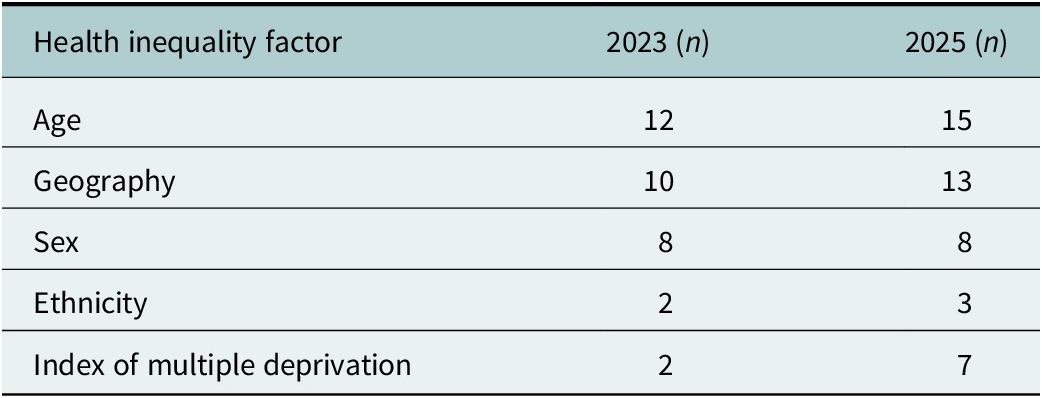
Progress within England towards the NAP commitments was assessed one year following the publication of the 2024–2029 NAP in May 2024. A gap analysis originally conducted in 2023 (UKHSA, 2023) was repeated in 2025 to determine whether there has been an increase in the UKHSA’s routine reporting on AMR within populations with factors associated with health inequalities, including protected characteristics and inclusion health groups (definitions available in Supplementary Material 1), as well as factors listed within the NHS CORE20Plus framework (NHS England, n.d.; Government, H, 2010). The gap analyses conducted in 2023 and 2025 highlighted consistent reporting of age, sex and geographic variations across the UKHSA’s routine outputs (Supplementary Material 9). There was an increase from 2023 to 2025 in the number of routine surveillance reports containing data on at least one health inequalities variable (Table 5). For example, within the ESPAUR report, bloodstream infection incidence, AMR burden and 30-day all-cause mortality are now reported by both index of multiple deprivation (IMD) and ethnicity (UKHSA, 2025a). Antibiotic use in primary care and broad-spectrum antibiotic use are also now reported by IMD compared to 2023. Furthermore, the Carbapenemase-producing Gram-negative organisms in England quarterly report now reports data by IMD (UKHSA, 2025b). Furthermore, improvements to reporting quality have been made with the latest ethnicity and IMD data within the ESPAUR report stratified by age and sex. Data on the burden of resistant infections among those in contact with the justice system was also included in the 2025 Chief Medical Officer report on the health of people in prison, on probation and in the secure NHS estate in England (Department of Health and Social Care, 2025).
The number of published routine surveillance reports that include data on factors associated with health inequalities in 2023 and 2025

Table 5. Long description
The table consists of three columns: Health inequality factor, 2023 (n), and 2025 (n).
* Age: 12 reports in 2023, increasing to 15 in 2025.
* Geography: 10 reports in 2023, increasing to 13 in 2025.
* Sex: 8 reports in 2023, remaining at 8 in 2025.
* Ethnicity: 2 reports in 2023, increasing to 3 in 2025.
* Index of multiple deprivation: 2 reports in 2023, increasing significantly to 7 in 2025.
This highlights the early progress made by the UKHSA in embedding inequality factors into AMR surveillance, particularly through deprivation and ethnicity reporting. However, challenges remain in capturing inclusion health groups within routine surveillance as inclusion health status is not routinely recorded within health data systems with governance issues likely to arise when linking from systems within different sectors. Therefore, proxy measures, such as postcodes, are often used although these may not always be feasible or accurate. Further work is needed to improve reporting for inclusion health groups and to progress from quantifying to addressing the problem through targeted intervention and accountability. To help address this gap, a series of rapid reviews are ongoing to determine AMR burden among inclusion health groups (Oliver-Williams et al., Reference Oliver-Williams, Nasim, Cook, Edge and Ashiru-Oredope2025) (Figure 2).
Ongoing and planned reviews to determine AMR burden and identify potential interventions to reduce health inequalities among inclusion health groups. Permission to adapt figure granted from ESPAUR.

Figure 2. Long description
The flowchart is organized into three horizontal sections from left to right.
* The first section on the left has a green header labeled Submitted for publication. An arrow points down to the group: Individuals in contact with the justice system.
* The middle section has an orange header labeled In progress. Four arrows point down to specific groups. From left to right, these are: Individuals living in adult social care; People who use drugs (indicated by a longer central arrow); Sex workers; and Victims of modern slavery.
* The third section on the right has a pink header labeled Not started. Two arrows point down to the groups: People experiencing homelessness; and Gypsy, Roma and traveller communities.
For Commitment 8.2 (health inequalities toolkit publication), work has commenced with a scoping review conducted in 2024 to identify potential resources aimed at reducing health inequalities in vulnerable populations which could be implemented by local and regional teams. This review found 10 resources which targeted the elderly (4/10) (UKHSA, n.d.; England, P.H, 2018a; Jones et al., Reference Jones, Cooper, Joseph, Allison, Gold, Donald and McNulty2020, Reference Jones, Williamson, Downing, Lecky, Harcourt and McNulty2021), pregnant women (1/10) (UKTIS, n.d.), ethnic minority groups (2/10) (Hayes et al., Reference Hayes, Mahon, Sides, Allison, Lecky and McNulty2021; Bhogal et al., Reference Bhogal, Powell and Elkhalifa2023), children (1/10) (Public Health England, 2018b) and inclusion health groups, such as people experiencing homelessness, vulnerable migrants, sex workers, Gypsy, Roma and Traveller groups, people in contract with the justice system and people with learning disabilities (1/10) (Friends, Families and Travellers, n.d.). Identified resources were intended for primary care, care homes and community pharmacy settings and could be grouped under three themes: facilitating consultations, guiding prescriptions and encouraging best practice. Future work aims to conduct more in-depth grey literature reviews as many of the resources are likely to be published by organisations rather than being available in peer-reviewed literature. Furthermore, a series of regional short guides have been developed and published by the Programme Delivery Unit at the UKHSA. These have been reviewed by the AMR and HCAI division to ensure they feature relevant AMR and AMU information to raise awareness of AMR among regional health practitioners.
For the final commitment (Commitment 8.3 – identification and implementation of interventions to tackle inequalities in AMR), a series of rapid reviews are ongoing or planned to identify interventions to tackle AMR in groups with factors associated with health inequalities, including inclusion health groups and adult social care (Figure 2). These reviews focus on inclusion health groups due to the surveillance gap among these groups and the existing literature that has predominantly focused on ethnicity and deprivation (Harvey et al., Reference Harvey, De Brún, Casale, Finistrella and Ashiru-Oredope2023; Ghataure et al., Reference Ghataure, Gilham, Casale, Harvey, De Brún, Finistrella and Ashiru-Oredope2025; Obed-Arthur et al., Reference Obed-Arthur, Casale, Harvey, De Brún, Finistrella, Gilham and Ashiru-Oredope2026).
Discussion
This article outlines the process taken which aimed to gain consensus on national targets and commitments for tackling health inequalities in AMR. A modified Delphi process was implemented to facilitate the translation of emerging national surveillance reported in the ESPAUR report and evidence review data into policy commitments. It highlighted three key areas of work for public health bodies to progress. These have been developed into commitments by stakeholders who participated in the Delphi process. These include improving our understanding of differences in infection risk and antibiotic use in populations with factors associated with health inequalities through increased data reporting and assessment of where reporting gaps are, collation of resources on tackling health inequalities, and identifying or adapting interventions to tackle inequalities in inclusion health groups and adult social care. Despite progress towards achieving the health inequalities commitments set out in the UK AMR NAP, no reductions in these inequalities were reported in the 2024–2025 ESPAUR report, which instead highlighted further increases in AMR burden between deprivation groups. From 2019 to 2024, the rate of resistant bacteraemia has increased from being 29% to 47% in the most compared to the least deprived quintiles (UKHSA, 2025). However, given the NAP was published five months into the reporting period covered within the ESPAUR report (January 2024 to December 2024 with the NAP published in May 2024), it is unlikely that actions taken as a result of the NAP would have such an immediate effect.
The identification of health inequalities commitments included in the 2024–2029 NAP was facilitated by the formation of the health inequalities workstream within the UKHSA in 2019 which supported the development of reporting mechanisms for ethnicity and deprivation data within routine surveillance reports including the ESPAUR report (Hood et al., Reference Hood, Toleikyte and Ashiru-Oredope2019; UKHSA, 2022). The differences highlighted through this initial reporting provided the evidence needed to inform further action in this area by demonstrating the significance of the problem and outlining groups that are likely to be adversely affected. This is a strong example of the policy action that can result from national surveillance data.
Since our project and COVID-19, evidence is increasingly being published that highlights inequalities in AMR and AMU with other countries beginning to also report significant inequalities within their populations (Piednoir et al., Reference Piednoir, Thibon, Messidor, Launay, Verdon and Tattevin2025; Sijbom et al., Reference Sijbom, Boelens, de Boer and Numans2025; Singer et al., Reference Singer, Sandfort, Reichert, Dörre, Hoebel, Klingeberg, Haller and Michalski2025). For example, in Germany, estimated Methicillin-resistant Staphylococcus aureus (MRSA) incidence was nearly five times higher in areas with the lowest compared to the highest socio-economic position with these associations being strongest in large cities and sparsely populated rural areas (Singer et al., Reference Singer, Sandfort, Reichert, Dörre, Hoebel, Klingeberg, Haller and Michalski2025). Furthermore, in France, there is emerging evidence of significantly higher levels of antimicrobial prescribing in primary care among deprived communities (β = 4.19) (Piednoir et al., Reference Piednoir, Thibon, Messidor, Launay, Verdon and Tattevin2025).
Despite the growing body of evidence demonstrating the widespread inequalities in AMR and AMU, as of 2023, there remained a lack of focus on this area within published national and global action plans for AMR (Charani et al., Reference Charani, Mendelson, Pallett, Ahmad, Mpundu, Mbamalu, Bonaconsa, Nampoothiri, Singh, Peiffer-Smadja, Anton-Vazquez, Moore, Schouten, Kostyanev, Vlahović-Palčevski, Kofteridis, Corrêa and Holmes2023; Batheja et al., Reference Batheja, Saint, Dobreva, Goel, Lewycka, Mutua, Nayiga, Paulin-Deschenaux, Simpson, Steege, Westwood, Charani, Mpundu and Balachandran2025). The role national reporting on inequalities in AMR and AMU (e.g. through the ESPAUR report) played in supporting the inclusion of a dedicated health inequalities outcome within the UK NAP and in the development of commitments highlights the importance of collating health inequalities information within national reports on AMR. Despite the body of evidence exposing inequalities in AMR and AMU within the UK and other high-income countries (Piednoir et al., Reference Piednoir, Thibon, Messidor, Launay, Verdon and Tattevin2025; Sijbom et al., Reference Sijbom, Boelens, de Boer and Numans2025; Singer et al., Reference Singer, Sandfort, Reichert, Dörre, Hoebel, Klingeberg, Haller and Michalski2025), many countries face barriers to achieving consistent reporting, such as issues with data access, limited funding needed to support additional workstreams, the need for standardised methods of analysis to ensure that data is comparable across sectors and in some cases, legislation restrictions on data that can be collected. Nevertheless, some action is being taken to address this, for example through funding calls supported by WHO and the Alliance for Health Policy and Systems Research (AHPSR) on the development of methods to generate knowledge of inequalities to support the development of solutions to these problems (AHPSR, n.d.).
Future work, including target-setting and intervention development
While data reported within the ESPAUR report prior to the NAP development supported the inclusion of a dedicated health inequalities outcome and commitments within the UK AMR NAP, the limited data reporting across all UK nations, alongside limited or no current understanding of risk factors, meant that it was not possible to develop a target that stated a quantifiable reduction in inequalities that could be achieved over the duration of the NAP. Additional work is therefore required to facilitate the inclusion of a health inequalities target within future NAPs. This is likely to be of importance as targets have been shown to provide clear measurable objectives to motivate key stakeholder organisations, ensure continued focus in this area and support the consistent implementation of AMR policies (Anderson et al., Reference Anderson, Kluge, Wong, Butler and Mossialos2024). Future work could consider developing a metric against which quantifiable changes in inequalities can be assessed. One example of this is the metric currently being developed that predicts excess mortality (UKHSA, n.d.). The establishment of such a metric may contribute towards the development of a measurable target for inclusion in future NAPs. Alternatively, given the widening gap in the rate of resistant bacteraemia between deprivation quintiles reported within the ESPAUR report (UKHSA, 2025), another potential consideration for an outcome metric could be the reduction of the gap in the rate of resistant bacteraemia per 100,000 population between the most and least deprived quintiles. For example, in England, this was reported as a 47% difference between the highest and lowest IMD quintiles as of 2024.
In addition, gaps remain in the data that is being reported on health inequalities, especially for inclusion health groups. This creates potential challenges when developing effective metrics and targets as these require consistent data, clear interpretation and identifiable policy levers.
The final commitment included in the NAP relates to developing, adapting and implementing interventions to reduce health inequalities. While variations in infection incidence and antibiotic use by age, sex, ethnicity and deprivation are staring to be understood due to improvements seen in data reporting, the underlying causes of this variation remain challenging to determine. This is due to the multiple social determinants of health, such as socioeconomic status, poor housing and environmental conditions, food insecurity and malnutrition, substance misuse, comorbidities and incarceration, that may impact on risk of infection (Duarte et al., Reference Duarte, Aguiar, Pinto, Furtado, Tiberi, Lönnroth and Migliori2021), and therefore subsequently affect antibiotic use (UKHSA, 2022) and risk of resistant infection. Therefore, future work is planned to identify modifiable risk factors with a systematic review currently ongoing to identify risk factors associated with disparities in antibiotic-resistant bloodstream infections among socio-economically disadvantaged groups in high-income countries (Ashiru-Oredope et al., Reference Diane Ashiru-Oredope, Barber, Husson, Gerver, Inada-Kim and Brown2024). It is important to consider health equity, which refers to addressing inequalities that are rooted in social injustice, by ensuring that the burden of targeted interventions is not simply passed onto those populations that experience higher AMR burden.
Strengths and limitations
A strength of this article is that, to the best of our knowledge at the time of conducting the Delphi process, no structured evidence-based approach for developing a national AMR policy was available to guide the development process. The consensus process used to determine key areas of work for inclusion in the NAP featured a wide range of individuals, including subject-matter experts, policy leads and lay members from across the four UK nations. As a result, the proposed targets and commitments were informed by experts’ views on actions that need to be taken to address health inequalities in AMR at local, regional and national levels.
There were some limitations associated with the process, including time constraints which meant rapid development of the protocol was needed. Furthermore, while a range of experts were recruited to participate in this process, the use of purposive sampling may have introduced biases. For example, areas of work that the research team are unfamiliar with, particularly within academia and local-level projects may not have been well represented within the panel of experts, thus potentially impacting on the topic areas for the proposed commitments. Another related challenge is the need to engage the same experts across the multiple stages of the Delphi process. This was particularly evident in the low response rate to the third stage of the Delphi process which could have also been affected by the limited amount of time available for the process. This may have impacted how initial ideas were developed over the course of the process.
Finally, while the restriction of the review of NAPs to OECD-countries may have resulted in the omission of some health inequalities-related content included within non-OECD NAPs, the distinct challenges that these countries face in terms of limited access to healthcare and diagnostics, higher infectious disease burden, weaker surveillance systems and constraints in antimicrobial availability and regulation is likely to have limited relevance to the UK context. Restricting the review to OECD countries facilitated comparison with nations that share similar levels of economic development, healthcare coverage and regulatory frameworks. This is likely to enable a more meaningful assessment of how countries have incorporated health inequality considerations into AMR policy and identify approaches that are likely to reduce AMR-related inequalities within the UK.
Conclusion
The national health inequalities workstream within UKHSA (a national public health insitiute) has supported our further understanding of health inequalities in AMR which aided the development of the NAP. The baseline knowledge was built on by key stakeholders with the modified Delphi process identifying three key areas for future work which have since been published as commitments within the UK AMR 2024–2029 NAP. This article outlines a methodology that can be implemented by others, following consideration of context, when gaining consensus on the content of future policy documents.
Open peer review
To view the open peer review materials for this article, please visit https://doi.org/10.1017/S2977755026100039.
Supplementary material
The supplementary material for this article can be found at http://doi.org/10.1017/S2977755026100039.
Acknowledgements
We would like to acknowledge the UKHSA’s AMR and Prescribing team, the Gram Negative and Gram Positive teams, the UKHSA Health Equity Division, the ESPAUR Oversight Group members and those who were involved in and contributed to the Delphi consensus.
Author contributions
Conceptualisation: D.A.-O. and D.M.L.; Data analysis: N.A., E.L.T. and M.O.; Original draft: E.L.T. and D.A.-O; Validation: D.A.-O. and D.M.L. All authors have read and agreed to the final draft.
Competing interests
The authors declare no competing interest.
Data availability statement
The datasets presented during this article are available from the corresponding author on reasonable request.
Ethics and approvals
Ethical approval was not necessary for this study. Informed consent was obtained from respondents when completing the questionnaires.
Funding statement
No specific funding was provided for this study. D.A.-O’s research activities are supported by the National Institute for Health and Care Research, Senior Clinical and Practitioner Research Award (NIHR304553).




 Open access


Comments
Dear Editorial Board,
RE: Developing national commitments to tackle health inequalities in Antimicrobial Resistance: Findings from a modified Delphi approach to achieve consensus for the UK National Action Plan on AMR by D. Ashiru-Oredope et al.
I am writing on behalf of the co-authors to submit this original manuscript for your consideration for publication in Cambridge Prisms: Antimicrobial Resistance. Our manuscript describes the process taken to develop targets and commitments for the health inequalities outcome of the 2024-29 UK National Action Plan for AMR.
Increasingly, evidence is emerging at the national level within individual countries that highlights inequities in AMR burden. For example, data published in the ESPAUR report shows significant inequalities in AMR burden and antimicrobial consumption among populations with factors associated with health inequalities. This highlights the need for targeted action to address inequalities in AMR both within the UK and globally.
However, currently very few countries include mention of tackling health inequalities within their National Action Plans with the UK government’s five-year National Action Plan being one of the few with an outcome dedicated to reducing health disparities and inequalities in AMR. Therefore, our paper aims to describe the process used to develop national health inequalities commitments for inclusion in the UK National Action Plan, alongside a case study which highlights the progress made to date in delivering these commitments. This paper complements another paper that has been submitted to Cambridge Prisms: Antimicrobial Resistance by E. L Tang et al. which outlines the development of a health inequalities workstream within the AMR and HCAI division of UKHSA, findings from which informed the development of the National Action Plan targets and commitments.
We are convinced that the potential for other nations, both within Europe and globally, to take inspiration and learn from our process when developing their own national policies to tackle antimicrobial resistance is of interest to Cambridge Prisms: Antimicrobial Resistance’s readership.
We confirm that neither the manuscript nor any parts of its content are currently under consideration or published in another journal, and all authors have approved the manuscript and agree with its submission to Cambridge Prisms: Antimicrobial Resistance.
Thank you for considering our manuscript. We look forward to your response.
Yours sincerely,
Diane Ashiru-Oredope, on behalf of all authors.