




No CrossRef data available.
Hemodialysis for end-stage renal disease: A cost-effectiveness analysis of treatment options
Published online by Cambridge University Press: 02 March 2005
Abstract
Background: During 2001, over 32,000 patients in the United Kingdom received renal replacement therapy (RRT). Approximately half had a functioning transplant, with the remainder receiving dialysis therapy. The main form of dialysis is hemodialysis (HD), which is provided to 37.1 percent of the RRT population. HD is provided in three main settings: hospital (24.5 percent), satellite (10.9 percent), or home (1.7 percent). The objective of this study is to explore the cost-effectiveness of these different modalities.
Methods: By using clinical and cost data from a systematic review, a Markov model was developed to assess the costs and benefits of the three different modalities. The model included direct health service costs and quality-adjusted life years (QALYs). Sensitivity analyses were performed to assess the robustness of the results.
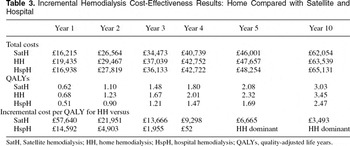
Results: Satellite HD has lower costs £46,000 and £62,050 at 5 and 10 years than home HD £47,660 and £63,540. The total effectiveness of home HD was slightly greater than for satellite HD, so the incremental cost per QALY of home versus satellite HD was modest at £6,665 at 5 years and £3,943 at 10 years. Both modalities dominated hospital HD.
Conclusions: Results from the study reveal that satellite HD was less costly than home HD, and home HD was less costly than hospital HD. The lack of robust data on the effectiveness and new dialysis equipment, which were not included in this review, throws some caution on these results. Nonetheless, the results are supportive of a shift from hospital HD to satellite and home HD.
Keywords
Information
- Type
- GENERAL ESSAYS
- Information
- International Journal of Technology Assessment in Health Care , Volume 21 , Issue 1 , January 2005 , pp. 32 - 39
- Copyright
- © 2005 Cambridge University Press
As the number of patients receiving renal replacement therapy (RRT) for end-stage failure (ESRF) continues to increase, many countries including the United Kingdom are facing the problem of trying to appropriately support the provision of RRT within the limited resources available. As such, the importance of evaluating both the effectiveness and cost-effectiveness of RRT is well recognized by policy-makers (11;12).
ESRF is a chronic condition, involving the irreversible loss of kidney function, with RRT being required when the loss of function fails to support life. In terms of the two main forms of RRT, dialysis and transplantation, the latter is usually the favored option; however, the number of donor kidneys is limited. Consequently, many patients require long-term and often life-long dialysis. Of the two main modalities, hemodialysis (HD) and peritoneal dialysis (PD), HD involves patients being dialyzed on a hospital out-patient basis and sometimes at home. HD is usually performed three times per week for around 4 hours. PD is carried out in the patient's usual setting and usually involves four exchanges of peritoneal fluid each day.
At the end of 2001, a total of 33,363 patients were receiving RRT in the United Kingdom, with around 50 percent receiving a transplant and the remainder dialysis therapy, with HD providing 37 percent of UK RRT, the remaining (13 percent) received other forms of dialysis, principally PD. PD, although suitable for some patients, is not suitable for all, and its use in certain countries is limited (16). Furthermore, in the United Kingdom, the use of this modality is declining; hence, this study focuses on the use of HD. HD can vary in terms of setting, type of equipment used, duration of sessions; frequency of sessions (e.g., 3, 5, 6, or 7 times per week) and type of membranes (artificial kidneys) and dialysate (fluid formulated to attract excess blood and water from the blood) used. The three modalities of HD considered in this study are satellite, home, and hospital HD (defined below). The relative cost-effectiveness of these three modalities is considered both in terms of plausible variations in the evidence and for variations in the way in which they are organized and delivered.
HEMODIALYSIS MODALITIES
In 1962, the Seattle Artificial Kidney Center became the first outpatient dialysis center, with three beds treating patients with ESRF. By 1964, dialysis was performed by trained nurses with minimum physician coverage and, by the end of the year, a home HD program was developed. By 2001, 17,637 patients were treated by dialysis in the United Kingdom. Of these patients 3,637 were on satellite HD, 8,174 were on hospital HD, and 567 patients were on home HD.
Satellite HD
Satellite units are outreach facilities from main renal units, and in the United Kingdom, satellites tend to be based in smaller district general hospitals and contain a varying number of dialysis stations (the area where the dialysis machine and the bed/chair for patient are situated). Nursing staff are specialized, and clinical cover is limited. The often close proximity of satellite to the patients' home offers advantages over hospital HD, as less travel time is required and there is more opportunity for patients to continue with usual activities such as work. Patients in satellite units usually commence HD in a hospital unit and transfer to a satellite unit on stabilization of their clinical condition. The use of this modality is increasing. For example in the first quarter of 2000, only 8.9 percent of RRT patients were on satellite HD, but by the first quarter of 2001, this rate had increased to 9.9 percent and then to 10.9 percent by the end of the year.
Home HD
Around 2 percent (roughly 600) of UK RRT patients received home HD in 2001, and for these patients, the presence of a carer (e.g., spouse, parent) is often required during the treatment. Aside from minimal renal staff, this treatment uses equipment and consumables identical to hospital and satellite HD. Home HD offers several potential advantages over hospital and satellite HD. Notably, patients do not have to travel for treatment, and there is more scope to tailor the dialysis regimen to patients' requirements by changing the timing, the length, and/or the frequency of dialysis sessions. More frequent and/or longer hemodialysis may improve an individual's physical well-being (8). For example, as the patient has sole use of the home dialysis machine, a regimen of short, frequent hemodialysis sessions (1.5 to 2 hours sessions 5 to 7 times per week), or slow nocturnal HD (dialyses for 6 to 10 hours overnight 3 to 7 times per week) is possible.
Hospital HD
In the United Kingdom, hospital HD is provided in specialist units within large district general or teaching hospitals. The size of such units varies (7 to 55 dialysis stations) (15), nursing staff are specialized, and nephrologists are on call. Patients receive a regimen of regular HD, usually three treatments per week, each lasting for 3–5 hours. In 2001, a total of 24.5 percent of patients on RRT received hospital HD.
METHODS
Development of the Model
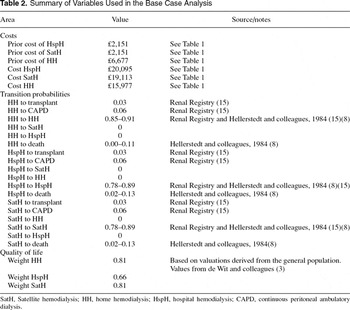
To estimate cost-effectiveness over a lifetime of a typical cohort of patients starting home, hospital, or satellite HD treatment, a model of the costs and outcomes of the three HD modalities was designed. As ESRF is a chronic condition requiring continuous treatment, a Markov model was considered appropriate to explore longer term costs and outcomes. Markov models are used to represent processes that evolve over time. They are particularly suited to modeling treatments for chronic conditions (1) such us RRT, as they allow estimation of relative effectiveness and cost over time. The Markov model developed for this study described the process of care as several discrete states and allowed for the possibility that patients may, over their lifetime, use several different RRT modalities. Patients begin their progression through the model in one of three states: home HD (although this state initially includes a stabilization and training period at a hospital unit), hospital HD, or satellite HD. Patients are only in one health state at any particular time and can only make a transition (a movement between these states) once per cycle (discrete time period considered). For example patients in the home HD state can remain in the same state at the end of a cycle or can be transferred to hospital HD, satellite HD, continuous peritoneal ambulatory dialysis (CAPD), transplantation, or death at the end of the cycle. Death, transplantation, and CAPD are included in the model to represent all the possible scenarios, but only as so-called absorbing states. Once an individual makes a transition into one of these absorbing states, no further costs or benefits incurred are included in the analysis.
Clinical Effectiveness and Transition Probabilities
Clinical effectiveness data for the model were obtained from a systematic review of the literature (12). Electronic searches were conducted to identify published and unpublished studies. The search methods built upon those of a previous health technology assessment (11). All titles and abstracts identified by the reviewers were assessed. Full text papers were obtained for all potentially relevant studies and formally assessed for inclusion. Two reviewers independently abstracted data: study designs; participants; intervention; and outcomes. The methodological quality of included systematic reviews and primary studies was assessed using standard checklists (6;13;14).
The literature search identified twenty-seven published studies that met the inclusion criteria on type of study design, participants, interventions, and measures of outcomes. There were four systematic reviews, one randomized crossover trial, and twenty-two comparative observational studies, which had attempted to correct for differences in case mix. The main outcomes of the review were technique and access failure, quality of life, hospitalization rate, and employment/education status.
This review was the main source of information on transition probabilities (e.g., the probability of starting on one modality and switching to another) required to populate the model. Additional estimates were acquired by using the Markov requirement that each row of the matrix of possible transitions should sum to one.
The base case analysis used an annual risk of death over a 5-year time horizon for younger patients (less than 50 years of age) without any comorbidity. These mortality rates were taken from Hellerstedt and colleagues (8), and it was assumed that mortality rates for satellite HD were equivalent to those for hospital HD due to the scarcity of published studies reporting mortality rates for satellite HD. The review of effectiveness revealed that older patients and those with diabetes tended to have higher mortality rates. The review also suggested that the relative risk of death for patients over 65 years of age was between 1.8 and 2.4 times greater than the risk of death for patients 40 to 45 years of age (8). These two values were used to compute mortality rates for diabetic (relative risk=2.4) and nondiabetic patients (relative risk=1.8) over 65 years of age by combining the relevant relative risk with data on the mortality rates for patients aged 40 to 45 obtained from Hellerstedt and colleagues (8). The remaining probabilities required for these groups were estimated using the same methods described previously, and a detailed description of this review was presented elsewhere (12).
Costs
The model included the direct health service costs associated with the treatment options, and an annual cost per patient was calculated for each health state in the model. Dialysis resource uses measured were those of access surgery/set up, training, regular dialysis sessions, and complications of the dialysis, such as clotting of the fistula or hypotension episodes. For the dialysis sessions, most of the cost data were derived from one of the UK centers (Aberdeen) included in the European Dialysis and Cost-Effectiveness study (EURODICE), which compared hospital HD and CAPD. EURODICE had performed detailed microcosting, collecting data on staffing, consumables, capital, and overheads (Table 1) (4). Questionnaires were used to collect details of staff time allocated to dialysis activities. Capital items included the building area for treatment and equipment items such as dialysis machines, with an equivalent annual cost calculated for these items using a 6 percent discount rate over the predicted life span. Local unit costs were then applied.

Although home and satellite HD were not included in EURODICE, it was assumed that consumable and capital costs were the same for satellite as they were for hospital HD, with staff costs being estimated from data provided by Drey and colleagues (7). For home HD, additional information on the cost of staff was obtained from Mackenzie and Mactier (1998) (10), and on the cost of converting a home for HD and in training of the patient for the procedure, from the renal administration at the Grampian University Hospital Trust.
With respect to transport costs, evidence from patient groups' submissions to the National Institute of Clinical Excellence suggest that there is no nationally agreed policy for transport costs. There is variation across the United Kingdom in terms of who pays for transport, the National Health Service or patients. Therefore, for the purposes of our analysis, transport costs are excluded. Finally, access and surgical costs were obtained from Kirby and Vale (9), and all costs are presented for the year 2001/2 in UK pounds sterling (£).
Health State Utilities
The summation of time spent in each health state was used to estimate life expectancy. This figure was then weighted by a quality of life value to estimate quality adjusted life years (QALYs). These quality of life estimates (e.g., values ranging from zero for death to one for full health) were obtained from the literature. Sixteen studies reporting quality of life were identified by the systematic review (12), with two providing appropriate data for inclusion into the model. The principal source of these values was De Wit (3), reporting values of 0.66 (SD 0.29) and 0.81 (SD 0.24) for the comparison of hospital and satellite HD. These estimates were based on valuations obtained by using the EQ5D and the UK general population tariff (5). It was assumed that home HD had the same utility as satellite HD. Further data on health state utilities were available from Churchill (2), a study that had used the time trade-off approach to derive a utility score for home and hospital HD. The scores for home and hospital HD were 0.49 and 0.43, respectively. As these data indicate that home HD was associated with a 13.95 percent higher utility, this rate was applied to the data from De Wit (3) for satellite HD (0.81) to give a value of home HD of 0.92, used in our sensitivity analysis. QALY estimates were discounted at 1.5 percent, the current UK Treasury rate for health benefits.
Estimation of Cost-Effectiveness
The two time horizons for the model were 5 and 10 years, determined by the availability of data and the adoption of cautious assumptions. Incremental costs per QALY gained were calculated by using the estimates of costs and QALYs for each modality obtained from the model. The final results were presented as incremental costs per QALY.
In addition to the sensitivity analyses noted above, the effect of changing the frequency of home HD was explored as data from the effectiveness review suggested that requirements for erythropoietin (EPO), a drug used to reduce anemia, may be reduced by 50 percent for short daily and nocturnal home HD, compared with hospital HD (12). Short daily HD and nocturnal home HD also have the potential to reduce adverse events by 45 percent compared with the standard regimen of 4-hour-long sessions three times per week (12).
Further sensitivity analysis was also performed to assess the impact of changing the costs of home and satellite HD. For home HD, the impact of a paid carer present during each session was considered. For satellite HD the impact of clinical cover equal to that provided in a hospital unit or equal to that provided for home HD was considered. The evidence suggests considerable variability in the way in which satellite HD units are organized. Therefore, two scenarios were developed, the first one a satellite unit with clinical cover similar to that provided in a hospital unit, and the second scenario a satellite unit with a clinical cover similar to that of home HD (7).
A final sensitivity analysis of mortality rates was performed. The first sensitivity analysis assumed that mortality rates for home HD were the same as those of satellite and hospital HD, and the second set the mortality rates for satellite and hospital HD equal to those of home HD.
RESULTS
Table 2 presents a list of the parameters in the model and their value in the base case analysis. The available literature indicates that home HD may be associated with slightly higher survival compared with the other HD modalities. Table 3 illustrates the results of the baseline analysis, where the duration and frequency of HD are the same for all three modalities. The first section of the table provides information on the cost and QALY results for the three modalities. Costs for all modalities increase fairly rapidly over time, as the costs of dialysis are incurred in every cycle.


Table 3 reveals that the initial costs of home HD were higher than those of satellite HD, and the cumulative discounted costs of home HD also exceed those of satellite HD. The gain in utility from home HD compared with satellite HD was not substantial, as it was assumed that time spent in each state was associated with the same utility weight. Therefore, the difference in QALYs is due entirely to the increased survival of home HD compared with satellite HD. In comparison with hospital HD, home HD costs are higher until year 5, but from year 5 onward, home HD dominates hospital HD (more effective and less costly). Similarly, satellite HD costs are lower and QALYs are greater than those of hospital HD during the time horizon considered.
Sensitivity Analyses
Results from the model for patients over 65 years of age reveal an estimated incremental cost per QALY of home relative to hospital HD of £18,325 at year 5 (year 10 results were not estimated due to data limitations for this subgroup). Home HD dominated both satellite and hospital HD for the subgroup of patients with diabetes and less than 50 years of age. For diabetic patients older than 65 years, the incremental cost-effectiveness of home with respect to satellite and hospital HD was £36,007 and £6,597, respectively. As Table 4 shows, the cost-effectiveness of both home and satellite HD are considerably affected by changes in staff costs. In particular, satellite units with relatively high levels of clinical cover, approaching that of hospital units, are unlikely to be cost-effective compared with home HD.

Table 4 presents the results of adopting the same mortality rates for home HD as those of satellite and hospital HD and the results of applying the home HD rates to satellite and hospital HD. In these two new scenarios, home HD dominates both satellite HD and hospital HD.
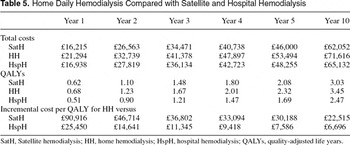
In comparing short daily home HD (six sessions per week of 1.5- to 2-hour length) with satellite and hospital HD, home HD failed to dominate hospital HD. The incremental costs per QALY relative to hospital HD were £7,586 and £6,696 (£30,118 and £22,515 relative to satellite HD) for a 5- and 10- year follow-up, respectively (Table 5).

DISCUSSION
This study has presented the results of a study designed to examine the relative cost-effectiveness of three HD modalities for the treatment of ESRF. The results reveal that, for patients at low risk (i.e., those with few comorbidities), satellite HD is less costly than home HD and home HD in turn is less costly than hospital HD. However, home HD is associated with a modest incremental cost per QALY compared with satellite HD. For older patients and those with comorbidities, home HD was less likely to be considered cost-effective, as these patients were less likely to survive long enough for the savings in running costs to offset the initial set-up costs of home HD. Furthermore, the provision of daily home HD and nocturnal daily home HD was more costly than hospital HD due to the additional consumables required for both.
In terms of a cost per QALY, the results of the analysis presented in this study are similar to those reported elsewhere (12). The main difference between our results and the existing literature is that the costs of satellite HD over 10 years were lower than those of home HD, although the additional cost per QALY was modest at £3,493. The main explanation for this is that the cost of home conversion necessary for home HD was not compensated for over the time horizon considered.
In interpreting the results from this study, there are several issues to consider. First, to be efficient, home HD requires patients to remain on this modality for a reasonably long period of time. However, many of the patients who would survive for a sufficient period of time to make the initial cost of home conversion worthwhile may, in practice, receive transplantations. Furthermore, home HD programs require oversight by specialist nurses who are in short supply. Similarly, satellite HD units may require more skilled nurses than a hospital unit to compensate for the limited clinical cover provided. The cost estimates provided here do not include the costs of more skilled nurses or the training of additional nurses.
Second, the cost estimates, although based on rigorous methods, may not be transferable to other settings. Consideration, therefore, is required to assess whether the total costs of each modality and the costs of each component of care are applicable to other settings. A further concern is related to the organization of care for modalities, which may differ between settings. One of the areas identified by the systematic review was the level of staffing required for both home and satellite HD (12). The available evidence suggested that, in the United Kingdom, satellite care may vary between that found in minimal care facilities and that found in standard hospital units, and cost-effectiveness estimates were sensitive to variations in care levels.
Third, model survival rates were obtained from a prospective observational study of patients starting RRT in the 1980s. Although these rates were consistent with the other data sources (12), data quality remains limited and, for this reason, it was assumed that patient survival at the start of dialysis would be the same regardless of the HD setting. Also, utility data were not without problems as they were derived from two studies conducted outside the United Kingdom, which made limited attempts to control for case mix between modalities. However, these data were the best available and were identified as part of a comprehensive systematic review, the direction of the effect reported by these two studies was consistent with the quality of life findings in other studies identified by the review (12).
Fourth, the technology available for HD is constantly improving. In particular, a new generation of home HD machine is under development, although not included in this review (as no useable data were identified). These new machines may improve use and reduce complications rates and the need for carer involvement in the home. Furthermore, depending upon the relative cost of these new machines compared with current models, their use may improve the cost-effectiveness for patients requiring minimal care.
Fifth, transport costs were not included in the base case analysis. If they were included, the final results would improve home HD cost-effectiveness compared with satellite and hospital HD.
CONCLUSION
Satellite HD is less costly and more effective than hospital HD. Satellite HD is also less costly, but less effective than home HD. The incremental cost per QALY for home HD compared with satellite HD is modest, but there is considerable uncertainty in the difference in the estimates of effectiveness. Under such circumstances, it seems reasonable to conclude that, based on available data, the provision of satellite and home HD could potentially increase. Nonetheless, data used to populate the model were limited. Few studies identified by the systematic review were based on randomized designs, appropriate to control for differences between patient groups (12). Further research is required to ensure unbiased estimates for the relative effectiveness of the different modalities considered and, in particular, of satellite HD whose use is rapidly increasing in the United Kingdom (15). Furthermore, satellite HD services may be organized in a variety of different ways (7), and estimates of cost-effectiveness may be highly sensitive to these differences. Further research is required to examine how such services might be organized and to explore the generalizability of the modeling of service costs estimates.
POLICY IMPLICATIONS
The expansion of satellite and home HD may provide a partial solution to coping with the increased prevalence of ESRF. Such a policy could also maintain or improve patient well-being and enable the continuation of usual activities, such as working, due to the flexibility of these modalities. In particular, moving patients who have a similar health status from hospital and satellite HD, depending upon the way satellite care is organized, may allow more patients to be treated within a fixed budget and overcome the limited space issue for new dialysis stations in hospitals. However, it might be that patients on hospital HD are those with a worst health status, and the shift to satellite HD might not be feasible due to the most intensive care those patients might require.
The increased use of home dialysis may also be worthwhile compared with hospital and satellite HD. Because cost-effectiveness of home HD increases the longer a patient remains on this modality, any increased use would be most efficiently limited to those unlikely to receive a transplant but likely to survive on HD for several years. However, several limitations of home HD could reduce the probability of a shift to this modality. For instance, there could be a lack of a dedicated carer to assist patients at home, patients themselves may not want the responsibility of performing a fairly technical process, and finally, there could be a lack of space to store dialysis products.
CONTACT INFORMATION
Juan G. Gonzalez-Perez, MSc, Research Fellow (j.perez@abdn.ac.uk), Health Economics Research Unit, University of Aberdeen, Foresterhill, Aberdeen AB25 2ZD, UK
Luke Vale, MSc, Senior Research Fellow (l.vale@abdn.ac.uk), Health Economics Research Unit, Health Services Research Unit, University of Aberdeen, Foresterhill, Aberdeen AB25 2ZD, UK
Sally C. Stearns, PhD, Associate Professor (sstearns@email.unc.edu), Department of Health Policy and Administration, CS #7411, University of North Carolina at Chapel Hill, Chapel Hill, North Carolina 27599-7411, USA
Sarah Wordsworth, MSc, Research Fellow (sarah.wordsworth@dphpc.oxford.ac.uk), Health Economics Research Unit, University of Oxford, Headington, Oxford OX3 7LF, UK
This study would not have been possible without the support of our colleagues in the Health Services Research Unit and the Health Economics Research Unit. This work was funded by the UK Department of Health. The Health Economics Research Unit and the Health Services Research Unit are funded by the Chief Scientist Office of the Scottish Executive Health Department. The opinions and views expressed are of the authors and not of the funding bodies.
References
Briggs A,
Sculpher M.
1998
An introduction to Markov Modelling for economic evaluation.
Pharmaeconomics.
13:
397–
409.Google Scholar
Churchill DN.
1988:
The effect of treatment modality on the quality of life for patients with end-stage renal disease.
In: Khana R, ed.
Advances in CAPD.
Toronto:
Peritoneal Dialysis Bulletin Inc;
63–
65.
De Wit GA.
1998
Economic evaluation of end stage renal disease treatment.
Health Policy.
44:
209–
227.Google Scholar
Dialysis and Cost-Effectiveness Study.
2002.
Final report to European commission.
Biomedical Research Fund (BIOMED 2),
Downs SH,
Black N.
1998
The feasibility of creating a checklist for the assessment of the methodological quality both of randomised and non-randomised studies of health care interventions.
J Epidemiol Community Health.
52:
377–
384.Google Scholar
Drey N,
Armitage A,
Greenwood R, et al.
2003.
Improving access to dialysis care: A national survey of renal satellite units in England and Wales. Annual Report.
Bristol:
The UK Renal Registry;
Hellerstedt WL,
Johnson WJ,
Ascher N, et al.
1984
Survival rates of 2,728 patients with end-stage renal disease.
Mayo Clin Proc.
59:
776–
773.Google Scholar
Kirby L,
Vale L.
2001
Dialysis for end stage renal disease. Determining a cost-effective approach.
Int J Technol Assess Health Care.
17:
181–
189.Google Scholar
Mackenzie P,
Mactier RA.
1998
Home haemodialysis in the 1990s.
Nephrol Dial Transplant.
13:
1944–
1948.Google Scholar
MacLeod A,
Grant A,
Donaldson C, et al.
1998
Effectiveness and efficiency of methods of dialysis therapy for end stage renal disease: Systematic reviews.
Health Technol Assess.
2:
1–
166.Google Scholar
Mowatt G,
Vale L,
Perez J, et al.
2003
Systematic review of the effectiveness and cost-effectiveness and economic evaluation of home dialysis versus hospital or satellite unit haemodialysis for people with end-stage renal failure.
Health Technol Assess.
7:
1–
174.Google Scholar
Oxman AD,
Guyatt GH.
1993
The science of reviewing research.
Ann N Y Acad Sci.
703:
125–
133.Google Scholar
UK Renal Registry.
2000.
Annual report.
Bristol:
The UK Renal Registry;
UK Renal Registry.
2003.
Annual report.
Bristol:
The UK Renal Registry;

Summary of Initial and Annual Treatment per Patient for Different Hemodialysis Modalities: Base Case Analysis
Summary of Variables Used in the Base Case Analysis
Incremental Hemodialysis Cost-Effectiveness Results: Home Compared with Satellite and Hospital

Sensitivity Analysis for Home vs. Hospital and Satellite HD
Home Daily Hemodialysis Compared with Satellite and Hospital Hemodialysis
 You have
Access
- 36
- Cited by