Coups d’état, once commonplace in the Americas, have declined sharply in recent decades. Is this change accompanied by diminishing citizen support for coups? If so, what determines that changing opinion, and do these factors help explain regional trends in coup support? This article examines two overarching theses. One is normative regime preferences theory, which aims to explain why democracies and dictatorships emerge, survive, or collapse, focusing on elites’ embracing democracy for its intrinsic value (Mainwaring and Pérez-Liñán Reference Mainwaring and Pérez-Liñán2013; Pérez-Liñán and Mainwaring Reference Page and Shapiro2013).Footnote 1 The other is classic modernization theory (Inglehart Reference Inglehart1988; Inglehart and Welzel Reference Inglehart and Welzel2005), which predicts democratic emergence based on a combination of values held by the mass public.
While explicitly rejecting arguments about modernization’s effects on mass political culture by Inglehart and Welzel (Reference Inglehart and Welzel2005), Mainwaring and Pérez-Liñán (Reference Mainwaring and Pérez-Liñán2013, 2) nonetheless contend that public opinion plays a key role in democratic breakdown and stability. Indeed, they argue that countries that have developed strong support for democracy are largely vaccinated against successful military coups.
[i]n competitive regimes, public opinion is one of the most valuable resources that actors can employ. It often sways powerful actors one way or the other in regime battles. For example, it is unlikely that a successful coup could occur in the face of solid public support for democracy. Conversely, democracy is more likely to be imperiled if large parts of the public turn against it. In democracies, public opinion routinely limits what leaders can do …. (2013, 12)
Mainwaring and Pérez-Liñán do not, however, test this public opinion thesis in their initial work.Footnote 2 However, in a follow-on article, Pérez-Liñán and Polga-Hecimovich (Reference Pérez-Liñán and Polga-Hecimovich2017) extend Mainwaring and Pérez-Liñán’s initial theory (Reference Mainwaring and Pérez-Liñán2013) to explain two types of presidential downfalls: military coups and presidential impeachments. While still focusing predominantly on elite-level and structurally based explanations, Pérez-Liñán and Polga-Hecimovich explicitly hypothesize that the public contributes to democratic (in)stability. They claim that “mass protests indicate that major social forces are against the government, and motivate opposition elites to overthrow the president” (2017, 4). These authors offer an indirect test of the role of public opinion by incorporating an aggregate measure of social mobilization, but they do not utilize a direct measure of public opinion. This article fills that gap.Footnote 3
While a definitive test of the influence of mass norms on elite actions remains an elusive goal of political science, this article advances our understanding of the connection between them by investigating whether overall trends in support for coups in Latin America comport better with the normative regime preferences argument of Mainwaring, Pérez-Liñán, and Polga-Hecimovich or with the modernization-cultural argument of Inglehart and Welzel. These are not, of course, mutually exclusive possibilities, as both exert effects. However, we aim to determine whether one explanation better predicts levels of and trends in coup support. Although the study focuses on elites, we expect that the normative regime preferences explanation will better explain mass orientation toward coups in our sample. The modernization-cultural approach has a useful focus on mass preferences, but we find evidence in our data that it does not account for the change in preferences over time, as Mainwaring and Pérez-Liñán argue (Reference Mainwaring and Pérez-Liñán2013, 1).
To better compare the utility of these explanations, this study employs a large set of survey data from 21 countries in Latin America and the Caribbean for the period 2004–2014, amounting to 122,348 individuals analyzed. We utilize a direct measure of respondent support for coups as the central dependent variable, rather than using inferred preferences or indirect measures (such as aggregate measures of social mobilization). The results show that one of the most destructive mechanisms of democratic breakdown—coups—has, over time, lost support among the region’s mass publics.Footnote 4 We find a substantively meaningful effect of democratic attitudes on coup support and a weak effect for national wealth. From this, we infer that evolving values and preferences of the elites are paralleled at the mass level and, together, play a stronger role in the consolidation of democratic regimes than modernization theory would predict.
Theory: Bringing the People Back In
For decades, political scientists have attempted to demonstrate the role of public opinion in determining national-level public policies and elite behaviors, starting with the classic work of Miller and Stokes (Reference Miller and Stokes1963). Later analysis, for example, Page and Shapiro (Reference Page and Shapiro1983), concluded that public opinion was likely to move policy in the United States when opinions were large and stable and based on a salient issue (175), as coups certainly have been in Latin America. Further evidence at the subnational level of the public opinion–outcome connection comes from Gibson (Reference Gibson1988), who found that individual U.S. states with more repressive political cultures during the McCarthy era were more likely to enact repressive policies.
Relatedly, Bartels (Reference Bartels1991) found significant evidence that mass opinion influenced defense spending during the Reagan administration. In a similar vein, Canes-Wrone (Reference Canes-Wrone2006) contends that under certain conditions, presidents were more likely to “pander” to the public by taking the most popular opinion among the masses. More recently, however, Gilens and Page (Reference Gilens and Page2014, 564) found that ordinary people “have little or no independent influence” on U.S. policy, thus contradicting Page’s earlier work. While research in this contested field has not reached definitive conclusions for the United States and far less so for other countries, there is evidence that public opinion may influence elite outcomes in certain circumstances.
We recognize that more needs to be done in this field to cement a link between mass attitudes and elite actions. Therefore, our central claim is modest, but one we hope will serve as a basis to build on: we explore how much the mass public would support coups and identify trends in that support over the past decade. Second, we examine the dynamics of coup support before the one coup (Honduras) and the police uprising (Ecuador) that occurred within the timeframe of our data. And third, we examine the evidence of whether mass attitudes toward coups in Latin America parallel the elite trends that Mainwaring et al. have uncovered.
Accordingly, while we certainly agree with Mainwaring and Pérez-Liñán that ordinary citizens rarely play a direct role in perpetrating breakdowns, we hypothesize that public opinion matters in one of two ways.Footnote 5 First, economic conditions, mass protests, and government hypercorruption can create conditions in which military elites, as a representative and component of the middle class, step in to restore order and probity, executing a classic “middle-class military coup” (Nun Reference Nun1967). José Nun’s thesis has been a bedrock explanation for instances of coups in Latin America for half a century. Middle classes, fearing unrest brought on by radical student or labor groups, call on the military to intervene to reestablish order.
Second, a more contemporary approach has mass publics signaling in many additional ways that they would support (or oppose) a military coup (Casper and Tyson Reference Casper and Tyson2014). Coup attempts in Venezuela in 2002 and Turkey in 2016 confronted strong citizen opposition, aided by social media and modern mass communication capabilities, and both ultimately failed. In contrast, the successful coup in Chile in 1973 involved important middle-class elements, who repeatedly signaled to the military their support of a coup. Evidence suggests that the coup plotters heard this signal loud and clear (Linz and Stepan Reference Linz and Stepan1978; Valenzuela and Valenzuela Reference Valenzuela and Valenzuela1986).Footnote 6
Gibson makes the theoretical, and to some extent the empirical, case that “opinion is important in the policy process because it delimits the range of acceptable policy alternatives” (1988, 522). In the context of our broader interest in democratization, we see mass support for coups as an often necessary condition for the emergence and success of elite conspiracies to topple democracy. Based on this framework, if the public strongly supports a coup, as we show was the case in Honduras, that gives would-be coup plotters a green light. On the other hand, in cases where public opinion is trending firmly against a coup, as we show prevailed in Ecuador, this should limit the prospects of those who seek to disturb the civil order.
Illustrative Case Studies: Coups and Public Opinion
We begin with two illustrative cases to suggest that our data are consistent with the possibility of mass signaling to elites. In Honduras, elites engineered a successful coup in 2009. In Ecuador, a police uprising, categorized by some scholars as a coup, failed in 2010.Footnote 7
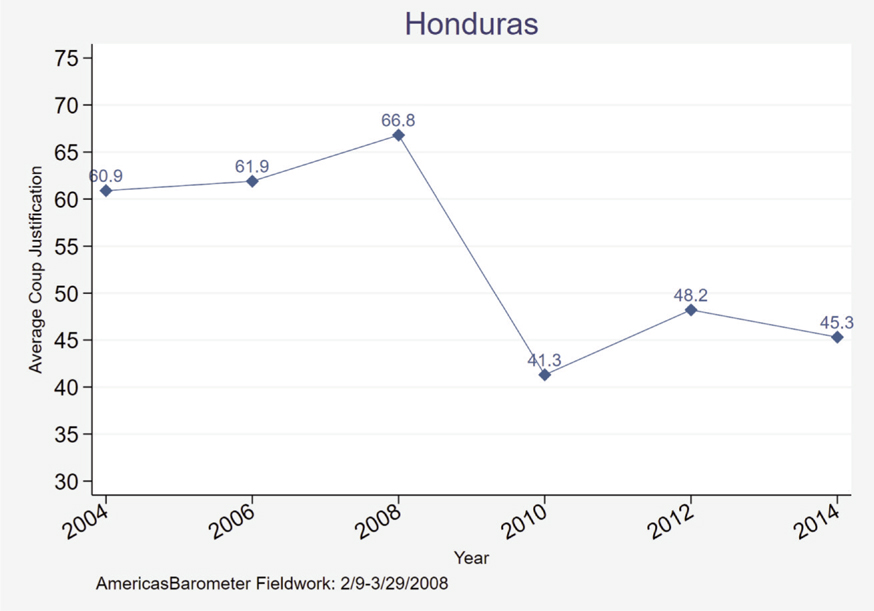
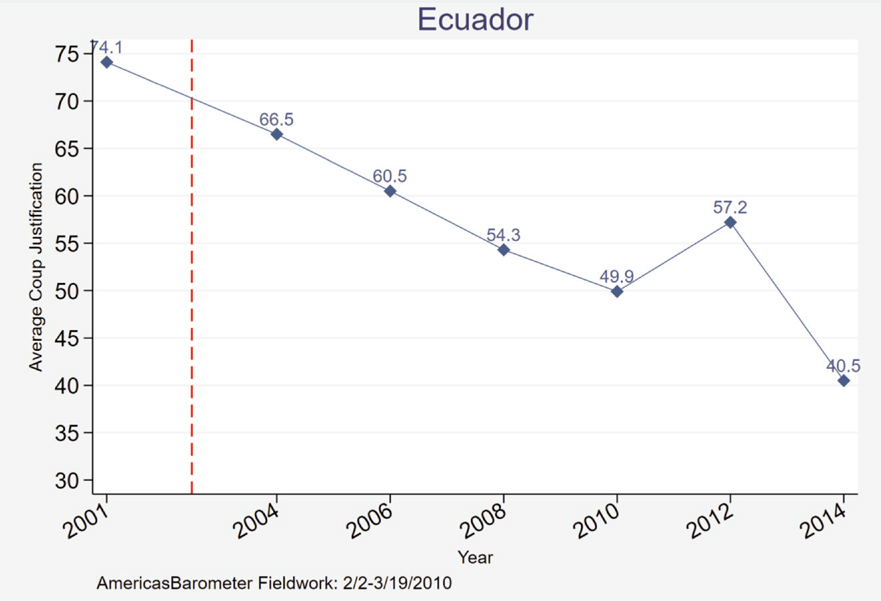
Our theory suggests that in Honduras, we should observe a high and growing level of coup justification. Figure 1 shows what we expect: Hondurans’ support for coups peaked in the AmericasBarometer public opinion surveys in 2008; nearly 60 percent of Honduran respondents reported then that they would have justified a hypothetical coup. Alternatively, in the failed police uprising in Ecuador, we expect to see declining support for coups before the attempt. Figure 2 demonstrates that the failed police uprising there occurred at a low point of citizen justification of coups, which had declined from a remarkably high 74.1 percent in 2001 to approximately 50 percent in the 2010 AmericasBarometer survey, conducted a few months before the uprising.Footnote 8
High Coup Justification in Honduras

Low Coup Justification in Ecuador

The Honduran and Ecuadorian examples suggest that citizen signaling may well have played a role in elite decisionmaking, as Mainwaring and Pérez-Liñán’s theory suggests.Footnote 9 Our theory suggests that coup plotters in Honduras were emboldened by attitudes strongly against the incumbent president, while in Ecuador, public opinion supported the president and correspondingly weakened the insurgents. Thus, while our illustrations from Honduras and Ecuador suggest that public opinion matters when it comes to coups, one cannot definitively test that hypothesis. Instead, this study provides extensive data analysis that helps fill in the gap for the normative regime preferences argument.
Measuring Justification for a Coup
With these cases in mind, we empirically analyze competing explanations of citizen support for coups and, further, why such support steadily declined from 2004 to 2014 in the Americas. Our analysis tests whether generalized democratic norms, as suggested by Mainwaring and Pérez-Liñán, affect individuals’ willingness to support democratic breakdown via a coup, or whether modernization (Inglehart Reference Inglehart1988; Inglehart and Welzel Reference Inglehart and Welzel2005) still offers explanatory power.
To test the normative preferences argument, we include individual attitudes toward democracy and presidential approval, plus the age of democracy in each country, which we interpret as a blunt measure of elite norms. To assess modernization theory, we include a measure of national-level wealth. In addition to these two overarching theoretical frameworks, we include several factors that extant literature expects to influence individuals’ willingness to justify a coup: system support, demographics, and socioeconomic predictors. Finally, we include controls directly relevant to our dependent variable, including respondents’ trust in the military, the perception of elite corruption, and perception of crime in one’s neighborhood. To anticipate our results, we find that democratic norms exert strong downward pressure on attitudes toward coups, privileging the normative regime preference argument over modernization theory.
Survey data from the AmericasBarometer carried out by LAPOP have consistently shown that beyond the traditional economic issues, two concerns predominate when citizens are asked to identify the most important problem their country faces: crime and corruption.Footnote 10 Thus, the LAPOP surveys have regularly asked whether a coup would be justified under conditions of high crime or high corruption: “Some people say that under some circumstances it would be justified for the military of this country to take power by a coup d’état (military coup). In your opinion, would a military coup be justified or not justified under the following circumstances? 1) When there is a lot of crime? 2) When there is a lot of corruption?”Footnote 11 We code coup justification dichotomously: individuals who would not justify a coup, and individuals who would support a hypothetical coup under conditions of either high crime or high corruption.Footnote 12
Coup Justification: Levels and Trends
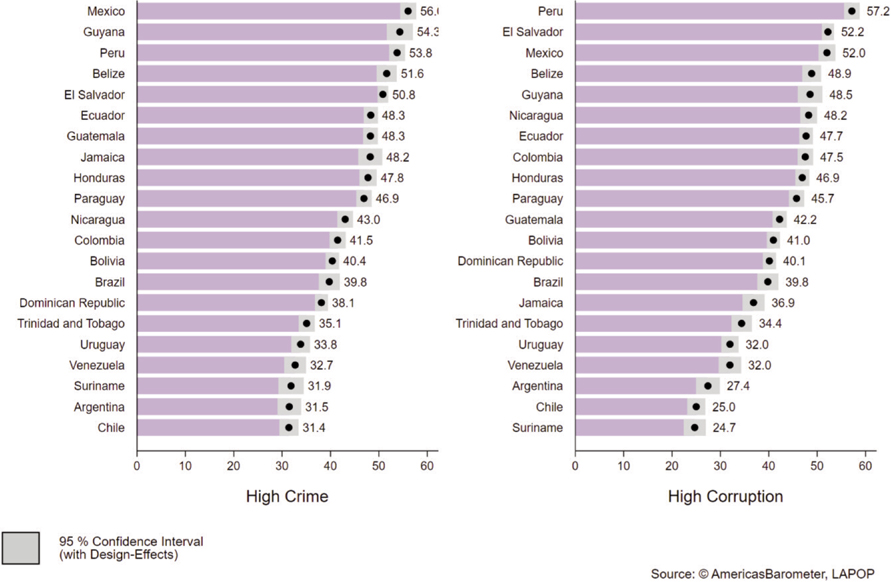
How much support for coups exists among the citizens of Latin America and the Caribbean? Figure 3 displays the average level of each component of our coup justification index over six waves of our survey, conducted in even-numbered years from 2004 to 2014.Footnote 13 We omit the United States, Canada, Barbados, and the Bahamas, owing to the absence of key survey questions, and exclude Costa Rica, Panama, and Haiti because they do not have national armies. That still leaves us with wide coverage of 21 Latin American and Caribbean countries, comprising 122,348 cases.
Coup Justification (Percent) Under High Crime And High Corruption, 2004–2014

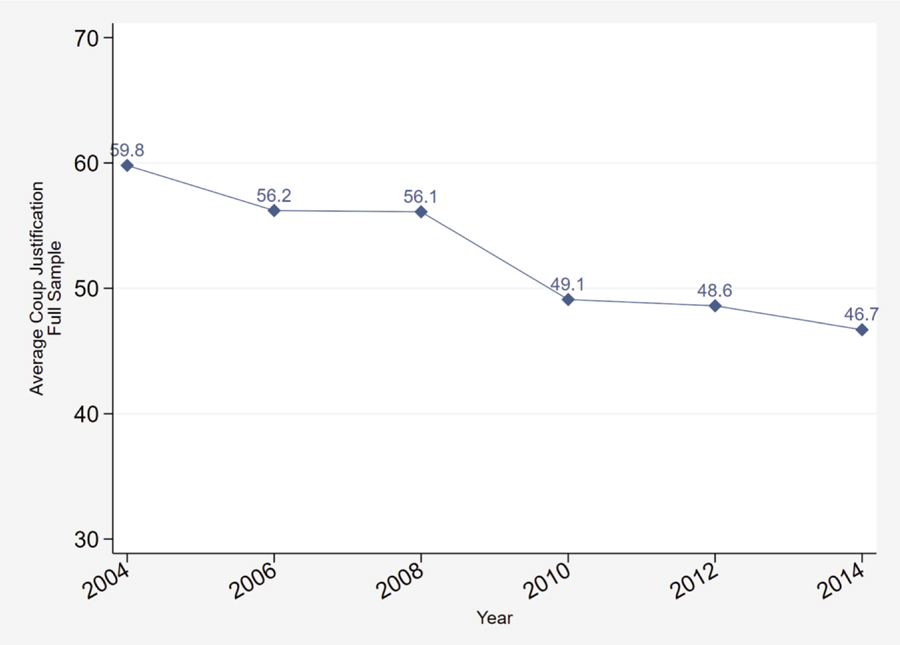
We found that of the voting-age populations of these countries, 44.1 percent agreed that high levels of crime, and 43.1 percent agreed that high levels of corruption would justify a coup.Footnote 14 We note wide variation across the Americas, falling as low as one-quarter of the population and as high as more than half. While these levels of coup justification are interesting in themselves, we also examine the trend over time. Figure 4 shows that from 2004 to 2014, the combined regional mean percentage of crime- and corruption-justified coup support declined 13 percent.Footnote 15 We explore the factors that determine these levels and trends.
Average Coup Justification (Percent) in the Americas, 2004–2014

In selecting our dependent variable, we assume that higher public support for coups indicates a process of weak democratic consolidation more broadly, in line with Pérez-Liñán and Polga-Hecimovich (Reference Pérez-Liñán and Polga-Hecimovich2017). While coup support is only one indicator of this process, we find evidence that people who support coups also tend to support other forms of radical change. In 2004, the AmericasBarometer survey asked about support for radical preferences, defined as either staunch defense of the status quo or support for revolutions, versus a preference for gradual reforms. We find that in all ten countries represented in our sample in 2004, there was a negative correlation between support for coups and preference for gradual reform. We corroborate the finding using several pre-AmericasBarometer datasets and find this to be the case with few exceptions.Footnote 16
Explaining Coup Support
The analysis tests the normative regime preferences and modernization-cultural arguments. The primary aim is to evaluate whether normative preferences for democracy matter for regime outcomes (Mainwaring and Pérez-Liñán Reference Mainwaring and Pérez-Liñán2013; Pérez-Liñán and Polga-Hecimovich Reference Pérez-Liñán and Polga-Hecimovich2017) or whether modernization-cultural explanations (Inglehart Reference Inglehart1988; Inglehart and Welzel Reference Inglehart and Welzel2005) better explain both levels of and trends in coup justification in the Americas.
For the former theory, we rely on both individual- and aggregate-level measures, because we are explicitly testing whether the theory can apply at the individual level; and for the latter, we exclusively examine a national-level predictor: national wealth. To test the normative regime preferences argument at the individual level, we rely on a survey question that has been used as a measure of democracy norms worldwide: “Democracy may have problems, but it is better than any other form of government. To what extent do you agree or disagree with this statement?” (Rose and Mishler Reference Rose and Mishler1996). We acknowledge that this relationship is intuitive but argue that there are sound theoretical reasons for examining it. Importantly, “An explanation based on normative preferences could be treated as obvious only if we claimed that these preferences always explained outcomes…. Some actors do not have normative preferences” (Mainwaring and Pérez-Liñán Reference Mainwaring and Pérez-Liñán2013, 53).
We think this is especially true at the individual level. Indeed, we find variation across subgroups: urban residents, the economically privileged, and those with secondary or postsecondary education display the strongest (negative) association between normative preferences on the one hand, and coup support on the other. Thus the importance of norms is not evenly distributed within populations.Footnote 17 Unfortunately, we cannot rule out reverse causality, given the nature of survey questions—it is difficult, if not impossible, to find a valid instrument that predicts normative preferences but has no bearing on coup justification. However, we can look at empirical distinctions, such as correlations and means.Footnote 18
We include two other indicators derived from the normative regime preferences argument. Following Pérez-Liñán and Polga-Hecimovich’s Reference Pérez-Liñán and Polga-Hecimovich2017 measure of presidential support in the legislature, we include a measure of individuals’ approval of the incumbent president. We expect high presidential approval to negatively affect support for military coups, but we predict that its effect will be limited compared to normative preferences, which should discourage coups irrespective of presidential approval. If coup justification were merely dislike for incumbent executives, we should see significantly more coups or coup attempts under unpopular executives.
We also include the age of democracy in each country. Przeworski’s analysis of democratic versus coup-generated government changes (2015) argues that democracy is habit-forming. Once democratic elections take place and incumbents leave office without a fight, the process is likely to become routine, thus reducing the frequency of coups. We see this measure as a plausible macrolevel test of our individual-level measure of democratic norms: citizens of democracies become habituated to democracy and develop congruent values, contributing to stability (Rustow Reference Rustow1970; see also Jackman and Miller Reference Jackman and Miller2004).Footnote 19 Accordingly, we anticipate that as the age of democracy increases, support for coups should decrease (Booth and Richard Reference Booth and Richard2015; Booth and Seligson Reference Booth and Seligson2009; Svolik Reference Svolik2015).
An important alternative to the normative regime preferences argument is modernization theory, which long ago proposed that as countries developed economically, they would move away from authoritarian rule and toward democracy (Lipset Reference Lipset1959, Reference Lipset1981, Reference Lipset1994). Recent analyses find some evidence of a link between higher economic development and lower support for coups because of the intervening effect of higher socioeconomic development on higher democratic norms (Lehoucq and Pérez-Liñán Reference Lehoucq2013; Londregan and Poole Reference Londregan and Poole1990; O’Kane Reference O’Kane1981), while Mainwaring and Pérez-Liñán (Reference Mainwaring and Pérez-Liñán2013) find a null effect at the elite level. Yet both Mainwaring and Pérez-Liñán (Reference Mainwaring and Pérez-Liñán2013) and Pérez-Liñán and Polga-Hecimovich (Reference Pérez-Liñán and Polga-Hecimovich2017) find a positive effect for GDP growth on regime consolidation. We include a test for the effect of economic modernization (measured as the log of GDP per capita PPP) to see if our individual-level findings comport with the mixed elite-level findings.Footnote 20
Additional Explanations
This study’s chief contribution is to articulate the role of the individual, which the above theories speculate about but do not test directly. Accordingly, we analyze several attitudes relevant to coup justification that were not relevant or not testable at the elite level. We first examine system support, which we see as complementary to our analysis of democratic norms. Mainwaring and Pérez-Liñán describe how “a normative preference builds a reservoir of support that enables competitive regimes to survive when times are hard. It is a procedural legitimacy that helps democracy withstand periods of weak performance” (2013, 39).
We concur that normative preferences fulfill this function, but we believe that the addition of system support more fully captures the difference between output-based considerations during “hard times” and the intrinsic value of a democratic system in a way not easily measured at the elite level. We operationalize system support as an additive index of individual responses on five aspects of trust in the state, each measured on a seven-point scale (Booth and Seligson Reference Booth and Seligson2005, Reference Booth and Seligson2009; Seligson Reference Seligson2000; Seligson and Booth Reference Seligson2013). We expect an inverse relationship with respondents’ willingness to justify coups: support for coups is not merely the love of the military but a more generalized lack of normative preference for democracy and lack of support for the system as it functions.
We also incorporate factors known to separate individuals regarding their support for the military. Education’s effect, for instance, is well documented: individuals with higher education are, on average, less likely to support military intervention. We also include age, gender, the size of the city or town in which the respondent resides, and household wealth (measured by the presence or absence of household items).Footnote 21 Consistent with the extant literature, we expect greater coup support among younger citizens, rural dwellers, and the poor. We also expect coup support to be higher among women, drawing from extensive literature that shows that women are less supportive of democracy, or conversely, are more authoritarian (Carnaghan and Bahry Reference Carnaghan and Bahry1990; García-Peñalosa and Konte Reference García-Peñalosa and Konte2014). With the possible exception of female gender, we expect these subgroups to be less likely to be receptive to the transmission of elite norms, either for lack of opportunity (rural, poor) or youthful resistance, and thus less likely to demonstrate the sort of signaling argument we suggest.
In addition, we include three controls. We think it obvious that individuals who express high trust in the military as an institution will be more likely to justify a military takeover. The reverse is also true: even though individuals may be deeply concerned about crime and corruption, if they do not trust those who would “rescue” the system, they will be unlikely to support a military solution.Footnote 22 Our analysis would suffer from omitted variable bias if we neglected to include this item.
We also incorporate respondents’ evaluations of the amount of corruption prevalent in their country and the feeling of insecurity in their neighborhood (higher values indicate greater perceived corruption and insecurity). These specific indicators mirror the hypothetical conditions in our dependent variable, and have been shown to affect respondents’ feelings toward the political system (Anderson and Tverdova Reference Anderson and Tverdova2003; Canache and Allison Reference Canache and Allison2005; M. Seligson Reference Seligson2002a, Reference Seligsonb, Reference Seligson2004, Reference Seligson2006), of which we think coup justification is a natural extension. Perceived insecurity has been shown to affect several other attitudes, including incumbent vote choice (Carreras Reference Carreras2013; Pérez Reference Pérez2003, Reference Pérez2015; Ungar Reference Ungar2007), so we believe it may also affect attitudes toward the regime. We expect both indicators to increase support for coups but to remain substantively behind attitudes toward the system.
Two-Step Multilevel Model
Because countless studies have reiterated the importance of context in determining outcomes, we employ a two-step multilevel model to test how the features of nations affect trends among our cases.Footnote 23 Another advantage of a two-step model is that it employs appropriate standard errors.Footnote 24 In a two-step model’s first step, the individual-level dependent variable, in this case support for coups, is regressed on the individual-level explanatory variables and controls This model evaluates a different intercept for each country in each survey wave, which becomes the dependent variable in the second step. The second step of the model then regresses the intercepts produced in the first step on national-level variables (Moehler and Lindberg Reference Moehler and Lindberg2009).
First Step
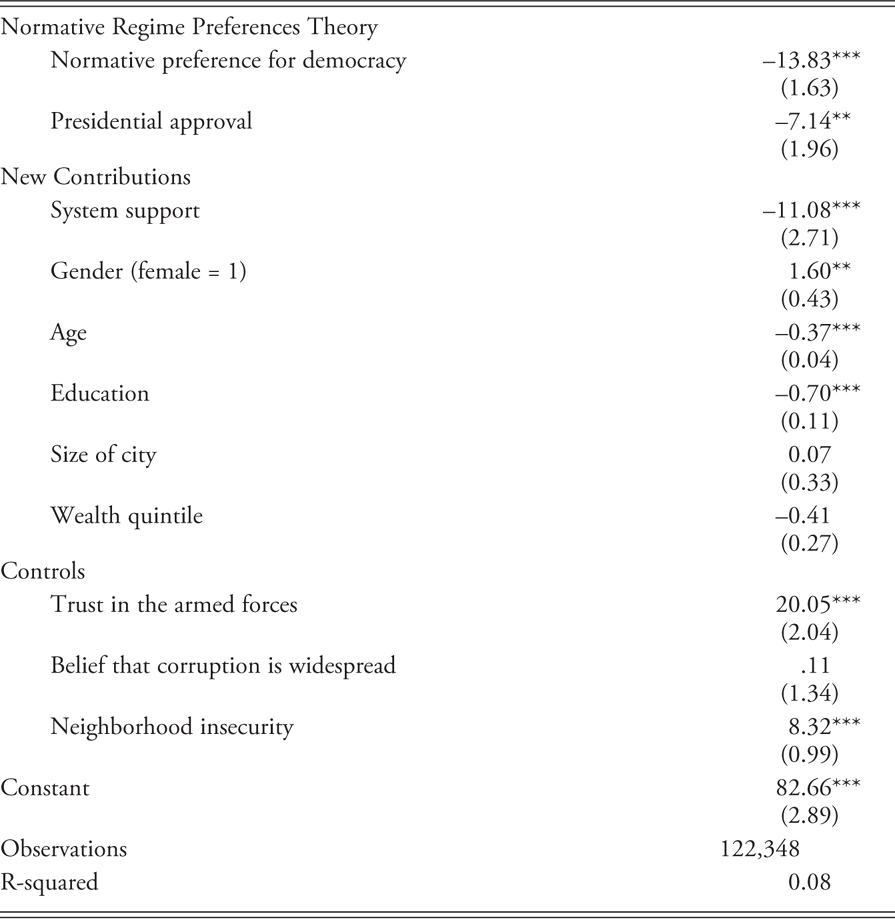
Because we rely on intercepts of each country in each survey, the first step produces estimates of the baseline effect of support for coups when controlling for all explanatory variables and country-year interactions. Due to the dichotomous structure of the dependent variable, we employ a linear probability model.Footnote 25 Table 1 reveals, unsurprisingly, that trust in the military has the greatest predictive power. However, we also find a large effect for preference for democracy as the second most important determinant in the model, followed by system support. We conclude that individuals who embrace democracy for its intrinsic value and who have higher trust in the political institutions of their country are significantly less likely to support the overthrow of those institutions in times of high crime and corruption.
First-Stage Analysis, Individual-Level Determinants of Coup Justification

*** p<0.001
** p<0.01
* p<0.05
^ p<.10
Standard errors in parentheses. Linear probability model. Standard errors clustered by country.
Note: Year, country, and country-year fixed effects included but not presented.
For the most part, demographic and socioeconomic factors behave as expected. By a wide margin, younger, less-educated citizens support hypothetical coups more. Females justify military intervention more than males, all else equal, as widely reported in the literature indicating that women are less supportive of democracy than men. On the other hand, family wealth and size of one’s community of residence fail to affect coup justification significantly, which suggests that these beliefs are widely distributed across socioeconomic populations. While these results conform to our expectations, we explore these relationships further with a set of subgroup analyses. Because of space constraints, we do not present the empirical models; interested readers are directed to online appendix C. What we found particularly interesting is the picture that arose of women who support coups: urban, well-educated, and well-off women are more likely to support coups, which directly contrasts with the picture of coup supporters in the model as a whole.Footnote 26 In a smaller sample, from 2006 to 2014, females increasingly justify coups the greater their interest in politics.Footnote 27
Returning to table 1, our findings demonstrate that many respondents disapprove of their president sufficiently to support the military’s stepping in. This result gives us pause, given the volatility of executive popularity in the region in recent years. Our analysis ends with 2014, but major recent events demonstrate the continuing salience of these attitudes: President Nicolás Maduro’s attempts to close Venezuela’s Congress, countrywide protests of corruption scandals implicating former president Otto Molina Pérez in Guatemala, and the impeachment of Brazil’s Dilma Rousseff and intense popular reaction against political insiders in the vast, elite-led corruption machine. All have troubling implications for stability should citizens wish the military to “throw the rascals out.” In a democracy riven with corruption and scandal, public coup support might be a double-edged sword—viewed as a tool to purge a poorly performing elected government.
Our measures allow us to consider whether governmental failure to provide for citizens’ safety or corruption influences coup justification. Living in a neighborhood perceived as unsafe significantly increases support for coups. Given the pervasively high crime rates in the Americas, this is also a potentially worrying finding: might military coups make a reappearance if crime continues to increase? We suggest that this might be possible if neighborhood insecurity becomes so widespread that it becomes ingrained. In some places, this may already be happening: in some countries, the military patrols jointly with the police, thereby effectively reminding civilians of a potentially positive effect of bringing the military back in. Nun’s Reference Nun1967 argument would probably support this implication. Further research on the link between crime and willingness to support military coups is warranted.
We suspect that table 1’s null finding for corruption arises from the type of democratic breakdown in question. It is easier to understand how individuals who fear crime might support coups, given criminal violence rates and the growing practice by several regimes of deploying military units to accompany police patrols.Footnote 28 In contrast, combating corruption has never been a significant role for the region’s militaries. Furthermore, regional governments now tend to address corruption via impeachment or forced resignation, as occurred recently in Guatemala and Brazil.Footnote 29
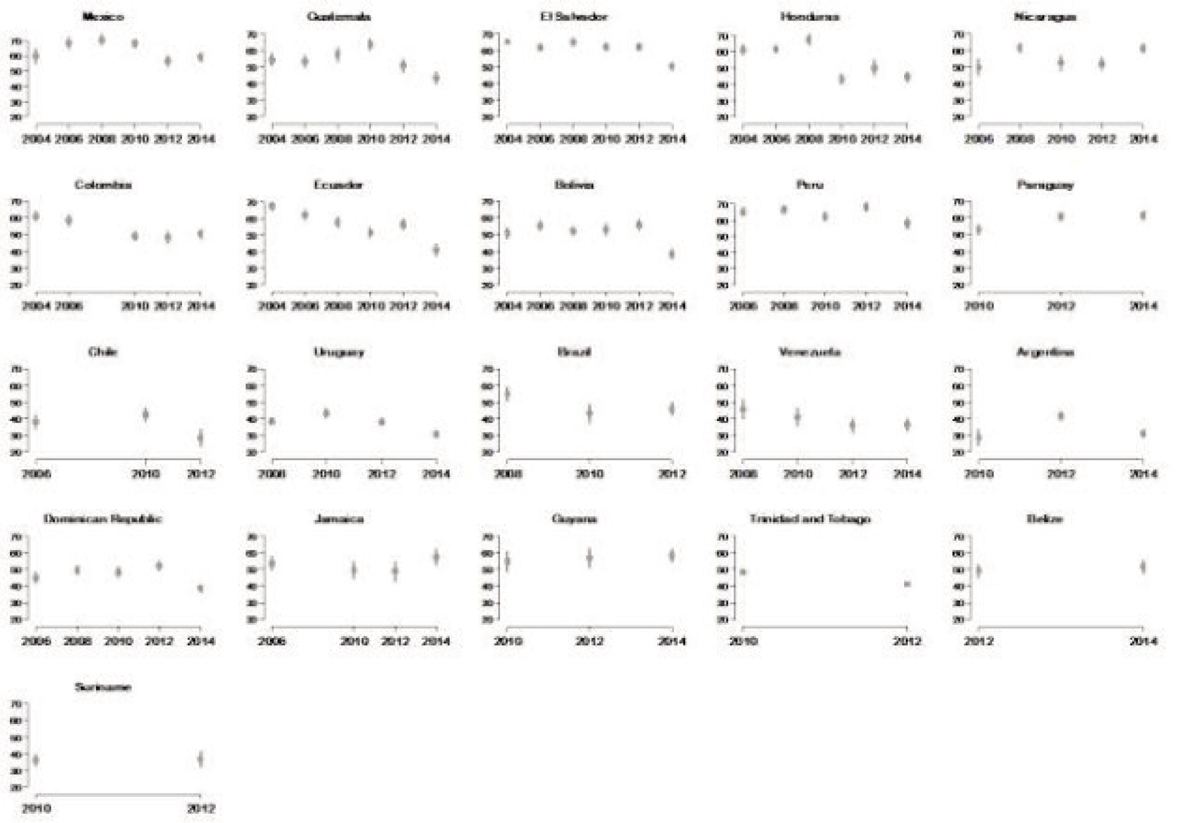
Figure 5 presents the average predicted value of coup justification in each country over each survey wave, revealing an overall regional trend of declining coup justification. Some countries experienced an uptick in the 2010 survey wave, probably in reaction to the sharp 2008–9 economic downturn. However, this slump did not affect all countries, as some of them experienced economic growth during this time.
Predicted Coup Justification by Country and Survey Wave

Second Step
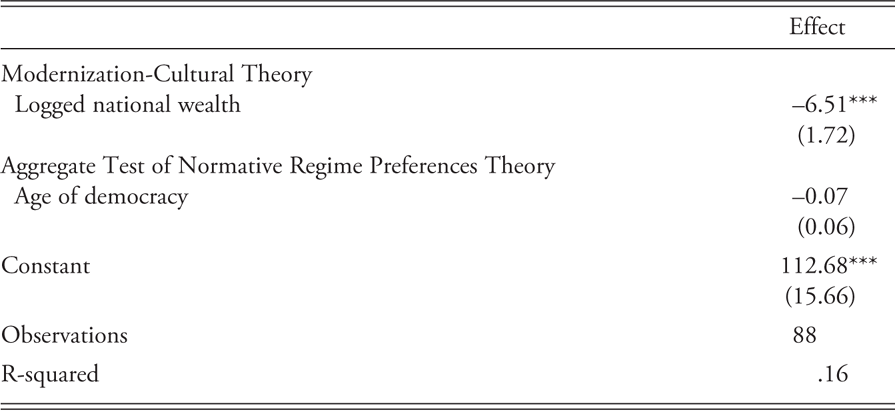
The second step of the two-step model allows us to estimate the extent to which these contextual-level predictors affect the intercepts for each country in each survey wave.Footnote 30 The unit of analysis is each country in each survey wave, for a total of 88 observations. As table 2 demonstrates, the age of democracy fails to influence mean national coup justification. In contrast, (log-transformed) national wealth attains statistical significance at conventional levels, but the effect is substantively small.Footnote 31 A one-percent increase in national wealth is associated with a diminutive decline of only .065 in coup support.
Mean National Coup Justification: Two-Step National-Level Model

*** p < 0.001
** p < 0.01
* p < 0.05
^ p<.10
Standard errors in parentheses.
So while modernization theory is empirically relevant in our analysis, it is not substantively meaningful for the scope of our data. (We suspect that a longer temporal span covering a greater range of economic growth would provide a better test.) Our finding diverges from Mainwaring and Pérez-Liñán’s (Reference Mainwaring and Pérez-Liñán2013), but we focus on individuals rather than elites. Individuals have been known to punish elites irrationally for things beyond their control (one could start with Achen and Bartels Reference Achen and Bartels2016). In any case, our findings suggest that over time, countries with growing national wealth may see individual support for coups decline but not disappear. Several other factors play a stronger role in this relationship than economic modernization.
What Affects Support for Coups Over Time?
Figure 4 demonstrates declining average coup support in Latin America and the Caribbean from 2004 to 2014. We build on these findings by analyzing whether our hypotheses hold across time. This is particularly important because our macrolevel theory presumes that citizens’ values evolve over time under the constraints of economic modernization or regime rules. Four countries deviate from the regional trend and show increases in coup justification over time: Paraguay (+25 units), Nicaragua (+10 units), Jamaica (+8.5 units), and Argentina (+5 units).Footnote 32 We suggest possible explanations for these increases, rooted largely in sui generis conditions for each case.
Relatively prosperous Argentina stands out, with its democratically inclined citizenry that nevertheless increasingly supports coups. This finding is probably because Argentines in recent years have evaluated most of their national democratic institutions (e.g., parties, legislature, courts) very poorly compared to other Latin Americans. This pattern mirrors trends in other developed democracies (Foa and Mounk Reference Foa and Mounk2016). Meanwhile, Paraguay and Jamaica are poorer countries beset by specific problems, and exhibit low individual satisfaction with how democracy performs. Jamaica experienced a recent economic slump and a violent crime rate that led to an insurrection in an area bordering the national capital. Paraguay faces violent insurgent activities by paramilitary groups, probably raising levels of perceived threat, factors known to drive antidemocratic attitudes powerfully (Carlin et al. Reference Carlin, Singer and Zechmeister2015; Merolla and Zechmeister Reference Merolla and Zechmeister2009).
In Nicaragua, the poorest country with a military in our sample, the 2008 economic slump appears to have driven a sharp increase in support for a coup in that year, which, on close inspection of our data, then fell back to pre-2008 levels and below. In 2014, Nicaraguans again perceived that their personal economic situations had eroded, and coup justification again rose (though less than in 2008). In sum, Nicaraguans have not steadily increased their coup justification as have Paraguayans and to a lesser extent, Jamaicans.
Dynamic Model
Having added public opinion into the normative regime preferences theory and explored individual associations of support or rejection of coups in the Americas, we take our analysis one step further. The two-step model employs a static dependent variable, preventing us from making claims as to whether our predictors contribute to the observed change in coup justification. Ideally, we would utilize panel data on the same individuals over time. However, in the absence of a panel, we follow the approach of Luna and Zechmeister (Reference Luna and Zechmeister2005) and estimate bivariate correlations among the variables of interest. To do so, we utilize two specifications of a dynamic dependent variable. The first represents the average net change in coup justification from the last to the first survey wave for each country at the aggregate level. The alternate specification relies on the average net change in coup justification between each survey wave. Similarly, the individual-level variables included also represent dynamic country-level averages instead of the static variables that capture moments in time.Footnote 33 Though we cannot offer a conclusive estimation of the determinants of coup justification over time, we can take preliminary steps in evaluating the merit of our theory.Footnote 34
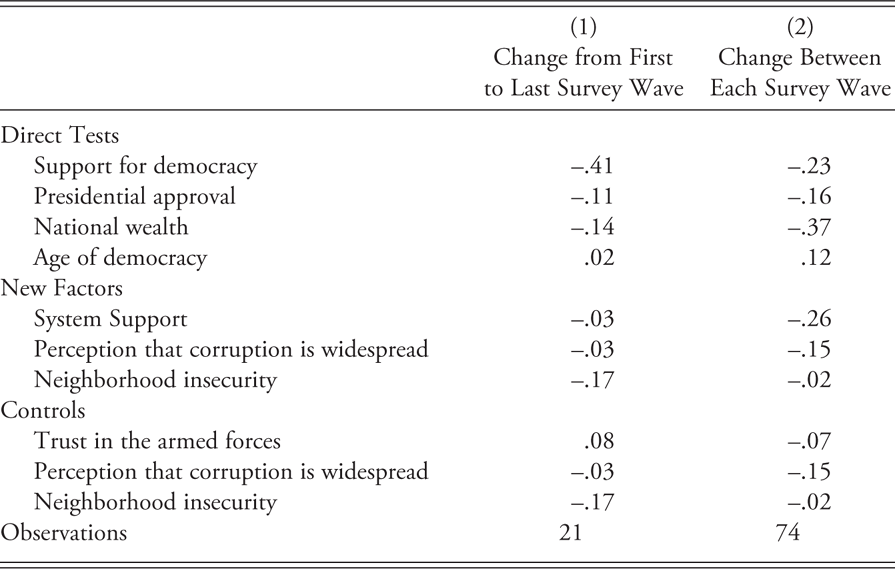
We find that as support for democracy increases, coup justification over time decreases. In the model evaluating change from first to last survey wave, the correlation is −.41, the highest of any variable examined. In the model of change between surveys, the correlation is more modest, −.23, but is still notable. System support does not appear to play a determining role in model 1 but surpasses support for democracy in model 2 (see table 3). Despite being the strongest predictor in the individual model, change in trust in the military does not appear to drive declining coup support over time, nor do any of the other significant findings from previous models. Correlations between contextual variables and coup justification are not particularly strong: neither the age of democracy nor national wealth offers predictive power in a dynamic model.
Bivariate Correlations: Determinants of Coup Justification over Time

The contribution of this analysis is to point to where the action is in explaining the change in coup justification in the Americas over a decade-long span, from 2004 to 2014. In our two-step analysis, we find that normative support for democracy offers the greatest potential for explaining the region’s decline in coup support. We have relied on the normative regime preferences and modernization-cultural theoretical frameworks to guide the building of our models. Using two distinct analytical strategies, we have determined that normative preference for democracy is the only variable in our dynamic analysis to offer robust explanatory power: citizens of the Americas support coups less over time, in large part because their support for democracy has increased over time. However, caution is warranted. As democracy declines globally, as it now clearly seems to be doing, our findings indicate that support for coups may, in turn, increase, particularly if trust in the military increases.
Conclusions
In Latin America and Caribbean countries with armies, citizen justification for coups d’état under realistic yet hypothetical conditions of high crime and high levels of corruption declined from 2004 to 2014. This study demonstrates that coup justification can be construed more broadly as an important aspect of a wider trend toward the institutionalization of democracy. Our analysis evaluated individual characteristics from a sample of more than 120,000 respondents in 21 countries to provide evidence that the normative regime preferences theory has parallels among the mass public. The analysis reveals that mass democratic norms exert significant effects on levels of and trends in coup justification and have a stronger effect than economic modernization.
We also found that members of the mass public who feel insecure in their neighborhoods and who disapprove of the incumbent president are more likely to justify coups under conditions of high crime and high corruption. Additionally, while our findings largely confirm conventional expectations about the role of demographic and socioeconomic status in coup support—specifically that older, better-educated, system-supporting citizens support coups less—we add an important caveat. Women often do not comport with these expectations.
At the contextual level, we found that greater economic development very modestly lowers levels of coup support, but that this effect did not appear in our dynamic model over time. Similarly, the age of democracy weakly associated with lower justification in the static model but not the dynamic model. In both cases, a larger country sample over a greater time span would permit a more persuasive test of these relationships, given the slow rate of change for these variables.
Supporting Information
Additional supporting materials may be found with the online version of this article at the publisher’s website: Online appendixes
For replication data, see the authors’ file on the Harvard Dataverse website: https://dataverse.harvard.edu/dataset.xhtml?persistentId=doi:10.7910/DVN/P1UXI5&version=DRAFT