1. Introduction
Regularization has become crucial in machine learning practice and the goal of this paper is to revisit the idea of regularization from an optimal transport perspective. Specifically, we show that the role of regularization in machine learning can often be interpreted as the result of optimally transporting mass from the empirical measure in order to maximize a certain loss under a budget constraint. Thus, our results connect directly optimal transport phenomena (a classical concept in probability reviewed in Section 2.1) to regularization (a key tool in machine learning to be discussed in the following subsection).
Moreover, this connection will show that the so-called regularization parameter (i.e. the coefficient of the regularization term) coincides with the size of the budget constraint by which we permit mass transportation to occur. As we shall see, the budget constraint has a natural interpretation based on a distributionally robust optimization (DRO) formulation, which in turn allows us to define a reasonable optimization criterion for the regularization parameter. Thus, our approach uses optimal mass transportation phenomena to explain the nature of regularization and how to select the regularization parameter in several machine learning estimators, including square-root LASSO (least absolute shrinkage and selection) and regularized logistic regression, among others.
The size of the budget constraint is also referred to as the radius (or size) of the uncertainty set in the DRO literature. The method that we develop for optimally choosing this budget constraint can actually be applied to a wide range of inference and decision problems, but we have focused our discussion on machine learning applications because of the substantial amount of activity that the area has generated, and also to demonstrate the utility of the tools that are commonly used in applied probability in this rapidly growing area.
1.1. Regularization in linear regression
In order to introduce the proposed method for optimally choosing the radius of the uncertainty set, let us walk through a simple application in a familiar context, namely, that of linear regression. Throughout the paper any vector is understood to be a column vector and the transpose of x is denoted by
 $x^\top$
. We use the notation
 $\mathrm{E}_{\mathrm{P}}[{\cdot}]$
to denote expectation with respect to a probability distribution P.
Example 1. (Square-root LASSO.) Consider a training data set
 $\{(X_{1},Y_{1}),\ldots,(X_{n},Y_{n})\}$
, where the input
 $X_{i}\in\mathbb{R}^{d}$
is a vector of d predictor variables and
 $Y_{i}\in\mathbb{R}$
is the response variable. It is postulated that
 \[
Y_{i}=\beta_{\ast}^\top X_{i}+e_{i}
\]
for some
 $\beta_{\ast}\in\mathbb{R}^{d}$
and errors
 $\{e_{1},\ldots,e_{n}\}$
. Under suitable statistical assumptions we may be interested in estimating
 $\beta_{\ast}$
. Underlying is a general loss function,
 $l( x,y;\,\beta) $
, which we shall take for simplicity in this discussion to be the quadratic loss, namely,
 $l(x,y;\,\beta)=( y-\beta^\top x) ^{2}$
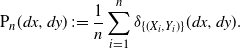
. Let
 $\mathrm{P}_{n}$
denote the empirical distribution:
 \[
\mathrm{P}_{n}( dx,dy) \,:\!=\frac{1}{n}\sum_{i=1}^{n}\mathcal{\delta
}_{\{ (X_{i},Y_{i})\} }(dx,dy).
\]
Over the last two decades, various regularized estimators have been introduced and studied. Many of them have gained substantial popularity because of their good empirical performance and insightful theoretical properties (see, for example, [Reference Tibshirani47] for an early reference and [Reference Hastie, Tibshirani, Friedman and Franklin21] for a discussion on regularized estimators). One such regularized estimator, implemented, for example in the ‘flare’ package (see [Reference Li, Zhao, Yuan and Liu27]), is the so-called square-root LASSO estimator that is obtained by solving the following convex optimization problem in
 $\beta$
:
 \begin{equation}
\min_{\beta\in\mathbb{R}^{d}}\{ \sqrt{\mathrm{E}_{\mathrm{P}_{n}}[ l\,(
X,Y;\,\beta) ] }+\lambda\Vert \beta\Vert _{1}\}
=\min_{\beta\in\mathbb{R}^{d}}\left\{\sqrt{\frac{1}{n}\sum_{i=1}^{n}l(
X_{i},Y_{i};\,\beta) }+\lambda\Vert \beta\Vert _{1}\right\},
\label{eqn1}
\end{equation}
where
 $\Vert \beta\Vert _{p}$
denotes the
 $\ell_p$
-norm. The parameter
 $\lambda$
, commonly referred to as the regularization parameter, is crucial for the performance of the algorithm. It is often chosen using cross validation, a procedure that iterates over a multitude of choices of
 $\lambda$
in order to choose the best.
1.1.1. DRO representation of square-root LASSO
One of our contributions in this paper (see Section 2) is a representation of (1) in terms of a distributionally robust optimization formulation. We construct a discrepancy measure,
 $\mathcal{D}
_{c}( \mathrm{P},\mathrm{Q}) $
, corresponding to a Wasserstein-type distance between two probability measures P and Q which is defined in terms of a suitable transportation cost function
 $c(\!\cdot\!)$
. If
 $c(\!\cdot\!) $
is based on the
 $\ell_{q}$
-distance (for
 $q \gt 1$
), we show that
 \begin{equation}
\min_{\beta\in\mathbb{R}^{d}}\{ \sqrt{\mathrm{E}_{\mathrm{P}_{n}}[ l(
X,Y;\,\beta) ] }+\lambda\Vert \beta\Vert _{p}\}
^{2}=\min_{\beta\in\mathbb{R}^{d}}\, \max_{\mathrm{P}\,:\, \mathcal{D}_{c}(\mathrm{P},\mathrm{P}_{n}
)\leq\delta}\, \mathrm{E}_{\mathrm{P}}[ l(X,Y;\,\beta)],
\label{eqn2}
\end{equation}
where
 $1/p+1/q=1$
and
 $\lambda = \sqrt{\delta}$
. We can gain a great deal of insight from (2). For example, note that the regularization parameter
 $\lambda = \sqrt{\delta}$
is fully determined by the size (or ‘radius’) of the uncertainty,
 $\delta$
, in the DRO formulation on the right-hand side of (2). In addition, we can interpret (2) as a game in which an artificial adversary is introduced in order to explore and quantify out-of-sample effects in our estimates of the expected loss.
1.1.2. Optimal choice of the radius
 $\delta$

The set
 $\mathcal{U}_{\delta}(\mathrm{P}_{n})=\{\mathrm{P}\,:\,\mathcal{D}_{c}(\mathrm{P},\mathrm{P}_{n})\leq\delta\}$
is called the uncertainty set in the language of DRO, and it represents the class of models that are, in some sense, plausible variations of
 $\mathrm{P}_{n}$
. Note that
 $\mathcal{U}_{\delta}(\mathrm{P}_{n})$
is precisely the feasible region over which the maximization is taken in (2). Then we define the collection
 $$\Lambda_{n}(\delta) \,:\!= \bigcup_{\mathrm{P} \, \in \,
\mathcal{U}_\delta(\mathrm{P}_n)} % \left\{
\arg \min_{\beta \in \mathbb{R}^d} \mathrm{E}_\mathrm{P}[l(X,Y;\,\beta)]
\label{eqn3}
$$
comprising optimal
 $\beta$
for every
 $\mathrm{P} \in \mathcal{U}_\delta(\mathrm{P}_n)$
to be the set of plausible selections of the parameter
 $\beta_\ast$
. For
 $\delta$
chosen sufficiently large, the set
 $\Lambda_{n}( \delta) $
is a natural confidence region for
 $\beta_{\ast}$
. Moreover, we shall see that any
 $\beta$
that solves
 $\inf_\beta \sup_{\mathrm{P} \in \mathcal{U}_\delta(\mathrm{P}_n)} \mathrm{E}[
l(X,Y;\,\beta)]$
is a member of
 $\Lambda_n(\delta)$
.
Given these interpretations, it is natural to select a confidence level,
 $1-\alpha$
, and then choose
 $\delta = \delta_n^\ast$
optimally via
 \begin{equation}
\delta_{n}^{\ast}=\min\{\delta > 0\,:\, \mathrm{P} (
\beta_{\ast}\in\Lambda_{n}(
\delta)) \geq 1-\alpha\}.
\label{eqn4}
\end{equation}
In words, the optimization criterion can be stated as finding the smallest
 $\delta$
such that
 $\beta_{\ast}$
is itself a plausible selection with
 $1-\alpha$
confidence. Essentially, given a desired confidence level
 $1-\alpha$
, we seek to choose a
 $\delta$
just large enough such that
 $\Lambda_n(\delta)$
is a
 $(1-\alpha)$
-confidence region for the parameter
 $\beta_\ast$
. As we shall see in Section 4, this choice ensures that any
 $\beta$
that minimizes
 $\inf_\beta \sup_{\mathrm{P} \in \mathcal{U}_\delta(\mathrm{P}_n)} \mathrm{E}[
l(X,Y;\,\beta)]$
is indeed in the confidence region
 $\Lambda_n(\delta)$
. We next explain how to solve the optimization problem in (4) asymptotically as
 $n\rightarrow\infty$
.
1.1.3. The associated Wasserstein profile function
In order to asymptotically solve (4) we introduce a novel statistical inference methodology, which we call RWPI (robust Wasserstein-distance profile-based inference; pronounced similar to ‘rupee’). This can be understood as an extension of empirical likelihood (EL) that uses optimal transport cost rather than the likelihood. The extension is not just a formality, as we shall see, because different phenomena and scalings arise relative to EL.
We next illustrate how
 $\delta_{n}^{\ast}$
in (4) corresponds to the quantile of a certain object which we call the robust Wasserstein profile (RWP) function evaluated at
 $\beta_{\ast}$
. This will motivate a systematic study of the RWP function as the sample size, n, increases.
Observe that, by convexity of the loss function,
 $\beta\in\Lambda_{\delta }( \mathrm{P}_{n}) $
if and only if there exists
 $\mathrm{P}\in\mathcal{U}_{\delta }(\mathrm{P}_{n})$
such that
 $\beta$
satisfies the first-order optimality condition, namely
 \begin{equation}
D_\beta \mathrm{E}_\mathrm{P}[ l(X,Y;\,\beta)] = \mathrm{E}_{\mathrm{P}}[ (
Y-\beta^\top X) X] =\mathbf{0}.
\label{eqn5}
\end{equation}
We then introduce the following object, which is the RWP function associated with the estimating equation (5):
 \begin{equation}
R_{n}( \beta) =\inf\{ \mathcal{D}_{c}( \mathrm{P},\mathrm{P}_{n}
) \,:\,\mathrm{E}_{\mathrm{P}}[ ( Y-\beta^\top X) X] =\mathbf{0}\}.
\label{eqn6}
\end{equation}
It turns out that the infimum is achieved in the previous expression, so we can write
 $\min$
instead; this is not crucial for our discussion but it is sometimes helpful to keep in mind. Using this definition of
 $R_{n}(\beta)$
, we can see immediately that the events
 \[
\{R_{n}(\beta_{\ast}) \leq\delta\}=\{\beta_{\ast}\in\Lambda _{n}(\delta) \},
\]
which implies that
 $\delta_{n}^{\ast}$
is precisely the
 $1-\alpha$
quantile,
 $\chi_{_{1-\alpha}}$
, of
 $R_{n}( \beta_{\ast});$
that is,
 \[
\delta_{n}^{\ast}=\chi_{_{1-\alpha}}=\inf\,\{z\,:\,\mathrm{P}( R_{n}(
\beta_{\ast}) \leq z) \geq1-\alpha\}.
\]
Moreover, note that
 $R_{n}(\beta)$
allows us to provide an explicit characterization of
 $\Lambda_{n}(\chi_{_{1-\alpha}})$
:
 \[
\Lambda_{n}( \chi_{_{1-\alpha}}) =\{\beta\,:\,R_{n}(\beta)
\leq\chi_{_{1-\alpha}}\}.
\]
So,
 $\Lambda_{n}( \chi_{_{1-\alpha}}) = \{\beta\,:\,
R_n(\beta) \leq \chi_{1-\alpha}\}$
is a
 $(1-\alpha)$
-confidence region for
 $\beta^{\ast}$
.
1.1.4. Further intuition behind the RWP function
In order to further explain the role of
 $R_{n}(\beta_{\ast})$
, let us define
 $ \mathcal{P}_{\rm opt}\,:\!=\{ \mathrm{P}\,:\,\mathrm{E}_{\mathrm{P}}[ (Y-\beta_{\ast}^\top%
X)X] =\mathbf{0}\}$
. In words,
 $\mathcal{P}_{\rm opt}$
is the set of probability measures for which
 $\beta_{\ast}$
is an optimal risk minimization parameter. Naturally, the distribution of (X,Y), from which the samples are generated, is an element of
 $\mathcal{P}_{\rm opt}$
. Since
 $R_{n}(\beta_{\ast})=\inf\{\mathcal{D}_{c}(\mathrm{P},\mathrm{P}_{n})\,:\,\mathrm{P}\in\mathcal{P}_{\rm opt}\}$
, the set
 $\{\mathrm{P}\,:\,\mathcal{D}_{c}(\mathrm{P},\mathrm{P}_{n})\leq R_{n}(\beta_{\ast})\}$
denotes the smallest uncertainty region around
 $\mathrm{P}_{n}$
(in terms of
 $\mathcal{D}_{c}$
) for which there exists a distribution P satisfying the optimality condition
 $\mathrm{E}_{\mathrm{P}}[ (Y-\beta_{\ast}^\top X)X] =\mathbf{0}$
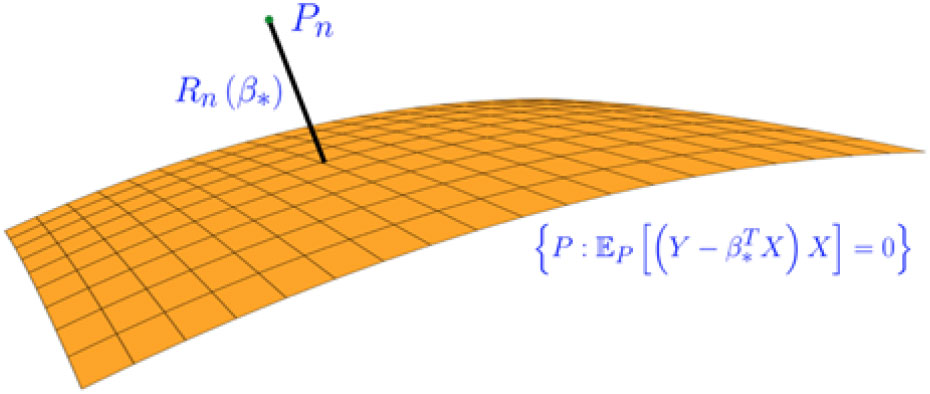
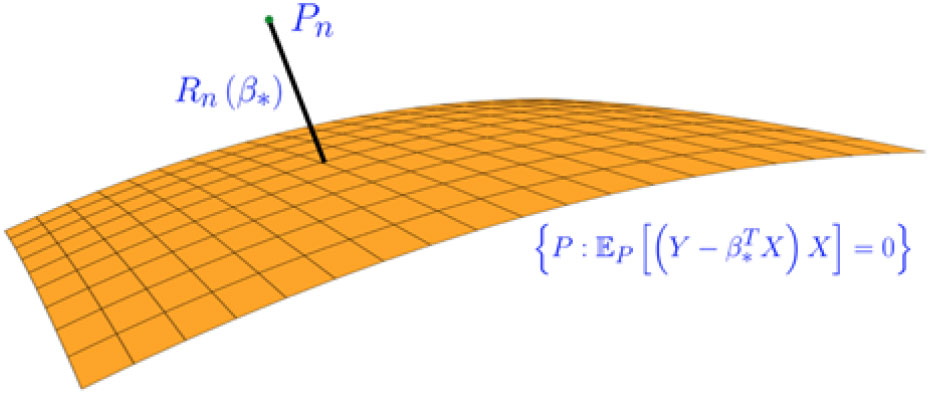
. See Figure 1 for a pictorial representation of
 $\mathcal{P}_{\rm opt}$
and
 $R_n(\beta^\ast)$
.
Illustration of RWP function evaluated at  $\beta_{\ast}$
.
In summary,
 $R_{n}(\beta_{\ast})$
denotes the smallest size of uncertainty that makes
 $\beta_{\ast}$
a plausible choice. If we were to select a radius of uncertainty smaller than
 $R_{n}(\beta_{\ast})$
, then no probability measure in the neighborhood will satisfy the optimality condition
 $\mathrm{E}_{\mathrm{P}}[ (Y-\beta_{\ast}^\top X)X] =\mathbf{0}$
. On the other hand, if
 $\delta>R_{n}(\beta_{\ast})$
then the set
 \[
\{ \mathrm{P}\,:\,\mathrm{E}_{\mathrm{P}}[(Y-\beta_{\ast}^\top X)X]=\mathbf{0},\mathcal{D}
_{c}(\mathrm{P},\mathrm{P}_{n})\leq\delta\}
\]
is non-empty.
1.2. A broader perspective of our contribution
The previous discussion in the context of linear regression highlights two key ideas: (a) the RWP function as a key object of analysis, and (b) the role of distributionally robust representation of regularized estimators.
The RWP function can be applied much more broadly than in the context of regularized estimators. We shall study the RWP function for estimating equations generally and systematically, but we showcase the use of the RWP function only in the context of optimal regularization.
Broadly speaking, RWPI can be seen as a statistical methodology that utilizes a suitably defined RWP function to estimate a parameter of interest. From a philosophical standpoint, RWPI borrows heavily from EL, introduced in the seminal work of Owen [Reference Owen30, Reference Owen31]. There are important methodological differences, however, as we shall discuss below. In the last three decades there has been a large number of successful applications of EL for inference [Reference Bravo11, Reference Hjort, McKeague and Van Keilegom22, Reference Owen32, Reference Qin and Lawless35, Reference Zhou52]. In principle all of those applications can be revisited using the RWP function and its ramifications.
We now provide a more precise description of our contributions.
(A) We explain how, by judiciously choosing
$\mathcal{D}_{c}(\!\cdot\!) $
, we can define a family of regularized regression estimators (see Section 2). In particular, we show how square-root LASSO (see Theorem 1), regularized logistic regression, and support vector machines (see Theorem 2) arise as particular cases of suitable DRO formulations.(B) We derive general limit theorems for the asymptotic distribution (as the sample size increases) of the RWP function defined for general estimating equations. These limit theorems, derived in Section 3.3, allow us to employ RWPI to perform inference and choose the radius of uncertainty
$\delta$
in settings that are more general than linear/logistic regression.(C) We use our results from (B) to obtain prescriptions for regularization parameters in square-root LASSO and regularized logistic regression settings (see Section 4). We also illustrate how coverage results for the optimal risk that demonstrate an
$O(n^{-1/2})$
rate of convergence are obtained immediately as a consequence of choosing
$\delta \geq
R_n(\beta_\ast)$
.(D) We analyze our regularization selection in the high-dimensional setting for square-root LASSO. Under standard regularity conditions, we show (see Theorem 7) that the regularization parameter
$\lambda$
might be chosen as where
\[
\lambda= \frac{\pi}{\pi- 2} \frac{\Phi^{-1}(
1-\alpha/2d) }
{\sqrt{n}},
\]
$\Phi(\!\cdot\!) $
is the cumulative distribution of the standard normal random variable and
$1-\alpha$
is a user-specified confidence level. The behavior of
$\lambda$
as a function of n and d is consistent with regularization selections studied in the literature motivated by different considerations (see Section 4.4 for further details).(E) We analyze the empirical performance of RWPI-based selection of regularization parameters in the context of square-root LASSO. In Section 5, we compare the performance of RWPI-based optimal regularization with that of a cross-validation-based approach on both simulated and real data. We conclude that the RWPI-based approach yields similar performance, without having to repeat the algorithm over various choices of regularization parameters (as done in cross-validation).


We now provide a discussion of topics related to RWPI.
1.3. On related literature
Connections between robust optimization and regularization procedures such as LASSO and support vector machines have been studied in the literature [Reference Bertsimas and Copenhaver3, Reference Xu, Caramanis and Mannor50, Reference Xu, Caramanis and Mannor51]. The methods proposed here differ subtly: While [Reference Xu, Caramanis and Mannor50] and [Reference Xu, Caramanis and Mannor51] add deterministic perturbations of a certain size to the predictor vectors X to quantify uncertainty, the distributionally robust representations that we derive measure perturbations in terms of deviations from the empirical distribution. While this change may appear cosmetic, it brings a significant advantage: measuring deviations from the empirical distribution, as we shall see, allows us to derive suitable limit laws (or) probabilistic inequalities that can be used to give a systematic prescription for the radius of uncertainty,
 $\delta$
, in the definition of the uncertainty region
 $\mathcal{U}_{\delta}(\mathrm{P}_{n}) =\{\mathrm{P}\,:\,
\mathcal{D}_{c}(\mathrm{P},\mathrm{P}_{n})\leq\delta\}$
.
It is well understood that as the number of samples n increases, the expected deviation of the empirical distribution from the true distribution decays to zero, as a function of n, at a specific rate. To begin with, as a direct approach towards choosing the size of the uncertainty
 $\delta$
, we can perhaps use a suitable concentration inequality that measures such rate of convergence in terms of Wasserstein distances (see, for example, [Reference Fournier and Guillin17] and references therein). Such a simple specification of the size of the uncertainty, suitably as a function of n, does not arise naturally in the deterministic robust optimization approaches in [Reference Xu, Caramanis and Mannor50, Reference Xu, Caramanis and Mannor51].
For an application of these concentration inequalities to choosing the size of the uncertainty set in the context of distributionally robust logistic regression and data-driven DRO, refer to [Reference Mohajerin Esfahani and Kuhn28, Reference Shafieezadeh-Abadeh, Esfahani and Kuhn40]. The exact representation for regularized logistic regression we derive later, in Section 2.4, can be can be seen as an extension in which the approximate representation described in [Reference Shafieezadeh-Abadeh, Esfahani and Kuhn40, Remark 1] is made to coincide exactly with the regularized logistic regression estimator that has been widely used in practice. It is important to note that, despite imposing severe tail assumptions, the concentration inequalities used to choose the radius of the uncertainty set in [Reference Mohajerin Esfahani and Kuhn28, Reference Shafieezadeh-Abadeh, Esfahani and Kuhn40] dictate that the size of the uncertainty decay at the rate
 $O(n^{-1/d})$
; unfortunately, this prescription scales non-gracefully as the number of dimensions d increases, and the resulting coverage guarantees suffer from a poor rate of convergence (see, for example, [Reference Mohajerin Esfahani and Kuhn28, Theorem 3.5], [Reference Shafieezadeh-Abadeh, Esfahani and Kuhn40, Theorem 2]). Since most of the modern learning and decision problems have huge numbers of covariates, application of such concentration inequalities with poor rates of decay with dimensions may not be suitable for applications.
In contrast to directly using concentration inequalities, as we shall see, the prescription obtained via RWPI typically has a rate of convergence of order
 $O( n^{-1/2}) $
as
 $n\rightarrow\infty$
(for fixed d). In particular, as we discuss in the case of LASSO, according to our results corresponding to contribution (E), RWPI-based prescription of the size of uncertainty can actually be shown (under suitable regularity conditions) to decay at a rate
 $O(\sqrt{\log d/n})$
(uniformly over d and n such that
 $\log^2d \ll n$
), which is in agreement with the findings of the high-dimensional statistics literature (see [Reference Belloni, Chernozhukov and Wang2, Reference Candes and Tao12, Reference Negahban, Ravikumar, Wainwright and Yu29] and references therein). A profile-function-based approach towards calibrating the radius of uncertainty in the context of empirical-likelihood-based DRO can be found in [Reference Duchi, Glynn and Namkoong14, Reference Gotoh, Kim and Lim20, Reference Lam and Zhou26, Reference Lam25].
Although we have focused our discussion on the context of regularized estimators, our results are directly applicable to the area of data-driven DRO whenever the uncertainty sets are defined in terms of a Wasserstein distance or, more generally, an optimal transport metric. In particular, consider a distributionally robust formulation of the form
 \[
\min_{\theta\,:\,G( \theta) \leq0}\ \max_{\mathrm{P}\,:\, \mathcal{D}
_{c}(\mathrm{P},\mathrm{P}_{n})\leq\delta}\ \mathrm{E}_{\mathrm{P}}[ H(W,\theta)]
\]
for a random element W and a convex function
 $H(W,\cdot)$
defined over a convex region
 $\{\theta\,:\,G( \theta) \leq0\}$
(assuming
 $G\,:\,\mathbb{R}^{d}\rightarrow\mathbb{R}$
convex). Here,
 $\mathrm{P}_{n}$
is the empirical measure of the sample
 $\{W_{1},\ldots,W_{n}\}$
. One can then follow reasoning parallel to what we advocate throughout our LASSO discussion. Argue, by applying the corresponding Karush–Kuhn–Tucker conditions, if possible, that an optimal solution
 $\theta_{\ast}$
to the problem
 \[
\min_{\theta\,:\,G( \theta) \leq0}\mathrm{E}_{\mathrm{P}_{\rm true}}[H(
W,\theta) ]
\]
satisfies a system of estimating equations of the form
 $\mathrm{E}_{\mathrm{P}_{\rm true}}[h( W,\theta_{\ast}) ]=0$
for a suitable
 $h(\!\cdot\!) $
(where
 $\mathrm{P}_{\rm true}$
is the weak limit of the empirical measure
 $\mathrm{P}_{n}$
as
 $n\rightarrow\infty$
). Then, given a confidence level
 $1-\alpha$
, we should choose
 $\delta$
as the
 $(1-\alpha)$
quantile of the RWP function
 \[
R_{n}( \theta_{\ast}) =\inf\{\mathcal{D}_{c}(\mathrm{P},\mathrm{P}_{n}
)\,:\,\mathrm{E}_{\mathrm{P}}[h( W,\theta_{\ast}) ]= \mathbf{0}\}.
\]
The results in Section 2 can then be used directly to approximate the
 $(1-\alpha)$
quantile of
 $R_{n}( \theta_{\ast}) $
. Just as we explain in our discussion of the square-root LASSO example, the selection of
 $\delta$
is the smallest possible choice for which
 $\theta_{\ast}$
is plausible with
 $(1-\alpha)$
confidence.
1.4. Connections to related inference literature
We next discuss the connections between RWPI and EL. In EL we build a profile likelihood for an estimating equation. For instance, in the context of EL applied to estimating
 $\beta$
satisfying (5) we would build a profile likelihood function in which the optimization object is defined as the likelihood (or the log-likelihood) between a given distribution P with respect to
 $\mathrm{P}_{n}$
. Therefore, the analogue of the uncertainty set
 $\{\mathrm{P}\,:\,\mathcal{D}_{c}(\mathrm{P},\mathrm{P}_{n})\leq\delta\}$
in the context of EL will typically contain distributions whose support coincides with that of
 $\mathrm{P}_{n}$
. In contrast, the definition of the RWP function does not require the likelihood between an alternative plausible model P and the empirical distribution
 $\mathrm{P}_{n}$
to exist. Owing to this flexibility, we are able, for example, to establish the connection between regularization estimators and a suitable profile function.
There are other potential benefits of using a profile function which does not restrict the support of alternative plausible models. For example, it has been observed in the literature that in some settings EL might exhibit low coverage [Reference Chen and Hall13, Reference Owen33, Reference Wu49]. It is not the goal of this paper to examine the coverage properties of RWPI systematically, but it is conceivable that relaxing the support of alternative plausible models, as RWPI does, can translate into desirable coverage properties.
From a technical standpoint, the definition of the profile function in EL gives rise to a finite-dimensional optimization problem. Moreover, there is a substantial amount of smoothness in the optimization problems defining the EL profile function. This smoothness can be leveraged in order to obtain the asymptotic distribution of the profile function as the sample size increases. In contrast, the optimization problem underlying the definition of the RWP function in RWPI is an infinite-dimensional linear program. Therefore, the mathematical techniques required to analyze the associated RWP function are different (more involved) than the ones which are commonly used in the EL setting.
A significant advantage of EL, however, is that the limiting distribution of the associated profile function is typically chi-squared. Moreover, this distribution is self-normalized in the sense that no parameters need to be estimated from the data. Unfortunately, this is typically not the case in using RWPI. In many settings, however, the parameters of the distribution can be easily estimated from the data itself.
Another methodology, strongly related to RWPI, by the name of SOS (sample out-of-sample) inference has been studied recently [Reference Blanchet and Kang6]. A suitable RWP function is built in this setting as well, but the support of alternative plausible models is assumed to be finite (but not necessarily equal to that of
 $\mathrm{P}_{n}$
). Instead, the support of alternative plausible models is assumed to be generated not only by the available data, but additional samples from independent distributions (defined by the user). The limit results obtained for the RWP function in the context of SOS are different from those obtained in this paper. For example, in the SOS setting the rates of convergence are dimension dependent, which is not the case in the RWPI. As explained in [Reference Blanchet and Kang6, Reference Blanchet and Kang7], SOS inference is natural in applications such as semi-supervised learning, in which massive amounts of unlabeled data inform the support of the covariates.
1.5. Organization of the paper
The rest of the paper is organized as follows. Section 2 corresponds to contribution (A): we first introduce Wasserstein distances and then discuss distributionally robust representations of popular machine learning algorithms. Section 3 deals with contribution (B): we discuss the RWP function as an inference tool in a way which is parallel to the profile likelihood in EL, and derive the asymptotic distribution of the RWP function for general estimating equations. Section 4 discusses contribution (C), namely the application of the results from (B) for optimal regularization. Our high-dimensional analysis of the RWP function in the case of square-root LASSO is also presented in Section 4. Numerical experiments using both simulated and real data sets are given in Section 5. Proofs of all the results are presented in the supplementary material [Reference Blanchet, Kang and Murthy9].
2. Optimal transport definitions and DRO representations of machine learning estimators
We begin with definitions of optimal transport costs and Wasserstein distances.
2.1. Optimal transport costs and Wasserstein distances
Let
 $c\,:\,\mathbb{R}^{m}\times\mathbb{R}^{m}\rightarrow\lbrack0,\infty]$
be any lower semi-continuous function such that
 $c(u,u)=0$
for every
 $u \in \mathbb{R}^m$
. Given two probability distributions
 $\mathrm{P}(\!\cdot\!) $
and
 $\mathrm{Q}(\!\cdot\!) $
supported on
 $\mathbb{R}^{m},$
the optimal transport cost or discrepancy between P and Q, denoted by
 $\mathcal{D}_{c}(\mathrm{P},\mathrm{Q})$
, is defined as
 \begin{equation}
\mathcal{D}_{c}(\mathrm{P},\mathrm{Q}) =\inf\{\mathrm{E}_{\pi}[ c (
U,W) ] \,:\,\pi\in\mathcal{P}( \mathbb{R}^{m} \times
\mathbb{R}^{m}) , \ \pi_{_{U}}=\mathrm{P}, \ \pi_{_{W}}= \mathrm{Q} \}.
\label{eqn7}
\end{equation}
Here,
 $\mathcal{P}( \mathbb{R}^{m} \times\mathbb{R}^{m} ) $
is the set of joint probability distributions
 $\pi$
of (U,W) supported on
 $\mathbb{R}^{m} \times\mathbb{R}^{m}$
, and
 $\pi_{_{U}},\pi_{_{W}}$
denote the marginals of U and W, respectively, under the joint distribution
 $\pi$
. Intuitively, the quantity c(u, w) can be interpreted as the cost of transporting unit mass from u in
 $\mathbb{R}^{m}$
to another element w in
 $\mathbb{R}^{m}$
. Then the expectation
 $\mathrm{E}_{\pi}[c(U,W)]$
corresponds to the expected transport cost associated with the joint distribution
 $\pi$
. In addition to the stated assumptions on the cost function
 $c(\!\cdot\!)$
, if
 $c^{1/\rho}$
satisfies the properties of a metric for any
 $\rho > 1$
then
 $\mathcal{D}_{c}^{1/\rho}(\mathrm{P},\mathrm{Q}) $
defines a metric between probability distributions (see [Reference Villani48] for a proof and other properties of
 $D_{c}$
). For example, if
 $c( u,w) =\Vert u-w\Vert _{2}^{2}$
then
 $\rho=2$
yields that
 $c( u,w) ^{1/2}=\Vert u-w\Vert _{2}$
is symmetric, non-negative, lower semi-continuous, and it satisfies the triangle inequality. In that case,
 \[
\mathcal{D}_{c}^{1/2}(\mathrm{P},\mathrm{Q}) =\inf\bigg\{
\sqrt{\mathrm{E}_{\pi}[ \Vert U-W\Vert _{2}^{2}] }\,:\,\pi\in\mathcal{P}( \mathbb{R}^{m} \times\mathbb{R}^{m})
,\text{ }\pi_{U}=\mathrm{P},\text{ }\pi _{W}=\mathrm{Q} \bigg\}
\]
coincides with the Wasserstein distance of order two. More generally, if we choose
 $c^{1/\rho}( u,w) =\Vert u - w \Vert_q$
for some
 $\rho, q\geq1$
, then
 $\mathcal{D}_{c}^{1/\rho}(\!\cdot\!) $
is known as the Wasserstein distance of order
 $\rho$
.
Wasserstein distances metrize weak convergence of probability measures under suitable moment assumptions and have received immense attention in probability theory (see [Reference Rachev and Rüschendorf36, Reference Rachev and Rüschendorf37, Reference Villani48] for a collection of classical applications). In addition, earth-mover’s distance, a particular example of a Wasserstein distance, has been of interest in image processing (see [Reference Rubner, Tomasi and Guibas38, Reference Solomon, Rustamov, Guibas and Butscher44]). More recently, optimal transport metrics and Wasserstein distances are being actively investigated for their use in various machine learning applications (see [Reference Frogner, Zhang, Mobahi, Araya and Poggio18, Reference Peyré, Cuturi and Solomon34, Reference Seguy and Cuturi39, Reference Srivastava, Cevher, Tran-Dinh and Dunson45] and references therein for a growing list of new applications).
Throughout this paper we consider optimal transport costs
 $\mathcal{D}_{c}(\!\cdot\!)$
for a judiciously chosen cost function
 $c(\!\cdot\!) $
to result in formulations such as (2). As we shall see in Section 2.4, it is useful to allow
 $c(\!\cdot\!) $
to be lower semi-continuous and potentially be infinite in some region. Thus our setting requires discrepancy choices which are slightly more general than standard Wasserstein distances.
2.2. DRO formulation using optimal transport costs
A common theme in machine learning problems is to find the best-fitting parameter in a family of parameterized models that relate a vector of predictor variables
 $X\in\mathbb{R}^{d}$
to a response
 $Y\in\mathbb{R}$
. In this section we shall focus on a useful class of such models, namely linear and logistic regression models. Associated with these models we have a loss function
 $l(X_{i},Y_{i};\,\beta)$
which evaluates the fit of the regression coefficient
 $\beta$
for the given data points
 $\{(X_{i},Y_{i})\,:\,i=1,\ldots
,n\}$
. Then, just as we explained in the case of square-root LASSO in Section 1.1, our first step will be to show that regularized linear and logistic regression estimators admit a DRO formulation of the form
 \begin{equation}
\inf_{\beta\in\mathbb{R}^{d}}\sup_{\mathrm{P}\,:\,\mathcal{D}_{c}(\mathrm{P},\mathrm{P}_{n}
)\leq\delta}\mathrm{E}_{\mathrm{P}}[ l(X,Y;\,\beta)].
\label{eqn8}
\end{equation}
In contrast to empirical risk minimization that performs well only on the training data, the DRO problem (8) aims to find an optimizer
 $\beta$
that performs uniformly well over all probability measures in the neighborhood that can be perceived as perturbations to the empirical training data distribution. Hence, the solution to (8) is said to be ‘distributionally robust’, and can be expected to generalize better. See [Reference Shafieezadeh-Abadeh, Esfahani and Kuhn40], [Reference Xu, Caramanis and Mannor50], and [Reference Xu, Caramanis and Mannor51] for earlier works that relate robustness and generalization.
Recasting regularized regression as a DRO problem of the form (8) lets us view these regularized estimators under the lens of distributional robustness. The regularized estimators that we consider in this paper include the regularized logistic regression estimators in Example 2, support vector machines (see [Reference Hastie, Tibshirani, Friedman and Franklin21]), and the family of
 $\ell_p$
-norm penalized linear regression estimators of the form
 \begin{align}
\min_{\beta\in\mathbb{R}^{d}}\{\sqrt{\mathrm{E}_{\mathrm{P}_{n}}[ l(
X,Y;\,\beta) ] }+\lambda\Vert \beta\Vert _{p}\}
\label{eqn9}
\end{align}
for any
 $p\in\lbrack1,\infty)$
. This collection includes the square-root LASSO estimator described in Example 1 as a special case where
 $p=1$
.
Example 2. (Regularized logistic regression.) Consider the context of binary classification in which case the training data is of the form
 $\{(X_{1},Y_{1}), \ldots,(X_{n},Y_{n})\}$
, with
 $X_{i}\in\mathbb{R}^{d}$
, response
 $Y_{i}\in\{-1,1\}$
, and the model postulates that
 \[
\log\bigg( \frac{\mathrm{P}( Y_{i}=1 \mid X_{i}=x) }{1-\mathrm{P}( Y_{i}=1 \mid X_{i}=x) }\bigg) =\beta_{\ast}^\top x
\]
for some
 $\beta_{\ast}\in\mathbb{R}^{d}$
. In this case the log-exponential loss function (or negative log-likelihood for a binomial distribution) is
 \[
l( x,y;\,\beta) =\log( 1+\exp(-y\cdot\beta^\top x)) ,
\]
and we are interested in estimating
 $\beta_{\ast}$
by solving
 \begin{equation}
\min_{\beta\in\mathbb{R}^{d}} \{\mathrm{E}_{\mathrm{P}_{n}}[ l( X,Y;\,\beta
) ] +\lambda\Vert \beta\Vert _{p}\}
\label{eqn10}
\end{equation}
for
 $p\in\lbrack1,\infty)$
. Refer to [Reference Hastie, Tibshirani, Friedman and Franklin21] for a more detailed discussion on regularized logistic regression.
2.3. Dual form of the DRO formulation (8)
Though the DRO formulation (8) involves optimizing over uncountably many probability measures, recent strong duality results for Wasserstein DRO (see, for example, Theorem 1 in [Reference Blanchet and Murthy8]) ensures that the inner supremum in (8) admits a reformulation which is a simple, univariate optimization problem. Before stating the result, we recall that the definition of discrepancy measure
 $\mathcal{D}_{c}$
(see (7)) requires the specification of the cost function
 $c( (x,y),(x^{\prime},y^{\prime})) $
between any two predictor–response pairs
 $(x,y),(x^{\prime},y^{\prime})\in\mathbb{R}^{d+1}.$
Proposition 1. Let
 $c\,:\, \mathbb{R}^{d+1} \times \mathbb{R}^{d+1} \rightarrow [0,\infty]$
be a lower semi-continuous cost function satisfying
 $c((x,y),(x^\prime,y^\prime)) = 0$
whenever
 $(x,y) = (x^\prime,y^\prime)$
. For
 $\gamma\geq0$
and loss functions
 $l(x,y;\,\beta)$
that are upper semi-continuous in (x,y) for each
 $\beta$
, define
 \begin{equation}
\phi_{\gamma}(X_{i},Y_{i};\,\beta)\,:\!=\sup_{u\in\mathbb{R}
^{d}, v\in\mathbb{R} }\{l(u,v;\,\beta)-\gamma c((u,v), (X_{i}
,Y_{i}))\}.
\label{eqn11}
\end{equation}
Then
 \[
\sup_{\mathrm{P}\,:\, \mathcal{D}_{c}(\mathrm{P},\mathrm{P}_{n})\leq\delta}\mathrm{E}_{\mathrm{P}}[l(X,Y;\,\beta
)] =\min_{\gamma\geq0}\bigg\{ \gamma\delta+\frac{1}{n}\sum_{i=1}^{n}
\phi_{\gamma}(X_{i},Y_{i};\,\beta)\bigg\} .
\]
Consequently, the distributionally robust regression problem (8) reduces to
 \begin{equation}
\inf_{\beta\in\mathbb{R}^{d}}\,\sup_{\mathrm{P}\,:\, \mathcal{D}_{c}(\mathrm{P},\mathrm{P}_{n})\leq\delta
}\mathrm{E}_{\mathrm{P}}[l(X,Y;\,\beta)]=\inf_{\beta\in\mathbb{R}^{d}}\, \min_{\gamma\geq
0}\bigg\{ \gamma\delta+\frac{1}{n}\sum_{i=1}^{n}\phi_{\gamma}(X_{i}
,Y_{i};\,\beta)\bigg\} .
\label{eqn12}
\end{equation}
Proposition 1 follows as a straightforward application of [Reference Blanchet and Murthy8, Theorem 1]. As we shall see in Section 2.4, the function
 $\phi_{\gamma}(\!\cdot\!)$
is explicitly computable for various examples of interest. Of the reformulations in the literature for Wasserstein-distance-based DRO (see [Reference Blanchet and Murthy8, Reference Esfahani and Kuhn16, Reference Gao and Kleywegt19]), the general cost structure assumed in [Reference Blanchet and Murthy8, Theorem 1] is essential for the exact recovery of the machine learning estimators that are presented in Section 2.4.
2.4. Distributionally robust representations
Example 1.
(Continued: Recovering regularized estimators for linear regression.) We examine the right-hand side of (12) for the square loss function for the linear regression model
 $Y=\beta^\top X+e$
, and obtain the following result without any further distributional assumptions on X,Y and the error e. For brevity, let
 $\bar{\beta}=(-\beta,1)$
, and recall the definition of the discrepancy measure
 $\mathcal{D}_{c}$
in (7).
Proposition 2. (Distributionally robust linear regression with square loss.) Fix
 $q\in
(1,\infty]$
. Consider the square loss function and second-order discrepancy measure
 $\mathcal{D}_{c}$
defined using the
 $\ell_{q}$
-norm. In other words, take
 $l(x,y;\,\beta)=(y-\beta^\top x)^{2}$
and
 $c((x,y),(u,v))=\Vert (x,y)-(u,v)\Vert_{q}^{2}$
. Then
 \begin{equation}
\inf_{\beta\in\mathbb{R}^{d}}\,\sup_{\mathrm{P}\,:\, \mathcal{D}_{c}(\mathrm{P},\mathrm{P}_{n})\leq\delta
}\mathrm{E}_{\mathrm{P}} [l(X,Y;\,\beta)]=\inf_{\beta\in\mathbb{R}^{d}}
\{ \sqrt{
{\rm MSE}_{n}(\beta)}+\sqrt{\delta}\ \Vert\bar{\beta}\Vert_{p}
\}^{2},
\label{eqn13}
\end{equation}
where
 ${\rm MSE}_{n}(\beta)=\mathrm{E}_{\mathrm{P}_{n}}[(Y-\beta^\top X)^{2}]=\frac{1}{n} \sum_{i=1}%
^{n}(Y_{i}-\beta^\top X_{i})^{2}$
is the mean square error for the coefficient choice
 $\beta$
and p is such that
 $1/p+1/q=1$
.
As an important special case we consider
 $q=\infty$
and identify the following equivalence for distributionally robust regression applying a discrepancy measure based on neighborhoods defined using the
 $\ell_{\infty}$
-norm:
 $$\text{arg}\,\text{min}_{\beta\in\mathbb{R}^{d}}\,\sup_{\mathrm{P}\,:\, \mathcal{D}%
_{c}(\mathrm{P},\mathrm{P}_{n})\leq\delta}\mathrm{E}_{\mathrm{P}} [l(X,Y;\,\beta)]=\text{arg}\,\text{min}_{\beta\in\mathbb{R}^{d}}\{ \sqrt{ {\rm MSE}_{n}(\beta)}+\sqrt{\delta
}\ \Vert\bar{\beta}\Vert_{1}\}.$$
The right-hand side of (13) resembles
 $\ell_{p}$
-norm regularized regression (except for the fact that we have
 $\Vert\bar{\beta }\Vert_{p}$
instead of
 $\Vert\beta\Vert_{p}$
). In order to obtain exact equivalence, we introduce a slight modification to the norm
 $\Vert \cdot\Vert_{q}$
to be used as the cost function,
 $c(\!\cdot\!)$
, in defining
 $\mathcal{D}_{c}$
. We define
 \begin{align}
N_{q}((x,y),(u,v))=
\begin{cases}
\Vert x-u\Vert_{q}\quad\quad & \text{ if }y=v,\\
\infty & \text{ otherwise,}%
\end{cases}%
\label{eqn14}
\end{align}
in order to use
 $c(\!\cdot\!) = N_{q}(\!\cdot\!)$
as the transportation cost instead of the standard
 $\ell_{q} $
-norm
 $\Vert(x,y)-(u,v)\Vert_{q}$
. Subsequently, we can consider modified cost functions of the form
 $c((x,y),(u,v))=(N_{q}((x,y),(u,v)))^{\rho}$
. As this modified cost function assigns infinite cost when
 $y\neq v$
, the infimum in (6) is effectively over joint distributions that do not alter the marginal distribution of Y. As a consequence, the resulting neighborhood set
 $\{\mathrm{P}\,:\,\mathcal{D}_{c} (\mathrm{P},\mathrm{P}_{n})\leq\delta\}$
admits distributional ambiguities only with respect to the predictor variables X.
The following result is essentially the same as Proposition 2 except for the use of the modified cost
 $N_{q}$
and the resulting norm regularization of the form
 $\Vert\beta\Vert_{p}$
(instead of
 $\Vert\bar{\beta }\Vert_{p}$
as in Proposition 2), thus exactly recovering the regularized regression estimators in (9).
Theorem 1. Consider the square loss
 $l(x,y;\,\beta) = (y-\beta^\top x)^2$
and discrepancy measure
 $\mathcal{D}_{c}(\mathrm{P},\mathrm{P}_{n})$
defined as in (7) using the cost function
 $c((x,y),(u,v))=(N_{q}((x,y),(u,v)))^{\rho}$
with
 $\rho = 2$
. Then
 \[
\inf_{\beta\in\mathbb{R}^{d}}\,\sup_{\mathrm{P}\,:\,
\mathcal{D}_{c}(\mathrm{P},\mathrm{P}_{n})\leq\delta
}\mathrm{E}_{\mathrm{P}}[l(X,Y;\,\beta)]=\inf_{\beta\in\mathbb{R}^{d}}\{
\sqrt{{\rm MSE}_{n}(\beta)}+\sqrt{\delta}\ \Vert\beta\Vert_{p}\}
^{2},
\]
where
 ${\rm MSE}_{n}(\beta)=\mathrm{E}_{\mathrm{P}_{n}}[(Y-\beta^\top X)^{2}]=n^{-1}\sum_{i=1}^{n}%
(Y_{i}-\beta^\top X_{i})^{2}$
is the mean square error for the coefficient choice
 $\beta$
and p is such that
 $1/p+1/q=1$
.
Example 2. (Continued: Recovering regularized estimators for classification.) Apart from exactly recovering norm-regularized estimators for linear regression, the discrepancy measure
 $\mathcal{D}_{c}$
based on the modified norm
 $N_{q}$
in (14) is natural when our interest is in learning problems where the responses
 $Y_{i}$
take values in a finite set, as in the binary classification problem where the response variable Y takes values in
 $\{-1,+1\}$
. The following result allows us to recover the DRO formulation behind the regularized logistic regression estimators discussed in Example 2 and also for the widely used support vector machines (see [Reference Hastie, Tibshirani, Friedman and Franklin21]).
Theorem 2. (Regularized regression for classification.) Consider the discrepancy measure
 $\mathcal{D}_{c}(\!\cdot\!)$
defined using the cost function
 $c((x,y),(u,v))=N_{q} ((x,y),(u,v))^\rho$
with
 $\rho = 1$
. Then for logistic regression with a log-exponential loss function and a support vector machine with the hinge loss function, we have
 \[
\inf_{\beta\in\mathbb{R}^{d}}\,\sup_{\mathrm{P}\,:\, \mathcal{D}_{c}(\mathrm{P},\mathrm{P}_{n})\leq\delta
}\mathrm{E}_{\mathrm{P}} [\!\log(1+{\rm e}^{-Y\beta^\top X})]=\inf_{\beta\in\mathbb{R}^{d}}%
\frac{1}{ n}\sum_{i=1}^{n}\log( 1+{\rm e}^{-Y_{i}\beta^\top X_{i}})
+\delta\Vert \beta\Vert _{p} %,
\]
and
 \[
\inf_{\beta\in\mathbb{R}^{d}}\, \sup_{\mathrm{P} \,:\, D_{c}(\mathrm{P}, \mathrm{P}_{n}) \leq\delta} \mathrm{E}_{\mathrm{P}}
[ (1-Y\beta^\top X)^{+}] = \frac{1}{n}\sum_{i=1}^{n}(1-Y_{i}\beta
^\top X_{i})^{+}+ \delta\Vert \beta\Vert _{p},
\]
where p is such that
 $1/p+1/q=1$
.
The proofs of all of the results in this subsection are provided in Appendix A.1 in the supplementary material [Reference Blanchet, Kang and Murthy9]. The example of logistic regression with Wasserstein-distance-based uncertainty sets has been considered in [Reference Shafieezadeh-Abadeh, Esfahani and Kuhn40]. The representation for regularized logistic regression in Theorem 2 can be seen as an extension in which the approximate representation described in [Reference Shafieezadeh-Abadeh, Esfahani and Kuhn40, Remark 1] is made to coincide exactly with the regularized logistic regression estimator that has been widely used in practice. The approximate representation for regularized logistic regression in [Reference Shafieezadeh-Abadeh, Esfahani and Kuhn40] is based on semi-infinite linear programming duality results due to [Reference Shapiro, Goberna and López42]. On the other hand, due to the presence of infinite transportation costs in our DRO formulation that results in the desired exact representation (see Theorem 2), we utilize a different strong duality result, [Reference Blanchet and Murthy8, Theorem 1], that is specifically derived for Wasserstein DRO with general cost structures. In addition, other equivalences described for square-root LASSO and support vector machines in terms of Wasserstein DRO, as far as we know, have been reported for the first time in this paper. See [Reference Shafieezadeh-Abadeh, Kuhn and Esfahani41] for additional examples.
3. The robust Wasserstein profile function
Given an estimating equation
 $\mathrm{E}_{\mathrm{P}_{n}}[h(W,\theta)]=\mathbf{0}$
, the objective of this section is to study the asymptotic behavior of the associated RWP function
 $R_{n}(\theta)$
. As discussed in Section 1, this analysis is key in our approach towards constructing the confidence region
 $\Lambda_n(\theta)$
and choosing the radius of the uncertainty set optimally.
3.1. The RWP function for estimating equations and its use in constructing confidence regions
The robust Wasserstein profile function’s definition is inspired by the notion of the profile likelihood function introduced in the pioneering work of Art Owen in the context of EL (see [Reference Owen33]). We provide the definition of the RWP function for estimating
 $\theta_{\ast}\in\mathbb{R}^{l}%
$
, which we assume satisfies
 \begin{equation}
\mathrm{E}[ h( W,\theta_{\ast}) ] =\mathbf{0},
\label{eqn15}
\end{equation}
for a given random variable W taking values in
 $\mathbb{R}^{m}$
and an integrable function
 $h\,:\,\mathbb{R}^{m}\times\mathbb{R}^{l}\rightarrow \mathbb{R}^{r}$
. The parameter
 $\theta_{\ast}$
is required to be unique to ensure consistency, but uniqueness is not necessary for the limit theorems that we shall state, unless we explicitly indicate so.
Given a set of samples
 $\{W_{1},\ldots,W_{n}\}$
, which are assumed to be independent and identically distributed copies of W, we define the Wasserstein profile function for the estimating equation (15) as
 \begin{equation}
R_{n}(\theta) \,:\!=\inf\{D_{c}(\mathrm{P},\mathrm{P}_{n})\,:\,\mathrm{E}_{\mathrm{P}}[
h(W,\theta)] =\mathbf{0}\}.
\label{eqn16}
\end{equation}
Recall here that
 $\mathrm{P}_{n}$
denotes the empirical distribution associated with the training samples
 $\{W_{1},\ldots,W_{n}\}$
, and
 $c(\!\cdot\!)$
is a chosen cost function. In this section we are primarily concerned with cost functions of the form
 \begin{equation}
c( u,w) =\Vert w-u\Vert _{q}^{\rho},
\label{eqn17}
\end{equation}
where
 $\rho \in [1,\infty)$
and
 $q \in (1,\infty]$
. We remark, however, that the methods presented here can be easily adapted to more general cost functions. For simplicity we assume that the samples
 $\{W_{1},\ldots,W_{n}\}$
are distinct.
Since, as we shall see, the asymptotic behavior of the RWP function
 $R_{n}(\theta)$
is dependent on the exponent
 $\rho$
in (17), we sometimes write
 $R_{n}( \theta;\,\rho) $
to make this dependence explicit; whenever the context is clear, though, we drop
 $\rho$
to avoid notational burden. Also, observe that the profile function defined in (6) for the linear regression example is obtained as a particular case by selecting
 $W=( X,Y) $
and
 $\beta=\theta$
, and defining
 $h( x,y,\theta) =(y-\theta^\top x)x$
.
Our goal in this section is to develop an asymptotic analysis of the RWP function which parallels that of the theory of EL. In particular, we shall establish
 \begin{equation}
n^{\rho/2}R_{n}( \theta_{\ast};\,\rho) \Rightarrow\bar{R}(
\rho)
\label{eqn18}
\end{equation}
for a suitably defined random variable
 $\bar{R}( \rho)$
. Throughout this paper, the symbol ‘
 $\Rightarrow$
’ is used to denote convergence in distribution.
As the empirical distribution weakly converges to the underlying probability distribution from which the samples are obtained, it follows from the definition of the RWP function in (18) that
 $R_{n}(\theta;\,\rho )\rightarrow0$
as
 $n\rightarrow\infty$
if and only if
 $\theta$
satisfies
 $\mathrm{E}[h(W,\theta)]=\mathbf{0}$
; for every other
 $\theta$
we have that
 $n^{\rho/2}R_{n}(\theta;\,\rho)\rightarrow\infty.$
Therefore, the result in (18) can be used to provide confidence regions around
 $\theta_{\ast}$
as follows: Given a confidence level
 $1-\alpha$
in (0,1), if we denote
 $\eta_{\alpha}$
as the
 $(1-\alpha)$
quantile of
 $\bar {R}(\rho) $
, that is,
 $\mathrm{P}( \bar{R}( \rho) \leq\eta_{\alpha}) =1-\alpha,$
then the set
 \[
\bar{\Lambda}_{n}( n^{-\rho/2}\eta_{\alpha}) =\{
\theta\,:\,R_{n}(\theta;\,\rho) \leq n^{-\rho/2}\eta_{\alpha}\}
\]
is an approximate
 $(1-\alpha)$
-confidence region for
 $\theta_{\ast}$
. This is because, by definition of
 $\bar{\Lambda}_{n}(\!\cdot\!) $
,
 \begin{align}
\mathrm{P}( \theta_{\ast}\in\bar{\Lambda}_{n}(
n^{-\rho/2}\eta_{\alpha}) ) =\mathrm{P}(
n^{\rho/2}R_{n}( \theta_{\ast};\,\rho) \leq
\eta_{\alpha}) \approx \mathrm{P}( \bar{R}( \rho)
\leq \eta_{\alpha}) =1-\alpha.
\label{eqn19}
\end{align}
Throughout the development in this section, the dimension m of the random vector W is kept fixed and the sample size n is sent to infinity; the function
 $h(\!\cdot\!) $
can be quite general.
3.2. The dual formulation of the RWP function
The first step in the analysis of the RWP function
 $R_{n}(\theta)$
is to use the definition of the discrepancy measure
 $D_{c}$
to rewrite
 $R_{n}(\theta)$
as
 \begin{align*}
R_{n}(\theta) & = \inf\{\mathrm{E}_{\pi}[ c(U,W)] \,:\, \pi
\in\mathcal{P}( \mathbb{R}^{m} \times\mathbb{R}^{m} ) ,\text{\ }
\mathrm{E}_{\pi}[ h(U,\theta) ] = \mathbf{0}, \text{ }%
\pi_{_{W}}=\mathrm{P}_{n} \},
\end{align*}
which is a problem of moments of the form
 \begin{align}
R_{n}(\theta) = %
\inf_{\pi\in\mathcal{P}(\mathbb{R}^{m} \times
\mathbb{R}^{m})} \Big\{ \mathrm{E}_{\pi} [ c(U,W)]\,:\, \mathrm{E}_{\pi}[
h( U,\theta) ] = \mathbf{0}, \ \mathrm{E}_{\pi}[ \mathbf{1}(W
= W_{i})] = \frac{1}{n},\ i \leq n\Big\}.
\label{eqn20}
\end{align}
The problem of moments is a classical linear programming problem for which the respective dual formulation and strong duality have been well studied (see, for example, [Reference Isii23, Reference Smith43]). The linear program problem over the variable
 $\pi$
in (20) admits a simple dual semi-infinite linear program of the form
 \begin{align*}
& \sup_{a_{i} \in\mathbb{R}, \lambda\in\mathbb{R}^{r}} \bigg\{ a_{0} +
\frac{1}{n}\sum_{i=1}^{n} a_{i} \,:\, a_{0} + \sum_{i=1}^{n} a_{i}
\mathbf{1}_{\{w = W_{i}\}}(u,w) + \lambda^\top h(u,\theta) \leq c(u,w)\ %,\
\forall u,w \in\mathbb{R}^{m}\bigg\} \\
& \quad\quad\quad\quad=\sup_{\lambda\in\mathbb{R}^{r}} \bigg\{ \frac{1}{n}
\sum_{i=1}^{n} \inf_{u \in\mathbb{R}^{m}} \{ c(u,W_{i}) - \lambda^\top
h(u,\theta) \} \bigg\} \\
& \quad\quad\quad\quad=\sup_{\lambda\in\mathbb{R}^{r}} \bigg\{ - \frac{1}{n}
\sum_{i=1}^{n} \sup_{u \in\mathbb{R}^{m}} \{ \lambda^\top h(u,\theta) -
c(u,W_{i}) \} \bigg\} .
\end{align*}
Proposition 3 states that strong duality holds under mild assumptions, and the dual formulation above indeed equals
 $R_{n}(\theta)$
.
Proposition 3. Let
 $h(\!\cdot,\theta)$
be Borel measurable, and
 $\Omega= \{ (u,w) \in\mathbb{R}^{m} \times\mathbb{R}^{m}\,:\, c(u,w) \lt \infty\}$
be Borel measurable and non-empty. Further, suppose that
 $\mathbf{0}$
lies in the interior of the convex hull of
 $\{ h(u, \theta)\,:\, u \in\mathbb{R}^{m}\}$
. Then
 \begin{align*}
R_{n}(\theta) = \sup_{\lambda\in\mathbb{R}^{r}} \bigg\{ - \frac{1}{n}
\sum_{i=1}^{n} \sup_{u \in\mathbb{R}^{m}} \{ \lambda^\top h(u,\theta) -
c(u,W_{i}) \} \bigg\} .
\end{align*}
A proof of Proposition 3, along with an introduction to the problem of moments, is provided in Appendix B in the supplementary material [Reference Blanchet, Kang and Murthy9].
3.3. Asymptotic distribution of the RWP function
In order to gain intuition for (18), let us first consider the simple example of estimating the expectation
 $\theta_{\ast}= \mathrm{E}[W]$
of a real-valued random variable W using
 $h( w,\theta) =w-\theta$
.
Example 3. Let
 $h( w,\theta) =w-\theta$
with
 $m=1=l=r$
. First, suppose that the choice of cost function is
 $c( u,w) =| u-w| ^{\rho}$
for some
 $\rho>1$
. As long as
 $\theta$
lies in the interior of the convex hull of support of W, Proposition (3) implies that,
 \begin{align*}
R_{n}(\theta;\,\rho) & = \sup_{\lambda\in\mathbb{R}} \bigg\{ - \frac{1}{n}
\sum_{i=1}^{n} \sup_{u \in\mathbb{R}} \{ \lambda(u-\theta)- | W_{i}
- u| ^{\rho} \}\bigg\} \\
& = \sup_{\lambda\in\mathbb{R}}\bigg\{ -\frac{\lambda}{n} \sum_{i=1}^{n}(W_{i}-\theta)-\frac{1}{n}\sum_{i=1}^{n}\sup_{u \in\mathbb{R}}
\{\lambda( u - W_{i}) -| W_{i}-u| ^{\rho}
\}\bigg\} .
\end{align*}
As
 $\max_{\Delta}\{\lambda\Delta- |\Delta|^{\rho}\} = (\rho-1)|\lambda
/\rho|^{\rho/(\rho-1)}$
, we obtain
 \begin{align}
R_{n}( \theta;\,\rho) & =\sup_{\lambda}\bigg\{ -\frac{\lambda}{n}\sum_{i=1}^{n}(W_{i}-\theta)- (\rho-1)\bigg| \frac{\lambda}{\rho}\bigg|
^{\frac{\rho}{\rho-1}} \bigg\} \nonumber\\
& = \bigg\vert \frac{1}{n}\sum_{i=1}^{n}( W_{i}-\theta)
\bigg\vert ^{\rho}.\nonumber
\end{align}
Then, under the hypothesis that
 $\mathrm{E}[ W ] = \theta_{\ast}$
, and assuming
 $\text{Var}[W] = \sigma_{_{W}}^{2} \lt\infty$
, we obtain,
 \[
n^{\rho/2}R_{n}( \theta_{\ast};\,\rho) \Rightarrow\bar{R} (
\rho) \sim\sigma_{_{W}}^{\rho}\vert N( 0,1)\vert ^{\rho},
\]
where N (0,1) denotes a standard Gaussian random variable. The limiting distribution for the case
 $\rho= 1$
can be formally obtained by setting
 $\rho= 1$
in the above expression for
 $\bar{R}(\rho)$
, but the analysis is slightly different. When
 $\rho= 1$
,
 \begin{align*}
R_{n}( \theta) & =\sup_{\lambda\in\mathbb{R}}\bigg\{
-\frac{\lambda}{n} \sum_{i=1}^{n}(W_{i}-\theta)-\frac{1}{n}\sum_{i=1}^{n}\sup_{u \in\mathbb{R}} \{\lambda( u - W_{i}) -\vert u -
W_{i}\vert \}\bigg\} \\
& =\sup_{\lambda}\bigg\{ -\frac{\lambda}{n}\sum_{i=1}^{n}(W_{i}-\theta
)-\sup_{\Delta\in\mathbb{R}}\{\lambda\Delta-\vert \Delta\vert
\}\bigg\} .
\end{align*}
Following the notion that
 $\infty\times0 = 0$
,
 \begin{align*}
R_{n}(\theta) & =\sup_{\lambda}\bigg\{ \frac{\lambda}{n}\sum_{i=1}^{n}(W_{i}-\theta)-\infty % I
\mathbf{1}( \vert \lambda\vert >1)
\bigg\} \\
& =\max_{\vert \lambda\vert \leq1}\frac{\lambda}{n}\sum_{i=1}^{n}(W_{i}-\theta)=\bigg\vert \frac{1}{n}\sum_{i=1}^{n}(W_{i}-\theta
)\bigg\vert .
\end{align*}
So, if indeed
 $\mathrm{E}[W] =\theta_{\ast}$
and
 ${\rm Var}[ W] = \sigma_{_{W}}^{2} \lt\infty$
, we obtain
 \[
n^{1/2}R_{n}( \theta_{\ast}) \Rightarrow\sigma_{_{W}}\vert
N( 0,1) \vert .
\]
We now discuss far-reaching extensions to the developments in Example 3 by considering estimating equations that are more general. First, we state a general asymptotic stochastic upper bound, which we believe is the most important result from an applied standpoint as it captures the speed of convergence of
 $R_{n}(\theta_{\ast})$
to zero. Following this, we obtain an asymptotic stochastic lower bound that matches the upper bound (and therefore the weak limit) under mild additional regularity conditions. We discuss the nature of these additional regularity conditions, and also why the lower bound in the case
 $\rho=1$
can be obtained basically without additional regularity.
For the asymptotic upper bound we shall impose the following assumptions:
(A1) Assume that
$c( u,w) =\Vert u-w\Vert_{q}^{\rho}$
for
$q\geq1$
and
$\rho\geq1$
. For a chosen
$q \geq1$
, let p be such that
$1/p + 1/q = 1$
.(A2) Suppose that
$\theta_{\ast}\in\mathbb{R}^{l}$
satisfies
$\mathrm{E}[ h(W,\theta_{\ast})] =\mathbf{0}$
and
$\mathrm{E}
\Vert h(W,\theta_{\ast})\Vert _{2}^{2} \lt\infty$
. (While we do not assume that
$\theta_{\ast}$
is unique, the results are stated for a fixed
$\theta_{\ast}$
satisfying
$\mathrm{E}[h(W,\theta_{\ast})] \,{=}\, \mathbf{0}$
.)(A3) Suppose that the function
$h(\!\cdot,\theta_{\ast})$
is continuously differentiable with derivative
$D_{w}h(\!\cdot,\theta_{\ast})$
.(A4) Suppose that, for each
$\zeta\neq0$
, (21)
\begin{equation}
\mathrm{P}( \Vert \zeta^\top {D}_{w}h( W,\theta_{\ast})
\Vert _{p}>0) >0.
\label{eqn21}
\end{equation}










Assumptions (A1)–(A3) make precise the setting considered. Assumption (A4) is the only assumption which is technical in nature; it can be stated equivalently as
 \[\mathrm{E}[D_wh(W,\theta_\ast)D_wh(W,\theta_\ast)^\top] \succ 0, \]
where
 $A \succ 0$
is used to denote that the matrix A is positive definite. Verification of this positive definiteness condition for linear and logistic regression problems is presented in Sections 4.2 and 4.3, respectively. In order to state the theorem, let us introduce the notation for the asymptotic stochastic upper bound,
 \[
n^{\rho/2}R_{n}(\theta_{\ast};\,\rho)\lesssim_{{\rm D}}\bar{R}( \rho) ,
\]
which expresses that for every continuous and bounded non-decreasing function
 $f(\!\cdot\!)$
we have
 \[
\overline{\lim}_{n\rightarrow\infty}\,\mathrm{E}[ f( n^{\rho/2}R_{n}%
(\theta_{\ast};\,\rho)) ] \leq \mathrm{E} [ f( \bar{R}(
\rho) ) ] .
\]
Similarly, we write
 $\gtrsim_{{\rm D}}$
for an asymptotic stochastic lower bound:
 \[
\underline{\lim}_{n\rightarrow\infty}\,\mathrm{E} [ f( n^{\rho/2}R_{n}%
(\theta_{\ast};\,\rho)) ] \geq \mathrm{E} [ f( \bar{R}(
\rho) ) ] .
\]
Therefore, if both stochastic upper and lower bounds hold then
 $n^{\rho
/2}R_{n}(\theta_{\ast};\,\rho)\Rightarrow\bar{R}( \rho) $
as
 $n\,{\rightarrow}\,\infty$
(see, for example, [Reference Billingsley5]). Now we are ready to state our asymptotic upper bound.
Theorem 3. Under Assumptions (A1) to (A4) we have, as
 $n\rightarrow
\infty$
,
 \[
n^{\rho/2}R_{n}(\theta_{\ast};\,\rho)\lesssim_{{\rm D}}\bar{R}( \rho) ,
\]
where, for
 $\rho>1$
,
 \[
\bar{R}( \rho) \,:\!=\max_{\zeta\in\mathbb{R}^{r}}\{ \rho
\zeta^\top H - (\rho-1) \mathrm{E}\Vert \zeta^\top D_{w}h( W, \theta_{\ast
}) \Vert _{p}^{\rho/(\rho-1)} \} ; % ,
\]
if
 $\rho=1$
,
 \[
\bar{R}( 1) \,:\!=\max_{\zeta\,:\,\mathrm{P}( \Vert \zeta^\top {D}
_{w}h( W,\theta_{\ast}) \Vert _{p}>1) =0}
\{\zeta^\top H\}.
\]
In both cases,
 $H\sim\mathcal{N}(\mathbf{0}, {\rm Cov}[h(W,\theta_{\ast})])$
and
 ${\rm Cov}[h(W,\theta_{\ast})]=\mathrm{E}[ h(W,\theta_{\ast})h(W,\theta
_{\ast})^\top ] $
.
We remark that as
 $\rho\rightarrow1$
we can verify that
 $\bar{R}( \rho) \Rightarrow\bar{R}( 1) $
, so formally we can simply keep in mind the expression
 $\bar{R}( \rho) $
with
 $\rho>1$
. It is interesting to note that
 $\bar{R}(\rho)$
resembles the Fenchel transform when viewed as a function of H. Indeed, in the case where
 $p= q = \rho =2$
and
 $\mathrm{E}[D_wh(W,\theta_\ast)]$
is invertible, the expression for
 $\bar{R}(\rho)$
simplifies as follows:
 \begin{align}
\bar{R}(\rho) = \max_{\zeta \in \mathbb{R}^r} \{ 2\zeta^\top H -
\zeta^\top \mathrm{E}[ D_wh(W, \theta_\ast) ] \zeta \} =
H^\top (\mathrm{E}[D_wh(W,\theta_\ast)]) ^{-1} H.
\label{eqn22}
\end{align}
We now study some sufficient conditions which guarantee that
 $\bar{R }( \rho) $
is also an asymptotic lower bound for
 $n^{\rho/2}R_{n}(\theta_{\ast};\,\rho)$
. We consider the case
 $\rho=1$
first, which will be used in applications to logistic regression discussed later in the paper.
Proposition 4. In addition to assuming (A1) to (A4), suppose that W has a positive density (almost everywhere) with respect to the Lebesgue measure. Then
 \[
n^{1/2}R_{n}(\theta_{\ast};\,1) \Rightarrow \bar{R}(1).
\]
The following set of assumptions can be used to obtain tight asymptotic stochastic lower bounds when
 $\rho>1$
; the corresponding result will be applied to the context of square-root LASSO.
(A5) (Growth condition) Assume that there exists
$\kappa
\in( 0,\infty) $
such that, for
$\Vert w\Vert _{q}%
\geq1$
,(23)and that
\begin{equation}
\Vert D_{w}h(w,\theta_{\ast})\Vert _{p}\leq\kappa\Vert
w\Vert _{q}^{\rho-1},
\label{eqn23}
\end{equation}
$\mathrm{E}\Vert W_{i}\Vert ^{\rho}\lt\infty$
.(A6) (Local Lipschitz continuity) Assume that there exists exists
$\bar{\kappa}\,:\, \mathbb{R}^{m}\rightarrow[0,\infty)$
such that for
\[
\Vert D_{w}h(w+\Delta,\theta_{\ast})-D_{w}h(w,\theta_{\ast})\Vert
_{p}\leq\bar{\kappa}( W_{i}) \Vert \Delta\Vert _{q} %,
\]
$\Vert \Delta\Vert _{q}\leq1$
, and
$ \mathrm{E} [ \bar{\kappa}( w) ^{c} ] \lt\infty$
for
$c \leq\max\{2, \frac{\rho}{\rho-1}\}$
.








We now summarize our last weak convergence result of this section.
Proposition 5. If Assumptions (A1) to (A6) hold and
 $\rho\gt1$
then
 \[
n^{\rho/2}R_{n}(\theta_{\ast};\,\rho)\Rightarrow\bar{R}(\rho).
\]
Before we move on with the applications of the previous results, it is worth discussing the nature of the additional assumptions introduced to ensure that an asymptotic lower bound can be obtained which matches the upper bound in Theorem 3.
As we shall see in the technical development in Appendix A.3 (see supplementary material [Reference Blanchet, Kang and Murthy9]) where the proofs of the above results are furnished, the dual formulation of the RWP function in Proposition 3 can be reexpressed, assuming only (A1) to (A4), as
 \begin{equation}
n^{\rho/2}R_{n}( \theta_{\ast};\,\rho) =\sup_{\zeta}\bigg\{
\zeta^\top H_{n}-\frac{1}{n}\sum_{k=1}^{n}\sup_{\Delta}\bigg\{ \int_{0}
^{1}\zeta^\top Dh( W_{i}+ \Delta u /n^{1/2},\theta_{\ast}) \Delta
{\rm d} u-\Vert \Delta\Vert _{q}^{\rho} \bigg\} \bigg\} .
\label{eqn24}
\end{equation}
In order to make sure that the lower bound asymptotically matches the upper bound obtained in Theorem 3 we need to make sure that we rule out cases in which the inner supremum is infinite in (24) with positive probability in the prelimit.
In Proposition 4 we assume that W has a positive density with respect to the Lebesgue measure because in that case the condition
 \[
\mathrm{P}( \Vert \zeta^\top Dh( W,\theta_{\ast}) \Vert
_{p}\leq1) =1 %,
\]
(which appears in the upper bound obtained in Theorem 3) implies that
 $\Vert \zeta^\top Dh( w,\theta_{\ast})
\Vert _{p}$
 $\leq1$
almost everywhere with respect to the Lebesgue measure. Due to the appearance of the integral in the inner supremum in (24), an upper bound can be obtained for the inner supremum, which translates into a tight lower bound for
 $n^{\rho/2}R_{n}( \theta_{\ast}) $
.
Moving to the case
 $\rho>1$
studied in Proposition 5, condition (23) in (A5) guarantees that (for fixed
 $W_{i}$
and n)
 \[
\Vert Dh( W_{i}+\Delta u/n^{1/2},\theta_{\ast})
\Delta\Vert =O( \Vert \Delta\Vert _{q}^{\rho
}/n^{( \rho-1) /2}) % ,
\]
as
 $\Vert \Delta\Vert _{q}\rightarrow\infty$
. Therefore, the cost term
 $-\Vert \Delta\Vert _{q}^{\rho}$
in (24) will ensure a finite optimum in the prelimit for large n. The condition that
 $\mathrm{E} \Vert W\Vert _{q}^{\rho}\lt\infty$
is natural because we are using an optimal transport cost
 $c( u,w) =\Vert u-w\Vert _{q}^{\rho}$
. If this condition is not satisfied, then the underlying nominal distribution is at infinite transport distance from the empirical distribution.
The local Lipschitz assumption (A6) is just imposed to simplify the analysis, and can be relaxed; we have opted to keep (A6) because we consider it mild in view of the applications that we will study below.
4. Using RWPI for optimal regularization
In this section we aim to utilize the limit theorems for the RWP function derived in Section 3.3 to select the radius of uncertainty,
 $\delta$
, in the DRO formulation (8). Then, from the DRO representations derived in Section 2.4, this would imply an automatic choice of regularization parameter
 $\lambda=\sqrt{\delta}$
in the square-root LASSO example (following Theorem 1), or
 $\lambda=\delta$
in the regularized logistic regression (following Theorem 2). In the development below, we follow the logic described in Section 1 for the square-root LASSO setting.
4.1. Selection of
$\delta$
and coverage properties

Throughout this section, let
 $\beta_{\ast}$
denote the underlying linear or logistic regression model parameter from which the training samples
 $\{(X_{i}%
,Y_{i})\,:\,i=1,\ldots,n\}$
are obtained. Lemma 1 establishes that the infimum and the supremum in the DRO formulation (8) can be exchanged. See Appendix C [Reference Blanchet, Kang and Murthy9] for a proof of Lemma 1.
Lemma 1. In the settings of Theorems 1 and 2, if
 $\mathrm{E}\Vert X \Vert_{2}^{2} \lt \infty,$
we have that
 \begin{equation}
\inf_{\beta\in\mathbb{R}^{d}}\,\sup_{\mathrm{P} \in \mathcal{U}_{\delta}(\mathrm{P}_{n})}
\mathrm{E}_{\mathrm{P}}[ l( X,Y;\,\beta)] =\sup_{\mathrm{P} \in \mathcal{U}_{\delta
}(\mathrm{P}_{n})}\,\inf_{\beta\in\mathbb{R }^{d}}\mathrm{E}_{\mathrm{P}}[ l(X,Y;\,\beta
)].
\label{eqn25}
\end{equation}
Recall the definition of
 $\Lambda_n(\delta)$
in (3). As a consequence of Lemma 1, the set
 $\Lambda_n(\delta)$
contains the optimal solution obtained by solving the problem on the left-hand side of (25). Indeed, if this was not the case, the left-hand side of (25) would be strictly smaller than the right-hand side of (25). Recall from Section 1.1.2 that our primary criterion for choosing
 $\delta$
is to choose
 $\delta$
large enough so that
 $\beta_\ast \in \Lambda_n(\delta)$
with the desired confidence. The property that the estimator obtained by solving the DRO formulation (8) lies in
 $\Lambda_n(\delta)$
, we believe, makes our selection of
 $\delta$
logically consistent with the ultimate goal of the overall estimation procedure, namely, estimating
 $\beta_{\ast}$
.
Due to the optimality of
 $\beta_\ast$
, the convexity of the loss
 $\ell(x,y;\,\cdot)$
in Examples 1 and 2, and the finiteness of
 $\mathrm{E}\Vert X \Vert_2^2$
, we have that
 $\mathrm{E}[D_\beta l(X,Y;\,\beta_\ast)] = \mathbf{0}$
. Consider the RWP function with estimating equation
 $D_\beta l(x,y;\,\beta) = \mathbf{0}$
given by
 \[
R_{n}(\beta)=\inf\{\mathcal{D}_{c}(\mathrm{P},\mathrm{P}_{n})\,:\, D_\beta
\mathrm{E}_\mathrm{P}[l(X,Y;\,\beta) ] = \mathbf{0} \}.\]
Then, as explained in Section 1.1.3, the events
 $\{R_n(\beta_\ast) \leq \delta\}$
and
 $\{ \beta_\ast \in \Lambda_n(\delta)\}$
coincide. If
 $\delta$
is selected so that
 $\delta \geq R_n(\beta_\ast),$
then the worst-case loss estimated by the DRO formulation (8) can be shown to form an upper bound to the empirical risk evaluated at
 $\beta_\ast,$
thus controlling the bias portion of the generalization error. This is the content of Proposition 6.
Proposition 6. In the settings of Theorems 1 and 2, if
 $\delta \geq R_n(\beta_\ast)$
we have
 \begin{align*}
\Big\vert \mathrm{E}_{\mathrm{P}_n}[ l(X,Y;\,\beta_
\ast)] - \inf_\beta
\sup_{\mathrm{P}\,\in\,\mathcal{U}_\delta(\mathrm{P}_n)} \mathrm{E}_\mathrm{P}[ l(X,Y;\,\beta)]
\Big\vert \leq C_1\delta + C_2(n)\mathbf{1}_{\{\rho = 2\}}\sqrt{\delta},
% \quad\text{ as } n \rightarrow
% \infty.
\end{align*}
where
 $C_1 \,:\!= (2\rho-1) \Vert \beta_\ast \Vert^\rho$
and
 $C_2(n) \,:\!= 2\Vert \beta_\ast \Vert_p \sqrt{\mathrm{E}_{\mathrm{P}_n}[l(X,Y;\,\beta_\ast)]}$
.
Now, in order to guarantee that
 $\delta \geq R_n(\beta_\ast)$
(or, equivalently,
 $\beta^\ast \in \Lambda_n(\delta)$
) with the desired confidence
 $1-\alpha$
, it is sufficient to proceed as in Section 3.1: Let
 $\eta_\alpha$
be the
 $(1-\alpha)$
quantile of the weak limit,
 $\bar{R}$
, resulting from
 $n^{\rho/2}R_n(\beta_\ast) \Rightarrow \bar{R}$
as derived in Section 3.3. In light of Theorems 1 and 2 we have
 $\rho = 2$
for Example 1 and
 $\rho = 1$
for Example 2. If we take
 $\eta \geq \eta_\alpha$
,
 \begin{align}
\delta = n^{-\rho/2}\eta, \quad\text{ and } \quad \Lambda_n(\delta) = \{\beta\,:\, R_n(\beta) \leq
n^{-\rho/2}\eta\},
\label{eqn26}
\end{align}
then
 $\lim_{n \rightarrow \infty}\mathrm{P}(R_n(\beta_\ast) > n^{-\rho/2}\eta)
\leq \alpha.$
Then, as demonstrated in (19), we have
 $\lim_{n \rightarrow \infty} \mathrm{P}(\beta_\ast \in \Lambda_n(\delta)) \geq
1-\alpha$
. In Sections 4.2 and 4.3 we illustrate the application of this prescription by deriving upper bounds for
 $\bar{R}$
that are not dependent on the knowledge of
 $\beta_\ast$
.
Theorem 4. In the settings of Theorems 1 and 2, suppose that the samples
 $\{(X_i,Y_i)\,:\,i \leq n\}$
are obtained from the distribution
 $\mathrm{P}_\ast$
and
 $\mathrm{E}_{\mathrm{P}_\ast}\Vert X \Vert_{2}^{2} \lt \infty.$
For any
 $1-\alpha \in (\frac{1}{2},1)$
, if
 $\delta$
is chosen to be
 $n^{-\rho/2}\eta$
for some
 $\eta \geq \eta_\alpha$
then we have that
 \begin{align*}
\lim_{n \rightarrow \infty} \mathrm{P}\bigg( \bigg\vert \inf_{\beta \in \mathbb{R}^d} \mathrm{E}_{\mathrm{P}_\ast}[l(X,Y;\,\beta)] -
\inf_{\beta \in \mathbb{R}^d}\,\sup_{\mathrm{P}\,\in\,\mathcal{U}_\delta(\mathrm{P}_n)}
\mathrm{E}_\mathrm{P}[ l(X,Y;\,\beta)]\bigg\vert \lt \frac{C}{\sqrt{n}} \bigg) \geq 1- 2\alpha %,
\end{align*}
for some positive constant C depending on
 $\rho$
,
 $\mathrm{E}_{\mathrm{P}_\ast}[ \ell(X,Y;\,\beta_\ast)]$
, and
 $\rm{Var}_{\mathrm{P}_\ast}[ \ell(X,Y;\,\beta_\ast)]$
.
Proofs of Propositon 6 and Theorem 4 are furnished in Appendix A.2 in the supplementary material. Explicit prescriptions for the selection of
 $\delta$
satisfying the conditions of Theorem 4 for the case of linear and logistic regression examples are provided in Sections 4.2 and 4.3.
In contrast to the
 $O(n^{-1/d})$
rate of convergence for the prescription of
 $\delta$
resulting from concentration inequalities for
 $D_c(\mathrm{P}_n, \mathrm{P}_\ast)$
(see, for example, [Reference Shafieezadeh-Abadeh, Esfahani and Kuhn40, Theorem 2] and [Reference Mohajerin Esfahani and Kuhn28, Theorem 3.5]), Theorem 4 asserts that the DRO formulation with RWPI-based prescription for
 $\delta$
enjoys the optimal
 $O(n^{-1/2})$
rate of convergence for the optimal risk. Roughly speaking, this is because the objective of RWPI is to choose the radius
 $\delta$
resulting in good coverage properties for the optimal parameter
 $\beta_\ast$
, which has d degrees of freedom; on the other hand, the objective behind concentration inequalities is to choose
 $\delta$
with good coverage properties for the data-generating probability distribution itself, which is an infinite-dimensional object. It is well known that the distance between a probability distribution and an empirical version of itself constituting n independent samples is
 $\Omega(n^{-1/d})$
as
 $n \rightarrow \infty$
(see, for example, [Reference Talagrand46]).
Coverage for the optimal risk, for the particular example of the LASSO estimator, can also be derived, for example, from the limit theorems in [Reference Knight and Fu24]. Once
 $\delta$
is chosen using the RWP function, as can be seen from the proofs of Proposition 6 and Theorem 4, the deduction of the rate of convergence and coverage turns out to be fairly intuitive and simple. This serves to illustrate the fundamental role played by the RWP function in determining the radius of the uncertainty set. A unified profile-function-based method to deduce the coverage of optimal risk for regularized estimators is entirely novel. We believe that the approach described here could serve as a template for deducing similar coverage guarantees for more general DRO formulations that are not necessarily amenable to be recast as regularized estimators.
4.2. Linear regression models with squared loss function
In this section we derive the asymptotic limiting distribution of a suitably scaled profile function corresponding to the estimating equation
 $\mathrm{E}[(Y-\beta^\top X)X] = \mathbf{0}$
. The chosen estimating equation describes the optimality condition for the expected loss
 $\mathrm{E}[(Y-\beta^\top X)^{2}],$
and therefore the corresponding
 $R_{n}(\beta_{\ast})$
is suitable for choosing
 $\delta$
as in (26) and the regularization parameter
 $\lambda= \sqrt{\delta}$
in Example 1.
4.2.1. A stochastic upper bound for the RWP limit
Let
 $H_{0}$
denote the null hypothesis that the training samples
 $\{(X_{1},Y_{1}),\ldots,(X_{n},Y_{n})\}$
are obtained independently from the linear model
 $Y=\beta_{\ast}^\top X+e$
, where the error term e has zero mean, variance
 $\sigma^{2}$
, and is independent of X. Let
 $\Sigma= \mathrm{E}[XX^\top]$
.
Theorem 5. Consider the discrepancy measure
 $\mathcal{D}_{c}(\!\cdot\!)$
defined as in (7) using the cost function
 $c((x,y),(u,v))=(N_{q}((x,y),(u,v)))^{2}$
(the function
 $N_{q}$
is defined in (14)). For
 $\beta\in\mathbb{R}^{d}$
, let
 \begin{align*}
R_{n}(\beta) = \inf\{ D_{c}(\mathrm{P},\mathrm{P}_{n})\,:\, \mathrm{E}_{\mathrm{P}}[(Y-\beta^\top X)X] =
\mathbf{0}\}.
\end{align*}
Then, under the null hypothesis
 $H_{0}$
,
 \[
nR_{n}(\beta_{\ast}) \Rightarrow L_{1}\,:\!= \max_{\xi\in\mathbb{R}^{d}}\{
2\sigma\xi^\top Z-\mathrm{E}\Vert e\xi-(\xi^\top X)\beta_{\ast}\Vert _{p}%
^{2}\} % ,
\]
as
 $n\rightarrow\infty$
.
In the above limiting relationship,
 $Z\sim
\mathcal{N}(\mathbf{0},\Sigma).$
Further,
 \[
L_{1}\overset{{\rm D}}{\leq}\ L_{2}\,:\!=\frac{\mathrm{E}[e^{2}] }{\mathrm{E}[e^{2}] - (
\mathrm{E}|e|) ^{2}}\Vert Z\Vert_{q}^{2}.
\]
Specifically, if the additive error term e follows a centered normal distribution, then
 \[
L_{1}\overset{{\rm D}}{\leq}\ L_{2}\,:\!=\frac{\pi}{\pi-2}\Vert Z\Vert_{q}^{2}.
\]
In the above theorem, the relationship
 $L_{1}\overset{{\rm D}}{\leq}L_{2}$
denotes that
 $L_{1}$
is stochastically dominated by
 $L_{2}$
in the sense that
 $\mathrm{P}(L_1 \geq x) \leq \mathrm{P}(L_2 \geq x)$
for all
 $x \in \mathbb{R}$
. Note that this notation for a stochastic upper bound is different from the notation
 $\lesssim_{{\rm D}}$
introduced in Section 3.3 to denote asymptotic stochastic upper bound. A proof of Theorem 5 as an application of Theorem 3 and Proposition 5 is presented in Appendix A.4 (see supplementary material [Reference Blanchet, Kang and Murthy9]).
4.2.2. Using Theorem 5 to obtain the regularization parameter for (9).
Let
 $\eta_{_{1-\alpha}}$
denote the
 $(1-\alpha)$
quantile of the limiting random variable
 $L_{1}$
in Theorem 5, or its stochastic upper bound
 $L_{2}$
. Then, following the prescription in (26) and the DRO equivalence in Theorem 1, the regularization parameter for the
 $\ell_{p}$
-penalized linear regression in (9) can be chosen as follows:
1. Draw samples Z from
$\mathcal{N}(\mathbf{0}, \Sigma)$
to estimate the
$1-\alpha$
quantile of one of the random variables
$L_{1}$
or
$L_{2} $
in Theorem 5. Let us use
$\hat{\eta}_{_{1-\alpha}}$
to denote the estimated quantile. While
$L_{2}$
is simply the norm of Z, obtaining realizations of the limit law
$L_{1}$
involves solving an optimization problem for each realization of Z. If
$\Sigma= \mathrm{E}[XX^\top]$
is not known, one can use a simple plug-in estimator for
$\mathrm{E}[XX^\top]$
in place of
$\Sigma$
.2. Choose the regularization parameter
$\lambda$
to be
\begin{align*}
\lambda= \sqrt{\delta} = \sqrt{{\hat{\eta}_{_{1-\alpha}}}/{n}}.
\end{align*}


It is interesting to note that the prescription for the regularization parameter obtained by using
 $L_2$
does not depend on the variance of e, thus removing the need for estimating the variance of e. This property is a key advantage of using the square-root LASSO estimator over the traditional LASSO (see [Reference Belloni, Chernozhukov and Wang2]).
4.2.3. On the approximation ratio
$L_2/L_1$
when
$p=q=2$


In the case where q is taken to be
 $q = p = 2$
in Theorem 1 (corresponding to
 $\ell_2$
penalization as in ridge regression), it is possible to obtain an explicit expression for the limit law
 $L_1$
as follows: Under the assumptions stated in Theorem 5, we have
 $\mathrm{E}[(e\mathbf{1}_d - X\beta_\ast^\top) (e\mathbf{1}_d - X\beta_\ast^\top)^\top] =
\sigma^2 \mathbf{1}_d + \Vert\beta_\ast\Vert^2 \Sigma$
. Then, as in (22), we obtain
 $L_1 = \sigma^2 Z^\top(\sigma^2 \mathbf{1}_d +
\Vert\beta_\ast\Vert^2 \Sigma)^{-1}Z.$
Suppose that X is centered so that
 $\mathrm{E}[X] = \mathbf{0}$
and
 $\Sigma$
is invertible. Then, if
 $\Sigma = U\Lambda U^\top$
is the eigendecomposition of
 $\Sigma$
we have that
 $N = \Lambda^{-1/2}U^\top Z$
has a normal distribution with mean
 $\mathbf{0}$
and covariance
 $\mathbf{1}_d$
. As a result,
 \begin{align*}
L_1 = \sigma^2 Z^\top(\sigma^2 \mathbf{1}_d +
\Vert\beta_\ast\Vert^2 \Sigma)^{-1}Z = \sum_{i=1}^d
\frac{\Lambda_{ii}}{1+ \Lambda_{ii}\Vert \beta_\ast \Vert^2/\sigma^2 }
N_i^2 % , \text{ and }
\end{align*}
and
 \begin{align*}
\frac{\mathrm{E}[e^2] - (\mathrm{E}\vert e
\vert)^2}{\mathrm{E}[e^2]} L_2 = \Vert Z \Vert_2^2 =
\sum_{i=1}^d\Lambda_{ii}N_i^2. % \leq L_1\left(1 + \lambda_{max} \Vert \beta_\ast
% \Vert^2/\sigma^2\right),
\end{align*}
If we let
 $c_1 = 1 + \sigma^{-2}\Vert \beta_\ast\Vert^2
\max_{i=1,\ldots,d}\Lambda_{ii}$
and
 $c_2 = \text{Var}[e]/\text{Var}\vert e \vert,$
we arrive at the relationship that
 $L_1 \leq L_2 \leq c_1c_2L_1$
.
One could aim to achieve lower bias in estimation by working with the
 $(1-\alpha)$
quantile of the limit law
 $L_1$
(see Proposition 6) instead of that of the stochastic upper bound
 $L_2$
. In order to do so, we propose to use any consistent estimator for
 $\beta_\ast$
to be plugged into the expression for
 $L_1$
to result in an asymptotically optimal prescription for
 $\delta$
. The argument goes as follows: Let us write the limit law
 $L_1$
as
 $L_1(\beta_\ast)$
in order to make the dependence of the limit law
 $L_1$
on
 $\beta_\ast$
explicit. As
 $L_1(\!\cdot\!)$
is a continuous function, if
 $\beta _{n}\rightarrow \beta _{\ast }$
in probability then we have
 \begin{equation*}
nR_{n}( \beta _{\ast }) - L_1( \beta _{n}) = (nR_{n}(
\beta _{\ast }) -L_1( \beta _{\ast }) ) + (L_1( \beta _{\ast
}) - L_1( \beta _{n})) \Rightarrow 0.
\end{equation*}
One could use, for example, sample average approximations (without regularization) to compute
 $\beta _{n}$
. We seek to verify in future research that the estimator obtained via this plug-in approach indeed enjoys better generalization guarantees.
4.3. Logistic regression with a log-exponential loss function
In this section we apply the results in Section 3.3 to prescribe the regularization parameter for the
 $\ell_{p}$
-penalized logistic regression in Example 2.
4.3.1. A stochastic upper bound for the RWP function
Let
 $H_{0}$
denote the null hypothesis that the training samples
 $(X_{1}%
,Y_{1}), \ldots, (X_{n},Y_{n})$
are obtained independently from a logistic regression model satisfying
 \begin{align*}
\log\bigg( \frac{\mathrm{P}(Y = 1 \mid X = x)}{1-\mathrm{P}(Y = 1 \mid X = x)} \bigg) = \beta_{\ast
}^\top x %,
\end{align*}
for predictors
 $X \in\mathbb{R}^{d}$
and corresponding responses
 $Y
\in\{-1,1\};$
further, under the null hypothesis
 $H_{0}$
the predictor X has positive density almost everywhere with respect to the Lebesgue measure on
 $\mathbb{R}^{d}$
. The log-exponential loss (or negative log-likelihood) that evaluates the fit of a logistic regression model with coefficient
 $\beta$
is given by
 \begin{align*}
l(x,y;\,\beta) = -\log p(y \mid x;\,\beta) = \log(1 + \exp(-y\beta^\top x ) ).
\end{align*}
If we let
 \begin{align}
h(x,y;\,\beta) = D_{\beta}l(x,y;\,\beta) = \frac{-yx}{1+\exp(y\beta^\top x)},%
\label{eqn27}
\end{align}
then the optimal
 $\beta^{\ast}$
satisfies the first-order condition that
 $\mathrm{E} [ h(x,y;\,\beta_{\ast})] = \mathbf{0}.$
Theorem 6. Consider the discrepancy measure
 $\mathcal{D}_{c} (\!\cdot\!)
$
defined as in (7) using the cost function
 $c((x,y),(u,v))=N_{q}((x,y),(u,v))$
(the function
 $N_{q}$
is defined in (14)). For
 $\beta\in\mathbb{R}^{d},$
let
 \begin{align*}
R_{n}(\beta) = \inf\{ D_{c}(\mathrm{P},\mathrm{P}_{n})\,:\, \mathrm{E}_{\mathrm{P}} [ h(x,y;\,\beta) ] =
\mathbf{0} \} ,
\end{align*}
where
 $h(\!\cdot\!)$
is defined in (27). Then, under the null hypothesis
 $H_{0}$
,
 \[
\sqrt{n}R_{n}(\beta_{\ast}) \Rightarrow\ L_{3}\,:\!=\ \sup_{\xi\in A} \xi^\top Z
\]
as
 $n\rightarrow\infty$
. In the above limiting relationship,
 \begin{align*}
Z &\sim\mathcal{N}\bigg( \mathbf{0},\mathrm{E}\bigg[ \frac{XX^\top }{(1+\exp
(Y\beta_{\ast}^\top X))^{2}} \bigg] \bigg) \text{ and }\\
A &= \{ \xi
\in\mathbb{R}^{d}\,:\, {\rm ess\ sup}_{x,y} \| \xi^\top %
D_{x}h(x,y;\,\beta_\ast)\|_{p} \ \leq1 \} .
\end{align*}
Moreover, the limit law
 $L_{3}$
admits the following simpler stochastic bound:
 \[
L_{3}\overset{{\rm D}}{\leq} L_{4}\,:\!= \|\skew2\tilde{Z}\|_{q},
\]
where
 $\skew2\tilde{Z} \sim\mathcal{N}(\mathbf{0},\mathrm{E}[XX^\top ])$
.
A proof of Theorem 5 as an application of Theorem 3 and Proposition 4 is presented in Appendix A.4 (see supplementary material [Reference Blanchet, Kang and Murthy9]).
4.3.2. Using Theorem 6 to obtain the regularization parameter for (10)
Similar to linear regression, the regularization parameter for regularized logistic regression discussed in Example 2 can be chosen by the following procedure:
1. Estimate the
$(1-\alpha)$
quantile of
$L_{4} \,:\!= \|\skew2\tilde{Z}\|_{q}$
, where
$\skew2\tilde{Z} \sim\mathcal{N}(\mathbf{0},\mathrm{E}[XX^\top ])$
. Let us use
$\hat
{\eta}_{_{1-\alpha}}$
to denote the estimate of the quantile.2. Choose the regularization parameter
$\lambda$
in the norm-regularized logistic regression estimator (10) in Example 2 to be
\begin{align*}
\lambda= \delta= {\hat{\eta}_{_{1-\alpha}}}/\sqrt{n}.
\end{align*}





4.4. Optimal regularization in high-dimensional square-root LASSO
In this section, let us restrict our attention to the square-loss function
 $l(x,y;\,\beta) = (y - \beta^\top x)^{2}$
for the linear regression model and the discrepancy measure
 $D_{c}$
defined using the cost function
 $c = N_{q}$
with
 $q = \infty$
in (14). Then, due to Theorem 1, this corresponds to the interesting case of square-root LASSO or
 $\ell_{2}$
LASSO that was a particular example in the class of
 $\ell_{p}$
-norm-penalized linear regression estimators considered in Section 4.2.
As an interesting byproduct of the RWP function analysis, the following theorem presents a prescription for the regularization parameter even in high-dimensional settings where the ambient dimension d is larger than the number of samples n. Given observations
 $\{(X_i,Y_i)\,:\, i = 1,\ldots,n\}$
from the linear model
 $Y = \beta_\ast^\top X + e$
, let
 $\tilde{e}_i \,:\!= (Y_i - \beta_\ast^\top X_i)/\sigma$
for
 $i =
1,\ldots,n$
. We have that the variance of the normalized error terms
 $\tilde{e}_i$
does not depend on
 $\sigma$
.
Theorem 7. Suppose that the assumptions imposed in Theorem 5 hold. Then
 \[
nR_{n}(\beta_{\ast}) \overset{{\rm D}}{\leq} \frac{\Vert Z_{n}\Vert_{\infty}^{2}
}{{\rm Var}_n|\tilde{e}|},
\]
where
 $Z_{n}\,:\!=\frac{1}{\sqrt{n}} \sum_{i=1}%
^{n}\tilde{e}_{i}X_{i}$
and
 ${\rm Var}_n\vert \tilde{e} \vert \,:\!= \sum_{i=1}^n(\vert \tilde{e}_i
\vert - n^{-1}\sum_{k=1}^n \vert \tilde{e}_i \vert)^2$
.
Remark 1. Suppose that the additive error e is normally distributed and the observations
 $X_i = (X_{i1},\ldots, X_{id})$
are normalized so that
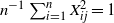 $n^{-1}\sum_{i=1}^nX_{ij}^2 = 1$
for
 $j = 1,\ldots,d$
. Then, for any
 $\alpha \lt 1/8$
,
 $C > 0$
, and
 $\varepsilon > 0$
, due to Lemma 1(iii) of [Reference Belloni, Chernozhukov and Wang2], the stochastic bound in Theorem 7 simplifies as follows: Conditional on the observations
 $\{X_i\,:\,i=1,\ldots,n\},$
we have,
 \[
\sqrt{R_{n}(\beta_{\ast})} \leq \frac{\pi}{\pi-2}\frac{\Phi
^{-1}(1-\alpha/2d)}{\sqrt{n}} %,
\]
with probability asymptotically larger than
 $1-\alpha$
as
 $n \rightarrow \infty$
uniformly in d such that
 $\log d \leq C n^{1/2-\varepsilon}$
. Here,
 $\Phi ^{-1}(1-\alpha)$
denotes the quantile x satisfying
 $\Phi(x)=1-\alpha$
, and
 $\Phi(\!\cdot\!)$
is the cumulative distribution function of the standard normal distribution defined on
 $\mathbb{R}$
. Moreover, if the additive error e is not normally distributed, then under the additional assumption that
 $\sup_{n \geq 1}\sup_{1 \leq j \leq d}\mathrm{E}_{\mathrm{P}_n}\vert X_j \vert^a \lt \infty$
for some
 $a \gt 2,$
we obtain from Lemma 2(iii) of [Reference Belloni, Chernozhukov and Wang2] that,
 \[
\sqrt{R_{n}(\beta_{\ast})} \leq \frac{\mathrm{E}[e^2]}{\mathrm{E}[e^2] - (\mathrm{E}\vert e
\vert)^2}\frac{\Phi^{-1}(1-\alpha/2d)}{\sqrt{n}} %,
\]
with probability asymptotically larger than
 $1-\alpha$
as
 $n \rightarrow \infty$
uniformly in d such that
 $ d \leq 0.5\alpha n^{(a-2-\varepsilon)/2}$
.
A proof of Theorem 7 is presented in Appendix A.4 (see supplementary material [Reference Blanchet, Kang and Murthy9]). A commonly adopted approach in the high-dimensional regression literature (see, for example, [Reference Banerjee, Chen, Fazayeli and Sivakumar1, Reference Belloni, Chernozhukov and Wang2, Reference Bickel, Ritov and Tsybakov4, Reference Negahban, Ravikumar, Wainwright and Yu29] and references therein) is to start with any choice
 $\lambda \gt \Vert \tilde{S}\Vert_q$
, where
 $\tilde{S}$
is the score function
 $D_\beta \mathrm{E}_n[l(X,Y;\,\beta_\ast)]$
. This choice, in the context of square-root LASSO, results in the regularization parameter being chosen larger than the
 $(1-\alpha)$
quantile of
 $n^{-1/2}\Vert Z\Vert_\infty/\sqrt{\text{Var}_n[\tilde{e}]}$
(see (10) in [Reference Belloni, Chernozhukov and Wang2]). As observed in Theorem 7, working with an upper bound of the RWP function results in choosing the
 $(1-\alpha)$
quantile of
 $n^{-1/2}\Vert Z\Vert_\infty/\sqrt{\text{Var}_n\vert\tilde{e}\vert}$
. Indeed, this agreement of the regularization parameter with the high-dimensional linear regression literature strengthens the RWPI-based approach for selecting the radius of uncertainty. Since the RWPI-based approach results in a prescription for the regularization parameter that is larger (by a factor
 $\text{Var}_n[\tilde{e}]/\text{Var}_n\vert \tilde{e} \vert$
), the generalization error bounds derived in the literature for high-dimensional regularized regression (see, for example, [Reference Belloni, Chernozhukov and Wang2, Corollary 1]) hold.
The approach in Theorem 7 is to identify an upper bound that does not depend on
 $\beta_\ast$
. Instead, one could choose
 $\delta \geq R_n(\hat{\beta}_n)$
by plugging in any consistent estimator
 $\hat{\beta}_n$
. We identify investigating the possibility of obtaining tighter error bounds via this plugin approach as a subject of future research.
5. Numerical examples
In this section we consider two examples that compare the numerical performance of the square-root LASSO algorithm (see Example 1) when the regularization parameter
 $\lambda$
is selected in the following two ways: (1) as described in Section 4.2 using a suitable quantile of the RWPI limiting distribution, and (2) using cross-validation. For comparison purposes we also list the performance of the respective ordinary least squares estimator. In both the examples the cross-validation-based approach iterates over a multitude of choices of
 $\lambda$
, whereas the optimal regularization via RWPI utilizes the respective square-root LASSO algorithm only once for the prescribed value of
 $\lambda$
. This naturally suggests potentially huge savings in computation that could be valuable in large-scale settings.
Example 4. Consider the linear model
 $Y = 3X_{1} + 2X_{2} + 1.5X_{4} + e$
where the vector of predictor variables
 $X = (X_{1}, \ldots, X_{d})$
is distributed according to the multivariate normal distribution
 $\mathcal{N}(\mathbf{0}, \Sigma)$
with
 $\Sigma_{k,j} = 0.5^{|k-j|}$
and the additive error e is normally distributed with mean 0 and standard deviation
 $\sigma=10$
. Letting n denote the number of training samples, we illustrate the effectiveness of the RWPI-based square-root LASSO procedure for various values of d and n by computing the mean square loss/error (MSE) over a simulated test data set of size
 $N = 10\,000$
. Specifically, we take the number of predictors to be
 $d = 300$
and 600, the number of standardized i.i.d. independent and identically distributed training samples to range from over
 $n = 350, 700, 3500, 10\,000$
, and the desired confidence level to be 95%, that is,
 $1-\alpha= 0.95$
. In each instance, we run the square-root LASSO algorithm using the ‘flare’ package proposed in [Reference Li, Zhao, Yuan and Liu27] (available as a library in R) with the regularization parameter
 $\lambda$
chosen as prescribed in Section 4.2.
Repeating each experiment 100 times, we report the average training and test MSE in Tables 1 and 2, along with the respective results for ordinary least squares regression (OLS) and the square-root LASSO algorithm with regularization parameter chosen as prescribed by cross-validation (denoted as SQ-LASSO CV in the tables).We also report the average
 $\ell_{1}$
and
 $\ell _{2}$
error of the regression coefficients in Tables 1 and 2. In addition, we report the empirical coverage probability that the optimal error
 $\mathrm{E}[(Y - \beta_{\ast}^\top X)^{2}] = \sigma^{2} = 100$
is smaller than the worst-case expected loss computed by the DRO formulation (8). As this empirical coverage probability reported in Table 3 is closer to the desired confidence
 $1-\alpha= 0.95$
, the worst-case expected loss computed by (8) can be seen as a tight upper bound on the optimal loss
 $\mathrm{E}[l(X,Y;\,\beta_{\ast})]$
(thus controlling generalization) with probability at least
 $1-\alpha = 0.95$
.
Sparse linear regression for
 $d = 300$
predictor variables in Example 4. The training and test mean square errors of RWPI-based square-root LASSO regularization parameter selection are compared with the ordinary least squares estimator (OLS) and cross-validation-based square-root LASSO estimator (SQ-LASSO CV) for different values of the training data set size n.
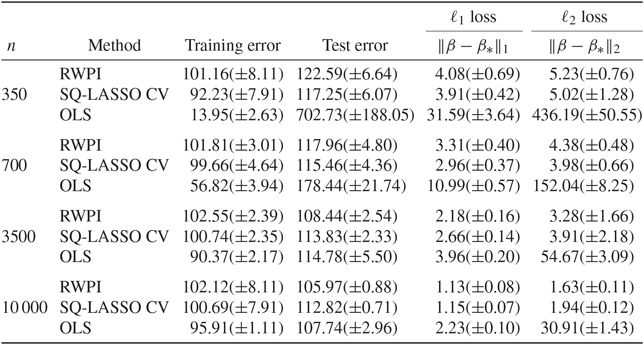
Sparse linear regression for
 $d = 600$
predictor variables in Example 4. The training and test mean square errors of RWPI-based square-root LASSO regularization parameter selection are compared with the ordinary least squares estimator (OLS) and cross-validation-based square-root LASSO estimator (SQ-LASSO CV). As
 $n < d$
when
 $n
= 350$
, OLS estimation is not applicable in that case.
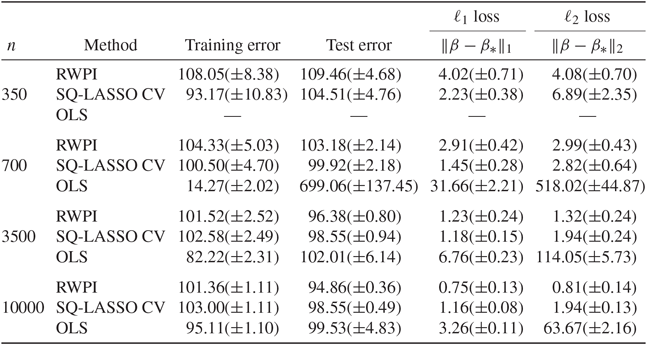
Coverage probability of empirical worst-case expected loss in Example 4.
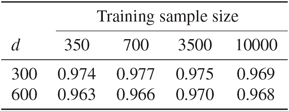
Example 5. Consider the diabetes data set from the ‘lars’ package in R (see [Reference Efron, Hastie, Johnstone and Tibshirani15]), where there are 64 predictors (including 10 baseline variables and another 54 possible interactions) and 1~response. After standardizing the variables, we split the entire data set of 442 observations into
 $n = 142$
training samples (chosen uniformly at random) and the remaining
 $N = 300$
samples as test data for each experiment, in order to compute training and test mean square errors using the square-root LASSO algorithm with the regularization parameter picked as in Section 4.2. After repeating the experiment 100 times, we report the average training and test errors in Table 4, and compare the performance of RWPI-based regularization parameter selection with other standard procedures such as OLS and the square-root LASSO algorithm with regularization parameter chosen according to cross-validation.
Linear regression for diabetes data in Example 5 with 142 training samples and 300 test samples. The training and test mean square errors of RWPI-based square-root LASSO regularization parameter selection are compared with the ordinary least squares estimator (OLS) and the cross-validation-based square-root LASSO estimator (SQ-LASSO CV).
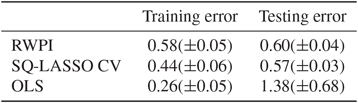
6. Conclusions
We have shown that popular machine learning estimators such as square-root LASSO, regularized logistic regression, support vector machines, etc. can be recast as particular examples of the optimal-transport-based DRO formulation in (8). We introduced a robust Wasserstein profile function and utilized its behavior at the optimal parameter
 $\beta_\ast$
to present a criterion for choosing the radius,
 $\delta$
, in the DRO formulation (8). We illustrated how this translates to choosing regularization parameters and coverage guarantees for optimal risk in the settings of
 $\ell_p$
-norm-regularized linear and logistic regression. We observe that the proposed prescriptions for the radius
 $\delta$
for the DRO formulation (8) result in similar prescriptions that arise from independent considerations in the statistics literature. This indeed strengthens the Wasserstein-profile-function-based approach towards choosing the radius,
 $\delta$
, for the DRO formulation (8).
Following the results presented in this paper, we investigate the behavior of the profile function
 $R_n(\theta)$
in the vicinity of the optimal parameter
 $\theta_\ast$
in [Reference Blanchet, Murthy and Si10] and establish a limiting relationship of the form
 $n^{\rho/2}R_n(\theta_\ast + \Delta/\sqrt{n}) \Rightarrow L(\Delta)$
for a continuous
 $L(\!\cdot\!)$
. Such a relationship can be used to accomplish the following tasks: (i) construct confidence intervals for the optimal parameter
 $\theta_\ast$
, (ii) establish error bounds for the solution to the DRO formulation (8), and (iii) systematically establish the validity of plugging in any consistent estimator for
 $\theta_\ast$
in order to obtain an asymptotically optimal prescription for the radius
 $\delta$
. Such a plugin approach would obviate the need to derive stochastic upper bounds on a case-by-case basis, as is presently required in Section 4.
Supplementary material
Proofs of all the results in this article are furnished in the supplementary material [Reference Blanchet, Kang and Murthy9].
Acknowledgements
Support from NSF grants 1436700, 1720451, and 1820942, DARPA grant N660011824028, and Norges Bank are gratefully acknowledged by J. Blanchet.