Introduction
Deliberate self-harm is a common cause of presentations to hospital emergency departments (EDs) worldwide and is associated with significant patient morbidity and mortality (Klonsky, Reference Klonsky2011; Cipriano et al. Reference Cipriano, Cella and Cotrufo2017; Olfson et al. Reference Olfson, Wall, Wang, Crystal, Gerhard and Blanco2017). It is broadly defined as an intentional act of causing physical injury to oneself (Pattison & Kahan, Reference Pattison and Kahan1983) and can also be referred to as intentional self-harm (World Health Organization, 2004). It most commonly includes behaviours such as cutting or scratching, hitting oneself, or intentional drug overdose (Klonsky, Reference Klonsky2007).
Deliberate self-harm is a major issue in Ireland, with figures showing 11 600 separate ED visits for deliberate self-harm in the year 2017 alone (Griffen et al. Reference Griffen, Dillon, McTernan, Arensman, Williamson, Perry and Corcoran2017). Many of those who self-harm will go on to do so again, and they have a significantly higher risk of completed suicide than the general population (Olfson et al. Reference Olfson, Wall, Wang, Crystal, Gerhard and Blanco2017). While a multitude of risk factors for deliberate self-harm have been identified (Larkin et al. Reference Larkin, Di Blasi and Arensman2014), it is important to investigate the role of protective factors as these have knock-on implications in terms of preventative strategies and patient care.
Studies across different faiths show that religious affiliation is a protective factor against deliberate self-harm. This has been shown by several large studies using a variety of measures, from frequency of attendance at religious services to self-reported religious affiliation (Kannan et al. Reference Kannan, Pillai, Gill, Hui and Swami2010; Kleiman & Liu, Reference Kleiman and Liu2014; Caribe et al. Reference Caribé, Studart, Bezerra-Filho, Brietzke, Nunes Noto, Vianna-Sulzbach, Kapczinsk, Silva Neves, Correa and Miranda-Scippa2015; O’Reilly & Rosato, Reference O’Reilly and Rosato2015; Wu et al. Reference Wu, Wang and Jia2015). The main proposed explanation for this finding is the sense of community, social ties, and a sense of shared identity that comes with belonging to a religious group. This fits with early theories of suicidal behaviour, which emphasise the effects of social ties as a protective factor against suicide (Durkiem, Reference Durkiem1951).
This protective effect appears to be particularly prominent at times of heightened religious significance, such as times of religious worship, celebration, and fasting. For example, the period preceding Christmas is associated with reduced self-harm rates in Christians (Plöderl et al. Reference Plöderl, Fartacek, Kunrath, Pichler, Fartacek, Datz and Niederseer2015), as is the period of Ramadan amongst Muslims (Demirci et al. Reference Demirci, Hakan Dogan and Koc2013). No such data exist for Lent, which comprises the 40 days immediately preceding Easter, the Christian celebration of the resurrection of Jesus Christ. This is traditionally a period of self-denial, repentance, and self-reflection amongst Christians and is followed by the festivities of Easter.
University Hospital Limerick provides a regional ED service to three Irish counties with a predominantly Christian population based on Census data (Central Statistics Office, 2019). We sought to analyse rates of deliberate self-harm patients presenting to University Hospital Limerick to assess whether the Lenten period affects this rate. We hypothesised that rates of presentation of deliberate self-harm would decrease during this period in line with previous research relating to self-harm during times of increased religious significance.
Methods
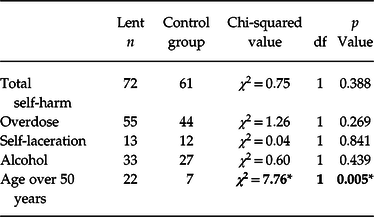
Following ethical approval, a retrospective review of data on those presenting with deliberate self-harm to the ED of University Hospital Limerick, Ireland, was carried out during the 40 days preceding Lent (26 December 2015–9 February 2016) and for the period of Lent (10 February–24 March 2016). Data on those presenting with deliberate self-harm are routinely kept in order to aid in service development and audit and is fully anonymised. Data are kept on Excel spreadsheets on password-protected computers within the ED and includes patient age, gender, and method of self-harm. Method of self-harm is broken down into the following categories: overdose, cutting, hanging, shooting, poisoning, drowning, or alcohol. There is also a category of ‘other’ if the method is not covered by the above categories. Data from the Lent and control groups were inputted into SPSS for comparison. Frequency data were compared using Pearson’s chi-squared tests (see Table 1).
Number of patients presenting with self-harm, type of self-harm, and age range

df = degrees of freedom.
* bold font indicates statistical significance.
Results
The total number of patients presenting with deliberate self-harm in the period of Lent was 71 (25 male, 46 female), with 61 (19 male, 42 female) presenting in the preceding 40 days. The age range of those presenting was between 18 and 67 years. The difference in overall numbers presenting with deliberate self-harm was not statistically significant (See Table 1).
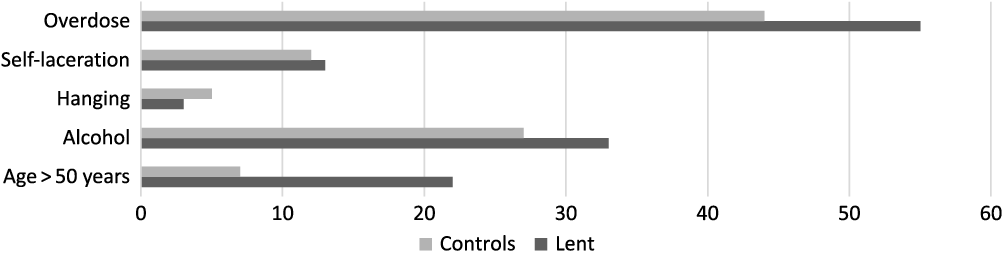
Overdose was the commonest method of self-harm, followed by self-laceration. Alcohol was a factor in 33 (46%) of presentations during Lent and 27 (44%) of presentations in the preceding period (see Fig. 1). There were also three presentations of attempted self-hanging during Lent, with five in the control group. These numbers were too small for any meaningful statistical analysis. There were no presentations that involved shooting, poisoning, or drowning during the period of our study.
As it became clear from our data that the numbers of those over the age of 50 presenting were increased during the period of Lent, these were included in our statistical analysis. We found that there was a significant increase in the numbers of those presenting in the over 50’s age group during Lent as compared to controls (χ 2 = 7.76, df = 1, p = 0.005).
Discussion
The aim of the current study was to assess whether the period of Lent influences rates of deliberate self-harm presentations to an ED in an Irish Hospital. Our hypothesis was that the rate would be lower during this period, in line with previous research showing that times of increased religious significance are a protective factor against self-harm.
Our results showed that Lent is not a protective factor against deliberate self-harm. Somewhat surprisingly, a higher number of patients presented with deliberate self-harm during Lent compared to the period preceding it. However, this difference was not statistically significant (see Table 1). This may in part be to our small sample size and should be repeated in a larger scale study. There was no difference in the types of self-harm that presented, with overdose remaining the most common method used. Almost half of the presentations had alcohol as a contributing factor. Results show a significantly higher number of patients over the age of 50 presenting with self-harm during the Lenten period compared to the 40 days preceding it.
Our finding that Lent is not a protective factor against deliberate self-harm may be due to multiple factors. Although 80% of individuals identify as Catholic on the census in this area, this may not accurately reflect the number of practicing Catholics and likely reflects a wide range of degrees of religious affiliation. Ireland has become increasingly secular in recent years as evidenced by referendums on abortion and gay marriage passing by large margins, both of which were opposed by the Catholic Church. We also had a small sample size which may have affected our results. A larger study using population data would be useful to further explore this area.
An interesting and unexpected finding was that there was a significant increase in presentations of deliberate self-harm among the over 50’s age group during Lent. This was contrary to previous research showing the times of heightened religious significance tend to be associated with a decrease in presentations of deliberate self-harm. One possible explanation is that these are individuals who would have grown up at a time when the influence of the Catholic Church was much more pronounced than in recent years and therefore may have a heightened level of religious affiliation than the younger generation. It may be that a time of increased reflection and repentance has a negative effect on these individuals, bringing to the fore regrets and feelings of guilt surrounding the past. It may also be that the waning influence of the Catholic Church has left them without the protective factor of religion that has been shown in previous studies. This would be an interesting area for future research.
While, to the best of the authors’ knowledge, this is the first study to examine the presentations of deliberate self-harm during Lent, it must be noted that the study also has several limitations. Our small sample size means that the generalisability of our study may be limited. It is also difficult to ascertain the level of religious affiliation based on population census data and degrees of religious affiliation may be better ascertained by patient questionnaires or other similar methods. Nevertheless, we believe our study highlights an area neglected by the literature and raises important issues for further research.
Overall, our study has shown that Lent is not a protective factor against deliberate self-harm and was associated with an increase in presentations of deliberate self-harm amongst the over 50’s age group. An interesting area for future research would be a large study based on population data examining this finding and/or qualitative analysis of factors leading to increased rates of self-harm among the over 50’s age group during Lent.
Self-harm presentations during Lent in comparison to controls.

Acknowledgement
The authors wish to acknowledge the contribution of Father Edward O’Callaghan OFM of the Cork Franciscan Friary.
Conflict of Interest
The authors N.M., K.G., E.H., V.M., and G.G. have no conflicts of interest to declare.
Financial Support
This research received no specific grant from any funding agency, commercial, or not-for-profit sectors.
Ethical Standards
The study protocol was approved by the ethics committee at University Hospital Limerick. The authors assert that all procedures contributing to this work comply with the ethical standards of the relevant national and institutional committee on human experimentation with the Helsinki Declaration of 1975, as revised in 2008.