1 INTRODUCTION
This paper is about clause-initial PPs in French that are introduced by the complex prepositions au niveau (de) Footnote 2 ((1a)), en matière de ((1b)) and pour ce qui est de ((1c)).
(1)
a. Mais quand on peut il faut impérativemement (sic) regarder BBC News en ce moment, au niveau de l’info, ils sont vraiment au top.
b. En matière de droit mieux vaut contacter un avocat, mais en général si il (sic) y a une irrégularité importante dans un CDD il est automatiquement requalifié en CDI selon le droit Français (sic).
c. Pour ce qui est de Dieudonné, je ne le défendrai pas.
(Contrastive Corpus of Questions and Answers [YCCQA], De Smet, 2009)
These complex PPs are part of a larger class including complex prepositions such as quant à, en ce qui concerne, concernant, à propos de, au sujet de, etc., which are often called ‘topicality markers’ (Lagae, Reference Lagae2007c), ‘marqueurs de topicalisation’ (Combettes, Reference Combettes, Combettes, Schnedecker and Theissen2003, Reference Combettes2007), ‘thematic introducers’ (Porhiel, Reference Porhiel2004b) or ‘introducteurs de cadres ou espaces discursifs’ (Anscombre, Reference Anscombre2006). The PPs they introduce are generally called ‘topic-marking constructions’. In what follows, these complex prepositions will be called ‘thematic markers’ (TMs) and the whole prepositional phrase will be referred to as a ‘TM construction’ (TMC).
TM constructions are interesting because they indicate lexically that an entity has an ‘aboutness’ or a ‘framing’ function. In (1a) and (1b), the PP functions as a topic Chinese style (Chafe, Reference Chafe and Li1976), frame (Jacobs, Reference Jacobs2001) or discursive frame (‘espace/cadre discursif’, Anscombre, Reference Anscombre2006) because it limits ‘the applicability of the main predication to a certain restricted domain [. . .] The topic sets a spatial, temporal, or individual framework within which the main predication holds’ (Chafe, Reference Chafe and Li1976: 50). For example, in (1a), it is said that BBC News is really good with regard to news broadcasts. In (1b), en matière de droit specifies the domain in which the predication mieux vaut contacter un avocat is to be situated. In (1c), the individual referred to as Dieudonné is not the frame in which the predication ‘to defend Dieudonné’ holds; the PP here introduces the aboutness-topic of the predication: the author says about Dieudonné that he will not defend him (see Strawson, Reference Strawson1964; Kuno, Reference Kuno1972; Reinhart, Reference Reinhart1981; Dik, Reference Dik and Hengeveld1997; Vallduví, Reference Vallduví1992, Reference Vallduví1994; van Kuppevelt, Reference Kuppevelt1995; Erteschik-Shir, Reference Erteschik-Shir1997, Reference Erteschik-Shir, Rebuschi and Tuller1999; Lambrecht, Reference Lambrecht2000 on aboutness-topics).
Whereas some TMs have been well described, such as quant à (Fløttum, Reference Fløttum and Guimier1999, Reference Fløttum, Combettes, Schnedecker and Theissen2003; Debaisieux, Reference Debaisieux2001; Choi-Jonin, Reference Choi-Jonin, Combettes, Schnedecker and Theissen2003; Anscombre, Reference Anscombre2006; Lagae, Reference Lagae2003, Reference Lagae2007c, Reference Lagae, Comes and Miculescu2011b, see also Prévost, Reference Prévost, Combettes, Schnedecker and Theissen2003b, Reference Prévost2008, Reference Prévost, Combettes, Guillot, Oppermann-Marsaux, Prévost and Rodríguez Somolinos2010 for a diachronic account), en fait de (Lagae, Reference Lagae, Flaux and Stosic2007a,Reference Lagaeb,Reference Lagaec; Lagae, Reference Lagae, Comes and Miculescu2011b), à propos de (Porhiel, Reference Porhiel2001; Péroz, Reference Péroz, Combettes, Schnedecker and Theissen2003; Prévost, Reference Prévost2008; Lagae, Reference Lagae, Amiot, De Mulder, Moline and Stosic2011a), côté (Le Querler, Reference Le Querler2001; Noailly, Reference Noailly2006), question (Le Querler, Reference Le Querler, Combettes, Schnedecker and Theissen2003, Noailly, Reference Noailly2006) and en ce qui concerne (Debaisieux, Reference Debaisieux2001; Fløttum, Reference Fløttum, Combettes, Schnedecker and Theissen2003; Anscombre, Reference Anscombre2006), this is not the case for the TMs which are at issue here. Pour ce qui est de and au niveau (de) are only mentioned in comparison with other TMs (see Anscombre, Reference Anscombre2006 and Porhiel, Reference Porhiel2004a,Reference Porhielb on pour ce qui est de, and Flament-Boistrancourt, Reference Flament-Boistrancourt, Binon, Desmet, Elen, Mertens and Sercu2002 and Delahaie and Flament-Boistrancourt, Reference Delahaie, Flament-Boistrancourt, Bolly and Degand2013 on (au) niveau (de)). As far as we know, en matière de in a clause-initial position has not been described before. Furthermore, most previous analyses are based exclusively on formal written language. As far as we know, only Debaisieux (Reference Debaisieux2001), Flament-Boistrancourt (Reference Flament-Boistrancourt, Binon, Desmet, Elen, Mertens and Sercu2002) and Delahaie and Flament-Boistrancourt (Reference Delahaie, Flament-Boistrancourt, Bolly and Degand2013) study TMs in spoken French.
The goal of this paper is two-fold. The first goal is descriptive: on the basis of corpus research in informal written French, we will provide a descriptive analysis of the distribution of pour ce qui est de, en matière de and au niveau (de) in the clause, as well as of their formal and discourse-semantic properties. The hypothesis put to the test here is that these TMs do not exhibit exactly the same behaviour, and, hence, as has been suggested in previous work, they do not form a homogeneous class.
The second, theoretical, goal of this paper, is to use TM constructions as a test-case to provide insight into some conflicting hypotheses about the notion of topicality.
First, in the extensive literature on the notion of topicality, some authors present aboutness-topics and frames as two separate notions (Chafe, Reference Chafe and Li1976; Erteschik-Shir, Reference Erteschik-Shir1997; Lambrecht, Reference Lambrecht2000), whereas other authors seem to favour a ‘gradient’ view on topicality, in which a constituent can be ‘more or less’ topical (Jacobs, Reference Jacobs2001). These theoretical works, however, are mostly based on made-up examples, without extensive discourse context. Our analysis will show the extent to which the distinction between aboutness-topics and frames is operative and relevant in corpus research. This will provide insight into the question of whether they should be considered as two separate notions rather than as occupying two positions on a gradient of topicality.
The second theoretical goal of this paper is to determine whether and if so, to what extent, the lexical and syntactic properties of the TMC interact with its information-structural function. In the theoretically-oriented linguistic literature on topicality (and information structure in general) attention is given not only to the pragmatic definition of the notions, but also to the specific constructions in which the phenomena are realised. For instance, aboutness-topics are often realised as grammatical subjects or as left-dislocated constituents (cf. Blasco-Dulbecco, Reference Blasco-Dulbecco1995; Erteschik-Shir, Reference Erteschik-Shir1997; Lambrecht, Reference Lambrecht2000; De Cat, Reference De Cat2007), whereas frames are generally claimed to be prototypically realized by clause-initial adverbial phrases (Chafe, Reference Chafe and Li1976; Le Querler, 1993; Erteschik-Shir, Reference Erteschik-Shir1997, Reference Erteschik-Shir, Rebuschi and Tuller1999 among many others). However, the extent to which the specific (lexical, syntactic and other) properties of the construction realising the aboutness-topic or frame affect its precise information-structural function is not well established.
The structure of the article is as follows. In section 2 we briefly present previous work on TMCs introduced by pour ce qui est de and au niveau (de). In section 3 we introduce our corpus data and in section 4, we analyse the position of these PPs with regard to the main verb, the syntactic category of the element introduced by these TMs and the presence or absence of coreference between the phrase introduced by the TM and another expression in the clause. These criteria show that pour ce qui est de, au niveau (de) and en matière de behave differently in our corpus. In section 5 we will show that this also holds for their discourse-semantic properties. Finally, in section 6, we discuss the interaction between their lexical, syntactico-semantic and discourse-functional properties.
2 PREVIOUS ANALYSES OF POUR CE QUI EST DE AND AU NIVEAU (DE)
Of the three TMs under discussion, only pour ce qui est de and au niveau (de) have been studied to any extent (see Anscombre, Reference Anscombre2006; Porhiel, Reference Porhiel2004a,Reference Porhielb on pour ce qui est de and Flament-Boistrancourt, Reference Flament-Boistrancourt, Binon, Desmet, Elen, Mertens and Sercu2002 and Delahaie and Flament-Boistrancourt, Reference Delahaie, Flament-Boistrancourt, Bolly and Degand2013 on au niveau (de)).Footnote 3 As far as we know, en matière de has not been described before.
In what follows, we briefly present Anscombre's (Reference Anscombre2006), Porhiel's (Reference Porhiel2004a,Reference Porhielb) and Flament-Boistrancourt's (Reference Flament-Boistrancourt, Binon, Desmet, Elen, Mertens and Sercu2002) views on the position of the PP in the clause (2.1), the syntactic category of the phrase introduced by the preposition (2.2), the coreference between the expression introduced by the TM and an element in the main clause (2.3), and the discourse function of TMCs introduced by pour ce qui est de and au niveau (de) (2.4).
2.1 Position with respect to the main verb
Porhiel (Reference Porhiel2004b: 1026) and Anscombre (Reference Anscombre2006) observe that the PPs en ce qui concerne and pour ce qui est de appear both in a clause-initial ((2)) and clause-final ((3–4)) position. The same holds for au niveau (de) (Flament-Boistrancourt, Reference Flament-Boistrancourt, Binon, Desmet, Elen, Mertens and Sercu2002: 120) ((5–6)).
(2) Pour ce qui est des baleines, ce sont des mammifères.
(Anscombre, Reference Anscombre2006: 157)
(3) Ils s’inquiètent en ce qui concerne l’avenir. (Porhiel, Reference Porhiel2004b: 1026)
(4) À présent, toute discussion sur le référendum organisé par M. Gorbatchev sur le maintien de l’Union soviétique le 17 mars relève du bavardage pour ce qui est de la Lituanie. (Le Nouvel Observateur, 1991 quoted in Anscombre, Reference Anscombre2006: 163)
(5) Alors euh oui au niveau des réservations, c’est des acomptes ou des arrhes? (Flament-Boistrancourt, Reference Flament-Boistrancourt, Binon, Desmet, Elen, Mertens and Sercu2002: 120)
(6) Je vais vous donner le catalogue (. . .) ça vous donnera déjà des petites idées au niveau tarifs. (Flament-Boistrancourt, Reference Flament-Boistrancourt, Binon, Desmet, Elen, Mertens and Sercu2002: 120)
Only PPs in a clause-initial position are considered to be a TM; in a clause-final position they depend on the object NP or the verb, as in (6), where au niveau tarifs is a part of the VP. The authors mentioned above, however, do not provide data about the frequency of the PP in both positions (see section 4.1 below), which is a highly relevant factor, indicating the degree to which the PP is specialized as a TM.
2.2 The syntactic category of the element introduced by the TM
Porhiel (Reference Porhiel2004a,Reference Porhielb) and Anscombre (Reference Anscombre2006) agree, without providing quantitative data, however, that pour ce qui est de is most frequently combined with a definite NP (see (2) and (4)). Porhiel (Reference Porhiel2004b: 1030), however, adds that the element following pour ce qui est de can also be an adverb ((7))Footnote 4 or an infinitival clause ((8)).
(7) Pour ce qui est d’ici, ne compte pas avoir le lit. (Porhiel, Reference Porhiel2004b: 1030)
(8) Pour ce qui est de crier, il sait. (Porhiel, Reference Porhiel2004b: 1030)
2.3 Coreference
It has been claimed (Porhiel, Reference Porhiel2004b) that the presence of a coreferential relation between the phrase introduced by the TM and an element in the main clause is related to the TMC's interpretation as an aboutness-topic rather than a frame. According to Anscombre (Reference Anscombre2006: 156), pour ce qui est de can occur with ((1c)) and without ((9)) coreference between the phrase introduced by the TM and an expression in the main clause. As for (au) niveau (de), Delahaie and Flament-Boistrancourt (Reference Delahaie, Flament-Boistrancourt, Bolly and Degand2013) claim that the element it introduces cannot be coreferential with an element in the main clause ((10)). With respect to example (10), however, several native speakers we consulted found it grammatical, as long as au niveau de la rémunération is followed by a pause.
(9) Je crois que, pour ce qui est de l’innovation, nous avons répondu ‘présent’. (Frantext 1999, quoted in Anscombre, Reference Anscombre2006: 156)
(10) ?Au niveau de la rémunération, elle s’élève à 1200 euros par mois. (Delahaie and Flament-Boistrancourt, Reference Delahaie, Flament-Boistrancourt, Bolly and Degand2013: 89)
Porhiel (Reference Porhiel2004b: 1027) claims that coreference is prevalent for TMs introducing the aboutness-topic (‘thematic introducers’ in her terminology), but she does not provide quantitative data in support of this observation.Footnote 5 In her opinion, TMs which occur with coreference introduce the aboutness-topic. In section 5 we will indeed show that coreference is a sufficient condition for TMs to be interpreted as introducing the aboutness-topic. Without coreference, the aboutness interpretation is not obvious and the TMC is more likely to be interpreted as a frame for the utterance.
2.4 Discourse functions
Porhiel (Reference Porhiel2004a,Reference Porhielb) claims that pour ce qui est de typically introduces the aboutness-topic, as with the first TM in (11), where the main clause provides information about someone's contact information. TMs such as pour ce qui est de and en ce qui concerne, can also be used to switch topics or to (re-) introduce one, as with the second TM in (11).
(11) Pour ce qui est des coordonnées de X, je vais les chercher et je te les ferai parvenir. (. . .) En ce qui concerne l’opéra hier soir, l’histoireFootnote 6 était noire (. . .) (Porhiel, Reference Porhiel2004b: 1023)
Anscombre (Reference Anscombre2006: 168) and Flament-Boistrancourt (Reference Flament-Boistrancourt, Binon, Desmet, Elen, Mertens and Sercu2002: 123) also mention the list-marking function of pour ce qui est de and au niveau (de), respectively: these TMs indicate that the theme has been selected from a list of other possible themes.Footnote 7 For instance, in (12), the crashed car evokes a list of parts that are possibly damaged: the engine, the coachwork, the lights, etc. Of all possible topics, pour ce qui est de picks out only one, in this case the engine, and indicates that the main clause will add information about it. Hence, pour ce qui est de is a kind of operator which indicates a topic shift locally and creates a contrast between several referents within an evoked (implicit or explicit) list.Footnote 8
(12) Je suis allé voir la voiture accidentée au garage: pour ce qui est du moteur, il n’a rien. (Anscombre, Reference Anscombre2006: 167)
2.5 Conclusion
In this section we gave a brief overview of distributional, syntactico-semantic and discourse-functional properties of pour ce qui est de and au niveau (de) as discussed in previous research. In the next sections we describe our corpus of informal written French and we present a corpus-based description of the properties of TMCs introduced by pour ce qui est de, au niveau (de) and en matière de.
3 SYNTACTICO-SEMANTIC PROPERTIES OF TMCS
Our analysis is based on data from the Yahoo-based Contrastive Corpus of Questions and Answers (YCCQA)Footnote 9 developed by Hendrik De Smet (KU Leuven) in 2009. YCCQA is a contrastive corpus of English, French, German and Spanish data, based on questions and answers submitted by users of the Yahoo Answers website. The context of each sentence is limited to the particular question-answer interaction it occurs in. The discourse context of each instance is thus controlled for, which is especially interesting in the light of the analysis of the discourse-functional properties of the TMCs at issue (section 5). The language represented in the corpus is typically informal and unmonitored, illustrating the casual writing style of internet postings. Hence, this corpus allows us to analyse the properties of TMs in a more informal register, in contrast with most previous studies of TMs, which focus on written and formal examples (see section 2).
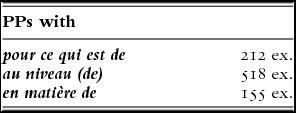
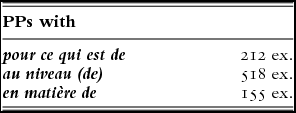
The French part of the corpus consists of 19,924 questions and 138,874 answers and contains 6.1 million words. The examples cited below are authentic and have not been corrected for grammar or spelling. Table 1 contains the number of occurrences of pour ce qui est de, au niveau (de) and en matière de in the corpus.
Absolute frequency of PPs with pour ce qui est de, au niveau (de) and en matière de in the YCCQA.
We hypothesise that au niveau (de) is more frequent than en matière de and pour ce qui est de because it is intuitively less formal.Footnote 10
In this section we show that PPs introduced by pour ce qui est de, au niveau (de) and en matière de do not behave alike when it comes to their position with respect to the verb (3.1), the syntactic category of the expression they introduce (3.2) and the presence or absence of a coreferential element in the main clause (3.3). We conclude from this that these TMs do not form a homogeneous class.
3.1 Position of the TMC with respect to the verb
PPs introduced by pour ce qui est de, au niveau (de), and en matière de can appear in either a clause-initial or a clause-final position (cf. supra).
Table 2 shows the frequency of these PPs with regard to their position with respect to the verb.
Position of PPs introduced by pour ce qui est de, au niveau (de) and en matière de.

There is a clear distinction between pour ce qui est de on the one hand, and en matière de and au niveau (de) on the other, to the extent that pour ce qui est de PPs occur most frequently (95%) in clause-initial position, whereas au niveau (de) PPs and en matière de PPs occur in this position in less than 20% of the cases. Our data thus confirm Porhiel's (Reference Porhiel2004a,Reference Porhielb) and Anscombre's (Reference Anscombre2006) observation that clause-final position is marked for TMs with pour ce qui est de. The data for au niveau (de) and en matière de indicates that these TMs pattern together and have different properties from pour ce qui est de.
In clause-final position, pour ce qui est de, au niveau (de) and en matière de PPs belong to the rhematic part of the clause. As the examples in (13) show, they can indeed function as the answer to a question:Footnote 11
(13)
a.
- Les chiens ont-ils toujours une excellente vision?
- Non, mais ils ont une excellente vision pour ce qui est de la découverte des objets en mouvement de nuit.
b.
- TF1 est-elle une chaîne de référence en France ?
- TF1 est la référence en matière d’émissions scientifiques.
c.
- Quels sont les points communs des différentes religions ?
- Elles se valent toutes au niveau de l’intolérance.
(examples based on attested examples in YCCQA)
This does not hold for the examples in which the PP appears in clause-initial position: native speakers confirm that clause-initial TM constructions are not felicitous in a context where they provide the answer to a question, and, hence, are intended as rhematic, as in (14):
(14)
a.
- Dans quel domaine la BBC est-elle vraiment au top?
- # Au niveau de l’info, la BBC est vraiment au top.
b.
- Quand faudrait-il contacter un avocat?
- # En matière de droit mieux vaut contacter un avocat.
(examples based on attested examples in YCCQA)
Hence, just as is the case for other types of clause-initial and clause-final phrases, clause-final PPs introduced by pour ce qui est de, au niveau (de) and en matière de are rhematic, whereas clause-initial PPs are generally interpreted as the topic or frame of the clause. Since our data shows that pour ce qui est de almost exclusively occurs in clause-initial position, we conclude that it prototypically functions as a TM, in contrast with en matière de and au niveau (de).
3.2 Formal properties of the noun phrase introduced by the TM
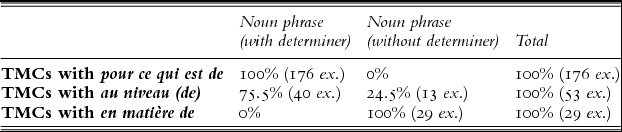
Table 3 shows that pour ce qui est de also behaves differently from en matière de and au niveau (de) with respect to the type of NP they introduce.Footnote 12
Formal properties of the noun phrase introduced by the TM
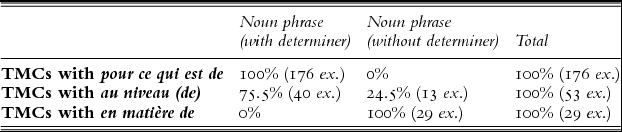
These data show that the NPs following pour ce qui est de and au niveau (de) differ from those introduced by en matière de: whereas pour ce qui est de only combines with NPs with a determiner in our corpus,Footnote 13 this is not the case for au niveau (de) and en matière de.Footnote 14Au niveau (de) allows a bare NP complement ((15)) and a clause-initial en matière de only occurs with bare NP complements ((16)). This is due, at least to some extent, to the internal structure of the PPs. Pour ce qui est de X contains a verb followed by a PP introduced by de, whereas the two other TMs contain a noun. The preposition de is more easily followed by a determinerless NP when it is preceded by a noun (N de N) than by a verb (V de N).
(15) Au niveau sécurité, le paiement par paypal ne donne AUNCUNE (sic) garantie.
(16) En matière de question, laquelle révériez (sic) vous de me poser?
In this section we showed that pour ce qui est de on the one hand and en matière de and au niveau (de) on the other behave differently with respect to the formal properties of the NP they introduce. The next section shows that the TMs also have to be distinguished with respect to the presence or absence of a coreferential relation between the phrase introduced by the TM and an expression in the main clause.
3.3 Presence vs. absence of coreference
By coreference we mean that the main clause contains an expression which has the same referent as the phrase introduced by the TM. This can be a clitic, such as le in (17), which is coreferential with Dieudonné, or another anaphoric expression, as in (18), where cet être mythique is coreferential with les ryu.Footnote 15
(17) Pour ce qui est de Dieudonné, je ne le défendrai pas.
(18) Pour ce qui est des ryu, il semblerait que cet être mythique ai (sic) inspiré plus d’une école.
In other cases, such as (19), the main clause does not contain an element that is coreferential with the phrase introduced by the TM.
(19) Pour ce qui est de la tenue de route, j’ai jamais roulé pire qu’une twingo, ça glisse même dans un rond point sur route sèche, en plus ça consomme plus qu’une 107 en moyenne!
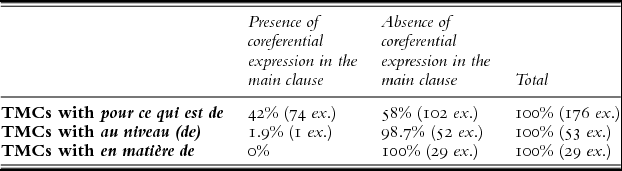
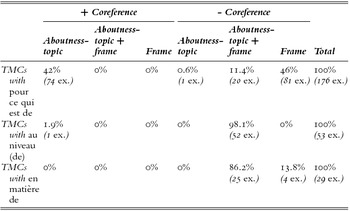
Table 4 shows the frequency of coreference in our corpus.
Coreferential relation between X and an element in the main clause.
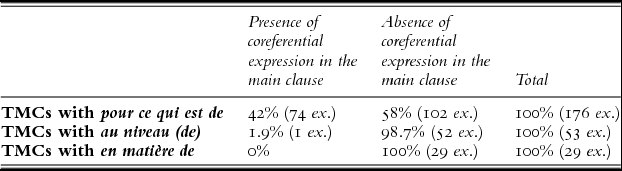
It appears from Table 4 that whereas 42% of all the corpus examples with pour ce qui est de contain an expression that is coreferential with the phrase introduced by the TM (see (17)–(18)), we did not find any example of this with en matière de and only one of au niveau (de) Footnote 16 : in (20), elle seems to refer to the pain one can feel at the moment when one donates blood (as suggested by the question).Footnote 17 According to Francis Cornish (p.c.), rather than being an example of real coreference, this may well be a case of indirect anaphora (see Cornish, Reference Cornish, Branco, McEnery and Mitkov2005).
(20)
- Je souhaite vivement donner mes plaquettes. Qui peut me conseiller ? (. . .) Est ce (sic) fatiguant ? douloureux ?
- ?#Au niveau ‘douleur’: elle dure le temps de te mettre 2 aiguilles: 1 à un bras qui pélèvera (sic) le sang, et une à l’autre qui te rendra ton sang après prélèvement des plaquettes par un appareil.
In section 6, we will show that the absence or presence of coreference is related to the discourse interpretation of the TM construction.
3.4 Conclusion
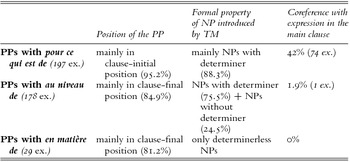
In this section we have shown that au niveau (de), en matière de and pour ce qui est de do not form a homogeneous class with respect to several properties, as represented in Table 5.
Summary of the properties of TMCs under consideration

In the next section we will show that they also do not behave alike with respect to their discourse-semantic interpretation, and we argue that their specific function is determined at least partly by the interplay between the inherent properties of the TM and the specific syntactic construction in which they appear.
4 DISCOURSE-FUNCTIONAL PROPERTIES OF POUR CE QUI EST DE, AU NIVEAU (DE) AND EN MATIÈRE DE TMCS
In this section we show that pour ce qui est de can introduce both the aboutness-topic and the frame of the clause, whereas the TMCs introduced by en matière de and au niveau (de) mainly establish the frame in which the main clause holds. We first provide some definitions and tests for the notions of aboutness-topic and frame (4.1) and then present some examples (4.2), before discussing the results of our corpus research (4.3). In section 5, we will then show that there is a relation between the lexical, syntactico-semantic and discourse-functional properties.
4.1 Aboutness-topics and frames: definitions and tests
An aboutness-topic is a referent about which some new information is added, it is ‘the thing which the proposition expressed by the sentence is about’ (Lambrecht, Reference Lambrecht2000: 118), ‘the discourse referent itself about which information is being conveyed in a proposition’ (Lambrecht, Reference Lambrecht2000: 127) (see also Strawson, Reference Strawson1964; Kuno, Reference Kuno1972; Reinhart, Reference Reinhart1981; Dik, Reference Dik and Hengeveld1997; Vallduví, Reference Vallduví1992, Reference Vallduví1994; van Kuppevelt, Reference Kuppevelt1995; Erteschik-Shir, Reference Erteschik-Shir1997, Reference Erteschik-Shir, Rebuschi and Tuller1999 for similar definitions).
A typical test to determine whether an entity can count as an aboutness-topic is to embed the expression evoking the entity in a so-called about sentence (Reinhart, Reference Reinhart1981: 64):
(21)
a. Example: Kracauer's book is probably one of the most famous ever written on the subject of the cinema. Of course, many more people are familiar with the book's catchy title than are acquainted with its turgid text. (The Village Choice, cited in Reinhart, Reference Reinhart1981: 62)
b. Test: He said {about/of} Kracauer's book that it is probably one of the most famous ever written on the subject of the cinema.
In this example, the fact that (21b), in which Kracauer's book immediately follows about/of is a good paraphrase of (21a), shows that its referent can function as the aboutness-topic of sentence (21a). Another test to determine whether a linguistic expression can realise an aboutness-topic consists of checking if the utterance can be the answer to a question asking something about the referent of that expression. Hence, (21a) can function as the answer to a question as What do you know about Kracauer's book?
A frame or topic Chinese style (Chafe, Reference Chafe and Li1976) limits the ‘applicability of the main predication to a certain restricted domain [. . .] The topic sets a spatial, temporal, or individual framework within which the main predication holds’ (Chafe, Reference Chafe and Li1976: 50), and ‘specifies a domain of (possible) reality to which the proposition expressed by Y is restricted’ (Jacobs, Reference Jacobs2001: 656). For instance, the PP In Dwinelle Hall in (22) limits the application of the main predication ‘people are always getting lost’ to the domain of Dwinelle Hall.
(22) In Dwinelle Hall people are always getting lost.
(Chafe, Reference Chafe and Li1976: 50)
4.2 Corpus examples
In this sub-section we consider instances where the TM introduces the aboutness-topic (4.2.1) or the frame of the utterance (4.2.2). For some TMCs the interpretation is ambiguous (4.2.3).
4.2.1 The TM introduces the aboutness-topic
In the next examples, pour ce qui est de introduces the referent about which the main clause provides new information. In (23), the author first introduces the syllabus of Philosophy degrees and then adds about it that it is probably different depending on the universities and teachers involved. In (24), the author says about ‘Les 39 marches’ that he already knew the movie and that it is a good spy film.
(23) Ce que j’en ai pensé? [d’une licence en philosophie] Plein de choses positives: ouverture d’esprit garantie, culture générale améliorée grâce à ces grands noms de la philosophie, esprit d’analyse et de synthèse (. . .) Pour ce qui est du programme, il doit différer selon les universités et les profs.
(24)
- Le dernier film que j’ai vu en DVD est un film datant de 1935 d’Alfred Hitchcock ‘Les 39 marches’ avec Robert Donat et Madeleine Carroll dimanche dernier. (. . .)
- (. . .) Pour ce qui est du film ‘Les 39 marches’, je connaissais déjà: oui, c’est un bon film sur l’espionnage!
The TM in (23) cannot be interpreted as a frame: it does not make any sense to state that the claim ‘it will be different depending on the universities and teachers’ is valid in the domain of the syllabus. The same applies for (24), which cannot be interpreted such that the author of the sentence already knew [the film in question] and that this claim is valid within the domain of the movie ‘The 39 steps’.
4.2.2 The TMC establishes a frame
Many authors (Charolles, Reference Charolles1997, Reference Charolles2003; Prévost, Reference Prévost2003a,Reference Prévost, Combettes, Schnedecker and Theissenb; Porhiel, Reference Porhiel2004a,Reference Porhielb; Lagae, Reference Lagae, Flaux and Stosic2007a,Reference Lagaeb,Reference Lagaec; 2011) argue that, besides introducing the aboutness-topic of the clause, TMs can also set the frame. All the TMs under discussion can indeed establish the frame in which the predication is situated. In example (25) the TMC limits the statement that PSP is at the top within the domain of ergonomics. In (26), the TM indicates that the testimony of a man is worth two of women, in any case in the domain of Justice. In (27) it is said that the record belongs to Australia but the TMC limits this claim to the domain of national football teams.
(25) La PSP sans aucun doute : l’écran est géant, le design impeccable.
Au niveau ergonomie et prise en main, la PSP est top, et puis on peut regarder des films sur la PSP!
(26)
- Sourate II, 282 : Appelez deux témoins choisis parmi vous; si vous ne trouvez pas deux hommes, appelez-en un seul et deux femmes parmi les personnes habiles (sic) à témoigner.
- En matière de Justice, le témoignage d’un homme vaut donc celui de deux femmes. Elles sont si distraites.
(27)
- C’est quoi le plus gros score effectué en football?
- Bonsoir, pour ce qui est des équipes nationales, le record appartient à l’Australie, qui à (sic) battu l’équipe des Samoa américain (sic) sur le score de 31 à 0.
The aboutness-interpretation is unlikely in these examples. In (25) it is not stated about ergonomics that PSP is really good, and (26) does not assert about Justice that the testimony of a man is worth two of women. In (27), it is impossible to say about the national teams that the record belongs to Australia.
4.2.3 Between frame and aboutness-interpretation
In some instances, as in (28) and (29), the TMC seems to function as a frame and an aboutness-topic at the same time.
(28)
- Comment faire une pizza ? (. . .) Je veux toutes les astuces pour faire la pâte et la sauce tomate merci beaucoup (. . .)
- Pour la (sic) pâtes faite (sic) à la MAP et (. . .) Pour ce qui est de la garniture, il est permis de se montrer inventif.
(29)
- Si vous pouviez modifier la Constitution, que changeriez-vous ? (. . .)
Je constate que (. . .) Alors que feriez-vous :
1 / Une nouvelle constitution ? (. . .)
2/ Si une nouvelle constitution : prééminence du Parlement au détriment de l’exécutif ? (. . .)
3/ Si vous préférez conserver l’ancienne : que changeriez-vous concrètement et pourquoi ?
(. . .) Pour l’Angleterre, tu joues sur les mots. C’est l’élection législative qui décide de l’exécutif. Une seule élection. Pour la double détente, ton point de vue se défend (. . .) Et pour ce qui est du système politique, la période 1789/1870 a été la meilleure, 4 rois et 2 empereurs, couic !
In (28) la garniture can be considered as the aboutness-topic: it is said about garnish that you have to be creative, and the sentence can also function as the answer to a question such as What do you know about toppings [of pizzas]?. In addition, pour ce qui est de la garniture can be considered as the frame of the utterance: you have to be inventive, in particular with regard to the garnish [of pizzas].
The same goes for (29), in which the speaker states about the political system that the period between 1789 and 1870 was the best. The frame interpretation cannot be excluded, however: the period between 1789 and 1870 was the best and this holds for the political system.
4.3 Results from corpus research
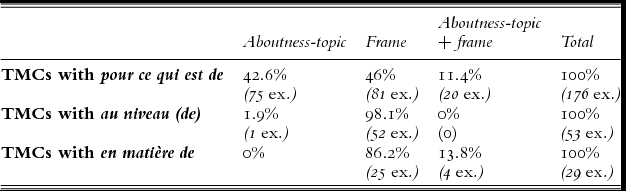
Table 6 summarises the results of our corpus research with respect to the discourse interpretation of the TMCs we are considering.
Frequency of aboutness-topic and frame interpretation.
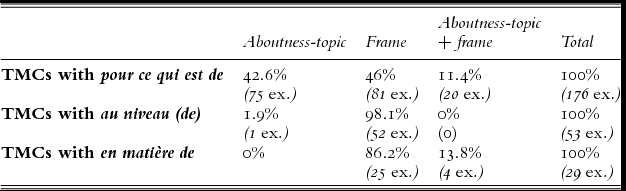
Our data show that pour ce qui est de behaves differently from au niveau de and en matière de: if the ambiguous examples are not taken into account, pour ce qui est de introduces the aboutness-topic in 42.6% of the occurrences and the frame of the utterance in about 46%, whereas TMCs introduced by au niveau (de) Footnote 18 and en matière de only introduce the frame of the utterance. Hence, these data confirm that the TMCs introduced by pour ce qui est de behave differently from those introduced by au niveau (de) and en matière de, not only with respect to the syntactico-semantic properties mentioned in section 4, but also with respect to their discursive properties. This confirms the hypothesis that TMs do not form a homogeneous class.
The fact that we find some cases in which the TMC seems to function both as an aboutness-topic and a frame is important evidence against the claim (or the assumption implicit in much work) that frames and aboutness-topics are fundamentally distinct notions (cf. Chafe, Reference Chafe and Li1976; Erteschik-Shir, Reference Erteschik-Shir1997; Lambrecht, Reference Lambrecht2000; see introduction). The existence of clear cases in which these notions coincide rather suggests that these notions represent different degrees of topicality (cf. Jacobs, Reference Jacobs2001).
In the next section we will show that the lexical, syntactico-semantic and discourse-functional properties interact.
5 INTERACTIONS AMONGST LEXICAL, SYNTACTICO-SEMANTIC AND DISCOURSE-FUNCTIONAL PROPERTIES
The previous two sections (see Tables 5 and 6) showed that, in our corpus, pour ce qui est de behaves differently from au niveau de and en matière de with respect to the following properties:
(i) Pour ce qui est de occurs in clause-initial position in 95% of the cases, whereas this holds for only 15% of the occurences of au niveau (de) and 18% of the occurences of en matière de.
(ii) Pour ce qui est de almost never introduces a determinerless NP, in contrast with au niveau (de) and en matière de.
(iii) The phrase introduced by pour ce qui est de is coreferential with a phrase in the main clause in 42% of the instances, whereas this is almost never the case with au niveau (de) and en matière de.
(iv) The TMC introduced by pour ce qui est de introduces the aboutness-topic or the frame, or both at the same time, whereas the TMCs with au niveau (de) and en matière de almost exclusively evoke the frame of the proposition.
These observations prompt two important questions. First, why exactly do en matière de and au niveau (de) pattern alike and contrast with pour ce qui est de (5.1). Second, are the properties discussed above independent or rather related in some way (5.2)?
5.1 The internal structure of TMs
With respect to the first question, we argue that the internal structure of the complex prepositions plays a role. In contrast to pour ce qui est de, the complex prepositions au niveau (de) and en matière de indeed contain the nouns niveau and matière, which explicitly denote a domain. Hence, it is not surprising that the latter two TMs are specialised in signalling the domain or the frame of the utterance. Pour ce qui est de does not contain a noun denoting a domain. Hence, from a lexical point of view, this TM is neutral with respect to this aspect, which explains why it can be used to introduce both an aboutness-topic and a frame (property (iv)). Since pour ce qui est de can introduce two types of topical elements (i.e. an aboutness-topic and a frame), it is also not surprising that this PP is much more frequent in clause-initial than in clause-final position. In contrast, au niveau (de) and en matière de rarely introduce an aboutness-topic and are less specialised as thematic markers (property (i)). Correspondingly, they most frequently occur in clause-final position and do not allow coreference.
5.2 The relation between syntactico-semantic and discourse-functional properties
In this section we show that the discourse interpretation of a TMC (property (iv)) is determined, at least to some extent, by its syntactico-semantic properties (properties (i), (ii) and (iii)).
Consider first the interaction between the discourse interpretation of TMCs (property (iv)) and the presence or absence of coreference with an expression in the main clause (property (iii)), represented in Table 7.
Coreference and discourse function.

Our corpus data show that, in the examples with coreference between the phrase introduced by the TM and an expression in the main clause, the TM is always interpreted as introducing the aboutness-topic. In the absence of coreference between an expression in the main clause and the phrase introduced by the TM, the latter is interpreted as an aboutness-topic or a frame, or the interpretation is ambiguous.
Our corpus contains only one example without coreference where the TM unambiguously introduces the aboutness-topic. However, in this case, the main predicate is il s’agit de, ‘it is all about’. In (30) below, the author says about the movie ‘The Day the Earth Stood Still’ that it is a remake.
(30)
- Quel est le dernier film que vous avez vu au ciné ou en DVD ? Ca (sic) vous a plu ?
- Le dernier film que j’ai vu en DVD est un film datant de 1935 d’Alfred Hichcock ‘Les 39 marches’ avec Robert Donat et Madeleine Carroll dimanche dernier. (. . .)
@léo : pour ce qui est du film ‘Le jour ou (sic) la terre s’arrêta’, il s’agit d’un remake ! Il faut l’original de ce film qui a le même titre : ‘Le jour ou la terre s’arrêta’ film américain de 1951 de Robert Wise.
Although this example does not contain an expression in the main clause which is coreferential with the phrase following the TM, we argue that the impersonal expression il s’agit de, which means ‘it is about’, must be completed by a contextually given logical subject (note for instance the fact that a sentence with il s’agit de cannot be used discourse-initially); in this example, the phrase introduced by pour ce qui est de. Moreover, il s’agit d’un remake can be replaced by c’est un remake where c’ corefers to le film ‘Le jour où la terre s’arrêta’.
Hence, the presence of coreference is a sufficient condition for the introduction of the aboutness-topic by the TMC.
There is also a relation between the formal properties of the noun phrase introduced by the TM (property (ii)) and its discourse interpretation (property (iv)).
Non-plural bare NPs,Footnote 19 such as droit in (31), do not refer to an individual or a set, and this prevents them from being interpreted as an aboutness-topic (see Reinhart, Reference Reinhart1981: 65, who argues that aboutness-topics must refer to an individual or a set). As a result, they must be interpreted as a frame.
(31) En matière de droit mieux vaut contacter un avocat, mais en général si il (sic) y a une irrégularité importante dans un CDD il est automatiquement requalifié en CDI selon le droit Français (sic).
Plural bare NPs, such as élections professionnelles in (32), can denote a set, however, and this explains why these sentences can be interpreted both as a claim that is true within a particular frame and a claim about a generic topic.
(32)
- Le droit de vote s’achète-t-il? Accorder le droit de vote aux étrangers pour des élections locales, au seul motif qu’ils payent des impôts, n’est-ce pas d’une certaine façon rétablir un suffrage censitaire ?
- Non, c’est juste affaiblir la notion de citoyenneté, une manière de faire plier les Français qui ne seront plus les maîtres chez eux. Longtemps en matière d’élections professionnelles seuls les citoyens français votaient, puis il y a eu élargissement à tous les employés sans distinction de nationalité.
As shown in section 3, pour ce qui est de does not introduce bare NPs in our corpus, contrary to au niveau (de) and en matière de. This correlates with our claim that en matière de and au niveau (de) are specialised in introducing frames.
Thirdly, there is also a relation between the frequency of PPs in clause-initial and clause-final position (property (i) above), the possibility of coreference (property (iii)) and their discourse interpretation in clause-initial position (property (iv)). PPs containing pour ce qui est de typically appear in clause-initial position (95%), allow coreference in this position (42%) and can introduce the aboutness-topic, whereas au niveau (de) and en matière de predominantly occur in clause-final position (85% and 81%, respectively), do not or rarely allow coreference in clause-initial position and rarely introduce the aboutness-topic in this position. Since pour ce qui est de makes it possible both to establish the frame in which the main clause holds and to introduce the aboutness-topic by means of a coreferential relation between the phrase it introduces and an expression in the main clause, we can conclude that it is more specialised as a TM than are au niveau (de) and en matière de.
We can conclude that these PPs do not only form a heterogeneous class as far as their syntactico-semantic properties and discourse functions are concerned, but that some PPs, such as pour ce qui est de, are more specialised as thematic markers than others, such as en matière de and au niveau (de), which more often appear in clause-final position and depend on the VP or an NP.
6 CONCLUSION
In this article we have presented an analysis of certain thematic markers (TMs), on the basis of 212 occurrences of pour ce qui est de, 518 of au niveau (de) and 155 of en matière de in the Yahoo-based Contrastive Corpus of Questions and Answers (YCCQA, De Smet, 2009). We have shown that pour ce qui est de behaves differently from au niveau (de) and en matière de with respect to a series of syntactico-semantic properties (position in the clause, presence/absence of coreference and formal properties of the noun phrase introduced by the TM) and with respect to its discourse interpretation (aboutness-topic, frame or both at the same time). We have shown that, whereas pour ce qui est de can introduce aboutness-topics and frames, the other two TMs are specialised in introducing the frame of the utterance.
Along the way, our corpus analysis has confirmed and refined the descriptive hypothesis put forward by other linguists (Porhiel, Reference Porhiel2004b; Lagae, Reference Lagae2007c, Reference Lagae, Comes and Miculescu2011b) that TMs are not a homogeneous class. From a theoretical point of view, the fact that in quite a number of corpus examples pour ce qui est de has both an aboutness-topic and a frame interpretation confirms that aboutness-topics and frames are not completely separate notions, but should rather be seen as different points on a continuum of topicality (see Prévost, Reference Prévost2003a), or different dimensions of topicality (see Jacobs, Reference Jacobs2001).
In addition, our research contributes to an understanding of the relationship between the lexical, formal and discourse-semantic properties of TM constructions. We have indeed shown in this article that the discourse interpretation of the three TMs at issue is determined (at least partly) by the lexical make-up of the TMs themselves and by the presence or absence of an expression in the main clause which is coreferential with the phrase introduced by the TM. More specifically, we have argued that the observation that au niveau (de) and en matière de prototypically function as frame-markers is explained by the fact that they contain the noun niveau and matière, which explicitly denote a domain. In addition, we have shown that, in sentences containing a coreferential relation between the phrase introduced by the TM and an expression in the main clause, the phrase introduced by the TM is interpreted as the aboutness-topic. This has led us to the conclusion that the discourse interpretation of the phrase introduced by the TM is the result of an interplay between the properties of the whole TMC construction and the individual properties of the TM concerned.