What role can history play in tackling the environmental challenges facing modern cities? This question was the starting point for the War on Waste project. It uses the history of waste management in World War II as a critical vantage point from which to consider contemporary efforts to reduce waste, encouraging people to consider the links between wartime behaviour and current debates over reduction, reuse and recycling. To date, the project has primarily focused on Leeds, where household recycling rates have fallen since 2013–14 and the city council is consulting on a new waste and resource strategy. This article situates the War on Waste project within a broader discussion of public history practice in the United Kingdom. It is organized in three sections: the first briefly considers motives for engaging beyond the academy and the relationship between urban history and policy; the second deals with the underpinning research; and the third section reflects on my personal experience of involvement in the War on Waste. I will argue that, while it is right to be sceptical about the lessons that can be drawn from the past, a historical understanding does allow parallels to be drawn and can be used to inspire behavioural change.
Urban history beyond the academy
The symposium to which this article owes its foundations reflected a long-standing belief that historians have a responsibility to engage people in an understanding of their past.Footnote 1 The idea that academics should be active beyond the academy is certainly not new. This is especially true in the United Kingdom, where the concept of public history has developed from radical approaches to community and labour history. These impulses were obvious in the History Workshop movement founded at Ruskin College in the late 1960s. The movement represented a belief that history should be ‘relevant to ordinary people’ and promoted the co-production of historical knowledge. Its protagonists argued that history was ‘a source of inspiration, a means of understanding the present and the best critical vantage point from which to view the present’.Footnote 2 This was markedly different to how public history was viewed in other contexts. In North America, for example, public historians were usually understood as disinterested experts working in entirely non-academic settings.Footnote 3 The intellectual contribution of the History Workshop movement – especially that of its co-founder, Raphael Samuel – continues to shape discourse on public history to this day. To those who subscribe to his view of history as ‘a social form of knowledge’, it is almost axiomatic that they should strive to do more.Footnote 4
In the last two decades, these feelings have been matched with more strategic concerns about the reach and influence of academic research. Urban historians are now working in a landscape shaped by the twin concepts of ‘public engagement’ and ‘impact’. When compared to the organic collaboration envisaged by Samuel, the criteria for impact adopted by the Research Excellence Framework are decidedly blunt, founded on a top-down model of cause and effect. This, according to Laura King and Gary Rivett, perversely means that ‘much of the most “impactful” and significant work of historians engaging beyond the campus…is not captured or valued’.Footnote 5 In the interests of transparency, it is worth noting that the War on Waste project does not currently form part of an impact case-study, although my approach was inevitably shaped by it. Moreover, as King and Rivett suggest, the ability to articulate impact (whether potential or realized) is now often central to securing the funding that makes engagement possible in the first place.Footnote 6
The use of history within contemporary policy-making long predates the REF, although recent developments have certainly been influenced by it.Footnote 7 Those who champion greater engagement tend to invoke one of two inter-related arguments. The first is that history allows for a deep understanding of complex problems by placing contemporary issues in perspective. This argument has been made most loudly by the organization History & Policy, which was set up in 2002 to provide a platform for historians to share their work with politicians, policy-makers and media commentators. Pat Thane, one of its founders, explained that she wanted to ‘persuade the political class that they would make better…policies if they thought longer term and took more advice from historians’.Footnote 8 History & Policy has pursued this end by using history both to provide direct evidence about past circumstances and to provide analogies to disentangle contemporary problems.Footnote 9 The second argument for greater engagement owes more to the radical tradition associated with Samuel and the History Workshop. It rests on the idea that the historical process is itself invaluable. In the words of John Tosh, whose book Why History Matters was a clarion call for greater engagement, ‘The proper role of the historian…is not to claim absolute authority, but to promote the discipline as a resource for debate.’Footnote 10 In this view, the historical method (and especially its ability to handle complexity and ambiguity) is just as valuable as the findings it produces.Footnote 11
Historians are, however, rightly wary of attempts to draw clear lessons from the past. We are instead trained to view our work as a process of critical analysis, based upon our interpretation of fragmentary evidence from the past. As Pam Cox noted in a thoughtful response to Thane's call for greater policy engagement, historians deal in ‘partial rather than absolute truths’.Footnote 12 We are also taught to view the past in its own right, forcing us to tread carefully with grand narratives and comparisons between different moments in time.Footnote 13 In the words of Lucy Delap, Simon Szreter and Paul Warde: ‘The instincts of the discipline are frequently to anticipate that a problem is more complex than anyone can easily perceive.’Footnote 14 This disciplinary reticence stands at odds with the certainty that many policy-makers seek. Indeed, a 2008 survey carried out for History & Policy by Virginia Berridge found that senior policy-makers and influencers had ‘little knowledge of the interpretative role of history’ so prized by academic historians.Footnote 15 A more recent report co-produced by the Arts and Humanities Research Council (AHRC) and Institute for Government contained similar findings. While primarily focused on ways to engage, its suggestions were founded on the premise that many policy-makers ‘invoke the phrase “learning the lessons from history”…without a clear understanding of what it means’.Footnote 16 The risks include generalizations about the past or the misleading use of precedent.Footnote 17
It is significant that these warnings reflect broader criticisms of public history. While engagement beyond the academy is not new, there has recently been a marked growth in scholarship on public history as a concept and method. The term was not commonly used in the United Kingdom until the early 2000s, but is now established well enough to warrant a place in most textbooks on academic practice. For Faye Sayer, whose practical guide to the subject exemplifies this process, public history has ‘developed from a separate entity…into an integrated and essential element of the subject's research and communication’.Footnote 18 While this may be the case, few elements of the discipline have remained so ambiguous. Without a clear definition, public history has become an adaptable umbrella term that can describe a myriad of encounters with the past. To take Sayer's textbook as an example, the term can equally be applied to historical practice in museums, at heritage sites, for community projects, on television, on film, on radio and across a range of digital media. Some, Sayer included, argue that this lack of definition has hindered attempts to establish public history as a serious form of historical practice. The suggestion is that a lack of clarity has left academic historians to perceive public history as untheorized, uncritical and nostalgic.Footnote 19
The accusation that public history presents a celebratory view of the past with little room for critical investigation echoes earlier debates regarding the heritage industry. Consider the Daily Mail-sponsored Chalke Valley History Festival as an example. In 2017, it found itself at the centre of a social media storm when a number of speakers pulled out as a protest against its programme. Although sparked by questions concerning the diversity of speakers, the debate quickly escalated into a discussion of the Festival's bias towards relatively safe, well-trodden subjects.Footnote 20 With these criticisms in mind, it is important to note that I am writing from a position of privilege. Matters of race and gender aside, I am a historian of World War II, which has such an enduring legacy that it is possible to argue that ‘even those who were born in its aftermath have particular “memories” of it’.Footnote 21 This can easily be denounced as the mark of a sick society, much as Robert Hewison and Patrick Wright criticized heritage in the 1980s. It is certainly the implication of Owen Hatherley's polemic Ministry of Nostalgia, which linked the ubiquity of wartime propaganda – not least the mantra ‘Keep Calm and Carry On’ – to austerity.Footnote 22 Yet, following in the footsteps of Raphael Samuel, who responded to Hewison and Wright by arguing that popularity need not imply passivity, it is equally possible to view fascination as an opportunity for deeper thought.Footnote 23
Salvage and recycling
The War on Waste project was founded on a belief that the popularity of World War II could be harnessed to command attention in the present. It focuses on the history of recycling – then ‘salvage’ – during the conflict. This was an important part of life on the home front. In the face of raw material shortages, Britain's wartime government used emergency legislation to prevent ‘waste’ by diverting materials into the war economy. It used a variety of levers to do this, including import controls to focus shipping on specific goods; price controls and production licences to manipulate the domestic market; and controls over the movement of labour. Alongside these restrictive measures, recycling was promoted as a means to channel new material into the war economy.Footnote 24 From virtually nothing, an almost universal recycling system was in operation by 1941 and the government estimated that 94 per cent of households were separating at least part of their waste by 1942.Footnote 25 My research on this subject considers the way that the system operated, the messages that were used to encourage participation and the individual experiences of recycling in wartime. Urban history provides a useful tool for understanding each of the three areas.
First, despite moves towards centralization, the wartime government depended on local authorities for the collection of most household waste. Official efforts were focused on larger conurbations, with rules for the compulsory collection of recycling initially limited to towns and cities with a population of 10,000 or more.Footnote 26 However, the material conditions in individual areas shaped the way that policies were developed, adapted and implemented. The number of materials collected, the mode and frequency of collection and the containers provided to households were all determined by local authorities. In Leeds, which had invested in a new sorting plant, the council initially focused on recovering material from the existing waste stream rather than providing a separate recycling collection. The situation was very different in Birmingham, where a shortage of collection vehicles and bomb damage to council facilities led to an approach where volunteers recruited by the Women's Voluntary Services (WVS) and other women's organizations managed local dumps on behalf of the city. The success of this approach eventually led the government to encourage other towns and cities to adopt similar schemes, demonstrating that the initiative was not always top down. Even then, however, significant local differences remained. In Leeds, for example, volunteers were only used to facilitate the collection of paper and the council was content to leave its day-to-day organization to the WVS.Footnote 27
Secondly, municipal authorities played a key role in publicity, with national advertising campaigns sitting alongside those targeted at a local level. These campaigns stressed the importance of recycling and were especially important in areas where there had been little or no recycling infrastructure before 1939. In common with other examples of home front propaganda, they invoked the idea of a ‘people's war’ by emphasizing the cumulative significance of individual actions.Footnote 28 Separating household waste or managing a communal dump was not a glamorous job, but it was portrayed as a form of national service on which the entire war effort depended. For instance, a leaflet explaining the compulsory collection in urban areas stressed that ‘Your Council will arrange for the collection of all this valuable waste material. But it depends on YOU – on how carefully You save it and keep it for collection.’Footnote 29 Such messages were frequently combined with allusions to civic duty. This was the case in Leeds, where the leaflet was delivered alongside a flyer that promised ‘we will [collect salvage] – with your co-operation’.Footnote 30 Those responsible maintained that ‘Leeds citizens are very conscious of their duties’, noting in 1941 that their record ‘compares favourably with that of any other city in the kingdom’.Footnote 31 As the recycling campaign developed, towns and cities were increasingly encouraged to see themselves in direct competition with one another, with cash prizes offered to those areas that made the largest contributions.Footnote 32 This technique drew on longer traditions of inter-urban rivalry and shows how even wartime concepts of citizenship and duty were shaped by a complex interplay between national, local and urban identities.Footnote 33
Investigations carried out during the war suggested that local messages were more successful than national publicity in changing behaviour. For example, a government survey conducted in March 1942 found that 17 per cent of respondents had been motivated to recycle paper as a result of local campaigns compared to just 2.8 per cent who cited posters and 2.3 per cent films.Footnote 34 This survey took place at the height of efforts to increase the number of volunteers running dumps on behalf of local councils. My effort to understand the individual experience of recycling in wartime has centred on those who responded to these appeals. The results demonstrate once more the importance of place. Volunteers were forthcoming in many areas, with at least 350,000 people receiving an official badge in recognition of their efforts (the badges were distributed by local authorities on behalf of the government). Nevertheless, some councils struggled to find volunteers in areas where the housing was comprised mostly of flats, citing a lack of community spirit. Suburban areas also posed problems because the additional space between houses resulted in greater distances between dumps.Footnote 35 An urban lens thus allows the interactions between policy, publicity and experience to be explored, showing that wartime recycling did not exist in a spatial vacuum.Footnote 36
Whatever the difficulties, the results of these efforts remain striking. Take the example of waste paper, which was the material most commonly collected from households. In 1939, local authorities collected around 60,000 (imperial) tons of paper from their residents. By 1942, this had grown to 433,405 tons. When combined with the paper collected by other bodies, there was an increase in recycling from roughly 19 per cent of all paper produced in 1939 to around 60 per cent in 1942.Footnote 37 This was a rapid adjustment for a society that had previously favoured controlled tipping and incineration for the disposal of waste. It suggests that the combination of war conditions, the availability of a recycling service and the messages used to promote participation had changed behaviours. The campaign was, however, not an unqualified success. Opinion surveys conducted during the war recorded frequent complaints about overflowing bins, recalcitrant local authorities and apparently unused dumps of perfectly good waste material. Practical difficulties like these undermined the message that recycling was necessary for victory and made it difficult to maintain such high levels of participation. From 1942 onwards, the campaign lost momentum and the amount of paper collected from households fell to 215,000 tons in 1945, although this still indicated a recycling rate of around 40 per cent.Footnote 38
While the history of recycling during World War II has mostly faded from memory, the issues that it raises are an increasingly pressing concern. In the last 20 years, the provision of kerbside recycling collections and an improved awareness of environmental issues have led to marked changes in the way households dispose of their waste. However, despite long-term commitments to encourage a circular economy, household recycling rates in England (it is a devolved responsibility) are effectively unchanged since 2012. The current national average stands at 44 per cent, making it highly likely that the UK government will miss a European target to recycle half of all household waste by 2020.Footnote 39 This average conceals significant geographical variation. According to 2017–18 figures, the East Riding of Yorkshire Council has the highest household recycling rate at 64 per cent (although half of this comprises of organic – i.e. garden – waste), while the London Borough of Newham has the lowest rate at just 14 per cent.Footnote 40 In Leeds, the second largest local authority area, the city council calculate that the recycling rate is currently 38 per cent (down from 44 per cent in 2013–14).Footnote 41 The statistics also conceal some very large numbers. For example, the 62 per cent of waste that is currently not recycled in Leeds equates to almost 190,000 (metric) tonnes, or around half a tonne of waste for every household in the city.Footnote 42
The government's approach to waste management in England has lately rested on the twin-track approach of landfill taxes and the promotion of alternatives. Alongside the expansion of kerbside recycling, this has resulted in the resurgence of incineration as a form of disposal, but has had little impact on the overall quantity of waste produced. The approach has also come under increased scrutiny in light of concerns surrounding single-use plastics and the health impacts of carbon dioxide, nitrous oxide and particulate emissions. In late 2017, the visible impact of plastic pollution shown by the BBC documentary series Blue Planet II and China's decision to cease importing low-grade recyclables compounded concerns, leading to an unlikely alliance between long-time environmental activists and conservative commentators.Footnote 43 The Department for Environment, Food and Rural Affairs (DEFRA) responded with a series of wide-ranging proposals, including a new 25-year resource and waste strategy. This includes plans for increased producer responsibility, standardized kerbside recycling, new rules for consistent labelling, the mandatory collection of food waste and the introduction of deposit return schemes. The ambition is to ‘become a world leader in using resources efficiently and reducing the amount of waste we create as a society’.Footnote 44
There are significant differences between this situation and the effort to conserve materials during World War II. Most importantly, the environmental challenges facing contemporary society are much less tangible than the threats posed by Nazi Germany. The conditions of total war also favoured a reconceptualization of waste, as the public already faced material shortages and the rationing of certain goods. The decades after World War II saw a distinct change in attitudes as wastefulness became an accepted part of an increasingly consumer-orientated society.Footnote 45 The composition and management of our waste is also very different from that produced by previous generations. Most obviously, the inexorable rise of plastic has radically altered the waste stream, with around five million tonnes used in the United Kingdom each year (less than one third of which is currently recycled).Footnote 46 Moreover, as Peter Thorsheim has argued, the aim of wartime recycling was not to preserve resources, but to divert them into destructive means. As salvage came with its own environmental costs, he warns that it would be a mistake to view World War II as an unproblematic golden age.Footnote 47
There are nevertheless parallels between then and now. In both cases, national government has responded to a particular crisis by drawing up potentially far-reaching policies. DEFRA's strategy, like the historical example, rests on a combination of service design, incentives, nudges and communications targeted at individual citizens.Footnote 48 This approach draws upon practices developed during the last 20 years. Studies have found that the availability of recycling services have the single greatest impact on participation, with engagement improved through active promotion.Footnote 49 However, as was the case during World War II, recent evidence also suggests that outcomes are often determined by social and cultural factors. Investigations into recycling behaviour have reiterated that social interactions and community norms have a significant impact on overall rates. It is, in short, very difficult to encourage people to act in a certain way if they do not perceive it to be important.Footnote 50 Moreover, just as the persistence of dumps in World War II undermined the message that salvage was being put to productive use, problems with infrequent or missed collections can lead previously engaged households to abandon their efforts altogether.Footnote 51
The War on Waste
A number of environmental and urban historians have recognized these parallels. Most notably, in the mid-2000s, the AHRC-sponsored Centre for Environmental History at the Universities of St Andrews and Stirling brought together a range of research projects on the social and cultural histories of waste. It consciously aimed to historicize current practices by providing a long-term perspective on issues including the language of waste, the politics of incineration and the rise of controlled tipping.Footnote 52 This work reached non-academic audiences through a combination of engagement with trade bodies and media appearances. Wartime recycling featured in the centre's activities, with Timothy Cooper and Mark Riley both publishing articles that drew attention to it as a subject of study. The latter deliberately framed his work as a contribution to contemporary discussions about waste management. The history of salvage, he argued, demonstrated the need to develop a coherent message that would connect the act of recycling to the environmental challenges facing contemporary society.Footnote 53
The War on Waste project builds on this attempt to use history as both an inspiration and a critical vantage point from which to consider contemporary efforts to reduce the amount of rubbish sent for landfill and incineration. My first strand of activity follows the approach taken by the Centre for Environmental History – and Pat Thane's argument about the benefits of the long view – by making contributions to public discussion through existing media channels. My approach has been to use contemporary policy announcements to draw attention to general conclusions from my historical research. For example, an opinion piece published by History & Policy in the wake of a government announcement regarding DEFRA's new waste strategy explored the way that wartime recycling was used alongside other levers, the importance of local experiences and the contingent nature of public involvement.Footnote 54 I have adapted this approach according to the local context. For instance, when asked to write an opinion piece for the Yorkshire Post, I centred on Leeds City Council's recent decision to revise its waste strategy, drawing a comparison between the old strategy's focus on incineration and the faith the council's wartime predecessor placed in sorting.Footnote 55
My second strand of activity has used the exposure gained from the first to make links with key stakeholders in the local waste and resource sector. This began with two source-based workshops run for Leeds City Council's waste advisory team. They had recently adopted a new communications strategy and wanted to understand how similar messages had been delivered in the past. The workshops used examples like the leaflet and flyer outlined in the previous section to show how local messages could be used to amplify national publicity. This led to an invitation to address the North East Centre of the Chartered Institution of Wastes Management about the way different bodies worked together to change behaviour during the war. Here, I used the example of Leeds to show how publicity and infrastructure formed two sides of the same coin, with the city's wartime council forced to change its approach in line with the national campaign. These examples have sat alongside a programme of work with Zero Waste Leeds, an umbrella group that promotes citizen-led actions to increase reuse and recycling.Footnote 56 Their ultimate ambition is to build a popular movement to help Leeds become a zero waste city. In the shorter term, they are working with Leeds City Council and the environmental charity Hubbub to deliver a trial campaign to improve ‘on the go’ recycling in the city.Footnote 57 My research findings were used to frame a discussion of campaigning and community engagement at the first Zero Waste Leeds meet up and helped shape a subsequent funding bid. I have also contributed to events organized by the group, using the example of recycling during World War II to argue that significant behavioural change is possible in the right circumstances.
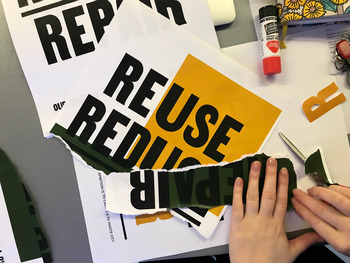
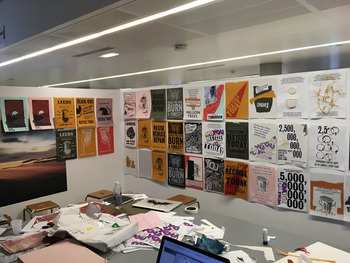
This relationship has also allowed a small experiment to test whether the popularity of World War II can be harnessed to encourage critical reflection in the present. The trial centres on a series of posters that combines conclusions from my historical research with messages about waste reduction in the present day. The posters were produced by a group of 16 BA Graphic Arts & Design students at Leeds Beckett University during a day long workshop facilitated by the Leeds-based designers saul studio. This activity was supported by Zero Waste Leeds, which acted as a client for the students, and was generously funded by Leeds Beckett University's Centre for Culture and the Arts. The workshop began with a short talk to introduce the challenges facing Zero Waste Leeds and a source-based exercise to introduce the history. The students responded by producing a series of bespoke A3 posters inspired by messages used during World War II. In keeping with the theme, the designs were hand produced using cut-and-paste techniques that would have been familiar to designers working in the 1940s and were printed using paper stock made from recycled coffee cups (see Figures 1 and 2). They are designed to be displayed on a wooden frame based on a World War II design, but can be detached for use in a variety of contexts. The posters were launched at the ‘Urban History beyond the Academy’ symposium, were shown at a handful of Zero Waste Leeds events in 2018 (see Figure 3) and were displayed in Leeds Town Hall during summer 2019.
Using cut and paste to produce posters for the War on Waste exhibition © saul studio.

Example of student work for the War on Waste exhibition © saul studio.

A Zero Waste Leeds meet up in May 2018 © Henry Irving.

There are obvious limits to the impact a small exhibition like this will have on waste reduction in Leeds. Nonetheless, my experience of the workshop that led to its creation has convinced me that history can be a powerful source of inspiration. The students involved knew nothing about the history of recycling during World War II before they began work, but created almost 60 different designs that encapsulated this in a way that I could not. By approaching the subject as a piece of urban history, they were able to identify successful publicity techniques and consider the relationship between these, the infrastructure that makes recycling possible and the experiences of those upon whose actions it depends. This knowledge was applied to the present, but it was the students’ interaction with the past that ultimately shaped their understanding. Moreover, although the techniques were inherently nostalgic, the project did not shy away from the challenges facing contemporary efforts to reduce waste. As Tosh suggests, the real value here was in the process of analysis. The inclusion of both historical and the contemporary examples in the finished display is designed to encourage a similar analytical process, with the audience left to connect one with the other and in order to come to their own conclusions.
Conclusion
This article has used the example of recycling to consider whether urban history can be used to encourage public debate around policy without sacrificing a professional understanding of history as an inherently subjective process of critical analysis. Drawing on experience gained during the War on Waste project, it has argued that urban history is particularly well placed to do this, as it provides focus to an array of analytical tools. In this case, an urban history approach illuminated the links between the way recycling operated during World War II, the way that it was promoted and the experience of those who participated, all of which remain important in present day approaches to waste management. The work of Thane, Tosh and Riley suggested that these parallels were worth exploring even though there are significant differences between both time-periods. The War on Waste project is just one, small-scale example of taking urban history beyond the academy. However, like the other papers in this special section, its conclusion has wider implications. Most importantly, by challenging the idea that nostalgia automatically produces a simplistic view of the past, it suggests that the stories connected to towns and cities will always provide opportunities for critical thought.