Introduction
Caregiver burden (CB) and its effects on the quality of life for both caregiver and care receiver has been documented in studies dealing mostly with Alzheimer's disease and dementia. However, it may not be entirely possible to generalize the results of these studies to a population of Parkinson's disease (PD) patients and caregivers. Unlike dementia, it is the motor deficits, not cognitive symptoms, which are usually most prominent when caring for a person with early- to mid-stage PD. Furthermore, the experience of caregiving may be altered by the distinct behavioral disturbances associated with PD and dopamine replacement therapy (Leroi, Reference Leroi2011). Research in the field of PD has given relatively little attention to CB associated with the disease (Pasetti et al., Reference Pasetti2003). Assessing and relieving CB may be an effective method of enhancing patient care and improving health of both patient and caregiver.
The existing literature on PD burden demonstrates correlations between CB and severity of motor symptoms (Aarsland, Reference Aarsland1999; D'Amelio, Reference D'Amelio2009), disease stage (Carter, Reference Carter1997), hours per day spent in caregiving (Chang, Reference Chang2010), patient neuropsychiatric disturbances (Fernandez, Reference Fernandez2001; Thommessen, Reference Thommessen2002; Schrag, Reference Schrag2006) as well as depression and sleep disturbances in both patient and caregiver (Happe, Reference Happe2002). These studies of PD caregivers have utilized a variety of scales, including the Zarit Caregiver Burden Inventory (Zarit et al., Reference Zarit1986), the Montgomery Burden Scale (Montgomery, Reference Montgomery1985), and the CBI (Novak, Reference Novak1989). These tools were developed initially for caregivers of elderly patients with dementia. There is currently no established tool to assess CB specifically in PD caregivers.
The existing literature supports the use of a multidimensional scale to assess CB (Novak, Reference Novak1989; Caserta, Reference Caserta1996) and we therefore aimed to develop a multidimensional CB questionnaire that addresses issues specific to PD. Such a scale would function either as a standalone instrument to assess CB, or as a supplementary tool to be used in conjunction with the existing CBI.
Methods
Questionnaire development
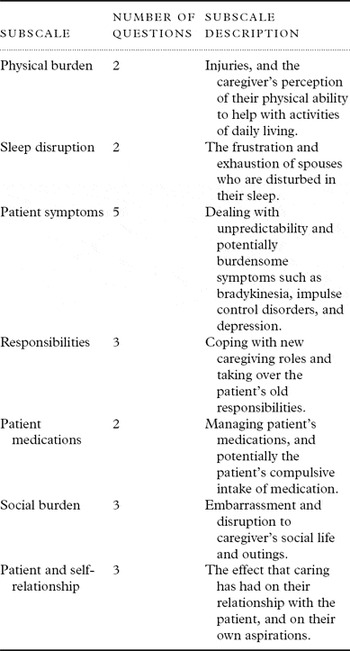
Structured discussions were held with five healthcare professionals, including Neuropsychiatrists and Movement Disorder specialists, to determine the process of constructing a new questionnaire, as well as potential domains of burden worth exploring. One-on-one and group interviews were held with patients and caregivers attending a local PD support group, before being transcribed and content analyzed to elaborate PD-specific themes and problems. These interviews were structured and unscripted. The information from these sources guided the development of PD-specific items, which together formed the initial PDCB scale. A Neuropsychiatrist and Neurologist were involved in the development of this scale. Prominent and identifiable issues were taken from the interview responses to form seven separate subscales as shown in Table 1.
Subscales of the PDCB

Twenty items were developed for the PDCB questionnaire, which covered these domains (see Appendix A1 published as supplementary material online attached to the electronic version of this paper at http://www.journals.cambridge.org/ipg). Item options were assigned values on a 5-point scale, and ranged from “strongly disagree,” to “strongly agree.” A score between 0 and 4 was given for each item depending on the polarity of the question.
A global burden scale was also included at the end of the questionnaire, and respondents were asked to indicate, out of 100, the overall burden they felt as a caregiver of the patient. Caregiver scores for this global burden (contributing 20% of the total score) were then combined with their scores from the questionnaire items (out of 80) to form a composite total out of 100.
Participants
A caregiver was defined as a spouse, relative, or friend who identified themselves as being primarily responsible for the care of the patient. Caregivers were included as potential participants if they were (1) over 18 years of age, and able to give informed consent; (2) able to speak, read, and write English; and (3) physically and cognitively able to understand and complete all relevant assessments and questionnaires.
The research-recruited patients and caregivers attended one of the two private clinics of Movement Disorders specialists (AE and RP) in Melbourne, or a public outpatient clinic (Royal Melbourne Hospital). Potential participants were invited to the study between November 2010 and May 2011. During this period, 50 patient–caregiver dyads were recruited.
The local Mental Health Research Ethics Committee provided ethical approval.
Instruments
To assess the PDCB against an established measure of burden, all caregivers were asked to complete both the PDCB questionnaire and the CBI. The CBI is a 24-item questionnaire designed to assess the burden of caregiving for confused or disoriented older people and has been shown to have good reliability and validity (Novak, Reference Novak1989).
Statistical analysis
The internal validity and reliability of the PDCB scale was assessed by calculating item–total correlations as well as Cronbach's alpha (α). The effect of deleting a particular item or subscale on Cronbach's α was also determined.
To assess the external validity of the PDCB scale, total scores were correlated with those of the CBI. Spearman's rank correlation coefficient was calculated for correlations between the PDCB questionnaire and the CBI.
The sensitivity and relevance of all PDCB and CBI items were assessed. Instrument sensitivity was determined by calculating the proportion of population-appropriate items.
Results
Sample characteristics
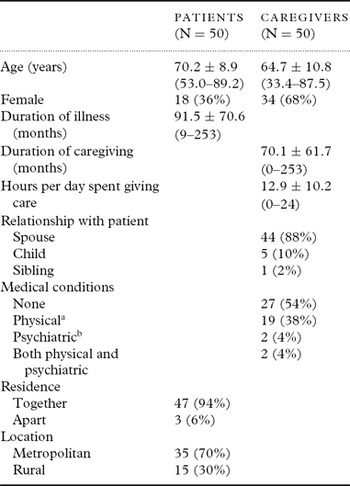
Table 2 outlines the characteristics of patients and caregivers. The majority of caregivers were female spouses living with the patient. Most of the caregivers were non-smokers and were without significant existing medical conditions.
Patient and caregiver demographic characteristics

Note: Figures are presented as mean ± SD (range), or as number (percentage).
a“Physical conditions” included hypertension, diabetes mellitus, arthritis, osteoporosis, bone fractures, lumbar disc degeneration, carpal tunnel syndrome, chronic obstructive pulmonary disease, asthma, Addison's disease, and Hashimoto's thyroiditis.
b“Psychiatric conditions” included depression, anxiety, post-traumatic stress disorder, and bipolar disease.
PDCB questionnaire feasibility
The feasibility and face validity of the PDCB scale were established during interviews involving clinicians, caregivers, and patients at the time of development of questionnaire and recruitment stages of the study. Caregivers took five to ten minutes to complete the PDCB questionnaire, and all respondents were able to finish the assessment once they had started it.
Response distributions to burden assessments
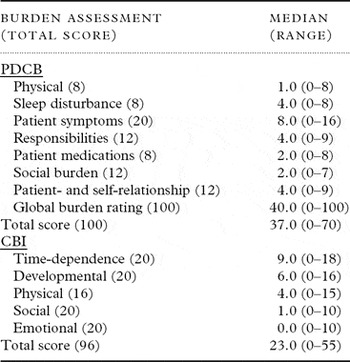
Results and distributions of the PDCB and other caregiver assessments are summarized in Table 3. The 20-item PDCB questionnaire elicited an average of 6.8 zero-scoring responses per caregiver. There was an average of one maximum-scoring (4 points) response per caregiver. Conversely, the average caregiver responding to the 24-item CBI gave 12 “never” responses, and 0.92 “nearly always” responses. Only Item 2 (“the patient is dependent on me”) had a significant proportion of positive responses (39% “quite frequently,” 10% “nearly always”).
Summary of results for caregiver burden assessments

PDCB questionnaire reliability and validity
Statistical analysis demonstrated a standardized Cronbach's α of 0.856 for the PDCB scale. As shown in Table S2 (published as supplementary material online attached to the electronic version of this paper at http://www.journals.cambridge.org/ipg), individual item analysis found that item–total score correlations ranged between 0.311 and 0.661 for all questions, except Item 1 (0.235) and Item 2 (0.177). Deletion of either of the first two items of the questionnaire led to slight increase in Cronbach's α. Cronbach's α was not affected significantly by deletion of any of the other questionnaire items.
External validity was considered by correlating the PDCB questionnaire scores with the CBI and global burden scores. Spearman's correlations for the PDCB questionnaire score (out of 80) were 0.773 and 0.837 (p < 0.01) against the CBI total score and global burden score, respectively. The correlation between the CBI score and the global burden rating was equally strong (Spearman's r = 0.799, p < 0.01).
Discussion
The current study sought to develop a caregiver questionnaire specific to PD. The PDCB scale was found to display good external validity against the CBI. This, along with the fact that patients found the PDCB questionnaire more relevant with more sensitive items, may make it preferable to the CBI.
Consistent with past studies, a very high percentage of caregivers (88%) were spouses of the patient (McRae et al., Reference McRae2009; A'Campo, Reference A'Campo2010). The majority of caregivers were either wives or children of the patient, and caregivers were on average five years younger than the patient.
The sensibility and feasibility of the PDCB questionnaire was established with feedback from clinicians, patients, and caregivers. Respondents felt that the items sufficiently covered the concept of burden in a reasonable amount of time. The wording of some items was reversed; for example, “I am uncomfortable going out with him/her” was changed to “I am comfortable going out with him/her.” Despite this, caregivers found the scale understandable, and no respondent failed to complete the questionnaire once they had started it.
The Cronbach's α for the PDCB (0.864) indicates a high degree of internal consistency. Item–total correlations were strong, except for Items 1 and 2 (0.256 and 0.242, respectively). These two items constitute the “Physical Burden” subscale that was found to be not reliable, and contributed poorly to the total score. Reliability improved upon deletion of Items 1 and 2. It has been suggested that items with item–total correlations lower than 0.30 be removed from the instrument (Field, Reference Field2005). It may be necessary to study this effect in a larger sample.
The consistency of the PDCB results with the CBI demonstrated the concurrent validity of the PDCB questionnaire. A strong, statistically significant correlation was shown between the PDCB scale and the CBI, considered to be an established tool for CB appraisal. When the PDCB scores were compared with the global burden ratings, an even stronger correlation was found.
There were four PDCB items (1, 5, 16, and 18) that drew zero-scoring responses mostly, while another four items (4, 5, 12, and 19) attracted a large proportion of high-scoring responses. In other words, one-fifth of the PDCB questionnaire was quite pertinent, while another one-fifth of the tool was found to be not applicable in the case of most respondents.
Conversely, the 24-item CBI contained only one statement (Item 2) that drew a substantial proportion of high-scoring reactions. For 12 CBI items, the majority of respondents answered “never,” suggesting that about half of the questionnaire describes situations irrelevant to most PD caregivers.
The fact that the PDCB describes scenarios specific to PD caregiving experience may explain the larger proportion of PDCB items attracting high-scoring responses. On the other hand, the dementia and Alzheimer's disease background of the CBI meant that a very significant fraction of questions did not relate to the average PD caregiver. Overall, the PDCB appears to possess greater item relevance for this population compared with the CBI. It would be worthwhile assessing the specificity of the PDCB in a larger sample.
The main limitation of this study relates to relatively small sample size (N = 50). Other limitations of this study may impact its generalizability to other settings. Given the nature of the clinics involved in this research, the sample was restricted geographically (all participants were from the state of Victoria). Participation was restricted to those fluent in English, although respondents came from diverse cultural backgrounds.
Social desirability response bias may have been introduced by caregivers who felt inclined to respond to items in a way that presented a favorable image of their ability to cope with caring for the patient (Choi and Pak, Reference Choi and Pak2005). Furthermore, because caregivers who participated did so voluntarily, selection bias may have altered the characteristics of the sample. For example, caregivers who refused to complete the questionnaire may have scored highly on burden measures, but did not participate due to time constraints.
Conclusion
This exploratory study has determined strong initial feasibility, reliability, validity, and sensitivity for the PDCB Questionnaire. The PDCB may prove to be a valuable supplementary tool to the existing CBI or, with further refinement and evaluation, a standalone instrument aimed at PD caregivers. With the development of this PD-specific burden scale, the topic of CB in the setting of PD can be more thoroughly investigated.
Conflict of interest
None.
Description of authors’ roles
M. Zhong was involved in the conception and design of the study, participant recruitment, data collection, statistical analysis as well as the drafting and revision of the manuscript. A. Evans and D. Velakoulis contributed equally to the study and manuscript. A. Evans was involved in the conception and design of the study, supervision of participant recruitment, statistical analysis, and revision of the manuscript. D. Velakoulis was involved in the conception and design of the study, statistical analysis, and assisted with the drafting and revision of the manuscript. R. Peppard was involved in participant recruitment and data collection.