Introduction
A decline in the Adélie penguin (Pygoscelis adeliae Hombron & Jacquinot) population has been observed in all monitored breeding colonies on the Antarctic Peninsula and outlying islands (Forcada et al. Reference Forcada, Trathan, Reid, Murphy and Croxall2006, Carlini et al. Reference Carlini, Coria, Santos, Libertelli and Donini2007, Reference Carlini, Coria, Santos, Negrete, Juáres and Daneri2009, Lynch et al. Reference Lynch, Naveen and Fagan2008, Reference Lynch, Fagan and Naveen2010, Trivelpiece et al. Reference Trivelpiece, Hinke, Miller, Reiss, Trivelpiece and Watters2011, Fraser et al. Reference Fraser, Patterson-Fraser, Ribic, Schofield and Ducklow2013, among others). Overall, this trend has been related to different aspects of their life-history strategies, as well as to climatic changes reported in the region. The Adélie penguin is a migratory and pagophilic species (Ainley Reference Ainley2002) and the spatio-temporal reduction of sea ice during winter (e.g. Stammerjohn et al. Reference Stammerjohn, Martinson, Smith and Iannuzzi2008) adversely affects its wintering habitat, thus having a negative impact on juvenile and adult survival (e.g. Hinke et al. Reference Hinke, Salwicka, Trivelpiece, Watters and Trivelpiece2007, Carlini et al. Reference Carlini, Coria, Santos, Negrete, Juáres and Daneri2009). Furthermore, the abundance of Antarctic krill (Euphausia superba Dana), their main prey during the breeding season (Volkman et al. Reference Volkman, Presler and Trivelpiece1980, Juáres Reference Juáres2013), has also declined (Atkinson et al. Reference Atkinson, Siegel, Pakhomov and Rothery2004). This change in krill abundance has been associated with the sea ice reduction during winter and with fluctuations in phytoplankton availability during summer (Atkinson et al. Reference Atkinson, Siegel, Pakhomov and Rothery2004, Moline et al. Reference Moline, Claustre, Frazer, Schofield and Vernet2004, Loeb et al. Reference Loeb, Hofmann, Klinck, Holm-Hansen and White2009).
Fraser et al. (Reference Fraser, Patterson-Fraser, Ribic, Schofield and Ducklow2013) recently reported that variability in the terrestrial environment leads to a detrimental impact on the population dynamics of the Adélie penguin. The increased frequency of years with high snow deposition (Turner et al. Reference Turner, Lachlan-Cope, Colwell and Marshall2005, Thomas et al. Reference Thomas, Marshall and McConnell2008) negatively affects the brood survival and population size (e.g. Trivelpiece & Fraser Reference Trivelpiece and Fraser1996, Hinke et al. Reference Hinke, Polito, Reiss, Trivelpiece and Trivelpiece2012).
Since top and meso-predator populations are sensitive to environmental variability, their population dynamics may be used as an indicator of the status or quality of the ecosystem. For this reason, it is extremely important to know the factors that drive the long-term fluctuations in the Adélie penguin population. This paper will report the long-term abundance and breeding success of Adélie penguins at Stranger Point, King George Island (25 de Mayo). This work was developed over 19 years (from the 1995/96 to the 2013/14 breeding season), partially supplementing the data reported in Carlini et al. (Reference Carlini, Coria, Santos, Negrete, Juáres and Daneri2009). Additionally, a historical review of the number of breeding pairs is used to analyse the fluctuations across a broader time period.
Materials and methods
Study area
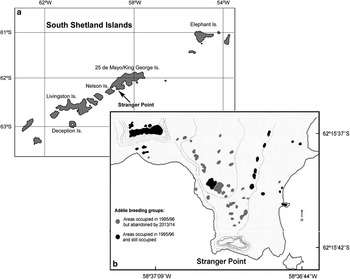
The study was carried out at Stranger Point, King George Island (25 de Mayo, 62°16'S, 58°37'W), South Shetland Islands (Fig. 1), within the Antarctic Specially Protected Area number 132 during 19 consecutive breeding seasons from 1995/96 (hereafter 1995) to 2013/14 (hereafter 2013). In this colony, Adélie and gentoo (Pygoscelis papua Forster) penguins breed sympatrically.
Study area. a. Stranger Point, King George Island (25 de Mayo), South Shetland Islands, Antarctica. b. Locations of the breeding groups of Adélie penguin at Stranger Point colony from 1995/96 to 2013/14.

Breeding population size and chicks crèched
In this study, a breeding group was defined as a group of birds breeding as a geographically continuous unit within a colony (Young Reference Young1994, p. 18). Currently, 20 breeding groups form the Stranger Point colony (Fig. 1b), and the 16 breeding groups monitored represent c. 50% of the total breeding pairs of this colony. Annually since 1995, all occupied nests and chicks crèched were counted. The number of all the occupied nests included both nests with eggs as well as the number of pairs occupying a nest (CCAMLR 2004). According to standard methods from the Commission for the Conservation of Antarctic Marine Living Resources Ecosystem Monitoring Program (CCAMLR 2004), three counts were made for each breeding group and the average values were calculated.
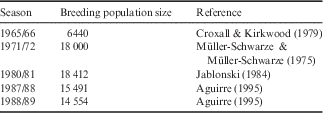
This work estimated: i) the breeding population size from all the occupied nests (i.e. all breeding pairs), in contrast to the previous report by Carlini et al. (Reference Carlini, Coria, Santos, Negrete, Juáres and Daneri2009) who considered only nests with eggs, and ii) the productivity from the number of chicks that survived until crèche stage, supplementing the data reported in Carlini et al. (Reference Carlini, Coria, Santos, Negrete, Juáres and Daneri2009). Additionally, considering information on previous censuses (taken from Aguirre Reference Aguirre1995, Table I), the overall fluctuation in the number of breeding pairs of the whole colony was analysed over a broader period (48 years), during which the long-term population variation was evaluated considering the total breeding colony size counted during the 2013 season.
Summary of the Adélie penguin abundance registered at Stranger Point from 1965. These data were previously compiled and published by Aguirre (Reference Aguirre1995) and represent the breeding population size of the entire colony.
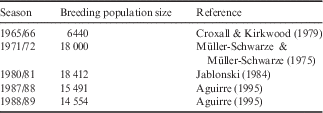
Breeding population size=number of pairs occupying nests (according to the CCAMLR Ecosystem Monitoring Program methods).
The percentage annual change in the total number of breeding pairs (all the occupied nests) and in the number of chicks reared to crèche were calculated.
 $${\rm Annual}\,{\rm change}\,{\rm (}{\tf="TimesNewRom_font_roman"%}{\rm )=}\,\left( {\left( {{{{\rm PS}_{{(t{\plus}{\rm 1})}} } /{{\rm PS}_{{(t)}} }}} \)\!-{\rm 1}} \right)\,{\asterisk}\,{\rm 1}00,$$
where PS=population size or chicks crèched and t=time.
Index of breeding success
The index of breeding success was calculated as: the number of chicks in crèches divided by the number of occupied nests. This index was estimated for each season when both parameters were available.
Statistical analyses
Simple linear regressions of counts against time were used to test trends in the abundance of breeding pairs and chicks crèched. The significance level was set at P≤0.05.
The coefficient of variation (CV) of the index of breeding success was calculated to evaluate the temporal fluctuation in the breeding performance when considering the entire study period and two temporal fractions (1995–2006 and 2007–2013).
Results
Breeding population size
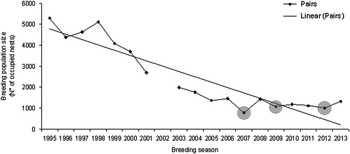
In 1995, the Adélie penguin colony consisted of 50 breeding groups. After 19 years, 30 of these were abandoned. During the study, there was no colonization of new breeding areas or re-occupation of sites previously abandoned (Fig. 1b). The breeding population declined by 75% throughout the study (F (1,17)=84.21, P<0.001, R 2=0.84; Fig. 2). Although the number of breeding pairs has significantly declined since 1995, this reduction was almost continuous from 1995 to 2006 (Fig. 2). In contrast, interannual fluctuations were observed between 2006 and 2013, and the breeding population size only diminished by 9.9% (F (1,7)=0.05, P=0.83, R 2=0.009). Moreover, the number of reproductive pairs registered during the 2007, 2009 and 2012 seasons represented the lowest values recorded since 1995 (777, 1083 and 1003, respectively).
Breeding population size over a broader period
Changes in the direction of the Adélie population trend were observed from 1965 to 2013 (Table I). The number of breeding pairs showed an increase of 186% between 1965 and 1980. Since 1980, an almost continuous decline was evidenced. Over this 33 year period, the colony declined to 3703 pairs (registered during the 2013 breeding season), which represents only 20% of the total population size reported in 1980.
Chicks crèched
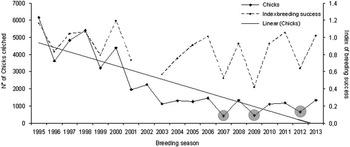
Over the study period (1995–2013), a decline of 78% in the number of chicks in crèches was recorded (F (1,17)=40.85, P<0.01, R 2=0.71; Fig. 3). As with the breeding population size, the reduction in the number of chicks was marked between 1995 and 2006 (Fig. 3), but the decrease between 2006 and 2013 was only 9.1% (F (1,7)=0.005, P=0.95, R 2=0.001). The number of chicks crèched observed during the 2007, 2009 and 2012 breeding seasons were the lowest reported since 1995 (6.6%, 7.4% and 10.4% of those counted in 1995, respectively).
Index of breeding success
The mean index of breeding success was 0.86±0.22. The index of breeding success estimated for the 2007, 2009 and 2012 breeding seasons was 0.52, 0.42 and 0.64, respectively. These values were lower than those registered in other seasons, except for 2003 (0.56). The CV of the index evidenced a higher temporal fluctuation of breeding success in the period 2007 to 2013 (CV=32.4, mean±SD=0.79±0.26, n=7), compared to both the previous period (1995–2006: 21.7, 0.91±0.20, n=11) and the entire study period (25.9, n=18).
Discussion
The trends in the size of the Adélie penguin breeding population recorded at Stranger Point were consistent with previous reports for the Antarctic Peninsula and islands of the Scotia Arc (Forcada et al. Reference Forcada, Trathan, Reid, Murphy and Croxall2006, Carlini et al. Reference Carlini, Coria, Santos, Libertelli and Donini2007, Lynch et al. Reference Lynch, Naveen and Fagan2008, Reference Lynch, Fagan and Naveen2010, Trivelpiece et al. Reference Trivelpiece, Hinke, Miller, Reiss, Trivelpiece and Watters2011, Fraser et al. Reference Fraser, Patterson-Fraser, Ribic, Schofield and Ducklow2013, among others). In this area, the Adélie penguin populations increased from 1965 until the late 1970s and early 1980s when they started to decline almost continuously up to the present (e.g. Hinke et al. Reference Hinke, Salwicka, Trivelpiece, Watters and Trivelpiece2007, Trivelpiece et al. Reference Trivelpiece, Hinke, Miller, Reiss, Trivelpiece and Watters2011, Korczak-Abshire et al. Reference Korczak-Abshire, Wegrzyn, Angiel and Lisowska2013, this study). In agreement with Korczak-Abshire et al. (Reference Korczak-Abshire, Wegrzyn, Angiel and Lisowska2013), we consider that the 1965 census could be inaccurate, yet it is still evidence of a population increase.
Interestingly, at Stranger Point it became evident that although both the breeding population size and the number of chicks in crèches has significantly declined from 1995 to 2013, this reduction was strongly marked only up to 2006. Since 2006, interannual fluctuations were observed, though with low numbers of breeding pairs. Moreover, an increase in the breeding effort was recorded, especially in chick production. During the study, both parameters showed the lowest values in the 2007, 2009 and 2012 seasons. However, a recovery of the population was registered during each of the following breeding seasons (i.e. 2008, 2010 and 2013; Figs 2 and 3).
Breeding population size (pairs) of Adélie penguins at Stranger Point from 1995/96 to 2013/14. Linear regression of breeding population size was plotted (y=-253.2x+5024). Grey circles indicate the lowest values of breeding pairs recorded during the study.

Fluctuation in the number of chicks crèched (solid line) and index of breeding success (dashed line) of Adélie penguins at Stranger Point from 1995/96 to 2013/14. Linear regression of number of chicks crèched was plotted (y=-264.8x+4935). Grey circles indicate the lowest values of chicks in crèches recorded during the study.

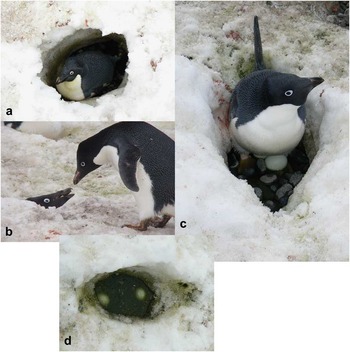
In philopatric species, such as the Adélie penguin (Ainley et al. Reference Ainley, LeResche and Sladen1983), a long-term decrease in the number of chicks that can be potentially recruited to the breeding population negatively affects the future population size of the colony. In addition to this overall decline in abundance, low values for the index of breeding success were most often recorded from 2007 (in 2007, 2009 and 2012). The breeding success of penguins can decline because of a variety of factors, such as food availability, snow or human disturbance, among others. At Stranger Point, Antarctic krill is the main prey of Adélie penguins (Juáres Reference Juáres2013). The evidence suggests an apparent reduction of local food availability from 2007–10; during this period, the weight of the stomach contents decreased while the duration of the foraging trips increased (Juáres Reference Juáres2013). Similar results were concurrently registered in gentoo penguins breeding in this colony (Juáres et al. Reference Juáres, Santos, Negrete, Santos, Mennucci, Rombolá, Longarzo, Coria and Carlini2013). A low krill abundance at the west Antarctic Peninsula during the 2010/11 summer reported by Siegel et al. (Reference Siegel, Reiss, Dietrich, Haraldsson and Rohardt2013) supports this theory. However, given that this was not the case for the 2007 or 2012 seasons, the low values for the index of breeding success observed during the 2007, 2009 and 2012 seasons cannot be associated with food depletion near the study area. Human disturbance is not a plausible explanation for these results either, as this colony is located within a protected area and can only be accessed with permission. Therefore, we conclude that the nesting populations of Adélie penguins were negatively impacted by precipitation. Snowfall can lead to the loss of breeding habitat at the start of the season, as well as causing a reduction in the breeding performance due to high loss of nests with eggs and chicks during the season (Trivelpiece & Fraser Reference Trivelpiece and Fraser1996, Lynch et al. Reference Lynch, Fagan, Naveen, Trivelpiece and Trivelpiece2009, Reference Lynch, Fagan and Naveen2010, Fraser et al. Reference Fraser, Patterson-Fraser, Ribic, Schofield and Ducklow2013, among others). For the period 1995–2006, Carlini et al. (Reference Carlini, Coria, Santos, Negrete, Juáres and Daneri2009, p. 1431) stated ‘nesting locations at Stranger Point are situated on well-drained slopes with porous substrate and good water runoff, suggesting that the overall Adélie population trend at Stranger Point was not driven by the loss of breeding habitat’. Nevertheless, abnormally high accumulation and persistence of snow (Fig. 4) was reported in the study area at the beginning of the 2007 and 2009 breeding seasons (Juáres et al. Reference Juáres, Santos, Negrete, Santos, Mennucci, Rombolá, Longarzo, Coria and Carlini2013), and similar conditions were observed in 2012 (Perchivale, personal communication 2012). During these seasons, population size and number of chicks in crèches represented the lowest values throughout the study. Furthermore, when the 19 year period was divided into two temporal fractions (1995–2006 and 2007–2013), a greater temporal fluctuation in the index of breeding success was evident in the last seven years. Other authors have also reported abnormally high snow deposition in 2007 and 2009 (e.g. Hinke et al. Reference Hinke, Polito, Reiss, Trivelpiece and Trivelpiece2012), supporting our conclusions. These results could provide more evidence that abnormally high snowfall is an adverse factor that is manifesting with more frequency.
Adélie penguins at Stranger Point during seasons with abnormally high snow accumulation (i.e. 2007, 2009, 2012). a.–c. Birds incubating. d. Nest flooded and abandoned.

At Stranger Point the negative effects of snow were more evident in Adélie penguins (this study) than in gentoo penguins (Juáres et al. Reference Juáres, Santos, Negrete, Santos, Mennucci, Rombolá, Longarzo, Coria and Carlini2013), whose population has been increasing since 1995 (Carlini et al. Reference Carlini, Coria, Santos, Negrete, Juáres and Daneri2009, Juáres Reference Juáres2013). Either local weather conditions do not have the same effect on both species or these species face such conditions in different ways, which manifests as an impact on breeding performance. The gentoo penguins exhibited life-history strategies that help reduce seasonal and interannual variability in breeding success. Their plasticity in reproductive phenology and the selection of better nesting sites might contribute to maintaining the breeding success under adverse local conditions (Juáres et al. Reference Juáres, Santos, Negrete, Santos, Mennucci, Rombolá, Longarzo, Coria and Carlini2013). In contrast, the Adélie penguins are less flexible in their reproductive chronology and exhibited high nesting site fidelity, suggesting that this species was unable to cope with the adverse effects of snow (Juáres Reference Juáres2013).
A combination of factors, operating separately or concurrently depending on the season, would determine the trend in the breeding abundance of Adélie penguins. Firstly, as this species is an obligate inhabitant of the pack ice, climate change affects their wintering habitat. The conditions that they must confront during winter negatively impacts adult and juvenile survival, reducing recruitment and, consequently, the breeding population size (e.g. Trathan et al. Reference Trathan, Croxall and Murphy1996, Hinke et al. Reference Hinke, Salwicka, Trivelpiece, Watters and Trivelpiece2007, Carlini et al. Reference Carlini, Coria, Santos, Negrete, Juáres and Daneri2009, Lynch et al. Reference Lynch, Fagan and Naveen2010). Furthermore, the availability of Antarctic krill has declined in the Scotia Sea, having a profound impact on Adélie penguin abundance (e.g. Forcada et al. Reference Forcada, Trathan, Reid, Murphy and Croxall2006, Trivelpiece et al. Reference Trivelpiece, Hinke, Miller, Reiss, Trivelpiece and Watters2011). In addition to these factors operating on a regional scale, attention should be focused on the variability of the terrestrial environment; an increase in the frequency of high snow deposition reduces the availability of nesting sites and/or breeding success during spring and summer (e.g. Trivelpiece & Fraser Reference Trivelpiece and Fraser1996, Hinke et al. Reference Hinke, Polito, Reiss, Trivelpiece and Trivelpiece2012, Fraser et al. Reference Fraser, Patterson-Fraser, Ribic, Schofield and Ducklow2013, Juáres et al. Reference Juáres, Santos, Negrete, Santos, Mennucci, Rombolá, Longarzo, Coria and Carlini2013).
Acknowledgements
We want to thank L. Longarzo, E. Moreira, G. Donnini, S. Mut Coll, M. Gray, P. Moran, B. Fusaro, P. Pastorizo, A. Pereira and A. Silvestro for help with the data collection associated with this study. The permit for this work was granted by the Dirección Nacional del Antártico (Environmental Office). The Instituto Antártico Argentino provided financial and logistical support. We also thank the reviewers and Professor David Walton for their helpful suggestions on improving the paper.
Author contribution
This research was part of doctoral work by Mariana A. Juáres. Mariana A. Juáres participated in the fieldwork and the conception, design and execution of the research, performed the statistical analyses, provided interpretation of the findings and conclusions, wrote and edited the manuscript according to the ideas, suggestions and corrections of all authors and reviewers, and participated in the selection and development of figures. Mercedes Santos, Javier Negrete and Jorge A. Mennucci participated in fieldwork and in the overall development of the manuscript (including conception, design and execution). They provided interpretations of the findings, ideas and conclusions, and helped with drafting and translation. Jorge A. Mennucci also prepared the images. Pablo J. Perchivale participated in fieldwork and also collaborated in the conception and design. Ricardo Casaux contributed with literature and interpretation of the findings, and also helped improve drafting and translation. Néstor R. Coria, with A. Carlini, established the CCAMLR Ecosystem Monitoring Program in 1995, he was director of the programme from 1995–2013 (M. Santos is the current director). He provided suggestions for the development of the manuscript and conducted revision of the manuscript.