Introduction
All species of Salvia native to China belong to the East Asia clade of Salvia (Wei et al., Reference Wei, Wang and Huang2015; Hu et al., Reference Hu, Takano, Drew, Liu, Soltis, Soltis, Peng and Xiang2018), and 70 of them are endemic to China. The high diversity of Salvia in China is probably a result of the country’s wide range of geological and climatic conditions, and the genus is most prominent in the Qinghai–Tibet Plateau, the Hengduan Mountains, and the karst regions found across the country.
Several new Salvia species have been described from China in recent years (Su et al., Reference Su, Shen and He1984; Hu et al., Reference Hu, Liu, Hu and Liu2014, Reference Hu, Liu, Zhang, Cai and Xiang2017), but there is still a lack of comprehensive studies in areas such as the provinces of Yunnan, Sichuan, Guizhou, Guangxi and Hunan, and the collection of specimens across the Himalayas is much needed (Li & Hedge, Reference Li, Hedge, Wu, Raven and Hong1994). The existing taxonomy of Salvia (Wu & Li, Reference Wu and Li1977) is based purely on morphology, and it is currently being revised in the light of new molecular evidence and detailed field investigations (Will et al., Reference Will, Schmalz and Classen-Bockhoff2015; Drew et al., Reference Drew, González-Gallegos, Xiang, Kriebel, Drummond, Walker and Sytsma2017; Will & Claßen-Bockhoff, Reference Will and Claßen-Bockhoff2017; Hu et al., Reference Hu, Takano, Drew, Liu, Soltis, Soltis, Peng and Xiang2018). In the present study we describe a new species of Salvia from Hunan Province and discuss its placement within the revised classification of Salvia.
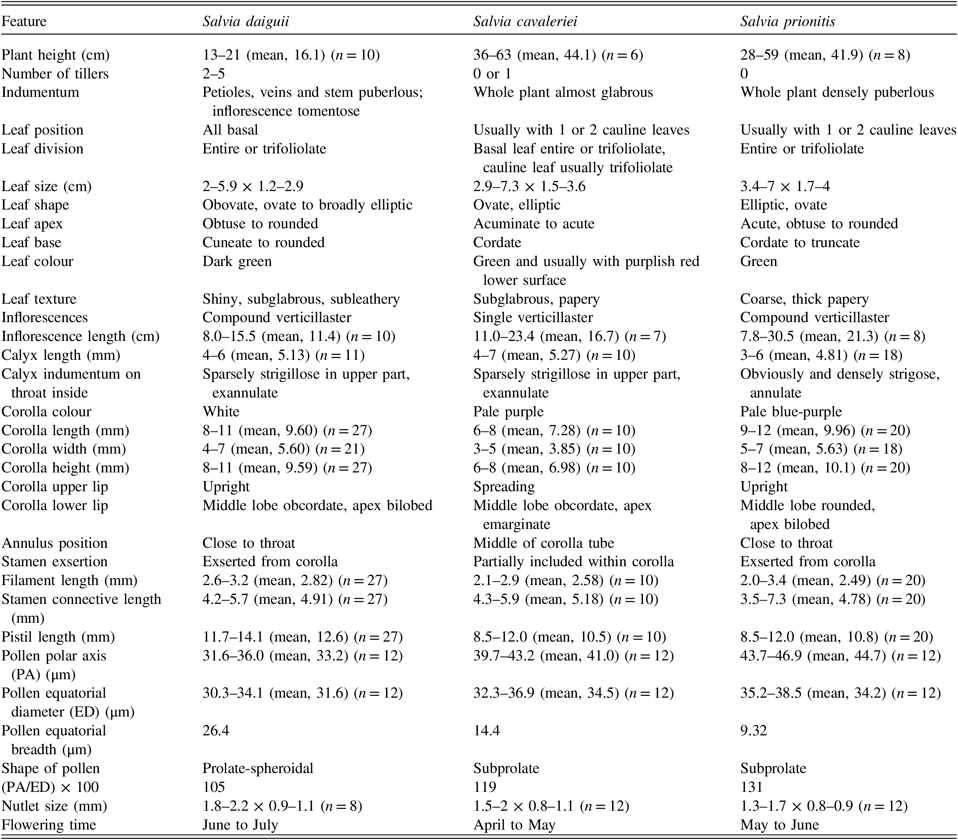
In 2007, Zhang Daigui collected a Salvia in western Hunan, China, and initially identified it as the widespread Chinese species Salvia cavaleriei H.Lév., following the account in the Flora of China (Li & Hedge, Reference Li, Hedge, Wu, Raven and Hong1994). Further investigations in the field and comparison with herbarium material of Salvia cavaleriei and the morphologically similar S. prionitis Hance (Table), found in South Central and East China, have confirmed that Zhang’s collection represents a new species, and it is described and illustrated below. The new species is superficially similar to Salvia japonica Thunb. and S. scapiformis Hance, which are also found in South Central and East China, but readily distinguished from both by the prominent, fused, boot-shaped lower arms of its stamens in contrast to the very reduced and free lower arms of the latter species.
Material and Methods
Stems, leaves, flowers and fruits were measured on herbarium specimens or living plants. Pollen micromorphology was examined for Salvia daiguii, S. cavaleriei and S. prionitis by using scanning electron microscopy (SEM). Pollen grains were transferred directly onto SEM stubs with double-sided adhesive tape, sputter-coated and examined with a Quanta 250 scanning electron microscope (FEI, Hillsboro, Oregon, USA). Pollen polar axis, pollen equatorial diameter and pollen equatorial breadth were measured for 12 individual pollen grains from each species by using Adobe Photoshop CS3’s ruler tool (Adobe Systems, San Jose, California, USA).
Morphological comparison of Salvia daiguii, S. cavaleriei and S. prionitis a

a Where mean values are given, this refers to measurements taken from different plants.
Salvia daiguii Y.K.Wei & Y.B.Huang sp. nov.
Salvia daiguii differs from S. cavaleriei H.Lév. and S. prionitis Hance in having white corollas and only basal leaves whereas the latter species have pale blue-purple or pale purple corollas and cauline leaves; furthermore, its leaves are subleathery, whereas the other two species have papery leaves. It is distinguished from Salvia japonica Thunb. and S. scapiformis Hance by the boot-shaped, united lower arms of its stamens whereas the lower arms of stamens in the latter species are reduced and free. – Type: China, Hunan, Zhangjiajie, Yongding District, 762 m, 29°2′7.60′′N, 110°29′12.19′′E, 25 x 2011, Y.K. Wei & Y.B. Huang S0297 (holo, here designated, CSH [CSH0126047]; iso CSH, E). Figs. 1,2.
Etymology. The epithet commemorates Daigui Zhang, the species’ first collector.
Vernacular name. 张家界鼠尾草 (‘Zhangjiajie sage’).
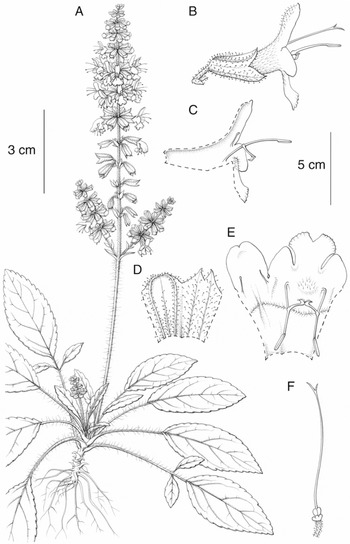
Salvia daiguii sp. nov. A, Habit; B, side view of flower; C, longitudinal section of flower; D, outer view of dissected calyx; E, corolla with stamens reflexed; F, ovary and style. Scale bars: A, 3 cm; B–F, 5 mm. Drawn by Claire Banks, based on D.G. Zhang S0297 (E).

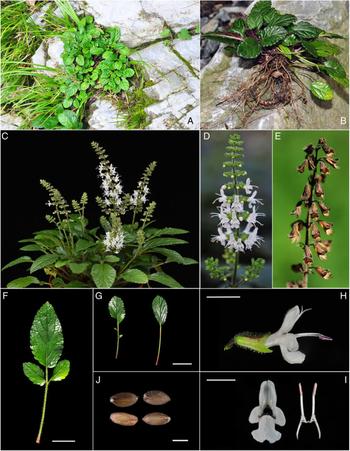
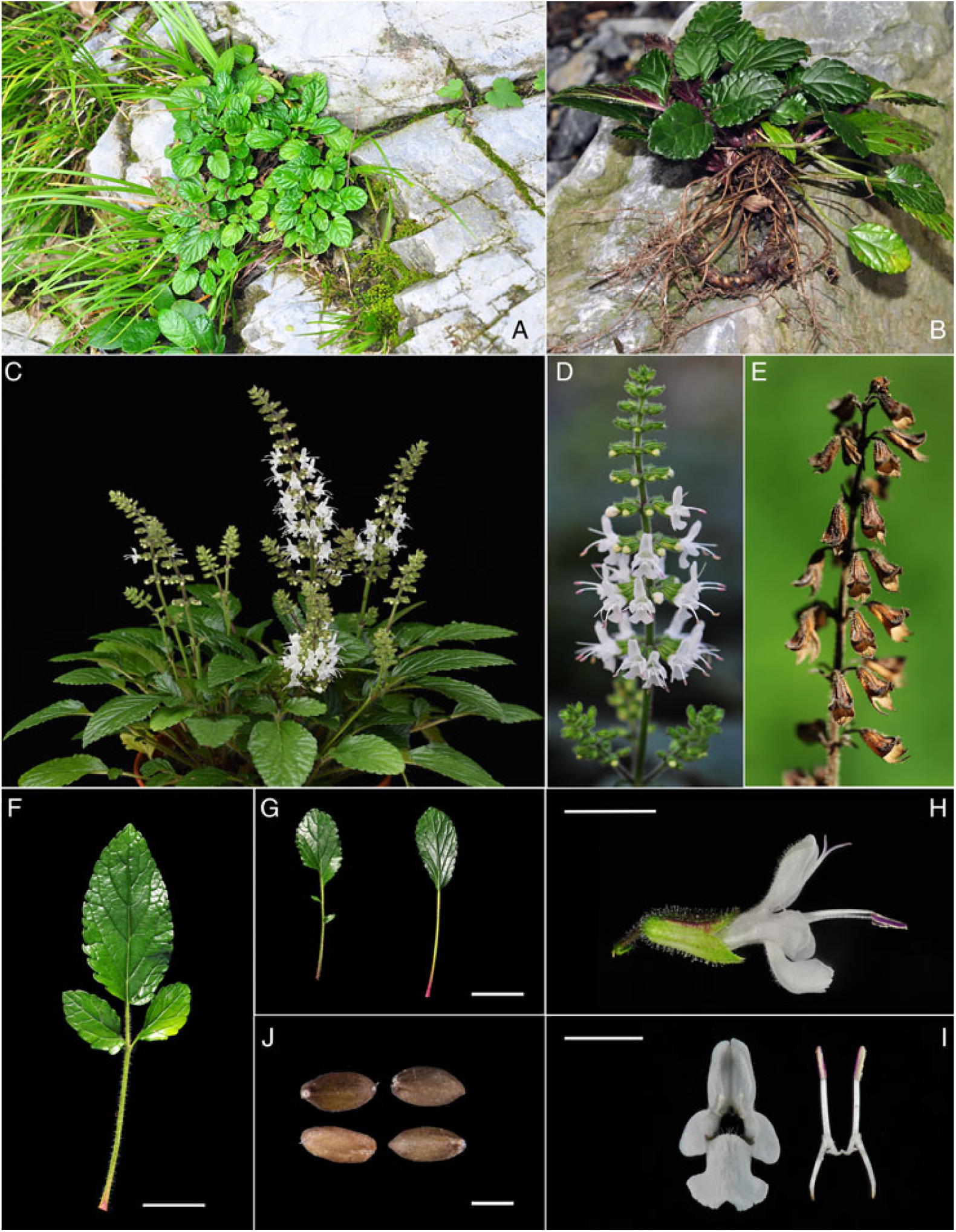
Salvia daiguii sp. nov. A, Plant growing in a crevice in limestone; B, excavated plant showing roots; C, habit; D, inflorescence; E, infructescence; F, leaf; G, leaves showing reduced or absent lateral leaflets; H, flower; I corolla and stamens; J, nutlets. Scale bars: F and G, 4 cm; H and I, 5 mm; J, 1 mm.
Description. Perennial herb, 13–21 cm, roots fibrous. Stem with up to 5 branches below ground, unbranched above. Indumentum of lower stem, petioles and veins puberlous and glandular; inflorescence axis tomentose and densely glandular hairy. Leaves all basal, simple or trifoliolate, with the lateral leaflets sometimes much reduced and very oblique. Petiole usually purplish, 2–14.5 cm. Leaf blade subleathery, obovate to broadly elliptic or ovate, 2–5.9 × 1.2–2.9 cm, apex obtuse, base cuneate to rounded, margin crenate, glabrous above, sparsely puberlous below, denser on the veins. Inflorescence 8–15.5 mm, thyrsoid, a raceme of dense, 6- to 8-flowered verticillasters. Bracts elliptic 5–35 mm, bracteoles ovate to lanceolate, acuminate, 3–4 mm, entire. Pedicels 0.8–2.7 mm, covered with glandular hairs. Calyx tubular-campanulate 4.5–5.9 mm, bilabiate to one-third its length, upper lip rounded, 1.5–2 mm, mucronate, lower lip 2–3 mm, teeth 1.5 mm, acuminate, tube exannulate, glandular outside, sparsely strigillose within. Corolla white, pubescent outside, with glandular and simple hairs, 8–11.5 mm, tube 6–8 mm, 2–4 mm across, annulus 4 mm from base, throat pronounced, with the upper and lower lips spreading at nearly 180°, upper lip 3–5 mm, lower lip c.5 mm, middle lobe obcordate, apex bilobed, c.4 × 6 mm. Stamens exserted 5 mm from the corolla, filaments 2.6–3.2 mm, connective 4.2–5.7 mm, upper arm 2.7–4.1 mm, lower arm 0.8–1.7 mm, upper theca fertile, 1.5 mm, lower theca sterile and fused, boot-shaped. At anthesis upper connective arms close to upper lip of the corolla, later bending downwards until the upper thecae reach the middle lobe of the lower lip of the corolla. Staminodes 1–2 mm. Pistil 10.6–14.1 mm, included or up to 4–6 mm exserted. Nutlets ellipsoid, yellow-brown, c. 2 × 1 mm, apex slightly acute, base rounded, mucilaginous on wetting.
Additional specimens examined. China. Hunan: Zhangjiajie, 600 m, 3 x 2015, Jianjun Zhou 15100303 (CSFI, four duplicates); Tianmenshan, 8 vii 2007, Daigui Zhang 70708009 (Herbarium of Hupingshan National Nature Reserve).
Flowering. June to July.
Fruiting. July to August.
Elevational range. 300–800 m.
Ecology. Rocky streamsides and cliffs, on limestone. Growing in cracks in the rocks and apparently well adapted to intermittent floods.
Distribution. Salvia daiguii is currently known only from Wulingyuan Zhangjiajie, Hunan Province, China, where two populations have been recorded.
Conservation status. Despite extensive searches made in 2011, 2012 and 2015, Salvia daiguii has been observed at only two sites, which are only about 1 km apart and therefore considered to constitute a single locality. There are no more than 200 individuals present at each of the two sites, and the total area of occupancy is 8 km2, so our assessment is CR B2ab(iii) (IUCN Standards and Petitions Subcommittee, 2017).
Discussion
The current taxonomic system classifies the Chinese species of Salvia into three subgenera, Salvia, Allagospadonopsis and Sclarea, based on stamen structure and whether their lower arms are fertile and united (Wu & Li, Reference Wu and Li1977). Recent molecular work has shown that almost all the Salvia species native to East Asia belong to a single clade that has been recognised as a new subgenus, Glutinaria (Raf.) G.X.Hu, C.L.Xiang & B.T.Drew (Hu et al., Reference Hu, Takano, Drew, Liu, Soltis, Soltis, Peng and Xiang2018). Within subgenus Glutinaria there are eight major subclades, which Hu et al. (Reference Hu, Takano, Drew, Liu, Soltis, Soltis, Peng and Xiang2018) treated as sections. Although there is some congruence with Wu & and Li’s (Reference Wu and Li1977) classification, the clades do not correspond well with the existing subgenera, particularly for species from subgenera Allagospadonopsis and Sclarea which are spread across six of the eight new sections.
The newly described Salvia daiguii is most similar to S. cavaleriei and S. prionitis so clearly belongs to section Sobiso (Raf.) G.X.Hu, A.Takano & B.T.Drew. Wu & Li’s (Reference Wu and Li1977) classification relied heavily on the fusion or otherwise of the lower stamen arms and placed these two species in subgenus Sclarea because of their united lower stamen arms. However, this character is unreliable, because in some individuals the lower arms are free, and there are clear morphological differences from the other species in subgenus Sclarea.
Section Sobiso includes two clades: the Salvia lutescens (Koidz.) Koidz. group and the S. chinensis Benth. group. The Salvia lutescens group is made up exclusively of taxa from Taiwan and Japan, and the S. chinensis group (including S. cavaleriei and S. prionitis) has 14 exclusively Chinese species, one species occurring in both China and Japan, and one species that is endemic to Japan. It is in the latter group that Salvia daiguii is placed. Within the Salvia chinensis group, Hu et al. (Reference Hu, Takano, Drew, Liu, Soltis, Soltis, Peng and Xiang2018) observed a distinct staminal character in all the sampled taxa: at anthesis the upper connective arms initially cling closely to the upper lip of the corolla, and then bend downwards gradually until the upper, fertile thecae reach the middle lobe of the lower lip of the corolla. This character is considered to be diagnostic for the Salvia chinensis group.
Key to the Species of the Salvia chinensis Group
1a. Leaves hairy. Upper and lower lips of corolla subrounded, upper lip spreading. Stamens clearly exserted from the corolla ____________________ S. prionitis Hance
1b. Leaves glabrous. Upper and lower lips of corolla oblong, upper lip folded. Stamens included in the corolla or scarcely exserted _______________________________ 2
2a. Cauline leaves simple, sessile or very shortly petiolate. Inflorescence secund. Calyx 6–7 mm. Corolla 12–18 mm long ________________________________________ 3
2b. Cauline leaves usually compound, sometimes simple, petiolate. Inflorescence not secund. Calyx 4–6(–7) mm. Corolla 7–12 mm long __________________________ 6
3a. Corolla 15–18 mm long ________________________________________________ 4
3b. Corolla 12–13 mm long ______________________________________________ 5
4a. Leaf lanceolate, apex attenuate. Corolla tube widening to the throat S. liguliloha Y.Z.Sun
4b. Leaf broadly lanceolate to ovate, apex acute. Corolla narrow with constricted throat_________________________________________________ S. chienii E.Peter
5a. Corolla tube and lower lip pink, upper lip cream. Anhui and Hubei
S. baimaensis S.W.Su & Z.A.Shen
5b. Corolla purple or cream. Jiangxi, Hunan and Fujian _______ S. kiangsiensis C.Y.Wu
6a. Lower arms of stamens modified into a secondary structure, fused or rarely free ____ 7
6b. Lower arms of stamens reduced, free ____________________________________ 9
7a. Plants up to 21 cm. Leaves all basal, simple or trifoliolate, subleathery
S. daiguii Y.K.Wei &Y.B.Huang
7b. Plants up to 30–60 cm. Cauline leaves 2 or 3, simple to 2- or 3-pinnate, papery _____ 8
8a. Cauline leaves 2- to 3-pinnate or deeply bipinnatisect. Corolla white S. filicifolia Merr.
8b. Cauline leaves simple to 1-pinnate. Corolla white to purple or deep purple-red
S. cavaleriei H.Lév.
9a. Calyx tube strigillose-annulate within. Corolla white or blue-purple to pale blue-purple, densely villous or glandular hairy ______________________________________ 10
9b. Calyx tube exannulate. Corolla pale purple or purplish red, sparsely puberulous or glandular ____________________________________________________________ 11
10a. Leaves 1- or 2-pinnate, bipinnatisect or trifoliolate, apex acute to attenuate, closely spaced with short internodes ____________________________ S. japonica Thunb.
10b. Leaves simple or trifoliolate, apex obtuse to rounded, distantly spaced with long internodes ___________________________________________ S. chinensis Benth.
11a. Leaves 1- or 2-pinnate, or deeply bipinnatisect ____________ S. adiantifolia E.Peter
11b. Leaves simple ______________________________________ S. scapiformis Hance
Acknowledgements
This work was supported by Specific Project for Strategic Biological Resources and Technology Supporting System from the Chinese Academy of Sciences (grant no. ZSZY-001) and Chenshan Special Foundations from Shanghai Municipal Administration of Forestation and City Appearances (grant nos. G162408, G172410 and G182409).
The Royal Botanic Garden Edinburgh is supported by the Scottish Government’s Rural and Environment Science and Analytical Services Division. We are also grateful for the support of players of People’s Postcode Lottery towards our scientific research.
The curators of CSFI, E and the Herbarium of Hupingshan National Nature Reserve are thanked for the access to specimens. We also wish to thank Claire Banks for her excellent illustration.
We thank Philip Thomas for his assistance with the Conservation Assessment and the two anonymous reviewers for their helpful comments.