





The genus Symmorphus Wesmael (Hymenoptera: Vespidae) includes 54 species of cavity-nesting wasps found throughout the Holarctic and Oriental realms, as well as in the northern Neotropics (Cumming Reference Cumming1989; Li and Chen Reference Li and Chen2014). Four species are native to North America, where they are generally widespread and commonly encountered predators of insects (Fye Reference Fye1965; Cumming Reference Cumming1989; Buck et al. Reference Buck, Marshall and Cheung2008; Taki et al. Reference Taki, Viana, Kevan, Silva and Buck2008; O’Neill and O’Neill Reference O’Neill and O’Neill2013). Members of this genus are relatively small, slender vespids that range in length from approximately 5 to 12 mm, with little sexual dimorphism (Cumming Reference Cumming1989). The genus can be recognised by the prominent notaulices on the mesoscutum, the unhooked male antennae, and the distinctly narrowed first metasomal tergum (although not petiolate), which has a transverse carina (Buck et al. Reference Buck, Marshall and Cheung2008; Li and Chen Reference Li and Chen2014).
Symmorphus are solitary predatory wasps that provision their nests with the larvae of herbivorous insects – primarily leaf beetles (Chrysomelidae), but also weevils (Curculionidae) and moths (Lepidoptera) (Cumming Reference Cumming1989; Sears et al. Reference Sears, Smiley, Hilker, Müller and Rank2001; Taki et al. Reference Taki, Viana, Kevan, Silva and Buck2008). Species of Symmorphus use preexisting cavities such as plant stems and abandoned burrows to build their nests, creating individual cells out of mud in which to lay their eggs (Edwards Reference Edwards1997; Sears et al. Reference Sears, Smiley, Hilker, Müller and Rank2001; Peeters et al. Reference Peeters, Reemer and van Loon2004). Nest cells are constructed in linear fashion, each one well provisioned with paralysed beetle larvae before being sealed off from the next (Edwards Reference Edwards1997; Sears et al. Reference Sears, Smiley, Hilker, Müller and Rank2001; Peeters et al. Reference Peeters, Reemer and van Loon2004). Adults frequent the flowers of various plants to feed on nectar (Edwards Reference Edwards1997; Sears et al. Reference Sears, Smiley, Hilker, Müller and Rank2001). In the Palaearctic, S. bifasciatus provisions its nests primarily with the larvae of Phratora Chevrolat leaf beetles (Coleoptera: Chrysomelidae) (Edwards Reference Edwards1997; Budrienė Reference Budrienė2003; Peeters et al. Reference Peeters, Reemer and van Loon2004). Notable among its recorded prey species is the imported willow leaf beetle, Plagiodera versicolora (Laicharting), an introduced and widely established pest of willows and poplars (both Salicaceae) in eastern North America (Riley et al. Reference Riley, Clark and Seeno2003).
As of April 2025, the presence of S. bifasciatus in North America had not been formally recognised (Cumming Reference Cumming1989; Li and Chen Reference Li and Chen2014). The earliest record we know of is from a Malaise trap sample collected in Puslinch, Ontario, in 2010 as part of the Barcode of Life initiative (Hebert et al. Reference Hebert, Ratnasingham, Zakharov, Telfer, Levesque-Beaudin and Milton2016), which yielded a single specimen of S. bifasciatus. The species was also detected in Toronto, Ontario, during a 2011–2013 trap-nest study by Moretti et al. (Reference Moretti, Fontana, Carscadden and MacIvor2021), who identified a single specimen. Neither study remarks on its presence as unusual nor on its potential as an invasive species.
Our samples were collected as part of the Bees@Schools programme (www.beesatschools.com), a Canada-wide community outreach programme that aims to engage classrooms and community organisations in citizen science through the use of solitary “bee hotels” (Handler et al. Reference Handler, Coveny, Braukmann, Raine and Steinke2026). The bee hotels were constructed following guidelines developed by Dr. Scott MacIvor at the University of Toronto (Toronto, Ontario; MacIvor Reference MacIvor2017). Bee hotels are prepared at the University of Guelph (Guelph, Ontario) and sent out to participating schools across the country, where they are deployed for the majority of the reproductive season of solitary bees and wasps and then collected and returned in early September. Upon their return, the nests are stored at –20 °C to await further processing. The nests are then opened, and DNA is extracted from the contents of individual tubes. The extracts are then metabarcoded (Taberlet et al. Reference Taberlet, Coissac, Pompanon, Brochmann and Willerslev2012) using cytochrome c oxidase subunit 1 (CO1) primers to identify arthropod communities and ribulose-1,5-bisphosphate carboxylase/oxygenase large subunit (rbcL) primers to identify plant communities within each tube. Protocols for samples collected in 2019–2020 are outlined in Handler et al. (Reference Handler, Coveny, Braukmann, Raine and Steinke2026); protocols used for samples collected in 2021–2022 are outlined by Steinke (unpublished data). For all samples, nest occupancy was determined using a read count threshold of 1000 to ensure reads were not from parasitic species or from visitors. Amplicon sequence variants were cross-referenced using a Hymenoptera reference library based on the BOLD reference database (www.boldsystems.org; Ratnasingham and Hebert Reference Ratnasingham and Hebert2007). This database uses a barcode index number (BIN) system, which exploits species-specific gene sequences to catalogue and identify species (Ratnasingham and Hebert Reference Ratnasingham and Hebert2013). The BIN representing S. bifasciatus (BOLD:AAN3541; https://doi.org/10.5883/BOLD:AAN3541) was established for DNA barcoded specimens from Europe, where the species is considered native.
The presence of S. bifasciatus in the dataset was first noticed in May 2024 during a review of the ecology and phenology of the most abundant Vespidae found in our samples. Noting that its introduction has gone unremarked until now, we first sought to confirm its identity. Of the 74 voucher specimens belonging to the S. bifasciatus BIN (BOLD:AAN3541; https://doi.org/10.5883/BOLD:AAN3541), the specimen collected by Hebert et al. (Reference Hebert, Ratnasingham, Zakharov, Telfer, Levesque-Beaudin and Milton2016) is the only North American representative (sample ID: BIOUG00821-F10). We compared that specimen with others in the BIN system to confirm their identification and conspecificity. We also examined specimens of S. albomarginatus (de Saussure) (BOLD:AAG6372; https://doi.org/10.5883/BOLD:AAG6372), S. canadensis (de Saussure) (BOLD:AAG6364; https://doi.org/10.5883/BOLD:AAG6364), S. cristatus (de Saussure) (BOLD:AAD2004; https://doi.org/10.5883/BOLD:AAD2004), and S. projectus Bohart (BOLD:AEA9612; https://doi.org/10.5883/BOLD:AEA9612). Morphological identifications were performed with the help of the keys in Buck et al. (Reference Buck, Marshall and Cheung2008) and Cumming (Reference Cumming1989). All of the examined specimens are deposited at the Centre for Biodiversity Genomics in Guelph, Ontario. Compared to the four North American species, S. bifasciatus is most similar to S. cristatus.
Below, we provide an updated key to species of Symmorphus in North America. Abbreviated terms in the key include male flagellomere 11 (F11), median ocellar diameter (MOD), first sternum (S1), and first tergum (T1) of metasoma. Specimens illustrated in the key were imaged using a Keyence (Osaka, Japan) VHX-7000 digital microscope system, with their associated sample identifications listed in the figure captions (Figs. 1–4).
First tergum (T1), dorsal view: A, Symmorphus albomarginatus (collection record: CBG-A53662-D01); B, S. projectus (CBG-A24252-A03); C, S. bifasciatus (BIOUG00821-F10); D, S. cristatus (09BBEHY-1215). Scale bars equal 0.5 mm.

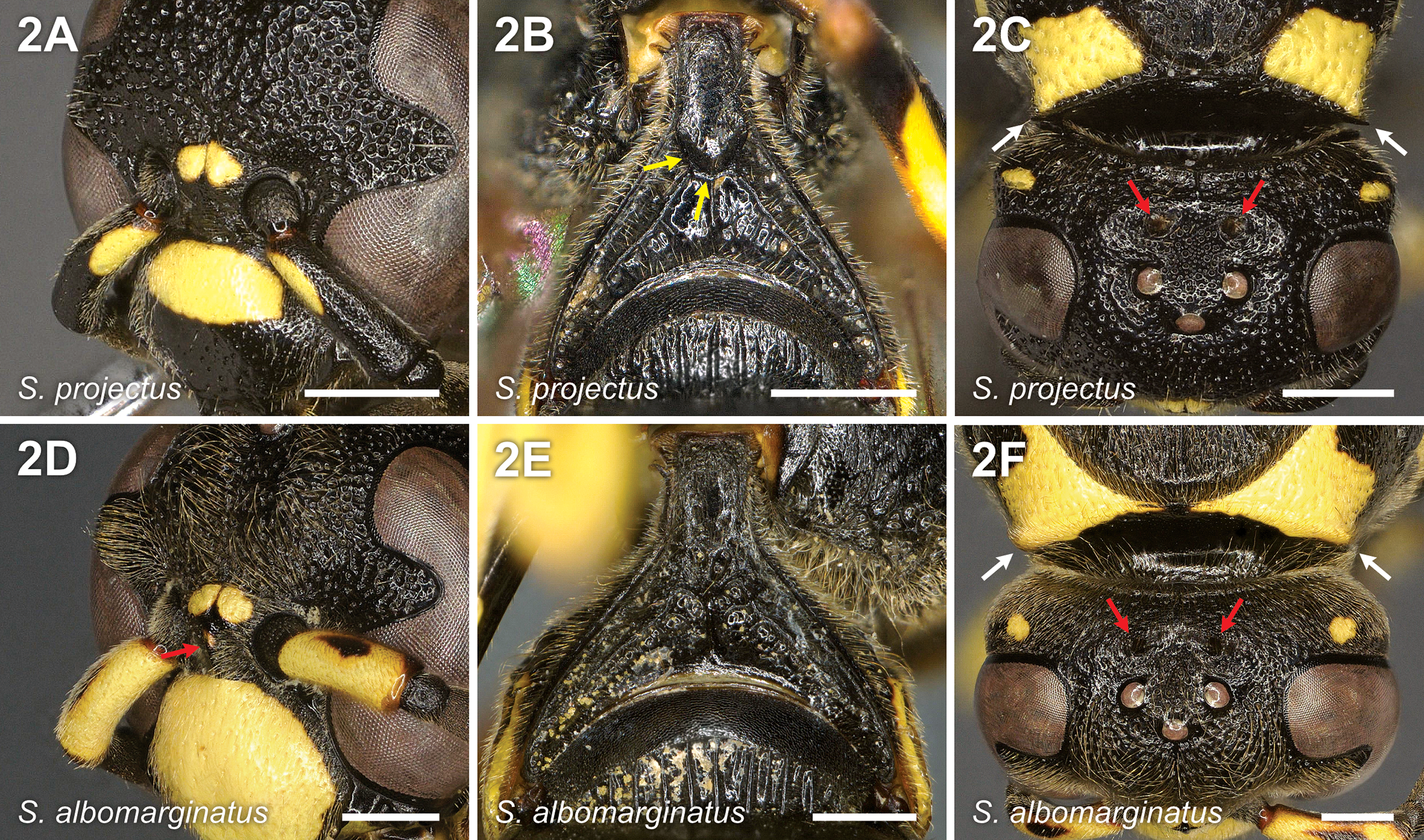
Symmorphus projectus: A, face, oblique view (CBG-A24252-A03); B, first sternum (S1), ventral view, yellow arrows indicate transverse carina (BIOUG49457-B06); C, female head and pronotum, dorsal view, red arrows indicate large cephalic foveae, white arrows indicate produced anterolateral corners of pronotum (BIOUG49457-B06). S. albomarginatus: D, face, oblique view, red arrow indicates interantennal carina (CBG-A53662-D01); E, S1, ventral view, without distinct transverse carina (CBG-A53662-D01); F, female head and pronotum, dorsal view, red arrows indicate smaller cephalic foveae, white arrows indicate anterolateral corners of pronotum (CBG-A53662-D01). Scale bars equal 0.5 mm.
Symmorphus canadensis: A, hind femur, anterior view, yellow arrow indicates short, uniform hairs on ventral margin (BIOUG01034-G12); B, female head, dorsal view, red arrows indicate large cephalic foveae (BIOUG01034-G12). Symmorphus bifasciatus: C, hind femur, anterior view, yellow arrows indicate long, irregular ventral hairs (BIOUG00821-F10); D, female head, dorsal view, red arrows indicate smaller cephalic foveae (BIOUG00821-F10). Scale bars equal 0.3 mm.

Figure 3. Long description
The image contains four photos comparing the hind femurs and female heads of two wasp species, Symmorphus canadensis and Symmorphus bifasciatus. Panel A: A photo of the hind femur of Symmorphus canadensis, viewed from the anterior side. A yellow arrow indicates short, uniform hairs on the ventral margin. Panel B: A photo of the female head of Symmorphus canadensis, viewed from the dorsal side. Red arrows indicate large cephalic foveae. Panel C: A photo of the hind femur of Symmorphus bifasciatus, viewed from the anterior side. Yellow arrows indicate long, irregular ventral hairs. Panel D: A photo of the female head of Symmorphus bifasciatus, viewed from the dorsal side. Red arrows indicate smaller cephalic foveae. Scale bars equal 0.3 millimeters.
Mesepisternum, dorsal area above scrobe (red arrow): A, Symmorphus bifasciatus (collection record: BIOUG00821-F10), punctures densely spaced; B, S. cristatus (08BBHYM-0131), punctures widely spaced. Scale bars equal 0.25 mm.

Key to species of Symmorphus Wesmael in North America
-
1. T1 broad, median postcarinal length 0.44–0.56× apical width of tergum (Fig. 1A and 1B)… 2
-
–. T1 longer, median postcarinal length 0.61–0.83× apical width of tergum (Fig. 1C and 1D)…3
-
2. Interantennal carina absent or very faint (Fig. 2A); S1 with a distinct transverse carina near its midlength (“basal carina” sensu Li and Chen, 2014; Fig. 2B); anterolateral corners of pronotum distinctly and sharply produced (Fig. 2C). Male: F11 slightly shorter than maximum width (0.84–0.94×). Female: cephalic foveae large, separated by approximately 2.0–2.5× their own diameter (Fig. 2C)… S. projectus Bohart
-
–. Interantennal carina distinct (Fig. 2D); S1 without a transverse carina or, if present, then obscure laterally and interrupted medially (Fig. 2E); anterolateral corners of pronotum only weakly produced (Fig. 2F). Male: F11 at least as long as maximum width (1.0–1.2×). Female: cephalic foveae small, separated by more than 4× their own diameter (Fig. 2F) … S. albomarginatus (de Saussure)
-
3. Hair along ventral surface of hind femur very short (length approximately 0.2× MOD), length and density more-or-less uniform (although somewhat sparser distally), resulting in velvety appearance (Fig. 3A). Female: cephalic foveae very large, separated by at most 1.5× their own diameter (Fig. 3B)… S. canadensis (de Saussure)
-
–. Hair along ventral surface of hind femur longer and more irregular (length 0.3–0.5× MOD), longer hairs interspersed with shorter ones, decreasing in length and density distally (Fig. 3C). Female: cephalic foveae smaller, separated by at least 2× their own diameter (Fig. 3D) … 4
-
4. Mesepisternum dorsal of scrobe with large, densely spaced punctures, interspaces smaller than the average puncture diameter (Fig. 4A); T1 noticeably tapered basad (Fig. 1C), carinal width about two-thirds as wide as apical width (0.63–0.68×) and narrower than median postcarinal length (the latter: 0.71–0.77× apical width of tergum). Male: F11 at least as long as maximum width (1.0–1.18×) .… S. bifasciatus (Linnaeus)
-
–. Mesepisternum dorsal of scrobe with large, relatively widely spaced punctures, interspaces typically as large or larger than the largest puncture diameter (Fig. 4B); T1 more squarish (Fig. 1D), carinal width about three-quarters as wide as apical width (0.70–0.78×) and wider than median postcarinal length (the latter: 0.61–0.69× apical width of tergum). Male: F11 much shorter than maximum width (0.55–0.71×) .… S. cristatus (de Saussure)
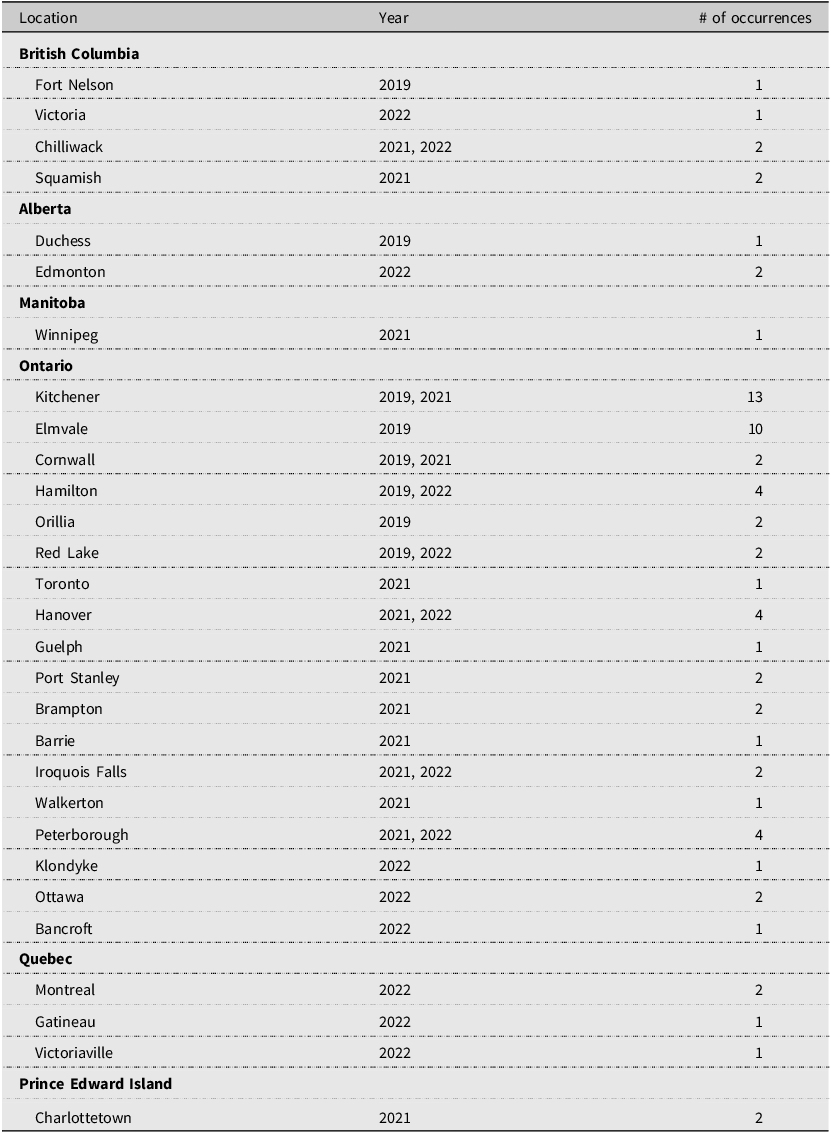
From 2019 to 2022, S. bifasciatus were identified as the main occupant of 72 nest tubes. The remaining eight identifications represent occurrences where S. bifasciatus was detected but was not determined to be the main occupant. It was found most frequently in southern Ontario (55 nests) but was detected as far west as Victoria, British Columbia (1 nest) and as far north as Fort Nelson, British Columbia (1 nest; Table 1; Fig. 5). No specimens of S. bifasciatus were detected in 2020.
Map of sites across Canada where Symmorphus bifasciatus was determined to be the true occupant of a nest. Relative size of points correlates with the number of occurrences at a given site.

Symmorphus bifasciatus was identified as the main occupant of a nest 72 times throughout the four-year sampling period (2019–2022). Location is reported as the nearest major city to the sample site, with a true distance of no more than 5 km. Locations are organised by province, from west to east.

Table 1. Long description
The table presents the occurrences of Symmorphus bifasciatus in different locations across Canada from 2019 to 2022. It has three columns: Location, Year, and Number of occurrences. The table is organized by province, from west to east, and lists the nearest major city to the sample site. Row 1: British Columbia, Fort Nelson, 2019, 1. Row 2: British Columbia, Victoria, 2022, 1. Row 3: British Columbia, Chilliwack, 2021, 2022, 2. Row 4: British Columbia, Squamish, 2021, 2. Row 5: Alberta, Duchess, 2019, 1. Row 6: Alberta, Edmonton, 2022, 2. Row 7: Manitoba, Winnipeg, 2021, 1. Row 8: Ontario, Kitchener, 2019, 2021, 13. Row 9: Ontario, Elmvale, 2019, 10. Row 10: Ontario, Cornwall, 2019, 2021, 2. Row 11: Ontario, Hamilton, 2019, 2022, 4. Row 12: Ontario, Orillia, 2019, 2. Row 13: Ontario, Red Lake, 2019, 2022, 2. Row 14: Ontario, Toronto, 2021, 1. Row 15: Ontario, Hanover, 2021, 2022, 4. Row 16: Ontario, Guelph, 2021, 1. Row 17: Ontario, Port Stanley, 2021, 2. Row 18: Ontario, Brampton, 2021, 2. Row 19: Ontario, Barrie, 2021, 1. Row 20: Ontario, Iroquois Falls, 2021, 2022, 2. Row 21: Ontario, Walkerton, 2021, 1. Row 22: Ontario, Peterborough, 2021, 2022, 4. Row 23: Ontario, Klondyke, 2022, 1. Row 24: Ontario, Ottawa, 2022, 2. Row 25: Ontario, Bancroft, 2022, 1. Row 26: Quebec, Montreal, 2022, 2. Row 27: Quebec, Gatineau, 2022, 1. Row 28: Quebec, Victoriaville, 2022, 1. Row 29: Prince Edward Island, Charlottetown, 2021, 2.
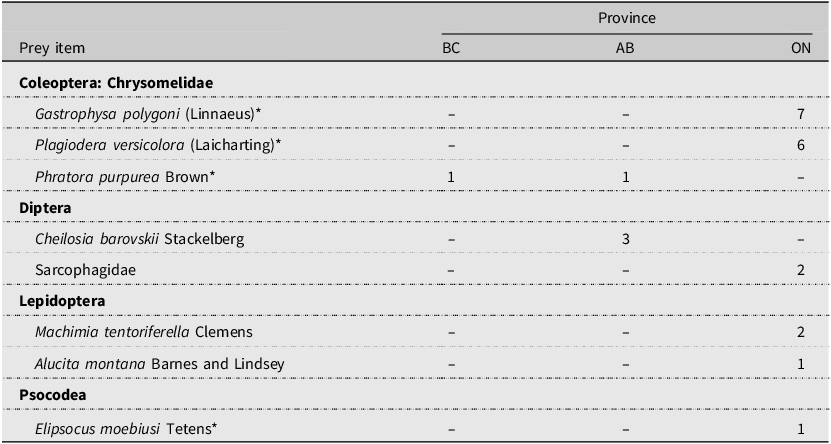
We inferred the dietary preference of S. bifasciatus by identifying potential prey in each nest. All BINs that were detected with more than 1000 reads were assumed to be prey items, provided they were not otherwise considered to be potential predators or competitors. As expected, most of the host prey identified were leaf beetles (Table 2), although two species of moth, Machimia tentoriferella Clemens (Lepidoptera: Depressariidae) and Alucita montana Barnes and Lindsey (Lepidoptera: Alucitidae), and at least two species of fly, Cheilosia barovskii Stackelberg (Diptera: Syrphidae) and at least one unidentified Sarcophagidae, were also identified as host prey. The hover fly Cheilosia barovskii is not known to occur in North America and may represent a misidentification of another species in that genus.
Host prey identified in nests occupied by Symmorphus bifasciatus organised by province, west to east. Prey species marked by an asterisk (*) are considered introduced to Canada. BC, British Columbia; AB, Alberta; ON, Ontario.
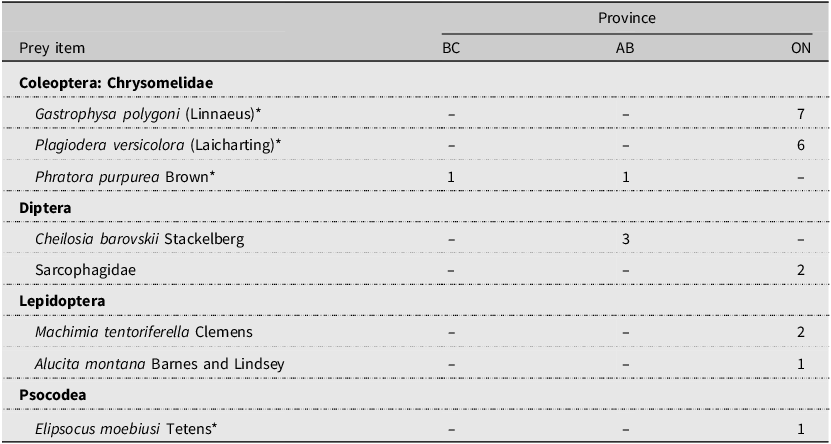
Table 2. Long description
A table listing prey items identified in nests occupied by Symmorphus bifasciatus, organized by province. The table has 4 columns and 10 rows. The columns are labeled ‘Prey item’, ‘BC’, ‘AB’, and ‘ON’. The rows are labeled with different prey items and their respective counts in each province. The prey items are categorized under different orders such as Coleoptera, Diptera, Lepidoptera, and Psocodea. The table includes specific prey items like Gastrophysa polyoni, Plagiodera versicolora, Phratora purpurea, Cheilosia barovskii, Sarcophagidae, Machimia tentoriferella, Alucita montana, and Elipsocus moebiusi. The counts for each prey item vary across the provinces British Columbia, Alberta, and Ontario.
Given that S. bifasciatus is so widely distributed in the Palaearctic – occurring from the United Kingdom, Finland, and Siberia south to Spain, as well as in Turkey and in China (Cumming Reference Cumming1989; Pekkarinen and Huldén Reference Pekkarinen and Huldén1991) – there is perhaps little surprise that this species has become established across Canada. It is difficult to assess the impact that S. bifasciatus’s introduction has had or will have on insect communities in its introduced range; however, we detected S. bifasciatus in more than twice as many nests as its native congeners combined. We also observed several instances where S. bifasciatus was detected alongside another species of Symmorphus, perhaps indicating that it can occasionally usurp the already established nests of its relatives. There were seven instances where S. bifasciatus usurped the nest of S. cristatus, five instances of S. bifasciatus usurping the nests of S. canadensis, and two instances where the nests of S. albomarginatus were usurped. It appears that S. bifasciatus may also usurp the nests of many stem-nesting solitary bees, based on identifications of several species of Megachilidae within the same nest. Megachile mendica Cresson, M. relativa Cresson, M. rotundata (Fabricius), M. campanulae (Robertson), and Osmia caerulescens (Linnaeus) were all detected alongside S. bifasciatus five, three, nine, two, and four times, respectively. In its native range, S. bifasciatus is noted for its contribution to pest control (Pekkarinen and Huldén Reference Pekkarinen and Huldén1991; Budrienė Reference Budrienė2003), particularly in deciduous forests, where it hunts on broad-leaved trees (Budrienė Reference Budrienė2003). Although our results do appear to show that S. bifasciatus preys upon the introduced pest Plagiodera versicolora (Coleoptera: Chrysomelidae) most frequently, this is not to the exclusion of native prey items that are also used by its relatives. Indeed, although it is reported that S. bifasciatus preys primarily on larvae of Phratora beetles (Coleoptera: Chrysomelidae) (Budrienė Reference Budrienė2003), our findings suggest that their dietary preferences are broader than expected. Therefore, it is possible that the introduction of S. bifasciatus has led to increased competition for both resources and nesting sites among native Symmorphus species (Ode et al. Reference Ode, Vyas and Harvey2022) and potentially to a reduction in the ability of the latter to adequately control herbivore populations (Lahey et al. Reference Lahey, McAuslane and Stansly2016). On the other hand, Symmorphus are relatively indiscriminate in their selection of nesting sites, which, besides plant stems, can also include sand banks, dead wood, the walls of buildings, vacated galleries of wood-boring insects, and plant galls (Cumming Reference Cumming1989; Edwards Reference Edwards1997; Budrienė Reference Budrienė2003; Peeters et al. Reference Peeters, Reemer and van Loon2004). Nest site abundance is therefore probably not a limiting factor. Nevertheless, it is clear that S. bifasciatus is established and abundant across Canada, which could have important implications for assessing the health of solitary wasp populations.
Although the exact source of the willow mason wasp’s introduction is unclear at this stage, there is sufficient genetic information generated by the Bees@Schools project to warrant further investigation (beyond the scope of the present note). As with most introductions of plant-nesting Hymenoptera, the most likely scenario is the import of infested materials (Liebhold et al. Reference Liebhold, Brockerhoff, Garrett, Parke and Britton2012; Otis et al. Reference Otis, Taylor and Mattila2023). Because Symmorphus receives relatively little taxonomic attention, other specimens of S. bifasciatus may have been overlooked, misidentified as S. cristatus, or both, and it is therefore possible that this species arrived in Canada even earlier than documented here. We hope that the included identification key and biological details help to reveal more about this introduced species and its impact on ecosystems across North America.
Acknowledgements
The authors thank the participants of the Bees@School project. Financial support for this work was provided by the Food from Thought: Agricultural Systems for a Healthy Planet Initiative, through the Canada First Research Excellence Fund (Project 000054), the Natural Sciences and Engineering Research Council of Canada (NSERC) PromoScience programme, the Canada Foundation for Innovation (MSI 42450), and the New Frontiers in Research Fund (NFRFT-2020-00073).



 Open access

