

Introduction
We are entering the early stages of the “Sixth Mass Extinction” (Ceballos et al. Reference Ceballos, Ehrlich, Barnosky, García, Pringle and Palmer2015), where estimates of the proportion of species to go extinct over the next century are dire (e.g. Urban Reference Urban2015, Carlson et al. Reference Carlson, Burgio, Dougherty, Phillips, Bueno, Clements, Castaldo, Dallas, Cizauskas, Cumming, Doña, Harris, Jovani, Mironov, Muellerklein, Proctor and Getz2017) and species may not be able to adapt quickly enough to respond to climate change (Keogan et al. Reference Keogan, Daunt, Wanless, Phillips, Walling, Agnew, Ainley, Anker-Nilssen, Ballard, Barrett and Barton2018, Radchuk et al. Reference Radchuk, Teplitsky, van de Pol, Charmantier, Hassall, Adamík, Adriaensen, Ahola, Arcese and Avilés2019). This amount of loss may destabilise already compromised ecosystems, while conservation agencies are finding it difficult to plan for the challenges and uncertainties ahead (Armsworth et al. Reference Armsworth, Larson, Jackson, Sax, Simonin, Blossey, Green, Klein, Lester, Ricketts, Runge and Shaw2015). While our best guesses about how and when species will go extinct in the future are largely based on model predictions, much can be gained by studying the spatial, temporal, and mechanistic processes that led to recent extinctions (e.g. Stanton Reference Stanton2014, Bond et al. Reference Bond, Carlson and Burgio2019). Investigating the past may not only allow us to recover some of the natural history lost with the extinction of these species but may also yield important insights that can inform conservation actions now and in the future.
Parrots are one of the most threatened orders of birds, with ˜43% of all species listed as Near Threatened or worse by IUCN (Marsden and Royle Reference Marsden and Royle2015), and they face many different pressures, including habitat loss and trapping (Snyder et al. Reference Snyder, McGowan, Gilardi and Grajal2000). Parrots are often considered “keystone mutualists,” providing many important ecosystem functions (Blanco et al. Reference Blanco, Bravo, Pacifico, Chamorro, Speziale, Lambertucci, Hiraldo and Tella2016). The loss of parrots would affect plant species especially, likely contributing to ecosystem instability. While many parrot species have gone extinct over the past few centuries, most were endemic to islands (Olah et al. Reference Olah, Butchart, Symes, Guzmán, Cunningham, Brightsmith and Heinsohn2016). There is, however, one notable exception – the Carolina Parakeet Conuropsis carolinensis, which had a geographic range an order of magnitude larger than the average for all other recently extinct parrot species (Olah et al. Reference Olah, Butchart, Symes, Guzmán, Cunningham, Brightsmith and Heinsohn2016). Even though Carolina Parakeets were charismatic and were of considerable interest to ornithologists during the 1800s and have received considerable attention by scientists over the last 50–60 years, we know little about how and when they went extinct.
The Carolina Parakeet is one of the four forest-dependent bird species to go extinct within the continental United States since the arrival of Europeans (Pimm and Askins Reference Pimm and Askins1995). Before its decline, the Carolina Parakeet was widely distributed, stretching from the mid-Atlantic coast to Nebraska and south to Florida (Burgio et al. Reference Burgio, Carlson and Tingley2017). The Carolina Parakeet has two subspecies (C. c. ludovicianus and C. c. carolinensis). Accounts of the species show a gradual population decline starting with European colonisation (Snyder and Russell Reference Snyder, Russell and Poole2002). By the early 1800s, Audubon (Reference Audubon1831) noted a marked decline in their population numbers and range, although he still considered them relatively common. During their decline, the species’ range receded from east to west toward the Mississippi River (except in Florida), and from north to south, along the Ohio River, seemingly in concert with the expansion of European settlements, destruction of bottomland forests, and the rise of intensive agriculture (Askins Reference Askins2000).
It is unclear exactly why the Carolina Parakeet went extinct. People shot Carolina Parakeets for sport, food, feathers, scientific collections, and to protect crops, in addition to trapping them for the pet trade (Snyder and Russell Reference Snyder, Russell and Poole2002). Despite lurid accounts by Audubon about the mass shooting by a farmer (Audubon Reference Audubon1831) and a room full of 200 imported Carolina Parakeets in the United Kingdom for the pet trade (Gedney Reference Gedney1877), researchers have dismissed overexploitation as the primary contributor to their extinction (McKinley Reference McKinley1980, Snyder Reference Snyder2004). Others have suggested other potential causes, such as competition for food with other avian species, habitat loss, competition with introduced European honeybees Apis mellifera for nesting/roosting sites, and disease (McKinley Reference McKinley1980, Brunswig et al. Reference Brunswig, Winton and Hamel1983, Pimm and Askins Reference Pimm and Askins1995, Snyder and Russell Reference Snyder, Russell and Poole2002).
Additionally, it is also unclear when the Carolina parakeet went extinct. At the turn of the 20th century, the Carolina Parakeet could be found only in Florida, South Carolina, and a few isolated regions west of the Mississippi River (Hasbrouck Reference Hasbrouck1891, Snyder Reference Snyder2004). The last captive Carolina Parakeet died in a zoo about 100 years ago in 1918. The final “accepted” sighting of the parakeet occurred in Florida in 1920 (Snyder Reference Snyder2004). Still, there were Carolina Parakeet reports into the 1930s and 1940s in Florida and the Carolinas (Snyder Reference Snyder2004), which were likely legitimate (Wright Reference Wright2005).
While extinction is itself a single event, the processes that lead up to it, and how those vary spatially, can be important for understanding the mechanisms involved. This is especially true for continental species with large ranges. With two subspecies separated geographically, determining the variation in extinction date of Carolina Parakeets may suggest that different stressors or processes influenced species’ demise in different areas. Determining exactly when the parakeet went extinct, and how that differed between subspecies, may be the first step in determining how they became extinct, a question that may provide valuable information for parrot conservation. Here, we use a recently published, extensive dataset of Carolina Parakeet occurrence (Burgio et al. Reference Burgio, Carlson and Bond2018), paired with recent advances in extinction date estimation (Solow and Beet Reference Solow and Beet2014, Kodikara et al. Reference Kodikara, Demirhan and Stone2018), to determine when these iconic parakeets went extinct.
Methods
Data collection
We collected and georeferenced locality data from Carolina Parakeet specimens found in natural history collections around the world and observations of the parakeets published in the literature from 1564 to 1944 (see Burgio et al. Reference Burgio, Carlson and Bond2018 for the description of the data collection methods and a link to the freely available dataset). We then split our dataset by subspecies. We considered all occurrence points west of the Appalachian crest and west of Alabama to be C. c. ludovicianus and sites east of the Appalachian divide and east of the state of Mississippi to be C. c. carolinensis. These broad geographic delineations are generally accepted as the two subspecies’ range limits (Ridgway Reference Ridgway1916, Swenk Reference Swenk1934). They are also consistent with the subspecies identifications listed on all 261 labelled museum specimens represented in the dataset for which subspecies was recorded or inferred.
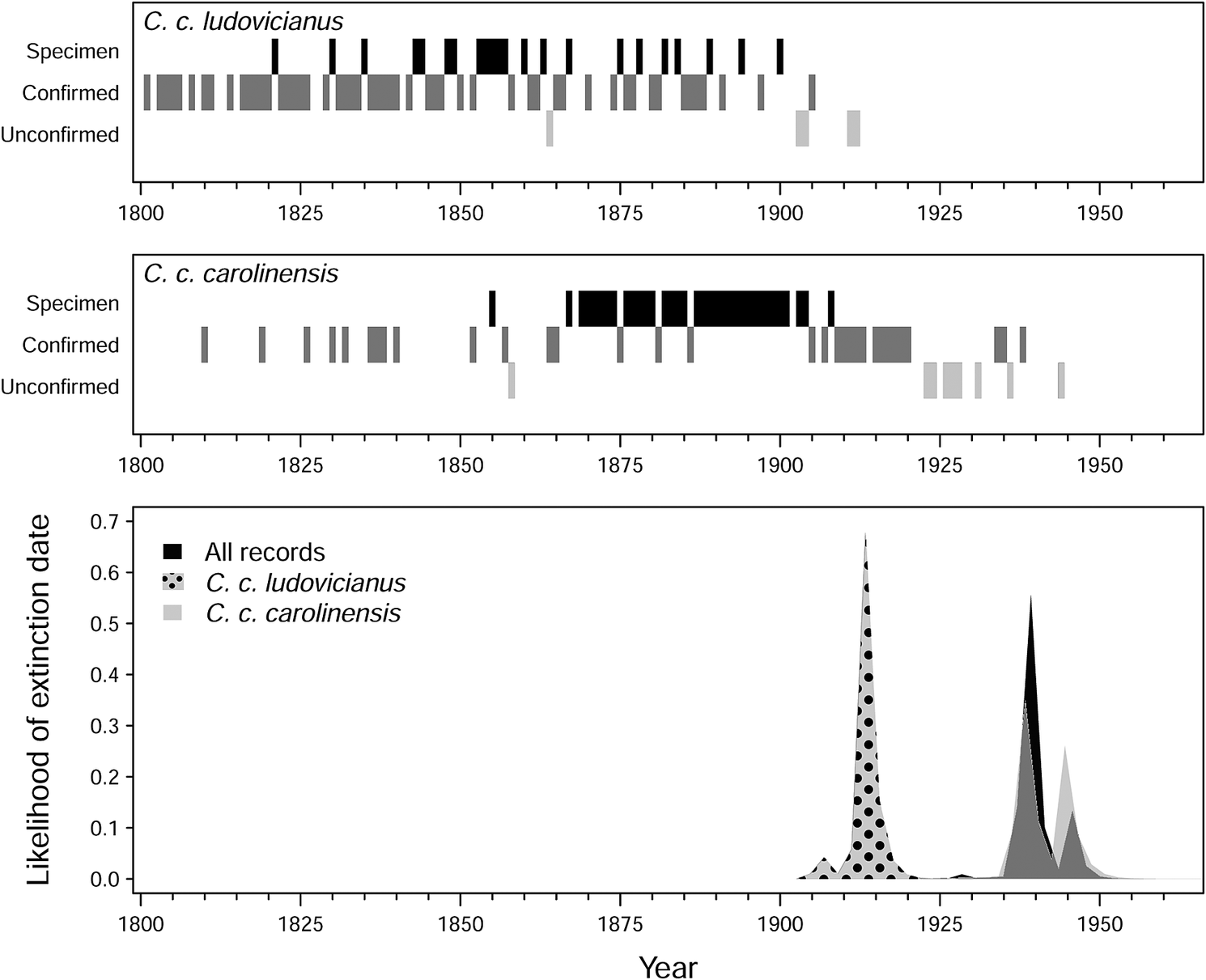
We determined the level of certainty of each observation based on expert opinion from the literature, from Snyder (Reference Snyder2004) and 18 articles by McKinley (Reference McKinley1960, Reference McKinley1964, Reference McKinley1965, Reference McKinley1976, Reference McKinley1977a, Reference McKinley1977b, Reference McKinley1978a, Reference McKinley1978b, Reference McKinley1978c, Reference McKinley1978d, Reference McKinley1979a, Reference McKinley1979b, Reference McKinley1979c, Reference McKinley1979d, Reference McKinley1981, Reference McKinley and Hardy1985, McKinley and James Reference McKinley and James1984, McKinley and Hardy Reference McKinley and Hardy1985). We truncated our analysis at 1800, as observations before 1800 were sporadic due, primarily, to a lack of consistent occurrence records and also because this was the point at which Audubon (Reference Audubon1831) noted decreasing numbers of Carolina Parakeets. We used the entire dataset and designated physical evidence, such as a specimen, as “1”, while observations considered legitimate by expert opinion, but not interrogable in the present as “2”, and controversial as “3”. When individual years had multiple records, we always used the evidence with the highest certainty (Figure 1a, 1b). While the last “official” sighting of the Carolina Parakeet was in 1920 (Snyder Reference Snyder2004), contemporary experts consider the sightings in the Santee swamp area in South Carolina in the 1930s to be legitimate (Snyder Reference Snyder2004, Wright Reference Wright2005); therefore, we treated all reported sightings after 1920 as unconfirmed, aside from those sightings in South Carolina.
a. The sighting record for C. c. carolinensis. b. The sighting record for C. c. ludovicianus. For panels a and b, the top row represents specimen records (black), the middle row represents confirmed observations (dark grey), and the bottom row represents unconfirmed or controversial records (light grey). For each year, we used data with the highest certainty. c. The estimates of likely extinction dates for C. c. ludovicianus (grey with black dots), C. c. carolinensis (light grey), and for all records (black); note, overlap between all records and C. c. carolinensis is represented by dark grey.

Analyses
We estimated the date of extinction for all Carolina parakeets generally and both subspecies specifically. Given that our dataset combined physical evidence (specimens) and observations with varying degrees of reliability, we used the Bayesian extinction estimating equations proposed by Solow et al. (Reference Solow, Smith, Burgman, Rout, Wintle and Roberts2012) and modified by Solow and Beet (Reference Solow and Beet2014). We ran the analyses in the R package “spatExtinct” (Carlson et al. Reference Carlson, Burgio, Dallas and Bond2018a). This modelling approach weighs various types of evidence-based on their reliability (Solow et al. Reference Solow, Smith, Burgman, Rout, Wintle and Roberts2012) and considers the validity of certain and uncertain sightings independently (Boakes et al. Reference Boakes, Rout and Collen2015, Kodikara et al. Reference Kodikara, Demirhan and Stone2018), which is especially useful in inferring extinction dates (τE) of recently extinct species with both specimen and observation data (Carlson et al. Reference Carlson, Bond and Burgio2018b, Bond et al. Reference Bond, Carlson and Burgio2019). The general equation is as follows (from Solow and Beet Reference Solow and Beet2014; Equation 1):
 $$ p\left(E|t\right)=\frac{p\left(t|E\right)p(E)}{p\left(t|E\right)p(E)+p\left(t|\overline{E}\right)\left(1-p(E)\right)} $$
where
 $ E $
is the event the species went extinct;
 $ \overline{E} $
is when it did not; and
 $ t $
is the complete sighting record (
 $ t={t}_1<{t}_2<\dots <{t}_n $
). Of the two models presented in Solow and Beet (Reference Solow and Beet2014), we used “Model 2” because some of the “uncertain” observations are from reportedly dubious sources (e.g., egg hunters with a vested interest in selling more expensive Carolina Parakeet eggs) and “Model 2” is appropriate when uncertain sightings are more likely invalid (Kodikara et al. Reference Kodikara, Demirhan and Stone2018). “Model 2” modifies the above equation as follows (from Solow and Beet Reference Solow and Beet2014; Equation 9):
 $$ p\left(t|{\tau}_E\right)=p\left({t}_c|{\tau}_E\right)\;p\left({t}_u|{\tau}_E\right) $$
where
 $ {t}_c $
and
 $ {t}_u $
are the sets of certain and uncertain sighting times, respectively. We ran these analyses independently for each subspecies (C. c. carolinensis: n = 76; C. c. ludovicianus: n = 80) and both subspecies together (n = 116).
Results
We estimated that the eastern subspecies, C. c. carolinensis, likely went extinct somewhere in the late 1930s or the mid-1940s, with the two most likely values for τE in 1938 and 1944 (Figure 1c) while the western subspecies, C. c. ludovicianus, went extinct 25–30 years earlier; the most likely value for τE was 1913 (Figure 1c). When considering both subspecies together, the extinction estimate does not differ much from the estimate for C. c. carolinensis since the highest probability of τE was 1939 (Figure 1c); however, failing to consider each subspecies individually obscures important distinctions between the two, which may help to determine causation in the future.
Discussion
The two subspecies of the Carolina Parakeet appeared to go extinct ˜30 years apart, far later than currently believed, beyond the currently accepted date of 1920. The most recent analysis that estimated they went extinct around 1915 (Elphick et al. Reference Elphick, Roberts and Reed2010). However, Elphick et al. (Reference Elphick, Roberts and Reed2010) used a less complete dataset and did not take into account uncertain sightings. While dismissed at the time (Snyder Reference Snyder2004), our results lend credibility to the sightings in South Carolina in the late 1930s. It is even possible that the observation from North Carolina in 1944 reported to Roger Tory Peterson (Snyder Reference Snyder2004) may have been accurate, as well as the mystery population of Carolina Parakeets in Florida reported by ornithologist Oscar Baynard to persist well into the late 1930s, but for which he refused to disclose the location (Snyder Reference Snyder2004). That the western subspecies went extinct first despite occupying a more extensive range (Burgio et al. Reference Burgio, Carlson and Tingley2017) is curious and suggests a lower initial population or different or more severe pressures.
Learning the most likely extinction dates of the two subspecies of the Carolina Parakeet is the first of many steps needed to solve the mystery that has eluded researchers for over 50 years. That the two subspecies went extinct 30 years apart is an important clue that has implications for how we interpret the loss of this species and consider the factors that pushed a species that appeared stable in 1800 to be found only in small populations in remote areas less than 100 years later.
Beyond anecdotes about widespread shooting, like Audubon’s account (Reference Audubon1831) and Gedney’s (Reference Gedney1877) observation of hundreds of imported individuals for the pet trade, there is no direct evidence to suggest overexploitation as the main driver of the Carolina Parakeet’s decline; in fact, McKinley (Reference McKinley1980) points out that populations may have already declined substantially before trapping and shooting began in earnest. If true, that may make overexploitation more of a “nail in the coffin” rather than the reason they were “in the coffin” in the first place. However, if overexploitation was the leading driver of the Carolina Parakeet’s extinction, the 30-year difference in extinction dates may be consistent with trapping practices, as trappers often deplete an area before moving on to the next. Additionally, it is important to note that around the same time, another wide-ranging, continental parrot species, the Glaucous Macaw Anodorhynchus glaucus, went extinct, likely due to the loss of palm groves and pet-trade demands from Europe in the 19th century (Yamashita and Valle Reference Yamashita and Valle1993, Juniper and Parr Reference Juniper and Parr1998).
Instead of overexploitation, both McKinley (Reference McKinley1980) and Snyder (Reference Snyder2004) suggested disease as the most likely factor leading to the Carolina Parakeet’s extinction, despite there being only anecdotal evidence of parrots exhibiting any symptoms associated with illness, and most of these observations are of captive birds, making post-hoc diagnoses difficult at best. Since the Carolina Parakeet’s range did not overlap with other parrot species, they may have been especially susceptible to any new diseases brought in with domesticated poultry or parrots imported to the United States as pets. Snyder and Russell (Reference Snyder, Russell and Poole2002) suggested that Carolina Parakeets’ affinity for foraging on farms may have brought them into close contact with domesticated poultry, which may have contributed to disease transmission. It may be possible that psittacosis (or any disease for that matter) was introduced to Carolina Parakeets after European colonisation and spread throughout their populations over time. While a recent genomic study of one individual Carolina Parakeet (collected at an unknown date or location) found no evidence of disease (Gelebert et al. Reference Gelabert, Sandoval-Velasco, Serres, de Manuel, Renom, Margaryan and Mañosa2020), this analysis of one individual specimen is far from conclusive in disproving disease as the primary driving force of the parakeet’s extinction.
If disease was the leading cause of extinction, differences in behavior and migratory patterns between the two subspecies might explain why there was a 30-year gap between extinction estimates for each. For instance, the western subspecies likely shifted their range seasonally (Burgio et al. Reference Burgio, Carlson and Tingley2017) and frequently congregated in huge flocks at local salt licks (Snyder Reference Snyder2004), while the eastern subspecies did not. These movements and congregations may have led to higher transmission rates, much as seasonal aggregation and affinity for bird feeders help spread conjunctivitis Mycoplasma gallisepticum among House Finches Carpodacus mexicanus; Hosseini et al. Reference Hosseini, Dhondt and Dobson2004, Altizer et al. Reference Altizer, Hochachka and Dhondt2004). Subsequently, this increased transmission level may explain the earlier extinction of C.c. ludovicianus, despite the fact that their range was more extensive than the eastern subspecies C.c. carolinensis.
Of the remaining potential causes, limitations in both landscape change data and occurrence data may make it difficult to rule out habitat loss as a significant factor (but see Pimm and Askins Reference Pimm and Askins1995). In addition to the work done by Gelabert et al. (Reference Gelabert, Sandoval-Velasco, Serres, de Manuel, Renom, Margaryan and Mañosa2020), advances in genetic analyses, as found with passenger pigeons Ectopistes migratorius (Hung et al. Reference Hung, Shaner, Zink, Liu, Chu, Huang and Li2014) or examining the better-preserved specimens in natural history museums for signs of disease (e.g. Rothschild and Panza Reference Rothschild and Panza2005) may help shed light on what ultimately drove the Carolina Parakeet to extinction. The Carolina Parakeet was a wide-ranging species and faced challenges of the rapid agricultural expansion and industrialization of the United States during the 20th century, a process being repeated today in many areas where parrots are found.
By examining extinction at the subspecies or population level, we can better understand the mechanisms that result in species’ disappearance. The 30-year gap between the extinction of C.c. ludovicianus and C.c. carolinensis highlight that these taxa may have been under different pressures of varying intensities or may have differed in their responses. For continental species, understanding the spatial patterns of extinction can be just as informative as the temporal patterns.
Acknowledgements
K. Burgio was supported by a National Science Foundation GRFP grant # DGE-0753455 and a National Science Foundation NRT-IGE grant #1545458 to M. Rubega.