Introduction
Amnestic mild cognitive impairment (aMCI) is a risk state for Alzheimer's disease (AD) that is characterized by a deficit in memory with preserved daily functioning (Petersen, Reference Petersen2004). Over the years, several MCI subtypes have been identified that are thought to represent the prodromal stage of various dementias (e.g., nonamnestic MCI has been associated with frontotemporal dementia and dementia with Lewy bodies; Petersen, Reference Petersen2004). To date, aMCI has been the most commonly studied subtype, with the majority of research focusing on memory. Individuals with aMCI show poor retention or consolidation of information (e.g., Crowell, Luis, Vanderploeg, Schinka, & Mullan, Reference Crowell, Luis, Vanderploeg, Schinka and Mullan2002), as well as difficulties with acquisition and ineffective memory strategy use (e.g., Greenaway et al., Reference Greenaway, Lacritz, Binegar, Weiner, Lipton and Cullum2006; Ribeiro, Guerreiro, & De Mendonça, Reference Ribeiro, Guerreiro and De Mendonça2007). The memory impairments are thought to be the result of early neuropathological changes seen in the hippocampus and related structures in individuals with aMCI (Apostolova et al., Reference Apostolova, Morra, Green, Hwang, Avedissian and Woo2010; Jack et al., Reference Jack, Petersen, Xu, O'Brien, Smith, Ivnik and Kokmen1999), as well as AD-related changes in prefrontal regions (Braak & Braak, Reference Braak and Braak1991; Perry & Hodges, Reference Perry and Hodges1999). To date, a few studies have shown reduced memory strategy use in aMCI relative to controls (Bröder, Herwig, Teipel, & Fast, Reference Bröder, Herwig, Teipel and Fast2008; Malek-Ahmadi, Raj, & Small, Reference Malek-Ahmadi, Raj and Small2011; Price et al., Reference Price, Kinsella, Ong, Mullaly, Phillips, Pangnadasa-Fox and Storey2010; Ribeiro et al., Reference Ribeiro, Guerreiro and De Mendonça2007); however, there is a dearth of research investigating whether individuals with aMCI display a similar pattern of deficiencies in strategy use as AD patients (see Perri et al., Reference Perri, Carlesimo, Serra and Caltagirone2005, for a comparison between aMCI and AD strategy use).
Semantic clustering is an effective memory strategy that can be used to enhance recall. Here, participants actively reorganize items based on a shared semantic feature and then recall the words according to their superordinate category (e.g., recalling all “food” items followed by “jewelry” items; Delis, Kramer, Kaplan, & Ober, Reference Delis, Kramer, Kaplan and Ober2000). By “chunking” large amounts of information into smaller units, individuals can efficiently encode, store, and retrieve information more readily from memory (Baddeley, Reference Baddeley2001). Several methods have been developed to measure clustering (Stricker, Brown, Wixted, Baldo, & Delis, Reference Stricker, Brown, Wixted, Baldo and Delis2002), including recall-based and list-based approaches. In recall-based methods, semantic clustering is calculated by using chance-expectancy scores based on the number of words recalled. Therefore, this method assumes that the organizational process occurs after the words are retrieved from memory, which may not accurately reflect this strategic process. Mori (Reference Mori1975) showed that when participants detected the semantic category of the list items at learning, memory and semantic clustering performance improved at recall. In contrast, providing undetected categories to participants at recall did not improve memory or semantic clustering performance. As such, Mori suggested that category clustering is not a product of retrieval but rather a product of the storage process (i.e., encoding and/or consolidation). In addition, Cinan (Reference Cinan2003) found that semantic clustering of list items was disrupted by dual task performance at learning, but not by dual task performance at recall. Consistent with these data, Delis and colleagues (Delis et al., Reference Delis, Kramer, Kaplan and Ober2000; Stricker et al., Reference Stricker, Brown, Wixted, Baldo and Delis2002) developed a list-based method. In this approach, semantic clustering is calculated using the chance-expectancy score derived from the number of words on the to-be-remembered list, thus avoiding the assumption that semantic clustering occurs after recall has already been performed.
In healthy controls, semantic clustering is subserved by the prefrontal and medial temporal regions (Becker & Lim, Reference Becker and Lim2003; also see Alexander, Stuss, & Fansabedian, Reference Alexander, Stuss and Fansabedian2003, for intact clustering in patients with focal frontal lobe lesions) and is traditionally thought to be dependent, in part, on executive control. However, several studies have reported no significant relationship (Gaines, Shapiro, & Benedict, Reference Gaines, Shapiro and Benedict2006) or only modest associations (Malek-Ahmadi et al., Reference Malek-Ahmadi, Raj and Small2011; Tremont, Halpert, Javorsky, & Stern, Reference Tremont, Halpert, Javorsky and Stern2000) between traditional measures of executive functioning (e.g., Trail Making Test – Part B) and semantic clustering.
Poor semantic clustering may be related more to a breakdown in semantic networks rather than executive dysfunction. The semantic network model proposes that one's general fund of knowledge is organized into complex associative networks in temporal and parietal cortices (Salmon, Reference Salmon2012) or more diffusely in the cortex (Fuster, Reference Fuster2003), with concepts that share many attributes being more strongly associated than those concepts that have fewer commonalities (Collins & Loftus, Reference Collins and Loftus1975; Fuster, Reference Fuster2003). For example, a cow and a pig would be more strongly associated within one semantic network than a cow and a chair, because these concepts share more salient attributes, such as being four-legged farm animals that are relatively similar in size. The theory of spreading-activation (Collin & Loftus, 1975) suggests that when a concept is processed, activation spreads throughout the semantic network along a decreasing gradient related to concept associations. That is, activation is inversely related to the strength of the associations between concepts within the network (e.g., the concept cow would be more likely to activate the concept pig than chair). Therefore, through spreading activation, memory performance is facilitated when words are more closely related. As neuropathological abnormalities in the temporal and parietal regions are evident early in the disease course, it is not surprising that AD patients show robust deficits in semantic processing relative to healthy controls (e.g., Huff, Corkin, & Growdon, Reference Huff, Corkin and Growdon1986). In fact, a hallmark feature of AD is a breakdown in semantic networks (e.g., Chan, Salmon, & Butters, Reference Chan, Salmon and Butters1998).
The ability to use semantic clustering to improve memory performance is contingent upon the integrity of the associated semantic network. Price and colleagues (2010) explored the relative contribution of both executive and semantic processing to clustering on the Hopkins Verbal Learning Test (HVLT). They found that select measures of executive functioning did not predict clustering in participants with aMCI (also see Malek-Ahmadi et al., Reference Malek-Ahmadi, Raj and Small2011 for similar results). In contrast, semantic processing (i.e., semantic fluency, the ability to rapidly generate a series of semantically related words) predicted clustering performance in individuals with aMCI. They suggested that poor clustering reflects a breakdown in semantic associations, which is consistent with evidence of semantic processing impairments in aMCI (e.g., Adlam, Bozeat, Arnold, Watson, & Hodges, Reference Adlam, Bozeat, Arnold, Watson and Hodges2006; Murphy, Rich, & Troyer, Reference Murphy, Rich and Troyer2006).
Relative to healthy older adults, individuals with aMCI show impaired semantic clustering during learning and delayed recall. More specifically, Malek-Ahmadi and colleagues (2011) found reduced semantic clustering during learning and delayed recall trials on the HVLT using the recall-based method. Likewise, other researchers have shown aMCI-related reductions in semantic clustering across learning trials using the list-based approach on the HVLT (Price et al., Reference Price, Kinsella, Ong, Mullaly, Phillips, Pangnadasa-Fox and Storey2010) and the recall-based approach on an experimentally developed word-list recall task (Perri et al., Reference Perri, Carlesimo, Serra and Caltagirone2005). In the latter two studies, aMCI participants failed to show improvements in semantic clustering with repeated exposure to the list. Although Perri and colleagues (Reference Perri, Carlesimo, Serra and Caltagirone2005) included an AD group in their study, they did not investigate semantic clustering during delayed recall. Additionally, they used the recall-based approach when calculating semantic clustering scores. As such, it is unclear whether aMCI and AD participants display a similar pattern of semantic clustering deficits across learning and delayed recall trials using the list-based approach. Furthermore, to our knowledge, there have been no studies exploring semantic clustering in nonamnestic MCI. Considering that individuals with nonamnestic MCI can present with executive and semantic processing deficits (Petersen, Reference Petersen2004), these individuals may display a distinct pattern of semantic clustering from persons with aMCI. In the present study, we address these issues by examining semantic clustering in aMCI, nonamnestic MCI, and AD across learning and delayed recall trials on the California Verbal Learning Test-II (CVLT-II) using a list-based approach.
Changes in strategy use in aMCI may be due to the lack of spontaneous use of these compensatory methods. Ribeiro et al. (Reference Ribeiro, Guerreiro and De Mendonça2007) found that relative to controls, aMCI participants showed reduced semantic clustering on total learning, short-delay, and long-delay recall trials. However, aMCI participants showed improved semantic clustering after they were given semantic cues. Ribeiro et al. (Reference Ribeiro, Guerreiro and De Mendonça2007) proposed that this poor spontaneous use of semantic clustering in aMCI may reflect impaired executive functioning, difficulties detecting the semantic structure of the list, or some combination of the two.
Another important component of our study was the investigation of whether poor semantic clustering was associated with later development of aMCI in healthy controls and the progression to AD. There is evidence to suggest that poor recall performance and executive dysfunction are robust predictors of progression to AD in MCI participants (e.g., Albert, Moss, Tanzi, & Jones, Reference Albert, Moss, Tanzi and Jones2001); however, despite the disrupted semantic networks in AD, few studies have explored whether changes in semantic clustering are also associated with the development of dementia. Furthermore, there is limited research exploring the cognitive factors that predict aMCI development beyond memory deficits. As such, we investigated whether clustering at baseline testing differed between converters (controls to aMCI and aMCI to AD) and non-converters.
In sum, the present study investigated semantic clustering during learning (first and fifth learning trials) and recall trials (short-delay and long-delay free recall trials) in aMCI, nonamnestic MCI, and AD groups. We hypothesized that individuals with aMCI would display an intermediate level of semantic clustering across trials relative to the control and AD groups. We also expected the nonamnestic MCI group to show more efficient semantic clustering relative to the aMCI and AD groups. Finally, we predicted that reduced semantic clustering at baseline would be related to the development of aMCI in healthy controls, as well as to the progression to AD in aMCI participants at follow-up.
Methods
Participants
All data were collected in compliance with UCLA Institutional Review Board guidelines. Fifty-three healthy older adults (OA), 82 individuals with aMCI, 30 persons with nonamnestic MCI (naMCI), and 30 individuals with AD participated in the study. All were participants in the University of California, Los Angeles (UCLA) Alzheimer's Disease Research Center longitudinal study. Exclusion criteria included non-degenerative and non-vascular causes of cognitive impairment, unstable medical conditions (e.g., active uncontrolled diabetes, organ failure, etc.), and major psychiatric disorder (e.g., recurrent depression, schizophrenia).
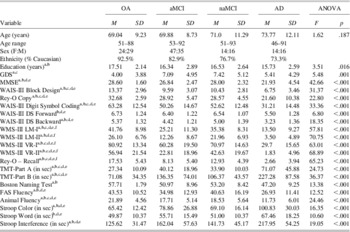
Participants underwent neurological and neuropsychological evaluations. See Table 1 for descriptive demographics and a summary of the neuropsychological test scores for each group. Diagnoses were determined during consensus conferences and were based on the National Institute of Neurologic and Communicative Disorders and Stroke and the AD and Related Disorders Association (NINCDS-ADRDA) criteria for AD (McKhann et al., Reference McKhann, Drachman, Folstein, Katzman, Price and Stadlan1984) and the Petersen (Reference Petersen2004) criteria for MCI. A diagnosis of MCI was given to an individual who exhibited a cognitive impairment (i.e., at least 1.5 SD below the age- and/or education-adjusted norms) on at least one neuropsychological measure (Attention: WAIS-III Digit Span and Digit Symbol Coding, Wechsler, Reference Wechsler1997a; Trail Making Test [TMT] – Part A, Tombaugh, Reference Tombaugh2004; Visuospatial: WAIS-III Block Design, Wechsler, Reference Wechsler1997a; Rey-O copy, Meyers & Meyers, Reference Meyers and Meyers1995; Language: Boston Naming Task, Kaplan, Goodglass, & Weintraub, Reference Kaplan, Goodglass and Weintraub1983; Semantic Fluency [animals], Tombaugh, Kozak, & Rees, Reference Tombaugh, Kozak and Rees1999; Memory: WMS-III Logical Memory II and Visual Reproduction II, Wechsler, Reference Wechsler1997b; Rey-O 3-min delay, Meyers & Meyers, Reference Meyers and Meyers1995; CVLT-II long delay free recall, Delis et al., Reference Delis, Kramer, Kaplan and Ober2000; Executive: TMT-Part B, Tombaugh, Reference Tombaugh2004; Phonemic Fluency [FAS], Tombaugh et al., Reference Tombaugh, Kozak and Rees1999; Stroop – Interference; Demick & Harkins, Reference Demick and Harkins1997), in the context of generally intact activities of daily living. To avoid circularity, semantic clustering was never used as a criterion for the diagnoses of MCI and AD. All controls scored above −1.5 SD on their age and/or education-adjusted norms on the neuropsychological measures. The aMCI group consisted of 20 single domain and 62 multidomain participants; whereas the naMCI group consisted of 8 single domain and 22 multidomain participants.Footnote 1 The AD group included 23 participants with mild dementia (MMSE scores ≥21) and 7 participants with moderate dementia (MMSE scores = 10–20). As part of the longitudinal study, follow-up diagnostic information was available for a subset of control and MCI participants (number of follow-up visits ranged from 1 to 8 years).
Demographic variables and neuropsychological test scores for each group

Note. GDS = Geriatric Depression Scale (raw score out of 30; N = 178; Brink et al., Reference Brink, Yesavage, Lum, Heersema, Adey and Rose1982); MMSE = Mini-Mental State Examination (raw score out of 30; N = 195; Folstein, Folstein, & McHugh, Reference Folstein, Folstein and McHugh1975); WAIS-III = Wechsler Adult Intelligence Scale – 3rd Edition; Block Design (age-corrected scaled scores; N = 190; Wechsler, Reference Wechsler1997a); Rey-O (raw score out of 36; N = 194; Meyers & Meyers, Reference Meyers and Meyers1995); Digit Symbol Coding (N = 181; Wechsler, Reference Wechsler1997b); DS = Digit Span (longest digit length; N = 181; Wechsler, Reference Wechsler1997b); WMS-III = Wechsler Memory Scale – 3rd Edition; LM = Logical Memory (raw score out of 75 and 50 for LM-I and LM-II, respectively; N = 182; Wechsler, Reference Wechsler1997b); VR = Visual Reproduction (raw score out of 104; N = 195; Wechsler, Reference Wechsler1997b); TMT = Trail Making Test (N = 194 for part A and N = 190 for part B; Strauss et al., Reference Strauss, Sherman and Spreen2006); Boston Naming Test (N = 180); FAS and Animal Fluency (N = 195); Stroop (N = 189 for color and word trials, and N = 152 for interference). Non-Caucasian participants included African-American (n = 17), Hispanic (n = 11), and Asian (n = 5) individuals. Multiple one-way ANOVAs were completed on the demographic and neuropsychological data, with post hoc comparisons completed using a Dunnett's T3 procedure (equal variances not assumed).
aSignificant difference between OA and aMCI groups (p < .05).
bSignificant difference between OA and AD groups (p < .05).
cSignificant difference between OA and naMCI groups (p < .05).
dSignificant difference between aMCI and AD groups (p < .05).
eSignificant difference between naMCI and AD groups (p < .05).
fSignificant difference between naMCI and aMCI groups (p < .05).
Measures
Chance-adjusted semantic clustering scores from the CVLT-II (Delis et al., Reference Delis, Kramer, Kaplan and Ober2000) were used to assess each participant's strategy use.Footnote 2 The CVLT-II is a standardized list-learning task, in which participants are presented with 16 words that can be grouped into four semantic categories: furniture, ways of travelling, vegetables, and animals. The list is presented orally across five learning trials, and recall performance is obtained after each trial. A second distractor list of words is then presented, followed by free recall for this list. Following the distractor trial, participants are administered short-delay free recall, short-delay cued recall (semantic categories are provided as a cue), long-delay (20-min) free recall, long-delay cued recall, and recognition trials for the first list.
Using the list-based approach (Stricker et al., Reference Stricker, Brown, Wixted, Baldo and Delis2002), we examined participants’ raw chance-adjusted semantic clustering scores from learning trials 1 and 5, short-delay free recall, and long-delay free recall trials. A semantic cluster includes consecutive recall of a pair of categorically related words. To control for clustering that may occur by chance, the list-based clustering index (LBC) is calculated by subtracting the chance-expected clustering (EXP) score from the observed clustering score (OBS; total number of consecutive word pairs recalled) based on the number of words from the original list, as can be seen below:
 $${\rm{LBC}}\, = \,{\rm{OBS}}\,{\rm{ - }}\,{\rm{EXP}}\left[ {\left( {r\,{\rm{ - }}\,{\rm{1}}} \right)\,\left( {m\,{\rm{ - }}\,1} \right)/{{N}_{\rm{L}}}\,{\rm{ - }}\,1} \right],$$
where r = the number of correct words recalled on that trial, m = the number of words in each semantic category, and N L = the total number of words on the original list. The score ranges from −3 to 9, with higher scores indicating more frequent use of semantic clustering. By calculating semantic clustering using the chance-expectancy score derived from the number of words on the to-be-remembered list (opposed to the number of words recalled), we avoid the assumption that semantic clustering occurs after recall has already been performed, an important distinction between the list-based and recall-based approaches to calculating semantic clustering.
Results
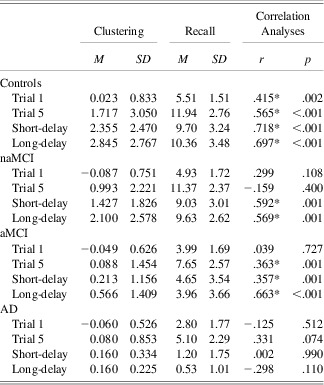
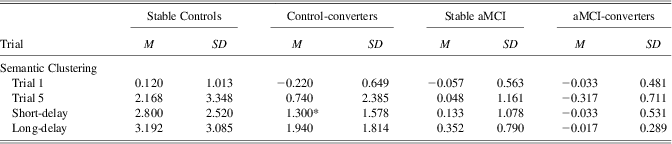
Demographic data and mean neuropsychological test performances are presented in Table 1, and mean clustering performances are presented in Table 2. Post hoc comparisons were completed using a Dunnett's T3 procedure (equal variances not assumed). Groups had similar age [F(3,191) = 1.62; p = .185] and gender [χ2 (3, N = 195) = 2.45; p = .485] distributions. There was a significant difference in education, F(3,191) = 3.51; p = .016, with controls (M = 17.51; SD = 2.14) attaining higher levels of education relative to the aMCI (M = 16.34; SD = 2.89) and AD (M = 15.73; SD = 2.59) groups. Therefore, education was a covariate in the univariate analyses. Age and education were modestly correlated with semantic clustering (OA: age and Trial 1, r = −.293; p = .033, education and Trial 1, r = −.288; p = .037; naMCI: education and Trial 1, r = −.387; p = .035), and age was modestly related to recall performance (OA: age and Trial 1, r = −.288; p = .037, age and Trial 5, r = −.336; p = .014, age and Short Delay, r = −.274; p = .047; aMCI: age and Trial 1, r = −.282; p = .010, age and Trial 5, r = −.494; p < .001, age and Short Delay r = −.402; p < .001, age and Long Delay, r = −.372; p = .001; naMCI: age and Long Delay, r = −.480; p = .007; AD: age and Trial 1, r = .440; p = .015). Consequently, we included both age and education as covariates in our mixed-model analyses.
Clustering and recall performance across trials on the CVLT-II, and corresponding Pearson correlation coefficients

Note. CVLT-II = California Verbal Learning Test-II (raw chance-adjusted semantic clustering scores: −3 to 9, raw recall scores: 0 to 16; Delis et al., Reference Delis, Kramer, Kaplan and Ober2000); * = Significant correlation between clustering and recall measures (p ≤ .0125).
Semantic Clustering Measures
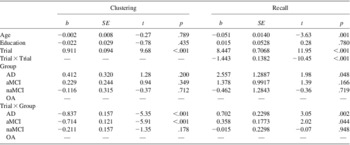
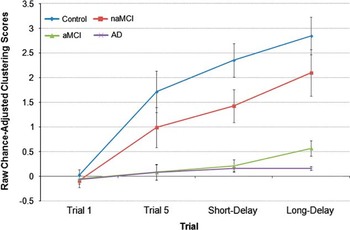
A linear mixed-effects regression analysis (unstructured using correlations) was conducted to determine if the rate of change in semantic clustering across trials (trial 1, trial 5, short-delay, long-delay) differed based on diagnosis (naMCI, aMCI, AD) relative to controls (see Table 3). There was a significant effect of trial, F(1,191) = 77.14, p < .001, that was modified by a significant diagnosis × trial interaction, F(3,390) = 16.05, p < .001. As illustrated in Figure 1, the controls and the naMCI group showed a similar semantic clustering slope [β = −0.211; β SE = 0.157; t(390) = −1.35; p = .178], with steady increases in clustering over trials. In contrast, the aMCI [β = −0.714; β SE = 0.1201; t(390) = −5.91; p < .001] and AD [β = −0.837; β SE =0.157; t(390) = −5.35; p < .001] groups displayed reduced semantic clustering slopes relative to the controls.
Results from the mixed-effects regression analyses for the clustering (linear) and recall (quadratic) data

Note. SE = standard error; AD = Alzheimer's disease; aMCI = amnestic mild cognitive impairment; naMCI = nonamnestic mild cognitive impairment.
Group mean semantic clustering scores (±SEM) as a function of trial.

To determine whether the aMCI and AD groups differed in their strategy use across trials, a similar linear mixed-effects regression analysis was conducted for only these two groups. Again, an effect of trial was observed, F(1,110) = 8.63, p < .004, with a relatively modest increase in semantic clustering across trials for both groups. Of interest, there was no significant difference between the groups in the rate of change in clustering across trials [β = −0.123; β SE = 0.0922; t(224) = −1.33; p = .184].
To determine whether the groups differed in semantic clustering during individual trials, we conducted simple effects analyses with an ANCOVA, assessing the impact of diagnosis (OA, naMCI, aMCI, AD) on semantic clustering separately for each trial (see Table 2). Age and education were the covariates, and a Bonferroni correction was applied (p ≤ .017). As shown in Figure 1, there was no significant difference between the groups in semantic clustering during trial 1, F(3,190) = 0.29, p = .833, η 2 = .005. In contrast, a group difference was observed on trial 5, F(3,190) = 7.71, p < .001, η 2 = .108, with the OAs showing greater semantic clustering relative to the aMCI (p < .001; d = 0.78) and AD (p = .004; d = 0.72) groups. A group difference was also observed for clustering during the short-delay trial, F(3,190) = 20.48, p < .001, η 2 = .244. Again, the OAs displayed greater semantic clustering relative to the aMCI (p < .001; d = 1.28) and AD (p < .001; d = 1.29) groups. Of interest, on the short-delay trial, the naMCI participants performed similarly to the OAs (p = .087; d = 0.41) and displayed greater semantic clustering relative to the aMCI (p = .004; d = 0.91) and AD (p = .020; d = 1.17) groups. Finally, on the long-delay free recall trial, a group difference was observed, F(3,190) = 18.23; p < .001, η 2 = .224. Again, the OAs displayed greater semantic clustering compared to the aMCI (p < .001; d = 1.17) and AD (p < .001; d = 1.45) groups. The naMCI group had similar semantic clustering scores as the controls (p = .649; d = 0.28) and outperformed the aMCI (p = .002; d = 0.89) and AD (p = .001; d = 1.38) participants. Overall, the aMCI and AD groups displayed similar semantic clustering across all trials.
Recall Measures
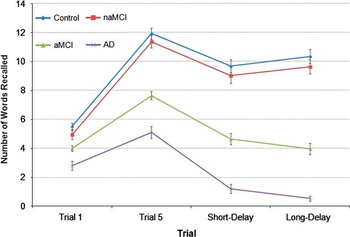
Recall performance was not a primary outcome of this study. However, to generally contrast the clustering and recall profiles of the groups, a quadratic mixed-effects regression analysis was conducted to determine if the rate of change in recall performance across trials (trial 1, trial 5, short-delay, long-delay) differed based on diagnosis (naMCI, aMCI, AD) relative to controls. As can be seen in Figure 2, the analysis revealed a significant quadratic effect of trial, F(1,386) = 226.17, p < .001, that was modified by a significant diagnosis × trial (quadratic) interaction, F(3,386) = 4.12, p = .007. The aMCI [β = 0.358; β SE = 0.177; t(386) = 2.02; p = .004] and AD [β = 0.702; β SE = 0.230; t(386) = 3.05; p = .002] groups displayed a reduced recall slope across trials relative to the controls. The naMCI group displayed a similar recall profile as the controls [β = −0.015; β SE = 0.230; t(386) = −0.07; p = .948]. To determine whether the aMCI and AD groups differed in their performance across trials, a similar analysis was conducted with these two groups. A significant quadratic effect of trial was observed, F(1,110) =51.43; p < .001, that was modified by a significant linear diagnosis × trial interaction, F(1,222) = 5.26; p = .023 [the quadratic interaction was non-significant, F(1,222) = 2.64; p = .106]. The AD group showed a reduced recall slope across trials relative to the aMCI group, β = −2.481, β SE = 1.082, t(222) = −2.29, p = .023. These findings indicate that the profiles of clustering and recall differ among the groups, and recall is not a direct function of clustering.
Group mean recall scores (±SEM) as a function of trial.

To determine whether the groups differed in recall during individual trials, we conducted simple effects analyses with an ANCOVA, assessing the impact of diagnosis (OA, naMCI, aMCI, AD) on recall separately for each trial. Age and education were the covariates, and a Bonferroni correction was again applied (p ≤ .017). In contrast to the semantic clustering data, group differences were observed on each trial (see Figure 2). The aMCI participants recalled fewer words during each trial relative to the controls and naMCI groups, who performed similarly across trials (see Table 2). Finally, the AD participants recalled fewer words at each trial relative to the other groups.
Relationship between Semantic Clustering and Recall
The correlational analyses (with Bonferroni correction: p ≤ .0125) between semantic clustering and recall performance are presented in Table 2. For the control group, increased semantic clustering was associated with increased recall across trials (all rs ranged from .415 to .718). In contrast, semantic clustering was not associated with learning trials 1 or 5 for the naMCI group, although it was associated with short- and long-delay recall. For the aMCI group, increased semantic clustering was related to recall performance on trial 5 and the short-delay and long-delay free-recall trials. Finally, semantic clustering was not associated with recall performance for the AD group on any trial, which may have been due to a floor effect for their recall scores.
Semantic Clustering and Progression to aMCI and AD
To determine whether poor memory strategy use at baseline was associated with progression to aMCI and AD on follow-up, we examined group differences in clustering in converters (i.e., controls who progressed to aMCI and aMCI participants who progressed to AD) relative to non-converters (i.e., stable controls and stable aMCI participants) using independent sample t tests. As part of the longitudinal study, follow-up diagnostic information was available for 44 controls and 56 aMCI participants (number of follow-up visits ranged from 1 to 8 years). Twenty-five control participants remained stable, 10 later met criteria for aMCI, and 9 were re-classified as naMCI at follow-up (mean number of follow-up visits = 2.55; SD = 1.80). Twenty-one aMCI participants remained stable, 9 aMCI participants were later classified as normal, 9 met criteria for naMCI at follow-up, 12 progressed to AD, and 5 were diagnosed with another type of cognitive disorder (e.g., dementia with Lewy bodies, vascular dementia, etc.; mean number of follow-up visits = 1.84; SD = 0.83). The subsequent analyses included control participants at baseline who met criteria for aMCI on any follow-up visit (control converters) or remained stable across visits (non-converters), and aMCI participants at baseline who progressed to AD (aMCI converters) or remained diagnostically stable across follow-up visits (non-converters).
Control converters
The independent t test analysis conducted on the baseline data revealed no group difference in age [t(33) = −1.57; p = .127] or education [t(33) = 0.711; p = .482] between the stable controls and control-converters. The control-converters displayed reduced semantic clustering during short-delay free recall relative to the stable controls [t(33) = 2.12; p = .044; d = 0.66]. Although the control-converters generally had reduced clustering across trials (see Table 4), there were no significant differences between groups on trial 1 [t(33) = 0.98; p = .335; d = 0.37], trial 5 [t(33) = 1.23; p = .229; d = 0.46], or long-delay free recall [t(33) = 1.49; p = .148; d = 0.46].
Semantic clustering and recall performance at baseline for stable controls, aMCI-converters, stable aMCI, and AD-converters

Note. * = Group difference between stable controls and control-converters (p < .05).
To explore whether deficiencies in semantic clustering were specific to the development of aMCI (and therefore more suggestive of underlying AD pathology), we also conducted similar analyses for stable controls and control participants who later met criteria for naMCI. There were no group differences in age [t(32) = 0.077; p = .939] or education [t(32) = 0.165; p = .870] between the stable controls and converters. Additionally, there were no differences in clustering between stable controls and participants who met criteria for naMCI on follow-up (t-values ranged from −.093 to .207, p-values ranged from .837 to .926).
aMCI converters
The independent t test analyses conducted on the baseline data revealed no group difference in age [t(31) = −0.99; p = .332] or education [t(31) = −1.44; p = .159] between stable aMCI and aMCI-converters. When semantic clustering was compared across trials, there were no significant differences between groups [trial 1: t(31) = −0.12; p = .903; trial 5: t(31) = 0.98; p = .333; short-delay free-recall: t(31) = 0.50; p = .621; long-delay free-recall: t(31) = 1.93; p = .064].
Relationship between Semantic Clustering and Neuropsychological Tests
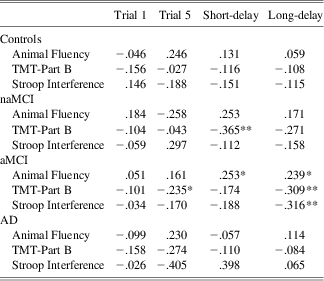
To determine whether clustering was associated with semantic processing (i.e., Animal Fluency) and/or executive functioning (i.e., TMT-Part B and Stroop Interference), correlation analyses were completed for each group (see Table 5). For the aMCI participants, semantic fluency was associated with clustering at short-delay free-recall, r = .253, p = .022, and long-delay free-recall, r = .239, p = .031. In addition, clustering at long-delay free recall was correlated with quicker response times on executive measures for the aMCI group [TMT-Part B: r = −.309, p = .005; Stroop Interference: r = −.316, p = .005]. Faster response times on the TMT-Part B were also associated with clustering at trial 5 for the aMCI group [r = −.235, p = .034] and at short-delay free recall for the naMCI group [r = −.365, p = .047]. In contrast, semantic clustering was not significantly associated with semantic processing or executive functioning across analyses for the control and AD groups (all rs ranged from −.026 to .398).
Correlations between semantic clustering on CVLT-II and neuropsychological test performance

Note. CVLT-II = California Verbal Learning Test-II (raw chance-adjusted semantic clustering scores: −3 to 9; raw recall scores: 0 to 16; Delis et al., Reference Delis, Kramer, Kaplan and Ober2000); naMCI = nonamnestic mild cognitive impairment; aMCI = amnestic mild cognitive impairment; AD = Alzheimer's disease; TMT = Trail Making Test.
* = small effect size.
** = medium effect size.
Discussion
Previous research has demonstrated that aMCI is associated with poor memory consolidation and acquisition (e.g., Crowell et al., Reference Crowell, Luis, Vanderploeg, Schinka and Mullan2002; Greenaway et al., Reference Greenaway, Lacritz, Binegar, Weiner, Lipton and Cullum2006; Ribeiro et al., Reference Ribeiro, Guerreiro and De Mendonça2007), as well as reduced semantic clustering (an efficient memory strategy; e.g., Malek-Ahmadi et al., Reference Malek-Ahmadi, Raj and Small2011). These findings are consistent with the early AD-related neuropathological changes observed in the hippocampus and prefrontal regions (Jack et al., Reference Jack, Petersen, Xu, O'Brien, Smith, Ivnik and Kokmen1999). Despite such reports, few studies have explored differences in semantic clustering between the subtypes of MCI or have investigated whether amnestic MCI participants show a similar pattern of deficiencies in clustering as individuals with AD. In the present study, we examined semantic clustering and recall patterns across learning and delayed recall trials in amnestic MCI, nonamnestic MCI, and AD. In addition, we explored whether reduced semantic clustering was related to the development of aMCI in healthy controls or the progression to AD in aMCI participants. Overall, we found that recall and clustering profiles did not mirror each other across groups. Semantic clustering and recall performance distinguished the amnestic MCI and AD groups from controls and persons with nonamnestic MCI group; the amnestic MCI and AD groups displayed similar semantic clustering but differed in recall performance. In addition, controls who progressed to amnestic MCI (and not nonamnestic MCI) showed reduced semantic clustering at the short-delay at baseline testing compared to stable controls. This suggests that poor clustering is more reflective of underlying AD pathology.
Semantic clustering and recall performance differed between subtypes of MCI. The nonamnestic MCI group performed similarly to controls across measures, whereas the amnestic MCI participants displayed attenuated semantic clustering that was similar in pattern and severity as the impairments exhibited by the AD group. Of importance, all four groups displayed similar semantic clustering at trial 1; however, the AD and aMCI groups failed to benefit from repeated exposure to the list (i.e., they showed a relatively flat semantic clustering curve). Additionally, the AD and amnestic MCI groups did not show a significant improvement in semantic clustering at long-delay recall trial, despite being provided with semantic cues at the short-delay. Although impairments in semantic clustering were similar in the aMCI and AD groups, the AD participants showed greater impairment on recall measures than the aMCI participants. These results suggest that deficits in semantic clustering associated with amnestic MCI are more pronounced than the deficits in acquisition and consolidation. As such, our findings indicate that semantic clustering deficiencies occur early in the course of the disease process, before the diagnosis of dementia. These results have important practical implications for clinicians. That is, in addition to findings of poor recall in patients, poor semantic clustering provides greater evidence of AD-related pathology.
Poor semantic clustering in amnestic MCI and AD likely reflects a breakdown in associations within semantic networks. It has been argued that semantic knowledge is organized into complex associative networks in temporal and parietal regions (Salmon, Reference Salmon2012). Concepts that share many attributes are thought to be more strongly associated than concepts with fewer commonalities, and through the principle of spreading activation, memory performance is facilitated when information is more strongly related within the network (Collins & Loftus, Reference Collins and Loftus1975). The ability to use semantic clustering to improve memory performance is contingent upon the integrity of these semantic networks. As demonstrated previously, individuals with AD display semantic deficits relative to healthy controls on clinical neuropsychological evaluations (e.g., Huff et al., Reference Huff, Corkin and Growdon1986; Rosser & Hodges, Reference Rosser and Hodges1994) and under experimental conditions (e.g., Chertkow & Bub, Reference Chertkow and Bub1990), both within and across modalities (e.g., Hodges, Salmon, & Butters, Reference Hodges, Salmon and Butters1992). These deficits have been attributed to a loss of semantic knowledge (e.g., Hodges et al., Reference Hodges, Salmon and Butters1992), as well as deterioration in accessing, retrieving, and manipulating semantic information (e.g., Bayles, Tomoeda, Kaszniak, & Trosset, Reference Bayles, Tomoeda, Kaszniak and Trosset1991).
As semantic networks are disrupted early in AD, it is not surprising that individuals with aMCI also show deficiencies in semantic processing on standard neuropsychological measures (Adlam et al., Reference Adlam, Bozeat, Arnold, Watson and Hodges2006; Murphy et al., Reference Murphy, Rich and Troyer2006) and experimental tasks (Hudon, Villeneuve, & Belleville, Reference Hudon, Villeneuve and Belleville2011; Joubert et al., Reference Joubert, Brambait, Ansado, Barbeau, Felician, Didic and Kergoat2010, 2008). Researchers have attributed poor semantic processing to a breakdown in semantic associations rather than degradation of exemplars (e.g., Murphy et al., Reference Murphy, Rich and Troyer2006). Our findings that semantic clustering in aMCI and AD does not improve with repeated exposure to a list of semantically related words, or when provided with semantic cues, support the hypothesis that semantic processing is impaired in aMCI. Individuals with aMCI and AD are unable to spontaneously use the semantic structure of a list to enhance recall performance because of a disruption in semantic networks. Our correlation analyses further support this interpretation. That is, poor memory strategy use at short-delay and long-delay free-recall was associated with reduced semantic processing in the amnestic MCI group. However, it is noted that reduced executive processing also contributed to poor semantic clustering in amnestic MCI participants.
Clustering is considered an efficient memory strategy that helps individuals “chunk” large amounts of information into smaller units, which allows for more efficient encoding, storage, and retrieval of information (Baddeley, Reference Baddeley2001; Delis et al., Reference Delis, Kramer, Kaplan and Ober2000). For the controls, semantic clustering was associated with recall performance across trials. This may reflect their intact ability to use learning strategies. In contrast, semantic clustering was only associated with short-delay and long-delay free recall for the nonamnestic MCI group, indicating that strategy use did not aid their initial acquisition. For the amnestic MCI participants, increased semantic clustering was related to better recall performance on trial 5 and the short-delay and long-delay trials. Finally, semantic clustering did not predict recall performance for the AD group, which likely reflects a floor effect in this group. It is unclear why semantic clustering did not predict recall performance on select learning trials for the MCI groups, particularly the nonamnestic participants, given that their performance was similar to that of controls across measures. This unexpected finding may reflect the heterogeneous nature of nonamnestic MCI, in which participants can differ significantly in the underlying etiology (e.g., frontotemporal dementia and dementia with Lewy bodies).
Of importance, our study shows that semantic clustering in controls is related to later progression to amnestic MCI. Clustering was generally reduced in these converters relative to non-converters, indicating that subtle changes in strategy use are evident in the pre-symptomatic stages of MCI. Although our findings were only significant at short-delay free-recall, similar trends with medium effect sizes were noted across learning and recall trials, suggesting that these analyses may have been underpowered.
Our results inform our understanding of how memory strategy use is impacted in MCI and AD; however, there are several limitations to our study. First, our participants were highly educated (i.e., college graduates on average), with years of education related (albeit modestly) to semantic clustering for the healthy controls and nonamnestic MCI groups. Although we controlled for education across analyses, our results may not generalize to all individuals with aMCI, naMCI, and AD. Second, our sample sizes were significantly different across groups, which may have influenced our findings. Finally, our analyses regarding progression to aMCI and AD may have been underpowered, underestimating the role of clustering in conversion. Given these limitations, future research should explore semantic clustering in participants with a wider range of educational backgrounds, with equal sample sizes maintained across groups.
In conclusion, our research demonstrates that semantic clustering is attenuated in aMCI and AD, whereas individuals with nonamnestic MCI perform similarly to controls. In contrast, AD participants show greater impairment relative to aMCI participants on traditional learning and recall measures. Whereas recall declines across trials for all groups after initial learning, investigation of semantic clustering reveals an “AD-type” profile in amnestic MCI participants and may be a useful tool for determining the early changes in the disease course.
Acknowledgments
This work was funded by the National Institutes of Health (NIH P50 AG016570), the Alzheimer's Disease Research Centers of California, the Sidell-Kagan Foundation, and the Jim Easton Consortium for Alzheimer's Disease Drug Discovery and Biomarkers at UCLA. None of the authors have potential conflicts of interest.