Introduction
This paper offers an alternative reading of the 1890 British Ultimatum, which placed British and Portuguese imperial interests in Africa in direct opposition, by focusing on its techno-diplomatic dimension. Unconventionally, however, we explore this dimension via an examination of the cartoons of the politically committed and polyvalent Portuguese artist and journalist Rafael Bordalo Pinheiro (1846–1905), who published his satirical journal Ponto nos iis from the end of 1889 and throughout 1890, the year in which the ultimatum took place.
The cartoons in Pontos nos iis are thus used in this paper as a primary source to support our claim that techno-scientific diplomacy in Portugal included informal instances to be found in non-canonical media.Footnote 1 In this case, cartoons made visible to wider audiences that British and Portuguese claims over railway infrastructures spanning the African continent and securing its economic resources were behind the diplomatic activities that the ultimatum set in motion.Footnote 2 The cartoons thus persuaded the wider publics in Britain and Portugal that colonial knowledge of the African territory (supporting the construction of large technological systems) assisted in imposing an inter-state hierarchy among European powers, thus acting as an instance of diplomacy.
More to the point, the entangled scientific and technological agendas that supported the period of global New Imperialism were designed to methodically map and explore the African hinterland (e.g. the role of explorers often supported by national societies, such as David Livingston, Henry Morton Stanley, Pierre Savorgnan de Brazza, Paul Du Chaillu, Georg Schweinfurth, Gustav Nachtigal, Luigi Robecchi Bricchetti, Hernenegildo Capelo, Roberto Ivens, Alexandre de Serpa Pinto) in order to build efficient networks of transport infrastructure (mainly railways) that were critical to the exploitation of African natural resources. It is in this context that Bordalo Pinheiro used his cartoons to translate a complex web of technology-driven imperial interests combining traditional diplomatic elements – attraction, cooperation and influence – with aggressive technological infrastructure. In turn, he persuaded his readers about the need for regime change in Portugal, thus strengthening the republican agenda. He thus used his cartoons as a soft-power device in order to shape the understanding of the British–Portuguese diplomatic clash and indirectly inform diplomatic activities associated with the British–Portuguese conflict.
Besides engineers, explorers, military men, politicians, diplomats and royalty, influential cartoonists in both countries staged a visual rendition of the context of the ultimatum and its aftermath. This informal cartoon diplomacy added an extra layer of diplomatic communication to the affair, and aimed at mobilizing audiences in various countries for specific alternative diplomacy options and hence indirectly put pressure on decision makers for these competing options.Footnote 3
We argue that Bordalo's cartoon diplomacy served three different diplomatic ambitions: (i) it made visible the otherwise hidden technological imbalance decisive to the conflict's outcome; (ii) it led his audience to believe that Portugal could have avoided humiliation had the government been based on republican values that were more deeply anchored in science and technology; and (iii) it sought, indirectly through images, to get support across Europe (and from other European countries) for Portugal's position vis-à-vis British imperialism, also promoting the cartoons outside Portugal and even engaging in a ‘cartoon fight’ with Punch.
Bordalo Pinheiro reached out to a very heterogeneous public, ranging from the knowledgeable elite to the illiterate masses, through the emerging satirical press, which gained considerable momentum in Portugal in the last quarter of the nineteenth century. Pinheiro's satirical drawings and cartoons, sprinkled with ironic words or curt and abrasive sentences, addressed political, social, and moral issues, and impacted on the expert and the lay public alike.
Pinheiro also redrafted foreign cartoons to put across an antithetical viewpoint, thus engaging in a sort of negotiation with other cartoonists qua informal diplomats. For instance, his take on the British Ultimatum is largely, but not exclusively, structured around a dialogue between Pontos nos iis and the well-known British satirical review Punch. Pinheiro's cartoons thus elaborated a ‘visual diplomacy’, playing a performative role in the landscape of British–Portuguese relations.Footnote 4
The comparison of Pontos nos iis and Punch in relation to the Scramble for Africa highlights the power imbalance (deepened by the ultimatum) between the two nations. What becomes visible is, on the one hand, the political supremacy of Britain and the inferiority of Portugal and, on the other, the diverging ways in which the conflict reached the public. Together the British and Portuguese satirical cartoons reveal opposing nationalistic viewpoints. The slim presence of cartoons in Punch materialized the British relative neglect of this political affair, while its overwhelming presence in Pontos nos iis reflected the enormous impact it had on Portuguese politics, eventually leading to the downfall of the monarchical regime. Although this imbalance clearly shows that the same event is perceived differently in different political and economic contexts, in both cases railways are a defining feature of both sets of cartoons, since they portrayed these technological systems as a vital tool to ‘remap’ access to African wealth (mineral and agricultural resources).
The British Ultimatum, cartoon informal diplomacy and soft power in the Scramble for Africa
On 16 January 1890, one of the most widely circulated Portuguese newspapers, O Século, posted on its front page a rousing call to arms urging the people of Lisbon to rise against the British flotilla, the ‘cruel’ and ‘savage’ navy, which was about to sail from Gibraltar to bombard Lisbon.Footnote 5 This was one of the many reactions to the ultimatum of the British government, headed by the prime minister, Lord Salisbury. Sent to Portugal on 11 January 1890, that memorandum triggered a wave of nationalistic fervour, mixed with strong criticism of the monarchy. Its impact was so devastating for Portugal that it fostered the ascendancy of the republican movement and the eventual demise of the monarchic regime twenty years later (the republican national anthem still used today is a call to arms against the ultimatum).
The ultimatum, however, was fundamentally the chief response on Britain's part to Portugal's recent efforts to secure its colonial possessions against the interests of the British Empire. Portugal had always relied on historical rights to claim possession over its African colonies, largely sticking to the traditional occupation of their coastal territory. The new principle of effective occupation imposed by the Berlin Conference (1884–5) shaped a new race for colonies in Europe. Its rulers now sought to secure international trading rights to counter rising American, Russian and Japanese interests, deflecting latent European hostilities and providing space for new stakeholders such as Germany.Footnote 6 The effective-occupation rule favoured the economically stronger European powers, leaving weaker countries in a difficult position. To occupy the African hinterland implied the building of settlements (to secure the administrative and demographic dimensions behind the effective-occupation rule) and the exploitation of resources within a worldwide economy based on an efficient transport network. It is in this context that all European imperial states planned scientific expeditions and public works aiming to use this new colonial-driven knowledge as an instance of bargaining power.
The UK administration was determined to control the African colonial chessboard, even if that meant going to war. At the core of British colonialism in Africa was Cecil Rhodes, a mining tycoon who used the so-called ‘imperial factor’ – his collaboration with the British government – to make his mining operations legal, secure and profitable. In 1889, Queen Victoria, through the British South Africa Company, granted Rhodes authority and rights to rule, police and make new treaties and concessions. Circulation, communication and mobility were instrumental to the governance of the new territories under Rhodes's sovereignty. Troops could move quickly to hot spots, protect white settlements and foster trade and mining.
The Cape-to-Cairo railway line was one of the cornerstones of Rhodes's strategy: an ‘all-red’ line (that is, 100 per cent under British control) connecting Cairo to Cape Town, running from north to south across the entire African continent. This enterprise was not without problems, as other European colonial powers – France, Portugal, Belgium and Germany – had their own plans to keep a slice of African territory. The railway line associated logistics, and communication links resulted from comprehensive diplomatic negotiations with regard to the technologies to be deployed.
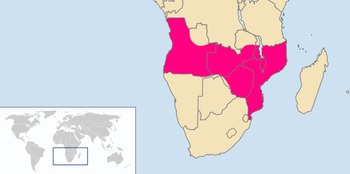
However, this diplomatic affair was not necessarily running towards a successful ending from the British perspective since it encroached on Portuguese interests. The ‘Pink Map’ (Figure 1), issued in 1886 at the conclusion of the Berlin Conference, represented the Portuguese claims to sovereignty in Africa. It followed the creation of the Geographical Society of Lisbon (1875) and was the culmination of a series of scientific expeditions to map the hydrographical, geological, botanical and zoological characteristics of the hinterland, in order not only to take possession of natural resources but also to build a capital of scientific knowledge deemed critical to claim effective occupation.Footnote 7 The Pink Map depicted a contiguous, transcontinental colonial territory, stretching from the Atlantic western coast of Angola to the Indian eastern coast of Mozambique, linking Luanda to Lourenço Marques (now Maputo).
The Pink Map.

The strategy designed by Portugal was to establish sovereignty in the inland territories between the two colonies considered as a kind of ‘no man's land’ (res nullius); that is, not formally claimed by any of the European powers despite various allegiances between local rulers and European countries. In this context, in 1888, the Portuguese government instructed its representatives in Mozambique to make treaties of protection with the Yao chiefs south-east of Lake Nyasa and in the Shire Highlands. Two expeditions were organized. One, under António Cardoso, set off for Lake Nyasa; the second expedition, under Serpa Pinto, who had led a previous expedition in 1878, moved up to the Shire valley.
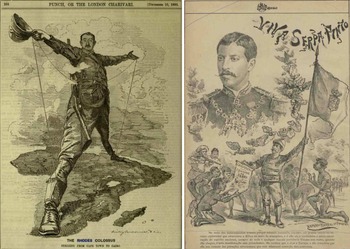
The clash between the British (linking the north to the south of Africa) and the Portuguese (connecting the western and the eastern coasts of Africa) railway projects was inevitable and clearly supports our argument concerning the techno-scientific dimension of the British Ultimatum. This techno-scientific dimension is visible in the cartoon rendition of the conflict unfolding in Punch and Pontos nos iis, albeit to different degrees. For the British, the now famous cartoon in Punch which shows Rhodes aggressively dominating Africa through infrastructures of telegraphs (and implicitly of railways) (1892) left no doubt as to the power of British technological might as an efficient geopolitical weapon to dominate the African continent and crush competing European nations.Footnote 8 The Portuguese counterpart (1890) kept these domination efforts hidden, showing instead Serpa Pinto in an educator's attitude ‘offering’ railways and progress to the local tribes. The contrast is clear: the greedy tycoon versus the altruistic scientist–explorer (Figure 2).
Left: ‘The Rhodes Colossus striding from Cape Town to Cairo’, Punch, 10 December 1892; right: ‘Viva Serpa Pinto,’ Pontos nos iis (9 January 1890) 237. Hemeroteca Nacional.

That African colonies were key to the ultimatum is further confirmed by the so-called ‘Serpa Pinto incident’, named after the Portuguese explorer. It was a minor military skirmish that, as the climax of years of latent tension between Portuguese and British interests in Africa, was the straw that broke the camel's back. Portuguese and European history traditionally presents the incident as a military, political and diplomatic affair, dependent on the negotiation and communication strategies of the main political actors on the European chessboard of imperial nations. It featured importantly in the diplomatically effective satirical cartoons, as will be seen below.
The satirical journal Pontos nos iis and Rafel Bordalo Pinheiro
While the colonial dimensions of the British–Portuguese conflict are widely known, we know far less about how the press played a performative role in the ensuing diplomatic activities, especially through the publication of satirical cartoons.
Throughout the nineteenth century, the satirical press especially became one of the most important and efficient means circulating information within and between societies in Europe. In this context, the illustrated press and a specific branch of journalism linked to caricature gained popularity.Footnote 9 Strongly based on political and social criticism, it was not constrained by the recent trends in journalism, which privileged instead the presentation of raw facts and left interpretation to the reader. As such the satirical press was free to voice strong opinions, supported by recent printing technologies, which offered new possibilities for intermingling text and images, and which in turn often used technological innovations as the main subject of their pictorial gaze.Footnote 10 By exploring various communication strategies, including texts loaded with jokes, puns, poetry and dialogues, among other things, and drawings full of representational and symbolic meanings associated with pressing political and societal issues, they managed to reach an even wider audience than more traditional forms of journalism.
In the last quarter of the nineteenth century, Portugal's politics and economy were growing increasingly unstable, thus generating fertile ground for satirical newspapers targeting politicians, and accusing them of corruption and lack of transparency. Rafael Bordalo Pinheiro stood as a rising star in this new caricature journalism in Portugal. He was innovative in the contents explored, ‘orchestrating the grotesque, the comic, the satire and the irony in a harmonious way, so as to destroy the aggressive elements of his protests, and to present them through laughter as irrefutable truths’.Footnote 11 He was also original as in the format used, treating each page as a harmonious unity, mixing illustrations, sentences and letters’ format.Footnote 12 In addition, Pinheiro treated each issue as a whole, including a sequence of cartoons to reinforce a certain perspective, in a cinematic plot antedating documentaries.Footnote 13 His cartoons attacked the monarchic status quo, and gave voice to a republican and anti-clerical sentiment, coming to exert a profound influence in Portuguese society. Besides a prolific career as the creator, illustrator and publisher of several satirical periodicals, he was a regular collaborator in satirical journals both in Portugal and abroad, including El Mundo Cómico, Ilústracion Española y Americana, the Illustrated London News (from 1873) and El Bazar (from 1874).Footnote 14
The highest point in Bordalo Pinheiro's career was the satirical production for the weekly O António Maria, published in Lisbon, from 12 June 1879 to 16 December 1899 (with a five-year interruption). Pontos nos iis, published from 7 May 1885 to 5 February 1891, replaced the journal. The title O António Maria was a comic allusion to the first name of Portuguese engineer Fontes Pereira de Melo, the leader of the Regeneration period, who conceived a technology-driven modernization agenda for Portugal focused on the building of a network of transport and communication infrastructure. Yet Fontes Pereira de Melo was also responsible for the appeasing approach distinctive of Portuguese foreign policy satirized by Bordalo Pinheiro.Footnote 15 In the pages of O António Maria, Bordalo Pinheiro immortalized the popular cartoon character Zé Povinho, created in 1875, who personified the Portuguese common man (as John Bull personified the British common man in Punch and other British satirical magazines), the main victim of government policies, which were often corrupt and designed to favour economic and political elites rather than the people.Footnote 16
Pinheiro's publications changed name regularly in a sort of cat-and-mouse game with the Portuguese authorities. When, in 1885, they forced him to cease publication of the periodical O António Maria, Pontos nos iis was published for the first time. In its pages, the fictional widow of António Maria introduced the public to the new satirical journal, claiming that her husband had passed away three months earlier, and she was now ready to continue his work. In 1891, when Pontos nos iis had to cease publication because of similar troubles with the authorities, O António Maria was resurrected to enable its continuation.
With eight pages per issue, like its predecessor, the weekly Pontos nos iis was also very successful, despite being six times more expensive than the generalist daily broadsheet newspapers Diário de Notícias and O Século, which had half the number of pages, did not fall under the category of illustrated journals, and therefore included a limited number of images.Footnote 17 The stringent monarchical control measures on the press also meant that after the republican revolt of 31 January 1891, it became compulsory to print the publisher's name, the administration headquarters and the address of the printing company on the first or last page.Footnote 18 The curious name of the journal, meaning literally ‘dots on the i's,’ stood for the Portuguese idiomatic expression equivalent in English to ‘crossing the Ts,’ and clearly pointed to the will to clarify hard situations using humour and satire as efficient weapons to dissect sensitive topics relevant for Portuguese society.
The journal's success is demonstrated by the existence of a committed readership eager to buy back issues, even at much higher prices, and of reader–collectors who wished to keep past numbers. Contrary to Punch, which counted on a host of cartoonists, writers and artists during each period of its long existence, Pontos nos iis was mostly a one-man show.Footnote 19 The productive Rafael Bordalo Pinheiro authored most of the drawings, only occasionally delegating to his brother and his son Gustavo. The republican and socialist writer and journalist Fialho de Almeida authored the texts.
Cartoon negotiations
Portuguese politics in general were the raw material for Bordalo Pinheiro's immense satirical production. During the short existence of Pontos nos iis, besides political topics, the journal also addressed mundane matters related to urban everyday life, special cultural events, disasters and crimes and the elite's leisure activities. It also portrayed technical novelties in railways and urban lighting, and the African geographical expeditions. Especially from mid-1889 onwards and until its demise, colonial politics in the context of the Scramble for Africa, and the new colonial order established by the Berlin Conference, and later by the British Ultimatum to Portugal, became dominant themes for the journal. Allusions to republicans and the republican regime also grew as the king failed to counter British threats. Every page conveyed the idea that the current Portuguese failures derived ultimately from the regime and not from an international power imbalance. These exposés increased both political tensions and popular indignation.
By embracing the republican agenda, Pontos nos iis conveyed to the general public a clear message: Portuguese foreign policy and particularly Portuguese imperial interests in Africa could only be protected by a new regime eager to use science and technology as the tools for nation building. Thus, for Bordalo Pinheiro, the British ultimatum focused Portuguese attention on the obsolete and decrepit character of the Portuguese monarchy. The king was incapable of opposing Great Britain's imperial agenda in order to defend Portuguese rights, especially as his retrograde Catholicism forestalled efforts to develop the country through science and technology. Eventually Pontos nos iis became a true republican manifesto and the price of such boldness was its suspension, in 1891.
The technological dimension was explicitly present in Pontos nos iis whenever Bordalo incorporated cartoons from Punch depicting railways. It was also present in one cartoon in Pontos nos iis, published on 9 January 1890, in which it acknowledged the role of technology at the service of the Portuguese empire and as the backbone of its civilizing mission. In this cartoon the expeditionary Serpa Pinto is hailed as a hero and portrayed holding the Portuguese flag while persuasively showing to the Africans a document that reads ‘Civilization = Railways’.Footnote 20 This cartoon is particularly important because it encapsulates in an explicit way the hidden or implicit technological dimension of republicanism. This dimension of the British Ultimatum is often obscured by the political and economic narrative, which focuses on the commercial interests of the British companies involved in Africa. Bordalo's cartoons focus instead on the companies’ involvement in the infrastructure of colonialism, including mining and the building of railways, roads and harbours. These companies feature in the cartoons as the architects of the large technological systems that made the imperial structures operational. It is in the framework of this metalanguage that Bordalo's cartoons must be understood and used as instances of visual techno-diplomacy.
The Serpa Pinto expedition triggered a series of events that began with the crossing of the Ruo river by Portuguese troops in mid-1889 and ended only in October 1910 when the Republican Party overthrew the monarchy. Over a shorter time frame, ending in 1891 with the first (albeit unsuccessful) attempt by the republicans to take power, Bordalo Pinheiro followed and intervened in these events, building, through his cartoons, a specific political interpretation – that of the weakness of a corrupt and subservient monarchy versus a nationalist and people-based republican regime. It is in this context that Pontos nos iis approached the Portuguese technologically driven imperial strategy, riding the growing tide of nationalism that blamed the monarchy for bowing to British impositions. But more than merely reacting to the political situation, Bordalo Pinheiro's cartoons played an active role in it, as his images were meant to persuade readers that a change of regime was needed in order to manage the Scramble for Africa in the international context. As such, from mid-1889 onwards, and particularly during 1890, the ongoing dispute between Portugal and Britain over African territories became the dominant theme in most issues of the journal, often occupying several pages per issue, and unfolding in successive issues, in a cinematic plot visualizing the evolution of negotiations at the table of ‘cartoon diplomats’.
Deployed in a stepwise strategy based on three different typologies of cartoons, like a comic book in three acts, Bordalo Pinheiro's visual narrative mirrored the ambiguity of European imperial diplomacy that coupled hollow peace treaties signed in embassy rooms with military aggression in contested colonial spaces. The narrative worked first to rebuke the British African political agenda vis-à-vis Portugal, which attempted to legitimize an unequal partition of Africa that was unfair to its older historical ally; second to reveal Britain's unsymmetrical, and therefore unethical, treatment of other European nations’ ambitions in Africa, accommodating to powerful (such as German, Russia and the United States) and demeaning the weak (such as Portugal); and finally to castigate the Portuguese monarchical reaction to the British Ultimatum and to persuade his readers that the republican cause was the only nationalistic acceptable dénouement.
The constant reference to the international satirical press in Pontos nos iis is striking and quite unexpected for the contemporary reader. It hints at the existence of an active and extended network of cartoonists around the world reading each other, sharing experiences, ultimately collaborating, and appropriating cartoons to their own aims at an incredible pace, at times in less than a week. While the specific contours of this dynamic interaction are still to be clarified, what is clear is that readers were able to access cartoons appearing in foreign journals and that these cartoons conveyed competing messages about geopolitical ambitions and the technological infrastructures needed for their achievement.
In our case, Portuguese readers of Pontos nos iis were offered a selection of cartoons from journals in Britain (Punch, the English Illustrated Magazine), Ireland (the Weekly Freeman), Germany (Kladderadatsch), the Netherlands (Amsterdamer) and Buenos Aires (Don Quijote), to name just those related to the British Ultimatum. In addition, cartoons’ captions or accompanying texts were at times written in foreign languages, for example in French, the elite language of the time, in order to be accessible to a learned foreign audience. As such, Pontos nos iis was a node in a network circulating political cartoons around the globe. Building on the fact that this international dimension of the conflict attracted wider attention as far as European newspapers and magazines were concerned, its appropriation reinforced the credibility of Bordalo Pinheiro's soft-power strategy. The message conveyed by Pontos nos iis on the Berlin Conference was clear and simple: its goal was to allow Britain (John Bull), mainly through the so-called African companies (private ventures supported by the British Crown, e.g. Rhodes's British South Africa Company), to take possession by force of the African territories that – in the view of Pontos nos iis – belonged to Portugal by historical right.
Bordalo Pinheiro considered newspapers such as Punch, the Times or the Standard as allies of the British Crown, which, in return for their deference, provided them with financial support.Footnote 21 Founded in 1841, in its initial days Punch defended the common man and embraced social and political causes, but by the time of the British Ultimatum it had become a conservative satirical journal aligned with the growing middle class and clearly in consonance with the British government. It was the conservative artist John Tenniel who illustrated many of the cartoons pertaining to the Anglo-Portuguese conflict, reviving for the job the bulky figure of John Bull.
To fight Punch, his main opponent in the cartoon diplomatic affair, Bordalo Pinheiro took seriously the political pressure that newspapers and journals could exert in moulding public opinion. He expertly used Pontos nos iis as his main instrument, presenting to the public a narrative in which Portugal is defeated, not because the nation is weak, but because it is ruled by a weak and illegitimate regime. Beyond sharing with his audience foreign political cartoons endorsing the Portuguese cause abroad, Bordalo's strategy appropriated foreign cartoons, mostly from Punch, and twisted their meanings to serve his own purposes. In such a way he used cartoons as pictorial Trojan horses. For the above reasons, as the political and diplomatic negotiations in the context of the Scramble for Africa unfolded, leading to the British Ultimatum, the exchange between the Portuguese cartoonist Bordalo Pinheiro and the British Punch cartoonists compels us to look at them as active players in a round of informal cartoon negotiations meant to influence their readers to take a stand, to embrace their respective positions, and eventually to get their voices heard by politicians and decision makers who had hitherto been more focused on the infrastructure and resources of the colonial world.
Seen from the perspective of Bordalo Pinheiro, the cartoon diplomacy round of negotiations comprised a stark sequence of visual ‘meetings’ that mirrored the ongoing events in the African and European arenas. Pontos nos iis's attacks and counterattacks traded with Punch are particularly acute in high-voltage moments in the Anglo-Portuguese imperial conflict, as will be seen below.
Unfolding the British Ultimatum
13–18 July 1889: on the eve of the confrontation
In mid-July, Serpa Pinto was camped on the east bank of the Ruo river. He knew that the British consul, Hamilton Johnston, who was facing him on the other side of the river, had been instructed to sabotage the Pink Map plan. Both men knew that they were living the last moments of peace before the storm and that their decisions in the following days would be decisive on the chessboard of power in colonial African territories.
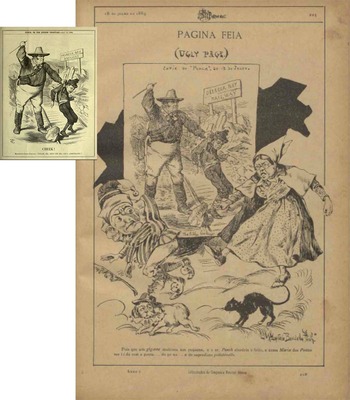
The first instalment of the ‘cartoon negotiations’ occurred precisely at this moment, with the publication by Punch of the cartoon ‘Cheek’ on 13 July 1889.Footnote 22 In ‘Cheek’, an angry John Bull spanked ‘a mischievous little Portuguese’, like a father spanked his little misbehaving child. The child (Portugal) had put a rock, which reads ‘confiscation’, on the railway track of the Delagoa Bay Railway line, under construction by an American contractor financed by British investors and expropriated by Portugal in June 1889.
In fact, the Delagoa Bay dispute went back to the 1870s, when the British government tried to take it from Portugal, an incident that was settled in favour of Portugal in 1875 by French arbitration of the conflict. The harbour of Delagoa Bay, located in Lourenço Marques district (today Maputo), was critical to secure access from the African hinterland to the sea without using territories under British control. In this context, the Volksraad of the South African Republic (also known as Transvaal Republic), a landlocked territory established by Dutch-speaking settlers who refused to stay in the Cape Colony after it was conquered by the British, considered it a priority to build a railway line connecting its gold-rich territories to the coastal harbour of Delagoa Bay.Footnote 23
An agreement between the Transvaal and Portuguese governments was signed and the section of the railway line from the coast to the Transvaal border was to be built and operated by the American contractor Edward McMurdo.Footnote 24 McMurdo did not receive any financial aid or guarantee from Portugal, but he was granted the liberty to decide the fares to charge and which investors to choose. It soon became clear that McMurdo's investors were mainly British and American, and the fares were too high, thus failing to fulfil the aim of the Transvaal–Delagoa Bay railway and empowering other railway lines under British control. Pressed by the Transvaal government to force a reduction of the fares or to rescind the contract, Portugal decided to confiscate the railway line itself, prompting a chorus of protest on the part of British investors and politicians.
In fact, the British government had kept a close eye on the Delagoa Bay railway, even suggesting that Great Britain should be more proactive concerning the future of the line. On 27 February 1888, the Earl of Rosebery discussed the topic of the Delagoa Bay railway in the British Parliament, stating that it was the main test of the colonial policy of the government of Britain for its future dealings with South Africa, ‘and that at this moment this railroad, which gives access to almost the only, if not the only, port on that enormous length of coast, is in danger of falling into hands which, if not hostile, are at any rate unfriendly’. The representative of the Secretary of State for the Colonies acknowledged ‘that the attention of Her Majesty's Government has been very seriously directed to the question of the Delagoa Bay Railway’, and different solutions were on the table, ranging from buying the territory from Portugal to promoting additional commercial treaties with the Transvaal.Footnote 25
The Delagoa railway line was thus a critical infrastructural piece in the African imperial chessboard, a kind of pawn check to a king. Portugal, a minor imperial power, was in an unexpected position to thwart the British trade monopoly in South Africa and British imperial interests in the continent at large. The technological dimension of the conflict was picked up first by Punch and afterwards by Pontos nos iis. Bordalo's cartoon brought to the fore the techno-diplomatic dimension of the conflict, which was addressed mainly through the incorporation of Punch's cartoons (Figure 3). The Delagoa Bay railway sign and the rock stood as the visual metaphor of Portuguese empowerment, which is conveyed differently by Punch and Pontos nos iis. Punch diminishes the Portuguese threat as something inconsequential, a prank, which calls for parental punishment, an image that is reinforced by the use of diminutives such as ‘little Lisbon lad’, ‘little boy’, ‘little Portuguese’, and the conclusion that tops the cartoon: ‘Lilliput rules not, nor will, though endowed with simian skills and sharp witted.’Footnote 26
Left: ‘Cheek’, Punch, 13 July 1889; right: ‘Página Feia (ugly page)’, Pontos nos iis (18 July 1889) 188. Hemeroteca de Lisboa.

The response in Pontos nos iis was published five days later and was penned by the son of Bordalo Pinheiro.Footnote 27 It reproduced ‘Cheek’ at the centre framed on the right by an angry Maria preparing to kick the behind of Mr Punch, dressed as a buffoon, and running on the left of the page, while her black cat scared Mr Punch's dog. The caption read, ‘A giant mistreats a dwarf, and Mr. Punch brags about it, our Mrs. Maria from Pontos nos iis lands her foot on the … of the aforementioned buffoon.’Footnote 28 Appealing to the Portuguese readership, the message could not be clearer: despite the asymmetrical power of the two nations on the geopolitical chessboard, Portugal would not be bullied. But the message was not addressed just to a national audience. Despite the universal visual impact of cartoons, a page-long text written in French reinforcing the visual message and comprising a detailed explanation voicing the Portuguese perspective reached foreign audiences.Footnote 29 It was authored by Fernando Leal, a Portuguese poet, military man, scientist and explorer, who travelled extensively in Africa contributing to assert the Portuguese effective presence in Mozambique, and who was very critical of British imperialism, especially following the Berlin Conference.Footnote 30
3 August 1889: an unfriendly word of advice
It is in this already very tense context that in August 1889 Serpa Pinto met Johnston and was advised not to cross the river into the Shire Highlands, considered an area of interest to the British Crown; that is, to Rhodes and his British South Africa Company. Although Serpa Pinto strongly suspected that the Makololo chiefs would be hostile to Portuguese rule and would favour British interests – they had been brought to the northern and western areas of the Shire by David Livingston during his Zambezi expedition and had remained there after the expedition ended in 1864 – he knew that the success of the Pink Map project and the adjacent coast-to-coast railway depended precisely on crossing the Ruo to Chiromo.
At this moment, Pontos nos iis dedicated four of its eight pages to illustrating how Britain, represented by John Bull, behaved subserviently in respect to powerful nations such as the United States, Russia and Germany, while at the same time it was haughty and arrogant towards small countries such as Portugal, often dubbed ‘little Portugal’ and represented by a frail, tiny old man with long beard looking like a beggar. Pages 4 and 5, positioned side by side, were signed by Rafael Bordalo Pinheiro. Both fell under the title ‘Noble John Bull’.Footnote 31 They illustrate through example how, when it came to external policy, Britain was a bully bowing down to the strong while oppressing the weak: on the left page the caption ‘Subservience to the big’ is illustrated by John Bull squatting while offering a beverage to a German military man in front of him; on the right the caption ‘With small arrogance’ featured a huge John Bull accepting a gift from the frail old man representing Portugal. These two intermediate pages are closely connected with the first and last pages, which emphatically reproduced the same idea. On the first page, titled ‘Brave John Bull’, with the caption ‘How the rogue acts with powerful nations’, three different diminutive British men, one representing the Prime Minister Lord Salisbury, are held and struck with different sorts of whips by three large figures representing the United States, Russia and Germany.Footnote 32 Climaxing the pictorial narrative, the last page shared with the reader how Britain reacted after the beatings.Footnote 33 In ‘John Bull, the most vile of all’, John Bull kneels and licks the boots of the United States, Russia and Germany. This last cartoon used a shorthand unusual signature with location: ‘BP Paris’. Just below, a single line of text at the bottom right read ‘V. Hugo, Le Pape – trad. de F. Leal.’ This was a reference to Victor Hugo's poem ‘Le Pape’ (‘The Pope’), published in 1878, and translated into Portuguese by Fernando Leal, mentioned above. In the poem the republican writer attacked the rigid Catholic organization by staging a dream in which the Pope reassessed his beliefs and delivered a speech endorsing the republican ideals of ‘Liberté, Egalité, Fratérnité’. With clever reference to Hugo's poem and its Portuguese translator, Bordalo Pinheiro aligned his republican ideals with those of the European intelligentsia, presenting his agenda as part of a much broader political framework.
In such a way, the bulk of the issue of 9 August 1889 was used to convince Bordalo Pinheiro's audience of the unethical behaviour of Britain following the Berlin Conference by revealing British double standards concerning its rivals (a bully preying on a weak contender, but too scared to do so with a stronger one). Going a step further, by including the reference to Hugo in the latter cartoon of the sequence of two, he integrated this second round of ‘cartoon diplomatic talks’ in a broader republican literary (but also political) context, meant to win readers to the republican movement. More references to the technological dimensions of the imperial contest were soon to come.
14–19 December 1889: the straw that broke the camel's back
Well armed, Serpa Pinto decided not to follow Johnston's ‘advice’ and crossed the Ruo river in September 1889.Footnote 34 As expected, the Makokolo tribe (claiming to be outside Portuguese control) asked for British assistance to remain independent. On November 1889, Serpa Pinto occupied the Makokolo territory. Using this military skirmish as a pretext, the British accused Portugal of ignoring British interests and declared a British protectorate over the Shire Highlands in December 1889. It was the beginning of the Anglo-Portuguese crisis, leading to the British Ultimatum on 11 January 1890.
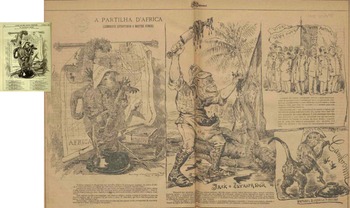
Besides being shown as a diminutive chap, whether young or old, Portugal was often represented in Punch by a much more derogatory caricature, that of a little monkey, a mindless primate. While in Western cultures the monkey often symbolizes trickery or mischief, in the country where the 1860 Huxley–Wilberforce confrontation took place this connotation left no doubt as to the inferior status of the Portuguese nation in the hierarchy of nations. Such was the case of the cartoon ‘The mischievous monkey’, published in Punch on 14 December 1889, authored by Linley Sambourne, and accompanied with a poem with the same title.Footnote 35 Sounding much like a nursery rhyme, it alluded to the Portuguese Pink Map and the Portuguese will to dominate the African hinterland, connecting Angola to Mozambique by railway, and clashing with British ambitions embodied in the Cape-to-Cairo railway line.
Bordalo Pinheiro's mordant answer did not take long. Five days later, he appropriated ‘The mischievous monkey,’ integrating it into a two-page cartoon titled ‘The Scramble for Africa’ and subtitled ‘Affectionate reminder to Mr. Punch’ (Figure 4).Footnote 36 The two pages were divided in three parts. On the left third, Bordalo reproduced Punch's cartoon, with a long text integrating the rhyme's description of the mess made by the little monkey when he spilled ink on the map of Africa, on the strip from Angola to Mozambique, and ending with a moral: ‘Monkeys should not play with maps, even when they are Portuguese; if they do, they risk being spanked by their owners.’Footnote 37 If the left side voiced the British perspective, then the central and right sides represented the Portuguese viewpoint. In the centre, Bordalo replaced the little monkey that had represented Portugal with a huge and frightening gorilla standing for Britain. The gorilla not only wore a cap with the words John Bull on it, but also was clearly linked to the London murderer, Jack the Ripper, whose name appears in the image right above its caption. The gorilla, qua Jack the Ripper, was shown dominating a prostrate nude woman symbolizing Africa, disembowelling her while distributing opium. A wrinkled Portuguese flag is depicted behind the female representing Africa.
Left: ‘The mischievous monkey’, Punch, 14 December 1889; right: ‘The Scramble for Africa. Affectionate reminder to Mr. Punch’, Pontos nos iis (19 December 1889) 229. Hemeroteca de Lisboa.

On the top right side, a cartoon praised the Portuguese explorer Serpa Pinto, whose actions following the Berlin Conference unleashed the British Ultimatum which was three weeks in the future. It also praised Portugal and the patriotic and noble Portuguese journalists, contrasting them with the ignorant British journalists who were endorsing the British claims in Africa. On the bottom right side, the little Portuguese monkey reappeared with the word Punch stamped on its behind, revealing the demeaning place where Bordalo Pinheiro located the British satirical journal, reinforced by the old word ‘Cambronne’ written with the ink taken from the inkpot, which meant in French ‘go to hell’ (or ‘shit’). At the centre, a long text reinforced the evident meaning of the whole triptych, explicitly attaching the aggressiveness of the British imperial policy concerning the exploitation of African natural resources – which Portugal, due to its economic fragility, could not match – to Jack the Ripper's cruel modus operandi.Footnote 38
In the two instances of direct cartoon diplomatic confrontation between Pontos nos iis and Punch discussed above, two opposing diplomatic perspectives were confronted in Pontos nos iis by cleverly reproducing Punch's cartoons while simultaneously subverting their meaning either by complexifying the initial cartoon or by integrating it in a succession of cartoons which twisted the visual narrative to suit a Portuguese perspective. They were soon to be followed by a third instalment a few days after the British Ultimatum, reinforcing the visual diplomatic clash and thereby revealing how the two parties had grown apart.
18–23 January 1890 and 6 February 1890: checkmate to the Pink Map
On 11 January 1890, Lord Salisbury sent the Portuguese government an ultimatum – later known as the British Ultimatum – demanding the withdrawal of the Portuguese troops from Mashonaland and Matabeleland (now Zimbabwe) and the Shire–Nyasa region (now Malawi), unleashing a chain of events that deeply affected Portuguese internal politics as the ultimatum was presented to and perceived by Portuguese public opinion as a vicious and cowardly attack on Portugal, and a national humiliation that became one of the main weapons used by the republicans to overthrow the monarchy.
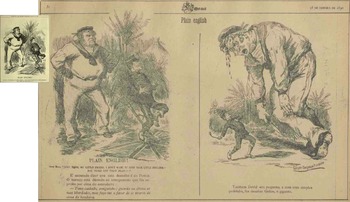
Published in Punch on 18 January 1890, seven days after the British Ultimatum, the cartoon ‘Plain English’ represented a huge and bulky John Bull dressed as a mariner standing behind a little Portuguese dressed as a military man, who was admonished by John Bull for stepping on the Union Jack.Footnote 39 He said, ‘Look here my little friend, I don't want to hurt your little feelings, – but come off that flag.’ In such a way, the cartoonist depicted Portugal's recent political and diplomatic defeat. Just five days later, Bordalo Pinheiro answered back, subverting once again Punch's rhetoric.Footnote 40 On the left side of the page, he reproduced the cartoon ‘Plain English’ published in Punch five days before. On the right side of the picture, Bordalo Pinheiro reversed the two character's positions by appropriating a biblical allegory that could be recognized by all readers, whether Protestant or Catholic. He portrayed the little Portuguese as David facing its enemy, and the big John Bull as Goliath on the verge of collapse (Figure 5). The caption read, ‘David was also small, but with just one stone he toppled the giant Goliath.’ The potent biblical metaphor left no doubt that for Bordalo Pinheiro there was still a solution to the diplomatic affair in which Portugal could be a winner. He again forced his readers to look beyond the immediate political scenario of defeat and hope for a change in internal politics in which Portugal was no longer subservient to Britain.
Left: ‘Plain English’, Punch, 18 January 1890; right: ‘Plain English’, Pontos nos iis (23 January 1890), 239. Hemeroteca de Lisboa.

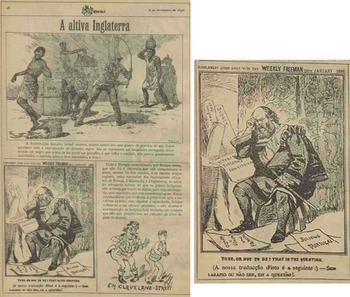
Less than a month later, Bordalo Pinheiro insisted in educating his readers as to the political meaning and long-term implications of the British Ultimatum. He dedicated three dense central pages of the issue of 6 February 1890 to a depiction of British ambitions in Africa as the result of a consistent foreign policy of theft, and the concomitant denigration of opponent nations when considered weak (Figure 6).
Left: ‘A altiva Inglaterra’, Pontos nos iis (6 February 1890) 241. Hemeroteca de Lisboa. Right: Close up from the Weekly Freeman, ‘To be, or not to be that is the question’.

Page 3 showed the map of Africa featuring the territories under dispute in the ‘Serpa Pinto incident’, making the pun between the name proposed by the English – Mashonoland – and the Portuguese word for a land occupied by rascals – Malandroland (close spelling and sound).Footnote 41 The map echoed a nationalistic message also conveyed in another cartoon in the same issue: Queen Victoria is represented acting as the Renaissance femme fatale Lucrezia Borgia, opening her arms to announce ‘you are all poisoned’ to Portuguese politicians to whom she has just served glasses of the ‘British alliance’ and ‘British commerce’. In other words, British infrastructure and the geopolitical and commercial relations it promoted were a poisoned chalice.Footnote 42
Additionally, Bordalo Pinheiro critically commented on a drawing published by a British illustrated magazine in which Portugal is portrayed as a pro-slavery country, stating that it is precisely the other way around.Footnote 43 The very active tracking of British propaganda against Portugal made by Pontos nos iis – in this case in the context of the General Act of the Brussels Conference (1890), which extended the measures approved during the Berlin Conference to Congo to suppress trafficking to all sub-Saharan Africa – proves that it was not just a specific event that was at stake, but a whole agenda of political agitation that was being pursued using this visual language. To reinforce this view and present it as part of a European pro-Portuguese vision, Bordalo Pinheiro included a cartoon published in the supplement of the Irish nationalist satirical magazine Weekly Freeman, the weekend edition of the Freeman's Journal, a daily broadsheet published in Dublin.Footnote 44 Dated 25 January 1890, it depicted a pensive and bulky Lord Salisbury surrounded by papers with illuminating titles, including ‘Bullying Portugal’. The caption read ‘To be, or not to be that is the question’, sarcastically ‘translated’ into Portuguese by Bordalo Pinheiro himself as ‘To steal or not to steal, that is the question.’ On the right side of the Irish cartoon, a long text called attention to the British imperial strategy in Africa of stifling opposition, noting that the British criticized Portugal for immoral actions which in fact they themselves practised. At its bottom, and to illustrate Bordalo's strong opinion on the immoral behaviour of Britain, the cartoonist could not resist adding a drawing to the text in which Britain's immorality was extended from the political to the sexual realm. He depicted John Bull looking greedily at a young telegraph worker, in a clear allusion to the recent Cleveland Street scandal involving the prostitution of a telegraph boy, which the British government had been accused of covering up in order to protect aristocratic clients.Footnote 45
20 November 1890 and 10 January 1891: after the winter of our discontent
The ultimatum was followed by two treaties. The first – the London Treaty – was signed on 20 August 1890 and formalized the Portuguese concessions in view of the British requirements detailed in the ultimatum. The other – the Modus Vivendi Treaty – was signed on 14 November 1890. It was a simplified version of the London Treaty, the result of Portugal's pragmatic resignation in the face of the inevitability of opening up the Mozambican hinterland to British interests, led by Rhodes the infrastructure builder. (Portugal managed to maintain control over the remaining territories and particularly over the rich colony of Angola. These were the two key events for Portugal in the context of the New Imperialism.) Even if accepted by the Portuguese monarchy, the Modus Vivendi continued to be presented by the republicans, and therefore by Bordalo Pinheiro's cartoons, as just one more tool to continue British oppression of Portugal.
On 20 November 1890, just a week after the Modus Vivendi was signed, Pontos nos iis published a double cartoon titled ‘The ultimatum/Modus Vivendi’, which revisited and summarized the conflict unfolding during the year between Portugal and the UK.Footnote 46 Nearly a year after the ultimatum and in the face of the inability of the Portuguese king to oppose the British, nationalist-driven protests continued, even if intermittently, and decisively strengthened the Republican Party. Pinheiro used his cartoons once more to keep his readers attentive to the political scenario, proselytizing in favour of republicanism. On 10 January 1891, the cartoon ‘The ultimatum’ depicted the political situation in Portugal, with a time lag of one year.Footnote 47 On January 1890, a sleepy Zé Povinho, betrayed and attacked by Britain, rested on a trunk which read ‘Portuguese–British alliance’, while John Bull attacked him from behind with a knife. But there was hope: the manifesto of the Republican Party had just been announced and so the cartoon pictured a rosy future. In January 1891, Zé Povinho awoke in order to affectionately salute a soldier who tried to overthrow the monarchy in favour of a republican regime (a failed republican military coup took place on 31 January). Pinheiro implied that the new political regime, awake to the requirements of modernity, would assert Portuguese rights and interests in both the European and African arenas.
Conclusion
Although Bordalo Pinheiro's cartoons in Pontos nos iis were often taken lightly, they in fact articulated a strongly structured political agenda that used a specific event in the context of the Scramble for Africa to convey to a wide audience a systematic criticism of the Portuguese monarchy and to persuade them that a change of regime was the only way to shape Portugal into a modern, technologically dynamic geopolitical player capable of competing with the United Kingdom. The cartoons enacted an instance of soft power as they seduced their readers into altering their political preferences. In this sense they exemplify the concept of informal visual diplomacy as they ‘transmit ideas to audiences, producing and circulating meanings that serve particular purposes, with the aim of influencing, shaping and transforming relations between actors and across publics’. They do so additionally by staging an informal cinematic diplomatic spectacle juste avant la lettre, a sort of comic act the meaning of which emerges via a cinematic staging that mimics the careful preparation of scenarios in diplomatic negotiations.Footnote 48
Pinheiro did not lose sight of the fact that technological infrastructure was an important element in the political and diplomatic disputes he depicted. Using the lens of history of science and technology allows us to take a fresh look at old, restrictively political historical narratives. Pinheiro's cartoons treat the 1890 British Ultimatum as a complex techno-scientific incident with repercussions at the European, colonial and national levels. The British–Portuguese conflict as depicted by Bordalo Pinheiro's Pontos nos iis also shows that techno-scientific diplomacy has long involved strong tensions and asymmetries of power, and not necessarily cooperation or win–win situations. Notably, the technological dimension of the New Imperialism is depicted explicitly in the British case but only implicitly in the Portuguese, the latter usually circumscribed to reactions to cartoons in Punch. This contrast underlines not only different public perceptions but also the importance of science and technology as building blocks of the two European empires.
The examples above show how Bordalo Pinheiro expertly managed to subvert the asymmetrical power structure as perceived by the British and many other foreign nations, one that favoured the British colonial agenda in Africa by underplaying Portuguese claims to historical rights. Pinheiro's visual strategy turned this asymmetry upside down. Pinheiro appropriated Punch's cartoons and changed their original meaning through their incorporation into a radically new visual context. As Punch did not care to reply to Bordalo Pinheiro, and Bordalo Pinheiro made sure that his response reached foreign audiences, Bordalo Pinheiro's actions can be seen as a successful instance of soft power. They simultaneously alerted his international audience to the Portuguese perspective and prepared his national audience for a change of political regime, one that would bring modernity, attention to technological infrastructure, and success on the imperial stage.
Acknowledgments
This paper results from ongoing research in the context of InsSciDE – Inventing a Shared Diplomacy for Europe (H2020 grant agreement no. 770 523), 2018–21. A preliminary version of this paper was presented at the ESHS 2020 Conference, Bologna (31 August–3 September 2020), at the Diplomacy and Images in Science session sponsored by the DHST Commission on Science, Technology and Diplomacy. We thank participants for their comments and questions. We heartily thank the guest editors for their invitation to participate in this issue and for all their insightful comments, which helped us to sharpen our argument in the final version of this paper. We extend our thanks to the referees and the BJHS editor for their suggestions. Finally, we thank the Foundation for Science and Technology (FCT) for supporting our research under the project UIDB/00286/2020.