Implications
Taihu pig breeds are renowned for having high-fertility characteristics, superior meat quality and high resistance to disease. This study examined a genome-wide map of selection signatures within Taihu pigs and between Taihu and Western commercial pigs. We identified some porcine genes related to productivity, disease and behaviour traits. This study will provide an insight to better understand the underlying mechanisms of selection in pig breeding. In addition, the difference between Taihu and Western commercial pigs may be useful to help develop a good hybrid through a crossing production system.
Introduction
Taihu pig breeds (Meishan, Fengjing, Shawutou, Erhualian, Jiaxing Black and Mizhu) are the most prolific breeds of swine in the world. They are distributed mainly in a narrow region around Taihu Lake in the lower Yangtze River Valley of China. In addition to their renowned reproduction traits and high proliferation, they also have many other outstanding economic traits, such as high resistance to disease, superior meat quality, and high resistance to crude feed and a docile temperament (China National Commission of Animal Genetic Resources, 2011). Current phenotypes of pig breeds have dramatically changed compared to their wild counterparts as a result of domestication and the subsequent selection of traits by humans or nature. During this process, different selection pressures (e.g. a wide variety of environmental conditions and intentional breeding by humans) has remarkably subjected the pigs to display enormous amount of phenotypic variations, and their genomes also has experienced changes that are consistent with their current phenotypes. For example, characteristics related to coat colour and muscle growth are favoured by breeders and are strongly selected for in certain breeds. Therefore, the identification of regions that have been subjected to selective breeding would be beneficial for identifying genes related to traits of interest and biological processes.
To date, research studies involving selection signature analysis have largely been conducted in animals. Several studies have revealed strong signatures of selection affecting genomic regions that harbour genes underlying the economic traits of pigs, such as body size (e.g. NR6A1, PLAG1 and LCORL, or ADAMTSL3 genes) (Rubin et al., Reference Rubin, Megens, Martinez Barrio, Maqbool, Sayyab, Schwochow, Wang, Carlborg, Jern, Jorgensen, Archibald, Fredholm, Groenen and Andersson2012), adaptation to high altitude (e.g. ADAMTS12, SIM1 and NOS1 genes) (Ai et al., Reference Ai, Huang and Ren2013), white belt coat colour (e.g. the EDNRB gene) (Ai et al., Reference Ai, Huang and Ren2013) and muscle growth (e.g. BARX2 gene) (Wang et al., Reference Wang, Chen, Yang, Yang, He, Zhang, Chen, Liao, Tu, Zhang, Wang and Pan2014). Nevertheless, the number of genes identified under selection is still small and does not provide insight into changes within the genomes between domestic pigs and wild pigs. In addition, the selection patterns in pig breeds are also different because of their distinct evolutionary histories. As mentioned above, Taihu pigs display superior economic traits of high proliferation, high resistance to disease, high resistance to crude feed and tameness, which are probably as a result of long-term artificial or natural selection. Therefore, a scan of genome-wide selection signatures in the genomes of Taihu pigs will help us identify porcine genes related to productivity, disease and behaviour traits. This will also provide an insight to better understand the underlying mechanisms of selection in pig breeding.
In this study, we detected the selection signatures of Taihu pigs at the genome level using the sequencing data of 252 Taihu pigs and 120 Western pigs. Both intra-population (Relative Extend Haplotype Homozygosity Test (REHH) (Sabeti et al., Reference Sabeti, Reich, Higgins, Levine, Richter, Schaffner, Gabriel, Platko, Patterson, McDonald, Ackerman, Campbell, Altshuler, Cooper, Kwiatkowski, Ward and Lander2002)) and inter-population (the Cross Population Extend Haplotype Homozygosity Test (XPEHH) (Sabeti et al., Reference Sabeti, Varilly, Fry, Lohmueller, Hostetter, Cotsapas, Xie, Byrne, McCarroll, Gaudet, Schaffner, Lander, Frazer, Ballinger, Cox, Hinds, Stuve, Gibbs, Belmont, Boudreau, Hardenbol, Leal, Pasternak, Wheeler, Willis, Yu, Yang, Zeng, Gao, Hu, Hu, Li, Lin, Liu, Pan, Tang, Wang, Wang, Yu, Zhang, Zhang, Zhao, Zhao, Zhou, Gabriel, Barry, Blumenstiel, Camargo, Defelice, Faggart, Goyette, Gupta, Moore, Nguyen, Onofrio, Parkin, Roy, Stahl, Winchester, Ziaugra, Altshuler, Shen, Yao, Huang, Chu, He, Jin, Liu, Shen, Sun, Wang, Wang, Wang, Xiong, Xu, Waye, Tsui, Xue, Wong, Galver, Fan, Gunderson, Murray, Oliphant, Chee, Montpetit, Chagnon, Ferretti, Leboeuf, Olivier, Phillips, Roumy, Sallee, Verner, Hudson, Kwok, Cai, Koboldt, Miller, Pawlikowska, Taillon-Miller, Xiao, Tsui, Mak, Song, Tam, Nakamura, Kawaguchi, Kitamoto, Morizono, Nagashima, Ohnishi, Sekine, Tanaka, Tsunoda, Deloukas, Bird, Delgado, Dermitzakis, Gwilliam, Hunt, Morrison, Powell, Stranger, Whittaker, Bentley, Daly, de Bakker, Barrett, Chretien, Maller, McCarroll, Patterson, Pe’er, Price, Purcell, Richter, Sabeti, Saxena, Schaffner, Sham, Varilly, Altshuler, Stein, Krishnan, Smith, Tello-Ruiz, Thorisson, Chakravarti, Chen, Cutler, Kashuk, Lin, Abecasis, Guan, Li, Munro, Qin, Thomas, McVean, Auton, Bottolo, Cardin, Eyheramendy, Freeman, Marchini, Myers, Spencer, Stephens, Donnelly, Cardon, Clarke, Evans, Morris, Weir, Tsunoda, Johnson, Mullikin, Sherry, Feolo, Skol, Zhang, Zeng, Zhao, Matsuda, Fukushima, Macer, Suda, Rotimi, Adebamowo, Ajayi, Aniagwu, Marshall, Nkwodimmah, Royal, Leppert, Dixon, Peiffer, Qiu, Kent, Kato, Niikawa, Adewole, Knoppers, Foster, Clayton, Watkin, Gibbs, Belmont, Muzny, Nazareth, Sodergren, Weinstock, Wheeler, Yakub, Gabriel, Onofrio, Richter, Ziaugra, Birren, Daly, Altshuler, Wilson, Fulton, Rogers, Burton, Carter, Clee, Griffiths, Jones, McLay, Plumb, Ross, Sims, Willey, Chen, Han, Kang, Godbout, Wallenburg, L’Archeveque, Bellemare, Saeki, Wang, An, Fu, Li, Wang, Wang, Holden, Brooks, McEwen, Guyer, Wang, Peterson, Shi, Spiegel, Sung, Zacharia, Collins, Kennedy, Jamieson and Stewart2007); F-STATISTICS, F ST (Weir and Cockerham, Reference Weir and Cockerham1984)) statistical methods were used to identify the selection signatures.
Material and methods
Populations and sequencing data preparation
A total of 372 individuals from nine pig breeds, including six Chinese Taihu pig breeds (Meishan, Fengjing, Shawutou, Erhualian, Jiaxing Black and Mizhu; n=252) and three Western pig breeds (Duroc, n=48; Yorkshire, n=35; Landrace, n=37) were obtained for this study (Supplementary Table S1). The detailed information about all the individuals and the methods of acquiring the raw Illumina DNA sequence data have been reported in our previous studies (Wang et al., Reference Wang, Chen, Liao, Zhang, Zhang, Liu, Zhu, Zhang, Xue, Yang, Zheng, Wang and Pan2016; Zhang et al., Reference Zhang, Yue, Pu, Wang, Liu, Liang, Yan, Zhao, Li, Shi, Zhang and Wang2016). Briefly, the genomic DNA was extracted from ear tissues. The DNA was digested by the restriction enzyme AvaII. Then, the unique adapter-barcode sequence was ligated to each individual’s digested fragments. Finally, the ligations of each individual were pooled to make up a DNA library. The library (digested fragments ranging from 200 to 300 bp) was sequenced. We aligned the reads to the pig reference genome (SGSC Sscrofa10.2; http://hgdownload.soe.ucsc.edu/goldenPath/susScr3/bigZips/) using Burrows-Wheeler Aligner (BWA ver 0.7.5) (Li and Durbin, Reference Li and Durbin2009) with the default settings and using the steps of the genotyping by genome reducing and sequencing approach (Chen et al., Reference Chen, Ma, Yang, Chen, Liao, Xie, Wang, He, Tu, Zhang, Yang, Yang, Yu, Zheng, Zhang, Wang and Pan2013). The alignment results with mapping quality scores less than 20 were filtered before the single nucleotide polymorphism (SNP) was called.
Single nucleotide polymorphism calling and genotyping
Single nucleotide polymorphisms were identified and genotyped using SAMtools (ver 0.1.19) (Li et al., Reference Li, Handsaker, Wysoker, Fennell, Ruan, Homer, Marth, Abecasis and Durbin2009) and the mpileup algorithm. These SNPs were retained for further analysis according to the following criteria: more than 111 (30%) genotyped samples and a sequencing depth greater than fivefold on average. The imputation analysis for the missing genotypes was performed with an iBLUP algorithm (Yang et al., Reference Yang, Wang, Chen, Liao, Zhang, Yang, Zheng, Zhang and Pan2014). Finally, a total of 114 596 SNPs (with an average depth for SNP calling of 10.9-fold; Supplementary Table S1) with minor allele frequencies of 0.05 were obtained from the selection signature analysis. In addition, the FASTPHASE program (Scheet and Stephens, Reference Scheet and Stephens2006) was implemented to reconstruct haplotypes for every chromosome using the default parameters to acquire full-phase haplotype data.
Detection of selection signatures
Three methods, including the REHH, XPEHH and F ST tests, were performed to detect the selection signatures. The REHH test can detect positive selection signatures that occurs within a population’s genome, whereas the XPEHH and F ST tests can detect selection signatures by comparing the genomes of two populations.
The program Sweep v.1.1 was implemented to compute the REHH statistic, and the core regions were defined as chromosome fragments that included at least four SNPs (Sabeti et al., Reference Sabeti, Reich, Higgins, Levine, Richter, Schaffner, Gabriel, Platko, Patterson, McDonald, Ackerman, Campbell, Altshuler, Cooper, Kwiatkowski, Ward and Lander2002). We then placed the REHH values in order, based on the frequency of all the haplotypes, into 20 bins to calculate their significance and obtained the P values by log-transforming the REHH in the bin to reach normality and calculate the mean and standard deviation. The core haplotypes with extreme REHH values (P<0.01) were considered to be statistically significant. We removed the core haplotypes with a frequency of less than 0.25 because regions harbouring the beneficial allele would have a high frequency due to a hitchhiking effect (Sabeti et al., Reference Sabeti, Reich, Higgins, Levine, Richter, Schaffner, Gabriel, Platko, Patterson, McDonald, Ackerman, Campbell, Altshuler, Cooper, Kwiatkowski, Ward and Lander2002). Finally, we extended 250 kb towards both the upstream and downstream directions of the significant core haplotypes with lengths longer than 1 kb, and we regarded these extended regions as candidates for selection regions.
The program available at http://hgdp.uchicago.edu (coded by Joe Pickrell) was employed to perform the XPEHH test (Pickrell et al., Reference Pickrell, Coop, Novembre, Kudaravalli, Li, Absher, Srinivasan, Barsh, Myers, Feldman and Pritchard2009). In our study, we defined Taihu pigs as the observed population and Western pigs as the reference population. The positive XPEHH scores indicate that a selection occurred in the observed population, whereas negative scores suggest that a selection occurred in the reference population. As the calculation of the XPEHH requires genetic distance between adjacent SNPs, we considered a chromosome segment of 1 Mb to be 1 cM. After normalization, the XPEHH values approximately followed a standard norm distribution (Sabeti et al., Reference Sabeti, Varilly, Fry, Lohmueller, Hostetter, Cotsapas, Xie, Byrne, McCarroll, Gaudet, Schaffner, Lander, Frazer, Ballinger, Cox, Hinds, Stuve, Gibbs, Belmont, Boudreau, Hardenbol, Leal, Pasternak, Wheeler, Willis, Yu, Yang, Zeng, Gao, Hu, Hu, Li, Lin, Liu, Pan, Tang, Wang, Wang, Yu, Zhang, Zhang, Zhao, Zhao, Zhou, Gabriel, Barry, Blumenstiel, Camargo, Defelice, Faggart, Goyette, Gupta, Moore, Nguyen, Onofrio, Parkin, Roy, Stahl, Winchester, Ziaugra, Altshuler, Shen, Yao, Huang, Chu, He, Jin, Liu, Shen, Sun, Wang, Wang, Wang, Xiong, Xu, Waye, Tsui, Xue, Wong, Galver, Fan, Gunderson, Murray, Oliphant, Chee, Montpetit, Chagnon, Ferretti, Leboeuf, Olivier, Phillips, Roumy, Sallee, Verner, Hudson, Kwok, Cai, Koboldt, Miller, Pawlikowska, Taillon-Miller, Xiao, Tsui, Mak, Song, Tam, Nakamura, Kawaguchi, Kitamoto, Morizono, Nagashima, Ohnishi, Sekine, Tanaka, Tsunoda, Deloukas, Bird, Delgado, Dermitzakis, Gwilliam, Hunt, Morrison, Powell, Stranger, Whittaker, Bentley, Daly, de Bakker, Barrett, Chretien, Maller, McCarroll, Patterson, Pe’er, Price, Purcell, Richter, Sabeti, Saxena, Schaffner, Sham, Varilly, Altshuler, Stein, Krishnan, Smith, Tello-Ruiz, Thorisson, Chakravarti, Chen, Cutler, Kashuk, Lin, Abecasis, Guan, Li, Munro, Qin, Thomas, McVean, Auton, Bottolo, Cardin, Eyheramendy, Freeman, Marchini, Myers, Spencer, Stephens, Donnelly, Cardon, Clarke, Evans, Morris, Weir, Tsunoda, Johnson, Mullikin, Sherry, Feolo, Skol, Zhang, Zeng, Zhao, Matsuda, Fukushima, Macer, Suda, Rotimi, Adebamowo, Ajayi, Aniagwu, Marshall, Nkwodimmah, Royal, Leppert, Dixon, Peiffer, Qiu, Kent, Kato, Niikawa, Adewole, Knoppers, Foster, Clayton, Watkin, Gibbs, Belmont, Muzny, Nazareth, Sodergren, Weinstock, Wheeler, Yakub, Gabriel, Onofrio, Richter, Ziaugra, Birren, Daly, Altshuler, Wilson, Fulton, Rogers, Burton, Carter, Clee, Griffiths, Jones, McLay, Plumb, Ross, Sims, Willey, Chen, Han, Kang, Godbout, Wallenburg, L’Archeveque, Bellemare, Saeki, Wang, An, Fu, Li, Wang, Wang, Holden, Brooks, McEwen, Guyer, Wang, Peterson, Shi, Spiegel, Sung, Zacharia, Collins, Kennedy, Jamieson and Stewart2007). We considered these outlying signals with a P value less than 0.01 to be statistically significant. We first merged the outlier signals with a physical distance less than 250 kb into one region and extended 250 kb towards the upstream and downstream directions of merged regions that were considered potential candidates of the selection regions. The F ST analysis described by Weir and Cockerham (Reference Weir and Cockerham1984) was also performed between Taihu pigs and Western pigs. The top 1% SNPs were considered as the candidate selection regions. Moreover, the difference of selection signatures among Taihu pigs and Western pigs were also performed, respectively.
Annotation and function analysis of identified genomic regions
The candidate selection regions were annotated to the closest genes based on the annotation for the Susscrofa assembly 10.2 available from the Ensembl databases (http://www.ensembl.org/index.html). The genes were defined as candidate genes when their positions were contained inside the candidate regions of selection. The functions and pathways in which these genes are involved were determined using the DAVID tool (ver 6.7) (Dennis et al., Reference Dennis, Sherman, Hosack, Yang, Gao, Lane and Lempicki2003). Because the Gene Ontology (GO) annotation of pigs is incomplete, corresponding human orthologous Ensembl IDs were retrieved to determine enrichment function categories using a perl script. The enriched GO terms and pathways with P values<0.05 after correction for multiple testing (with a false discovery rate of less than 25%) were considered to be statistically significant. In addition, we identified enriched networks in the Ingenuity Pathways Analysis (IPA, Ingenuity Systems and www.ingenuity.com) platform. Finally, the porcine quantitative trait locus (QTL) database (http://www.animalgenome.org) was searched to identify overlap with previously published porcine QTLs within the candidate regions. We removed QTLs with lengths more than 1 Mb to consider some QTLs with lengths that were too large for efficient post-processing, and we also merged the QTLs with overlapped QTLs. Ultimately, a total of 2031 non-overlapping QTL regions were acquired in the analysis (Supplementary Table S2).
Results
Sequencing and identification of single nucleotide polymorphisms
Approximately 1.47 billion reads of high quality (with approximately 3.95 million reads and a coverage of 2.7% on average for each individual) were used to call SNPs. The information of the average amount of coverage and the read number for each breed are shown in Supplementary Table S1. A density of 100 kb of a non-overlapping window for these 114 596 SNPs exhibited a relatively uniform distribution across each chromosome, except for the sex chromosomes (Supplementary Figure S1). The results of the population structure based on the principal component analysis, STRUCTURE and Neighbor-joining tree showed that Taihu pigs and Western pigs can be clearly separated into two different populations fostering comparison between the two populations (Supplementary Figure S2). Therefore, we conducted selection analysis by comparing the genomes of the two populations. However, there were also some differences among Taihu pig breeds and Western pig breeds. Therefore, the difference of selection signatures among Chinese native breeds and Western pig breeds were explored. Among the Taihu pig breeds, the sub-population number was set as 7 in the F ST analysis. There were no obvious difference between Yorkshire and Landrace pigs even when the K is 10 in the STRUCTURE analysis. We then considered the Yorkshire and Landrace pigs as a whole to compare with the Duroc pigs.
Candidate selection regions
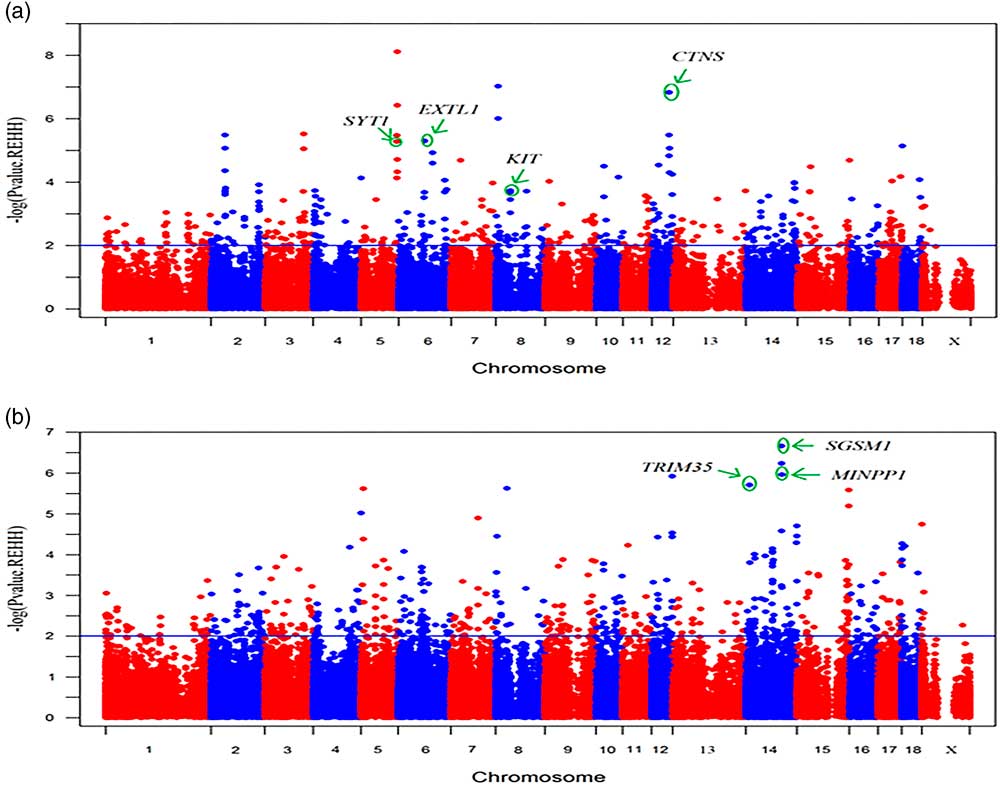
To detect signals of positive selection within the Taihu pig population as well as against the Western population, we used three statistical methods to comprehensively localize the source of selection. We first used the REHH test to detect the selected signals in the genomes of the Taihu and Western pigs. A total of 282 and 385 candidate selection regions with an overall length of 159.78 and 207.10 Mb, and average lengths of 0.57 and 0.58 Mb, accounted for approximately 6.15% and 7.96% of the genome, and they were identified in Taihu and Western pig populations, respectively (Table 1). Chromosome 14 in both Taihu and Western pigs showed the longest length of the selection regions compared to the rest of the chromosomes.
Summary of whole genome candidate selection regions identified in Taihu and Western pig populations (Mb)

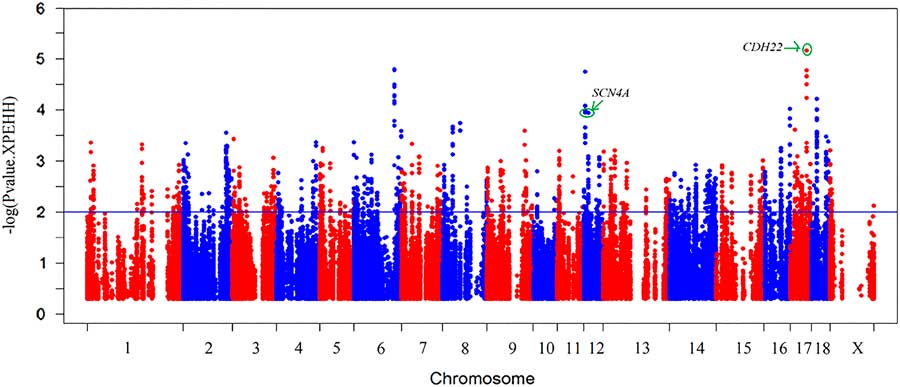
We then used the XPEHH and F ST tests to compare Taihu and Western pig populations. A total of 666 and 896 outliers (P<0.01) were detected in Taihu and Western pig populations in the XPEHH test. After merging the overlap outlier as described in the methods section, a total of 112 and 170 candidate selection regions with total lengths of 62.29 and 94.20 Mb, and average lengths of 0.56 and 0.55 Mb that accounted for approximately 2.40% and 3.63% of the genome, were identified in Taihu and Western pig populations, respectively (Table 1). In the genome of the Taihu pigs, chromosome 2 displayed the longest length of selection regions, and chromosome 18 was not identified in genomic regions under selection. Many neighbour loci showed consecutive lower P values (Figures 1 and 2), which indicated that more reliable evidence of those regions experienced selection. In the F ST analysis, the top 1% SNPs were considered as the candidate selection regions. The average F ST value between Taihu pigs and Western pigs was 0.198. Moreover, the average F ST value among Taihu pigs and Western pigs were 0.123 and 0.101, respectively.
(colour online) The genome-wide distribution of selection signatures detected by the Relative Extend Haplotype Homozygosity Test (REHH) across each chromosome in Taihu and Western pigs. (a) Results of the REHH test for Taihu pigs. SYT1=Synaptotagmin 1; EXTL1=exostosin-like glycosyltransferase 1; KIT=KIT proto-oncogene receptor tyrosine kinase; CTNS=cystinosin, lysosomal cystine transporter. (b) Results of the REHH test for Western pigs. TRIM35=tripartite motif containing 35, SGSM1=small G protein signalling modulator 1; MINPP1=multiple inositol-polyphosphate phosphatase 1. The green circle represents the most significant genes under the selection.

(colour online) The genome-wide distribution of selection signatures detected by the Cross-Population Extend Haplotype Homozygosity Test (XPEHH) across each chromosome in Taihu and Western pigs. SCN4=sodium voltage-gated channel alpha subunit 4; CDH22=cadherin 22. The Taihu pigs are defined as the observed population, and the Western pigs are the reference population. The green circle represents the most significant genes under selection.

Genomic annotation
To further investigate the possible biological functions of these regions under selection, we revealed the QTLs and genes harboured in the selection regions. We found that selection regions of approximately 25% overlapped with QTLs (Table 2). We noted that the vast majority of these genes identified under selection in the two populations were different, and even the genes identified under selection in the same population with different methods only displayed a small proportion of overlap (Taihu, 102 genes; Western, 124 genes; Supplementary Figure S3). Furthermore, the results of the enrichment analysis showed that the two breeds presented a different over-representation of genes with GO annotations and Kyoto Encyclopedia of Genes and Genomes (KEGG) pathways. The Taihu pigs showed over-representation of genes with pathways related to diseases, whereas the Western pigs displayed an over-representation of genes with pathways related to lipids and olfaction.
The number of candidate selection regions under quantitative trait loci in Taihu and Western pig populations

1 Some selection regions may be related to more than one trait, but they were only counted once.
Quantitative trait loci overlap with selection regions
The Pig QTLdb database includes almost all of the QTLs reported in the past few decades, and these data can provide information about genome regions that have been experimentally identified to be correlated with a specific trait. Therefore, we can explore the potential function of genomic regions under selection with traits by comparing their physical locations with QTLs.
The QTLs located in or overlapping with selection regions (REHH test) in each chromosome with the lowest P value are shown in Supplementary Table S3. The results show that a series of these QTLs is related to reproduction traits in Taihu pigs. Take the 268 556 705 to 268 561 835 bp selection signal of chromosome 1 for instance: one QTL (ID=18061) influencing the total number of piglets born alive was mapped in this region. Many of the QTLs in Western pigs are related to meat and carcass traits, for example, the 25 248 186 to 25 252 699 bp selection signal of chromosome 16 overlapping with the QTL (ID=22 311 to 22 314), which influenced the loin muscle area. In addition, we also found that some selection regions overlapped with QTLs that influence multiple traits, for example, the 7 116 095 to 7 124 680 bp selection signal of chromosome 12 in Taihu pigs was related to reproduction, production, health and exterior traits. Similarly, the 34 286 910 to 34 301 822 bp selection signals in Western pigs overlapped with QTLs related to meat and quality as well as reproduction and production traits.
Some of the QTLs located in or overlapping with the selection regions identified by the XPEHH test are summarized in Supplementary Table S4. In Taihu pigs, we found the 2 728 371 to 2 728 382 bp selection signal of chromosome 2 overlapped with many QTLs related to multiple traits (e.g. the total number of piglets born alive and backfat thickness), and these results also overlapped with the carnitine palmitoyltransferase 1A (CPT1A) gene. The CPT1A gene, which plays an important role in the regulation of fatty acid metabolism in newborn pigs (Lin et al., Reference Lin, Shim and Odle2010), has also been previously reported to be under selection (Ma et al., Reference Ma, Wei, Zhang, Chen, Wang, Liu and Ding2015). Compared to the Taihu pigs, Western pigs experienced more selection in meat and carcass traits (e.g. average backfat thickness, ID=22 292; drip loss, ID=8053).
Genes under potential selection regions
A total of 1219 (REHH test) and 742 genes (XPEHH test) in Taihu pigs and 1609 (REHH test) and 1061 (XPEHH test) genes in Western pigs were found under the selection regions (Supplementary Figure S3). For the F ST analysis, a total of 202 genes were detected between Taihu pigs and Western pigs (Supplementary Table S5). In addition, a total of 199 and 188 genes were detected among the Taihu pigs and Western pigs, respectively.
For the REHH test, we found that three genes in the Taihu population (CTNS, EXTL1 and SYT1 genes; Figure 1a) and three different genes in the Western population (SGMS1, MINPP1 and TRIM35 genes; Figure 1b) are under selection regions showing the smallest P values (the top 5) (Supplementary Table S6). For the XPEHH test, we found three out of five outliers with the smallest P values located in two genes (SCN4A and CDH22 genes; Figure 2). The SCN4A gene was identified under selection in the Taihu population, and the CDH22 gene was identified under selection in the Western population. For the F ST test between Taihu and Western pigs, the most significant gene in the chromosome 7 was LTBP2 (F ST value 0.967). Among the Taihu pigs analysis, the most significant gene was SLC27A1 (F ST value 0.866). Among the Western pigs analysis, the most significant genes were GNAL (F ST value 0.966) and CHST10 (F ST value 0.948).
Involved biological processes under selection
To see the functions of the putative genes under selection in the entire gene network, we performed an enrichment analysis for these genes using DAVID. According to the criterion mentioned above (see methods), we found seven and six significant pathways in total for the REHH test as well as 5 and 16 significant GOs in the Taihu and Western populations, respectively. For the XPEHH test, the Taihu pigs had only one significant pathway and seven significant GOs, and the Western pigs had two significant pathways and nine significant GOs. The significant GO and KEGG pathways of over-represented genes are shown in Supplementary Table S6.
The results suggested that the two populations present a different pattern of over-representation of genes in the GO annotations and KEGG pathways. For Taihu pigs (REHH test), the majority of the pathways were associated with disease, for example, asthma, autoimmune thyroid disease, the intestinal immune network for IgA production and graft-v.-host disease. The GO terms were associated with embryonic development, ossification and enzyme activity. For the Western pigs, the significant pathways were associated with reproduction (e.g. the GnRH signalling pathway) and lipid metabolism (e.g. ether lipid metabolism and alpha-Linolenic acid metabolism), and the significant GO terms were associated with development (e.g. embryonic development and regulation of developmental processes).
By comparing the genome of Western pigs, the genes under selection regions in Taihu pigs were over-represented in the GO terms related to reproduction (e.g. female pregnancy, endomembrane system) and health (e.g. stress response). In contrast, the genes in selection regions in Western pigs were over-represented in the pathway related to olfaction (e.g. the Olfactory transduction pathway), and the GO terms are related to oxygen binding and temperature homeostasis when compared to the genome of Taihu pigs. In addition, for the F ST test between Taihu and Western pigs, the significant term (GO:0019838~growth factor binding, P value was 3.17E-05) was associated with growth was detected.
Molecular subnetwork
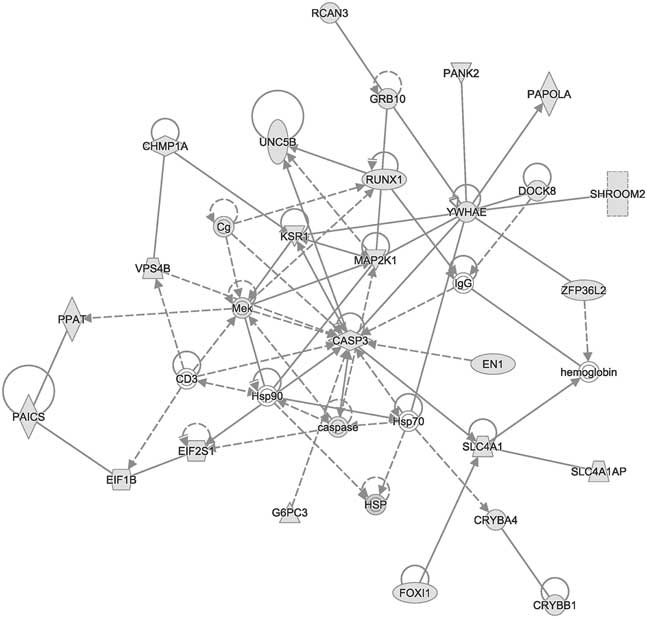
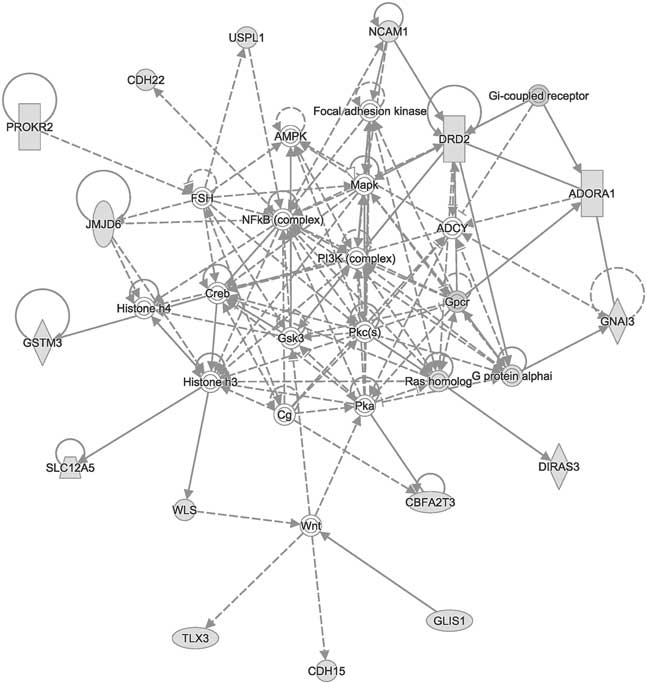
To assess the key roles of genes under selection regions in networks, we performed Fisher’s exact test based on the IPA molecular library, and we found a total of 49 (Taihu: 25 REHH; 6 XPEHH; Western: 10 REHH, 8 XPEHH) significant molecular networks (Supplementary Table S7). We also found that genes under selection regions of the Taihu pig genome were enriched in functions related to productivity and immunity, for example, one of the networks (ID=5, REHH; Figure 3) consists of 26 selected genes, and its most essential functions comprise cellular development, cellular growth and proliferation and embryonic development. Another network (ID=2, XPEHH) includes 17 selected genes, and the functions of cellular movement, haematological system development and function as well as immune cell trafficking were enriched in this structure. The results of this network show that the genes under selection regions of the Western pig genome were enriched in functions related to development and the nervous system, for example, one of the networks (ID=5, REHH) comprised 30 selected genes principally related to embryonic development, organismal development, skeletal and muscular system development and function, and the main functions of another network (ID=3, XPEHH; Figure 4), with 16 selection genes participating in the system, involve behaviour, nervous system development and function, and skeletal and muscular system development and function.
Significant ingenuity pathway analysis molecular networks under selection regions in Taihu pigs. Networks involving cellular development, cellular growth and proliferation as well as embryonic development in Taihu pigs.

Significant ingenuity pathway analysis molecular networks under selection regions in Western pigs. Networks involving behaviour, nervous system development and function, and skeletal and muscular system development and function in Western pigs.

Discussion
Taihu pig breeds are an invaluable component of the world’s porcine genetic resources. However, the genetic architecture of their economic important traits is still unclear and this might impede the full utilization of their genetic potential. Exploring the selection signatures in the genome of Taihu pigs will help us to identify porcine genes related to productivity, disease and behaviour traits as well as allow us to better understand the underlying mechanisms of selection in pig breeding. In this study, we used three complementary methods (REHH, XPEHH, F ST tests) to detect the selection signatures. The three approaches are necessary and helpful to construct a comprehensive selection map for the pig genome and to reveal genetic mechanisms of phenotypic diversity.
We noted that Taihu pigs exhibited less overall length of selection regions compared to the Western pigs, implying that Taihu pigs experienced less intensive selection unlike the Western pigs. This observation agrees with the history of the breeding programmes of the Western pig breed, which experienced a more intensive selection in the past few decades than indigenous Chinese pigs. Furthermore, the majority of genes under selection regions in Taihu pigs were different from selection genes in Western pigs, indicating that the Taihu and Western pigs experienced selection in different regions of the genome. Approximately 10 000 years ago, pigs from Asia and Europe were independently domesticated (Larson et al., Reference Larson, Albarella, Dobney, Rowley-Conwy, Schibler, Tresset, Vigne, Edwards, Schlumbaum, Dinu, Balacsescu, Dolman, Tagliacozzo, Manaseryan, Miracle, Van Wijngaarden-Bakker, Masseti, Bradley and Cooper2007). During this period, artificial selection and breeding has led to highly phenotypic changes among breeds on these continents (Megens et al., Reference Megens, Crooijmans, San Cristobal, Hui, Li and Groenen2008). The different selection pressures on their phenotypes eventually led to different selection in their genomes.
In addition, for each population, the selection regions identified by the two approaches (REHH and XPEHH) also showed a low fraction of overlap (Supplementary Figure S3). This outcome is presumably due to the methods being sensitive to different categories of selection signatures (Oleksyk et al., Reference Oleksyk, Smith and O’Brien2010; Suzuki, Reference Suzuki2010), for example, the REHH test is sensitive for detecting ongoing selection signatures with low-to-moderate frequency, whereas the XPEHH test is effective for detecting nearly complete selection signatures (Sabeti et al., Reference Sabeti, Varilly, Fry, Lohmueller, Hostetter, Cotsapas, Xie, Byrne, McCarroll, Gaudet, Schaffner, Lander, Frazer, Ballinger, Cox, Hinds, Stuve, Gibbs, Belmont, Boudreau, Hardenbol, Leal, Pasternak, Wheeler, Willis, Yu, Yang, Zeng, Gao, Hu, Hu, Li, Lin, Liu, Pan, Tang, Wang, Wang, Yu, Zhang, Zhang, Zhao, Zhao, Zhou, Gabriel, Barry, Blumenstiel, Camargo, Defelice, Faggart, Goyette, Gupta, Moore, Nguyen, Onofrio, Parkin, Roy, Stahl, Winchester, Ziaugra, Altshuler, Shen, Yao, Huang, Chu, He, Jin, Liu, Shen, Sun, Wang, Wang, Wang, Xiong, Xu, Waye, Tsui, Xue, Wong, Galver, Fan, Gunderson, Murray, Oliphant, Chee, Montpetit, Chagnon, Ferretti, Leboeuf, Olivier, Phillips, Roumy, Sallee, Verner, Hudson, Kwok, Cai, Koboldt, Miller, Pawlikowska, Taillon-Miller, Xiao, Tsui, Mak, Song, Tam, Nakamura, Kawaguchi, Kitamoto, Morizono, Nagashima, Ohnishi, Sekine, Tanaka, Tsunoda, Deloukas, Bird, Delgado, Dermitzakis, Gwilliam, Hunt, Morrison, Powell, Stranger, Whittaker, Bentley, Daly, de Bakker, Barrett, Chretien, Maller, McCarroll, Patterson, Pe’er, Price, Purcell, Richter, Sabeti, Saxena, Schaffner, Sham, Varilly, Altshuler, Stein, Krishnan, Smith, Tello-Ruiz, Thorisson, Chakravarti, Chen, Cutler, Kashuk, Lin, Abecasis, Guan, Li, Munro, Qin, Thomas, McVean, Auton, Bottolo, Cardin, Eyheramendy, Freeman, Marchini, Myers, Spencer, Stephens, Donnelly, Cardon, Clarke, Evans, Morris, Weir, Tsunoda, Johnson, Mullikin, Sherry, Feolo, Skol, Zhang, Zeng, Zhao, Matsuda, Fukushima, Macer, Suda, Rotimi, Adebamowo, Ajayi, Aniagwu, Marshall, Nkwodimmah, Royal, Leppert, Dixon, Peiffer, Qiu, Kent, Kato, Niikawa, Adewole, Knoppers, Foster, Clayton, Watkin, Gibbs, Belmont, Muzny, Nazareth, Sodergren, Weinstock, Wheeler, Yakub, Gabriel, Onofrio, Richter, Ziaugra, Birren, Daly, Altshuler, Wilson, Fulton, Rogers, Burton, Carter, Clee, Griffiths, Jones, McLay, Plumb, Ross, Sims, Willey, Chen, Han, Kang, Godbout, Wallenburg, L’Archeveque, Bellemare, Saeki, Wang, An, Fu, Li, Wang, Wang, Holden, Brooks, McEwen, Guyer, Wang, Peterson, Shi, Spiegel, Sung, Zacharia, Collins, Kennedy, Jamieson and Stewart2007).
The functions associated with the putative selection regions were investigated at three levels (i.e. trait level, gene level and gene set level) based on several genomic annotation databases, for example, the QTL database and KEGG. For the traits level, we first explored the pig QTL database to test whether the detected selection signatures were as a result of human selection during pig breeding. Interestingly, we found that about 25% of the selection regions were located in the newly defined QTLs, which is consistent with previous studies showing that the most important economic traits of pigs have been subjected to strong selection pressure (Chen et al., Reference Chen, Baxter, Muir, Groenen and Schook2007). Since Taihu pigs are especially famous for their reproduction traits, we expect to be able to identify selection signatures related to reproduction traits. Our findings supported this expectation with a series of selection regions located in QTLs of each chromosome (with the smallest P value) that were related to reproduction traits (Supplementary Table S3). Similarly, many of the QTLs overlapping with the selection regions in Western pigs were related to meat and carcass traits (Supplementary Table S3), and this observation correlates with the history of meat quality selection (such as lean meat percentage) in Western pig breeding programmes (Vidal et al., Reference Vidal, Noguera, Amills, Varona, Gil, Jimenez, Davalos, Folch and Sanchez2005; Amaral et al., Reference Amaral, Ferretti, Megens, Crooijmans, Nie, Ramos-Onsins, Perez-Enciso, Schook and Groenen2011). Furthermore, based on the selection regions identified by the XPEHH test, we found that Taihu pigs had a greater percentage (Taihu: 39.2%, 11/28; Western: 25%, 12/48; Table 2) of selection regions overlapping with the reproduction QTLs compared to Western pigs, whereas Western pigs had a greater percentage (Taihu: 42.8%, 12/28; Western: 66.7%, 32/48; Table 2) of selection regions overlapping with the meat quality and carcass QTLs compared to Taihu pigs. To a certain extent, the results indicate that the Taihu pigs experienced more selection in production traits compared to the Western pigs, whereas the Western pigs experienced more selection in meat quality and carcass traits compared to the Taihu pigs.
For the gene level, the genes under the most significant selection regions in Taihu pigs were relevant to disease and the nervous system (Figure 1a), for example, the CTNS gene has been reported to be related to argyrophilic grain disease, which is a progressive neurodegenerative disease of the human brain (Villela et al., Reference Villela, Kimura, Schlesinger, Goncalves, Pearson, Suemoto, Pasqualucci, Krepischi, Grinberg and Rosenberg2013). The EXTL1 gene is a member of the EXT tumour suppressor gene family (Wuyts et al., Reference Wuyts, Spieker, Van Roy, De Boulle, De Paepe, Willems, Van Hul, Versteeg and Speleman1999), and the SCN4A gene has been described as being associated with neuromuscular disorders such as paramyotonia congenita, sodium channel myotonias and congenital myasthenic syndrome in human studies (Vicart et al., Reference Vicart, Sternberg, Fontaine and Meola2005). The SYT1 gene plays an important role in neurons and is associated with feeding behaviour traits (Do et al., Reference Do, Strathe, Ostersen, Jensen, Mark and Kadarmideen2013). Furthermore, the SGMS1 gene, which was under the most significant selection regions in Western pigs was relevant to production traits, and it was reported to be associated with the residual feed intake (RFI) of pigs. This observation is consistent with the history of Western pig breeding in which the RFI is used as a trait for selection to improve feed efficiency (Onteru et al., Reference Onteru, Gorbach, Young, Garrick, Dekkers and Rothschild2013). The outcome indicated that genes related to feed intake may have experienced certain selection content.
We also found several other genes (MINPP1, TRIM35 and CDH22 genes) under the most significant selection regions in Western pigs. Among them, the MINPP1 gene was reported to affect milk fatty acid traits in dairy cattle (Li et al., Reference Li, Sun, Zhang, Wang, Wu, Zhang, Liu, Li and Qiao2014), and the CDH22 gene was reported to likely play a significant role during the development and the adult functions of the mouse brain (Mayer et al., Reference Mayer, Bercsenyi, Geczi, Szabo and Lele2010). In addition, we performed a χ 2 test of the genotypes and allele frequency distribution of these loci under the most significant selection regions for the two populations. We speculated that the two populations would exhibit a different pattern of distribution in genotypes or alleles due to different selection pressures (i.e. the selection pressures of Taihu pigs are mainly from natural selection and conventional breeding, whereas for Western pigs, the pressures largely arose from modern artificial selection). The results showed that all these loci displayed different distribution patterns that are extremely significant in the two populations (Supplementary Table S8), implying that the different selection pressures are likely to result in different frequency distributions of genotypes or alleles.
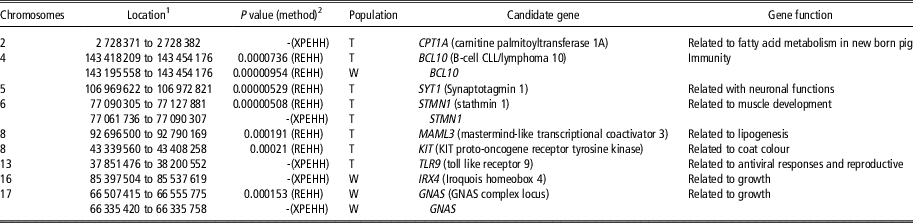
In addition, we screened the list of genes under the selection regions and found that many genes were related to economic traits (Table 3). For the Taihu pigs, we found that some genes under selection were related to lipogenesis and reproduction traits. For example, the CPT1A and MAML3 genes, which were reported to be relevant to lipogenesis in pigs (Lin et al., Reference Lin, Shim and Odle2010; Revilla et al., Reference Revilla, Ramayo-Caldas, Castello, Corominas, Puig-Oliveras, Ibanez-Escriche, Munoz, Ballester and Folch2014), overlapped with the selected region 2 728 371 to 2 728 382 bp on chromosome 2 and 92 696 500 to 92 790 169 bp on chromosome 8, respectively. Another example is the TLR9 gene, which overlapped with the selected region 37 851 476 to 38 200 552 bp on chromosome 13 and was reported to be related to porcine reproductive traits involved in antiviral responses. Furthermore, the KIT gene (a well-known coat colour gene that is an important factor regulating coat colour) was found to be under the selection region of 43 339 560 to 43 408 258 bp on chromosome 8 (Figure 1, Table 3), and it has also been reported as a selection gene in several previous studies (Rubin et al., Reference Rubin, Megens, Martinez Barrio, Maqbool, Sayyab, Schwochow, Wang, Carlborg, Jern, Jorgensen, Archibald, Fredholm, Groenen and Andersson2012; Bosse et al., Reference Bosse, Lopes, Madsen, Megens, Crooijmans, Frantz, Harlizius, Bastiaansen and Groenen2015; Ma et al., Reference Ma, Wei, Zhang, Chen, Wang, Liu and Ding2015). For the Western pigs, we found some genes related to growth and meat quality traits, for example, the IRX4 gene overlapping with selection region 85 397 504 to 85 537 619 bp on chromosome 16 was reported to be related to BW at 71 days of age (Jung et al., Reference Jung, Park, Lee, Yoo, Kim, Kim, Kim and Lim2014), and the GNAS gene overlapping with the selection regions identified by both tests (REHH, 66 507 415 to 66 555 775 bp; XPEHH, 66 335 420 to 66 335 758 bp; on chromosome 17) was reported to affect growth in pigs (Oczkowicz et al., Reference Oczkowicz, Ropka-Molik and Tyra2013). Furthermore, we also found that some genes were related to immunity, for example, the BCL10 gene was identified under selection regions in both Taihu (143 418 209 to 143 454 176 bp, chromosome 4, REHH test) and Western (143 195 558 to 143 454 176 bp, chromosome 4, REHH test) pig populations.
Representative candidate genes located in potential selection regions in Taihu and Western pig populations

1 The position of the start and end of a core region (Relative Extend Haplotype Homozygosity Test (REHH)) or outliers (the Cross-Population Extend Haplotype Homozygosity Test (XPEHH)), and extending 250 kb towards the upstream and downstream directions of one outlier would be a potential selection region.
2 ’-‘ represents a selected region including more than one outlier, and the P value is not shown.
T=Taihu population; W=Western population.
The gene set level functional enrichment analysis shows that there are strong selection candidates in the genomes of Taihu pigs that are associated with diseases, for example, asthma (P=0.00949), autoimmune thyroid disease (P=0.00204), the intestinal immune network for IgA production (P=0.00657) and graft- v.-host disease (P=0.00811). This result is likely to be consistent with the observation of the outstanding economic traits of Taihu pigs concerning high resistance to disease. Since the phenotypes of many traits (e.g. immune processes and behaviour) cannot be easily measured or scored for QTL/association studies, it is quite possible to cause the QTL mapping to lose its power for detecting genes subject to artificial selection during domestication. Nevertheless, the enrichment analysis for selected gene sets might be an effective way to identify some genes related to some specific phenotypes that are not easily measured (e.g. immune and disease traits). Overall, despite the Taihu pigs having a higher resistance to disease than Western pigs, we observed that asthma has been more common in recent years compared to the past for Taihu pigs. Interestingly, we found the genes under the selection regions to be over-represented for asthma (IL9, SLA-DQB1, SLA-DRB1, SLA-DQA, SLA-DRA and ENSSSCG00000001458) in Taihu pigs. This result indicates that the common occurrence of asthma may become one kind of selection pressure that leads to selection in the genomes of Taihu pigs. Currently, the asthma pathway contains 30 genes, and we speculated that other porcine homologous genes (except for the six genes identified under the selection regions in our study) could also experience selection pressure from asthma disease. In this case, asthma may result in a different frequency distribution of genotypes or alleles of these asthma-related genes between Taihu and Western pigs. To test our hypothesis, we implemented a χ 2 test for the genotypes and allele frequency distributions of these asthma-related genes in the two populations. We found that 11 out of 16 SNPs corresponding to eight genes (located in nine genes related to the asthma pathway in this study) exhibited a significantly different (P<0.01) frequency distribution of alleles, and all of these SNPs displayed a significantly different (P<0.01) frequency distribution of genotypes (Supplementary Table S9). In particular, the SLA-DQB1 and SLA-DQA genes, which were under the selection regions, showed a different frequency distribution of both genotypes and alleles that was extremely significant. Although the different frequency distribution of genotypes and alleles in genes related to asthma disease might be a result from some other factors (e.g. population differentiation), we speculated that the genes in the asthma pathway are more likely to experience selection in Taihu pigs. Furthermore, for Western pigs, we found that genes under the selection regions were over-represented in pathways related to lipids and reproduction. During the past 100 years, breeding programmes for Western pigs based on pedigree information have achieved a remarkable genetic progress in reducing backfat (−75%) for carcass quality and increasing the growth rate (+100%) for production efficiency (Merks et al., Reference Merks, Mathur and Knol2012). Although very small or negligible gains were made in reproduction traits, we still observed genetic progress in litter size (Merks et al., Reference Merks, Mathur and Knol2012). Interestingly, we also found the genes under selection to be over-represented in pathways related to lipids (e.g. ether lipid metabolism, P=0.0169; alpha-Linolenic acid metabolism, P=0.0203) and reproduction (e.g. GnRH signalling pathway, P=0.00562). These results indicate that genes related to lipids and reproduction traits (especially for litter size) have experienced intensive selection, and this correlates with the history of Western pig breeding programmes in terms of selection for carcass quality and reproduction traits. In addition, the genes related to reproduction and health traits may have experienced more selection in Taihu pigs compared to Western pigs. Based on the results of the genome comparison analysis (XPEHH test), we found that genes under the selection regions in Taihu pigs were over-represented in the GO terms related to reproduction (e.g. the female pregnancy and endomembrane system) and health (e.g. stress response), whereas the genes under selection regions in western pigs over-represented pathways related to olfaction (olfactory transduction pathway), which was also reported in the another study (Amaral et al., Reference Amaral, Ferretti, Megens, Crooijmans, Nie, Ramos-Onsins, Perez-Enciso, Schook and Groenen2011).
In order to check the signatures provided by method based on XPEHH, the F ST analysis was also performed. Using the F ST analysis, we detected the genes which were associated with growth. The most significant gene in the chromosome 7 was LTBP2. It was reported that this gene was associated with the number of ribs (Zhang et al., Reference Zhang, Yue, Pu, Wang, Liu, Liang, Yan, Zhao, Li, Shi, Zhang and Wang2016). For the genes annotation analysis, the term ‘GO:0019838~growth factor binding’ associated with growth was also detected. Within this term, the IGF1R gene was detected in our results. It was reported that IGF1R was associated with growth and BW in pigs (Pierzchala et al., Reference Pierzchala, Pareek, Urbanski, Goluch, Kamyczek, Rozycki, Smoczynski, Horbanczuk and Kuryl2012). These results may reflect the difference in growth between Taihu pig breeds and Western pig breeds. Interestingly, we also found that some selection signatures detected based on the XPEHH method were also detected based on the F ST method. Within the area Chr16: 85 397 504 to 85 537 619 (Table 3), the SNP rs346134186 was detected with the F ST value of 0.956 and the XPEHH P value of 0.003. This SNP was near the IRX4 gene (21 kb apart) and has been reported to be related with BW at 71 days of age (Jung et al., Reference Jung, Park, Lee, Yoo, Kim, Kim, Kim and Lim2014). Within the area Chr13: 37 851 476 to 38 200 552 (Table 3), we detected a synonymous SNP rs330592274 (Chr13: 37 865 536) located in the STAB1 gene. The XPEHH P value of this SNP was 0.009 and its ref allele frequency were 0.188 and 0.956 in Western pig breeds and Taihu pig breeds, respectively. The STAB1 gene has been reported to be involved in immune response as a result of strong artificial in the intensive production systems in pig (Herrero-Medrano et al., Reference Herrero-Medrano, Megens, Groenen, Bosse, Perez-Enciso and Crooijmans2014). Therefore, the rs330592274 may be the candidate marker of selection signature.
Due to some important differences observed within the Taihu and Western groups, we explored the difference of selection signatures among Chinese native breeds and Western pig breeds. The most significant gene detected among Taihu area pig breeds was SLC27A1. It was reported that this gene was associated with the lipid metabolism in pig (Melo et al., Reference Melo, Gallardo, Quintanilla, Zidi, Castello, Diaz, Amills and Pena2013). Among the Western pig breeds, the significant genes CHST10 and OCA2 were detected. It was reported that CHST10 has a potential role for reproduction (Suzuki-Anekoji et al., Reference Suzuki-Anekoji, Suzuki, Wu, Angata, Murai, Sugihara, Akama, Khoo, Nakayama, Fukuda and Fukuda2013), and the OCA2 gene was associated with pigmentation (Donnelly et al., Reference Donnelly, Paschou, Grigorenko, Gurwitz, Barta, Lu, Zhukova, Kim, Siniscalco, New, Li, Kajuna, Manolopoulos, Speed, Pakstis, Kidd and Kidd2012). These results were in accordance with the real situation among the Western pig breeds.
We also reported a genome-wide map of selection signatures of Taihu pigs. Further investigation of these selection signatures showed that many genes or QTLs were related to reproductive traits, coat colour and fat metabolism. In addition, gene enrichment analyses revealed that genes under selection candidate regions were significantly over-represented in pathways related to some complex diseases, such as autoimmune thyroid and asthma disease. This study provides insight into the architecture of selection in pig breeding, especially for production and health traits. Breeding has entered the genome era. It will be more effective to use genomic information in breeding plans most especially markers that has been associated with important economic traits. Both Chinese native pigs and Western pig breeds have their specific merits. It may be useful in pig breeding by combining their merits through a crossing production system.
Supplementary materials
To view supplementary material for this article, please visit https://doi.org/10.1017/S1751731118001714
Acknowledgements
This work was supported by the National Natural Science Foundation of China (No. U1402266, 31472069, 31370043). The authors thank Babatunde Shittu Olasege for improving the English of this paper.
Declaration of interest
The authors declare that they have no conflicts of interest.
Ethics statement
Animals were treated according to institutional guidelines, and the study protocol was approved by the Research Committee of Shanghai Jiao Tong University, Shanghai, China.
Software and data repository resources
The sequencing data information were obtained from the previous studies (Wang et al., Reference Wang, Chen, Liao, Zhang, Zhang, Liu, Zhu, Zhang, Xue, Yang, Zheng, Wang and Pan2016; Zhang et al., Reference Zhang, Yue, Pu, Wang, Liu, Liang, Yan, Zhao, Li, Shi, Zhang and Wang2016). The Bioproject number is PRJNA281578 in the NCBI Sequence Read Archive.