INTRODUCTION
Although young people, defined by the World Health Organization as individuals 10–24 years of age, can be quite resilient when faced with potentially traumatic events, the death of a parent is considered one of the most stressful life events that a young person can experience (Pfeffer et al., Reference Pfeffer, Karus and Siegel2000). Indeed, it has been stated that parental death is the ultimate attachment injury for young people (Stedmon et al., Reference Stedmon, Anning and Smart2008) and may put an individual at greater risk of social exclusion and mental health difficulties in the short and long term (Bowlby, Reference Bowlby1979; Ribbens McCarthy & Jessop, Reference Ribbens McCarthy and Jessop2005). However, whereas considerable clinical and research attention has been directed toward understanding the impact of parental death on children (ages 5–12), adolescents and young adults tend to be underrepresented in the literature (Dowdney et al., Reference Dowdney, Wilson and Maughan1999), and few empirical studies have attempted to investigate young people's needs in regard to the death of a parent, particularly when this loss occurs due to cancer.
Parental loss from cancer can impact upon many areas of a young person's life, and may result in social impairment, threaten a young person's emotional development and achievement of developmental tasks, and result in psychopathology, both during the immediate post-bereavement period and extending well into adulthood (Baker et al., Reference Baker, Sedney and Gross1992; Birenbaum, Reference Birenbaum2000; Lin et al., Reference Lin, Sandler and Ayers2004; Raveis et al., Reference Raveis, Siegel and Karus1999; Siegel et al., Reference Siegel, Karus and Raveis1996). Harris (Reference Harris1991) interviewed 11 healthy adolescents, aged 13–18 years, at 6 weeks, 7 months, and 13 months following parental death (from a variety of causes). Initial responses to the death were characterized by intense emotional, cognitive, physical, and behavioral reactions associated with impaired school performance, strained peer relations, and sleep disturbances, and the adolescents reported an equal or slightly higher sustained degree of distress when compared to a group of parentally bereaved adults. Further, Raphael (Reference Raphael1983) notes that the anger, guilt, and concern about acceptance of their grief behaviors by others may lead to behavioral problems such as withdrawal and acting out.
Social development may also be inhibited for the young person compared to peers due to their additional roles at home, with such responsibilities limiting their opportunities to engage in activities that are essential to healthy development. These include initiating and maintaining friendships and engaging in social recreational activities (Adams-Greenly et al., Reference Adams-Greenly, Beldoch and Moynihan1986; Vess et al., Reference Vess, Moreland and Schwebel1985). Also, young people often experience increased feelings of maturity as a result of having to “grow up overnight,” and these feelings may result in intolerance of the developmentally appropriate behaviors demonstrated by their peers, and foster feelings of sadness and loneliness due to a lost sense of belonging (Dehlin & Reg, Reference Dehlin and Reg2009; Dunsmore, Reference Dunsmore2002).
Regarding school performance, research interviews indicate that some bereaved children determine to do better at school as a form of tribute to their dead parent, while other young people become discouraged and underachieve, reporting more difficulty in concentration and poorer school performance following the death (Gray, Reference Gray1987; Ribbens McCarthy, Reference Ribbens McCarthy2006; Silverman & Worden, Reference Silverman and Worden1992). Teachers of bereaved children also rate them as being significantly less attentive than matched classroom peers (Dowdney et al., Reference Dowdney, Wilson and Maughan1999).
Finally, it is important to highlight that the death of a parent from a chronic illness should be conceptualized not as a single stressful event, but as a series of events that occur before and after death and which contribute to placing a young person at risk (Berlinsky & Biller, Reference Berlinsky and Biller1982). Dehlin & Reg (Reference Dehlin and Reg2009) in their qualitative analysis of adolescents' experiences of the death of a parent, including the time of illness leading up to death and after death, reported that young people attempt to make sense of this time by making the inconceivable (i.e., the death) more conceivable. Overall, adolescents indicated that in response to this threatening situation they needed to develop different strategies to cope, such as restoring order to their lives and seeking out time with their dying parent.
The chronic illness journey brings unique challenges at each stage of illness progression. Before death, the intensive treatments, adverse side effects, and progressively deteriorating health often result in the absence or withdrawal of the ill parent from family functions and changes in household economics, while forcing both the patient and their family to be confronted with an extended period of having to deal with the illness and the possibility of an impending death (Koocher, Reference Koocher1986). Additional stressors may then be experienced following the death including the loss of a sense of the world as a safe and predictable place, the presence of a distraught surviving parent, the loss of the deceased parent's psychological functions in the family, the reallocation of family roles, and at a later stage, the surviving parent's future romantic relationships (Ribbens McCarthy, Reference Ribbens McCarthy2006). There is considerable empirical evidence that the accumulation of these stressful events over time is related to higher levels of mental health problems in parentally bereaved young people (Silverman & Worden, Reference Silverman and Worden1992; Thompson et al., Reference Thompson, Kaslow and Price1998; West et al., Reference West, Sandler and Pillow1991). While depressive symptoms are the most consistently reported adverse psychological outcome (Lutzke et al., Reference Lutzke, Ayers, Sandler, Wolchik and Sandler1997), anxiety, dysphoria, decreased social competence, and lower self-esteem have also been described in the year following parental death (Gray, Reference Gray1987; Raphael, Reference Raphael1983; Siegel et al., Reference Siegel, Karus and Raveis1996).
While the extant research has been exploratory in nature and useful for understanding young people's reactions and responses to parental death, limited research has been directed at investigating young people's psychosocial needs during this time. Houts et al. (Reference Houts, Yasko and Kahn1986) emphasize the important application of needs knowledge in supplying service providers with practical information for use in planning better intervention programs at an individual and population level. Needs-based research can also lead to an understanding of the factors that contribute to resilience in bereaved young people, which may, for example, help to prevent or reduce the likelihood of their developing the long-term psychological problems already found in this population.
Given the aforementioned impact of parental death on young people and the importance of needs knowledge, the present study examined the needs of parentally bereaved young people guided by the research questions: what are the overall needs of young people who have lost a parent with cancer, and to what extent have these needs been met?
METHOD
Participants
All participants were recruited from CanTeen, the Australian Organization for Young People Living with Cancer. CanTeen provides programs and services designed to address the psychosocial needs of young people (12–24 years) living with cancer and these include a mixture of psychological support, development, and recreationally based activities. The organization consists of (1) Patient Members - young people who have, or have had, a cancer diagnosis, (2) Offspring Members - young people who have a parent with cancer, or have had a parent die from cancer (Bereaved Offspring Members), and (3) Sibling members — young people who have a sibling with cancer, or have had a sibling die from cancer (Bereaved Sibling Members). For the purposes of this study, “Bereaved Offspring Members” were invited to participate.
Measures
Needs were investigated through the use of an open-ended questionnaire. All participants were given the following instructions: “We would like to find out about needs you might have had or currently have as a result of your parent or guardian dying of cancer. In the spaces below, please list up to five needs (if you only have one or two needs that's ok, just list those).” The needs question began with the sentence stem “I need/ed…” Participants were also asked to indicate: “Why this was/is a need for you and whether or not this need had been met (yes/no).” In the event that the need had not been met, participants were asked to indicate “how has not getting this need met affected you and/or made you feel?”
Demographic items were used to gather information regarding the participants' age, length of bereavement, parent's cancer, employment/education data, and other such variables.
Procedure
The study was endorsed by both the University of Western Sydney Human Research Ethics Committee and the Ethics and Young People Committee of CanTeen Australia. Careful consideration was given to the issues of anonymity, confidentiality, and consensual practices due to the age of the sample population and the sensitivity of the research area. For individuals aged 12–17 years, parental consent was gained before recruitment practices were undertaken with the young person. Potential participants were identified through the CanTeen member database and were sent the following: a brief description of the research, an information sheet and consent form, the questionnaire, and a reply-paid envelope. Participants were also given the option of completing the questionnaire online (and were provided with a password to access the online version). The young person's consent was implicit in the return of the questionnaire as per the National Statement on Ethical Conduct in Human Research (NHMRC, 2007; Section 2.2). Participants were given 6 weeks to complete the questionnaire, and a reminder letter was sent 2 weeks before the return-by date.
Analytic Strategy
The needs data were subject to a thematic analysis (Morse & Field, Reference Morse and Field1995) where two researchers independently read the responses to the open-ended questions for both content (descriptive category) and theme (meaning). Through a process of discussion among the researchers and consultation with colleagues, a coding framework was devised and the responses were re-analyzed using this framework. Inter-rater reliability analysis indicated strong agreement between the coders (Cohen's kappa reliability coefficient was κ = 0.8).
RESULTS
Sample Characteristics
Of the 249 members eligible to participate (those listed as Bereaved Offspring Members in the CanTeen database of members), 62 completed questionnaires. Forty-six participants were excluded from the denominator when calculating the response rate for various reasons including incorrect address and membership, resulting in a response rate of 30.5%. No data are available regarding characteristics of non-respondents, because of the anonymous nature of the study.
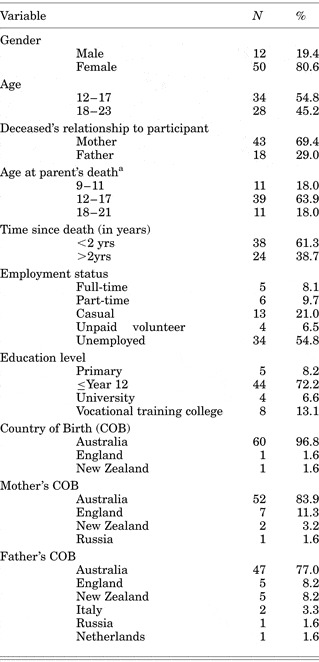
The majority of bereaved offspring members participating were female (80.6%) and 72.1% of the total sample had been a member of CanTeen for more than 12 months. There were 34 participants aged 12–17 years (54.8%) and 28 aged 18-23 years. Other sociodemographic indicators revealed that the majority of respondents were currently studying. More than half were currently unemployed/not working (54.8%), 30.7% were employed part-time/casual, 6.5% undertook volunteer or unpaid work, and only 8.1% were employed full-time. The majority of participants were from a Western culture (96.8% were born in Australia, with 83.1% of mothers and 77% of fathers also Australian born). Other countries of birth included New Zealand and England (participants); New Zealand, England, Russia (mothers); and New Zealand, England, the Netherlands, Italy, and Russia (fathers).
The majority of young people who participated had lost their mother to cancer (69.4%) and were aged 12–17 years at the time of their parent's death (63.9%). Parents had been diagnosed with a range of cancers including bone/tumor/sarcoma (21.3%), and brain (19.7%), breast (18%), bowel (11.5%) and lung cancer (8.2%). At the time of the study, 38 participants (61.3%) had been bereaved for <2 years (M = 10.61 months, SD = 7.07 months), and 24 (38.7%) had been bereaved for more than two years (M = 47.48 months, SD = 16.10 months). (See Table 1 for an overview of the sample demographics.)
Participant demographics (N = 62)

aOne participant's detail was missing on these questions (n=61).
Identification of Needs
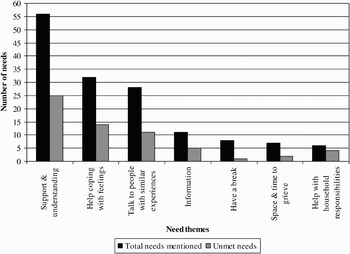
Figure 1 shows the frequency of needs reported for each theme and the number of times each need was also reported as being unmet.
Frequency of needs and unmet needs reported for each theme.

Following, the need themes are reported from most to least mentioned and this order remained the same when accounting for the number of participants who mentioned each theme. Finally, it is important to note that χ2 analyses revealed no difference overall in the number of unmet needs mentioned by age group (12–17 vs. 18–23); no difference when each need theme was analyzed across the age groups; and no differences in the reported number of unmet needs between participants whose parents had died from cancer within the last 2 years and those who had died > 2 years ago. The participant pool was therefore analyzed as a homogeneous set.
Support and Understanding
The most frequently mentioned need was the need for more support and understanding from others. This was also the domain that recorded the highest number of unmet needs. Within this theme, there were four sub-themes, namely teachers/education system, friends, people in general, and family members. Many participants noted that friends (e.g., school friends) lacked understanding of what they had experienced during their parents' illness and after their death, and how this experience had affected/changed them.
[I needed] friends to understand, not just to tell me that it was “going to be all right,” not just patronize me, (when Mum was sick) because they couldn't deal with it…I felt like I was helping them deal with it, while I needed the help dealing with it. (female, 19, mother died >2 yrs ago).
…my friends to understand more of what I was going through. However, it is hard for them to understand without experiencing it which I wouldn't wish upon others…Sometimes I felt people forgot or didn't see the impacts and implications Dad's illness had on me and my family. (female, 18, father died <2 years ago).
Young people also positioned themselves as being “different” from their peers, both in terms of what they had been through and what was important to them.
[I need] my friends to try and understand…When I am feeling down my friends don't get it, they want to just carry on with their own stuff, and it makes me angry when they go on about their fathers and how much fun they had at the weekend doing stuff with them…I am different from them, they haven't had to deal with anything bad in their life. (male, 14, father died <2 years ago)
…more understanding from teachers and school friends who haven't been affected in the same way I have. People don't understand when I feel upset. They think that because I don't want to talk about it I don't need help and they just leave me. Friends at school are mainly about gaining popularity and they're not really there when I need them to be and I feel alone a lot of the time. (female, 12,mother died <2 yrs ago).
A large number of participants also stated needing teachers/ education system to be more understanding and supportive of their situations.
[I needed] more academic/emotional support… school was not helpful at all, they just totally ignored my needs and were not sensitive at the time of mum's death. At the time, it affected my schooling and both my emotional and psychological state (female, 18, mother died >2 years ago).
Participants noted that teachers needed to appreciate the difficulties they faced, particularly relating to concentration and motivation:
[I needed] teachers at school to understand that I really couldn't concentrate on anything [because] it is difficult to focus on what is going on at school when your head is full of other stuff (male, 14, father died <2 years ago).
One female (16, mother died <2 years ago) also commented that teachers needed to
understand that still, after 8 months, things aren't great yet and that I can't be expected to do any more…Once I started to get myself back on track with my concentration and school work, my teachers pushed me further and I had too much pressure on me.
Participants also noted their need for support and understanding from people in general:
… people to understand that I was not going to be myself straight away… people demanded too much from me (female, 18, mother died >2 years ago)
… people to listen to me about what was happening and how I felt…At the time it made me angry because no one seemed to listen. (female, 19, father died <2 years ago).
Finally, a few participants specifically mentioned needing more support and understanding from family members:
[I needed] more family support…I needed family around me at that time and they weren't there (female, 18, mother died >2 years ago).
[I needed] my brother to help me through this and be there for me, we needed to have a better relationship…He understood what I was going through and it would have been nice for someone to talk about what I was going through, (female, 15, father died <2 ago).
[I needed] support from Dad and to see him more often…I had just lost one parent, I didn't want to lose another. (female, 18, mother died >2 years ago).
Help Coping with Feelings
The second most mentioned theme which emerged from the data was help coping with feelings, and almost half of these needs were reported as unmet. In this theme, participants noted the need for help dealing with a variety of feelings, including grief, anger, and depression. Most participants noted that they did not expect the “bad feelings” to disappear and acknowledged the need for assistance in coping with them:
[I need] help dealing with the depression that comes along with all the events that have happened in my life leading up to the death of my mother…I can't get rid of all the sadness and bad feelings that I have (female, 16, mother died <2 years ago).
[I needed] help in learning about grief and how to deal with it every day…I had never grieved to this extent before and I thought I was going nuts (female, 22, mother died >2 years ago).
Another participant also noted the need for
a time and/or place where I could vent my anger and depression in an environment where I wouldn't be judged or dismissed… If you are given a place where you are given the opportunity to vent your emotions in a constructive way, you are less likely to hold it all in which can be detrimental to other aspects of your life such as school, work or relationships. (female, 19, mother died >2 years ago).
Some participants appeared keenly aware of the consequences of not dealing with their feelings, noting that they “lashed out” and alienated friends and loved ones. For example, one stated her desire for
help dealing with anger… I lashed out at anyone that annoyed me (female, 17, mother died <2 years ago)
and a 19 year old male noted wanting
to control my aggression and hostility towards others…It was driving all my friends away and pushing my family away because I was acting out so much (mother died <2 years ago)
while another participant needed
help controlling my anxiety problems…I get anxious easily and have attacks and feel sick (male, 17, mother died <2 years ago).
To Talk to People who have had a Similar Experience
In this theme, participants noted the need to talk with people who did understand how they were feeling. For many participants this could only be achieved by speaking to other young people who had also lost a parent to cancer and was particularly important to those who said that they needed to feel that they were “not alone,” to know that others had felt and experienced the same things.
[I needed] to talk to other people whose parents had passed away…it helped me to cope better and talk about my feelings because they knew what I was going through (female, 13, mother died >2 years ago)
[I needed] support from people who have been through something like this as well…it makes you feel less alone (male, 14, father died <2 years ago)
Information
Participants noted their need for more information about cancer, cancer treatment, and “what was happening” in general so as to not be “kept in the dark” in the time leading up to the death of their parent:
[I needed] to be informed of my mother's condition changes, even if they were for the worse…so I could prepare myself to say goodbye (female, 16, mother died <2 years ago).
One male stated that he needed
more information on mum's journey. And the fact she was terminal, I had no idea until 3 weeks before she died. (22, mother died <2 years ago).
As a result of being “kept in the dark,” one participant wanted
a way of finding out information without going through my parents. My dad was in denial for most of the time and both parents were trying to protect us by not always telling us stuff, but I feel that it is better to know…It made me feel like there was a barrier between me and my parents because they weren't being honest (female, 19, father died <2 years ago).
One participant (aged 20), whose mother died of breast cancer (<2 ago), expressed wanting information about how she might minimize her chances of developing breast cancer.
[I need] to have some information about what may happen to me…I am a woman, if my mum had breast cancer, how can I stop or minimize my chance of getting it?
To Have a Break/Have Fun
This theme was solely mentioned by females in the sample and involved the need for “time out” from the situation they were facing, including needing to “have fun” or to have “a break”.
[I need] to have programs and activities to be involved in to keep having fun and to keep my mind on other things… (female, 18, mother died <2 years ago).
Another noted the desire for
a break…there were times when it just got too much and I just wanted to give up and hope it was a nightmare (female, 18, mother died >2 years ago).
Others wanted
time away from my family and the emotional tension (female, 20, mother died >2 years ago)
[I needed] a break…so that I wasn't always around things that reminded me of mum…[so] I could have fun and escape from life's pressures (female, 20, mother <2 years ago)
Space and Time to Grieve
Participants in this need theme noted the need to be alone with their feelings, and to have time and space to grieve. Again this theme was mentioned only by females.
[I needed] time to myself…When I'm alone I can't be judged and I wouldn't have 1000 people asking me if I was okay when I clearly wasn't (female, 16, mother died >2 years ago)
…to be able to grieve…I couldn't do it in front of my family – I needed a comfortable environment to cry (female, 20, mother died >2 years ago).
Help with Household Responsibilities
Female participants noted the need for help with increased household responsibilities or chores.
[I needed] help with household chores, help dealing with family members…It was my responsibility to look after the chores and pick up the pieces for everybody else and not be able to worry about myself (female, 23, mother died >2 years ago).
Another also mentioned needing
a “parent” to take control of my life again, so I could re-find my organisation and not have to worry about the little things – food, washing, getting to work etc…I am too young to be independent. (female, 16, mother died <2 years ago).
Similarly, another female wanted
help with everyday activities…I was pushed into running my house, doing the cleaning and cooking, paying the bills and I found this hard to do when I was having also to deal with the emotions of losing my mother (20, mother died <2 years ago).
DISCUSSION
Although it is inferred in the literature that young people who have lost a parent to cancer have a number of unmet needs (e.g., Buxbaum & Brant, Reference Buxbaum and Brant2001), as yet, no study has directly identified these needs in the adolescent/ young adult population. The present study thus focused on identifying, through self-reports, the needs of parentally bereaved young people and investigating whether these needs had been met. Seven conceptually distinct need themes emerged from the data, namely: support and understanding; help coping with feelings; talking to people who have had a similar experience; information; having a break; space and time to grieve; and help with household responsibilities. The two most mentioned needs (support and understanding from others and help coping with feelings) also had the highest self-reported levels of being unmet.
More than half of the participants reported support and understanding from others as a need and this category had the highest incidence of being unmet. Bereavement is difficult at any stage of life, but is particularly difficult for young people who are forced to cope with the stressors of bereavement in addition to the changes that accompany adolescence (Worden et al., Reference Worden, Davies and McCown1999). Approximately 50% of the needs mentioned in this need theme were also reported as currently unmet, and this need was sought most from friends and teachers/education system.
Although many studies have demonstrated the effectiveness of support from friends for young people (Berman et al., Reference Berman, Craff and Kuenzigl1988; Silverman & Worden, Reference Silverman and Worden1992), previous research has also highlighted the difficulties young people have in approaching their friends as a source of support (Harris, Reference Harris1991; Berman et al., Reference Berman, Craff and Kuenzigl1988), and that grieving behavior singled adolescents out as different from others (Grogan, Reference Grogan1990). It is thus not surprising that within the support and understanding theme, just over one-third of the responses mentioned the need for more support, understanding and “normalcy” from their existing network of friends (mainly school friends), and one-third of the responses in this sub-theme noted that the need for support and understanding from friends was still unmet.
Responses within the support and understanding theme also suggested that many teachers lacked insight and empathy into the realities facing a student who had lost a parent to cancer, particularly regarding homework expectations during critical periods of the cancer experience. A school-based psycho-educational program addressing issues of chronic illness, grief, and bereavement, would thus be beneficial in providing the opportunity for school staff and students to gain a better understanding of the issues faced by young people who have lost a parent to cancer, and how to best support them. Indeed Ribbens McCarthy and Jessop (Reference Ribbens McCarthy and Jessop2005) note that “death education needs to be much more widely and systematically included in schools as a key aspect of general education for life, and as a way of equipping individuals to help both themselves and others through mutual support and understanding in relation to bereavement experiences” (p. 69). Another benefit of such a program is that hearing factual information about normal grief reactions helps to normalize students' experiences, which is critical at a time when they are highly conscious about being and feeling different from their peers (Saldinger et al., Reference Saldinger, Porterfield and Cain2004).
Another important need for participants was help in dealing with the variety of negative feelings experienced after the loss of their parent, including grief, confusion, guilt, loneliness, and anger. Previous research has noted the psychological distress reactions of young people following their parent's death (Lin et al., Reference Lin, Sandler and Ayers2004; Siegel et al., Reference Siegel, Karus and Raveis1996) and the current results highlight the desire young people have in seeking help with these feelings. Many participants also mentioned the need to have someone to talk to about these feelings. It has been acknowledged that bereaved young people often receive messages from significant others to repress and deny their grief and remain strong for their surviving parent (Devita-Raeburn, Reference Devita-Raeburn2004). By avoiding discussing their feelings in order to prevent their parent from getting more upset, or using denial as a strategy to help them cope with bereavement, the young person may actually be left without the necessary support and opportunities to express feelings and concerns, thus increasing their feelings of loneliness, isolation, and anxiety (Charles & Charles, Reference Charles and Charles2006; Shrier, Reference Shrier1980). Listening to and acknowledging the emotional expressions of adolescents, and encouraging them to talk about their feelings, are therefore important short-term interventions that should be used when dealing with bereaved young people (Stevens, Reference Stevens1998; Davies, Reference Davies and Webb2002). Further, apart from individual counselling, given the strong emphasis in the literature on the importance of family communication and the ability to rely on the family for emotional support as key factors related to personal growth and coping after parental loss (Saler & Skolnick, Reference Saler and Skolnick1992; Ravies et al., 1999), it may also be useful to consider family-focused interventions as a means to help bereaved young people cope with their feelings and to overcome any communication barriers within the family. Indeed, family-based interventions which aim to enhance the ability of the parents to meet their children's heightened need for emotional support and physical care, and to encourage open communication within the family, have been shown to be effective (Siegler et al., Reference Siegler, Mesagno and Christ1990).
The benefits of peer support, including the ability to offload concerns in a safe and confidential environment, the chance to "share and compare," to normalize experiences and to put one's own experience into context, have been well-documented (Armstrong-Rowe, Reference Armstrong-Rowe1999; Turner, Reference Turner1999). In the present research nearly 40% of participants stated a need for talking with other young people who have had a similar experience. Given that the participants in this study were drawn from an organization that provides young people affected by cancer with opportunities to engage in peer support, it is somewhat surprising that half of the participants who stated the need to talk to others with a similar experience and who understood also stated it was currently unmet. One possible explanation for this result could be that effective peer support does require developed metacognitive skills, including the ability to be aware of one's own and others' feelings, and to understand and express those feelings in constructive ways (Rogers, Reference Rogers1977). In light of the substantial benefits of peer support and the fact that needing to talk to people who have had a similar experience and who understand is still largely unmet for these bereaved young people, providing opportunities and programs to teach them how to do peer support would seem to be useful. Foundationally, this would include being aware of one's own feelings and being able to express those feelings in constructive ways. Also, skills such as active listening, empathy, having a non-judgmental and accepting attitude, problem solving, negotiating, managing stress, assertiveness, and working through difficult emotions, would all contribute to the development of positive and caring peer support relationships (Peer Support Foundation, 2007).
The need for information regarding their parent's cancer, such as general information about their parent's cancer and treatment, and honest information about what was going on, was also an important concern to participants. This finding is in accordance with a study by Kristjanson et al. (Reference Kristjanson, Chalmers and Woodgate2004) which found that children reported a need for information about their parent's survival probability, the nature of their parent's cancer, treatment options, potential side-effects, and clearly presented information from healthcare professionals. It also corresponds with the finding that parents may underestimate their child's need for information, or may try to protect them by omitting details in the information they communicate about the cancer (Forrest et al., Reference Forrest, Plumb and Ziebland2006). This finding speaks to the importance of parents being aware that open communication and honest information may help to reduce a young person's anxiety and uncertainty, and give them the opportunity to understand what is going on, to ask questions and to feel involved (Worden, Reference Worden1996).
It is not surprising that the need to have a break and to have fun had a low number of participants indicating that it was unmet as they were drawn from an organization that regularly offers camps and recreational activity opportunities. Having said this, it was still an expressed need by some of the participants in this study. These results extend previous research that emphasizes the importance of helping a young person to maintain normalcy in their routines after parental loss (Dunsmore, Reference Dunsmore2002; Worden, Reference Worden1996), by highlighting the importance of providing young people with a break or opportunity for some respite and recreation following their parent's death. It is interesting to note that this need, the need for space and time to grieve, and help with household responsibilities were mentioned only by females in the current study.
In regard to help with household chores, the majority of mentions within this theme were reported as currently unmet. The literature indicates that a young person's experience of having a parent with cancer is often associated with changes in role functioning including increased household responsibilities (Adams-Greenly et al., Reference Adams-Greenly, Beldoch and Moynihan1986; Spira & Kenemore, Reference Spira and Kenemore2000; Vess et al., Reference Vess, Moreland and Schwebel1985). Results of the present study suggest that this demand is still present following the death of the parent, and arguably more so, if the surviving parent is too overcome with grief to run the household. Increased household responsibilities may also subsequently limit the time young people have available for socializing with their peers as well as time to grieve on their own. These categories were dominated by females and this may be due in part of the socialisation of females to assume the role of the caregiver and caretaker (Schmiege et al., Reference Schmiege, Khoo and Sandler2006).
Despite providing a unique insight into the needs of this population, this study did have a number of limitations. The participants used in the sample were drawn from a peer support organization for young people living with cancer, and as noted, the response rate was approximately one-third of those eligible to participate. One might suppose that young people not involved with such an organization may have other needs not identified in the present study as they do not have the benefit of this peer support, and indeed even within the organization there may be different needs reported from those that did not respond. As such, further investigation into psychosocial needs is warranted using different sub-populations of parentally bereaved adolescents and young people.
There was also an unequal ratio of males and females in this study (approximately 1: 4 respectively), so although some of the themes appeared to be exclusively female-mentioned concerns, it is possible that with a more equal proportion of males and females, the needs which were exclusively mentioned by the female participants may be mentioned also by males, and/or that some exclusively male mentioned needs may emerge.
A notable strength of the present research is that although some of the needs identified have been previously inferred in the literature, this study directly identified them, and whether or not they had been met. Needs-based research is becoming increasingly important as clinicians and service providers move from service-led practices towards more needs-based practices (Asadi-Lari et al., Reference Asadi-Lari, Tamburini and Gray2004). Moreover, needs-based research would be useful in identifying the factors that lead to resilience in these young people, and which can then be used to alleviate the negative impact of parental death. The results of the current research therefore are important, as they provide guidance to health professionals and service providers in developing prevention and intervention based programs and services that are more responsive to the needs of young people who have lost a parent to cancer. The replication of this study with a more culturally diverse group of young people, and those not belonging to a peer support organization, as well as the development and validation of a needs measure that addresses the needs identified through this research, seems an important next step.
ACKNOWLEDGMENTS
The authors thank Angela Pearce, part of the CanTeen research team, for her comments and editing of the draft paper in readiness for submission, and the participants for their willingness to share their experiences with us.