INTRODUCTION
Hydroids, typically colonial, are the asexual polypoid stage of meroplanktonic hydrozoans. While most species are typically benthic, some may occur in suspension, feeding and reproducing in the water column. Therefore, they assume a pelagic way of life, whether unattached (Billard, Reference Billard1917; Vannucci, Reference Vannucci1963; Madin et al., Reference Madin, Bollens, Horgan, Butler, Runge, Sullivan, Klein-MacPhee, Durbin, Durbin, van Keuren, Plourde, Bucklin and Clarke1996) or attached to floating substrates (e.g. Borstad & Brinckmann-Voss, Reference Brandini, Nogueira, Simião, Codina and Noernberg1979; Calder, Reference Calder1995). Free-floating hydroids are known to be common in the region of Georges Bank (Massachusetts, USA), where large aggregations of these organisms reach densities up to 2 × 10⁶ colonies m−3 (Norrbin et al., Reference Norrbin, Davis and Gallager1996). Long-term surveys in this region indicate that these colonies are not ephemeral, and that they comprise perennial components of the planktonic community (Concelman et al., Reference Concelman, Bollens, Sullivan, Madin, Horgan, Butler and van Keuren2001). They are prey items of carnivorous fishes, as well as being their competitors (Avent et al., Reference Avent, Bollens, Butler, Horgan and Rountree2001), and they can be important predators of fish eggs and larvae (Madin et al., Reference Madin, Bollens, Horgan, Butler, Runge, Sullivan, Klein-MacPhee, Durbin, Durbin, van Keuren, Plourde, Bucklin and Clarke1996; Adamík et al., Reference Adamík, Gallager, Horgan, Madin, McGillis, Govindarajan and Alatalo2006; Ohman et al., Reference Ohman, Durbin, Runge, Sullivan and Field2008).
The hydroid fauna of the South-west Atlantic is relatively well known (Genzano et al., Reference Genzano, Giberto, Schejter, Bremec and Meretta2009; Haddad & Marques, Reference Haddad, Marques, Rocha and Boeger2009), with more than 150 species recorded from Brazil as of early this century (Migotto et al., Reference Migotto, Marques, Morandini and Silveira2002). Nevertheless, occurrences of hydroids in the pelagic environment are mostly anecdotal, with records of Obelia longissima (Pallas, 1766) and Amphisbetia operculata (Linnaeus, 1758) from Argentina (Genzano et al., Reference Genzano, Mianzan, Diaz-Briz and Rodriguez2008), several species from north-eastern and south-eastern Brazil (Vannucci, Reference Vannucci1957, Reference Vannucci1958, Reference Vannucci1963), including ‘polyps of Hydrozoa’ (Resgalla, Reference Resgalla2001; Veado & Resgalla, Reference Veado and Resgalla2005; Resgalla et al., Reference Resgalla, de Souza, Rörig and Schettini2008) and Clytia spp. (Nagata et al., Reference Nagata, Nogueira Júnior, Brandini and Haddad2014; Nogueira Júnior et al., Reference Nogueira Júnior, Brandini and Codina2014) from southern Brazil. Although these records are anecdotal, they suggest that hydroids may be both common and widespread in the plankton of the region.
The lack of detailed information about occurrence patterns and regional distribution hamper an accurate evaluation of their regularity in the plankton environment, as well as their role in this ecosystem. In this study we analysed numerous zooplankton samples covering a large area of the South Brazilian Bight (SBB) over different seasons, in a search for free-floating planktonic hydroids. Objectives were to: (i) verify whether hydroids are common components of the planktonic community, (ii) analyse their regional distribution, (iii) describe the morphology of these colonies, and comment on their taxonomy, (iv) consider possible origins of the colonies, and implications for species biology, and (v) review records of free-floating hydroids living in the plankton through an extensive literature search.
MATERIALS AND METHODS
The general oceanographic features and large-scale ecological processes of the SBB are well described (e.g. Matsuura, Reference Matsuura1986; Brandini et al., Reference Bouillon2014). The three resident water masses – Coastal Water (CW), Tropical Water (TW), and South Atlantic Central Water (SACW) – alternate in dominance seasonally in response to changes of wind regime and regional or large-scale continental runoff.
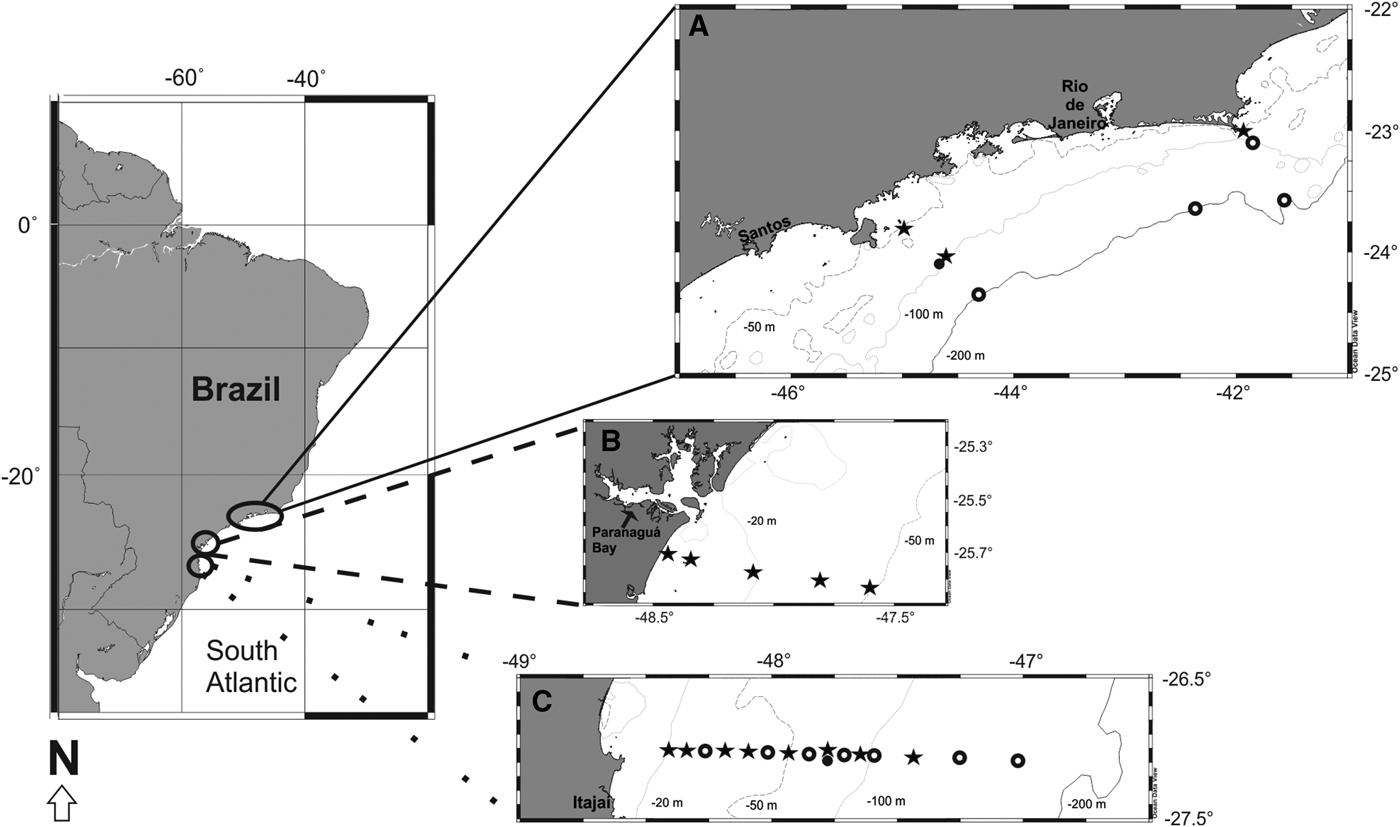
Zooplankton samples (N = 267) were taken within three sampling programmes covering a large area of the SBB (Figure 1):
(a) Five oceanographic cruises were carried out between December 2001 and May 2003 (11–15 December 2001; 18–20 March 2002; 25–28 July 2002; 26–28 November 2002; 26 April–8 May 2003) sampling five stations between Cabo Frio (Rio de Janeiro State) and Ubatuba (São Paulo State), over the isobaths of 50, 100 and 200 m (Figure 1A). A WP-2 plankton net with 200 μm mesh size was used to collect 77 samples. For more details, see Codina (Reference Codina2010).
(b) Five stations in the inner continental shelf (≤40 m) of Paraná State (Figure 1B) were sampled in monthly surveys (17 cruises) between November 1997 and March 1999, using a conical plankton net with 200 μm mesh size, in a total of 67 samples. For more details see Brandini et al. (Reference Borstad and Brinckmann-Voss2007) and Nagata et al. (Reference Nagata, Nogueira Júnior, Brandini and Haddad2014).
(c) Five oceanographic cruises were carried out between November 2005 and March 2006 (10–12 November 2005; 16–18 January 2006; 14–16 March 2006; 19–21 April 2006; 20–22 June 2006), sampling 14 stations in a cross-shelf transect off Santa Catarina State, between the isobaths of 20 and 140 m (Figure 1C). A WP-2 plankton net with 200 μm mesh size was used to collect 123 samples. For further details, see Brandini et al. (Reference Bouillon2014) or Nogueira Júnior et al. (Reference Nogueira Júnior, Brandini and Codina2014).
Map of the Brazilian coast showing stations sampled off (A) Rio de Janeiro and São Paulo, (B) Paraná and (C) Santa Catarina States. Stars indicate stations where colonies of Clytia sp. were found; closed circles indicate presence of C. arborescens; open circles stations where no hydroids were found.

In sampling programme ‘b’, samples were collected by vertical hauls from 1 m above the bottom to the surface integrating the entire water column. In sampling programmes ‘a’ and ‘c’, vertical tows were conducted: (i) from above the bottom to the surface, when the water column was not stratified; (ii) above and beneath the thermocline (two tows); or (iii) in three layers according to the predominant oceanographic structure (above, beneath and within the thermocline). Samples were preserved with borate-buffered 4% formalin in seawater. Using a stereomicroscope, all hydroids from the entire set of samples were counted, identified and measured. Reference specimens were deposited in the Museum of Zoology of São Paulo University (MZUSP).
RESULTS
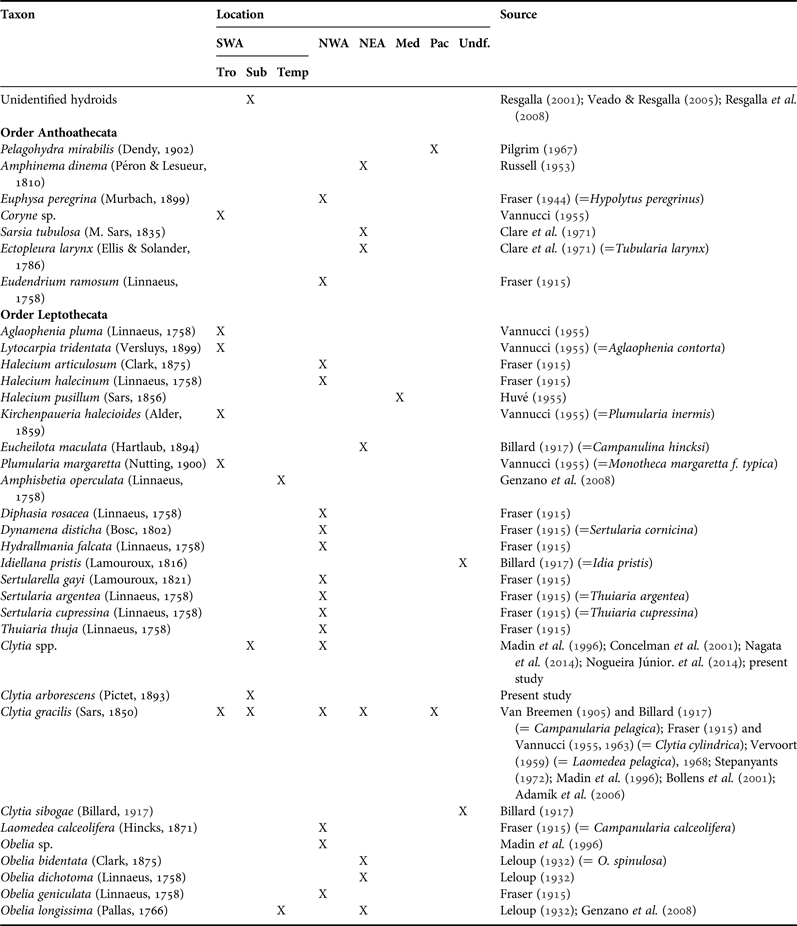
Of 267 samples analysed, 35 (13.1%) contained hydroids. Colonies were found in all three SBB regions studied here, occurring seawards to the 120 m isobath about 130 km offshore (Figure 1A–C). Two species of Campanulariidae were identified, Clytia sp. and Clytia arborescens Pictet, 1893 (Figure 2). The coenosarc in all colonies of both species was in good condition, hydranths usually contained food residues (Figure 2F‘b’) and gonozooids with medusae buds were present (Figure 2G). Colonies of Clytia sp. were typically found inshore, with their frequency of occurrence decreasing with increasing depth (Table 1). In shallow waters (<50 m), Clytia sp. occurred in over 20% of samples, but its frequency decreased to 12–13% between the isobaths of 50 and 90 m, and to less than 5% offshore at the 100 m isobath. Clytia sp. was not observed outside the 120 m isobath (Figure 1; Table 1). Clytia arborescens was found in only two samples, with one record in Santa Catarina at the 70 m isobath and another in Ubatuba (São Paulo) at the 100 m isobath, in both cases below the thermocline.
Colonies of free-floating planktonic hydroids from the South Brazilian Bight. Clytia sp. (A–C): (A, B) general view of a star-shaped colony with a gonotheca (arrow in B); (C) Detail of the gonotheca originating on the hydrothecal pedicel and part of the hydrotheca. Clytia arborescens (D–G): (D) Hydrotheca; (E) gonotheca; (F) general view of the colony with a thin ‘membrane’ under the hydrorhiza in ‘a’ and gastrozooid ingesting a copepod in ‘b’; (G) gonotheca, with gonozooid and medusa buds. Scale bars: A, B and F, 200 μm; C, D, E and G, 100 μm.
Frequency of capture (FC; %) and maximum abundance (AB; hydranths m−3) of Clytia spp. hydroids in plankton samples from South Brazilian Bight in different areas and isobaths.
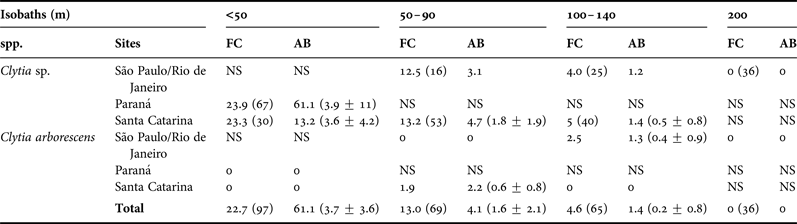
The number of analysed samples and the average ± standard deviation is shown in parentheses for FC and AB respectively. NS = not sampled.
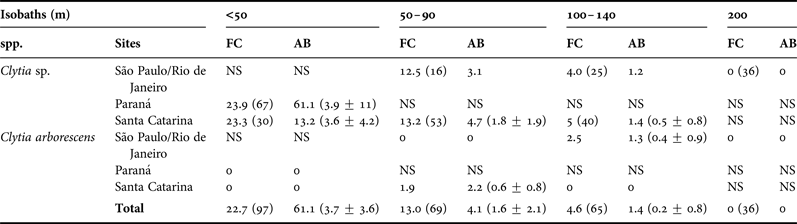
Worldwide records of free-floating hydroids living in the plankton are shown in Table 2.
Free-floating planktonic hydroids recorded in the plankton worldwide.
SWA, South-west Atlantic; NWA, North-west Atlantic; NEA, North-eastern Atlantic; Pac, Pacific; Med, Mediterranean; Undf., Undefined; Tro, Tropical; Sub, Subtropical; Temp, Temperate.
Taxonomic account
Family CAMPANULARIIDAE Johnston, 1836
Genus Clytia Lamouroux, 1812
Clytia sp.
(Figure 2A–C)
Voucher specimens: MZUSP 2647, two colony fragments.
Description: Colonies occurring in two forms; one morphotype similar to colonies found attached to substrates, with stolonal or erect and branched stems, each supporting up to two hydranths; second morphotype consisting of colonies lacking a hydrorhiza, with 3–5 hydranths up to 1 mm high, originating from a central disc and extending in all directions and planes, creating ‘star shape’ colonies (Figure 2A, B). Pedicels short, 179.3–641.0 μm (average ±SD = 373.3 ± 111.2) high; either lacking annulations, or with annulations at distal and proximal ends, or annulated throughout (Figure 2A, B). Hydrothecae deep, narrow, cylindrical, 338.8–635.3 μm (495.7 ± 79.3) high and 147.2–268.8 μm (213.5 ± 31.3) wide at margin; hydrothecal walls thin, opposite walls parallel in lateral view. Hydrothecal margin with 6–8 acute cusps reaching 34.8–95.3 μm (65.6 ± 13.7) high, cusps inclined to one side (Figure 2A, B). Hydrothecal chamber 18.3–64.7 μm (46.7 ± 11.4) high; base with fine transverse diaphragm 59.3–94.9 μm (76.7 ± 9.2) in diameter. Gonothecae on stems only (Figure 2B); measurements made on only one of them because all others were not fully developed; gonothecae walls smooth, 685.9 μm high, 279.1 μm of maximum width, 256.5 μm diameter at margin, diameter at constriction 230.7 μm (Figure 2C). Hydranths retracted and not measured.
Comments: Characters of our specimens corresponded to those of at least three species assigned to the genus Clytia: C. elsaeoswaldae Stechow, 1914, C. gracilis (Sars, 1850) and C. hemisphaerica (Linnaeus, 1767). They were similar to C. elsaeoswaldae in the general dimensions of their structures and in the shape and slope of the marginal cusps (Lindner et al., Reference Lindner, Govindarajan and Migotto2011). However, gonothecae in C. elsaeoswaldae originate only from the hydrorhiza (Lindner et al., Reference Lindner, Govindarajan and Migotto2011), while colonies described here have gonothecae arising from the stems. In having acute and inclined cusps, our specimens resemble C. gracilis. However, they differ in size, being much larger than both benthic and free-floating planktonic colonies of C. gracilis (Cornelius, Reference Cornelius, Barnes and Crothers1995). The hydrothecae of our specimens are as high as those of C. hemisphaerica, but they differ in shape. In addition, the marginal cusps are shorter in height, and they are rounded rather than being inclined as in C. hemisphaerica. Moreover, the gonothecal walls are smooth in our specimens rather than being corrugated, as in benthic C. hemisphaerica. Curiously, gonothecae in planktonic colonies of C. hemisphaerica are smooth (Cornelius, Reference Cornelius1982, Reference Cornelius, Barnes and Crothers1995). Recent phylogenetic studies have shown that the hydroids corresponding to C. gracilis, commonly found in SBB (e.g. Migotto et al., Reference Migotto, Marques, Morandini and Silveira2002; Miranda et al., Reference Miranda, Haddad, Shimabukuro, Dubiaski-Silva and Marques2011), comprise a species complex (Lindner et al., Reference Lindner, Govindarajan and Migotto2011). Thus, it is likely that our specimens are part of this group. The taxonomy of the genus Clytia is not well established (Lindner et al., Reference Lindner, Govindarajan and Migotto2011), mainly due to the great morphological plasticity of these organisms under different environmental conditions (Calder, Reference Calder1991), making their identification difficult.
Distribution in SBB (present study): Santa Catarina: between the isobaths of 20 and 120 m. Paraná: all sampled isobaths. São Paulo: at the isobaths of 50 and 100 m. Rio de Janeiro: at the 50 m isobath. In stratified samples, occurrences were mainly above the thermocline.
Clytia arborescens Pictet, 1893
(Figure 2D–G)
Voucher specimens: MZUSP 2648, one colony fragment.
Description: Colonies stolonal or with erect and branched stems, bearing up to five hydranths each (Figure 2F). Stems monosiphonic or sometimes polysiphonic, up to 3.5 mm high. Hydrorhiza branched, network-shaped, adhering to a thin ‘membrane’, apparently a part of its former substrate (Figure 2F‘a’). Hydrorhiza ending with signs of regeneration. Hydrothecal pedicels smooth, slightly curved, with 5–14 proximal annulations, 3–6 distal annulations, and sometimes with annulations in mid-region (Figure 2F). Internodes with a curved apophysis bearing next pedicel; each pedicel bearing one hydrotheca at distal end (Figure 2F). Hydrothecae narrow, conical, 522.7–825.8 μm (average of 672.9 ± 85.4) high, 251.0–472.9 μm (340.0 ± 61.0) in diameter at edge, with thin and diagonal walls in side view (Figure 2D). Hydrothecal margin pleated, with 9–14 rounded cusps (Figure 2D) 28.1–50.1 μm (35.8 ± 6.0) high. Hydrothecal chamber wide, 48.7–99.0 μm (72.2 ± 15.3) high, base with a fine transversal diaphragm 69.0–117.6 μm (96.7 ± 13.8) in diameter. Gonothecae arising from hydrorhiza and stems, containing 0–6 medusa buds arranged in a row (Figure 2E, G); gonothecal walls smooth, 656.8–863.2 μm (765.0 ± 67.7) high, 170.4–269.2 μm (217.9 ± 28.8) in maximum width. Gonothecal pedicels with up to two annulations (Figure 2E, G). Hydranths mostly retracted and not measured.
Comments: Both colonies of this species generally correspond with C. arborescens (see Schuchert, Reference Schuchert2003) in hydrothecal and gonothecal characters. In particular, marginal cusps of the hydrothecae are small and rounded, and pleats extend down from the hydrothecal margin. However, our specimens differ from the Indo-Pacific colonies of C. arborescens described by Schuchert (Reference Schuchert2003) in having hydrothecae that are higher and gonothecae that are shorter and originate mainly from hydrorhiza. Our specimens also resemble C. sibogae Billard, Reference Billard1917 in general characteristics, and C. linearis (Thornely, 1899) in having pleated hydrothecae. However, pleats on the hydrothecal margin and medusa buds arranged in a row, distinguish them from C. sibogae, which has no hydrothecal pleats and medusa buds that are arranged in two rows (Billard, Reference Billard1917). Our specimens differ from C. linearis (see Lindner & Migotto, Reference Lindner and Migotto2002) in hydrothecal size and in the shape and size of both cusps and gonothecae. In addition, pleats on the hydrothecal margin are more subtle.
Distribution in SBB (present study): Santa Catarina: at the 70 m isobath, between 70 and 35 m deep; São Paulo: at the 100 m isobath, between 100 and 70 m deep.
DISCUSSION
This is the first study to comprehensively analyse the distribution and abundance of hydroids in the planktonic realm of the South-west Atlantic. Two species of the genus Clytia have been identified. Clytia arborescens is formally recorded from the Atlantic Ocean for the first time. Colonies of this species were found in 1999 on pillars in coastal São Paulo (A.E. Migotto & A. Lindner, personal communication, 2014) but not formally recorded. Its known distribution previously encompassed only the Indo-Pacific region (Schuchert, Reference Schuchert2003; Galea, Reference Galea2010). The absence of previous records of C. arborescens from the coast of Brazil may be due to at least three reasons: (i) its possible rare occurrence in SBB; (ii) its apparent offshore distribution (between 80 and 100 km offshore in this study), remote from shallow coastal waters where most hydroid studies in Brazil have been undertaken (Haddad & Marques, Reference Haddad, Marques, Rocha and Boeger2009); and/or (iii) difficulties in identification of species of the genus Clytia, as discussed previously (Lindner et al., Reference Lindner, Govindarajan and Migotto2011), and possible misidentification of C. arborescens as another species. While specific identification of Clytia sp. was not possible, it probably is referable to the C. gracilis complex following Lindner et al. (Reference Lindner, Govindarajan and Migotto2011).
Free-floating planktonic colonies of Clytia sp. were relatively common in the SBB. These hydroids were found in the three regions sampled, and in more than 20% of inner shelf samples (<50 m isobath). However, densities were quite low (up to 61.1 hydranths m−3; Table 1), suggesting a low trophic impact. This differs from records of C. gracilis from the Crest Region of Georges Bank, USA, where free-floating planktonic hydroids may consume from 50 to over 100% of the daily production of young copepods (Madin et al., Reference Madin, Bollens, Horgan, Butler, Runge, Sullivan, Klein-MacPhee, Durbin, Durbin, van Keuren, Plourde, Bucklin and Clarke1996). If we consider that each planktonic Clytia hydranth may consume 0.24 nauplii day−1 (Madin et al., Reference Madin, Bollens, Horgan, Butler, Runge, Sullivan, Klein-MacPhee, Durbin, Durbin, van Keuren, Plourde, Bucklin and Clarke1996), planktonic hydroids populations from SBB would be preying on <15 nauplii m−3 day−1. This represents an extremely low fraction of the nauplii populations in coastal SBB, which may reach >9500 ind. m−3 (Miyashita et al., Reference Miyashita, Melo Júnior and Lopes2009).
Most colonies of Clytia sp. studied here had 3–5 hydranths arranged in such a way that colonies are star-shaped. This is similar to descriptions of free-floating planktonic colonies of C. gracilis from the North Atlantic and North Sea (Van Breemen, Reference van Breemen1905; Billard, Reference Billard1917; Cornelius, Reference Cornelius, Barnes and Crothers1995; Madin et al., Reference Madin, Bollens, Horgan, Butler, Runge, Sullivan, Klein-MacPhee, Durbin, Durbin, van Keuren, Plourde, Bucklin and Clarke1996). Free-floating colonies of Halecium pusillum Sars, 1856 may have a similar shape, with ‘the emission of hydrocauli in all planes’ (Huvé, Reference Huvé1955). Such an arrangement (Figure 2A, B) may be the result of regeneration of the fracture point (in case of the fragmentation hypothesis, see below) in a new hydranth (Fraser, Reference Fraser1915), or a morphological tendency of colonies occurring in this habitat due to the absence of bidirectional growth considering the absence of a substrate. This arrangement may be advantageous to colonies in feeding within the tridimensional planktonic environment, allowing the capture of prey items in any direction.
Although typically benthic and sessile, the absence of substrata seems to be little problem for survival and reproduction of the hydroids in our study. All colonies were developing normally, with the coenosarc in good condition, successful predation evident (with prey and/or remains in the gastric cavity), and in many cases reproductive structures in different developmental stages (Figure 2).
Possible sources of the colonies include direct development of the planula larvae to polyps in the water column. This kind of development has been described for some solitary hydropolyps (e.g. Eirene hexanemalis (Goette, 1886); Bouillon, Reference Bollens, Horgan, Concelman, Madin, Gallager and Butler1984), and also for colonial species settling beneath the surface film of water (e.g. C. hemisphaerica (=C. viridicans); Pagliara et al., Reference Pagliara, Bouillon and Boero2000), on sand grains in suspension (e.g. C. gracilis; Cornelius, Reference Cornelius, Barnes and Crothers1995), or on planktonic colonies of cyanobacteria (e.g. Pelagiana trichodesmiae Geiselman, Reference Geiselman1977; Borstad & Brinckmann-Voss, Reference Brandini, Nogueira, Simião, Codina and Noernberg1979). Another source of planktonic colonies is fragmentation of benthic colonies by wave action or water currents, and by release of propagules (Huvé, Reference Huvé1955; Gravier-Bonnet, Reference Gravier-Bonnet1992; Bavestrello et al., Reference Bavestrello, Puce, Cerrano, Castellano and Arillo2000), with fragments being suspended in the water column and remaining in the plankton for undetermined periods (Stepanyants, Reference Stepanyants1972; Cornelius, Reference Cornelius1992a, Reference Corneliusb; Norrbin et al., Reference Norrbin, Davis and Gallager1996; Bavestrello et al., Reference Bavestrello, Puce, Cerrano, Castellano and Arillo2000; Concelman et al., Reference Concelman, Bollens, Sullivan, Madin, Horgan, Butler and van Keuren2001; Genzano et al., Reference Genzano, Mianzan, Diaz-Briz and Rodriguez2008). Fragmentation of benthic colonies, the most common explanation given in the literature for the presence of typically benthic hydroids in the pelagic environment, is the likely source of both species reported herein. Yet, absolute confirmation of this hypothesis would require laboratory rearing and experiments.
Both colonies of C. arborescens had a thin ‘membrane’ under the hydrorhiza (Figure 2F), apparently constituting residue of their former substratum. Similarly, Stepanyants (Reference Stepanyants1972) also found colonies of C. gracilis suspended in the water column with remains of their former substrate still attached. This observation together with occurrences of the species beneath the thermocline in our samples suggests that colonies of C. arborescens had been dislodged from the benthos relatively recently.
Colonies of Clytia sp. were more frequent, and almost certainly originate from coastal sources. Our evidence is the fact that they were most common in sites shallower than 50 m and became rarer with increasing bottom depth (Table 1). Their coastal distribution coincides with distributions of benthic colonies of Clytia spp. on the coast of Brazil, most of them found in intertidal and shallow areas to 70 m (Grohmann et al., Reference Grohmann, Nogueira and da Silva2003, Reference Grohmann, Nogueira and da Silva2011; Miranda et al., Reference Miranda, Haddad, Shimabukuro, Dubiaski-Silva and Marques2011), and rarely to 200 m depths (Migotto et al., Reference Migotto, Marques, Oliveira, Amaral and Rossi-Wongtschowski2004). In shallow areas, benthic species probably are impacted more by tidal currents and turbulence generated by winds and storms than ones in deeper regions. Some hydroids may autotomize parts of the colony and assume a pelagic way of life (Gravier-Bonnet, Reference Gravier-Bonnet1992), and water turbulence is known to be an important factor inducing fragmentation (Bavestrello et al., Reference Bavestrello, Puce, Cerrano, Castellano and Arillo2000). Fragmentation of benthic colonies and their subsequent development in the water column may increase dispersal capabilities, since medusae of metagenetic species are typically short-lived and mostly restricted to coastal shallow waters (Cornelius, Reference Cornelius1992a, Reference Corneliusb). Nevertheless, it is difficult to be certain that the source of these colonies is really the fragmentation of benthic hydroids. Laboratory studies should be done to elucidate life cycle patterns and possible variations.
A literature review (Table 2) suggests that free-floating planktonic hydroids probably are common in marine plankton worldwide, although the matter has received relatively little attention. Altogether, 33 taxa were recorded, including seven species of Anthoathecata and 26 species of Leptothecata. Of these, the genus Clytia has been most frequently reported, with 15 records, while the genus Obelia has the most species, with five recorded (Table 2). Most of these records are from the North Atlantic, with 22 taxa; only 10 are from the South Atlantic.
Clytia sp. and C. arborescens (new record for Atlantic Ocean) are reported herein from pelagic environments of the SBB. Our samples reveal that free-floating planktonic hydroids are common in shallow coastal waters of the SBB. Clytia sp. is coastal and probably present in the plankton due to fragmentation of benthic colonies, while C. arborescens was sampled exclusively in waters of the mid- and outer shelf. Nevertheless, it too probably originates from benthic sources. Although relatively common, the trophic impact of these hydroids is low since their densities were low. In combination with information from the literature, we conclude that hydroids suspended in the water column are of widespread occurrence in shelf waters of the South-west Atlantic (and probably also worldwide), encompassing tropical (Vannucci, Reference Vannucci1955, Reference Vannucci1958), subtropical (this study) and temperate areas (Genzano et al., Reference Genzano, Mianzan, Diaz-Briz and Rodriguez2008).
ACKNOWLEDGEMENTS
We thank the crews of the RVs Fomalhaut (Brazilian Navy), as well as Professor W. Besnard (Oceanographic Institute, University of São Paulo) and Soloncy Moura (Brazilian Ministry of Environment) for their assistance during oceanographic cruises. PhD Rosana Moreira da Rocha and our colleagues in the ‘Scientific Writing’ course are acknowledged for many comments and suggestions on early versions of the manuscript. Thanks are extended to staff of the Centro de Estudos do Mar (CEM-UFPR, MPL) where this study was conducted between 2007 and 2010. Alexandre Morais helped with French literature. Also, thanks to an anonymous reviewer for kind help in English editing.
FINANCIAL SUPPORT
The authors were supported by the Conselho Nacional de Desenvolvimento Científico e Tecnológico (scholarship no. 132184/2011-7 to ACC, no. 131171/2008-9 to RMN and no 140945/2007-5 to MNJ) and by Fundação de Amparo à Pesquisa do Estado de São Paulo (scholarship no. 2011/09880-8 to MNJ and no. 2011/00436-8 to RMN). This investigation also received funds from the Conselho Nacional de Desenvolvimento Científico e Tecnológico (CNPq projects no. 62.0408/98-7 (PADCT program) and no. 474165/2004-3) and from Fundação de Amparo à Pesquisa do Estado de São Paulo (project no. 2011/21290-1).