Buffaloes contribute significantly to global milk production, particularly in South and Southeast Asia, where buffalo milk is valued for its higher fat, protein and mineral content than cow’s milk, making it ideal for cheese, yoghurt and ghee (Siddiky and Faruque, Reference Siddiky and Faruque2017). Milk composition varies with breed, diet and lactation stages, with early lactation richer in protein and solids, peak lactation characterised by higher fat, and late stages showing declines in fat and protein (Abrar et al., Reference Abrar, Mushtaq, Riaz, Ali, Rafique, Naz, Zaheer, Awan, Khan, Shaukat, Shaukat and Sindhu2021). In Malaysia, buffalo milk production remains small-scale but culturally significant, yet studies on its physicochemical properties under tropical conditions remain scarce (Rohani et al., Reference Rohani, Aminaee and Kianfar2011). The hot and humid climate increases the risk of aflatoxin M1 (AFM1) contamination, while antibiotic residues, such as amoxicillin and oxytetracycline, from improper veterinary practices pose further food safety concerns (Rohani et al., Reference Rohani, Aminaee and Kianfar2011; Aalipour et al., Reference Aalipour, Mirlohi and Jalali2013).
Despite the establishment of regulatory limits under the Malaysian Food Regulations (2020), empirical data regarding the quality and safety of buffalo milk in Malaysia remain limited, especially on the composition, AFM1 levels and antibiotic residues. The findings of this study offer important contributions to the global discourse on food quality and safety and support Malaysia's efforts to promote industrial growth and align with international public health standards. Hence, this study aims to assess the physicochemical properties, AFM1 levels and antibiotic residues in buffalo milk from selected farms in Peninsular Malaysia, thereby addressing the existing gap in region-specific data on milk quality and safety.
Materials and methods
Buffalo milk was sampled from nine farms in central and northern Peninsular Malaysia (Langkawi, Serdang and Jitra, [Kedah]; Seberang Perai, [Penang]; Hulu Langat, Petaling Jaya and Kuala Selangor, [Selangor]) between February and June 2023. A convenience sample (n = 500) of Murrah and Nili-Ravi buffaloes was selected from the Department of Veterinary Services Malaysia database (population: 8,487) based on accessibility and proximity. The selected farms were chosen based on the owners’ consent to participate and logistical feasibility, aligning with the study's scope and available data. Lactation stage analysis was conducted in Kuala Selangor (November 2022–March 2023) at early (≤3 months), middle (4–6 months) and late (>6 months) stages. Feed (150g) and milk samples (∼1,000mL), with temperature and humidity data, were collected.
Feed moisture was analysed by the method of the Association of Official Analytical Collaboration (AOAC) 930.15, and water activity (aw) was measured with a water activity meter (AquaLab CX-2, Decagon Devices Inc., Pullman, WA) (Association of Official Analytical Collaboration (AOAC), 2005). Aflatoxin B1 (AFB1) in feed was quantified using the AgraQuant Total Aflatoxin enzyme-linked immunosorbent assay (ELISA) test kit (Romer Labs, Singapore) with a limit of detection (LOD) and limit of quantification of 3and 4µg/kg, respectively. Milk composition (moisture, ash and titratable acidity) was determined by AOAC 930.15, 942.05, 947.05 (Association of Official Analytical Collaboration [AOAC], 1995; Association of Official Analytical Collaboration [AOAC], 2005). Fat, protein, casein, lactose, total solids (TS), solid non-fat (SNF), urea, citric acid, freezing point depression, free fatty acids, density, acidity and pH were determined using MilkoScan™ FT2 (Foss, Denmark) and a calibrated pH meter (Ohaus Starter 3100). AFM1 in milk was analysed with AgraQuant Aflatoxin M1 Sensitive 25/500 ELISA kit (Romer Labs, Singapore; LOD: 0.018µg/kg). Amoxicillin (AMO) and oxytetracycline (OTC) residues were detected using AMO ELISA (Elabscience Biotechnology Inc., China; LOD: 1µg/kg) and OTC ELISA kits (Beijing Meizheng Bio-Tech Co. Ltd, Beijing, China; LOD: 2µg/kg).
All analyses were in triplicate and reported as mean ±standard deviation. Data were analysed using one-way ANOVA (p ≤0.05) and Tukey's HSD test in Minitab® version 16 (Minitab Inc., State College, PA), with principal component analysis conducted using XLSTAT 2023 (Addinsoft, Paris, France).
Results and discussion
Principal component analysis of buffalo milk from different farms and lactation stages
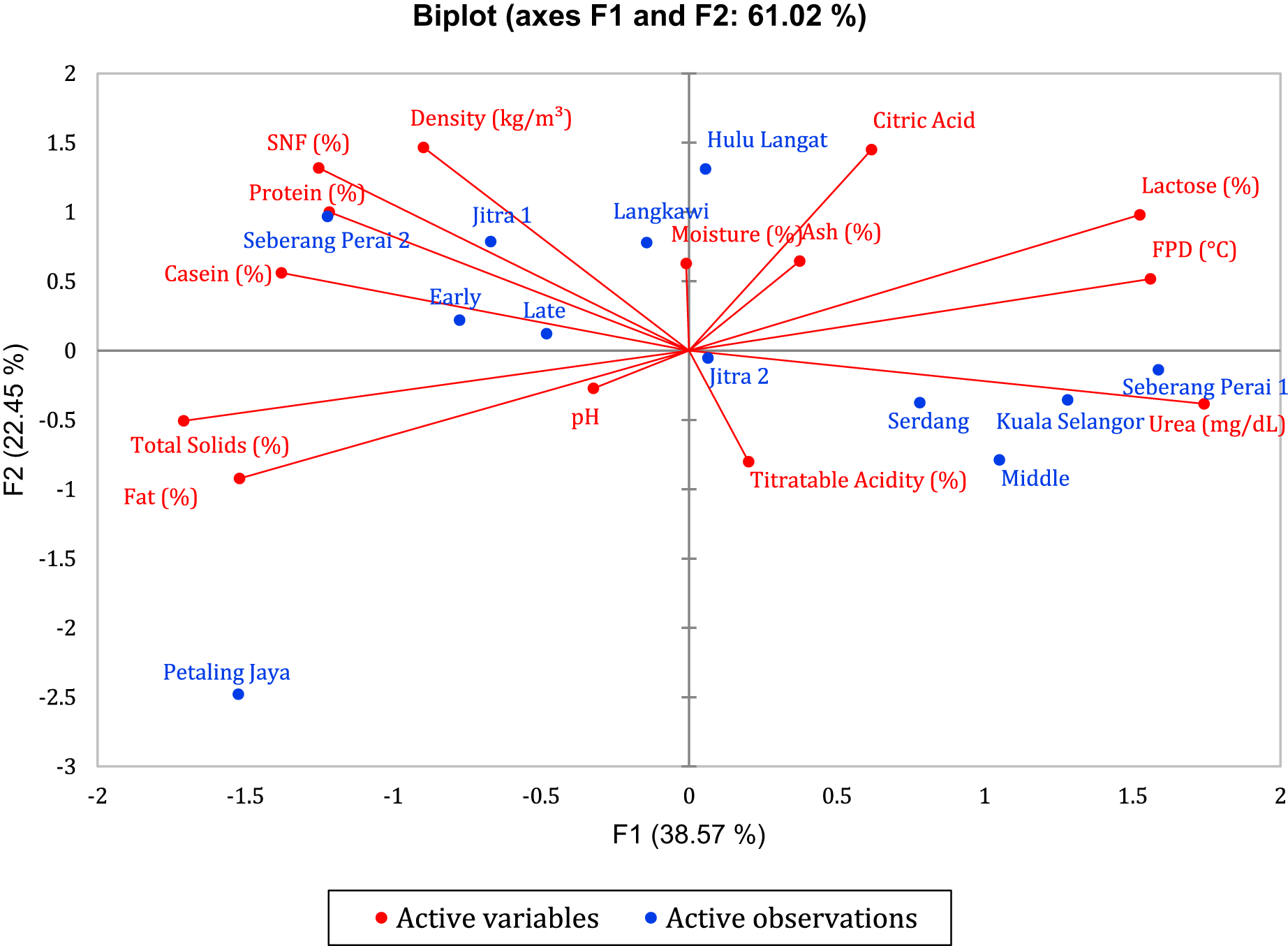
The principal component analysis (PCA) biplot (Fig. 1) explained 61% of the total variability in buffalo milk quality, with principal component 1 (PC1) (39%) and PC2 (22%) distinguishing key traits. Milk from Petaling Jaya had high fat (11.28%) and TS (20.09%) but lower protein (3.46%) and SNF (9.42%), linked to high-energy feeds like pellets and brew. The farms Jitra 1 and Seberang Perai 2 showed higher protein (5.27%, 4.50%), casein (4.76%, 3.60%) and SNF (10.74%, 11.01%), likely from soybean meal, favouring cheese and yoghurt production (Abrar et al., Reference Abrar, Mushtaq, Riaz, Ali, Rafique, Naz, Zaheer, Awan, Khan, Shaukat, Shaukat and Sindhu2021). Langkawi and Hulu Langat had higher moisture (88.5%, 88.53%), ash (2.41%) and lactose (4.71%, 4.69%), affecting shelf life and sensory traits (Filho et al., Reference Filho, Júnior, Rangel, Silva, Novaes, Júnior, Silva and Moreno2014).
Principal component analysis (PCA) biplot of physicochemical properties of buffalo milk.

Within the single farm studied, early and late lactation yielded higher protein and casein. Meanwhile, higher urea and titratable acidity were associated with Seberang Perai 1, Kuala Selangor and middle lactation (urea: 1073.33, 989.67, 908.1 mg/dL; acidity: 2.37%, 3.45% and 2.59%), reflecting metabolic differences linked to feeding practices (Borghese et al., Reference Borghese, Rasmussen and Thomas2007). Malaysian farms used both semi-intensive systems, combining grazing with pellets or intensive systems with diverse diets (forage, pellets, brown sugar, bread). This diversity reflects adaptive feeding strategies tailored to local availability and costs. Compared to countries like India and Italy, where diets often follow more uniform, high-protein rations for optimal yield, Malaysian practices are less standardised but more flexible (Azmi et al., Reference Azmi, Ahmad, Mohd Nor, Goh, Zamri-Saad, Abu Bakar, Salleh, Abdullah, Jayanegara and Abu Hassim2021; Kumar et al., Reference Kumar, Gulati, Ramkaran and P2024). While this adaptability benefits smallholders, improving feed formulation consistency and monitoring could enhance milk quality and reduce variability. Overall, PCA, integrated with compositional data, highlights how farm management and lactation stages shape buffalo milk's quality and processing suitability.
Feed storage conditions, moisture content and water activity of feed samples
Buffalo farms in the sampling area used varied feeds; Langkawi, Seberang Perai and Jitra relied on pellets, forage grass and soybean meal, while Serdang included rice bran and corn. Hulu Langat and Petaling Jaya incorporated pollard, brown sugar, bread and brew, potentially affecting milk energy and citric acid (Iqbal et al., Reference Iqbal, Asi and Jinap2013). Pellets and forage were staple feeds, with soybean meal as a primary protein source in Seberang Perai 2.
Feed storage conditions ranged from 27°C to 30°C and 65%–79% humidity (Table 1), with moisture at 58%–92% and water activity (aw) 0.915–0.986. No significant temperature differences were observed (p ≥ 0.05). Moisture and aw of feed peaked during late lactation (p ≤ 0.05), increasing the risks of fungal growth (Buerman et al., Reference Buerman, Worobo and Padilla-Zakour2019). Although Malaysia's hot, humid climate exacerbates such risks, storage remained below highly conducive levels for aflatoxin production (Benkerroum, Reference Benkerroum2020), consistent with Azman et al. (Reference Azman, Wan-Mustapha, Goh, Hassim, Selamat and Samsudin2021), who reported feed storage temperatures of 27.1°C–29.2°C and relative humidity of 72.19%–81.9% in Malaysia.
Storage conditions (temperature and humidity), moisture content and water activity for feed samples from different farms and lactation stages

Different superscripts between the rows within the same column show a significant difference (p ≤ 0.05).
Aflatoxins in feed and milk, and antibiotic residues in milk samples
Aflatoxin B1 (AFB1) in feed was below detection limits (Table 2), attributed to good storage practices and short feed cycles (Azman et al., Reference Azman, Wan-Mustapha, Goh, Hassim, Selamat and Samsudin2021). However, 66.7% of milk samples contained aflatoxin M1 (AFM1) (0.02–0.07 µg/kg), which is below the Malaysian regulatory limits (Food Regulations, 2020), with the highest levels found at Jitra 1. The presence of AFM1, despite undetectable AFB1 in feed, reflects bioaccumulation and carry-over (Tadele et al., Reference Tadele, Demissie, Amsalu, Demelash, Mengist, Ambelu and Yenew2023). Continuous monitoring is crucial for mitigating mycotoxin risks in milk production.
Aflatoxins in feed and milk, and antibiotic residues in milk from different farms and lactation stages

AFB1, Aflatoxin B1; AFM1, Aflatoxin M1; AMO, amoxicillin; OTC, oxytetracycline. Different letters within the same columns show a significant difference (p ≤ 0.05). LOD for AFB1 – 3 μg/kg; LOD for AFM1 – 0.018 μg/kg.
Amoxicillin (AMO) and oxytetracycline (OTC) residues were also detected (Table 2). AMO occurred in all samples (0.031–0.219 µg/kg) and OTC in nine samples (2.11–11.8 µg/kg), both within regulatory limits (Food Regulations, 2020). Across lactation stages, AMO rose from 0.037 µg/kg in early lactation to 0.096 µg/kg in late lactation, while OTC declined from 4.31 µg/kg (early) to 1.10 µg/kg (middle), then slightly increased (1.25 µg/kg) in late lactation. Although the injected volumes of AMO and OTC were the same for all buffaloes, indicating that differences were due to metabolism, withdrawal period, or physiological stage rather than dosage (Saleh et al., Reference Saleh, Elhenawee, Hussien, Ahmed and Ibrahim2021). Indiscriminate antibiotic use without proper withdrawal periods can lead to residues persisting for 7–14 days (Sharma et al., Reference Sharma, Sharma, Singh, Pandey and Singh2019). Despite levels remaining within safety thresholds, the presence of residues underscores the need for strict monitoring, better producer education and stronger regulatory enforcement.
Conclusion
In conclusion, buffalo milk from farms in Peninsular Malaysia exhibited significant variation in composition, as fat, protein and TS were highest in Petaling Jaya, Jitra 1 and Seberang Perai 2 farms. The lactation stage also influenced milk quality, as early and late stages were richer in protein and casein, while middle lactation showed higher urea and acidity. Despite undetectable AFB1 in feed, AFM1, amoxicillin and oxytetracycline residues were present at low but permissible levels across farms and lactation stages. Future research should prioritise the investigation of long-term effects associated with low-level residues, incorporating comprehensive and systematic sampling strategies to enable more accurate risk assessments and enhance the broader applicability of the findings.
Acknowledgements
The authors would like to acknowledge University Driven Research Programme (UDRP): Functional Food Development and Future Food, Faculty of Food Science and Technology and Human Nutrition and Health: Food Safety (including Food Traceability and Authenticity), Institute of Tropical Agriculture and Food Security, Universiti Putra Malaysia.
Funding sources
This work was supported by the Ministry of Higher Education (MOHE) of Malaysia under the Trans-disciplinary Research Grant Scheme (TRGS/1/2020/UPM/01/4/3).