Introduction
The concept of age-friendly communities has garnered international attention among researchers, policy makers and community organisations since the World Health Organization (WHO) launched its Global Age-friendly Cities Project (WHO 2007). Despite the growth of the age-friendly communities movement, few studies have examined age-friendly characteristics within different community contexts (Chiou and Chen Reference Chiou and Chen2009; Hanson and Emlet Reference Hanson and Emlet2006; WHO 2007). In order to accommodate the challenges of population ageing, community-planning processes will require a comprehensive understanding of the impact of the community environment on older adults’ quality of life. This study addressed this gap in the literature using a participatory methodology to explore older adults’ perceptions of age-friendliness in both urban and rural communities.
The WHO launched the Global Age-friendly Cities Project in 2006 (WHO 2007). The age-friendly concept was developed out of the WHO active ageing framework (2002) in which active ageing is seen as a ‘process of optimizing opportunities for health, participation and security in order to enhance quality of life as people age’ (WHO 2007: 5). Accordingly, age-friendly cities establish policies, services, settings and structures that support active ageing (WHO 2007). Based on focus groups in 33 cities around the world, the WHO study examined age-friendliness across eight a priori determined domains: outdoor spaces and buildings; transportation; housing; social participation; respect and social inclusion; civic participation and employment; communication and information; and community support and health services.
Although the notion of age-friendliness is a growing global movement, there is no universally accepted definition of what constitutes an age-friendly community and studies employ various conceptual frameworks and terminologies. For example, Hanson and Emlet (Reference Hanson and Emlet2006) used the term elder friendliness to assess community characteristics. The authors developed a framework for elder friendliness encompassing four variables: (a) addresses basic needs, (b) optimises physical and mental health, (c) promotes social and civic engagement, and (d) maximises independence for frail and disabled. Alley et al. (Reference Alley, Liebig, Pynoos, Banerjee and Choi2007) defined elder-friendly communities as those that engage, value and support older adults through infrastructure and services. Based on a review of the literature, the authors identified five components of elder-friendly communities: (a) accessible and affordable transportation, (b) housing, (c) health care, (d) safety, and (e) community involvement opportunities.
Other studies have applied the concept of age-friendliness to study specific services. For example, Broome et al. (Reference Broome, Worrall, McKenna and Boldy2010) examined priorities for an age-friendly bus system. Using ethnography and focus groups the authors identified seven priorities for an age-friendly bus service. Chiou and Chen (Reference Chiou and Chen2009) developed a seven-point strategy for age-friendly hospitals in Taiwan. The authors defined age-friendliness as accessible and supportive environments that promote the health and wellbeing of older adults.
An ecological approach to age-friendly communities
Embedded within the various frameworks for age-friendly communities is the notion that older adults’ quality of life is connected to their physical and social environments (Lui et al. Reference Lui, Everingham, Warburton, Cuthill and Bartlett2009; Menec et al. Reference Menec, Means, Keating, Parkhurst and Eales2011). Within the field of gerontology, a large body of literature examines the dynamic relationships between older adults and their environments (Lawton and Nahemow Reference Lawton, Nahemow, Eisdorfer and Lawton1973; Phillipson Reference Phillipson, Settersten and Angel2011; Wahl and Weisman Reference Wahl and Weisman2003), though considerable emphasis has been placed on micro-level settings such as the home and institutions (Gitlin Reference Gitlin2003; Sacco-Peterson and Borrel Reference Sacco-Peterson and Borell2004; Wahl and Weisman Reference Wahl and Weisman2003). Comparatively few studies examine ageing within the community context (Keating and Phillips Reference Keating, Phillips and Keating2008; Menec et al. Reference Menec, Means, Keating, Parkhurst and Eales2011).
Expanding on the WHO model of age-friendly communities, Menec et al. (Reference Menec, Means, Keating, Parkhurst and Eales2011) developed an ecological conceptualisation of age-friendly communities. The authors emphasised person–environment interrelationships and contend that ecological principals are implicit within the age-friendly community framework and call for research that takes a holistic, community-level approach to the study of ageing. Borrowed from biology, the concept of ecology has been used in a range of disciplines as a framework for understanding the complex interplay between humans and their social and material environments (Menec et al. Reference Menec, Means, Keating, Parkhurst and Eales2011; Stokols Reference Stokols1992; Wahl and Oswald Reference Wahl, Oswald, Dannefer and Phillipson2010). A core assumption of the ecological framework is that wellbeing and quality of life are connected to multiple dimensions of the physical and social environment (Stokols Reference Stokols1992). By extension, improving the physical and social environment should have a positive impact on the quality of life of older adults (Wahl and Oswald Reference Wahl, Oswald, Dannefer and Phillipson2010).
Ecological theory provides a suitable framework for the study of age-friendly communities because it takes into account the perspectives of older adults, the constraints and supports of their community environments as well as the complex connections between them. Employing the ecological conceptualisation of age-friendly communities discussed by Menec et al. (Reference Menec, Means, Keating, Parkhurst and Eales2011), this study used ecological theory to guide the research design and analysis by viewing the older adult as embedded within the community environment and larger policy environment. This approach is intended to contribute to a holistic understanding of ageing within the community context.
Purpose of the study
The purpose of this study was to use a participatory methodology to explore older adults’ perceptions of age-friendliness and to identify priorities and barriers to making communities more age-friendly. Whereas previous studies structure the research process around pre-determined domains of what constitutes an age-friendly community (e.g. WHO 2007), photovoice enables older adults to define and communicate their own interpretation of age-friendliness within the context of their communities. This approach is based on the notion that research designed to improve older adults’ quality of life should include the perspectives and priorities of older adults (Gabriel and Bowling Reference Gabriel and Bowling2004; Wang and Burris Reference Wang and Burris1997; Wang et al. Reference Wang, Morrel-Samuels, Hutchison, Bell and Pestronk2004). By focusing on the issues identified by older adults, this open-ended participatory approach was selected to determine if characteristics, barriers or contextual factors emerge that add new insights into the study of age-friendly communities.
Methodology
The study employed the photovoice technique with 30 older adults in four Manitoba communities. Photovoice refers to a qualitative participatory research methodology that combines photography, interviews and group discussions (Catalani and Minkler Reference Catalani and Minkler2010; Wang and Redwood-Jones Reference Wang and Redwood-Jones2001). This technique is well suited to examine community characteristics because photographs offer a means to collect and analyse information based on older adults’ experiences within their social and physical environments (Baker and Wang Reference Baker and Wang2006; Lockett, Willis and Edwards Reference Lockett, Willis and Edwards2005). Older adults were provided with cameras and took photographs to illustrate community features that they considered ‘age-friendly’ or presented barriers. Participants also recorded journal entries describing each photograph and took part in interviews and group discussions. For a more detailed discussion of the methodology, see Novek, Morris-Oswald and Menec (Reference Novek, Morris-Oswald and Menec2012).
Community selection
Four communities were selected for the project including one city and three rural communities. The first community selected for the study is the largest population centre in Manitoba and is home to about two-thirds of the entire population of the province. Located in the south of the province, the city has a population of approximately 660,000 people, 14 per cent of whom are 65 years of age and older (Statistics Canada 2007). Given the diversity within rural Manitoba, rural communities were selected according to several geographically defined regions of the province. The second community is an agricultural town located in the south of the province. The town has a population of approximately 3,000 people and a high proportion of the population aged 65 or older at about 34 percent (Statistics Canada 2007). The third community is located in the central region of Manitoba. The town has a population of approximately 8,000, 26 percent of whom are 65 and older. The fourth community is located in the remote north of the province. The town has a population of 13,400, with older adults representing 3 per cent of the total population (Statistics Canada 2007).
Participants
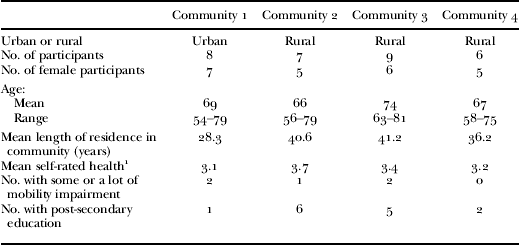
Participants were recruited using a combination of word of mouth and poster advertisements with the help of facilitators from local senior centres. Between six and nine participants were recruited in each community for a total of 30 participants. Seven men and 23 women participated in the project (see Table 1). Participants’ ages ranged from 54 to 81 years with an average age of 69.4 years. Individuals who were interested in the study were screened using a participant information form which solicited demographic information including their highest level of education and length of residence in the community. Participants were also asked for their self-rated health and whether impairments related to mobility, vision and hearing limit their daily activities. Participation in the study required attending and participating in group meetings, and manipulating a digital camera, thus few had any impairment. Only five participants reported having mobility problems (see Table 1).
Participant characteristics
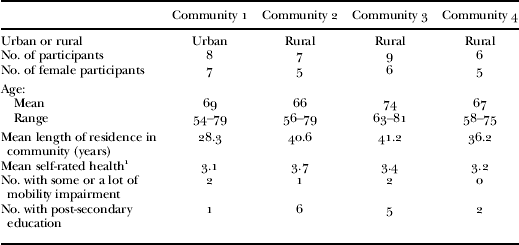
Notes: One participant did not provide her age. Five participants did not provide information regarding their education. 1. Coded as: 4 = excellent, 3 = good, 2 = fair, 1 = poor.
Data collection procedures
An information session was held in each community to explain the project and distribute the digital cameras. Research assistants provided instructions on camera use and ensured that each participant was comfortable using the camera. Participants were also provided with journals to describe and interpret each photograph. In order to limit the amount of data, participants were asked to take a maximum of 16 pictures. Typical of the photovoice technique (Lockett, Willis and Edwards Reference Lockett, Willis and Edwards2005; Wang and Burris Reference Wang and Burris1997; Wang et al. Reference Wang, Morrel-Samuels, Hutchison, Bell and Pestronk2004), each participant was also asked to select three priority photographs which were used to compile a list of key issues for each community. In total, participants took 393 photographs related to age-friendliness. Participants selected 70 of the photographs to represent priority issues.
Once the cameras and journals were collected, one-hour interviews were conducted with each participant. Interviews were conducted in person or over the phone depending on the location of the community. Interviews were structured around each participant's photographs. Participants were asked to elaborate on the meaning of their pictures, and to fill in any missing journal entries.
Following the interviews, participants in each community attended a focus group to generate discussion and to determine age-friendly priorities. A PowerPoint presentation was used as a guide for the discussion. The presentation included a mix of photos and commentary from each member of the group as well as the priority issues identified by participants. This process ensured that all participants’ perspectives were taken into account and allowed participants to comment on each other's photographs. It also provided an opportunity to obtain participant feedback on the preliminary themes generated from photographs, journals and interviews. The focus group discussion was tape-recorded and subsequently transcribed. At the end of the focus group, participants were asked how they wanted the findings to be used. For each community, a summary report of age-friendly issues and recommendations was sent to participants as well as political leaders, service providers and community organisations selected by the group.
Data analysis
Photographs, journals and focus group transcripts were analysed with the aid of NVivo 8 qualitative data software. Priority photographs and corresponding journal entries selected by participants were examined and re-examined by three researchers to identify themes. This process generated a preliminary list of themes. The themes were incorporated into a coding scheme that was used to guide data analysis of all journal entries and interview transcripts. Transcripts of journal entries and interviews were cross-coded to ensure consistent and reliable data coding. Coding discrepancies were identified and resolved through research team discussions. Once the coding scheme was finalised, photographs, journal entries, transcripts of interviews and focus group transcripts were coded using NVivo 8 software.
Results
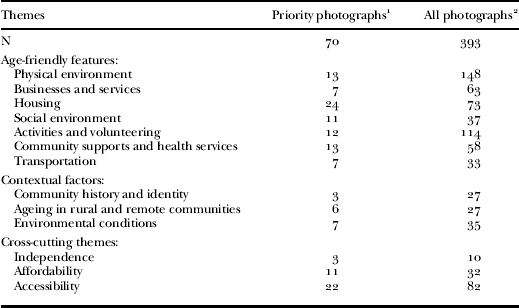
The themes identified in this study were organised into three broad categories: age-friendly features, contextual factors and cross-cutting themes. Table 2 shows the three broad categories, as well as the sub-themes within each. For each theme, we present the number of photographs that reflected the theme, both when considering photographs that participants identified as priorities, as well as all the photographs that participants took.
Frequency of age-friendly themes
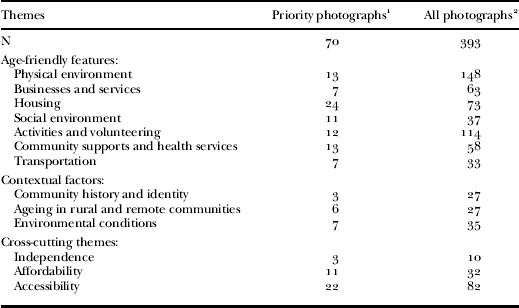
Notes: 1. Includes those photographs that participants identified as priorities. 2. Contains priority photographs, as well as all the other photographs that participants took. The numbers in each column add up to more than the total number of photographs because each photograph could be coded into multiple themes.
The age-friendly features participants identified in this study generally correspond to the WHO (2007) domains of age-friendliness. Clearly evident, however, was the inter-relatedness of age-friendly domains. Thus, the themes cannot be considered separately, but rather present a holistic picture of people's lives. In addition to age-friendly features, we identified three key contextual factors that impact the experiences of older adults within their community environment: community history and identity, ageing in rural and remote communities, and environmental conditions. Finally, independence, affordability and accessibility were identified as cross-cutting themes that intersect with various community features and contextual factors.
Age-friendly features
Physical environment
The physical environment was identified as a priority in all four communities and was a common theme in photographs, journal entries and discussion groups. The majority of participants photographed physical features of their environment that support or diminish independence. Several participants emphasised the relationship between outdoor spaces and physical activity and wellbeing. Photographs of the physical environment captured a range of themes in relation to buildings and outdoor spaces.
Photographs of buildings focused on accessibility. Images of icy entrances, steep stairways and heavy doors depicted some of the challenges that older adults face within their homes, local businesses, public offices and churches. On the other hand, pictures of ramps, automatic doorways and elevators provided positive examples of age-friendly features and advocated for the elimination of barriers. Parking was a significant issue for several participants. Participants identified the need for handicap parking stalls, well-maintained parking lots with regular snow and ice removal, and parking space in close proximity to local businesses and health services.
Photographs of outdoor spaces included sidewalks, neighbourhood streets, walking trails, urban parks and larger provincial parks. Participants illustrated the challenges that older adults face outdoors while also highlighting the positive impact of the outdoor environment on physical activity and wellbeing. In all four communities, participants photographed a range of sidewalk hazards, from piles of snow near bus stops, icy and cracked sidewalks, to steep kerbs.
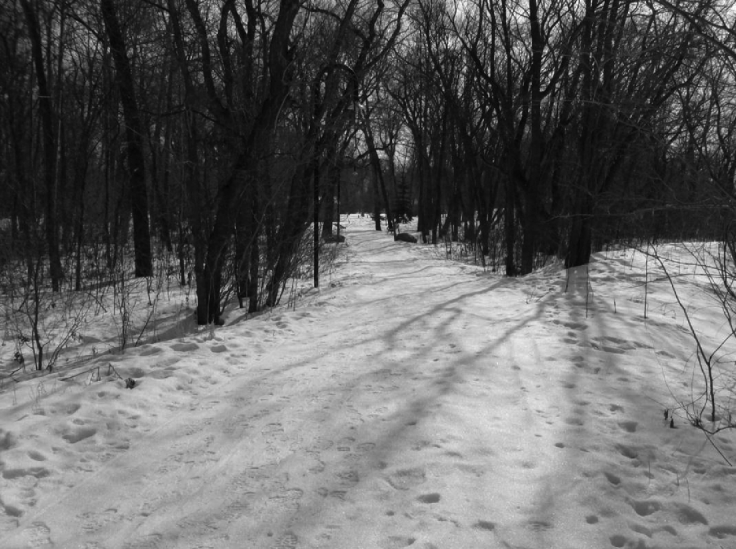
Outdoor activity was also associated with the aesthetics of the physical environment. Photographs of urban green spaces, streets lined with planters, community gardens, lakes and forests highlighted the impact of the environment on older adults’ sense of wellbeing and opportunities for physical activity. When interpreting their pictures of pathways and walking trails, participants often referred to the beauty of the natural surroundings. For example, one participant described her photograph of a walkway within an urban park (see Figure 1). Through visual imagery and commentary, participants highlighted the connections between the physical environment and other facets of older adults’ lives such as social participation, recreation, physical activity and wellbeing.
‘I see a beautiful park in the centre of our town! It ‘supplies’ beautiful walking trails, ski trails, picnic areas, camp grounds, home to birds and small animals, children's playground, a wading pool. It is beautiful! It is very accessible, and is used by many seniors.’

Businesses and services
Participants photographed a variety of businesses and services in their communities including grocery stores, banks, libraries, shopping malls, hardware stores, restaurants and postal services. Photographs showcased accessibility issues including handicap parking, ramps, automatic doorways, benches to rest on and public washrooms. Grocery stores were frequent subjects, reflecting their essential role in everyday life. In addition to accessibility issues, participants also described the importance of grocery delivery services and the availability of prepared meal options. Shopping malls were commonly cited as age-friendly due to their physical accessibility, range of shops and services, as well as opportunities for social and physical activity. For example, several participants described ‘mall walking’, which provided them with a cost-free opportunity to exercise and socialise during the winter.
Housing
Participants identified housing as an essential component of age-friendly communities. Twenty-four out of 30 participants took photographs related to housing, representing 24 of the 70 priority photographs and 73 out of the total 393 photographs (see Table 2). Photographs and commentary illustrated multiple dimensions of age-friendly housing including affordability, the physical design, neighbourhood characteristics and the social environment. According to participants, age-friendly communities require a range of housing options to accommodate the diverse needs of older adults.
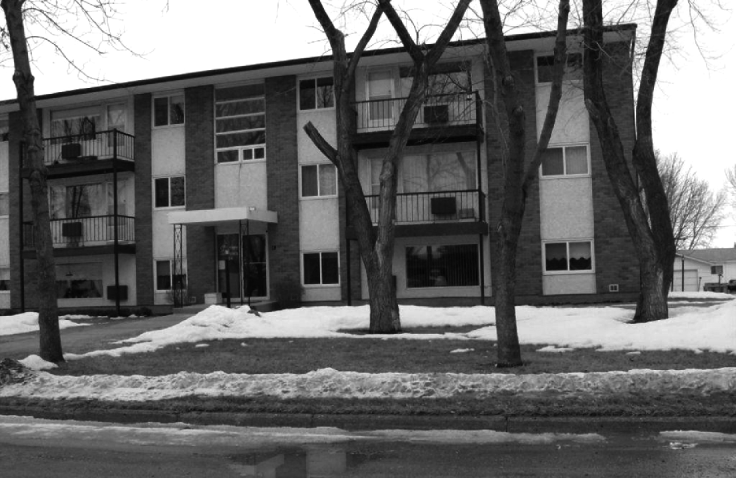
The availability of affordable and accessible housing was a critical issue for participants in all four communities. Participants expressed frustration with waiting lists for low-income housing and the lack of suitable housing options for people with limited mobility. Photographs of ageing housing stock, narrow doorways and multi-level apartments without elevators illustrated some of the challenges that older adults face within their homes (see Figure 2). While there were many examples of environmental barriers, there were also photographs to illustrate household modifications that support people as they age.
‘Very unfriendly to seniors. Bottom apartments are eight steps down. Second floor eight steps up, and third floor 24 or more steps up. No elevator: difficult access for seniors. Impossible access for those confined to wheelchairs. This town has numerous apartments constructed to these standards.’
Photographs and commentary illustrated the numerous ways that housing influences the wellbeing of older adults. In addition to the physical design, neighbourhood characteristics such as proximity to public transportation, services and amenities impact older adults’ quality of life and their ability to age in place. Living close to grocery stores and public transportation enabled participants to remain in their homes, while nearby coffee shops, malls and senior centres promoted physical and social activity.
The social environment
Photographs and group discussions of age-friendly housing also emphasised the impact of the social environment on older adults’ quality of life. Concerns about crime led several participants to feel unsafe in their homes. To demonstrate her fear, one participant photographed graffiti in her back lane, commenting, ‘Makes most seniors afraid to walk in their neighbourhoods’. Another participant photographed a parking lot in front of a housing complex for older adults that had recently been vandalised.
While some participants felt unsafe in their homes, others identified positive aspects of their social environment. Participants living in housing and apartment complexes for older adults enjoyed recreational and social activities offered in their buildings. Friendships with neighbours provided participants with social interaction and assistance with household tasks. Participants described receiving help from neighbours with carrying groceries, shovelling snow and bringing out the garbage. Intergenerational neighbourhoods were viewed as particularly desirable and supportive environments. For example, one participant described the mutual benefits of intergenerational neighbourhoods in her journal:
It is older people who are not working, helping with kids coming with end of the classes. Their parents are still working and coming to the seniors neighbors to wait until parents come home from work. On the other hand, when it's, when it's too much snow, the neighbors help neighbors taking it out, the same with the grass.
Maintaining relationships with family members provided participants with social and instrumental support. Commenting on his photographs of a hockey arena, one participant wrote: ‘It's one good way for seniors to see their grandchildren and their friends; a reason for seniors to continue living in [community name] – being near family’. The ability to entertain family was a key concern for older adults. For one participant, this meant remaining in the house where her children grew up. For those living in low-income apartment complexes, it was important to have a common room that they can use to visit with their families.
Activities and volunteering
Photographs of activities and volunteering depicted the vibrancy of older adults’ social lives and their contributions to their communities. To illustrate this point, one participant photographed an array of brochures advertising activities for older adults commenting: ‘Won't be long until seniors want to be considered as adults, not seniors’. In addition to pictures of senior centres and programmes aimed at older adults, participants also photographed art galleries, concert halls, museums, community gardens, coffee shops, educational classes and volunteer opportunities.
Photographs of activities also identified several barriers to participation and inclusiveness. These include physical accessibility, transportation, affordability and information. For example, one woman described the barriers that people face who do not have transportation means: ‘There are activities in this part of the building [for example] exercises, meals, bingos and potluck and games gatherings. These types of services are needed but many seniors cannot attend as they have no transportation’. Participants also identified ways that senior centres overcome these barriers. For one participant, the free programmes offered by her local senior centre enabled her to stay socially active. Referring to an organised trip to a professional baseball game, she commented, ‘Without [the senior centre] I just couldn't afford the ticket, it was very nice’. In order to facilitate participation, activities and programmes for older adults must ensure that their buildings are accessible, transportation is available, costs are affordable and that information about programmes is effectively communicated to older adults.
Community supports and health services
Ensuring that older adults have access to a broad range of community supports promotes health and wellbeing, and facilitates independent living. Participants photographed programmes that provide support to older adults including information provision, counselling, congregate meals, volunteer driving and a medical equipment-lending programme. Congregate meals were a common theme in each community. According to participants, these programmes are particularly beneficial to those who live alone, have limited income or have difficulty purchasing groceries. In addition to providing nutritious meals, congregate meals offer isolated older adults opportunities for social interaction.
Through photography, participants depicted an extensive continuum of care including home care services, assisted living, supportive housing, long-term care, acute care, primary care, palliative care and allied health professionals. Waiting lists for medical and long-term care were a key concern for participants in all communities, though they presented unique challenges for rural areas. Participants in rural communities feared having themselves or their family members placed in nursing homes outside their community. Commenting on her photograph of a local nursing home, a participant from the remote northern community wrote:
This is for seniors who cannot live without medical services. This is a new building and was filled immediately and also has a long waiting list. There are many seniors in the North. Many have to leave their families and communities.
Transportation
Older adults in rural communities often have to travel to urban centres to receive medical care. The trip can be costly and uncomfortable, particularly for people living in the remote north. This process is especially challenging for patients with chronic conditions who require frequent trips to receive medical care. To illustrate this issue, several participants from the northern community photographed buses that they used to travel to access health care. Commenting on her photograph, one participant wrote: ‘Seniors on a limited income use this mode of transportation, the trip is nine hours and it's very uncomfortable’. Through photographs and commentary, participants highlighted the connection between transportation and access to health services, as well as the unique challenges of providing health care to a growing older adult population in northern and remote communities.
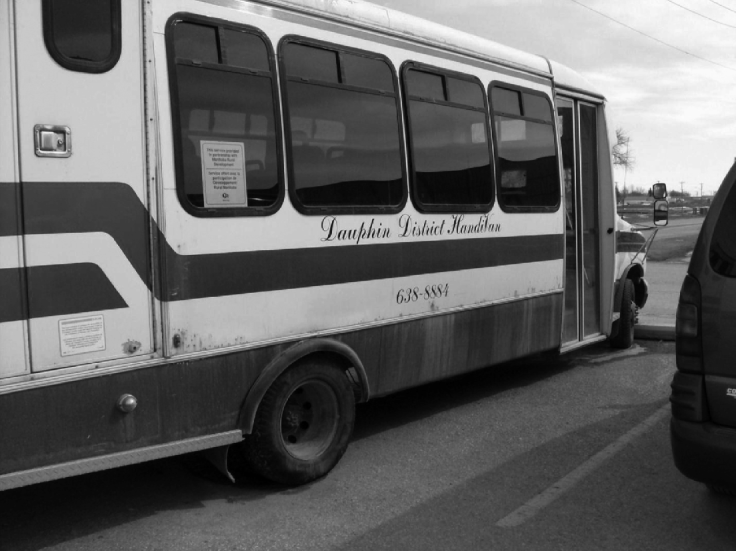
In addition to linking older adults with health services, transportation connects individuals with community life including local businesses, services and opportunities for social participation. For older adults who are unable to drive, access to transportation services is essential to maintaining active and independent lives. Handivan services provide transportation for mobility-disadvantaged individuals throughout Manitoba. Variation in cost, however, impacted older adults’ perception and utilisation of this service. For example, in one community where the handivan cost Can $2.00 per trip, participants viewed it as an excellent service that fostered independence and connected older adults with social activities and health services. In another community, the handivan cost Can $6.00 each way, which posed a significant financial barrier (see Figure 3). The absence of affordable and accessible transportation may contribute to social isolation and create barriers to health services.
‘This cost discourages many seniors from using this service and opt to just stay home!’
Contextual factors
Community history and identity
Participants documented several features of their communities that represent community history and identity. Through photographs of local architecture, public art works, memorials and community events, participants illustrated the importance of respect for the past and fostering a sense of community connection. One woman interpreted her picture of the local railway station: ‘This building represents the centre of what was a large railroad community. Many retirees of this community worked “on the railroad”. They were proud to be a member of the large railroad family.’ Architecture and public art works symbolised community identity and were a source of pride. One woman described the local courthouse: ‘Built in 1916. A beautiful symbol of the past eras. Many seniors take great pride in the architect of this building (inside and outside). Age-friendly because of the emotional pride!’ In the northern community, several participants took photographs of art work depicting wolves. Wolves were a symbol of the community, and local murals were a source of pride and identity: ‘[community name] is not only [the] nickel capital of the world but on its wait to being wolf capital of the world. The prestige of our community is spreading and people come from all parts of the world to settle here.’ These photographs showcased the complex interconnections between the built and symbolic environment, suggesting that age-friendly communities promote community pride through public spaces, buildings and art works.
Urban, rural and remote communities
The results of the study indicate that participants in urban, rural and remote communities face unique challenges as well as opportunities for ageing. Specifically, health care, community supports and transportation services differed between urban, rural and remote communities. Participants in all three rural communities described the difficulty of attracting and retaining health care professionals. As described in the Community Supports and Health Services section, older adults in the remote northern community face barriers to health services and many have to travel long distances to receive health care. In this community, participants described a growing population of older adults in a town that was traditionally viewed as a young, mining town. The town also provides services to older adults in smaller, surrounding communities, including Aboriginal reserves. As a result, participants stressed the need for a range of community supports, including programmes designed to meet the needs of Aboriginal older adults. Although participants in all communities were concerned about waiting times for long-term care, in rural communities participants were afraid of having themselves or their loved ones placed in a nursing home outside their home community. Expanded long-term care options are necessary in order to ensure that older adults who require care can remain in their communities, close to family and friends.
Environmental conditions
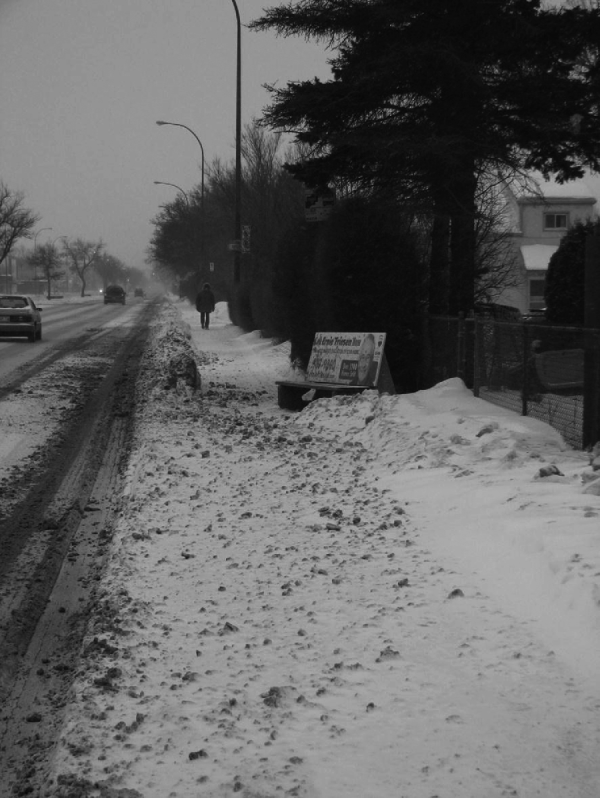
The impact of winter in the Canadian prairies was evident in photographs, journal entries and discussion groups. Many participants expressed a fear of falling on icy sidewalks and described the limited mobility and social isolation they experience during winter months (see Figure 4). Despite the pitfalls of cold weather, winter also provided opportunities for recreation. In all four communities participants took photographs of walking trails that they enjoyed during the winter. Participants in rural communities photographed parks, nearby lakes and forests, illustrating the beauty of the landscape as well as winter activities. A woman from the remote northern community described the age-friendly features of a walking trail encircling her town: ‘The trail is groomed for walking in summer and winter. You can walk outdoors safely in interesting surroundings. It has many trees, flowers, animals, and a river.’
‘Seniors rely on bus to go places … Winter is not friendly. The main sidewalks in winter are not walkable, slippery, dangerous.’
Cross-cutting themes
Independence
Participants identified independence as a key outcome of age-friendly communities. The theme of independence intersected with a variety of age-friendly domains including the physical environment, housing, the social environment, community supports and transportation. Participants assessed their physical environment for features that either enhance or diminish older adults’ independence. For example, one participant commented on a ramp at a local church: ‘Anytime seniors can access areas without assistance their independence is affirmed.’ Similarly, home modifications and accessible design features were perceived as independence enhancing. For example, one participant photographed modifications to furniture and bathroom fixtures that enabled him and his wife to remain in their home following knee surgery. These photographs, and the related group discussion, illustrated how the household adaptations increased quality of life and facilitated independent living.
The concept of independence was also discussed within the context of social values. Several participants contrasted independence with the experience of feeling like a burden to others when requesting assistance. One participant, who had immigrated to Manitoba, expressed a different perception of dependence and independence: ‘I grew up in different circumstances … there was always that the kids were taking care of parents, and that's how it still is where I come from … The kids should help.’ The differing perspectives on independence suggest that these concepts are informed by social values and meanings attributed to functional losses and the ageing process. These values shape perceptions of ageing, as well as the choices that older adults make in terms of accessing services or requesting help from family or friends.
Affordability
The issue of affordability impacted multiple aspects of older adults’ lives including housing, the social environment, activities and volunteering, community supports and health services, and transportation. For many participants in this study, financial barriers were a major impediment to age-friendliness. In all four communities, participants identified the lack of affordable housing as a key concern for older adults. Group discussions highlighted the complexity of this issue as participants pointed out the diversity of older adults’ housing preferences and levels of income. For example, one participant commented: ‘Because there is a person who earns, a year, [Can] $12,000, and there is the person who has almost a hundred thousand or more. So you cannot compare those two seniors and put them in the same basket.’ Participants illustrated the multiple ways that affordability impacts older adults’ quality of life, while also highlighting the range of income security among older adults.
Accessibility
Accessibility intersected with every theme related to age-friendly features as well as several contextual and cross-cutting themes such as environmental conditions and independence, as illustrated above. Physical accessibility impacts the wellbeing of older adults’ within their homes, neighbourhoods and community environment. The multiple connections between accessibility and quality of life suggest that accessibility issues should be considered when examining any aspect of an age-friendly community.
Discussion
This study was designed to explore what age-friendliness means to older adults using an open-ended, participatory approach. By using photovoice methodology we obtained a rich illustration of older adults’ experiences within their community environment. The study enabled participants to define what age-friendly means and capture images that matter to them. The research generated photographs, commentary and group discussions that highlight the multidimensional connections between older adults’ quality of life and various aspects of their environment.
The age-friendly features identified in the present study are consistent with previous research (Alley et al. Reference Alley, Liebig, Pynoos, Banerjee and Choi2007; Hanson and Emlet Reference Hanson and Emlet2006; WHO 2007). For example, housing, the physical environment, and opportunities for activities and volunteering were frequently identified as aspects of an age-friendly community. Our study clearly highlights the multidimensional interactions between individuals and their social and physical environment. For example, transportation was linked to accessing health services, while building accessibility affected participants’ ability to volunteer. These findings support ecological theory as applied to age-friendly communities, as it emphasises the complex connections between older adults’ quality of life and their social and material environments (Menec et al. Reference Menec, Means, Keating, Parkhurst and Eales2011).
Ecological theory also suggests that there are different levels of influence, from the immediate physical and social environment to macro-level factors (Stokols Reference Stokols1992). Thus age-friendly features need to be understood within a larger context (Menec et al. Reference Menec, Means, Keating, Parkhurst and Eales2011). This multi-level approach is supported by our findings related to contextual factors that impact the experiences of older adults within their community environments. Photographs and commentary related to community history and identity illustrated the social and historical meanings associated with various places that shape older adults’ experiences within their community environment. Participants described attachments to buildings and community spaces that informed their identity and their sense of social inclusion. Rowles (Reference Rowles, Rowles and Ohta1983, Reference Rowles1993) uses the concept of ‘insideness’ to describe various forms of attachment to place. This can include the physical awareness that people develop within familiar places, the shared social identity attributed to places and neighbourhoods, as well as the personal meanings that individuals attach to places over the course of their lives. He further argues that attachment to place may play a greater role in the maintenance of identity in older age, as places become, ‘a landscape of memories’ (Rowles Reference Rowles, Rowles and Ohta1983: 114).
The different experiences of participants in urban, rural, remote communities suggest that an understanding of age-friendly communities must take into account regional differences and characteristics. Although participants in all four communities were concerned with health care, community supports and transportation, the provision of these services varied considerably among communities. Proximity to urban centres was also a significant consideration, as people in the remote north often have to travel long distances to access medical care. Among environmental conditions, the weather was frequently mentioned as a factor that impacts older adults’ quality of life. This is not surprising in a province known for its long and cold winters. Difficulty getting around and fear of falling on icy streets are a present danger to many older adults.
We further identified several themes that frequently emerged in relation to other age-friendly features and contextual factors, suggesting that they intersect with older adults’ experiences with various facets of their social and physical environment. Affordability and accessibility were recurring themes in photographs, interviews and group discussions. The multiple connections between income security and access to housing, nutrition, health care and social opportunities suggest that income security should be explicitly addressed within conceptual frameworks of age-friendly communities.
The extensive overlap and interplay between various themes indicates that research and public policy targeting one age-friendly domain should consider the complex interconnections with other community features. For example, a community that is planning to build housing for older adults should consider how (and whether) residents will be able to access necessary services (e.g. grocery stores, health care services) and may need to consider developing transportation options. Transportation options can be particularly problematic in rural areas, as there may be no public transit available. Older individuals who do not, or no longer drive therefore need alternative options. As another example, the development of social opportunities for older adults needs to take into account building accessibility. Older buildings are often not wheelchair accessible; thus, locating social activity programmes in such buildings excludes those with mobility challenges.
Findings related to contextual and cross-cutting factors warrant further research, such as, how do other factors like gender or ethnicity intersect with issues such as affordability and environmental features? For instance, is the affordability of housing gendered? How do lack of transportation options affect men versus women differently in terms of their ability to remain socially engaged?
One of the limitations of this study was the relative homogeneity of participants. The requirements of the study, which included being able to use a camera and taking pictures of the community environment, may have introduced a selection bias towards healthier, younger individuals. There was also little ethnic diversity in our sample, with most participants being Caucasian. What ‘age-friendliness’ means from the perspectives of older adults from ethnic minorities remains a question for future research.
Conclusion
The photovoice technique enabled participants to define for themselves what age-friendliness means and document positive features and barriers in a variety of settings throughout their communities. Through photography, participants determined the subjects of their photographs and the key issues facing older people within their communities. They selected photographs to include in group discussions and engaged in critical dialogue about each other's pictures and journal commentary (Wang and Burris Reference Wang and Burris1997). In addition to contributing to the research findings, participants’ photographs and commentary were also used to advocate for change. At the conclusion of the study, a report outlining key issues and recommendations was sent to participants, political leaders and community organisations selected by participants in each community. The reports, which include illustrative photographs taken by participants, enabled older adults to convey their concerns and ideas to local policy makers and community organisations.
The high level of participation and multiple sources of data provided a rich visual and contextual illustration of older adults’ experiences within urban and rural community environments. In addition to the age-friendly features identified in the study, contextual themes emerged including community history and identity, ageing in urban, rural and remote communities, and environmental conditions. These themes suggest that contextual factors influence the perception, experience and characteristics of age-friendly communities. The inclusion of urban, rural and remote communities in this study highlighted the impact of community size, location and proximity to urban centres on other age-friendly features, particularly health care and support services. Finally, the cross-cutting themes of independence, affordability and accessibility illustrate the extent to which older adults are able to influence and in turn are influenced by their physical and material surroundings. These findings build on previous conceptualisations of age-friendliness (Alley et al. Reference Alley, Liebig, Pynoos, Banerjee and Choi2007; Hanson and Emlet Reference Hanson and Emlet2006; WHO 2007) and contribute to a more complex and comprehensive understanding of age-friendly communities from the perspectives of older adults.
Acknowledgements
The Age-friendly Community–University Research Alliance (CURA) is funded by the Social Sciences and Humanities Research Council of Canada (SSHRC). Verena Menec holds a Canada Research Chair in Healthy Aging.