Verdurization (lühua) has been a heavily loaded phrase in China. Like many other words in modern Chinese, it originated in Japan in the late nineteenth and early twentieth centuries, when Japan coined numerous words using kanji (Chinese characters) to convey new ideas and concepts derived from the west.Footnote 1 In the mind of progressive Chinese in the early twentieth century, verdurization was a sign of modernization and an essential step for nation building.Footnote 2 Since then, the country was frequently torn apart by war and revolution, making the goal of greening the environment a remote luxury. But the concept and dream lived on.
Verdurization gained momentum in the 1950s when the newly established Communist regime, following the Soviet model, vigorously promoted a ‘garden landscapes’ campaign as a part of so-called socialist reconstruction.Footnote 3 Along with the campaign, lühua became very much an everyday term.Footnote 4 Tree planting and park building also became an important buttress of the state's claim to legitimacy and a mechanism for extending its control of public space. Verdurization was taken as a yardstick of Communism – the ultimate goal of mankind in Marxism.
This article takes Shanghai as a case-study to look into an area that so far has been little studied: verdurization (lühua) in Chinese cities during the first 30 years of the People's Republic of China (PRC).Footnote 5 As part of its aspiration for a new society full of ‘socialist vigour’, the PRC government sponsored numerous verdurization programmes – planting roadside trees, building parks, renovating promenade gardens, creating public green spaces and so on – from the 1950s through the 1970s to make Chinese cities ‘garden like’.Footnote 6 Although the purposes of these programmes were more political than ecological and many of them were not well planned or implemented in the long run, they did make Shanghai significantly greener. On the other hand, ordinary people cared more about whatever foliage they could manage to have at home than the government's streets and parks programme. Home gardening in the city was not just a matter of aesthetics and recreation but also a retreat from the harsh political reality of the socialist revolution and, in some instances, a form of resistance to an all-pervasive state.
‘Our motherland is a flowering garden’
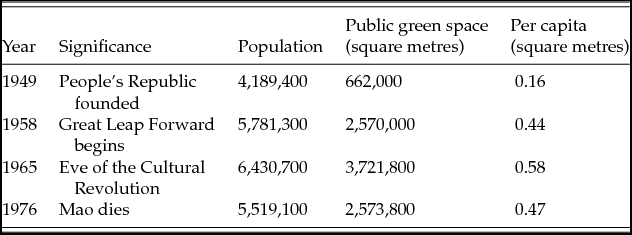
Despite its reputation as China's most modern city, Shanghai in its heyday in the Republican era (1912–49) was a city with little public green space. Along the Bund and Nanjing Road, the area that served as an emblem of the city, one could hardly see trees or any other greenery. In May 1949 when the Communists took over Shanghai, the entire city proper, an area of about 32 square miles, had merely 18,600 street trees.Footnote 7 Public green space per capita in the city was just 0.16 square metres (0.19 square yards). There were 361 acres (1.46 million square metres) of private green space in the city, 2.2 times public green space, but that space was very unevenly spread: over 65 per cent was in west Shanghai, mostly in private compounds in the city's affluent residential neighbourhoods.Footnote 8
The new regime promised the people a bright future and a just society and, as physical evidence of ‘socialist paradise on earth’, China would become a gigantic garden. In the words of a song composed in 1954,
Our motherland is a flowering garden,
Where the flowers are wonderfully bright-coloured
The warm and gentle sunlight shines upon us
And every face has a broad smile.
Wa-ha-ha and Wa-ha-ha,
Every face has a broad smile.Footnote 9
The song – the music was based on a Uyghur folk ditty while the lyrics are entirely in Mandarin Chinese – became one of the most popular children's melodies in China.Footnote 10 However, to turn China into a ‘garden’ was not merely a fantasy in children's songs but a serious part of government strategic planning. In Shanghai, the municipal government had made substantial efforts to add foliage to the city and the progress was impressive. By February 1958, the government had built 28 parks and planted 120,000 street trees. In less than eight years since May 1949, public green space in the city had been increased 5.8 times.Footnote 11
The Great Leap Forward of 1958 added momentum to the verdurization. One of its sub-campaigns was to ‘turn the earth into a garden’. The Chinese Communist Party (CCP) Central Committee passed a resolution late that year outlining a long-term plan to turn two-thirds of China's farmland into ‘garden landscapes’ of trees, lawns and lakes.Footnote 12 Such a plan sprang directly from Mao's mind. Before the resolution, in an extended CCP Politburo meeting in Beidaihe in August, Mao, explicitly linking the task of verdurization to the ultimate goal of building Communism, instructed that
We must make the mountains and rivers of our motherland entirely verdurous, reaching such a level that every place is landscaped as beautifully as a garden. The wild must be tamed. Trees must be planted well, to certain specifications, and not be planted without follow-up care. The spacing between rows of trees as well as the types of trees must be appropriately matched. Everywhere the landscape should look like a park. To achieve this means meeting the requirements of Communism.Footnote 13
With Mao's call for ‘garden landscaping’ or, more specifically, afforestation, almost immediately tree planting became a countrywide mass movement.Footnote 14 In Shanghai, the municipal government called for planting 155,000 trees, which exceeded the total number of trees planted in the city since 1949. But the plan was immediately dwarfed by the number of tree plantings pledged by the ‘masses’ during the Great Leap Forward: an absurd target of 120 million. The slogan of the day was ‘every family should plant trees, every home should plant flowers, everyone should take care of plants, and every plant should survive’. Drawing an analogy, the government promoted ‘using every bit of space, as long as a needle can be squeezed in, for greenery’.Footnote 15
There are no data on the actual results of the pledges, but given the irrationally inflated numbers reported all across the country during the campaign, one can be certain that most of these pledges did not materialize. According to Shanghai municipal government data, from 1958 to 1962, the city planted 319,000 street trees, of which 119,000 survived, a rate of 37 per cent.Footnote 16 The rate was not good; still, adding over 100,000 street trees in just about four years was impressive. Another survey found that by the end of 1962, Shanghai had more than 148,300 trees growing in green spaces that were affiliated with 6,850 work units; among them, 112,000 were sizable trees, with a trunk diameter of over 13 centimetres.Footnote 17 At any rate, Shanghai in the early 1960s was a city significantly greener than it had been a decade earlier (see Table 1). Arthur W. Galston (1920–2008), an American botanist who visited China twice, in 1971 and 1972, keenly noted that on Shanghai streets, ‘Trees are never far away.’Footnote 18
Public green space per capita in Shanghai, selected years of significance during Mao's era

Sources: Data based on Shanghai tongzhi bianzuan weiyuanhui, comp., Shanghai tongzhi (Comprehensive gazetteer of Shanghai) (Shanghai, 2005), vol. III, ch. 1; Shanghai yuanlin zhi bianzuan weiyuanhui, comp., Shanghai yuanlin zhi (A gazetteer of Shanghai's landscape gardens) (Shanghai, 2000), 384.
The most commonly planted street trees in Shanghai were London plane trees, a type of hybrid chinar that accounted for 87 per cent of all street trees in Shanghai in the early 1950s.Footnote 19 Shanghai started to plant trees, mostly willows, along the Bund and Nanking Road in 1865. In 1887, the French Concession authorities spent 1,000 taels of silver to purchase plane trees from France, and the trees soon became very popular in the city. By 1902, the trees planted in upscale residential areas along Avenue Joffre (present-day Huaihai Road) in the French Concession were almost exclusively plane trees. This French connection contributed to the tree's popular, albeit misleading, name, in Chinese, Faguo wutong, or ‘French parasol tree’.Footnote 20 The name led people to believe the tree was somehow European, and it became an enduring emblem of the Shanghai street scene beloved by writers. The novelist Zhou Erfu (1914–2004) starts his famous Morning in Shanghai simply by depicting street trees in the former French Concession in the early 1950s:
Its tires hissing softly over the asphalt surface of the road, a little black Austin car was approaching in the distance. The avenue was lined with neatly-spaced plane trees, the lime-wash applied last winter already beginning to flake off the bottoms of their trunks, and their broad, rich-green leaves fluttering in the breeze. The avenue was almost deserted and not a sound disturbed its tranquil calm. From a clear, cloudless sky the afternoon sun threw the shadows of the plane trees on the roadway in a neat pattern. Passing over an intersecting avenue, the little Austin slackened its pace and came running across the shadows of the trees.Footnote 21
To this day, the words ‘French parasol tree-lined streets’ still conjure up nostalgia for old Shanghai.Footnote 22 The trees were also brought from Shanghai to Nanjing after the Nationalist government established the latter as China's national capital in 1928. Major thoroughfares in present-day Nanjing are still lined with them.Footnote 23
However, in the anti-western atmosphere of the late 1950s, the foreign origin of the plane tree was deemed politically incorrect. In Shanghai, there was an attempt to get rid of it in favour of the white poplar, which commonly grows in the Loess Plateau of north-west China and was regarded as not only an ‘authentic Chinese tree’ but also a type of ‘revolutionary tree’. This symbolism was promoted by the celebrated left-wing writer Mao Dun (1896–1981), whose essay ‘Eulogizing white poplar’ (Baiyang lizan), written in 1941 right after the author visited Yan'an, the Communist heartland on the plateau, glorifies the tree as an icon of the spirit behind China's ‘national liberation’. After the Communist victory, the essay was included in middle school Chinese textbooks as required reading, and hence was extremely influential. A well-known Shanghai writer, Ru Zhijuan (1925–98), added to the imagery: she dedicated her first anthology to the tenth anniversary of the founding of the PRC and named it The Tall White Poplars (Gaogao de baiyangshu).Footnote 24 In late 1958, in some districts white poplars comprised 76.4 per cent of newly planted street trees. By 1964, there were 45,600 white poplars on Shanghai's streets, or 48.69 per cent of all the roadside trees in the city.Footnote 25
But it was soon found that white poplars cost more to maintain and provided relatively little shade. The trees also tended to attract a type of moth known as cimaochong (‘bristle insects’) whose bristles can float in the air and hurt human skin, something that children were particularly vulnerable to.Footnote 26 By the early 1970s, it was no longer a choice for street trees and London plane trees were back as the preferred type.Footnote 27 For instance, as part of the preparations for Nixon's visit in February 1972, all the poplar trees on both sides of Shanyin Road were replaced by London plane trees to impress the Americans, although the street was not on the itinerary of Nixon's delegation.Footnote 28
Overall, since the early 1970s, the selections of street trees became more diverse. A survey in 1990 found there were 29 main types of roadside trees in Shanghai. Among them, London plane trees remained the majority (60.8 per cent), followed by camphorwood (camphor laurel) (15.4 per cent) and others (23.8 per cent), including southern magnolias, gingko trees, Chinese ash trees (Fraxinus), paulownias and ailanthuses (tree of heaven).Footnote 29 In addition, a survey conducted in February 1982 found that 1,398 ‘ancient and precious trees’ (gushu mingmu) – of which 225 were over 300 years old – survived in the city.Footnote 30 By any account, the Communist regime did not turn Shanghai into a ‘garden’ but it is undeniable that the city became noticeably greener under its rule.
Parks in the city
Parallel with the tree planting projects, park building was another important part of the socialist verdurization programme. The Shanghai municipal government made significant progress on that front in just eight years: in May 1949, when the Communists took over Shanghai, there were 14 parks, covering 163 acres (658,800 square metres) in total.Footnote 31 By 1958, the number of parks increased to 50, and the total acreage to 568 (2.3 million square metres).Footnote 32
Like tree planting, park building was highly political. In a city where for decades the main parks excluded the Chinese, opening parks to the public was a palpable sign of Mao's proclamation that ‘the Chinese people have stood up’.Footnote 33 It was also a concrete measure for fulfilling the party's promise that ‘the people's government is for the people’. The following sketch of three parks along the Bund and Nanjing Road provides a glimpse of park building in the city that epitomized the party's use of parks to promote nationalism and socialism.Footnote 34
Since its establishment in 1868 as ‘the Public Garden’, Huangpu Park (also known as the Bund Garden before 1946) was embroiled in decades of controversy over its rule excluding ‘Chinese and dogs’ from entering.Footnote 35 Originally a fallow beachhead of about 5 acres at the confluence of Suzhou Creek and the Huangpu River, the park was the city's first ‘public garden’ – as it original name indicates – albeit it was exclusively for use by western expatriates. The Shanghai Municipal Council spent 10,224 taels of silver from both Chinese and foreign taxpayers for the project. Although the rule excluding ‘Chinese and dogs’ was lifted in July 1928, in the decades that followed, the park continued to symbolize China's national humiliation. The Communist regime was keen to use the park to demonstrate that the party was at the vanguard in the struggle to protect and promote China's national interests. On 9 June 1949, just two weeks after the Communist takeover, the newly established city government cleaned out all the landmines that had been placed in the park by the Nationalist army during the civil war and opened the park to the public. Over the next 30 years, the appearance of the park changed little, except for the addition of a flood-prevention wall, a pavilion for viewing the river and a 9 metre high manmade hill with a waterfall and spray fountain. As a showcase for the city, the park had flowers in bloom in all seasons. A survey in 1986 found there were 3,546 trees of 111 various species in the park. A 200 metre long shelterbelt on the north divided the park from the Bund.Footnote 36
Walking from the Bund along the famous Nanking Road westward for a mile, one reached People's Park (Renmin gongyuan) built on the northern part of what was originally the British racecourse. The project of turning the racecourse into a park at the centre of the city was unquestionably the most significant urban reconstruction for public recreation after the Communist takeover of Shanghai. The racecourse was established in 1850.Footnote 37 Over the ensuing century, it became home to Shanghai's largest casino and, in the minds of Chinese nationalists, was associated with vice brought by westerners. The decision to turn the northern part of the racecourse into a park was made in September 1951 and construction started in June 1952.Footnote 38 In just four months, a 47 acre (188,500 square metre) park was built. By any measure, the park was impressive. It had 73,700 square metres of greenswards and 13,400 trees. There was a manmade river 1.2 kilometres long, 3 to 5 metres deep and 12 metres wide, with a waterside pavilion and five graceful stone and wooden bridges. In 1956, in the south-west part of the park through which the river passes, an area was designated for fishing; it often attracted hundreds of anglers. In 1958, a 13 metre high hill occupying an area of 250 square metres was made at the southern end of the park. The hillsides were decorated with 1,500 plots of bright yellow and purple chrysanthemums dotted with a hundred plots of scarlet sage. The park also featured bamboo pavilions, corridors and pergolas. From the central lawn of the park, one can see a few famous buildings against the skyline: the Park Hotel, the Shanghai Library Tower, Grand Theatre, the Pacific Hotel and others, much like viewing Fifth Avenue high rises from New York's Central Park.Footnote 39
Strolling from People's Park further westward along West Nanjing Road (formerly Bubbling Well Road) for a mile and a half, one reached small yet stylish Jing'an Park, which was built in the early 1950s based on the same nationalistic agenda as the Bund Park and People's Park. The place was originally the Bubbling Well Cemetery, built for Europeans and Americans by the Shanghai Municipal Council in 1898 with a budget of 56,200 taels of silver.Footnote 40 Over the years, western expatriates considered it the ‘best cemetery’ in Shanghai. By the time the Communists took over the city, the cemetery had expanded to 8.3 acres (33,600 square metres). Although by then most foreigners had left the city, the cemetery still had 6,214 graves, of which 5,353 were occupied.Footnote 41 In 1954, with the approval of China's Ministry of Foreign Affairs, the Shanghai municipal government invested 180,000 yuan (about US$73,170) to remove most of the coffins and turn the cemetery into a park. It was named after Jing'an Temple, a nineteenth-century Buddhist temple located just across the street. The entrance of the park featured a 100 metre long, 27 metre wide trail with 32 London plane trees that had been planted when the cemetery was built.Footnote 42 On the western edge of the park stood an ancient gingko tree from the middle of the eighteenth century with a girth of 162 centimetres.Footnote 43 Numerous maidenhair trees, peonies, calyx canthus, southern magnolias and fragrant osmanthuses made this 8 acre park into a sort of mini-resort. That the former ‘foreigners’ hill cemetery’, as the place was dubbed by Shanghai locals, was turned into a park for ‘working people to relax’ was touted as a notable achievement of the new government.Footnote 44
Except for a few years in the early 1950s when parks were free, most parks charged an entrance fee of two, three or five cents, depending on the size of the park.Footnote 45 Starting from July 1956, a monthly pass with unlimited entrance to all parks in the city was available for 50 cents.Footnote 46 The average monthly pay for all employees in Shanghai in 1962 was 68.41 yuan and remained roughly the same throughout Mao's time, which means that the monthly pass cost just about 0.07 per cent of the average salary.Footnote 47 In 1963, a total of 312,500 monthly passes were sold and a third of park visitors in that year were monthly pass holders.Footnote 48 The cost of visiting parks was considerably lower than in the Republican era, when parks typically charged an entrance fee of 20 cents, which was about the average wage of a factory day-labourer at the time.Footnote 49 Park visiting thus was part of an affluent middle-class lifestyle, and not a recreation available to the great mass of the population.Footnote 50 The affordability of park entrance fees in socialist Shanghai led to park visiting becoming a common – and for many people, a daily – activity. The city's parks attracted close to a million visitors annually in the early 1960s; by 1990, the number exceeded three million.Footnote 51
Aside from their usual function as sites for recreation, Shanghai's parks fairly frequently held seasonal flower shows of various types and sizes. The chrysanthemum show, in particular, had a long tradition. As early as in 1875, a chrysanthemum show had been regularly held in Shanghai's walled Chinese city in the middle of the ninth month in the lunar calendar (usually October).Footnote 52 Among Shanghai's western expatriates, flower shows were customarily held in the Bund Garden.Footnote 53 During the Republican period, Shanghai's Chinese municipal government sponsored a number of chrysanthemum exhibitions and horticulture shows.Footnote 54
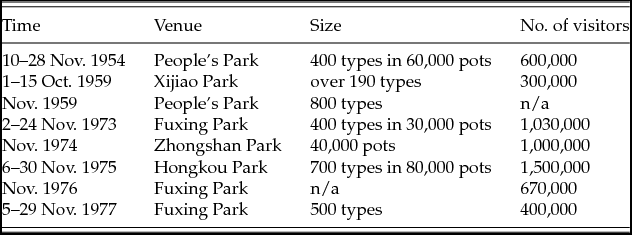
The Communist government certainly wanted to carry on this tradition and turn it into a showcase for the dictum, as mentioned before, ‘People's Government for the people’. With government funding, Shanghai's first chrysanthemum show after Liberation (as the founding of the PRC is dubbed) – held on 10–28 November 1954, at People's Park – was spectacular. It had more than 60,000 flowerpots with 250 different types of mums. Dozens of unusually large mums called daliju, or ‘great standing chrysanthemums’, were the gem of the show: one of them had 217 flowers, each about the size of a rice bowl, blooming from a single stem.Footnote 55
To celebrate the tenth anniversary of the founding of the People's Republic, a two-week event called ‘A Hundred Flowers Exhibition’ took place in October 1959 at Xijiao Park, a former British golf course of about 70 acres in a western suburb.Footnote 56 There were nearly 200 different species of flowers in bud or in bloom, including more than 50 that were blooming out of season. In simply equipped nurseries, the botanical gardeners made painstaking efforts to create this unseasonal florescence, and they succeed remarkably. Plants that typically do not bloom in late September and early October, such as the pear (which naturally blooms in early spring), peonies (in mid-spring) and the red plum and winter-sweets (in deep winter) all bloomed around National Day (1 October). These experiments were considered not merely scientifically but also politically important since they added to the imposing celebration of the tenth anniversary. The exhibition attracted some 300,000 visitors. And in November, immediately after the show, a huge chrysanthemum exhibition was held in People's Park.
Flower shows were suspended in the early years of the Cultural Revolution (1966–76), only to reappear on an even larger scale after Nixon's visit in 1972.Footnote 57 For nearly the entire month of November of 1973, there was a chrysanthemum show at Fuxin Park, Shanghai's ‘French Park’ in the former French Concession. Choosing this venue symbolized openness to the west. More than 30,000 chrysanthemums were on display, making the show an extremely popular event in the autumn of that year. Daily visitors averaged more than 44,000 and by the end of the show, about 1.3 million people – nearly all were Shanghai residents – had visited the exhibition. The population of the urban districts of Shanghai in the early 1970s was around 5.5 million, which means about a quarter of the population visited the exhibition.Footnote 58 Such large chrysanthemum shows continued to take place in various parks in the city throughout the Mao era, each attracting about one million visitors (see Table 2).
Major chrysanthemum exhibits in Shanghai parks, 1954–77

Notes:
1. All numbers have been rounded.
2. The 1959 exhibition was named ‘Hundred Flowers Booming’, which included over 50 types of plants that usually do not blossom in autumn. The exhibition was dedicated to celebration of the tenth anniversary of the founding of the People's Republic.
3. The 1976 exhibit was a combination of ‘Hundred Flowers Booming’ and a chrysanthemum exhibition in celebration of the downfall of the Gang of Four.
4. All the exhibitions were organized and sponsored by the Shanghai Municipal Park Management Office. Flower exhibitions in district parks are not included.
Source: Shanghai yuanlin zhi bianzuan weiyuanhui, comp., Shanghai yuanlin zhi (A gazetteer of Shanghai's landscape gardens) (Shanghai, 2000), 360–4.
Home gardening
Neither the amount of public green space per capita nor the city's parks could adequately reflect the full picture of the foliage in Shanghai. What official statistics ignored, but was important to the verdurization of the city, was greenery at home. For Shanghai's residents, a few ceramic pots of flowers and plants in a tiny space at home constituted a garden much more relevant to their daily life than street trees and city parks.
In comparison with the usual urban jungle of a modern metropolis, Shanghai in much of the twentieth century was a ‘lower’ city where the great majority of the residents lived in lilong, or alleyway houses, a type of reformed two- or three-storey Victorian/Edwardian terraced house that was introduced by the British in the late nineteenth century and became characteristic of Shanghai. Alleyway houses had been the homes for about 80 per cent of Shanghainese up to the end of the twentieth century.Footnote 59 There were typically three places where flowers could be raised outside such buildings: a front dooryard leading to the living room on the first floor, a balcony connecting the second-floor bedroom overlooking the dooryard and a flat roof at the back of the third floor.Footnote 60 The dooryard and balcony were designed for outdoor activities a step away from the rooms, and the flat roof was primarily for air drying the laundry. Although none of these places was big enough for a ‘garden’ in the usual sense, to Shanghainese, these were the spaces for creating a mini-Eden. As the city became increasingly crowded in the twentieth century, even the windowsill of an attic room could be used for a box garden. Balzac once jeered at Parisians’ appreciation for a little urban greenery, saying that only the ‘Paris townsfolk, who, emerging from the stony abyss in which they are buried, would find something to admire in the flats of La Beauce [an agricultural region in northern France].’Footnote 61 The Shanghainese's appreciation of the little greenery at home came from what might be called an urban craving for nature, shared by residents in other large cities such as Parisians or New Yorkers, but in Shanghai it had its own cultural roots and, moreover, political implications.
Contrary to the common image of the Taoist-like recluse living in the remote countryside or deep in the mountains, far from human contact, an age-old Chinese maxim has it that ‘the great hermit seeks retreat in the marketplace’.Footnote 62 Here, the ‘marketplace’ (shi) refers to any busy urban setting, and the idea is that in such a place an individual life would be easily submerged or go unnoticed – exactly what the hermit wants. More philosophically, the saying implies that the hubbub of a bustling city should not affect one's ability to find inner peace, and only those who live in the midst of urban dissipation while resisting its temptations are true hermits. Cities from this perspective were an ideal place to seek asylum from adversity – not in the sense of street people surviving on the curbside, but in the traditional Taoist ideal of rising above reality, especially in times of political repression.Footnote 63
One of the tangible if rudimentary ways to seek peace of mind in the city was through bonsai-type gardening in one's residence. As is commonly known, in Beijing's courtyard houses (siheyuan, or Chinese quadrangles), three items formed the classic scene in the courtyard: a pergola sunshade, a fish tank and a pomegranate bonsai.Footnote 64 The yard of an alleyway house was substantially smaller than that of a courtyard house, but the flavour and style were similar. Indeed, the Beijing style was said to have been brought by southerners from the Jiangnan region, in which Shanghai was by far the biggest and most important city.Footnote 65
The front dooryard of an alleyway house was usually walled and known as a ‘sky well’ – viewed from the bedroom on the second floor, the square or rectangular patio does look like a well.Footnote 66 The size of the sky well varied, but most were around 10 square metres. They were designed as an open-air space immediately outside the living room for outdoor activities – typically, gardening. A Shanghai resident, who left the city for San Francisco in 1981, recalled a common use of alleyway house front yards:
Walking in through the gate is a tiny dooryard where a leisure-minded household would have a ceramic tank for raising goldfish and keeping a few potted plants. At the corner of the yard, there might be a begonia. Although there wasn't enough sunlight for the plant, it still blossomed every year. The flowers didn't last long; they dropped in the rain and wind, leaving plenty of petals on the ground, and making the viewer a bit sentimental.Footnote 67
Such sentimentality was common. In another case, Ye Shengtao (1894–1988), a prominent educator and publisher, extensively planted around his Shanghai alleyway home and even hired workers to break up the pavement in his front yard for gardening, leaving only a strip for access to the house. The patio thus became a mini garden with wisteria, wild rose, peony and calyx canthus; in Ye's own words, he had created a small world to let the plants compete according to the Darwinist principle of ‘survival of the fittest in natural selection’.Footnote 68
Mao's politicization of flower planting
The common and simple pleasure of having a little flowerbed in one's dooryard was ludicrously politicized in the pan-politicization age of Mao, especially after the early 1960s. As mentioned earlier, in the 1950s, the government promoted tree and flower planting as part of its ‘turning the earth into a garden’ campaign. At the height of the campaign in 1958, gardening was encouraged as a way of ‘making our motherland a socialist great garden’. In praising the enthusiasm of the masses in the verdurization campaign, People's Daily mentioned particularly that in densely populated central Shanghai, where there was little space for outdoor plants, people ‘have started to plant flora along streets and alleys and grow all kinds of potted flowers, climbing plants, and so on in their balconies and flat roofs’.Footnote 69 The newspaper also reported that in Shanghai's working-class neighbourhood of Zhabei, where the Japanese bombing in 1932 and 1937 created notorious shantytowns, ‘residents tilled completely over the land that was deeply damaged by the gunfire of the Japanese imperialistic aggressors. In the shanty areas, working people are filling up stinking creeks and, on top them, planting beautiful flowers.’Footnote 70
However, the failure of Great Leap Forward, along with the great famine of 1959–61, led to another type of Maoist extremism. Flower planting, in particular at private homes, was criticized as bourgeois, and Mao personally endorsed such criticism. In July 1964, in a conversation with the head of his bodyguard regiment, Wang Dongxing (1916–2015), about gardening, Mao explicitly expressed his aversion to potted flowers:
Displaying potted flowers is the stuff of the old society. It is the pastime of the feudal gentry class and pampered sons of the bourgeoisie who [characteristically] hold a caged bird in their hands. Only those who stuff themselves with food but have nothing else to do would plant and display flowers. The country has been liberated for years, but the number of people who plant flowers has not been decreasing; instead, it is increasing. We must change this situation. I for one do not like to have potted flowers in my room – there might be some benefit in having them during the day but they are harmful at night. On my order the flowers in my house were removed long ago. After that, I also asked them to remove the flowers in the yard. . .All the greenhouses ought to be eliminated and most of the gardeners should be laid off, leaving just a few to take care of the courtyards.Footnote 71
Mao's remark was in reference to Zhongnanhai, the 100-hectare (247-acre) compound in central Beijing where China's top leaders lived. For that reason, his comment was taken as an internal matter and had not been publicized unit late 1966, when the Red Guards circulated it in their newspapers, accusing the leaders of Beijing's Department of Agriculture and Forestry of blocking a ‘supreme instruction of the great leader Chairman Mao’.Footnote 72 Nevertheless, even without official publication of Mao's words, the accusation of planting flowers being ‘bourgeois’ was widely known and taken seriously. One author recalled that after Mao's remark, ‘thousands of potted flowers were put on the sidewalks’, apparently abandoned by people who were afraid of the consequences of keeping flowers.Footnote 73 The writer Jung Chang (b. 1952) vividly describes how Mao's words affected her life in Chengdu, the capital of Sichuan Province in south-west China:
In 1964, Mao had denounced cultivating flowers and grass as ‘feudal’ and ‘bourgeois’, and ordered, ‘Get rid of most gardeners.’ As a child, I had had to join others in removing the grass from the lawns at our school, and had seen flowerpots disappear from buildings. I had felt intensely sad, and had not only struggled to hide my feelings, but also blamed myself for having instincts that went against Mao's instructions, a mental activity I had been brainwashed to engage in like other children in China.Footnote 74
Also in Chengdu, journalist Li Chengpeng (b. 1968) recalled a similar experience in his childhood. Li and his parents lived in a courtyard house that was the home of Li's extended family. There were Nationalists and Communists in the family. Different political affiliations did not prevent them from living in peace together for generations, including in the most difficult time during the War of Resistance against Japan (1937–45). However, after the Communist takeover, the little clan was divided by a seemingly trivial matter: how to use the courtyard. ‘Those who liked to plant flowers in the yard were seen as bourgeois, while those who proposed using the space for storage of scrap iron and copper [for the Great Leap Forward] were regarded as revolutionaries.’ The divide lingered for years and eventually turned to a bitter political fight among the family during the Cultural Revolution, replete with public accusation meetings where family members condemned each other over potted flowers.Footnote 75 It all sounds mad. Years later, even those who experienced the time firsthand called it absurd and surreal. An author who wrote for People's Daily exclaimed: ‘Now when we talk about the politics related to flowers and plants at the time, we cannot help but laugh about it. Nevertheless, it was indeed what we had once experienced!’Footnote 76
Back alleys in colour
But there were deviations and variations that were not readily noticeable in the widespread absurdity of Mao's China, as we shall see in the case of Shanghai. Unlike Beijing, Chengdu or other inland cities, in Shanghai flower planting continued to thrive at the time when it was criticized as ‘bourgeois’. It seems that people were aware of the danger involved, but few took it seriously. Besides, despite its ups and downs, the call for lühua initiated in the 1950s remained valid throughout Mao's era, giving people two kinds of political correctness concerning flower planting to play with: to condemn it as bourgeois or to justify it as an act of verdurization. In Shanghai at least, the latter prevailed.
For instance, in the neighbourhood of Shanyin Road (formerly Scott Road), a 712 yard long back street in north-east Shanghai, almost every household had planted flowers and trees in their dooryards, balconies or flat roofs. Da Qizhen (b. 1952), a resident for over 40 years, had fond memories of the urban greenery in her neighbourhood. According to Da, there was such a variety of plants in the area that walking down the street was like strolling through a little botanic garden. Among common plants were palms, camphor trees, pines, cypresses, magnolias, loquats, cherry-apple trees and plantains (dwarf banana plants). There were conifers, broadleaf plants, tropical plants and plants from the Frigid Zone. Late spring and early summer were the most beautiful seasons, when lianas were colourful and full of life. Pink and bright red rosebushes bloomed together with lilac wisteria in spring; in summer, tangerine-coloured Chinese trumpet creepers and purple morning glories were most striking. The tough Boston ivy needed just a little dew and sunlight to grow vigorously, ‘as if they were in high spirits to wrap around buildings with a thick layer of green velvet’. Da reminisced that such an environment ‘put the residents of the houses in a good mood and [soothed their] emotions and pedestrians felt mellow and carefree’.Footnote 77
Da was among many Shanghai residents who cherished memories of growing flowers at home. Another Shanghainese, Zhang Da-Peng (b. 1941), recalled that he took much pleasure in the tiny garden in the front yard of his alleyway home in west Shanghai. The yard once had an iron gate with a pretty inlaid running deer but, like thousands of other iron objects in the city, it was dismantled during the Great Leap Forward to feed the ‘backyard furnaces’, leaving just a gap in the wall.Footnote 78 Around 1963, the district housing administration had sent workmen over to set up a crude wooden gate. Zhang began to loosen the earth and plant flowers and vegetables in the yard and soon he ‘specialized’ in roses. He studied how to grow roses and searched everywhere for varieties that he did not have. The rosebushes grew luxuriantly. In the late spring of 1965, they burst forth in bloom in all colours at one time and numbered about a thousand, of which many were as big as a rice bowl. In Zhang's words, ‘the scenery had more beauty than one can take in’.Footnote 79
The writer Wang Anyi (b. 1954) had a similar description of a prevalent plant in Shanghai's residential areas: ‘Fragrant oleanders reach out over the courtyard walls, as if no longer able to contain their springtime passion.’ During the famine of spring 1960 in the city, ‘Even the scent of the oleanders aroused hunger.’ For a lonely Shanghai girl sitting in her room, it felt like ‘oleanders grow in other family's courtyards and pink clouds fill their sky; outside her window is a lonely parasol tree’. The popularity of the plant prompted Wang to use it as a background – in contrast to a murder scene – to end her most renowned novel about Shanghai: ‘The potted oleanders on the balcony across the way were beginning to bloom, opening the curtain on yet another season of flowering and decay.’Footnote 80
It should be noted that for Zhang, gardening went beyond a simple pastime to be a way to tide himself over hardship and survive the political persecution of the time. After graduating from a college of geology in Beijing, Zhang refused to take a government-assigned job in a factory in the city of Lanzhou, in a poor province in north-west China. He returned home to Shanghai in autumn 1963, unemployed. Zhang became one of the ‘urban idle labour force’, a government category for the unemployed, an object of suspicion and discrimination. He was subjected to the supervision of a middle-aged woman dubbed by the neighbours as Big Sister Hu, who was the head of the neighbourhood committee and lived on the upper floor of the same building where Zhang lived. It turned out that gardening helped Zhang get along with Hu. To Hu, a young man like Zhang staying home gardening indicated that he was not a troublemaker. Better yet, whenever the roses bloomed, he always cut some for her. Zhang and Hu thus maintained a cordial relationship. Over the years, the little front yard became Zhang's retreat in the midst of political upheaval: when the spring of 1966 arrived, as Zhang reminisces in his memoir in the third person voice, ‘the glorious sunshine gently touched [his] garden. The roses were in full bloom and “one hundred flowers contended in beauty”. It was all peace and tranquillity, his own desert isle. Outside, the world was very different’, as the Cultural Revolution was looming.Footnote 81
Zhang was not alone in taking up gardening as a way to cope with Maoist politics; indeed, it was common at the time. An outstanding case is the writer Fu Lei (1908–66) and his rose garden. Fu, best known for his translations of European classic literature, was labelled as a rightist in 1958. For various reasons, unlike most rightists whose lives were turned totally upside down by wearing a rightist ‘cap’, Fu continued to live in his old home, a western-style three-storey house in west Shanghai, and his daily life was little affected. Located in a subdivision called Anding Fang, or ‘Alley of Peace and Constancy’, Fu's home was in a light milky yellow house coated with pebble stones.Footnote 82 It had a spacious fenced-in front yard, where Fu pottered in the garden, as some of his biographers have suggested, as a way to ride out the depressing time and as a silent protest against the repression.Footnote 83 He grew pine trees, cypresses, sweet-scented osmanthuses, chrysanthemums and, most of all, roses in the garden. Fu planted over 50 types of roses, including special varieties he ordered from Paris and London through his son Fu Cong (Fou Ts'ong, b. 1934), who fled to London in December 1958, just eight months after his father was purged.Footnote 84
Another well-known case was Liu Haisu (1896–1994), a prominent painter and art educator who, like Fu and over half a million other intellectuals, was labelled a rightist in 1957 and persecuted during the Cultural Revolution. Liu himself was not particularly fond of gardening but his wife, Xia Yiqiao (1918–2012), also an artist, was a flower lover and, in the years of her husband's political trouble, managed to keep the family's little yard flourishing. The rose, calyx canthus (winter-sweet), plum, camellia, goji (wolfberry), all found their way into the yard.Footnote 85 Even during the most chaotic years of the Cultural Revolution, there were small gardening communities among neighbours and friends. For instance, through their shared love for roses, both Xia Yiqiao and Zhang Da-Peng knew Fu Lei's gardener, Ahxiao; and after Fu's tragic death in September 1966, Xia was able to hire Ahxiao for her garden.Footnote 86
While obviously not everyone had the leisure to raise flowers at home, flower planting went much beyond the few noted people mentioned above. Tan Yingzhou (b. 1966), a professor of foreign literature at Fudan University, recalled that his childhood was full of flowers and plants associated with average people, even though he grew up in the chaotic years of the Cultural Revolution and its aftermath. Tan's granduncle (his paternal grandmother's younger brother) planted over 100 plants on the flat roof of an alleyway house – typically such terraces are about 10 to 15 square metres – and literally turning it into a little roof garden. His garden also extended to his windowsills. Every morning, he would get up at 5 o'clock to water or fertilize his plants and admire the view. He took pleasure from giving away flowers to friends and relatives and serving as a volunteer ‘plant doctor’ for them. Often, he would take sick plants from friends and after ‘intensive care’ on the roof garden return the plants rejuvenated. Tan was particularly amazed how a dying pomegranate in the dooryard was transformed into a vigorous shrub under his granduncle's care. His pastime perhaps contributed to the granduncle's longevity: he lived to 98.Footnote 87
The pomegranate was not the only highpoint in Tan's childhood memories about gardening at home. His grandaunt (unrelated to the granduncle) lived in the same house with the Tans and planted all sorts of annuals on the roof. Among them, the cypress vine was most impressive. The delicate, pentagram-shaped little red flowers with white pistils climbing along the wall became a bright spot in Tan's childhood.Footnote 88 The plant, which originated in Central America, has a poetic name in Chinese, niaoluo, a term from the Classic of Odes, which could be loosely translated as ‘feminine touch.’ The cypress vine was a common climbing plant in Shanghai. Da Qizhen also recalled that in summer her balcony was constantly full of colourful climbing plants and flowers: red cypress vines and marvel-of-Peru, blue morning glories, yellow towel gourds and silver-grey houseleeks, not to mention the multicolour heronsbill, all making a kaleidoscopic scene in the little balcony.Footnote 89 To return to the case of Chengdu, although the neighbours of Li Chengpeng had their spats over flower planting, flowers never disappeared. During the Cultural Revolution, when Li grew up, the house still had a porch with fretwork decorated with chrysanthemums and spider plants.Footnote 90 Lu Zhiming (born c. 1960), a journalist in Xiamen (Amoy), recalled that some of his most joyful moments as a young boy were spent picking marvel-of-Peru (locally known as ‘rouge flowers’), which were ubiquitous in the city. ‘Early in the morning, we followed the grownups to go out to pick rouge flowers’, Lu reminisced. ‘We children like to suck out the pistil to taste the sweet nectar; this was our happiest moment.’ The custom was to throw half of the picked flowers up onto the roof and leave the other half at home – legend has it that this makes the women of the household beautiful.Footnote 91
These portraits do not readily correspond with the usual image of the Cultural Revolution as a dark age in Chinese history, full of misery and bloodshed, but neither do they necessarily contradict it. Rather, they reveal the complexity of life under Communism and remind us that it was multifaceted. In a city that was the heartland of Mao's last revolution, the much condemned bourgeois lifestyle – exemplified here in flower planting – persisted, or even flourished. In a way, as we have seen in a number of cases cited above, precisely because of the hardship people endured during Mao's time, they had all the more reason to take up some sort of recreation or pastime such as gardening as a way to retreat from the harsh reality surrounding them.
Private gardening could also be a modest protest against tyranny. Nie Chongbin (b. 1957), a Shanghainese who now lives in the United States, recalled how the plants on the flat roof of her home became a haven for her grandfather during the Cultural Revolution. In 1947, her grandfather Nie Qijun (b. 1906) paid seven gold bars (312.5 grams each) to purchase a permanent lease on a three-storey alleyway house built in 1939 on Changsu Road (formerly, Shanzhong Road) in west Shanghai.Footnote 92 During the Cultural Revolution, part of his house was forcibly occupied by ‘revolutionary rebels’, an action justified by Mao's call to attack the bourgeoisie. For seven years, Nie refused to leave the building in protest against the illegal occupation of his home. ‘The flat roof on the third floor of the house thus became his world, where he planted all sorts of morning glories in riotous profusion’, Nie Chongbin recalls. ‘In the summer, while playing in the alleyway, we children often raised our heads toward the flat roof calling: ‘Grandpa, grandpa, throw some morning glories down’, then we would see an abundance of morning glories flying down like numerous colourful parachutes descending from the sky.’Footnote 93
Conclusion
In 1958, at the height of the Great Leap Forward, Mao asserted that if Chinese landscapes everywhere looked like a park, China would have reached Communism.Footnote 94 By 1964, the Great Leap Forward had proven to be a failure; still, Mao reiterated the point, only figuratively prolonging the time needed: ‘Take two hundred years to achieve verdurization, that is Marxism.’Footnote 95 China's state-sponsored ‘reshaping the mountains and rivers’ (gaizao shanhe) often caused ecological disasters at the local level and went down in history as failed schemes to improve the human condition (to paraphrase James Scott's words).Footnote 96 However, the campaign for verdurization, despite its ups and downs during Mao's era, did make Chinese cities greener.Footnote 97 In the case of Shanghai, when Mao's army took the city in 1949, the per capita green space (0.16 square metres) was barely enough for a pair of shoes; by the time of Mao's death in 1976, it had increased threefold to 0.47 square metres, or about the size of a newspaper.Footnote 98
But greenery was politicized. The party-state proclaimed the afforestation of public spaces in the city as patriotic and evidence of the benevolence of Communist rule, but condemned home flower planting as a manifestation of a bourgeois lifestyle. Ordinary urban residents cared little about the ideologies ‘planted’ in verdurization but used them for their own purposes. Despite Mao's condemnation of flower planting as ‘feudal’ (the standard Maoist label for China's imperial past) and ‘bourgeois’ (the standard label for modern western values), in Shanghai home gardening for pleasure remained alive and well throughout the Mao era. A flowerbed in the dooryard, or potted plants on the balcony or flat roof of one's home, served as little islands of greenery in the midst of the urban jungle of concrete. More significantly, they represented a spirit that was deemed unorthodox, if not rebellious. In a seemingly trivial but pragmatic way, Chinese lives under Mao were more colourful – both metaphorically and literally – and diverse than has usually been thought.
At the height of the Cultural Revolution, when Chinese society seemed to have completely lost its moorings, Mao whined in private to his confidants on what he regarded as the ineffectiveness of his revolution, that is, that life still goes on: ‘What's all this talk about the Cultural Revolution?. . .Aren't people still getting married and having babies? The Cultural Revolution is very remote from most people.’Footnote 99 On a small note to his comment, what Mao may not have known was that, against his wishes, people were still growing flowers at home. What would have outraged Mao even more was that ordinary people gardened at home to assuage their anger, smooth human relations and express their discontent with his rule.
The story of public green spaces and private gardening in Shanghai thus reveals a split politics that goes beyond the simple matter of flora or greening. For the state, verdurization was a strategy to manifest ideological conviction, enhance socialist morality and claim political legitimacy. The city's residents did not always follow the dictates of the political rhetoric, much less comply with it. In general, they cared less about politicized greenery on streets and parks than whatever foliage they could manage to have at home. Moreover, for some victims of Mao's political campaigns, private home gardening was not only a recreation but also was taken, explicitly or inexplicitly, as a refuge from harsh political reality. Home gardening thus became what James Scott called a ‘weapon of the weak’, a circumspect manoeuvre for coping with tyranny.Footnote 100 In the end, the weapon of the weak might not be weak after all, as it was part of the grassroots pragmatism that eventually triumphed over the state's rhetoric in post-Mao China.