Introduction
The Gondwanan marine realm of Aptian–Maastrichtian time was host to a distinctive family of belemnites, the Dimitobelidae (Stevens, Reference Stevens1965; Doyle, Reference Doyle1988a). In establishing the family for “cylindrical and clavate belemnites provided with lateral grooves on the anterior portion of the rostrum, but devoid of antero-ventral or apical grooves” Whitehouse (Reference Whitehouse1924, p. 410) introduced four new genera as its compass. The ages and distribution of these genera are summarized by Doyle (Reference Doyle1988b, Reference Doyle1992), and Pirrie et al. (Reference Pirrie, Marshall, Doyle and Riccardi2004). Peratobelus, of Aptian age, is widespread in Australia and is also known from West Antarctica and southern Mozambique. Dimitobelus is the most widely occurring genus of the family, common in Australasia, southern South America, West Antarctica, and Papua New Guinea in Albian and Cenomanian time. It ranges to the Maastrichtian but its post-Cenomanian distribution is more limited and includes only New Zealand and West Antarctica, and possibly Western Australia (Doyle, Reference Doyle1988b). Tetrabelus is known with certainty only from the Aptian/Albian of southern India and West Antarctica with a possible occurrence in Madagascar. Cheirobelus, the fourth genus introduced by Whitehouse (Reference Whitehouse1924), is now treated as a junior subjective synonym of Dimitobelus (see Doyle, Reference Doyle1987). Dimitobelus, Peratobelus, and Tetrabelus all possess cylindrical to hastate rostrums of moderate to large size, with individual specimens ranging up to 10 cm, and rarely less than 3 cm, in length. Rostra representing juvenile individuals are very uncommon in the Dimitobelidae, as is the case for belemnites in general (Rexfort and Mutterlose, Reference Rexfort and Mutterlose2006).
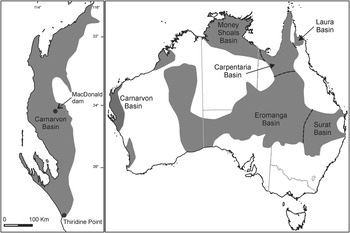
As recently surveyed by Williamson (Reference Williamson2006), Aptian–Albian Dimitobelidae are common and very widely distributed in the Rolling Downs Group of the Carpentaria and Eromanga Basins which accumulated in a vast, shallow epeiric sea that developed across eastern Australia (Fig. 1), and in the Aptian lower Bathurst Island Group of the Money Shoals Basin of northern Australia. In many stratigraphic intervals the representatives of this family are the dominant macrofossil, and local horizons of belemnite coquina “battlegrounds” of the type described by Doyle and MacDonald (Reference Doyle and Macdonald1993) are known to occur (e.g. Henderson, Reference Henderson1998). Belemnite records from Western Australia are less common. However for the Aptian–Cenomanian interval of the Winning Group of the Carnarvon Basin, mainly comprised of Windalia Radiolarite and Gearle Siltstone, which are poorly represented by outcrop, the macrofossil record is dominated by Dimitobelidae (Hocking et al., Reference Hocking, Moores and Van De Graaff1987). Recent sampling of Windallia Radiolarite and Gearle Siltstone by fully cored drilling at four widely separated locations has shown that these units host an abundant belemnite fauna (Williamson et al., Reference Williamson, Henderson, Price and Collerson2012; Price et al., Reference Price, Williamson, Henderson and Gagan2012).
Carnarvon Basin localities for Pumiliobelus n. gen. relative to the distribution of marine Cretaceous rocks in Australia (shaded). Labeled basins preserve records of the Dimitobelidae.

We describe here two distinctively diminutive belemnite taxa from the upper (Cenomanian) interval of the Gearle Siltstone with rostra less than 20 mm in length, dorso-ventally flattened and hastate to bulbous in outline. Their morphology, in particular the possession of ventrolateral grooves/lines, indicates affinity with other Dimitobelidae but they are sufficiently distinct to warrant generic separation.
We consider both these new species to be based on adult specimens, as distinct from juveniles, such that diminutive size is characteristic of them. This case is best argued for Pumiliobelus haigi, which is represented by some 80 rostra that show a range in size, with the smallest less than half the size of the largest. Such a proportional size range is typical of described belemnite species, including members of the Dimitobelidae (Stevens, Reference Stevens1965; Williamson, Reference Williamson2006). Certainty that the three rostra on which P. tumidus is based are mature is less certain. However, juvenile rostra less than 20mm in length are extremely rare in the documented fossil record of belemnites in general. Early ontogeny within the group has been established only from growth stages preserved within more mature rostra (e.g. Bandel and Spaeth, 1998).
Geologic setting
The Gearle Siltstone is extensively developed in the onshore Carnarvon Basin as part of the Winning Group, a succession which spans most of the Cretaceous and is biostratigraphically well constrained, mainly by microfossil assemblages (Hocking et al. Reference Hocking, Moores and Van De Graaff1987). In its northern distribution, the unit is largely Albian but its upper part is Cenomanian (Howe et al., Reference Howe, Haig and Apthorpe2000; Backhouse, Reference Backhouse2006). It outcrops sparingly and poorly. Localities furnishing the material described here are widely separated (Fig. 1).
The suite of Pumiliobelus haigi was collected from spoil from the construction of MacDonald’s dam, a small structure truncating only a very small interval (>3 m) of Geale Siltstone. Mudstone excavated in constructing the dam contains a very well preserved and diverse foraminiferal assemblage typical of the upper Gearle Siltstone, including rare Rotalipora reicheli (Mornod Reference Mornod1949), which suggests a mid Cenomanian age (D. Haig, pers. comm.).
The Gearle Siltstone near the southern limit of its distribution, such as at Thiridine Point on the edge of the Pillawarra Plateau from which P. tumidus was collected, represents only the upper (Cenomanian) part of the formation (Mory et al., Reference Mory, Haig, McLoughlin and Hocking2005). Here the underlying Albian Alinga Formation correlates with the lower part of the Gearle Siltstone in its distribution to the north.
Systematic paleontology
Prefixes preceding specimen numbers denote repositories: GSWA, Geological Survey of Western Australia; UWA, University of Western Australia; WAM, Western Australian Museum; JCU, James Cook University. Morphological terms and biometric notation follow Doyle (Reference Doyle1987). Linear dimensions are in millimeters.
Class Cephalopoda Cuvier, Reference Cuvier1795
Subclass Coleoidea Bather, Reference Bather1888
Order Belemnitida Jeletzky, Reference Jeletzky1965
Family Dimitobelidae Whitehouse, Reference Whitehouse1924
Pumiliobelus new genus
Type Species
Pumiliobelus haigi new species.
Other species
Pumiliobelus tumidus new species.
Diagnosis
Rostrum diminutive, hastate to bulbous, outline inflated with Dlmax more than 25% of the length. Apical region rounded. Transverse sections depressed with a flattened ventral surface. Apex eccentric and dorsally placed. Ventrolateral lines/grooves weak to strong, running the full length of the rostrum. Alveolus inconspicuous and phragmocone unknown.
Etymology
From the Latin pumilio meaning dwarf and belus, referring to a deity (as common to generic names within the Dimitobelidae).
Occurrence
Upper Gearle Siltstone of Cenomanian age, Carnarvon Basin, Western Australia.
Remarks
Pumiliobelus is affiliated with the Dimetobelidae by virtue of the rostrum outline and profile, and ventrolateral grooves/lines as the only surface markings. It is set apart from other members of the family by its diminutive size. The substantial sample available of the type species P. haigi n. sp., some 80 specimens, shows that its small size is not an artifact of immaturity. In addition, a depressed cross-section showing a flattened venter, and the rounded apical surface, are distinctive features of the genus.
Among previously described members of the Dimitobelidae, Dimitobelus shows the greatest affinity to the new genus proposed here. Dimitobelus liveridgei (Etheridge, Reference Etheridge1892) from the Albian of eastern Australia is comparable in commonly being represented by small specimens, but its rostra typically exceed 20 mm in length and range to over 40 mm. This species is unlike Pumiliobelus in that its rostra are slender, little depressed and taper to an acutely pointed apex. Dimitobelus dayi Doyle (Reference Doyle1987) resembles P. haigi in shape but is much larger, with specimens less than 40 mm in length unknown and it lacks the flattened venter characteristic of Pumiliobelus.
The two species referred here to Pumiliobelus, share a diminutive size, a broad rostrum relative to its length, a depressed cross-section and a rounded apical region.
Pumiliobelus haigi new species
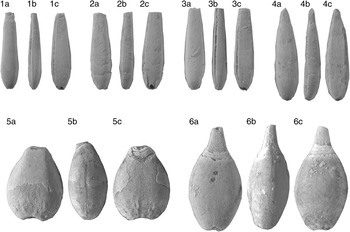
Pumiliobelus n. gen., Gearle Siltstone (Cenomanian), Carnarvon Basin, Western Australia, coated with ammonium chloride sublimate. Each rostrum shown sequentially in dorsal, lateral and ventral views. (1–4)Pumiliobelus haigi sp. nov.; (1a–c) holotype, GSWA F51434; (2a–c), paratype, GSWA F51435; (3a–c) paratype, GSWA F51436; (4a–c) paratype GSWA F51432.X4. (5–6)Pumiliobelus tumidus; (5a–c) paratype, GSWA F51437; (6a–c) holotype, GSWA F51438/1. X5.

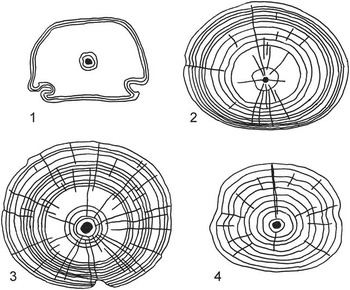
Rostral cross-sections of Pumiliobelus and Dimitobelus depicting growth laminae with domains marked by dark calcite, representing episodes of slow growth, shown as lines. (1)Pumiliobelus haigi n. sp., UWA 2/11/99-16 1, upper Gearle Siltstone (Cenomanian), Carnarvon Basin, Western Australia. X10. (2)Dimitobelus diptychus Whitehouse, JCU F11632, Ranmoor Member, Wallumbilla Formation, northern Eromanga Basin, Queensland. X2. (3)Dimitobelus dayi Doyle, JCU F11623, Wolena Claystone, Laura Basin, Queensland. X2. (4)Dimitobelus diptychus Whitehouse, WAM 91.839, Gearle Siltstone (Cenomanian), Murchison House Station, Carnarvon Basin, Western Australia. X2.

Types and other material
GSWA F51434 (holotype), GSWA F51432, F51433, F51435, F51436 (paratypes), some 74 other specimens, both fragmentary and complete (UWA 2/11/99-16).
Diagnosis
Rostrum diminutive, hastate, asymmetric in profile with the venter almost linear. Transverse sections depressed with a flattened venter. Ventrolateral grooves strongly inscribed for the full length of the rostrum.
Description
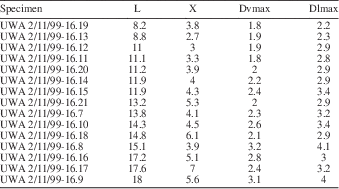
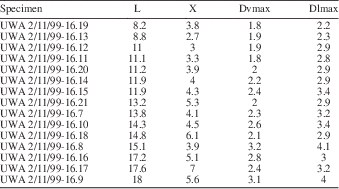
Rostral length less than 20 mm and approximately four times the diameter at the position of greatest inflation (Table 1). Outline symmetrical and hastate; apical surface ranges from obtuse to rounded. Maximum lateral diameter (Dlmax) within the posterior third of the rostrum. Profile asymmetrical with a gently arched dorsum and flattened venter. Apex slightly excentric, dorsally located. Transverse sections depressed (Dlmax/Dvmax 1.3) with the dorsal surface very gently convex, the lateral surfaces gently convex and sloping outwards to the position of maximum cross-sectional diameter near their ventral margin, ventral surface flattened. Ventrolateral grooves are well developed and deeply incised, extending the full length of the rostrum and positioned at the margin of the flattened ventral surface. A small pseudoalveolus is commonly developed obscuring the nature of the alveolus proper. Phragmocone unknown. Apical line centrally placed, and an apical canal is commonly present.
Biometric data for Pumiliobelus haigi new sp. L, length; X, distance from apex to axis of maximum diameter; Dlmax, maximum lateral diameter; Dvmax, maximum dorso-ventral diameter.
Etymology
Named for David Haig, University of Western Australia, who collected the specimens and who has made a major contribution to Australian paleontology.
Occurrence
Upper Gearle Siltstone (Cenomanian), MacDonald’s dam, 24o10'S, 114o29'E.
Discussion
Pumiliobelus haigi resembles Dimitobelus dayi Doyle (Reference Doyle1987) in its hastate outline, obtuse to rounded apex, and depressed rostral cross-section which may show a flattened venter. A small pseudoalveolus is commonly developed similar to that shown by D. dayi. However P. haigi differs in its diminutive size, the asymmetry of its profile, its subquadrate cross-sectional shape and the distinctive, strong ventrolateral grooves that extend the entire length of the rostrum.
Based on the representation of growth laminae as shown on cross-sectional surfaces (Fig. 3.1), thought to represent variation in growth rates reflecting episodes of differing environmental influence on the living animal (Stevens and Clayton, Reference Stevens and Clayton1971), Pumiliobelus haigi appears to have had a relatively short life span. The juvenile central zone of cross sections may show indistinct laminae but otherwise visible lamination is restricted to just a few bands at the periphery. This pattern contrasts with that typically shown by Dimitobelus, including D. dayi, where a more complex pattern of growth laminae, implying a more enduring exposure to environmental cycling, is typical (Fig. 3.2-4),
Pumiliobelus tumidus new species
Types
GSWA F51438/1 (holotype), GSWA F51437, F51438/2, (paratypes).
Diagnosis
Rostrum minute, clavate in outline. Apical and stem regions tumid, alveolar region slender. Transverse section semi-elliptical with a flattened ventral surface. Weak ventrolateral lines extending the full length of the rostrum.
Description
Extremely small in size with rostrum no more than 11mm in length, approximately twice the diameter at the position of maximum inflation (Table 2). Outline is symmetrical and strongly clavate; profile almost symmetrical and clavate. Maximum lateral diameter (Dlmax) positioned just posterior of the mid-length. Apical region bulbous, very obtuse to rounded in outline and profile, stem region very short, tapering anteriorly to a narrow alveolar region. Apex centrally located. Transverse sections depressed (Dlmax/Dvmax 1.5) and semi-oval with the dorsum and flanks rounded, whereas the venter is flattened. Faint ventrolateral lines are positioned just ventral of the midflank and extend from the apex to the alveolus. They are more pronounced in the alveolar region. A very small pseudoalveolus is commonly developed obscuring the form of the alveolus proper. Phragmocone unknown.
Biometric data for Pumiliobelus tumidus new sp. L, length; X, distance from apex to axis of maximum diameter; Dlmax, maximum lateral diameter; Dvmax, maximum dorso-ventral diameter.

Etymology
From the Latin tumidus, which means or refers to swollen.
Occurrence
Gearle Siltstone, Cenomanian, Thiridine Point, Pillawarra Plateau, Carnarvon Basin, 27°36’S, 114°13’E.
Remarks
Although Pumiliobelus tumidus is represented by only three specimens, it is uniquely distinctive. It somewhat resembles P. haigi in the apical and stem regions of the rostrum but the pronounced taper to a narrow alveolar region is unique. Among the Dimitobelidae, only Dimitobelus liveridgei (Etheridge 1982), also of small size, shows a narrow alveolar region but its entire rostrum is slender with an acute apex. Faint ventrolateral lines of P. tumidus contrast with the strong development of their equivalents in P haigi. However, ventrolateral grooves/lines are variably developed across the Dimitobelidae, including within single species, and even on the opposing flanks of individual specimens.
Discussion
Dimitobelus diptychus Whitehouse, Reference Whitehouse1924 co-occurs with Pumiliobelus, being present in collections from both MacDonald’s dam and Thiridine Point. Dimitobelus, most likely represented by D. dyptichus, is distributed throughout the Gearle Siltstone in core from drillhole Boologooro 1 (Williamson et al., Reference Williamson, Henderson, Price and Collerson2012) located some 70 km west of MacDonald’s dam (Fig. 1). Dimitobelus diptychus is a long-lived taxon, widely known from the Albian (eastern and Western Australia, New Zealand, New Guinea, West Antarctica) and the Cenomanian (New Zealand, Western Australia and West Antarctica). When living, this species filled an enduring niche in the shelfal and epeiric seas of Gondwana of those times. In contrast, Pumiliobelus haigi and P. tumidus described here are rare, with each known only from a single locality.
Dwarfism in Pumiliobelus relative to Dimitobelus diptychus, and to the Dimitobelidae in general, is likely to reflect an opportunistic strategy involving a limited life span and rapid population turnover to take short-term advantage of favorable paleoenvironmental conditions. Paedomorphism expressed as size could apply to Pumiliobelus, with derivation of P. haigi from Dimitobelus dayi to which it shows a likeness in miniature. Growth laminae in belemnites reflect episodes of more rapid and slower growth, most likely due to cyclic environmental change in the inhabited water mass (Wierzbowski and Joachimski, Reference Wierzbowski and Joachimski2009), although migratory behavior through differing water masses cannot be ruled out as a potential influence (Stevens and Clayton, Reference Stevens and Clayton1971). The simplicity of growth laminae observed for Pumiliobelus haigi relative to that of Dimitobelus (Fig. 3) is consistent with a shorter life span. Because the cross-sectional growth lines we document for P. haigi (Fig.3.1) are located both adjacent to the axial canal and near the periphery of the rostrum, sectors within the skeletal fabric most prone to diagenetic alteration with the potential loss of the growth laminae record, we consider the simple pattern to be original.
Contemporary squid are considered to be the nearest living relatives to belemnites (Monks et al., Reference Monks, Hardwick and Gale1996; Wierzbowski and Joachimski, Reference Wierzbowski and Joachimski2009) with the two groups closely analogous in form, function, habitat, and development. For squid, warmer ocean temperatures promote populations with faster growth over shorter life spans reaching maturity at a younger stage and at a smaller size (Pecl and Jackson, Reference Pecl and Jackson2008). It could be that the onset of the mid Cretaceous thermal maximum in the Cenomanian, with greatest effect for sea surface temperatures (see Henderson and Price, Reference Henderson and Price2012), influenced the development of dwarfism in Pumiliobelus. Progressive early maturation and size reduction in response to rising temperatures offers a potential evolutionary pathway to paedomorphism, especially if the lineage leading to Pumiliobelus favored a near sea surface range.
Dwarf squid taxa with mantle lengths less than 20 mm are well represented in contemporary seas (Reid and Jereb, Reference Reid and Jereb2005). Rondeletiola of east Atlantic and Mediterranean distribution has a mature mantle length of approximately 10 mm (Czudaj et al., Reference Czudaj, Pereira, Moreno, Saint-Paul and Rosa2013). Idiosepius, widely distributed in the Indo-West-Pacific, is also diminutive. It includes individuals maturing at mantle lengths less than 10 mm, with some of its seven species known to be extremely short-lived with a strategy of maximizing reproductive output (Boletzky et al. Reference Boletzky, Nishiguchi, Nabhitabhata and Nugranad2005) as an opportunistic strategy like that inferred for Pumiliobelus.
In comparison, dwarfism is rare among belemnites. The late Jurassic genus Suebibelus (Riegraf Reference Riegraf1981) from Germany, known only from S. pressuloides, is comparable in size to Pumiliobelus with a rostral length of 7-10 mm. Its rostrum is somewhat tumid and hastate with maximum diameter posterior in position. The similarity in rostral form for Suebibelus and Pumiliobelus suggests that these dwarfs were likely to be similar in body shape with the implication of convergent evolution.
In addition to Australian occurrences, the Dimitobelidae ranged northwards to Papua New Guinea in Albian-Cenomanian time (Challinor, Reference Challinor1990). Only one post-Cenomanian belemnite occurrence in Western Australia has been recorded. Dimitobelus specimens from the Santonian-Campanian Toolonga Calcarenite of the Carnarvon Basin were noted by Doyle (Reference Doyle1988b), based on old collections in the British Museum, but this occurrence awaits confirmation. Belemnite fragments are mentioned by McWhae et al. (Reference McWhae, Playford, Lindner, Glenister and Balme1958) from the Late Cretaceous Molecap Greensand of the Perth Basin. This unit is at least in part Cenomanian in age (Mory et al., Reference Mory, Haig, McLoughlin and Hocking2005).
The post-Cenomanian intervals of both the Carnarvon and Perth Basins are extensively developed and represent shallow marine, shelfal paleoenvironments. Their macrofossil record has commonly been influenced by aragonite dissolution (e.g. Henderson and McNamara Reference Henderson and McNamara1985). However calcitic fossils, particularly inoceramids, are common to prolific in some intervals. The absence of belemnites is noteworthy, and consistent with the conclusion of Doyle (Reference Doyle1988b) that the Dimitobelidae had become restricted to very high southern latitudes by the Campanian-Maastrichtian, based on their occurrence only in New Zealand and West Antarctica. The Bathurst Island Formation developed in the Money Shoals basin at the northern perimeter of Australia contains a richly diverse middle Cenomanian molluscan fauna (Stilwell and Henderson, Reference Stilwell and Henderson2002), but lacks belemnites. Progressive restriction of the Dimitobelidae to high southern latitudes may have been progressive for much of the Late Cretaceous.
Acknowledgments
We are grateful to Martin Kostak and Larisa Doguzhaeva for constructive reviews, which improved the manuscript. This research is based on collections made by David Haig, University of Western Australia, who drew our attention to belemnite occurrences in the Carnarvon Basin and also provided unpublished information on the age of Gearle Siltstone intersected in the construction of MacDonald’s dam. Adella Edwards assisted with the preparation of figures. Arrangements by the Geological Survey of Western Australia to act as the repository of type specimens is gratefully acknowledged, as is the Australian Research Council for supporting grant A39933019.