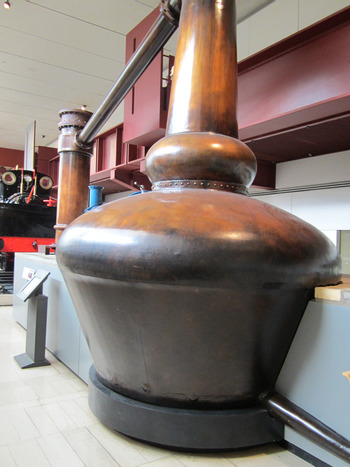


In September 1775, Joseph Foster Barham, an absentee sugar planter, ordered a large still from a London coppersmith, William Forbes, an Aberdonian who had set up business in the capital in 1771.Footnote 1 The still was made from English copper which was mined in Cornwall, coal-smelted in south Wales, and milled in Bristol. After final manufacture in London, the vessel was shipped to Barham's Mesopotamia plantation in Cornwall, Jamaica, and installed in the central factory (Figure 1). Enslaved labourers used the still to convert waste sugar products into rum, an intoxicant, which was sold in both local and export markets throughout the Atlantic world.Footnote 2
A copper still manufactured in Scotland for the Glenfiddich distillery in the 1960s and now on display in National Museums Scotland, Edinburgh. In size and design, it is similar to the vessel produced by Forbes for Barham in 1775.
Source: Photo by author.

Adam Smith deployed the case of ‘that very simple machine’, a shepherd's shears, to demonstrate the variety of labour needed to produce the tools required in the manufacture of a woollen coat, and the positive impact that this had on levels of division of labour, and specialization. In the case of Barham's still, an examination of the work, skills, and materials embodied in its manufacture and use highlights how slave production of rum in the Caribbean was inextricably linked with the increasing complexity of the industrial landscape on the other side of the Atlantic.Footnote 3 Sven Beckert has recently claimed that ‘the connection between slave agriculture in the Americas and manufacturing across Europe’ was ‘the invention of the cotton industry’.Footnote 4 He argued that, unlike cotton, earlier staples did not result in the rise of vast new manufacturing enterprises, did not create new markets for manufactures, and did not lead to an explosion of both slavery and wage labour. In fact, as seen in the life of Barham's still, rum production did all three things and is just one example of how the connection between factory and field was forged long before the rise of Britain's cotton industry. The Caribbean's sugar and rum works were not examples of a precocious modernity separated from a ‘pre-industrial Europe’, as in the ‘heretical’ suggestion offered by Sidney Mintz; rather, from the early days of colonization, they were integrated into a steadily advancing industrial capitalism linking dispersed sites on both sides of the Atlantic.Footnote 5
I
Rum, a distilled liquor, was among the many American novelties, including other intoxicants, which transformed British consumption patterns in the seventeenth and eighteenth centuries. Much has been written about the nature, extent, and chronology of the consumer revolution which shaped both tastes and desires in ways which allowed a new world of goods to be absorbed into everyday lives.Footnote 6 Less interest has been shown in the accompanying producer revolution and the adaptations in skills, techniques, tools, and work practices which not only played a necessary role in getting these goods to market but also helped to power Britain's sustained growth.
Distillation techniques were introduced into Europe in the thirteenth century but base materials were expensive and most production was for medicinal purposes. Large-scale commercial distilling for a recreational market began to develop in the early seventeenth century, with the Dutch leading the way.Footnote 7 At the same time, northern Europeans were introducing sugar cultivation in the eastern Caribbean and, although Frederick Smith has argued that earlier sugar producers limited themselves to making fermented cane drinks, the new producers certainly took the additional leap to distillation, with the Dutch supplying much of the equipment.Footnote 8
Richard Ligon, who visited Barbados in the 1640s, noted that it was standard to have a distillery on every plantation but, in the early years, the product was made from inferior ingredients (mainly sugar skimmings) with small-scale, inefficient equipment, and most of the product was consumed on the island.Footnote 9 Alcohol played an important role in both European and African sociability in the West Indies but imported beverages were expensive, and all classes, both enslaved and free, were quick to develop a taste for rum, which offered a cheaper substitute. The spirit was drunk neat, or in punch based on the increasingly popular concoction introduced from India, in which a spirit was combined with citrus, spices, sugar, and water and served as a focus for communal sociability.Footnote 10
By the late seventeenth century, as rum-makers gained experience, quality improved, with use of more and better molasses, and, although many condemned the product for ‘debauching the morals and debilitating the strength of the common people’, rum found external markets with general encouragement from state fiscal policy which promoted its substitution for foreign beverages, above all brandy.Footnote 11 There are no reliable figures for total rum output in the British Caribbean, but it certainly kept pace with sugar production, and legal exports to England and Wales rose from 1,964 gallons in 1700 to 2,631,220 gallons in 1770, as it was increasingly able to compete with brandy and gin.Footnote 12 There were also large exports to North America, foreign colonies, and Africa, where it was important as a gift to lubricate business, as well as a tradeable commodity. The astonishingly rapid growth made rum increasingly central to plantation revenues and created a strong market for copper equipment, which attracted investment into the industry in Britain.Footnote 13
II
Barham's still was destined for Mesopotamia, one of the largest estates in mid-eighteenth-century Jamaica, with 2,600 acres and an enslaved labour force of 270 workers. Between 1771 and 1775, around 200 acres of canes were harvested each year to produce an annual average of 180 hogsheads of sugar and 124 puncheons of rum, with the latter accounting for around one-third of the estate's revenues.Footnote 14 Some was consumed on the plantation, where it was a regular part of slave rations; some was sold on the island to defray local expenses; and the remainder was sent to England.
Rum production took place throughout the sugar harvest, or ‘crop time’, from late January until June, and continued deep into the summer. It involved fermenting four ingredients: scum from the cauldrons in the sugar boiling house; molasses drained from the sugar in the curing house; dunder, or waste, from previous distillations; and juice from damaged ‘rum canes’. After fermentation in wooden vats, the liquid, known as the wash, was poured into the copper still, a giant container set into a brick furnace, and brought to the boil over a fire. As alcohol has a lower boiling point than water, it separated from the liquid, and was drawn off as gases, which were collected in the still head, brought back to liquid form, passed through a coiled pipe, or worm, cooled with water, and collected in a receiver at the other end. The first distillate was a weak spirit, known as low wine, and it was usual to perform a second distillation to remove more impurities, improve the taste, and increase the alcohol content, or proof, of the final product.Footnote 15
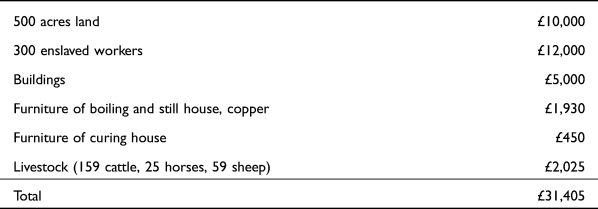
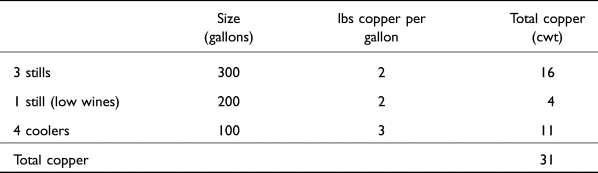
Rum played a central role in the viability of a plantation, both in sustaining the workers and in improving estate revenues. It is fitting that the production site dominated the landscape. In the late 1770s, the distillery at Mesopotamia, constructed from estate stone and timber, with arched door and windows, was the biggest building in the works complex, measuring 78 feet in length, and 34 feet in breadth. It dwarfed the adjacent overseer's house (32 feet by 28 feet) provided for the supervisory staff. The largest section of the distillery (34 feet square) contained eighteen wooden vats, sunk in deep clay, in which the sugar waste products were fermented for nine or ten days. In the adjacent tiled section (44 feet by 16 feet), three huge copper stills were set into a brick furnace, with one chimney for the largest still of 1,000 gallons, ordered from Forbes in 1775, and a double chimney for two smaller stills containing around 500 gallons apiece, and further space for a number of copper cooling cisterns.Footnote 16 Over 2 tons of copper plant in the Mesopotamia still house made an impressive sight and, as in other plantations, accounted for a large proportion of the capital value of the estate (see Tables 1 and 2).
Capital valuation of a plantation of 500 acres in 1755

Source: Belgrove, Treatise upon husbandry.
Schedule of a still house on a plantation of 500 acres in 1755

Source: Belgrove, Treatise upon husbandry.
Although they have grown in size, the basic design of pot stills, which stood at the centre of the rum production process, has changed little over the centuries. The lower part, or body, holds the wash to be boiled and resembles a round cauldron with a special domed bottom (curved inwards) to suit the technical specifics of firing. The design of the upper part, the still head, where the vapours are condensed, has undergone more variation as it affects the evaporation, flow, and taste of the liquid and so determines the efficiency of the process, and the character of the distillate, as does the shape, angle, and size of the pipe leading to the condenser.Footnote 17 Small-scale distillers often used glass and ceramic equipment, but larger production called for materials which were more durable, lighter weight, and more rapidly responsive to changes in heat, all of which encouraged the use of metals. Copper was the preferred choice because, although it was expensive, costing twice as much as iron, it was malleable and could be worked into fine shapes, and, crucially, it had very high conductivity. Rum distilling, like the linked sugar boiling, required even application of very great levels of heat, and any loss of control ended in spoilage. If the still overheated, the wash might burn to a crust in the bottom, or the whole liquid might boil over, taking both the desired alcohol and the other, undesired, elements into the still head together, down through the cooling worm, and into the can intended for the alcohol. This was not only costly in terms of wasted time and materials but also dangerous, as the hot liquor could be set alight. As Ambrose Cooper warned, ‘for an artist to lose his time, his labour, and his goods, is no small matter; but it follows from what we have promised that both his life and fortune are in danger from these conflagrations’.Footnote 18
In the British Caribbean, rum-making was largely in the hands of enslaved men and, as reflected in the value placed on them in inventories, the work required special skills and training, although less than was needed by building craftsmen.Footnote 19 Thomas Thistlewood, overseer of a Westmoreland plantation in the neighbourhood of Mesopotamia, was dismissive of claims of ‘a mighty mystery in the art’ of distillation.Footnote 20 He claimed that it could be learned in three weeks, and this is borne out by similar comments made by R. Campbell in his discussion of distilling in London, where he said that ‘it is not very common to take apprentices – nor does distilling require much ingenuity’.Footnote 21
Nonetheless, although it was broadly agreed that distilling did not need much in the way of formal ‘book training’, Richard Beckford, Thistlewood's employer, stressed the need for both innate attributes and learned skills in the rum house, and slow turnover among distillers in Mesopotamia's slave returns highlights the importance of specialization and experience in rum-making.Footnote 22 In 1775, two distillers, both Africans, were listed: Primus, aged sixty, noted as ‘infirm’, worked as a rum-maker from the 1740s until the 1780s; Augustus, aged thirty-six, held the job from 1762 until 1804, when he became a watchman.Footnote 23 Unfortunately, the estate's slave returns do not provide valuations on a regular basis, but Primus was rated as worth £100 in 1756, well above the average of £42 16s, and was one of the two most valuable of the 268 workers on the plantation. In an inventory of Barham's Island estate in 1778, with 175 workers, the four distillers were priced at an average of £73 15s, which was above the average valuation of £62 14s, although not in the top quartile, in which thirty-two of the enslaved were valued at more than £80, including sixteen women.Footnote 24 The enslaved distillers worked under the supervision of the senior book-keeper, designated ‘inspector of the still house’, but rapid turnover in this position suggests that the holders had little knowledge of distilling. The overseer's main task was to maintain discipline in the still house, above all keeping the workers awake late into the night, and minimizing embezzlement, which was always seen as a serious problem in the rum factory.Footnote 25
While experienced planters such as Samuel Martin, author of a manual, described the art of rum-making as lacking ‘self-evident principles’ which could be learned from books, it depended heavily on rules of thumb and tacit skills involving expert use of head and hand, and acutely trained senses of sight, hearing, taste, and smell.Footnote 26 In the first stages of processing, Augustus and Primus needed to know how to adjust the proportion of ingredients in the wash in response to fermentation results, shortage or glut of ingredients, and beliefs about what additives made the rum taste better, no doubt drawing on their own preferences and their African heritage.Footnote 27 As the enslaved on the plantation consumed estate rum on regular occasions (especially the distillers), it can be assumed that their own tastes mattered and affected the final product. They needed further skill in agitating the wash, monitoring the fermentation process over nine days or so, and recognizing the change in sound when it was over.
During distillation, the two furnaces needed careful attention and skill to regulate the fire and prevent accidents. Joints in equipment had to be kept sealed to prevent leakage. The worm tub needed to be kept full of water and the liquor to be drawn off at the correct moment. Finally, there was an increasing emphasis on cleanliness, with planters exhorted to ensure that ‘the cisterns [are] cleaned and scaled every time the liquor is drawn out and the bottom of the stills must be frequently scoured as well as the worms’, as any neglect of such tasks adversely affected the flavour of the rum.Footnote 28 Smiths like Forbes supplied pumps for cleaning the equipment but, nonetheless, it was a challenging task which required ingenuity. In 1754, Thistlewood reported that a blockage in a worm had halted production. On advice from a local coppersmith, he turned the worm upside down, and poured in boiling water. ‘[I] then used a stick with cotton wrapped round it to force on ye water, in imitation of a syringe, by which a blowing forced out a large piece of rag, cow dung etc.’ He added that regular cleaning involved ‘burning the worms as many times round as they had turns (laid upon planks of wood lengthways)’.Footnote 29
Work in the still house was not only skilled but also physically demanding. The noxious odours of the fermenting wash, and the extreme heat of the furnace fires, created unpleasant conditions. On visiting a plantation in 1802, Lady Nugent, the governor's wife, was delighted by her view of sugar-making, which she found very ‘curious and entertaining’, although she did express some concern about the safety of the workers. By contrast, she could not suffer more than a minute in the still house, as the smell of the dunder, ‘as it is called’, made her feel sick.Footnote 30 It was perhaps on account of the unpleasant nature of the work, or perhaps because Africans had special skills with fire, that both of Mesopotamia's distillers in the 1770s were Africans.Footnote 31
While the quantity and quality of Mesopotamia's rum production was heavily dependent on the skill and experience of the estate's enslaved artisans, it relied on the outside world for the supply and maintenance of the necessary tools, which called for a large capital outlay. According to William Belgrove's treatise of 1755, a sugar works in an estate such as Mesopotamia required expenditure of £1 on copper tools for every £6 spent on enslaved labour, and around one-third of the equipment was installed in the distillery (Table 1).Footnote 32 Barham paid £400 for the large still and pewter worm ordered from Forbes in 1775, which was a massive cost for a plantation that made a disappointing profit of £956 in the previous year, and an annual average profit of £2,538 in the more prosperous three years before.Footnote 33
Jamaica's strong market for copper attracted specialist smiths to the island. In 1773, a survey of St James's parish listed three coppersmiths to serve its sixty-seven sugar estates.Footnote 34 Mesopotamia drew on a local building firm, owned by Alex Wilson, to undertake the installation and maintenance of the distilling equipment, and the estate journals of the 1770s record regular copper repairs at an annual average cost of £20 for the still house alone. However, heavy wear during an annual production cycle of six months or more ensured that the vessels seldom lasted above ten years, and plantation records suggest an annual replacement rate of 10–20 per cent.Footnote 35 Despite the buoyant demand, evidence of a limited internal market for second-hand copper supports the notion that few local smiths had the capital or skills to make the leap from jobbing work to primary production.Footnote 36 Despite the high transactions costs of shipping bulky industrial plant, the sugar plantations conformed to mercantilist ideals and, with the help of protection from the Navigation Acts, their factories were heavily dependent on English producers for the supply of machines and tools, with the rum distilleries alone creating a substantial part of the demand.
Supposing that each of the 1,400 or so sugar plantations in the British Caribbean in 1774 had a distillery, housing copper equipment weighing 20 hundredweight (half the weight at Mesopotamia), it would suggest a fixed stock of at least 1,400 tons and an annual replacement rate of 140 tons.Footnote 37 In addition, there were 140 distilleries in North America, and a small number in Britain's trading posts in India and Africa.Footnote 38 These dispersed producers sent a very high proportion of their output (about 70 per cent) to London, and the capital also dominated home distilling, with Forbes listing sixty-three distilleries in 1776.Footnote 39 Given the concentration in the rum market, it is not surprising that the supporting industries were also focused on London. England and Wales's wrought copper exports (including stills), increased from 1,636 hundredweight in 1700 to 32,314 hundredweight in 1775, with over 70 per cent shipped out of London. Most was absorbed by the increasingly important sugar plantation complex: in the 1760s, the Caribbean took more than 50 per cent; North America, with a large rum distilling industry, took 10–20 per cent; Iberian America took 10 per cent, and Africa took around 5 per cent in payment for enslaved people destined to work in the sugar plantations.Footnote 40
III
London's large concentrated market for copper capital goods, including distilling equipment, encouraged the development of a specialized copper-smithing industry in the city, focused on production of large vessels, and promoted a national division of labour in the hinterland. The long supply chain which furnished the metal displayed very high levels of regional and functional specialization.Footnote 41 Until the rise of the Anglesey mines in the mid-1770s, almost all the raw copper came from Cornwall, where the expansion of the export market encouraged investment, and output of ore grew from little or nothing in the 1670s, to an annual average of 26,427 tons by the 1770s.Footnote 42 By that time, there were around ninety mines in the county, providing direct employment for at least 7,500 people (of whom around one-third were women and children), and large numbers of the latest steam engines to drain workings at great depths.Footnote 43 Production was concentrated in about twenty ‘great mines’ which each employed very large capital resources and hundreds of workers with a strong division of labour. As Cornwall lacked fuel reserves, most of the ore was smelted outside the county and, by the 1770s, the large, capital-intensive refineries were heavily concentrated in south Wales, where external investors took advantage of its convenient sea access to Cornwall and abundant coal reserves, which began to be exploited on a large scale.Footnote 44 The refined metal was often milled and manufactured in closer proximity to final markets and, after this third stage of production, copper plates, sheets, and bars were despatched to the brasiers and coppersmiths, including Forbes, to be converted into a final product.
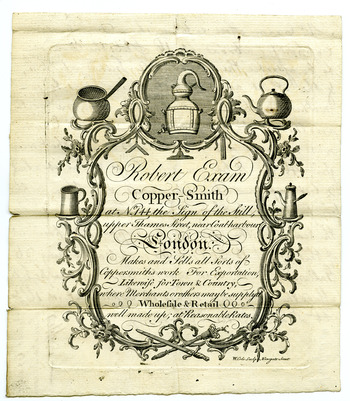
Brasiers and coppersmiths shared common skills and, in London, they were regulated by the same company, the Armourers and Brasiers, which maintained rights of search until 1769.Footnote 45 However, as noted by Campbell, the London market was big enough to support a division of labour, with smaller domestic items, such as coffee pots and pans, being largely the work of brasiers, while the coppersmiths focused on the ‘most laborious’ and extremely noisy production of ‘all manner of large vessels’. Stills were central to their product range, as seen in trade cards (Figure 2); in fact, Campbell placed his discussion of coppersmiths in the section on distilling.Footnote 46
Trade card of Robert Exam, coppersmith.
Source: Falkirk Archives, Forbes papers, A727.1412.

On moving from Aberdeen in 1771, Forbes joined a very small group of specialist coppersmiths in the capital. A directory of 1774 lists four other firms: William Cave in Smithfield; George Crew in Houndsditch; Robert Exam in Bread Street Hill; and William Thoyse in Whitechapel. In addition, two men combined the coppersmith's and brasier's trades: Thomas Pickles in Piccadilly and Arthur Scaife in Gracechurch Street. There were also twelve brasiers.Footnote 47 Forbes paid £35 to take freedom of the Armourers and Brasiers Company and was allowed to set up business in the City, where he rented a house at 62 Upper Thames Street, adjacent to the river, at Queenhithe Dock, with good connections to markets and part of an industrial landscape which included a cluster of seven sugar refineries, two distilleries, and other metal-working shops in the same street.Footnote 48 With living quarters above, Forbes's workshop extended across the entire ground floor of his rented house with three rooms: the smith's shop, the middle shop, and the back shop. According to an inventory taken in 1775, there was one forge in the smith's shop and two in the back shop, and tools valued at just over £200, including a large number of hammers, vices, anvils, five furnaces with doors, four pairs of bellows, five cranes, and hanging equipment. The stock, including raw materials and parts of stills, in various stages of completion, was valued at £1,153.Footnote 49 The ‘free’ waged labour force, which numbered between three and fourteen men, according to the state of the order book, was employed by the quarter-day (three hours), and worked from six in the morning until six in the evening in crowded, dirty, hot, exceptionally noisy, unpleasant conditions.Footnote 50
On first entry to the London trade, Forbes relied heavily on subcontracting and repair work but he quickly built up his own customer base, including a large overseas clientele with a West Indian focus. The firm's order books show that he produced at least forty-three stills and heads between January 1773 and June 1775, and a further twenty-four stills and heads (including Barham's order for Mesopotamia) between September 1775 and September 1776, alongside sugar coppers, pumps, pipes, cocks, funnels, and other utensils for customers in Jamaica, Antigua, Barbados, Dominica, Grenada, and Tobago in the Caribbean, as well as three stills for India, and one for Bance Island in Africa.Footnote 51
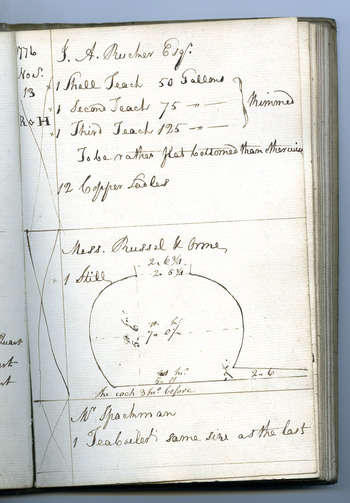
Each still made in the workshop was a bespoke item produced to individual specifications provided in written instructions with varying levels of detail. In some cases, the customer supplied drawings, as in the example from Messrs Russel and Orme (Figure 3). On the other hand, Barham's order for Mesopotamia in September 1775 provided little beyond the requirement of a capacity above 1,000 gallons, a monster still, and a request that the work should be executed with ‘care and dispatch’.Footnote 52 As a result, the London smiths exercised considerable discretion in the design of the stills and directly influenced the character and quality of the final rum, although the liquor was produced on the other side of the Atlantic.
Drawing of a still ordered from Forbes in 1776.
Source: Falkirk Archives, Forbes papers, A727.1443.

Barham was moving with the times in ordering a large still in 1775. In a period of rising slave prices, planters were interested in economizing on labour costs, and a big still employed no more workers than a small one. There were also fuel savings. A typical plantation of the 1650s had two stills containing less than 100 gallons, whereas Belgrove's schedule suggests that, by the 1750s, it was usual to have three stills containing about 300 gallons apiece (Table 2).Footnote 53 Scale further increased and, by the 1770s, large plantations like Mesopotamia were installing stills containing above 1,000 gallons for low wines, requiring over a ton of copper, alongside two smaller stills. Forbes claimed that it required more ingenuity to produce larger stills and, perhaps as a result, Barham reported a general complaint from Jamaica that standards of metal workmanship were deteriorating. This affected, above all, the fineness of the copper. Thicker vessels were less responsive to heat and made it harder to produce high-quality rum.Footnote 54 They were also more expensive, as the smiths charged by weight rather than by time. Forbes acknowledged that the smiths were challenged by plantation demands but claimed to have found ways to maintain quality, and he charged a higher rate for bigger vessels to compensate for additional effort (in 1775 he quoted 16d per pound for stills above 20 hundredweight and 15d for smaller ones).Footnote 55
Increasing scale, and quality considerations, encouraged some experimentation with the design of stills. Forbes altered the shapes and sizes of the still heads, affecting the character of the product, and varied the size and positioning of pipes and cocks, affecting the efficiency of the production process, and he exchanged information about best practice with merchants, planters, and distillers throughout the Atlantic world. Wrongly sized and poorly fitted pipes caused ‘a great deal of spirit to be lost’, besides a ‘great expense of fuel and time’, and affected performance and profits in the distillery.Footnote 56 However, more mundane concerns also influenced design. Barham's large still, with 1,000-gallon capacity, was intended for shipment on Captain White's Dorothy and Forbes was obliged to adjust the shape to ensure it would fit through the ship's hatch, measuring 6 by 7 feet.Footnote 57
After receipt of an order, Forbes used his coppersmith's experience and the associated problem-solving skills to produce a paper pattern for the still bottom, sides, and head, for which he also needed good drawing skills.Footnote 58 The pattern was then sent to a copper manufacturer. Forbes gave the business of Barham's still to his main supplier, Thomas Freeman and Company of Bristol, a long-established firm which owned the White Rock smelting works in Swansea and four or five refining, rolling, and battery establishments in their own area, including one which specialized in parts for stills.Footnote 59 After manufacture, and delivery to the Swan Inn in Holborn by Wiltshire's weekly wagon, a journey of seven days, the plates were assembled in Forbes's workshop under his close supervision.
Forbes was producing on a scale which allowed considerable division of labour: the wage books group the workforce as coppersmiths, brasiers, blacksmiths, and founders. The plates were first double-planished, or hammered, all over, to render the copper dense and firm, with one man working on the lower part of the still and another on the upper part. Given the large size of the plates, this work produced an almost deafening ringing and clanging, making the coppersmiths ‘very noisy neighbours’.Footnote 60 After hammering, the plates were fastened together by overlapping the edges, making holes, passing a rivet through them, and afterwards hammering down. Any leakage at the seams when the still was in use caused serious problems, not only with wastage but also with danger of fire.Footnote 61 Forbes advertised that in his workshop the holes were cut with an engine, of his own devising, ‘to make the holes to a standard size and reduce the risk of leakage’, an example of the efficiencies gained through narrow specialization and also an example of his problem-solving, mechanical skills.Footnote 62 He also boasted that all his nails were forged in-house (although his records show that, as he expanded, he did often subcontract the task) and that they were then riveted hot, or ‘brased’, which further prevented leakage at the seams.Footnote 63 Cocks, pipes, and collars were cast by founders and forged in-house, although, as with the nails, this work was at times subcontracted. Each still passed through many hands in the workshop and different levels of skill were reflected in widely varied rates of pay, ranging from 2s 6d to 5s a day according to the type of work and the individual's reputation; the nail-makers were often paid by the piece.Footnote 64
Despite his dependence on a highly skilled labour force, with deeply embedded knowledge, Forbes did not invest in formal training, although shared surnames in the wage books raise the possibility of fathers training sons in the shop. While his competitors took on a steady stream of apprentices, Forbes had none apart from his own younger brother Robert, who was bound for seven years in 1771, at the age of fourteen.Footnote 65 Furthermore, he resisted requests to provide informal training: in 1776, Barham asked him to help a young ‘genius’ about to be sent to Mesopotamia as a Moravian missionary to take Christianity ‘among the poor negroes’. Barham pleaded that the man might ‘work for a few months among your people that he might acquire the “jobbing” skills to “maintain himself by his hands” and be useful to himself and my estate too in mending the coppers’. Although Barham insisted that ‘neither you nor your people can lose any benefit by such a little assistance’, Forbes was adamant in refusing to take him on and claimed that his men were firm in defending their ‘mystery’.Footnote 66 The decision might have been more to do with Forbes's general focus on minimizing labour costs. As noted above, workers were hired, and paid, by the quarter-day according to the demands in his order book.Footnote 67 When bad weather or a trade downturn affected business, he had no hesitation in shedding workers, and he drove hard bargains on piece rates. None of the waged men lived with the family in Thames Street, and management roles were reserved for Forbes's siblings with a second brother, David, joining William and Robert in London in 1772.
After completion in Forbes's workshop, items were often inspected by the owner or his agent but, in many cases, this was not convenient and goods were despatched on trust, as with Barham's still in 1775. Captain White, the intended carrier of this item took in a full loading before Forbes's work was completed and so it was left behind. Forbes spent weeks finding a replacement ship with a large enough hatch to stow the massive vessel.Footnote 68 It was finally taken aboard Captain Richardson's Henry in December 1775, along with a swan neck and worm, at a freight charge of £19 10s, or 5 per cent of the value of the equipment. Such a large item required very careful packing in a box with strong stays, to keep it secure during the long journey, reaching Savanna-la-Mar in May 1776.Footnote 69 After unloading, it was taken by wagon on five miles of road, for delivery to Mesopotamia.Footnote 70
Barham's still arrived without mishap but, after the delays, it was too late for crop time in 1776. Furthermore, as was often the case with these bespoke, individually hand-crafted items, problems emerged only at the installation stage and, unlike in an English distillery, the manufacturer was not on hand to fix them. Barham's Jamaican agent complained that the worm was too large for the still, but Forbes was able to fob him off with excuses and Mesopotamia's local coppersmith had to adjust the fittings as best he could. Frequent discontent with poor-quality work, and failure to comply with directions, highlight the problems of long-distance supply, and no doubt exerted pressure to obtain more standardization between parts and reduce transaction costs. Buyer discontent also suggests a seller's market in a mercantilist world with little foreign competition. In 1779, another customer complained about a still which was ‘6 inches wider in the bulge than our order’ and which ‘could not be got into the [still] house without pulling down a wall’. Furthermore, the small end of the worm was pointed ‘very contrary to what was so clearly pointed out in our order both by word and diagram’. The exasperated customer estimated that Forbes's mistakes would cost him £60 but he also revealed that Forbes was a repeat offender: ‘Can you believe it, this very Mr Forbes served us the same way in a large still he made for us before.’Footnote 71 With imperial protection, Forbes was able to take great personal advantage from the opportunities presented by the promotion of a particularly concentrated form of agro-industrial production on appropriated New World lands, using enslaved African labour, and the rise of a sheltered market for copper. Like other winners discussed in Eric Williams's Capitalism and slavery, he used the slave plantation system to build up a flourishing business from which he went on to accumulate a fortune.Footnote 72
IV
Historians have noted the rising consumption of rum in eighteenth-century Britain and the mixed responses: condemnation for ‘debauching the morals’ of the workers, both enslaved and free, was mixed with praise for providing a substitute for foreign liquors and a convenient source of tax revenues. However, as seen in the capital, labour, and skills embodied in the copper stills used at Mesopotamia, rum production was also important in creating employment for thousands of people in a circular supply chain linking Cornish miners, Welsh smelters, and London smiths with enslaved workers in the fields and factories of the Caribbean and back again. At each turn of this wheel of commerce, increased specialization encouraged investments in improvements in skills, tools, and techniques to create an increasingly sophisticated and interconnected world. The character, flavour, and price of a glass of rum was the product of collaborative effort expended on both sides of the Atlantic Ocean. Sugar plantations were not isolated sites of precocious industrial modernity, as suggested by Mintz, but inextricably linked into the long, slow industrial revolution which gathered pace in Britain in the late seventeenth century and gave rise to sustained economic growth into the modern era.Footnote 73
Acknowledgements
This article forms part of Intoxicants and early modern European globalization: spaces, practices, material culture, a special issue resulting from a workshop series, held in 2017 at the Victoria and Albert Museum and in 2018 at the Beinecke Library, Yale University.
Funding Statement
The workshop series at the Victoria and Albert Museum was funded by the ESRC ‘Intoxicants & Early Modernity Project’.