Introducing an Evolution of Terms
The concept of environmental education became prominent in the late 1960s following the UNESCO Biosphere Conference in Paris. During the next decade, the goals and aims of environmental education were identified in the Belgrade Charter (United Nations Environment Program [UNEP], 1976) and the Tbilisi Declaration (Tbilisi Declaration, Reference Declaration1977) respectively. It was Agenda 21 (United Nations, Reference Nations1987) that introduced the terms sustainable development and education for sustainable development (ESD) into school curricula across the globe. There was a presumed link between environmental education, public awareness of the environment, and sustainable development (Holt & Barkemeyer, Reference Holt and Barkemeyer2012).
According to Sauvé (Reference Sauvé2005, p. 29), ‘the ideology of sustainable development gradually penetrated the environmental education movement and asserted itself as a dominant perspective’. The Brundlandt Report (World Commission on Environment and Development [WCED], 1987) defined sustainable development as referring to reconciling the needs of the present human generation with the ability of the future generations to meet their own needs. While the goal of The Belgrade Charter emphasised a need ‘to work individually and collectively toward solutions of current problems and the prevention of new ones’ (UNEP, 1976), thus implying the need to protect the natural world from human activities, Agenda 21 (United Nations, Reference Nations1987) suggested that a balance must be found between addressing the needs of the environment and those of humankind.
The transforming of environmental education into ESD involved the highlighting of environmental problems, as well as highlighting the integrated relationships with a focus on human development, and especially on global economic growth. This was a time when ‘the science-oriented styles of education were aimed at promoting awareness of environmental problems and the scientific or technical solutions for them, based on the assumption that when students are taught about these issues they will learn to care about and protect the environment’ (Kopnina, Reference Kopnina2014, p. 75). Dietz, Fitzgerald, and Shwom (Reference Dietz, Fitzgerald and Shwom2005) inform us that the 1970s was a time when the emphasis focused on clarifying values through personal experience. Fieldwork was advocated and typically explored local level environmental issues: ‘Approaches included a community of partners including pupils, students, teachers, non-governmental organizations, politicians: all working together to identify and resolve socioecological problems; and social learning towards a sustainable world’ (Kopnina, Reference Kopnina2014, p. 76). According to Kopina (Reference Kopnina2014), distinctions needed to be made concerning environmental education in, about, and for the environment. Education for the environment was the precursor of ESD, although the term Education for Sustainability (EfS) soon became the preferred slogan. Education for the environment brought a critical theorisation to environmental education, making it more political and anti-hegemonic and helping to balance its ‘Western’ perspective.
Since the turn of the current century, environmental education (EE) has been both compared with, and even equated to, EfS. The outline of EE and EfS pedagogies often overlap in environmental education literature, including the specification of student-centred learning, minds-on and hands-on learning, and active participation (Eilam & Trop, 2010). There is a strong pedagogical emphasis within both that favour inquiry-based practices (Kidman & Casinader, Reference Kidman and Casinader2017). Clearly, there have been changes over time in the language and discourse of EE, ESD, EfS, and sustainability education (or other variations emphasising sustainable societies or futures as the central goal). While there has been fluidity in the terminology used in the field, there is a consistent recommendation that the preferred educational delivery should be through an ‘integrated interdisciplinary curriculum’. We contest this from the view that environmental and sustainability education is best considered from interdisciplinary perspectives, and not simply as an interdisciplinary curriculum; that is, it requires a focus on the inherent integration of attitudes from disciplinary perspectives, and not just the integration of content. We believe that there is a misunderstanding around the nature of the term interdisciplinary when used in relation to environmental and sustainability education, and it this notion that is explored in this article. In doing so, the further intention of this discussion is to initiate a conversation around the case for fieldwork and Geography in the area of sustainability education.
Perceptions of Sustainability Education
The notion of sustainability is, according to Firth and Winter (2011), one of the most dominant and lasting legacies of the 20th century. However, the context for the emergence of the notion of sustainability was one much broader than the environmental context in which it now often perceived. Its initial construction was from within the perspective of ‘sustainable development’, the genesis of which dates back to the writings of researchers such as John Passmore in the early 1970s (Passmore, Reference Passmore1974), who wrote about the duty of stewardship to the Earth. These years marked a time that also saw the staging of the ‘first major international conference dedicated to the environmental crisis, the 1972 United Nations Conference on the Human Environment in Stockholm’ (Dyment, Hill, & Emery, Reference Dyment, Hill and Emery2015, p. 1106). For many, the next big step forward came with the 1992 Earth Summit in Rio de Janeiro (Dyment et al., Reference Dyment, Hill and Emery2015), but it can be argued that a far more significant milestone was reached earlier with what can be seen as the seminal conference in this area. The outcome of this global gathering was the 1987 Brundlandt Report of the World Commission on Environment and Development, more commonly known under its published title, Our Common Future (WCED, 1987). The importance of the WCED lay in the context in which it saw the environment, because it has fundamental implications for how EfS is conceived, constructed, and implemented in the current day; in short, the environment was seen as an integral part of human existence and not some entity that was related, yet divorced, from it.
This international push for a holistic conception of sustainability education has been reiterated at various points over the last three decades, and has also been reflected in a policy preference for EfS and ESD to be taught through an integrated interdisciplinary curriculum rather than any one particular subject discipline (United Nations Educational, Scientific and Cultural Organization [UNESCO], 2004). Such positions have been reflected in 21st-century national curriculum frameworks such as the Australian Curriculum, which will be explored in more depth later in this article. In other countries, they have been a source of discontent and debate. In the early 2000s, the UK's national curriculum included seven ‘cross-curricular dimensions’, one of which was ‘Global dimensions and sustainable development’ (Savage, Reference Savage2011). Concern was expressed at the time that, in spite of this policy and theoretical endorsement of an interdisciplinary approach, its implementation in practice was problematic for schools in the United Kingdom, largely because of lack of ‘institutional policy initiatives’ (Summers, Childs & Corney, Reference Summers, Childs and Corney2005, p. 634).
In concert with these shifts, another of the trends of the 21st century — and a deleterious one from the authors’ point of view — is that sustainability education has become largely divorced from its developmental context in practice and is now seen largely from the perspective of the natural environment. In the United Kingdom, a survey in the late 1990s by a local government authority of 29 schools in Oxfordshire revealed that 86% of schools dealt with environmental issues related to ESD in Science, but only 8–10% of these Science classes also addressed related issues of social equity and economic prosperity in the same classes (Summers et al., Reference Summers, Childs and Corney2005, p. 628). By 2003, a study of how ESD was taught in 22 UK schools illustrated that it was largely confined to Geography and Science as isolated subjects (Summers et al., Reference Summers, Childs and Corney2005, p. 633). More significantly, perhaps, it was geography teachers who felt better equipped to teach sustainability (79% as against 14% of science teachers), with the latter expressing concerns primarily about lack of knowledge (Summers et al., Reference Summers, Childs and Corney2005, p. 640). Such patterns of teacher attitude have been also reflected elsewhere:
Many science teachers are . . . ‘disciplinary chauvinists’ who place a higher priority on teaching content from their own disciplinary specialisation rather than engage the interdisciplinary or cross-disciplinary demands of environmental science. . . . the question remains as to whether science teachers understand environmental education as environmental educators understand it. Those who control the science curriculum appear to have only a very superficial understanding of environmental education and their representations of environmental education for science educators reinforce the view that science is a limited vehicle for environmental education within the curriculum. (Gough, Reference Gough2008, p. 41)
Similar disconnects between sustainability in overarching curriculum policy and its degree of reflection in school practice will be discussed later in this article in relation to the Australian Curriculum.
The ultimate outcome of this dichotomy between theory/policy and practice is that common notions around the concept of environmental and sustainability education tend to revolve more around its ecological context, framed within the values and principles that the world's natural environments, along with their associated resources, need to be used and managed in such a way as to make them available for future generations. Indeed, Fuller (Reference Fuller2010) has argued that this tendency to see sustainability in all things environmental without rigorous thought reflected ‘little more than accommodation to popular environmental consciousness, rather than part of an overall plan to provide genuine leadership towards sustainability’ (p. 8). For Huckle (Reference Huckle1991), the notion of sustainability in such a context was a political solution of the time: ‘. . . the concept of ecological sustainability was rediscovered and adopted as a mediating term to bridge the ideological and political differences between the environment and development lobbies’ (p. 45).
In light of this particular emphasis in definition, and since school education has been seen as the ‘critical tool in the transformation towards sustainability’ (Firth & Winter, Reference Firth and Winter2014, p. 600), educational approaches in environmental education that emphasise this prevailing notion of sustainability have tended to be more scientific in nature, revolving around an understanding of the mutual dependence between the four spheres of the natural environment: the biosphere, atmosphere, hydrosphere, and lithosphere. Consequently, pedagogical approaches in environmental education that follow this intellectual thread tend to adopt a standard scientific approach to inquiry-based learning, in which laboratory-sited experimental learning has priority (Kidman & Casinader, Reference Kidman and Casinader2017). Field-based inquiry in science tends to be similarly more narrowly focused on the testing of known hypotheses as part of a goal of objective investigation and treated as a ‘military’ phenomenon that is primarily concerned with the systematic, precise and measured study of a particular site, in which the gathering of information is controlled and managed at every stage (Nielsen, Harbsmeier, & Ries, Reference Nielsen, Harbsmeier, Ries, Nielsen, Harbsmeier and Ries2012).
While the importance of the natural systems components of sustainability cannot be ignored, an over-emphasis on the sustainability of the natural environment has tended to displace other inherent facets within the sustainability concept and, in particular, the actuality that any discussion as to the sustainable use of natural environments must incorporate knowledge and understanding of the way people interact with these environments. In short, sustainability is a far more complex beast: ‘a multi-dimensional process [that] embraces concepts such as political freedom and social justice’ (Fuller, Reference Fuller2010, p. 8). Such debates are not new; the 1987 WCED Conference was caught up in the same tensions between a purely environmental approach and one that incorporated ideas of development. The latter prevailed because of the realisation by the majority of participants that the ‘environment does not exist as a sphere separate from human actions, ambitions, and needs, and attempts to defend it in isolation from human concerns have given the very word “environment” a connotation of naivety in some political circles’ (Brundtland, Reference Brundtland1987, p. xi).
Further confusion has been added to the mélange of opinion by debates and assumptions about the meaning of the term ‘environment’ itself (Buchanan, Reference Buchanan2012). In more recent times, and as highlighted by Taylor, Littledyke, and Eames (Reference Taylor, Littledyke, Eames, Littledyke, Taylor and Eames2009), who saw the environment as the fundamental basis for human existence, early attempts to restrict education to teaching about the natural world were largely unsuccessful because it was largely ‘passive’. Instead, what was needed was a ‘more “socially critical” form, [one] that required students to question some of the actions of society that led to environmental degradation, and engage in positive action for the environment themselves’ (p. 3).
Educating for Sustainability
To achieve that deeper understanding about sustainability requires, therefore, a disciplinary approach that encompasses the essentiality of the people-environment interaction to sustainability. It is our contention, however, that it is not only the disciplinary approach that is important; it is also that interdisciplinary perspectives from within a discipline are key. At a time where the rate of global urbanisation has passed the 50% tipping point, it is imperative that the notion of sustainability must be always discussed in the context of the human environment, as much as the natural or physical environment; the future of human existence is inevitably equally bound up with our ability to manage the evolution of these constructed ‘biomes’. Educationally, therefore, effective student engagement in sustainability requires a pedagogy that promotes student evidence-based self-reflection, parameters that coalesce into an inquiry-based learning and teaching approach.
Consequently, it is our contention that the disciplinary approach of Geography, with an emphasis on the place-based utilisation of its conception of inquiry-teaching and learning, provides a far more powerful means of developing an effective environmental and sustainability education than does Science, as it is more cogniscent of the deeper aspects of the sustainability concept. With explicit aims of integrating environmental, social and economic dimensions, sustainability draws heavily from the foundational discipline of Geography, while being defined ‘more by the problems it addresses rather than the disciplines it employs’ (O'Byrne, Dripps, & Nicholas, Reference O'Byrne, Dripps and Nicholas2015). Furthermore, geographical fieldwork, with its focus on ‘the acquisition of deep and intimate knowledge of the land, or site, under investigation’ (Kidman & Casinader, Reference Kidman and Casinader2017), and in its wider conceptualisation of fieldwork as a dynamic, all-encompassing form of inquiry learning, enables a better understanding of the transformation or development of a landscape as modified by people; that is, the very interaction that is the core of the concept of sustainability. The need to create an interdisciplinary learning environment (through interdisciplinary curriculum) is questionable, as Geography, through its disciplinary nature, is an integrator of the physical and human environments within a place, both in concept and in practice; that is, Geography views the connections between natural and human systems from interdisciplinary perspectives.
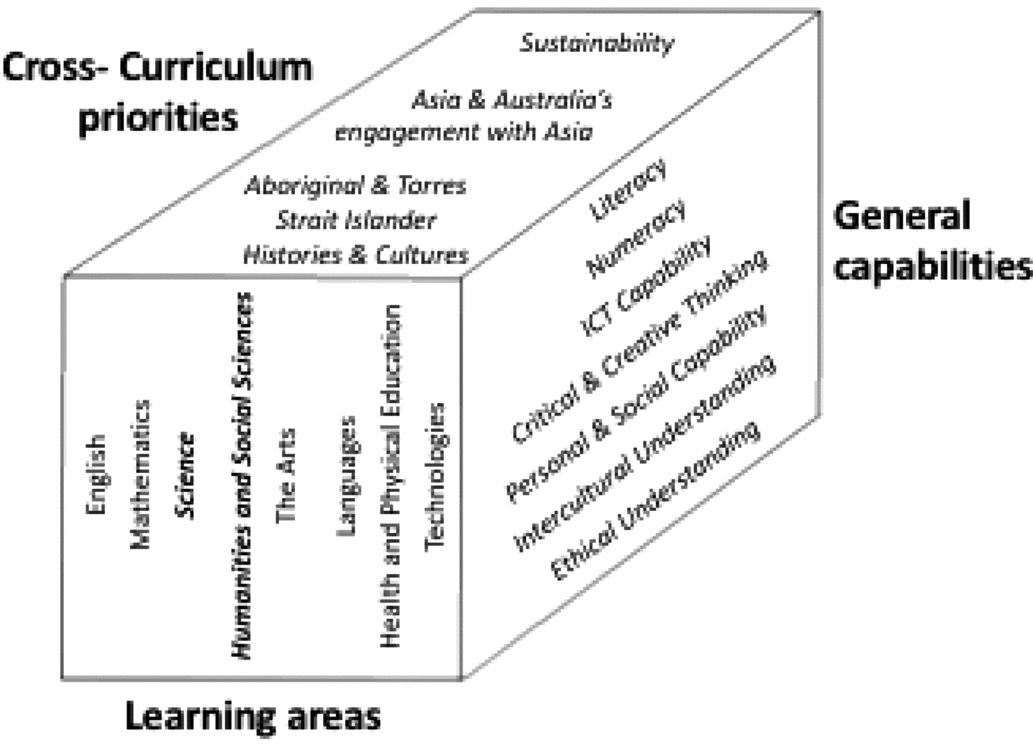
One recent example of how geographical inquiry enables and enhances environmental and sustainability education can be seen in the Australian Curriculum, introduced progressively since 2010 as a national framework of school learning and teaching. In the Australian Curriculum, Sustainability is incorporated as one of the three mandatory cross-curriculum priorities (CCP) that have been identified collectively as one of the avenues for encouraging complementary learning and teaching across different disciplines. Asia and Australia's engagement with Asia and Aboriginal and Torres Strait Islander histories and cultures comprise the other two priorities.
As shown by Figure 1, Australia's three CCPs are named explicitly and given particular salience to ensure that they also are attended to throughout the curriculum by teachers. The role of the CCPs is elevated in the development of curricula, instruction and assessments. It is intended, therefore, that Sustainability should become a common and familiar concept across the disciplines and year levels. It should explicitly emerge in these multiple disciplinary contexts, thus enabling the student to develop a cumulative, coherent, and usable understanding of the priority. Hill and Dyment (Reference Hill and Dyment2016) join our scepticism as to the future implementation successes of the CCPs. Hill and Dyment ask ‘Is the very concept of a cross-curriculum priority oxymoronic? That is, because it does not have the same place as a learning area (content descriptors, elaborations, assessment standards), is it no priority at all?’ (2016, p. 226). In their study, Hill and Dyment found that teachers do not necessarily have the time, content knowledge or interest to fully incorporate the Sustainability CCP into their planning, thus restricting this particular CCP from living up to its title and becoming a priority. There are eight Learning Areas (which are either individual disciplines or sets of perceived related disciplines) named in the Australian Curriculum: English, Mathematics, Science, Humanities and Social Sciences [HASS] (including Geography, History, Economics and Business, and Civics and Citizenship), Languages, the Arts, Health and Physical Education, and Technologies. In Figure 1, we have highlighted Science and HASS as they are the two Learning Areas of particular interest to this paper. The seven General Capabilities complete the curriculum.
Australia's cross-curriculum priorities, learning areas, and general capabilities.

The General Capabilities and the CCPs must not be considered as additional subjects to be taught. They must be covered, where relevant, within the teaching of the eight Learning Areas. Each dimension (Learning Areas, CCPs, or General Capabilities) works with the other two dimensions to allow students build a cohesive understanding over time. The structure reflects a belief that, by designing them to be integrated into Learning Areas along with the General Capabilities, students will begin to see knowledge as interdependent and connected, rather than as individual, isolated Learning Areas that function on their own. The belief is also that through the complementary integration of the Learning Areas through these conduits, students ultimately achieve a higher level of critical thinking.
This interdisciplinary approach that the Australian Curriculum encourages in sustainability education is not unique. New Zealand places Ecological Sustainability (which includes care for the environment) as one of eight suggested values in the Curriculum that students are encouraged to consider alongside other principles. The ways in which New Zealand's values might find expression in any particular school is negotiated between the school and its community (New Zealand Ministry of Education, 2016).
In the Australian Curriculum, all Learning Areas are required to contribute to the Sustainability CCP in ways that are consistent with the content and purpose of the Learning Area. For example, Science has content that enables students to work with ecological and human systems and to appreciate their interdependence. HASS contributes to the development of world views necessary for students to act to create a more socially and ecologically just world. English provides content that challenges students to consider sustainable futures and to design and take action that recognises projected future economic, social and environmental impacts. However, this requirement for sustainability education is not as explicit as some writers would have liked, for they have argued that while ‘the Australian Curriculum neither prescribes nor particularly encourages the processes and understandings underpinning commitment to sustainability, it allows ample opportunity for teachers to engage with EfS and to incorporate sustainability as a core priority in the primary curriculum’ (Kennelly, Taylor, & Serow, Reference Kennelly, Taylor and Serow2011, p. 211, emphasis in original). Although this current article does not aim to provide an in-depth content analysis of the Australian Curriculum in relation to sustainability-focused content, we do, however, provide a surface overview, as called for by Hill and Dyment (Reference Hill and Dyment2016).
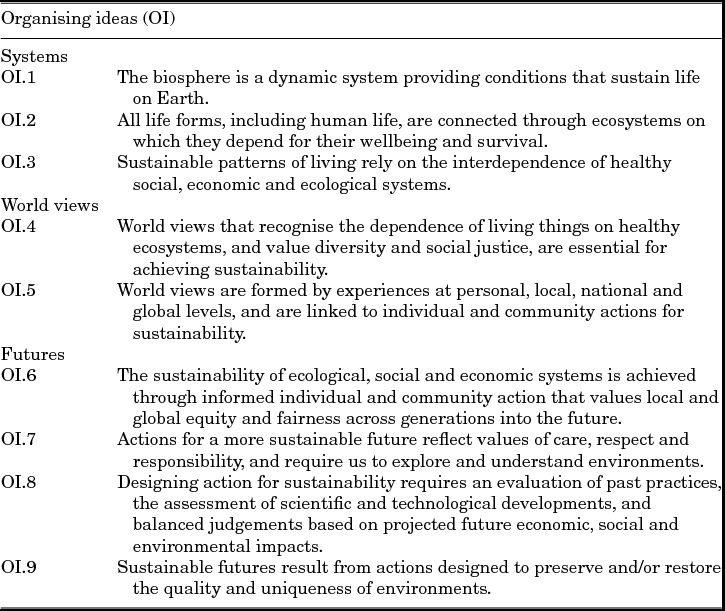
Within this frame, the concept of sustainability, as expressed in the Australian Curriculum documents, is expanded to not only include a consideration of the mutual interdependence of the environmental spheres (Systems — which explores the interdependent and dynamic nature of systems that support all life on Earth and our collective wellbeing), but also World View and Futures (see Table 1). The organising ideas within World View are focused on the relationships between living things (including people) and their natural environment. The World View concept enables a diversity of world views on ecosystems, values, and social justice to be discussed and recognised when determining individual and community actions for sustainability. More significantly, the Futures component highlights that the importance of long-term viability that is central to the idea of sustainability is not just confined to the natural environment, but incorporates ‘ecological, social and economic systems’ (ACARA, n.d.).
Australian Curriculum Cross-Curriculum Priority — Sustainability Key Ideas*

Note: *Sourced from the Australian Curriculum (http://www.australiancurriculum.edu.au/crosscurriculumpriorities/sustainability/key-ideas)
Environmental education, according to its current iteration, would focus only on Systems and adopt a scientific inquiry approach and is therefore not addressing the full scope of sustainability education as defined by the Australian Curriculum. The Futures concept is aimed at building capacities for thinking and acting in ways that are necessary to create a more sustainable future. The concept involves reflective thinking processes that will, hopefully, lead to more a more equitable and sustainable future.
Affordances for Sustainability Education: A Disciplinary Contrast
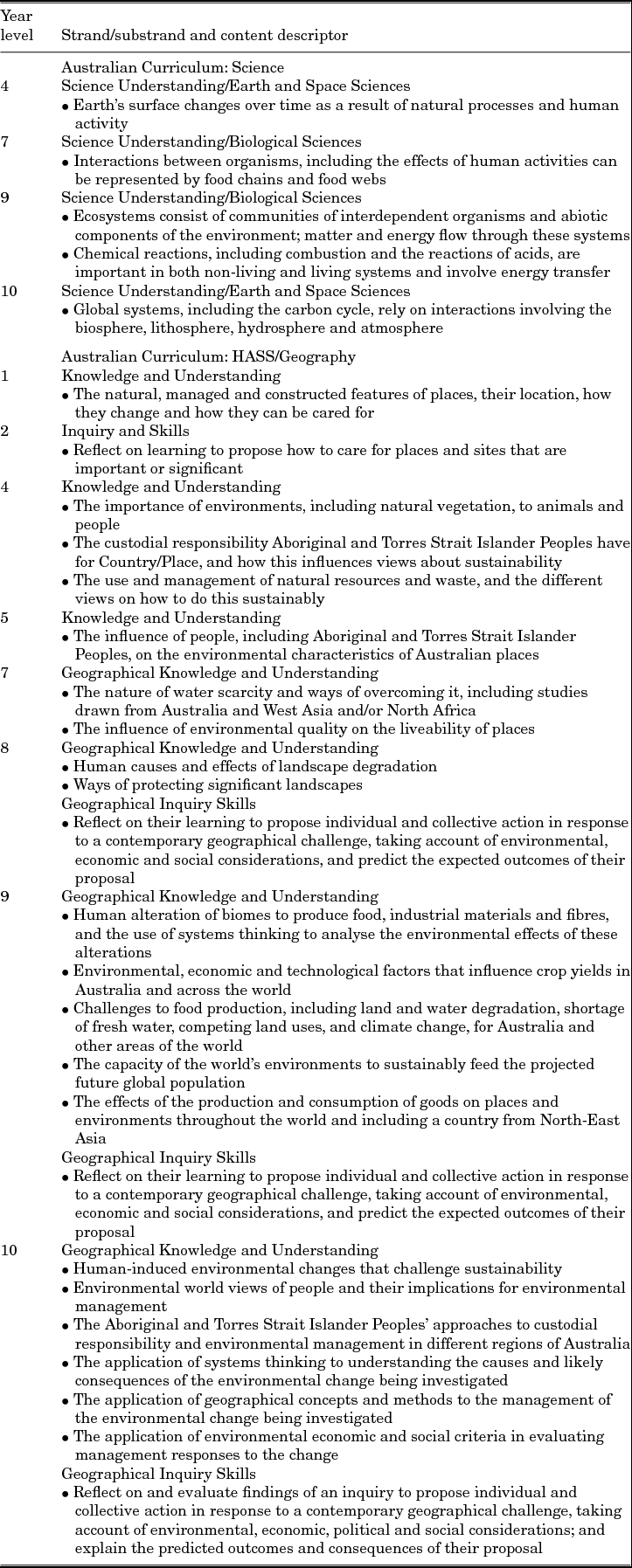
The ways in which the Australian Curriculum treats the imperative of sustainability education highlights a geographical prerogative as the more suitable foundation for sustainability education. As illustrated by Table 2, the Learning Areas of Humanities and the Social Sciences (Grades F–10, the primary school levels) and Geography (Years 7–10) align sustainability far more explicitly than their equivalents in Science F–10, with a ratio of 24 content descriptors in HASS to only 5 in Science. As such, it is both a reminder of the policy–practice dichotomy in sustainability education discussed previously and the more natural affinity of sustainability concepts within the geographical paradigm. For example, as reflected in Table 2, sustainability in Geography within the Australian Curriculum is introduced at a much earlier stage than in Science (Year 1 as opposed to Year 4). It is also addressed far more regularly during the compulsory years of schooling (P–10) in Geography than is the case in Science. In Geography, sustainability is addressed in 7 curriculum years, in contrast to 4 in Science. Moreover, Geography places greater emphasis on looking at sustainability issues in and throughout the years of primary schooling (Years 1, 2, 4, and 5), suggesting a higher emphasis on developing more embedded sustainability practices in the young, rather than waiting until the teenage secondary years, as is the case in Science.
Content Descriptors Relating to Sustainability in the Australian Curriculum: P–10 Science, Humanities, and Social Sciences (Geography and History)

Fieldwork Learning
The most powerful aspect of an argument for a geographical context for environmental and sustainability education is that it provides the most effective rationale for fieldwork learning in sustainability. Aside from the educational arguments that focus on the learning impact of experiential learning that is encapsulated by fieldwork, geographical field inquiry is ideally suited to the combined human and ecological dimensions of sustainability. The capacity to observe the real world — or a place as it exists in all its interwoven complexities — is at the core of geographical inquiry in all its variety of people-human interactions, sustainable or not (Foskett, Reference Foskett1999). A focus on the investigation of the real world also highlights that fieldwork is the definitive and therefore ideal form of geographical inquiry. Indeed, in the words of Stoddart, fieldwork is the ‘apogee’ of the geographical discipline, for it is here that ‘critical observation’ (1986, p. 56) is paramount.
Unlike Science, in which fieldwork is often a highly guided and selective process based on testing of specific interactions (Kidman & Casinader, Reference Kidman and Casinader2017), Geography in the field is concerned with the entirety of all that exists in a place. Its data gathering, although planned, is capable of being modified in order to respond to what is found to exist in a place and is not limited by a bounded reliance on what is perceived or expected to exist. It is able to combine the objectivity of a scientific data investigation with a reflexive engagement by the student in the process of studying what is sustainable and what is not. In consequence, sustainability education within a geographical frame investigates the issue as one that is not separate from the lives of human beings in a place; instead, it reinforces the mutual interdependence on which the two concepts coexist, both as discipline and priority. As a ‘real-world’ inquiry that is framed around goals of transformation, based on the data relating to a place, geographical fieldwork becomes the natural conduit for sustainability, simultaneously highlighting the immutable dependence of a long-term environmental solution in the modification and/or cooperation of people living in the same place. It places sustainability in its own ‘real’ context, avoiding what Huckle refers to as the tendency for sustainability education to ‘. . . [remain] idealistic (values feature more than politics), ignor[ing] political economy, and mak[ing] little reference to the global financial crisis that remains largely unresolved’ (Huckle, Reference Huckle, Wals and Corcoran2012, p. 46).
For the same reasons, Geography is also able to account for influences on the concept of sustainability that are not encompassed by scientific concepts that have their origins in ‘Western’ society. Shumba (Reference Shumba, Wals and Corcoran2012) has highlighted that sustainability in a traditional African community is likely to bear little relation to the priorities of an urbanised Euro-American society. The notion that Science is a universal construct is now being challenged more frequently (Kidman & Casinader, Reference Kidman and Casinader2017; Ma, Reference Ma2012), and writers such as Dei and Asgharzadeh (Reference Dei, Asgharzadeh, Abdi, Puplampu and Sefa Dei2006), Abdi (Reference Abdi2002), and Casinader (Reference Casinader2014) have all raised the importance of developing any curriculum and teaching programs of Indigenous knowledges and ways of knowing: ‘the variety and multi-site traditional instruction and pedagogies contained in local cultural resource base of African peoples’ (Shumba, Reference Shumba, Wals and Corcoran2012, p. 437).
The combination of the focus within sustainability on a predictive future and the disciplinary heart of Geography — that is, a focus on people-environment interactions in places at a variety of scales — makes the teaching of sustainability concepts far more effective if it is conducted within a geographical inquiry framework. Despite there being a less than emphatic agreement as to the meaning of inquiry learning in this context (Ferretti, Reference Ferretti, Lambert and Jones2013) — a situation that we would suggest has had some impact on the oscillating perceived value of Geography as a stand-alone, school-based discipline or as an integrated form of Social Studies — there has been some agreement as to its focus. The ability of a student to develop the skill of ‘thinking geographically’ depends upon them being challenged through their teachers being able to develop learning experiences that ‘stimulate curiosity, help the students learn by investigating issues and considering evidence . . .’, encouraging the adoption of ‘.a critical and questioning approach’ (Ferretti, Reference Ferretti, Lambert and Jones2013, p. 108). In achieving this, the employment of a fieldwork imperative becomes central.
The Fieldwork Imperative for Sustainability
As outlined earlier, and as found extensively in the research literature, recent years have seen an almost unprecedented use of the terms sustainability, environmental education and environmental concerns. This is despite the trend, at a national level, for governments to be winding back environmental protections (witness the virtual invisceration of the Environmental Protection Agency in the United States under Donald Trump), or overriding established environmental concerns, such as the symbiotic unity of the state and federal governments in Australia in arguing for the Adani Group's development of the Carmichael coalmine in the face of clear resistance on environmental and financial grounds. Importantly for educators, a recognition of the sustainability and environmental concepts has led to sustainability being included in the national curriculum of many countries. However, our intent in this article is to show that within such promising activity lie some concerns that require a closer look.
The major issue that we wish to raise is the cluster of educational attitudes and values that have had a powerful impact on sustainability and environmental education; specifically, those relating to fieldwork — or rather, the lack of it. Hill (Reference Hill2013) argues that ‘the nexus of ‘experience’ and ‘place’ offers significant promise for educational endeavours that seek to educate for a sustainable future’ (p. 19), advocating sustainability education in the field. However, very few national curriculum frameworks mandate fieldwork as part of sustainability education, with the literature highlighting that the factors of assessment difficulty, safety concerns, costs, and time as barriers have all played their part in facilitating a decline in fieldwork (de Baros, Almeida, & Cruz, Reference de Baros, Almeida and Cruz2012; Scott, Boyd, Scott, & Colquhoun, Reference Scott, Boyd, Scott and Colquhoun2015). We feel that with a more specific fieldwork mandate, a concerted effort by teachers and curriculum designers to have all students undertake fieldwork inquiries as a component of the Geography curriculum can result in progress being made in terms of individual and societal attitudes towards a more sustainable existence. This brings us to focus on the notion of a fieldwork imperative (Casinader & Kidman, Reference Casinader and Kidman2017) and the characteristics of fieldwork in Geography that make it so inclusive of the principles of sustainability education.
In terms of sustainability, the value of geographical fieldwork lies in its aforementioned inherent disciplinary interest in the interaction between the physical environment and human interaction, as well as its conception of inquiry or an investigation as being evaluative and predictive (Kidman & Casinader, Reference Kidman and Casinader2017). Since its focus is on the balance of the physical and human in any place, geographical field inquiry looks not only at what is occurring within a place, but also its value or correctness. The sustainability of that interaction is under consideration. The method of geographical inquiry is also suited to an appreciation of this physical-human interaction. In the words of Nielsen et al. (Reference Nielsen, Harbsmeier, Ries, Nielsen, Harbsmeier and Ries2012), geographical fieldwork is more ‘agricultural’ in nature, gathering as much information as possible from a place in the course of the inquiry. This is in contrast to the ‘military’ field focus of disciplines such as Science, which chooses to be selective in its data collection. In Geography, observation of all that exists in a place is fundamental, reflecting the inherent interdisciplinarity of the discipline (Pawson et al., Reference Pawson, Fournier, Haigh, Muniz, Trafford and Vajoczki2006) that makes it an ideal launching pad for sustainability education.
The notion of a fieldwork imperative is not a phrase that has been used in the media, or by the general public, but we contend that it captures the educational problem that we have highlighted; that is, the scarcity of the fieldwork learning required to enhance environmental and sustainability education. The phrase encapsulates a variety of important arguments about environmental and sustainability education that are emerging with increasing force of late. It incorporates, for instance, the existing bias for sustainability education to be conducted from a science education base rather than a geographical one (Sala, Farioli, & Zamagni, Reference Sala, Farioli and Zamagni2012). It also takes into account the meaning of such commonly heard phrases such as the ‘necessity’ of sustainability education (Sala et al., Reference Sala, Farioli and Zamagni2012), the ‘moral obligation’ to include an environmental perspective in all forms of education (Njoku, Reference Njoku2015), or the overpowering ‘promise’ of educating to preserve the planet.
The fact that the phrase fieldwork imperative (or something akin to it) has been little used is not the key issue; however, it is more important that such an imperative should be part of our particular educational culture and our larger social culture. We define fieldwork imperative as an internal drive to use fieldwork to gain various forms of knowledge and understandings for its own sake, as well as a means to achieve a valuable and measurable practical educational end. As with technology, where an attractive innovation generates an interest in finding an even better option, fieldwork embodies a similar kind of catalytic impetus. Fieldwork generates not only new knowledge and understandings for the participant, but also new ideas for further fieldwork and knowledge generation, and that is a major part of its excitement. In essence, fieldwork generates its own internal essentiality, that of extending the learning experience into areas unknown. The notion of a fieldwork imperative also raises an interesting observation as to a theory of fieldwork. Jarvie (Reference Jarvie1967) pointed out that we need to distinguish between the reasons why we do fieldwork and the reasons why we should do fieldwork. Understanding this differentiation gives rise to the necessary intellectual support for geographical fieldwork as a form of environmental and sustainability education.
In summary, this article argues that while national and international environmental and sustainability education policy argues for an interdisciplinary approach, it would have a more solid educational housing in Geography than in the Science curriculum, where it currently tends to reside. By being a priority in a Geography curriculum, it would find a natural nexus through the fieldwork imperative that we are calling to be instituted in all sustainability courses, an essentialism that gives rise to ideals already advocated in many curricular documents, but which are not necessarily recognised as the ideals of a fieldwork imperative. In order to achieve this goal, we advocate strongly that the future teaching of Geography and fieldwork would benefit from further research relating to the policy changes required to ensure the centrality of fieldwork in geographical education. In addition, we also need to know more about the inquiry-based pedagogies needed to support effective geographical fieldwork.
Fieldwork Ideals: An Epilogue
If we have placed a somewhat nebulous concept at the heart of this paper — that of the declining occurrence of fieldwork — we would also like to highlight the relevance to environmental and sustainability education of a set of stimulating fieldwork ideals, some of them commonplace, others perhaps less so:
• Respect for the environment — students develop an awareness of the impact of their interactions with nature and the environment (Bliss, Reference Bliss2009);
• ‘Real research’ — experiencing how it feels to explore real-world situations and create projects to simulate real-world conditions (Kleeman, Reference Kleeman2009);
• Intelligence in the Wild (Perkins, Tishman, Ritchhart, Donis & Andrade, Reference Perkins, Tishman, Ritchhart, Donis and Andrade2000) — the process of the student learning through ‘doing’ in the real world, and making mistakes;
• Observational skills — building a habit of being mindful of immediate surroundings, especially ones that the student thinks they are already familiar with (Bliss, Reference Bliss2009);
• Analytical skills — being able to visualise, articulate, conceptualise, and solve problems by making decisions that are sensible given the available information;
• Personal responsibility for their own learning — that personal circumstances and other people are not responsible for the choices each individual students make in relation to their learning in and out of school;
• Personal skills — the student's individual strengths, abilities, and attributes (Gold et al., Reference Gold, Jenkins, Lee, Monk, Riley, Shepherd and Unwin1991);
• Interpersonal skills — the tools a student uses to interact with others socially in the learning space (Gold et al., Reference Gold, Jenkins, Lee, Monk, Riley, Shepherd and Unwin1991).
Most curriculum documents and research publications in the area (e.g., see Bliss, Reference Bliss2009; Gold et al., Reference Gold, Jenkins, Lee, Monk, Riley, Shepherd and Unwin1991) would advocate similar ideals to these, but do not make the link explicitly to fieldwork for environmental and sustainability education. We call them ‘ideals’, not simply because they cannot be easily reduced to hard rules, but also because they represent high aspirations, not always or easily achievable. But that is no reason to not entertain such ideas and hope to succeed. A failure to reach those goals may not be worthy of condemnation, but the lack of any attempt to attain them would certainly be.
Author Biographies
Dr Niranjan Casinader is Senior Lecturer in Education (Curriculum & Assessment) at Monash University. Niranjan's current research is focused on three principal strands: the notion of transnationalism in education, particularly in relation to the impact of culture on curriculum, pedagogy, and thinking; the teaching of Geography and other humanities subjects in schools; and the role of education in British colonial policy and practice, with an especial focus on its relevance to contemporary society. His most recent books include Transnationalism, Education and Empowerment: Latent Legacies of Empire (Routledge 2017) and (with Gillian Kidman) Inquiry-Based Teaching and Learning Across Disciplines: Comparative Theory and Practice in Schools (Palgrave MacMillan, 2017).
Dr Gillian Kidman is an Associate Professor of Science Education at Monash University. Her research is primarily in relation to scientific inquiry, geographical inquiry, interdisciplinary pedagogies (e.g., STEM) and teacher education. Gillian is also a researcher in both Mathematics education and Indigenous education. She was a lead writer of the Australian Curriculum: Science, and a senior advisor for the senior secondary Australian Curriculum: Biology, specialising in the Science Inquiry Skills (SIS) strands. Her most recent book (with Niranjan Casinader) is Inquiry-Based Teaching and Learning Across Disciplines: Comparative Theory and Practice in Schools (Palgrave MacMillan, 2017).