The differential processing of consonants and vowels is a phenomenon that has been investigated by researchers working in several areas, including infant word learning (e.g., Nazzi, Reference Nazzi2005), visual and auditory word recognition (e.g., Carreiras, Vergara, & Perea, Reference Carreiras, Vergara and Perea2009; Toro, Nespor, Mehler, & Bonatti, Reference Toro, Nespor, Mehler and Bonatti2008), neuropsychological disorders (Boatman, Hall, Goldstein, Lesser, & Gordon, Reference Boatman, Hall, Goldstein, Lesser and Gordon1997; Caramazza, Chialant, Capasso, & Miceli, Reference Caramazza, Chialant, Capasso and Miceli2000), and models of short-term memory (STM; e.g., Drewnowski, Reference Drewnowski1980). Work in all these areas indicates that consonants and vowels are processed differently, across the various languages and populations studied.
Several studies (Bonatti, Peña, Nespor, & Mehler, Reference Bonatti, Peña, Nespor and Mehler2005; Carreiras, Duñabeitia, & Molinaro, Reference Carreiras, Duñabeitia and Molinaro2009; Carreiras, Gillon-Dowens, Vergara, & Perea, Reference Carreiras, Gillon-Dowens, Vergara and Perea2009; Carreiras, Vergara, et al., Reference Carreiras, Vergara and Perea2009; Cutler, Sebastian-Galles, Soler-Vilageliu, & Van Ooijen, Reference Cutler, Sebastian-Galles, Soler-Vilageliu and Van Ooijen2000; Havy, Bertoncini & Nazzi, Reference Havy, Bertoncini and Nazzi2011; Havy & Nazzi, Reference Havy and Nazzi2009; Nazzi, Reference Nazzi2005; Nazzi, Floccia, Moquet & Butler, Reference Nazzi, Floccia, Moquet and Butler2009; Nazzi & New, Reference Nazzi and New2007; Nespor, Peña, & Mehler, Reference Nespor, Peña and Mehler2003; New, Araujo, & Nazzi, Reference New, Araujo and Nazzi2008; Van Ooijen, Reference Van Ooijen1996) have suggested that there is a consonantal lexical processing bias, that is, that consonants give better cues to the lexicon than do vowels, and the evidence they provide comes from a variety of experimental tasks. Although French-learning young infants (0–2 months) were able to detect phonetic differences between different syllables, their representations of the syllables did not seem to be structured in terms of phonetic segments, that is, consonants and vowels (Bertoncini, Bijeljac-Babic, Jusczyk, & Kennedy, Reference Bertoncini, Bijeljac-Babic, Jusczyk and Kennedy1988; Jusczyk & Derrah, Reference Jusczyk and Derrah1987), yet their representations change over the first year of life. By 16 to 20 months, French-learning infants taught names for novel objects were able to learn pairs of new words that contained contrasting consonantal phonemes, but they did not learn pairs that contained contrasting vocalic phonemes, even though they were able to distinguish both the consonantal and the vocalic phonemes tested (Havy & Nazzi, Reference Havy and Nazzi2009; Nazzi, Reference Nazzi2005; Nazzi & New, Reference Nazzi and New2007). This consonant bias was found independent of position of the phone in the speech signal (Nazzi, Reference Nazzi2005; Nazzi & Bertoncini, Reference Nazzi and Bertoncini2009) and the consonant type (e.g., stop, fricative, or liquid; Nazzi, Reference Nazzi2005; Nazzi & New, Reference Nazzi and New2007) for infants 20 months of age. Although by 30 months of age French-learning children were able to learn novel word pairs that differed only in vowels (Nazzi et al., Reference Nazzi, Floccia, Moquet and Butler2009), they demonstrated a consonant bias in word learning until at least 3 years of age (Havy et al., Reference Havy, Bertoncini and Nazzi2011). English-learning children at 30 months of age demonstrated a consonant bias equal to that of their French counterparts when experimental conditions were held constant (Nazzi et al., Reference Nazzi, Floccia, Moquet and Butler2009).
In spoken word recognition experiments, adult native speakers of Spanish (Cutler et al., Reference Cutler, Sebastian-Galles, Soler-Vilageliu and Van Ooijen2000), Dutch (Cutler et al., Reference Cutler, Sebastian-Galles, Soler-Vilageliu and Van Ooijen2000), and English (Van Ooijen, Reference Van Ooijen1996) were found to use consonants as lexical cues more than vowels. In these experiments, participants performed word reconstruction tasks in which they were presented with nonwords and asked to change them into real words by changing a single sound. Participants were faster and more accurate when changing a single vowel sound rather than a consonant in order to make nonwords into real words (e.g., “kebra” became “cobra,” not “zebra”). The consonantal lexical processing bias was found for all first language (L1) groups tested, even though the phonemic repertoire and the relative distinctiveness of the phonemes within the repertoire differed across languages.
The same processing bias has been found in visual word recognition experiments using masked priming techniques and measuring both behavioral (New et al., Reference New, Araujo and Nazzi2008) and event-related potential responses (Carreiras, Duñabeitia, et al., Reference Carreiras, Duñabeitia and Molinaro2009; Carreiras, Gillon-Dowens, et al., Reference Carreiras, Gillon-Dowens, Vergara and Perea2009; Carreiras, Vergara, et al., Reference Carreiras, Vergara and Perea2009). New et al. (Reference New, Araujo and Nazzi2008) submitted French university students to a visual masked-priming lexical-decision task and found priming effects for identical primes (e.g., for the word joli, joli) and consonant-related primes (jalu), but not for vowel-related primes (vobi) or unrelated primes (vabu), suggesting that consonants constrain lexical access in a way that vowels do not. Carreiras and colleagues (Carreiras, Duñabeitia, et al, Reference Carreiras, Duñabeitia and Molinaro2009; Carreiras, Gillon-Dowens, et al., Reference Carreiras, Gillon-Dowens, Vergara and Perea2009; Carreiras, Vergara, et al., Reference Carreiras, Vergara and Perea2009) conducted a series of visual masked-priming lexical-decision task experiments with Spanish university students, utilizing both the transposed-letter and delayed letter masked prime paradigms, and found priming effects for identical and consonant-related primes, even transposed consonant primes, but not for vowel-related or unrelated primes. They also reported parallels between identical primes and consonant-related primes but not vowel-related primes in terms of event-related potential data (N250 and N400), suggesting that consonants and vowels are processed at successive temporal stages during visual word recognition (Carreiras, Duñabeitia, et al., Reference Carreiras, Duñabeitia and Molinaro2009). Carreiras, Duñabeitia, and colleagues (Reference Carreiras, Duñabeitia and Molinaro2009) argue that computational models of visual word recognition should be revised to account for the status of letters as either consonants or vowels. New et al. (Reference New, Araujo and Nazzi2008) also conclude that their findings challenge current models of word reading (p. 1226) because they do not treat vowels and consonants as categorically different (although see Berent & Perfetti's, Reference Berent and Perfetti1995, two-cycle model of reading for an exception).
The consonantal lexical processing bias has also been found in auditory speech processing experiments in which university students, both native speakers of French (Bonatti et al., Reference Bonatti, Peña, Nespor and Mehler2005) and Italian (Toro et al., Reference Toro, Nespor, Mehler and Bonatti2008), listened to continuous streams that contained nonsense syllables as well as “words” in an artificial language. When asked to isolate words from the stream, participants were able to learn transitional probabilities and locate words when the context was that of fixed consonants with variable vowels, but they were unable to do so if the consonants were varied and the vowels were fixed. Conversely, they used vowels more when detecting structural regularities or “rules” in the stream. These results support the Nespor et al. (Reference Nespor, Peña and Mehler2003) “CV [consonant–vowel] hypothesis,” which states that consonants provide cues primarily about the lexicon, whereas vowels provide cues primarily about morphosyntax.
In sum, the research on CV differences indicates that a consonantal lexical processing bias exists across languages and age groups. One might be led to hypothesize then that consonants are universally processed more rapidly and/or more deeply than vowels and expect an advantage for consonants to obtain in STM experiments. However, the few STM studies that have directly compared consonants to vowels (Cole, Reference Cole1973; Crowder, Reference Crowder1971; Drewnowski, Reference Drewnowski1980) have found just the opposite to be true. In these studies, native English speakers recalled vowels better than consonants during immediate serial recall tasks. In one of a series of immediate serial recall experiments, participants (Yale University students, n = 32) read 60 stimulus sentences consisting of either seven-syllable consonant-variable series made of the syllables “Bah, Dah, Gah” or seven-syllable vowel-variable series made of the syllables “Bee, Boo, Bih” (Crowder, Reference Crowder1971). The syllables appeared for 2 s, after which time participants wrote down what they recalled. Lower error rates obtained for all positions in the vowel-variable series compared to the consonants. Drewnowski (Reference Drewnowski1980) also performed a series of experiments that presented participants visually with series of English-like syllables, some series differing only in consonants and other series differing only in vowels, and found that participants recalled the order of vowels better than consonants, particularly in later positions in the series. The syllables were formed with three stops ([b, d, g]), three fricatives ([f, s, z]), and six vowel phonemes, both short ([æ, ɜ, ɪ]) and long ([e, ɔɪ, ɑɪ], with the vowels spelled as AH, EH, IH, EY, OY, IY, respectively. Syllables were presented at a rate of two items per second on a memory drum. The experiments reported in Drewnowski varied in terms of modality of presentation (visual and/or auditory) and recall (vocalized or silent), series length (three or six syllables), and phones included (short and/or long vowels). In general, Drewnowski concluded that vowels were remembered better than consonants, particularly toward the end of a series. Cole (Reference Cole1973) found identical results in immediate serial recall tasks with both English CV and VC syllables when they were presented auditorily, although not when they were presented visually. Cole concluded that the limited capacity acoustic storage component of STM preserved vowels longer than consonants.
These STM researchers (Cole, Reference Cole1973; Crowder, Reference Crowder1971; Drewnowski, Reference Drewnowski1980) reached the perhaps surprising conclusion that vowels are remembered better than consonants, at least by native English speakers, but they stopped short of sufficiently explaining the mechanism underlying this differential ability in STM. Crowder suggested that vowels may be remembered better because their acoustic cues are longer in duration than those of consonants, and the increased duration of the vowels may result in vowels forming better traces in STM. Even though the presentation of stimuli in Crowder was visual, participants presumably made use of the subvocal articulatory rehearsal mechanism believed to preserve memory traces in the phonological loop of the working memory system (Baddeley, Reference Baddeley1986, Reference Baddeley2000, Reference Baddeley2003; Baddeley & Hitch, Reference Baddeley, Hitch and Bower1974), such that they processed the stimuli as an acoustic signal containing cues for consonantal and vocalic phonemes. Drewnowski (Reference Drewnowski1980) did not provide a explanation for the STM advantage of vowels, although that long vowels were recalled better than short vowels and fricative consonants were recalled better than stops does lend some credence to Crowder's suggestion that duration of stimulus has an effect on performance in immediate serial recall tasks and may underlie the STM advantage for vowels over consonants.
The current study attempts to replicate the results of Crowder (Reference Crowder1971), Drewnowski (Reference Drewnowski1980), and Cole (Reference Cole1973) with English and also expand the investigation of consonants and vowels in STM to include a language other than English. Specifically, the current study tests the ability of native speakers of English to recall sequences of consonants and vowels in their L1, English, and their second language (L2), Arabic, as well as the ability of native speakers of Arabic to recall sequences of consonants and vowels in their L1 (Arabic) and L2 (English). Such a comparison will shed light on what might underlie the relative advantage found for vowels in STM and thus contribute to the growing body of research in consonant and vowel processing. Arabic was chosen for the current study because the relative status of consonants and vowels within its linguistic system and script differs markedly from English (and the other Indo-European languages investigated in the consonant and vowel processing literature thus far), namely, the phonemic inventory of Arabic vowels is restricted to three short ([a, i, u]) and three long ([a:, i:, u:]) vowels and 28 consonants (Ryding, Reference Ryding2005), compared to English's relatively expansive inventory of 17 vowels and 24 consonants (Nazzi, Reference Nazzi2005); in written Arabic texts only long vowels are indicated orthographically, whereas all short vowels are invisible (Ryding, Reference Ryding2005); and Arabic orthography is transparent in that the grapheme–phoneme correspondences are highly regular, compared to the more irregular grapheme–phoneme correspondences of English (Keiko & Zehler, Reference Keiko and Zehler2008).
The research question motivating the current study was as follows: do all participants recall sequences of vowels better than sequences of consonants, regardless of their L1 and the language of the stimuli? Following prior STM research (Cole, Reference Cole1973; Crowder, Reference Crowder1971; Drewnowski, Reference Drewnowski1980), it was hypothesized that vowels would be remembered better than consonants. Furthermore, given that researchers have thus far not found evidence of a cross-linguistic difference in consonant and vowel processing, and some have gone as far as to say that consonant and vowel processing differences may be universal (e.g., Nespor et al., Reference Nespor, Peña and Mehler2003), it was hypothesized that this relative advantage in STM recall for vowels over consonants would obtain for all participants, regardless of L1 and language of stimuli.
MATERIALS AND METHODS
Participants
Participants were all students or staff members of a small, private university in the Eastern United States, recruited via e-mails and fliers. They were not compensated for their participation. There were 19 native speakers of Arabic and 20 native speakers of English. No participant began learning an L2 before the age of 5. The group of native English speakers consisted of 10 females and 10 males whose ages ranged from 18–35 years (mean = 22.00, SD = 3.52) and who had studied Arabic for an average of 2.54 years (range = 3 months to 6 years, SD = 1.65). The group of native speakers of Arabic consisted of 10 females and 9 males whose ages ranged from 18 to 52 years (mean = 27.63, SD = 8.49) and who had studied English as an L2 for an average of 12.05 years (range = 4 months to 46 years, SD = 12.03). The groups were imbalanced with regards to L2 exposure, but this imbalance was difficult to correct given the geographic limitations of recruitment for the study. The native speakers of English reported also having studied Farsi (1 participant), French (9 participants), German (4 participants), Latin (1 participant), Italian (2 participants), Russian (1 participant), and Spanish (8 participants); the average amount of exposure they had to these additional languages was 4.3 years. The native speakers of Arabic reported also having studied French (6 participants), German (1 participant), Hebrew (3 participants), and Spanish (1 participant); the average amount of exposure they had to these additional languages was 5 years.
Materials
A female native speaker of Arabic and a female native speaker of English (the researcher) were recorded vocalizing the following nine syllables in their native languages: [mu], [ku], [zu], [mi], [ki], [zi], [ma], [ka], and [za]. The inventory of sounds was limited to these nine syllables for several reasons. An attempt was made to choose sounds that were equivalent in both languages and unproblematic for L2 learners. The vowel inventory of Arabic is quite restricted and capitalizes on distinctions of duration between long and short vowels. However, in Arabic, isolated syllables of the type CV are restricted to long vowels. Therefore, with a total of three vowels that could be used ([i], [a], [u]), it was decided that just three consonants should be used as well. The consonants used ([k], [m], [z]) were chosen because they represent a variety of articulatory places and manners, their English and Arabic varieties are virtually equivalent, and producing them vocally and orthographically is also unproblematic for even beginning L2 learners. Recordings were made with the audio-editing software Soundtrack Pro with a 16-bit, 48-kHz sampling rate.
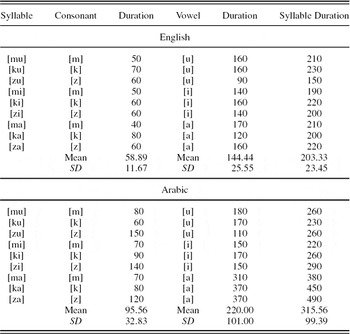
A subsequent analysis of the natural language stimuli revealed that there was variation in duration across phonemes within each language and across the two languages. Table 1 displays the duration of each syllable stimulus. The difference between consonant durations in English (mean = 58.59 ms, SD = 11.67 ms) and in Arabic (mean = 92.50 ms, SD = 33.7 ms) was significant: t (8.5) = 2.68, p = .026. However, the difference between vowel durations in English (mean = 144.44 ms, SD = 25.55 ms) and in Arabic (mean = 210.00 ms, SD = 100.33 ms) was not significant: t (10.3) = 2.00, p = .073. As is clear from Table 1, the native Arabic speaker produced relatively lengthy [z] and [a] phones, tending to fricate [z] and diphthongize [a] more than other phones, which accounts for the difference between the Arabic- and English-language stimuli. It was decided not eliminate these differences in duration through editing of the natural language stimuli.
Duration (ms) of syllable stimuli

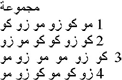
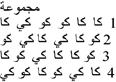
The recordings of the nine English and nine Arabic CV syllables were arranged into sequences of six syllables each using Soundtrack Pro. One unique token of each syllable was used for all sequences, so that all tokens of a particular syllable sounded exactly the same across sequences, and there was no recognizable prosody to the sequences. A total of 56 sequences were generated, divided into four blocks: Arabic consonants, Arabic vowels, English consonants, and English vowels. The syllables of the sequences in the consonant blocks varied only in terms of their consonant, whereas the vowel remained the same, for example, [ma za ka za ka za]. The sequences in the vowel blocks varied only in terms of their vowels, for example, [ki ka ki ku ku ka]. Syllables were distributed randomly but evenly throughout the blocks. The complete set of stimuli used is reproduced in Appendices A and B.
Methods
The stimuli and conditions used were based on the designs of Crowder (Reference Crowder1971) and Drewnowski (Reference Drewnowski1980), adapted for use with bilingual participants and multiple language stimuli. Crowder and Drewnowski presented English-like stimuli visually and/or auditorily to their native English-speaking participants. It was assumed that when presented visually with English-like syllables the participants' processing of the phones presented would precede in a consistent, uniform, and predictable manner because the orthographic–phonological relationships would be fully automatized. However, in the present study, it could not be assumed that the L2 learners would necessarily have behaved so consistently. For instance, an L2 English speaker reading the syllable koo multiple times might variably process it as [ku], [ku:], [ko], [ko:], or some other variant. Such variation could have become a confound. For that reason, all stimuli were presented auditorily. Crowder (Reference Crowder1971, p. 593) concluded that for natural language stimuli, optimal performance is supported by vocalized input and silent output. To optimize their performance, the participants in this study remained silent while they reported their recollections in writing.
Participants were seated at Macintosh computer stations and listened to the stimuli through noise-reducing headphones at a volume that was comfortable for them. The stimuli were presented in four blocks: English consonants, English vowels, Arabic consonants, and Arabic vowels. The order of the four blocks was counterbalanced across participants. Each block contained two practice sequences followed by three sets of four sequences each (see Appendices A and B), with an opportunity to pause between sets. Each sequence consisted of six syllables. Stimuli were presented at an approximate rate of one syllable per second, but due to variations in syllable duration (as noted in Table 1), as well as minor inaccuracies in the sound editing, the presentation of the stimuli was very nearly, but not exactly, equal across blocks. The duration, in seconds, of the six-syllable sequences in each block were English consonant mean = 6.98, SD = 0.23; Arabic consonant mean = 6.79, SD = 0.14; English vowel mean = 6.88, SD = 0.22; and Arabic vowel mean = 6.88, SD = 0.24.
After hearing the sixth and last syllable of a sequence, participants were allotted 12 s to respond, a response time window that was found to be appropriate during pilot testing. Participants wrote down the syllables that they recalled from the sequence on an answer sheet. All participants wrote in Arabic script during the Arabic blocks and in Roman script during the English blocks. The answer sheet accommodated differences in writing conventions, that is, right to left in Arabic and left to right in English. Each test block was preceded by two practice sequences, which were checked immediately by the researcher to assure that participants understood the instructions. Thus, a total of 48 sequences per participant were used in the subsequent analysis: 12 vowel-alternating sequences in English, 12 consonant-alternating sequences in English, 12 vowel-alternating sequences in Arabic, and 12 consonant-alternating sequences in Arabic, as shown in Appendices A and B. Each sequence consisted of six syllables. Therefore this set of stimuli included 144 total tokens of test consonants (i.e., consonants in consonant-alternating sequences) and 144 total tokens of test vowels (i.e., vowels in vowel-alternating sequences), half of which were in English (72) and half were in Arabic (72).
Scoring
Participants' responses were analyzed to determine the total number of correct syllables reported on each block. Response sheets provided six blanks for each sequence of six syllables, and any missing, incorrect, or misplaced syllable was counted as one error. For example, if a test string was [ma ka za ka za ma] and a participant's response was za ma ka ka za ma, then the first three syllables were misplaced, constituting three errors, and the score for that string was counted as 3 (out of 6). Alternative spellings were not counted as errors, for example, zu, zo, and zoo were all accepted as possible spellings of [zu]. Errors were also analyzed in terms of error type. All errors were transpositions, incorrect syllables, or missing syllables. For instance, if a test string was [ma ka za ka za ma] and a participant's response was za ma ka ka za ma, then the errors in the first three syllables were coded as three transposition errors. If a participant's response was ma za ka ka za za, then the errors in the second and third syllables were coded as two transposition errors, and the error in the sixth syllable was coded as an incorrect syllable. If a participant left a syllable position blank, it was coded as one missing syllable error.
RESULTS AND DISCUSSION
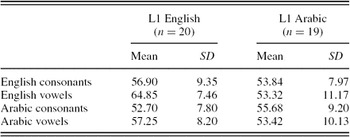
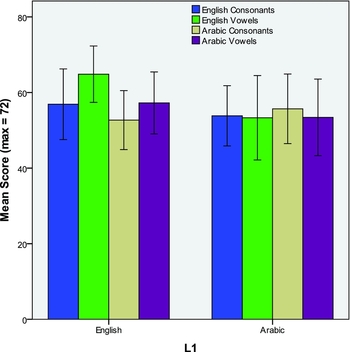
Descriptive statistics of the participants' mean scores are reported in Table 2 and depicted in Figure 1. A repeated measures analysis of variance (RM ANOVA) was run on these data with one between-groups factor (participants' L1) and two within-groups factors (phoneme type and language of the stimuli). Each factor had two levels; participants' L1 was either English or Arabic, phoneme type was either consonant or vowel, and language of the stimuli was either English or Arabic. Note that the data do meet the assumptions of the RM ANOVA: an examination of box plots and the results of the Shapiro–Wilk Test for goodness of fit indicate that the data are normally distributed, and the results of the Levene's Test indicate that variances are homogeneous. The two-way interaction of Phoneme Type×L1 was statistically significant: F (1, 37) = 17.61, p = .000, η2p = 0.32, power = 0.98. Thus, there was a significant group difference in consonant and vowel recall with a large effect size, suggesting that participants' differential processing of consonants and vowels was dependent on participants' L1. The two-way interaction of Language of Stimuli×L1 was also statistically significant, F (1, 37) = 13.68, p = .001, η2p = 0.27, power = 0.95, suggesting that participants' ability to recall Arabic-language or English-language sequences accurately also differed depending on their L1. There were statistically significant main effects of phoneme type, F (1, 37) = 9.71, p = .004, η2p = 0.21, power = 0.86, and language of stimuli, F (1, 37) = 5.98, p = .019, η2p = 0.14, power = 0.66, but the main effect for L1 was not statistically significant, F (1, 37) = 2.59, p = .116, η2p = 0.07, power = 0.35. No other interactions were statistically significant.
Descriptive statistics by block and L1 group

Note: L1, first language.
Mean scores by block and first language group. [A color version of this figure can be viewed online at journals.cambridge.org/aps]

Recall that the groups were not evenly matched on at least two potentially important factors: age and exposure to L2. The English group's ages ranged from 18 to 35 years (mean = 22.00, SD = 3.52), and they had studied Arabic for an average of 2.54 years (range = 3 months to 6 years, SD = 1.65). The Arabic group's ages ranged from 18 to 52 years (mean = 27.63, SD = 8.49), and they had studied English as an L2 for an average of 12.05 years (range = 4 months to 46 years, SD = 12.03). In order to control for these potentially important group differences, a repeated-measures analysis of covariance was run on these data with one between-groups factor (participants' L1), two within-groups factors (phoneme type and language of the stimuli), and two covariates (age and exposure to L2). The tests of between-subjects effects indicated that age was a statistically significant covariate, F (1, 35) = 7.61, p = .009, η2p = 0.18, power = 0.76, as was exposure to L2, F (1, 35) = 5.99, p = .019, η2p = 0.15, power = 0.66. However, controlling for group differences in age and in L2 exposure by including them as covariates in the RM analysis of covariance only strengthened the overall pattern of results found in the RM ANOVA as reported above. The two-way interaction of Phoneme Type×L1 was again found to be statistically significant, F (1, 35) = 29.69, p = .000, η2p = 0.46, power = 1.0, and found to have an even greater effect size once age and exposure to L2 were added as covariates, as was the two-way interaction of Language of Stimuli×L1, F (1, 35) = 14.67, p = .001, η2p = 0.30, power = 0.96.
As can be seen in Table 2 and Figure 1, native English speakers recalled vowels better than consonants, particularly on the English-language blocks. Paired-samples t tests confirmed that the English group's differences in vowel/consonant scores were statistically significant on both the English-language blocks, t (19) = 4.68, p = .000, 95% confidence interval (CI) = 11.51, 4.39, and the Arabic-language blocks, t (19) = 2.30, p = .033, 95% CI = 8.67, 0.40. The English group's superior performance on the English-language blocks (mean = 121.75, SD = 15.12) as opposed to the Arabic-language blocks (mean = 109.95, SD = 13.33) was also statistically significant, t (19) = 5.69, p = .000, 95% CI = 7.46, 16.14. Native speakers of Arabic, on the other hand, demonstrated no statistically significant variation in performance across blocks. The Arabic group's mean scores across vowel/consonant blocks in both languages and across Arabic-language/English-language blocks overall were not statistically different.
At first blush it may appear that the native Arabic speaking group performed worse than the native English speaking group overall. A comparison of the groups' aggregated scores from all four stimuli blocks shows that the English overall mean is 231.70, whereas the Arabic overall mean is 216.26 (out of a possible 288 points). Recall, however, that the RM ANOVA showed no main effect for L1 group. An independent samples t test comparing the overall group scores further confirmed that the difference was not statistically significant, t (37) = 1.61, p = .116. Also apparent from Table 2 is that the Arabic group displayed larger standard deviations on three out of the four stimuli blocks. Given the Arabic group's larger standard deviations and apparently (although not statistically significant) lower overall scores, the data were reexamined to find potential outliers. There were only two participants whose overall scores (143 and 152, respectively) fell outside of 2 SD (SD = 30.67) away from the sample mean (223.98), and both of those participants were in the native Arabic-speaking group. The RM ANOVA as described above was run again on the data after the two potential outliers were removed, but the results were the same and supported exactly the same conclusions that have already been drawn from the whole data set. It was decided not to eliminate these two participants' scores.
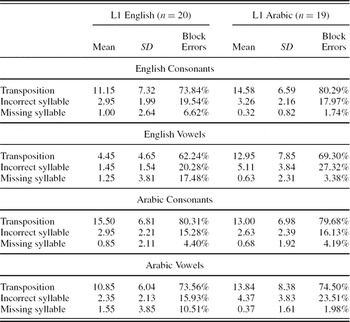
Recall that participants' errors were further subdivided into three types: transposition, incorrect syllable, or missing syllable. Descriptive statistics of the participants' error types are reported in Table 3. At first examination, it appears that the L1 groups produced roughly equivalent amounts of error types across the stimuli blocks. For both groups, transposition errors constituted the majority of the errors on all four stimuli blocks. This result is perhaps not surprising given that for any given series there were just three possible syllables that could be used, which made the series relatively predictable. Incorrect and missing syllable errors were much less frequent than transposition errors, across all blocks. Independent samples t tests were used to compare the numbers of transpositions made by the L1-English and L1-Arabic groups on each of the four stimuli blocks, and the only difference that was statistically significant pertained to the English vowel block, in which English speakers made fewer transposition errors (mean = 4.45) than Arabic speakers: mean = 12.95; t (37) = 8.50, p = .000, 95% CI = 12.66, 4.34. A series of paired-samples t tests run on each pairwise combination of all four stimuli blocks for both L1 groups determined that although there were no statistically significant differences across blocks in terms of transposition errors for the Arabic speakers, all comparisons reached statistical significance for the English speakers. That is, English speakers made more transposition errors on the English consonant block compared to the English vowel block, t (19) = 4.67, p = .000, 95% CI = 3.70, 9.70, more transposition errors on the Arabic consonant block compared to the Arabic vowel block, t (19) = 2.53, p = .020, 95% CI = 0.80, 8.50, fewer transposition errors on the English consonant block compared to the Arabic consonant block, t (19) = −2.52, p = .021, 95% CI = −7.97, −0.73, and fewer transposition errors on the English vowel block compared to the Arabic vowel block, t (19) = −5.42, p = .000, 95% CI = −8.87, −3.93. Of course, because transposition errors accounted for the majority of errors made on all blocks, for both groups, it is not surprising that there were fewer transposition errors on the blocks with higher accuracy overall. Therefore, the entire series of t tests as described above was run again, this time with transpositions errors as a percentage of the overall errors made on each block (see column 3 on Table 3), rather than raw scores, in order to control for overall block accuracy when comparing error types across blocks. No differences were found to be significant, across groups or within groups and across blocks. Therefore, it was concluded that all participants tended to make transposition errors more often than other types of errors, but the relative contribution of transposition errors to overall error rates errors did not vary significantly either between blocks and within L1 groups or between L1 groups.
Descriptive statistics of error types by block and L1 group

CONCLUSION
The present study investigated whether all participants would recall sequences of vowels better than sequences of consonants, regardless of their L1 and the language of the stimuli, as prior research would predict. On the contrary, the data clearly demonstrate that there is a group difference, or an interaction between L1 and STM for consonants versus vowels. The effect size found (η2p = 0.32) for the interaction was large, indicating that approximately one-third of the variance on scores was accounted for by the L1 of the participants. This result suggests that the differential processing of consonants and vowels, at least the level of processing tapped by the immediate serial recall task used, is language dependent and not universal. To the author's knowledge, the research to date (e.g., Cutler et al., Reference Cutler, Sebastian-Galles, Soler-Vilageliu and Van Ooijen2000; Nespor et al., Reference Nespor, Peña and Mehler2003; Toro et al., Reference Toro, Nespor, Mehler and Bonatti2008) has indicated that the consonant/vowel processing differences do not vary cross-linguistically. Such research has focused on lexical processing and has found a consonantal lexical processing bias in all languages and populations studied thus far. The current study does not challenge those findings, but instead suggests that there is at least one other level of processing (the STM processing level tapped by immediate serial recall tasks) in which the relative processing of consonants versus vowels is language dependent.
The current study replicated previous findings (Cole, Reference Cole1973; Crowder, Reference Crowder1971; Drewnowski, Reference Drewnowski1980) with its native English-speaking participants, who remembered vowels better than consonants in the English stimuli blocks. The current study also extended those findings by testing the participants in their L2, Arabic, and found again as predicted that they remembered vowels better than consonants. However, the native Arabic-speaking participants remembered consonants and vowels equally well, in both languages. This result calls into question the suggestion (Crowder, Reference Crowder1971) that vowels are remembered better because they are longer. If the underlying cause of differences in STM performance was differences in phoneme duration, then vowels should have been remembered better by all participants and in all languages, because the vowels were longer than the consonants in all stimuli blocks (see Table 1). An anonymous reviewer suggested that vowels might be better recalled because they appear more frequently in natural language or because they have to be retrieved from a shorter set than consonants. These suggestions, although plausible, are not fully supported by the present data either, as they would not explain the L1 group differences obtained. It may be the case that differences in STM for consonants and vowels can only be sufficiently accounted for by considering numerous factors, some of which are relatively language independent, such as relative phoneme duration, and some of which are language dependent, such as the ratio of consonants to vowels and the relative status of the phonemes in written script. In addition, individual differences other than L1 may have to be considered. In the present data, for instance, age and L2 experience were found to be statistically significant covariates.
More research is needed to isolate all the factors that may account for differences in STM for consonants versus vowels. The current study included only CV syllables because it attempted to replicate previous research, but in future studies, stimuli should also include a variety of syllable types, such as CVC syllables, which would allow inclusion of Arabic short vowels and permit exploration of to what extent vowel duration may be a significant factor. Other languages, including Semitic languages and languages of other language families, should be studied as well. There may be continuum of relative consonant/vowel STM ability that is predictable in large part based on L1. The current study compared only two languages. Future studies should also include native English speakers with more experience in Arabic or another L2. The current data sample was limited in that 6 years was the most L2 experience reported by any native English speaking participant. It would be important to note whether or not highly experienced Arabic L2 learners continued to demonstrate better recall of vowels than consonants in their L1 and L2. In addition, measuring L2 experience in terms of number of years studying or using L2 may be an overly coarse rubric. Age of onset of L2 learning might be more influential, although it was not included in the present study design. Another individual difference measure that was not collected here, yet may have further illuminated the results, is a general test of phonological STM, such as nonword repetition in L1 and L2. Future studies should attempt to address all of these limitations of the current study.
APPENDIX A
English consonants
Set 1 (practice):
1. za ka ma ka za ma
2. ka za ma za ma ka
Set 2:
1. mee kee zee zee mee kee
2. mee zee kee zee zee mee
3. kee mee mee zee mee kee
4. zee kee mee kee zee mee
Set 3:
1. koo zoo moo zoo koo koo
2. zoo moo koo koo zoo moo
3. koo zoo moo moo zoo koo
4. moo zoo zoo moo koo zoo
Set 4:
1. ma za ka ma za ma
2. ma ka za za ma ka
3. za ka ma ka za ma
4. ka za ka za ma ka
English vowels
Set 1 (practice):
1. za zee zoo zoo zee za
2. zee zoo za zoo zee za
Set 2:
1. mee ma moo mee mee ma
2. mee ma ma ma moo mee
3. moo mee ma ma mee moo
4. moo moo ma mee moo ma
Set 3:
1. ka kee koo koo kee ka
2. koo kee ka kee ka koo
3. ka koo kee kee ka ka
4. koo koo ka koo kee ka
Set 4:
1. zee za zoo zee zoo za
2. zoo za zee za za zoo
3. za zoo zee zee za zoo
4. zee zoo zee zoo zee za
APPENDIX B
Arabic consonants
1.

2.
3.
4.



Arabic vowels
1.
2.
3.
4.



ACKNOWLEDGMENTS
Special thanks to Robert DeKeyser, Elizabeth Zsiga, Rob Podesva and two anonymous reviewers for their constructive comments on initial drafts of this paper. The author is also grateful to Rusan Chen and Luke Amoroso for their expertise and assistance with statistical analyses and Huda Al-Mufti for her assistance with creation of the Arabic-language stimuli.